
WhatsApp vs Email Marketing in 2026: What the Open Rates Do Not Tell You
Every article comparing WhatsApp vs email marketing opens with the same pair of numbers: something like 98% open rates on WhatsApp against about 21% on email. It is a persuasive contrast and it is close to meaningless, for a reason that has nothing to do with either channel’s quality.
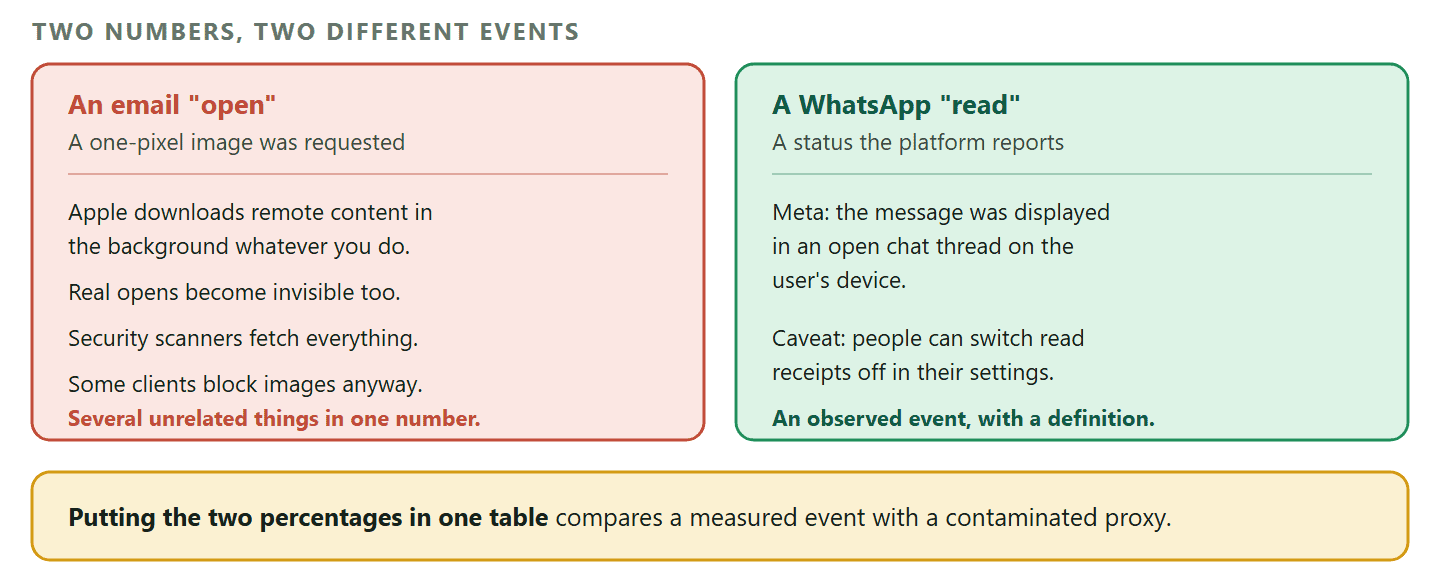
An email open is recorded when a tiny invisible image loads. Apple’s Mail Privacy Protection, on by default for people who accept it when they set up Mail, “downloads remote content in the background by default, regardless of whether you engage with the email”, and Apple says plainly that the feature “prevents senders from seeing if you’ve opened the email message they sent you”.
So for a large share of any list, an open is logged for a message nobody looked at, and a real open on that same list may be invisible. The number is not low or high. It is not a measurement.
A WhatsApp read is a different kind of thing. Meta defines the read status as “the message was displayed in an open chat thread in the WhatsApp user’s device”: an event the platform observes, not an image it hopes loads.
Comparing the two percentages puts a measured event next to a contaminated proxy and declares a winner. This guide throws both numbers away and compares the things that are actually different, starting with the one that decides most real cases.
Why the WhatsApp vs Email Open Rate Comparison Falls Apart
Not because email is worse than people say, but because nobody can tell you what an email open rate means any more.
Email’s open tracking has always been indirect. There is no signal from the mail client saying “this person read it”; there is a one-pixel image with a unique address, and the sender infers an open when their server is asked for it. That inference held up reasonably well for years. Then it stopped.
Apple’s Protect Mail Activity routes remote content through two relays and downloads it in the background whether or not the person engages. That produces two errors at once, in opposite directions:
- False opens. Messages that were never looked at are recorded as opened, which inflates the rate and destroys the value of open-based automation like “send a follow-up to anyone who did not open”.
- Invisible real opens. Because the sender cannot distinguish the background load from the human, the one signal you actually wanted is gone even when it happened.
Add the people who block images by default, the corporate security scanners that fetch every link and image in a message before it reaches an inbox, and the plain-text readers, and an email open rate is a number with several unrelated things inside it.
What this does and does not mean: It does not mean email is dead or that its engagement collapsed. It means open rate stopped being a comparable metric, and anybody putting it in a table next to a WhatsApp read rate is either not aware of that or hoping you are not. Click rates and replies survived; opens did not.
WhatsApp’s side is cleaner but not perfect either, and the honest caveats belong here rather than in a footnote. People can switch read receipts off in their privacy settings, in which case they see nobody else’s either, and receipts are always sent in group chats. What that does to the status a business receives is not something Meta’s documentation states, so this page does not claim it. What can be said is that a WhatsApp read is a platform event with a definition, and an email open is an image request with several possible authors.
The Difference That Actually Decides It
WhatsApp vs email marketing comes down to two differently shaped bills, and that shape settles more real cases than any engagement claim.
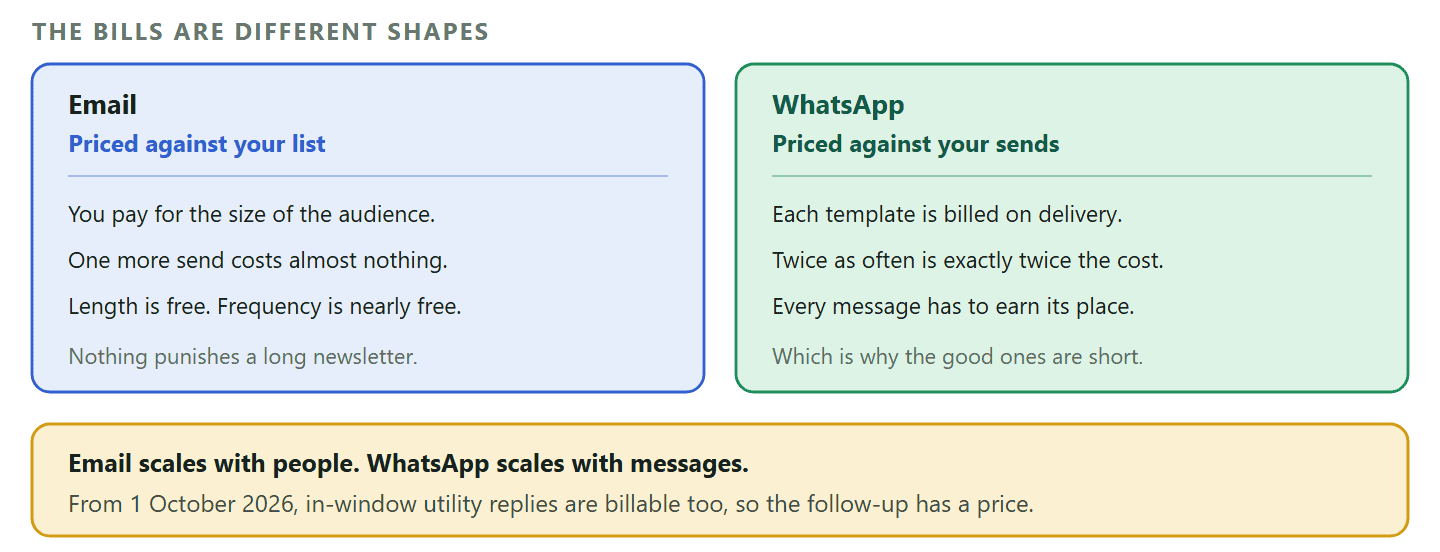
Email is priced against your list. You pay for the size of the audience, monthly, and sending to it more often costs little or nothing extra until you cross a plan boundary. The marginal cost of one more email to a list you are already paying for is close to zero, which is why email newsletters got long and frequent: nothing punished it.
WhatsApp is priced against your sends. Each template message outside the 24-hour customer service window is billed on delivery, and from 1 October 2026 utility templates sent inside that window are billed too, so the marginal cost of one more message to one more person is a real, countable amount. Doubling frequency doubles the bill exactly.
The arithmetic worth doing before you choose: Take your list size, multiply by how many times a month you would message them, and price that on WhatsApp using our WhatsApp pricing calculator. Then compare it with your email plan. For a list of a few hundred contacted twice a month, WhatsApp is usually cheap enough to be irrelevant. For tens of thousands contacted weekly, the answer is obvious in the other direction, and no engagement statistic changes it.
That is the honest headline of the whole comparison. Email scales with people. WhatsApp scales with messages. A business with a big list and a lot to say belongs on email. A business with a modest list and something specific to say to each person belongs on WhatsApp. Most local service businesses are the second kind, which is why WhatsApp suits them, and it has nothing to do with open rates.
Two changes to that arithmetic land on 1 October 2026: Meta will begin charging for service messages beyond the first 1,000 a month per business phone number, an allowance that resets monthly and does not roll over, and separately will charge per message for utility messages sent in response to users within an open 24-hour window, which get no free allowance at all. Both are free until then, and Meta states it does not offer volume tiers for service messages. Most small lists never reach a thousand service messages in a month, so for them answering customers stays free. The change to watch is the in-window one, which puts a price on utility templates sent while a conversation is open, and we cover both in our guide to the 1 October pricing change.
Doing the Sum on Your Own Numbers
Two multiplications, no percentages, and the WhatsApp vs email marketing question is settled for most businesses in about a minute.
Deliberately no prices appear below, because per-message rates vary by country and category and change, and a page quoting them goes stale within months. What does not change is the shape of the calculation.
- Count the list you would actually message. Not everybody in your contacts: the people who opted in and have been near you in the last year. For most local businesses this is a much smaller number than they expect, and that is the number that matters.
- Decide how often, honestly. Per month, counting only the sends you could genuinely justify to a customer.
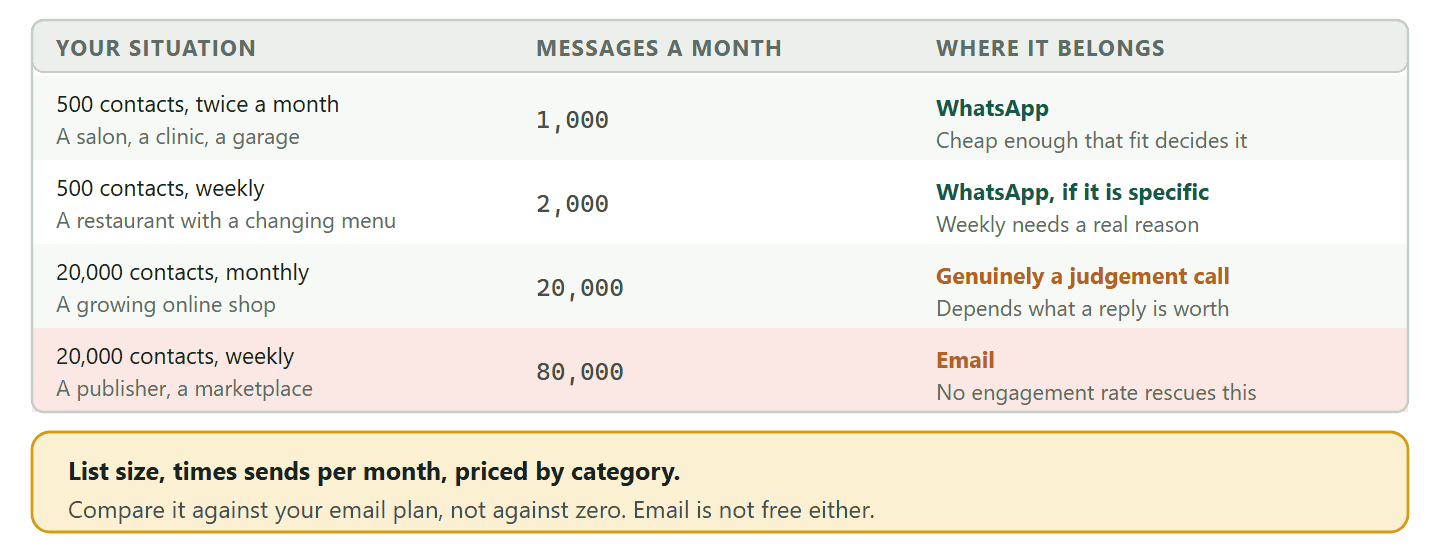
- Multiply. That is your monthly template volume. Five hundred contacts twice a month is a thousand messages. Twenty thousand contacts weekly is eighty thousand.
- Price it. Run that volume through our WhatsApp pricing calculator, choosing the category you would actually be sending, because marketing and utility are priced differently.
- Compare it with your email plan, not with zero. Email is not free either, and if you are paying for a list you rarely message the honest comparison may be less flattering to email than you assume.
The pattern that emerges is consistent enough to predict. Small list, low frequency: WhatsApp costs so little that the decision is about fit rather than money. Large list, high frequency: WhatsApp is expensive in a way no engagement rate can rescue, and email is the only sane home for a weekly send. In between, it depends on what a reply is worth to you, which is a question only you can answer, because a reply that turns into a booking is worth more than any number of opens.
The asymmetry inside that calculation: Email has no reply mechanic that changes the price, no per-person delivery cap and no 24-hour window. WhatsApp has all three, and they pull in the same direction: a message that earns an answer is cheaper to follow up, exempt from the per-user marketing cap while the window is open, and more likely to be delivered next time. So the WhatsApp side of the sum improves when your messages are good, in a way the email side does not.
What Each One Is Structurally Good At
Not which performs better, but which the format is actually built for.
WhatsApp is built for the message that needs an answer
It arrives in the same list as somebody’s family, it is read within minutes, and the reply is one tap away and goes to a person rather than into a no-reply address. That makes it the right home for anything where the point of the message is a response: confirming a booking, offering the slot that opened up, chasing an unpaid invoice, asking whether last week’s work was all right.
It also makes it the wrong home for anything long. A template’s structure is fixed when it is approved, the reading environment is a phone held in one hand, and the message is competing with a friend’s photograph directly above it. Four sentences is generous.
Email is built for the message that has to be kept
An email can be long, can be scanned, can be forwarded to a colleague, can be searched for a year later and can carry an attachment. Nothing about WhatsApp does any of that well. Receipts, itineraries, policy explanations, price lists, anything somebody may need to find again: email, every time.
Email is also the only one of the two that is genuinely yours. Which brings us to the part most comparisons leave out.
Permission, and Who Actually Owns the List
Two lists that look equivalent behave completely differently when something goes wrong.
An email list is a file of addresses. It is portable: you can move it between providers in an afternoon, and if your provider closes tomorrow the list survives.
A WhatsApp audience is a set of phone numbers tied to a WhatsApp Business Account and a number you registered with Meta. The contacts themselves are yours and exportable, but the ability to message them is not: it depends on that number keeping a healthy quality rating, on your templates staying approved, and on Meta’s rules about what you may send and to whom. There is more machinery between you and your customer than there is on email, and the machinery has opinions.
The permission model is different in kind, too.
- Email consent is a record. You store when and how somebody agreed and you honour unsubscribes. The channel does not enforce it; the law does.
- WhatsApp consent is enforced by the platform as well. Templates are reviewed before they may be sent. Meta caps how many marketing messages a person receives, adaptively, and returns error 131049 when the cap is hit. And a person who tells WhatsApp to stop marketing from your business disappears silently: Meta’s documentation says the API “will process the request but not send the message”, returning error 131050, so your report shows a send that never happened.
That is a real advantage of email, honestly stated: nobody at a mail provider decides whether your newsletter is allowed to exist. It is also a real advantage of WhatsApp, from the customer’s side, and it is why the channel still feels uncluttered.
What Breaks, and How You Find Out
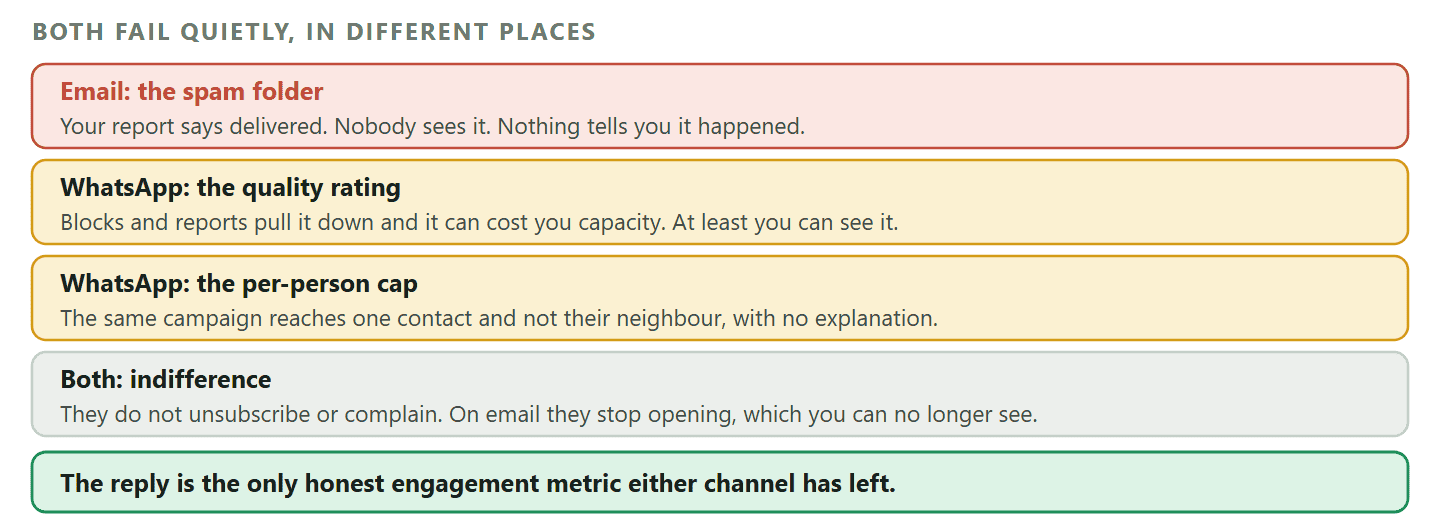
Both channels fail quietly. They fail quietly in different places, and knowing where to look is most of the skill.
- Email fails into the spam folder. Nothing tells you. Your reports show delivered, your recipients see nothing, and the damage is done gradually by authentication problems, complaint rates and sending patterns. The diagnosis is technical and lives outside your marketing tool.
- WhatsApp fails into the quality rating. Meta watches how people react to your messages, and blocks and reports pull the rating down, which can cost you messaging capacity. The signal is at least visible to you, which is the difference, and we cover reading it in our guide to quality rating and messaging limits.
- WhatsApp also fails per person, invisibly. The per-user marketing cap is set individually and adapts to that person’s own recent behaviour, so the same campaign can reach one contact and not their neighbour, and no report explains why.
- Both fail into indifference, which nothing measures. The person who has stopped caring does not unsubscribe, complain or report. On email they stop opening, which you can no longer see. On WhatsApp they stop replying, which you can.
That last line is the one worth carrying: the reply is the only honest engagement metric either channel has left. It cannot be faked by a privacy relay, it cannot be triggered by a security scanner, and it means something happened.
Using WhatsApp and Email Marketing Together
“Use both” is the standard advice and it is usually left there, which is how businesses end up sending the same content twice and annoying everybody once.
A division of labour that actually holds up:
- WhatsApp takes anything with a deadline. The appointment tomorrow, the slot that opened, the delivery arriving today, the invoice due Friday. Short, specific, answerable.
- Email takes anything with a shelf life. The seasonal guide, the price list, the receipt, the explanation somebody will search for later. Long, structured, keepable.
- The overlap goes to WhatsApp only when it is genuinely for one person. A birthday offer with their name in it is a WhatsApp message. The same offer sent to everybody on the same day is an email, whatever the personalisation tokens say.
- Never send the same content down both. Not because it is inefficient, but because the second copy is what teaches somebody that your messages are not worth reading. Pick one, and let the other channel do something the first cannot.
- Let each one recruit for the other. An email is a good place to offer a WhatsApp opt-in to people who would rather be messaged; a WhatsApp conversation is a good place to ask for an email address when you have something long to send them.
The mistake this section exists to prevent: Moving your email newsletter onto WhatsApp unchanged. It arrives four times too long, in a place where length is billed, to people who agreed to something else, and it produces the blocks and reports that damage the number your appointment reminders depend on. If you take one thing across, take the deadline, not the newsletter.
The Same Comparison, From the Customer’s Chair
Every version of this argument is written from the sender’s side, which is why it keeps reaching the wrong conclusion.
Ask somebody how they feel about the marketing email they got this morning and you will usually get a shrug. Ask how they feel about the marketing WhatsApp message and you will get an opinion. That difference is the most important thing in the whole WhatsApp vs email marketing comparison, and no engagement metric contains it.
An email lands in a place built for this. A promotional inbox is a room full of strangers, ignoring one costs nothing, and nobody feels intruded upon by a message they never opened. The channel has low expectations in both directions, which is a weakness when you want attention and a strength when you send often.
A WhatsApp message lands between a message from somebody’s sister and a photograph from a friend. That is why it gets read within minutes, and it is exactly why it can go wrong. The same proximity that makes the channel effective makes an unwanted message feel like an intrusion rather than clutter, and the response to an intrusion is not to ignore it, it is to block you.
The rule this produces: On email, the cost of a mediocre message is that it is ignored. On WhatsApp, the cost of a mediocre message is that you lose the person, and often the number’s reputation with them. That is not a reason to avoid the channel. It is the reason the good operators on it send a quarter as often as they could and write every message as though it were going to one named person, because effectively it is.
It also explains a pattern that confuses people running both. A message can perform beautifully on email and badly on WhatsApp while being word for word identical, and the reason is not the copy. It is that in one place it is a leaflet and in the other it is somebody speaking to you.
Testing It Without Betting the Business
Most people arriving at this comparison are deciding whether to move budget, and the sensible answer is to move a little of it, on purpose, for one quarter.
A test that produces a real answer has four properties, and the usual version has none of them.
- Pick one message type, not the whole programme. The appointment reminder, or the follow-up after a visit, or the message chasing an unpaid invoice. One job, done on both channels, is a comparison. Two whole strategies running side by side is a mess with a conclusion attached afterwards.
- Split by contact, not by week. Half your list gets it by email, half by WhatsApp, for the same period. Alternating months compares your channels with your seasons and tells you nothing.
- Measure the outcome, not the engagement. Bookings kept, invoices paid, slots filled. Not opens, which are unreliable on one side and undefined on the other, and not clicks, which measure interest rather than money.
- Run it for long enough to include a bad month. A quarter. Three weeks of a new channel measures novelty, and novelty always wins.
Two things worth expecting from that test, because they surprise people who ran it.
- The WhatsApp side generates work. Replies arrive, and they arrive to a person rather than to a no-reply address, which is the whole advantage and also a staffing question. If nobody is going to answer within a couple of hours, the test measures your response time rather than the channel.
- The email side looks worse than it is if you judge it on opens. Judge both on the outcome and email often holds up better than the reputation, particularly for anything the customer needed to keep.
Whichever way it lands, the result is specific to your business, which is worth more than every general comparison including this one.
The comparison is arithmetic, not an argument. Price your own list and frequency with the pricing calculator, and if the number works, DMly runs the WhatsApp side: the list as a segment, the templates, the scheduling and the replies in one inbox. See the plans.
Frequently Asked Questions
Is WhatsApp marketing better than email marketing in 2026?
Neither is better in general, and the open-rate comparison that usually settles the argument is not measuring comparable things. The useful question is what shape your bill is: email is priced against list size and barely moves with frequency, WhatsApp is priced per message on delivery. A modest list with something specific to say to each person suits WhatsApp. A large list with a lot to say suits email.
Do WhatsApp messages really have a 98% open rate?
That number circulates without a source, and even if a read rate that high were measured somewhere it would not be comparable to an email open rate, because the two record different events. Apple’s Mail Privacy Protection downloads remote content in the background regardless of engagement, so email opens include messages nobody looked at and exclude real ones. Treat any table putting the two side by side as decoration.
Is email marketing dead?
No, and the case for it is stronger than the usual defence. Email is the only one of the two that is cheap to send often, long enough to explain anything, searchable a year later, and fully portable between providers. What died is the open rate as a metric, not the channel.
Which is cheaper, WhatsApp or email?
Email, at almost any volume, because its cost is tied to list size rather than message count. WhatsApp becomes competitive when the list is small, the message is specific and the reply is worth money. Do the arithmetic on your own numbers rather than accepting anybody’s general claim, including this one.
Can I move my email list to WhatsApp?
Not directly, and not just because you may not have the numbers. Consent to receive email is not consent to receive WhatsApp messages, the platform enforces its own permission rules on top of the law, and messaging people who did not agree is the fastest route to the blocks and reports that damage your number. Invite them instead, by email, and let the ones who want it opt in.
Should I stop tracking email opens?
Stop making decisions with them. They are no longer reliable enough to trigger automation or to compare campaigns, and rules like “resend to everyone who did not open” now behave unpredictably. Clicks and replies still mean something.
Which one should a small local business start with?
WhatsApp, in most cases, because the list is small enough that the per-message cost is minor and the messages that matter are the ones with a date in them. Add email when you have something worth keeping to send, which usually arrives later than people expect.
Compare the Bills, Not the Percentages
The comparison that gets repeated everywhere is settled by two numbers that do not measure the same thing, one of which stopped measuring anything when Apple changed how Mail loads images.
The comparison that survives contact with a real business is duller and more useful. Email is cheap per send and good at length. WhatsApp is priced per message and good at answers. Work out which of those your next message needs, and the channel picks itself.
Writing about WhatsApp automation, bookings and growth for local business.
Turn WhatsApp into your busiest channel.
Start free and run message, bookings, payments and reviews in one place.
