
Looking for a SleekFlow Alternative? DMly vs SleekFlow Compared

If you are evaluating DMly vs SleekFlow, you are probably trying to solve a very practical problem: how to handle more customer conversations across WhatsApp and social channels without hiring linearly, while still improving lead conversion, response times, and reporting.
Today, most sales, marketing, and support teams rely heavily on messaging channels like WhatsApp, Instagram, and Messenger to acquire leads, answer questions, and close deals. But as conversation volume grows, managing everything manually quickly becomes expensive, messy, and inefficient.
That’s why platforms like SleekFlow have become popular. They centralize conversations across channels and help teams collaborate inside one shared inbox. For many businesses, this works well in the early stages.
But once companies start focusing on automation, advanced segmentation, and predictable scaling costs, the evaluation changes. That’s where SleekFlow alternatives like DMly begin to make more sense.
In this SleekFlow review, we’ll take a detailed look at SleekFlow vs DMly, comparing pricing, automation depth, AI capabilities, and scalability. By the end, you’ll have a clear understanding of which platform better supports growing teams that want to automate conversations, improve conversion rates, and maintain cost efficiency as they scale.
DMly vs SleekFlow Overview
At a glance, both DMly and SleekFlow solve the same problem: managing and automating customer conversations across messaging channels like WhatsApp and Instagram, in one inbox instead of one app per channel.
But once you look deeper into the platforms, the difference becomes clearer.
SleekFlow focuses primarily on centralizing conversations and enabling teams to collaborate across channels. DMly, on the other hand, is built around automation, segmentation, and scalable engagement. This means the two tools can feel quite different once a team begins running campaigns, automation flows, and larger messaging operations.
Below are the key differences between the two platforms.
| Feature | DMly | SleekFlow |
|---|---|---|
| Entry price | $29 a month, billed yearly (Starter) | $99 a month, billed yearly, or $129 monthly (Pro AI) |
| Users on the entry plan | 3 seats, extra seats $10 each | 3 user accounts |
| Contacts on the entry plan | 3,000 active contacts, topped up at $15 per thousand | 500 monthly active contacts, add-ons to 2,000 |
| Messaging channels | WhatsApp, Facebook Messenger, Instagram, Telegram, SMS, TikTok, Live Chat widget, plus Google Business Profile reviews | WhatsApp, Instagram, Messenger and other channels, listed on their site |
| Broadcasts on the entry plan | 10,000 messages a month, rising to 50,000 and 300,000 | Unlimited broadcast |
| Automation builder | Unlimited flows on every plan | Unlimited Flow Builder usage on every plan |
| API and webhooks | REST API and webhooks on every plan | Webhook and API calls start on Premium AI at $299 a month |
| Analytics dashboards | Conversation and campaign reports on every plan | Start on Premium AI |
| Role-based access | Roles and permissions on every plan | Starts on Premium AI |
| Salesforce | No native connector. Bridge it through Zapier, n8n or the REST API | Enterprise only, with custom integrations |
| Built-in CRM | Yes: lifecycle stages, tags, notes, custom fields | Integrates with an external CRM such as HubSpot or Salesforce |
| WhatsApp message charges | Paid to Meta directly at Meta’s own rates, nothing added | Broadcast message fees billed against SleekFlow’s own rate card |
| Appointment booking | Native calendar with services, staff and classes. No deposit or part-payment setting; invoice for a deposit instead | Not offered |
| Invoices and payments | Branded invoices that can sit partly paid, expenses, revenue dashboard | Not offered |
| Google reviews | Review requests and a reputation inbox | Not offered |
| Loyalty | Points on paid invoices, with an automatic coupon at your threshold | Not offered |
| White label | Full white label with a custom domain, through the agency product | Not offered |
What Is SleekFlow?

SleekFlow is a conversational messaging platform designed to help businesses manage customer conversations across multiple messaging channels from a single dashboard.
Instead of switching between WhatsApp, Instagram, Messenger, and other apps, teams can centralize all incoming conversations into one shared workspace. This allows sales, marketing, and support agents to collaborate, assign chats, and respond to customers more efficiently.
For many businesses, SleekFlow acts as a conversation management layer. It helps organize messages, keep communication consistent, and prevent leads or support requests from slipping through the cracks.
Companies typically use SleekFlow for:
- Managing customer conversations across social messaging platforms
- Running basic WhatsApp marketing campaigns
- Collaborating across support or sales teams
- Integrating messaging data with external CRM tools
However, SleekFlow’s primary focus is conversation centralization rather than deep automation. While it supports workflows and messaging campaigns, many of its more advanced capabilities are only available in higher-tier plans.
This is why teams that start with SleekFlow for conversation management sometimes begin evaluating other SleekFlow alternatives as their automation needs grow.
What Is DMly?
DMly is a conversational engagement and automation platform built for teams that want to scale customer communication across messaging channels without increasing operational complexity.
While some tools focus mainly on organizing conversations, DMly is designed to automate them. The platform combines an omnichannel inbox, AI-driven engagement, advanced automation workflows, and built-in CRM capabilities to help businesses manage conversations, nurture leads, and track performance from a single system.
Teams typically use DMly to handle conversations across WhatsApp, Instagram, Messenger, Telegram, and website live chat, while also running automated campaigns and customer journeys that drive conversions and retention.
In practical terms, DMly acts as both a communication hub and an automation engine. Instead of agents responding to every message manually, many interactions can be handled automatically through AI agents, workflow triggers, and lifecycle campaigns.
Some of the core capabilities that define DMly include:
- AI-driven conversation automation: DMly uses AI chatbots and rule-based automation to qualify leads, answer common questions, route conversations to the right team members, and guide customers through structured journeys.
- Omnichannel messaging management: All customer conversations from supported channels appear in a unified inbox, making it easier for teams to collaborate, assign chats, and maintain consistent communication.
- Advanced workflow automation: Businesses can build automated journeys triggered by events such as new leads, customer actions, campaign responses, or CRM updates. These workflows can include tagging, segmentation, drip campaigns, and follow-up messaging.
- Built-in CRM and segmentation tools: DMly includes contact management features such as tags, stages, notes, custom attributes, and pipelines. This allows teams to segment audiences and personalize campaigns without relying on external CRM software.
- Campaigns and broadcast messaging: Marketing teams can run WhatsApp broadcast campaigns with advanced segmentation and retargeting logic, helping them send more relevant messages instead of generic blasts.
- Analytics and reporting: DMly provides detailed insights into conversations, campaign performance, and customer satisfaction metrics, helping teams understand how messaging contributes to growth and retention.
Because of this combination of automation, AI capabilities, and built-in CRM functionality, DMly is often used by businesses that want messaging channels like WhatsApp and Instagram to function as structured growth and support systems rather than simple chat tools.
Now, let’s see how SleekFlow and DMly compare directly across pricing, automation, and core capabilities.
Pricing Comparison: DMly vs SleekFlow, Plan by Plan
Pricing is often where the difference between SleekFlow and DMly becomes most obvious.
From the surface, the two platforms help teams manage conversations across messaging channels. But once you start comparing their pricing structures and how features are distributed across plans, you’ll begin to see how far apart the tools are.
The thing to check on SleekFlow is not the headline price but which tier holds the feature you actually need. Some capabilities that sound advanced are on the entry plan, and some that sound basic are not.
Neither platform’s subscription is the whole bill either, because WhatsApp charges per message on top. How that gets billed differs between the two, and that difference is set out below.
SleekFlow Pricing

Read off SleekFlow’s own pricing page on 2 September 2026: Pro AI is $99 a month billed yearly, or $129 month to month, and carries three user accounts and 500 monthly active contacts. Premium AI is $299 a month billed yearly, or $349 monthly, with ten users and 1,000 monthly active contacts. Enterprise AI is quoted individually. SleekFlow bills on monthly active contacts, the people you actually talk to, so the plan price is a floor that moves with how busy you are.
SleekFlow’s entry plan is more generous than it is usually given credit for, and the real gate sits somewhere most comparisons miss:
- Flow Builder and broadcasts are unlimited on Pro AI, along with unlimited contact storage. If someone tells you SleekFlow gates its automation at the entry tier, their page says otherwise.
- Webhooks and API calls start at Premium AI, which is $299 a month. This is the real gate, and for anyone who wants to connect messaging to their own systems it triples the entry cost.
- Analytics dashboards and role-based access control also start at Premium AI. On Pro you get the inbox and the flows but not the reporting.
- Salesforce and custom integrations are Enterprise only, as is PII masking. Worth knowing if Salesforce is your system of record, because neither platform solves that on a mid-tier plan.
For smaller teams just starting out, this might be manageable. But as conversation volume grows and automation becomes more important, costs can increase quickly.
The second thing to check is how each platform bills the messages themselves. SleekFlow charges broadcast message fees separately against its own WhatsApp rate card, which varies by template, country and volume. DMly has you pay Meta directly at Meta’s own published rates. Whether a vendor rate card works out dearer than Meta’s depends on your countries and volumes, so compare the two rate cards for the markets you actually message rather than trusting a percentage from anybody, including us.
At low volume the difference is small. At tens of thousands of messages a month it is the largest single line on the bill, which is why it is worth ten minutes with both rate cards and our conversation cost calculator before you commit.
DMly Pricing
DMly takes a different approach.
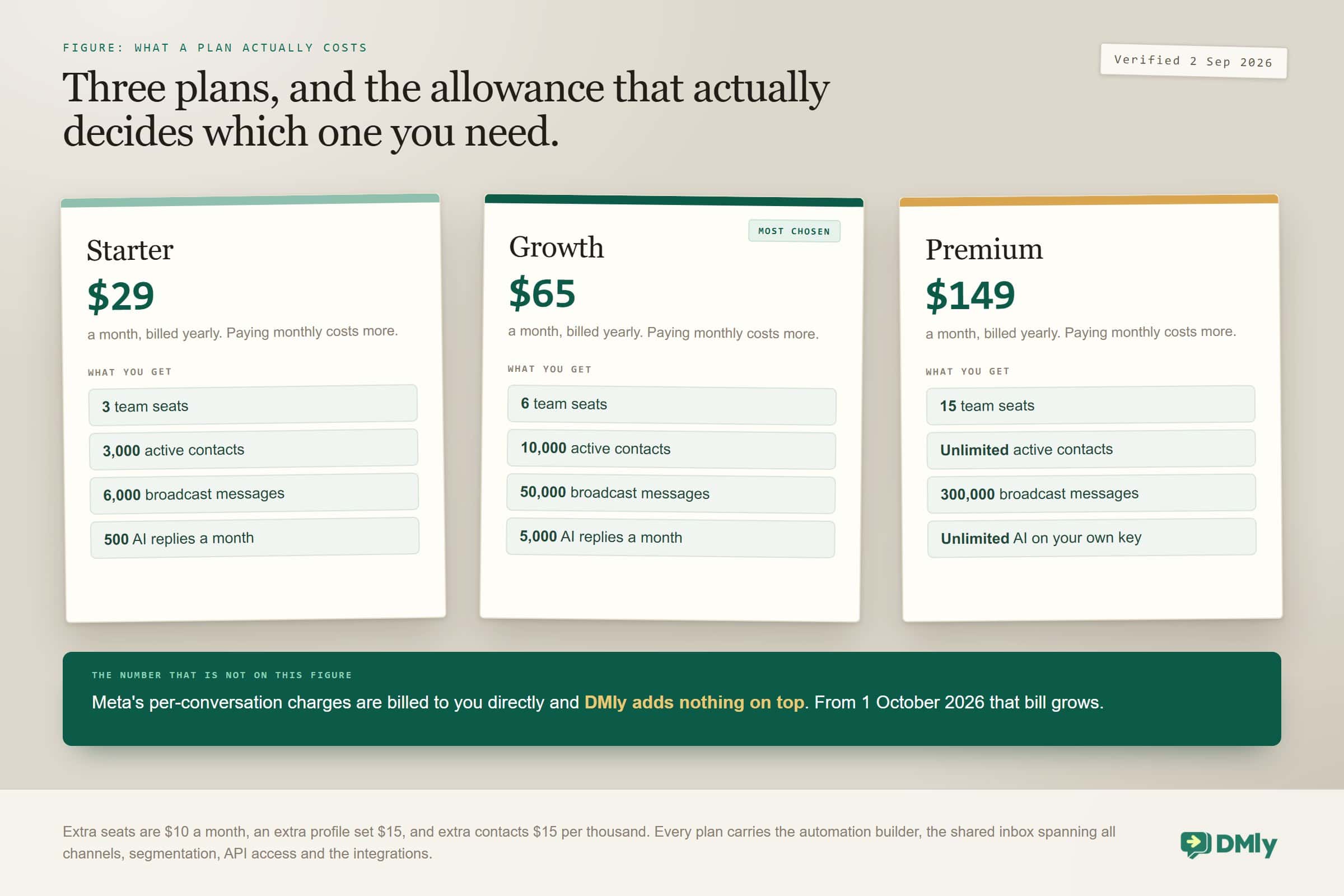
DMly starts at $29 a month billed yearly for Starter, then $65 for Growth and $149 for Premium. All three verified against the live pricing page on 2 September 2026.
More importantly, DMly does not add any markup to Meta’s WhatsApp messaging fees. Businesses pay Meta directly for their messaging usage, exactly at the official rates.
Several things that other platforms hold back for higher tiers are on every DMly plan. Some allowances still scale with the plan, so here is the honest split:
- On every plan: the automation builder with unlimited flows, tags and segmentation, drip sequences, the built-in CRM, REST API access, webhooks, Zapier and n8n, and the shared inbox across all eight channels.
- Scales with the plan: active contacts (3,000, 10,000, then unlimited), team seats (3, 6, 15), broadcast messages (10,000, 50,000, 300,000) and AI replies (500 a month, 5,000, then unlimited on your own provider key).
- Active bots are capped at ten per profile on Starter and unlimited from Growth up, so a business running several bots at once should look at Growth rather than Starter.
- Top-ups rather than upgrades: an extra seat is $10 a month, an extra profile set $15, and extra contacts $15 per thousand, so outgrowing one allowance does not force a whole plan jump.
- Not included: there is no native Salesforce connector. Bridge it through Zapier, n8n or the REST API, or pick SleekFlow Enterprise if a first-party one is a requirement.
- Also included, and unusual at this price: appointment booking, invoicing, Google review requests and loyalty points, none of which SleekFlow offers.
This means teams can build automation systems and scale messaging operations without constantly needing to upgrade plans.
Predictability as You Scale
Another factor that matters for growing businesses is cost predictability.
With SleekFlow pricing, feature gating and plan limitations can make it difficult to forecast operational costs as your messaging activity increases. As you add more agents, automation flows, or integrations, the pricing structure can become more complex.
DMly’s structure is designed to be simpler. Teams can focus on building campaigns, automation, and customer journeys without worrying about hitting feature limits or hidden upgrades.
Paying Meta directly at Meta’s own rates, with nothing added on top, is the part that keeps the messaging half of the bill predictable as volume grows. It also means the rise coming on 1 October 2026 reaches you at Meta’s price rather than a marked-up one. From that date each business number gets 1,000 free service messages a month and is charged only from the 1,001st, while utility templates sent inside an open 24-hour window become chargeable with no free allowance at all, which is where the bill actually grows.
For agencies, e-commerce brands, and support teams managing high conversation volumes, this difference can translate into significant long-term savings.
Automation Capabilities of the Two Platforms
When teams begin comparing SleekFlow and DMly seriously, automation is another area you cannot afford to neglect.
At the beginning, most businesses simply want a place to manage conversations. But as messaging becomes a core part of sales, marketing, and support, automation quickly becomes the engine that keeps everything running smoothly.
Without it, teams end up replying by hand to hundreds, or even thousands, of repetitive messages.
This is where the design philosophy of the two platforms becomes clear.
SleekFlow focuses mainly on helping teams manage conversations efficiently, while DMly is designed to automate large portions of those conversations altogether.
SleekFlow Automation
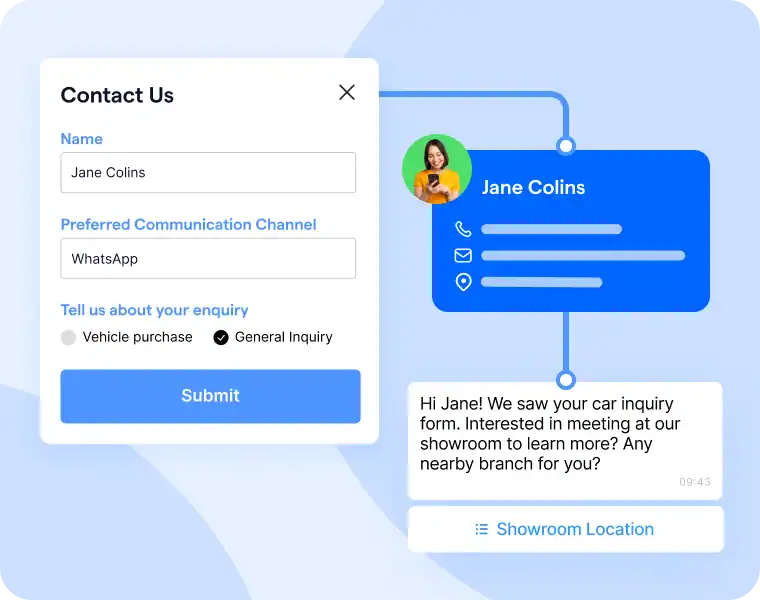
SleekFlow gives you a real flow builder, and it does not hold it back for higher plans: Pro AI includes unlimited Flow Builder usage and unlimited broadcasts. What you can build with it covers the everyday cases:
- Automated welcome messages
- Basic rule-based workflows
- Canned responses for common questions
- Simple routing between team members
These tools are helpful for reducing manual replies and keeping conversations organized. For smaller teams or businesses that mainly rely on human agents to handle interactions, this may be sufficient.
Where SleekFlow does hold things back is not the builder but the plumbing. Webhooks and API calls start on Premium AI at $299 a month, and so do the analytics dashboards. So a flow can do a great deal inside SleekFlow on the entry plan, and very little that reaches your own systems.
If your automation stays inside the messaging tool, that is fine. If it needs to write to your booking system, your stock or your accounts, the entry plan will not reach them and the tier that does costs three times as much.
DMly Automation

DMly approaches automation very differently.
Instead of focusing only on conversation management, the platform is built around event-driven automation systems that allow businesses to create structured messaging journeys across multiple channels.
These automations can be triggered by a wide range of events, such as:
- A new lead entering the system
- A customer replying to a campaign
- A tag or attribute being added to a contact
- A change in CRM stage or pipeline status
- A user clicking a message or interacting with a chatbot
From there, teams can design automated workflows that guide customers through specific journeys. For example, a typical automation flow might include:
- Lead qualification via AI chatbot
- Automatic tagging and segmentation
- Assignment to the appropriate sales agent
- Follow-up drip campaigns
- Retargeting messages if the lead goes inactive
This kind of automation allows businesses to nurture leads and manage customer relationships without requiring constant manual input from the team.
| Automation | DMly | SleekFlow |
|---|---|---|
| Flow builder | Unlimited flows on every plan, with triggers, conditions and CRM events | Unlimited Flow Builder usage from Pro AI upward |
| AI replies | 500 a month on Starter, 5,000 on Growth, unlimited on your own provider key on Premium | AI agents on Pro AI; advanced AI agents with integrations from Premium AI |
| Active bots | 10 per profile on Starter, unlimited from Growth | Not published as a numbered limit |
| Drip sequences | On every plan | Built with the flow builder |
| Behavioural triggers | Tags, custom fields, lifecycle stage, appointments, orders and payments | Available through the flow builder |
| Connecting your own systems | REST API and webhooks on every plan | Webhooks and API calls from Premium AI at $299 a month |
CRM and Customer Data Management
Another area where the difference between SleekFlow and DMly is clear is how each platform handles customer data.
As messaging channels like WhatsApp and Instagram become central to sales and support operations, businesses need more than just a chat interface. They need a structured way to organize customer information, track interactions, and segment contacts for campaigns and automation. And that is where CRM functionality becomes important.
SleekFlow’s CRM Approach
SleekFlow is primarily designed as a conversation management platform, so its CRM capabilities rely heavily on integrations with external tools.
Businesses typically connect SleekFlow with systems like HubSpot, Salesforce, or other CRM platforms to store and manage customer data. This setup works well for companies that already have an established CRM infrastructure.
Within SleekFlow itself, teams can manage conversations, assign chats, and tag contacts, but deeper CRM functionality, such as pipeline management, structured contact records, and lifecycle tracking, often requires external integrations.
While this approach offers flexibility, it also introduces an extra layer of complexity. Teams must maintain multiple tools and ensure that data syncs properly between systems.
DMly’s Built-In CRM
DMly takes a more integrated approach by including a built-in CRM directly inside the platform.
Instead of relying on third-party tools for basic customer management, teams can organize contacts, track interactions, and manage lead pipelines without leaving the system.
Some of the key CRM capabilities inside DMly include:
- Contact profiles with conversation history
- Tags and smart segmentation
- Custom attributes for customer data
- Lead stages and pipeline management
- Internal notes and activity tracking
This structure allows businesses to build automation and campaigns directly around customer data stored within the platform.
For example, a team could automatically trigger a follow-up campaign when a lead moves to a certain stage, or segment contacts based on their engagement history.
Segmentation and Broadcast Campaigns

For many businesses using WhatsApp and social messaging channels, broadcast campaigns are one of the most powerful growth tools available. They allow teams to reach hundreds or thousands of customers instantly, whether it’s announcing a promotion, sending product updates, or following up with leads.
But the real effectiveness of these campaigns depends on how well you can segment your audience.
Sending the same message to everyone rarely works. Customers respond better when messages are tailored to their behavior, interests, or stage in the buying journey.
This is another area SleekFlow review should look into, because it’s one area where SleekFlow and DMly seem to be different.
SleekFlow Broadcast and Segmentation
SleekFlow supports broadcast messaging, allowing businesses to send messages to groups of contacts through WhatsApp and other connected channels. Teams can segment audiences using basic attributes such as:
- Tags
- Contact lists
- Simple customer filters
This works well for straightforward campaigns like general announcements or promotions. For example, a business could send a broadcast message to all contacts tagged as “new leads” or “recent customers.”
However, segmentation options are relatively limited compared to platforms designed specifically for lifecycle marketing. As campaigns become more sophisticated, such as targeting users based on behavior or interaction history, teams may need additional tools or integrations.
DMly Broadcast and Segmentation
DMly approaches messaging campaigns with a stronger focus on behavior-driven targeting.
Instead of relying mainly on static lists or tags, the platform allows teams to build segments based on multiple attributes and customer actions. For example, contacts can be grouped based on:
- Tags and custom attributes
- CRM stage or pipeline status
- Previous campaign engagement
- Automation triggers
- Interaction history with the brand
This allows marketing teams to send more personalized broadcasts rather than generic messages.
For instance, a business could run a campaign specifically targeting customers who clicked on a previous offer but didn’t complete a purchase, or send a re-engagement message to contacts who have been inactive for a certain period.
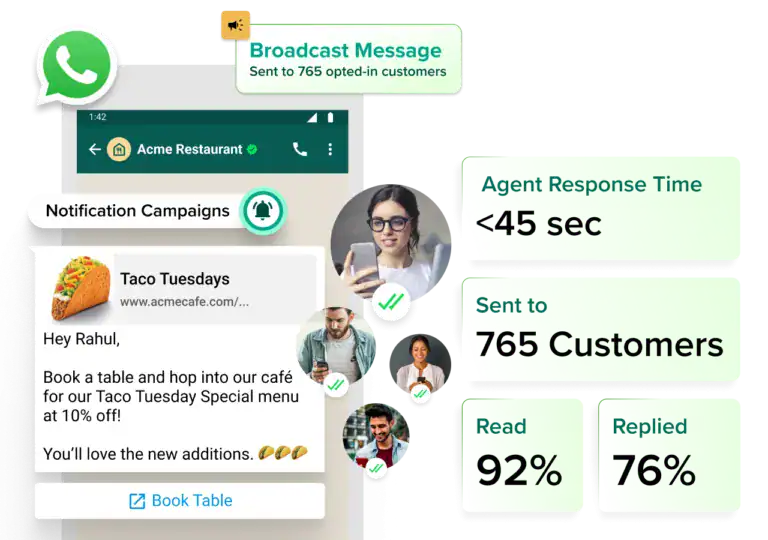
Better segmentation like this typically leads to:
- Higher open and response rates
- More relevant customer communication
- Improved conversion from messaging campaigns
- Reduced message fatigue for customers
For businesses that rely heavily on WhatsApp and messaging channels for marketing, this level of targeting can significantly improve campaign effectiveness over time. So, you see why many businesses are looking for SleekFlow alternatives.
Analytics and Reporting
Analytics play an important role in understanding whether your messaging strategy is actually working. It’s one thing to send campaigns or automate conversations, but without proper reporting, it becomes difficult to know what’s driving results and what needs improvement.
SleekFlow provides basic analytics that help teams monitor conversation activity, message delivery, and general engagement across channels. These reports can give a quick overview of response times, message performance, and agent activity, which is helpful for teams focused primarily on managing conversations and maintaining customer support efficiency.
DMly goes a step further by offering more comprehensive analytics designed to support both marketing and operational decisions. In addition to conversation metrics, teams can track campaign performance, automation results, customer engagement patterns, and satisfaction indicators like CSAT.
This deeper level of reporting allows businesses to understand how messaging contributes to lead conversion, retention, and overall customer experience.
If your team relies heavily on messaging channels as part of your growth strategy, having access to these insights makes it easier to optimize campaigns, refine automation workflows, and measure the real impact of customer engagement efforts.
Integrations and API Access
Integrations play a major role in how well a messaging platform fits into your existing tech stack. Most businesses already rely on several tools for CRM, ecommerce, analytics, and internal workflows, so the ability to connect those systems with your messaging platform can significantly improve efficiency.
SleekFlow integrates with the usual CRM platforms and business tools, but the deeper capabilities sit higher up: webhooks and API calls begin on Premium AI at $299 a month, and Salesforce and custom integrations are Enterprise only.
For teams running simpler setups, this may not be an issue. However, businesses that need to automate data flows between systems or build custom integrations may find these limitations restrictive as their operations grow.
DMly puts integration and API access on every plan: Shopify and WooCommerce for orders, HubSpot and Mailchimp for contacts, Google Sheets and Calendar, six payment gateways, plus Zapier, n8n, webhooks and a REST API. There is no native Salesforce connector, so that one goes through Zapier or the API. If you are weighing this against other platforms rather than SleekFlow alone, our twenty-tool roundup with every price re-checked covers the wider field.
This makes it possible to automate actions such as updating CRM records, triggering campaigns based on ecommerce events, or syncing customer data across platforms without relying on complex workarounds.
SleekFlow Review 2026: Final Note
Both SleekFlow and DMly are credible platforms in the conversational messaging space. They each help businesses manage customer conversations across various messaging channels, and both can improve how teams communicate with leads and customers.
The difference lies in what each platform is primarily built to do.
SleekFlow focuses strongly on centralizing conversations and helping teams collaborate across channels. For businesses that mainly want a unified inbox where agents can respond faster and keep conversations organized, SleekFlow can work well.
It provides the basic tools needed to manage chats, route conversations, and maintain visibility across messaging platforms.
DMly, however, is built with a stronger emphasis on automation, segmentation, and scalable engagement. The platform combines messaging, automation workflows, built-in CRM tools, and AI-driven interactions into a single system designed to support marketing, sales, and support operations as they grow.
Instead of simply managing conversations, DMly enables teams to automate large parts of the customer journey, from lead qualification and follow-ups to targeted campaigns and lifecycle messaging.
Pricing is another area where the difference becomes clear. With a starting price significantly lower than SleekFlow pricing and fewer feature restrictions across plans, DMly offers a more cost-efficient structure for teams that expect their messaging operations to scale over time.
In practical terms, the choice often comes down to business needs. If your primary goal is conversation management with simple workflows, SleekFlow can be a suitable option.
If your goal is to automate customer engagement, build sophisticated messaging campaigns, and scale operations without rapidly increasing costs, DMly is generally the stronger SleekFlow alternative.
SleekFlow Alternatives: Frequently Asked Questions
What is SleekFlow used for?
SleekFlow is mainly used to manage customer conversations across messaging channels like WhatsApp, Instagram, Messenger, and Telegram. Businesses use it to centralize messages in one inbox, collaborate across teams, and run basic messaging campaigns.
Is DMly cheaper than SleekFlow?
At the entry tier, yes, and by a wide margin. Checked on 2 September 2026, DMly starts at $29 a month billed yearly and SleekFlow’s Pro AI plan at $99 a month billed yearly, or $129 monthly. The gap widens once you need webhooks and an API, because SleekFlow puts those on Premium AI at $299 a month while DMly includes them on every plan. It narrows if all you want is a shared inbox and unlimited broadcasts, which SleekFlow gives you on Pro.
Does SleekFlow support WhatsApp automation?
Yes. SleekFlow supports WhatsApp automation through workflows, automated replies, and messaging campaigns. Businesses can set up simple automation such as welcome messages, routing rules, and broadcast campaigns. However, more advanced automation capabilities are often limited or available only in higher pricing plans.
Can DMly replace SleekFlow?
In many cases, yes. DMly offers a unified inbox similar to SleekFlow, but also includes advanced automation workflows, AI chatbots, built-in CRM functionality, and deeper segmentation tools. For businesses that want both conversation management and automation-driven engagement in one platform, DMly can serve as a full replacement.
Which platform is better for agencies or multi-brand teams?
For agencies or teams managing multiple brands, DMly often provides more flexibility. The platform supports multiple workspaces, advanced automation, and integrations that allow teams to manage campaigns, conversations, and reporting across several clients or business units.
SleekFlow can still work for agencies, but its pricing structure and feature limitations across lower plans may make scaling more expensive.
Writing about WhatsApp automation, bookings and growth for local business.
Turn WhatsApp into your busiest channel.
Start free and run message, bookings, payments and reviews in one place.
