
Manychat Review 2026: What It Costs, and What It Rests On
For most of this year, this page carried no Manychat price. It said so openly, and the reason was honest: Manychat’s pricing page sits behind a Cloudflare challenge that refuses automated readers, so every attempt to read it returned a 403 rather than a number. Checked again on 6 September 2026, that is still true, and it is a limitation on us rather than a criticism of them. Any person with a browser can read Manychat’s prices in about four seconds.
What changed is that we went looking somewhere else, and the numbers were sitting in plain sight. Manychat sells its subscriptions through the Apple App Store and Google Play, and both stores publish what a vendor charges. Apple lists the plan names and the exact figures. Google Play lists the range. Neither of those is a directory rumour or a reseller’s guess: they are Manychat’s own listings, filed by Manychat, Inc., and updated within the last week.
So this Manychat review has two findings. The first is a price you can now check for yourself. The second came out of the same search, and it is the more useful one for anyone deciding whether to build a business on Manychat: the platform publishes a status page, and that status page says a great deal about what Manychat rests on.
What Manychat Is, and Who It Is Really Built For
Manychat automates the conversations that start on social media, and it is very good at that specific job. Someone comments on your Reel, and a direct message goes out to them. Someone replies to your story, and a flow starts. Someone sends a keyword, and they get a link, a discount code or a booking prompt. You build all of it by dragging boxes around a canvas, and you never touch a line of code.
The company is Manychat, Inc. Its Google Play listing passed one million downloads and was last updated on 1 September 2026; its iPhone app sits at version 6.21.0, released on 31 August 2026, rated 4.3 from around 2,100 ratings, and ranked 133rd in Apple’s Business category on the day we looked. This is not a small operation, and it is not standing still.
Manychat’s own description of the product, written by Manychat and published on both stores, breaks it into three jobs: grow, engage and sell. Grow means automatic replies to story mentions, post comments and Reel replies. Engage means handling direct messages in one place. Sell means dropping affiliate links and discount codes, capturing an email or a phone number, and watching clicks and conversions. That is a marketing tool, described by the people who built it, and it is worth taking at face value rather than arguing with.
If you are a creator, a coach, an online seller, or a local business whose enquiries genuinely arrive through Instagram comments, Manychat is a reasonable first tool. The question this Manychat review exists to answer is what happens next, when the business grows past the point where a chat funnel is the whole operation.
Manychat Pricing in 2026: Read Off Manychat’s Own App Store Listings
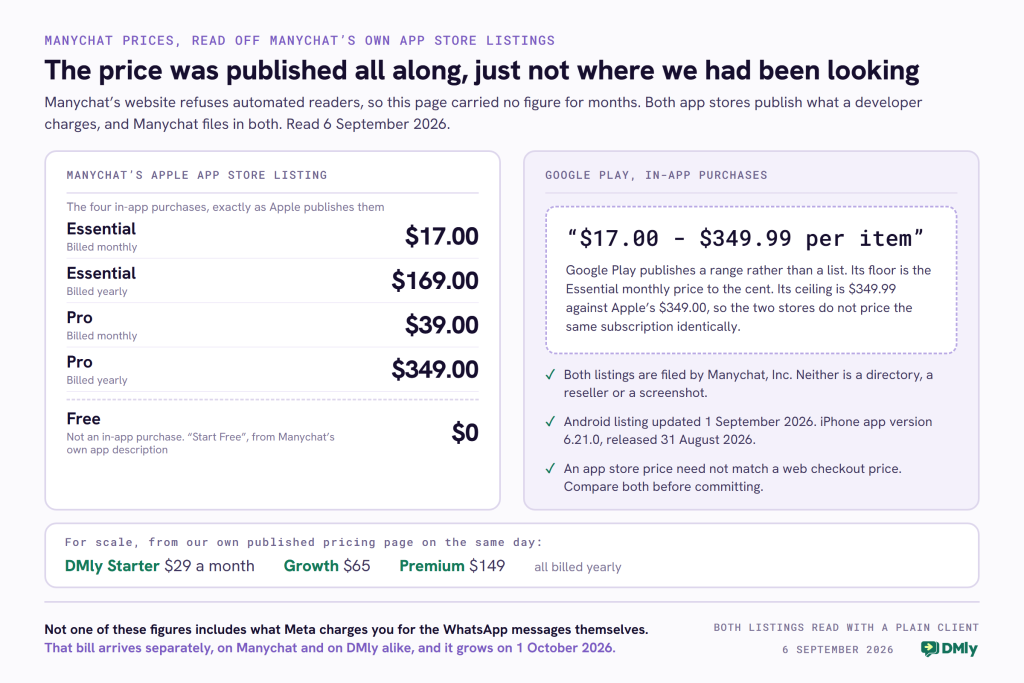
Here are the four figures, with the billing period and the source beside each one, because a price without a period is not a price. These come from Manychat’s own listing on the Apple App Store, read on 6 September 2026. Apple publishes every in-app purchase a developer sells, with the developer’s own product names.
| Manychat subscription | Price | Billing period | Where this number is published |
|---|---|---|---|
| Essential | $17.00 | Per month | Apple App Store, in-app purchase list |
| Essential | $169.00 | Per year | Apple App Store, in-app purchase list |
| Pro | $39.00 | Per month | Apple App Store, in-app purchase list |
| Pro | $349.00 | Per year | Apple App Store, in-app purchase list |
Google Play, where the same company files the Android version, publishes in-app purchases as a range running from $17.00 to $349.99 per item. The floor of that range is the Essential monthly price to the cent. The ceiling is $349.99 against Apple’s $349.00, a difference of ninety nine cents, which is a neat demonstration of the first caveat below: two stores selling the same subscription do not have to price it identically. Two independent listings bracketing the same four products is still a great deal more than a single screenshot.
Four caveats you should hold on to before you plan a budget around these
An app store price and a website price are not automatically the same price. Apple and Google take a commission on in-app purchases, and plenty of software companies set the mobile price higher to cover it, or lower to win the signup. We cannot read Manychat’s web checkout, so we cannot tell you whether the figures above match what you would pay signing up on a laptop. If the difference matters to your budget, open both and compare before you commit.
Two named plans are not necessarily the whole ladder. Apple lists Essential and Pro. Manychat’s app copy also says “Start Free”, so a free entry point exists. Whether there is a higher tier sold by conversation rather than through the stores, we do not know, and we are not going to guess at one. Older versions of this Manychat review described a “Pro plan from $15 a month” and an “Elite” tier with custom pricing. Neither of those names appears on either store listing today, and the $15 figure does not match anything currently published, so both have been withdrawn from this page rather than repeated.
A flat app store price cannot tell you what happens as your audience grows. An in-app purchase is a fixed item at a fixed price, which is how both stores work, so these four figures say nothing about whether the bill moves with the number of contacts you hold. Earlier versions of this page asserted that it does. We cannot verify that today, so we are not asserting it, and you should not plan on either answer. Ask the vendor directly, in the form that gets a usable reply: what will I pay at 5,000 contacts, and what will I pay at 25,000?
None of these figures includes what Meta charges you for WhatsApp messages. That is a separate bill on every platform in this category, ours included, and from 1 October 2026 it gets bigger. There is a whole section on that further down, because it is the part of the cost that most buyers do not model.
Why we spell out where a price comes from
A price on a comparison page can be in one of four states, and the state matters as much as the number. It can be published, which is a currency and a period you can read without an account. It can be not published, where no pricing page exists at all and every figure comes from a sales call. It can be gated, where a pricing page exists with the numbers removed, behind a login or a quote form. And it can be published but not verifiable by us, which is where Manychat’s website sits: the numbers are there for any human visitor, and our own automated checks cannot reach them.
That fourth state used to leave this page with a blank where a figure should be. The app store listings fill the blank honestly, because they are the vendor’s own filings rather than a third-party directory. We do not quote software directories for prices at all: they go stale, they mix currencies, and nobody at the vendor ever signed off on them.
Which Channels Manychat Covers, According to Manychat
This page used to say Manychat covers Facebook Messenger, Instagram, WhatsApp, SMS and email. That list is out of date, and the correction comes from Manychat’s own words. The description it files with both app stores says, in the section headed Engage: “Manage all your DMs from Instagram, TikTok, Facebook, WhatsApp, Telegram, and more, in one app.”
TikTok and Telegram are both on that list and neither appeared on this page before. If you have been avoiding Manychat because you assumed it was Meta only, that assumption is now wrong on its own terms, and it is fair to say so.
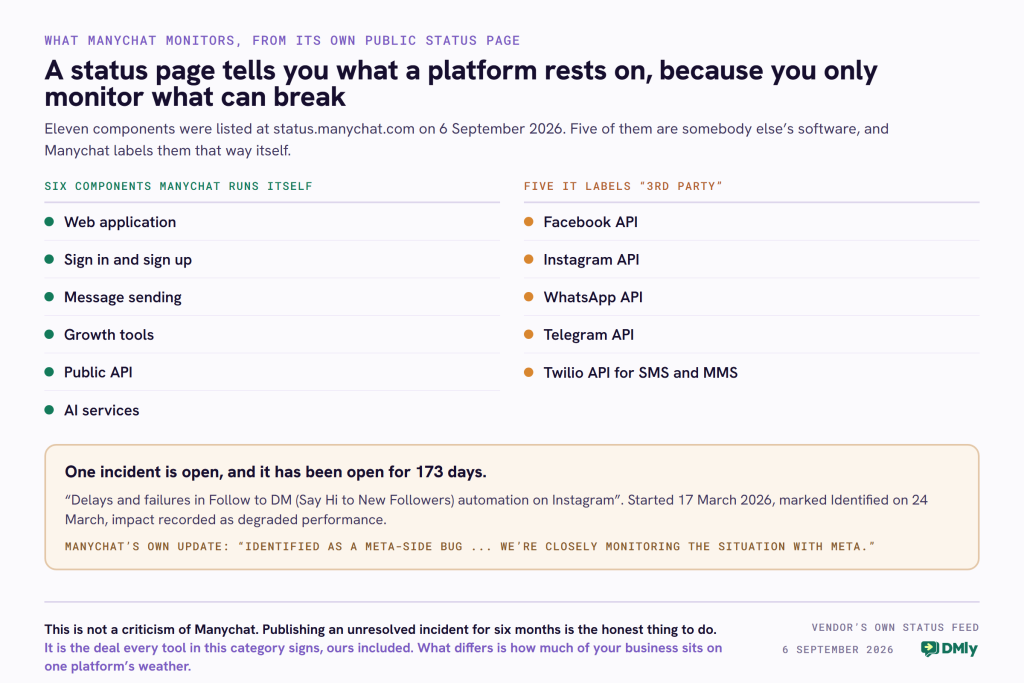
There is a second list worth putting beside it, and it is the more revealing of the two. Manychat runs a public status page at status.manychat.com, and a status page enumerates exactly what a platform depends on, because you only monitor what can break. On 6 September 2026 it listed eleven components. Six belong to Manychat: the web application, sign in and sign up, message sending, growth tools, the public API, and AI services. Five belong to somebody else, and Manychat labels those five “3rd party”: the Facebook API, the Instagram API, the WhatsApp API, the Telegram API and the Twilio API for SMS and MMS.
Read the two lists together and you get something more accurate than either alone. The marketing copy names TikTok. The status page, which is the operational document, does not monitor a TikTok dependency, and it does not monitor an email one either. That is not a contradiction anybody should be scandalised by, and it is not evidence of a missing feature. It does mean that if TikTok is central to your plan, that is a question to put to Manychat’s sales team with a specific answer expected, rather than a box to tick off a feature list.
The Platform Dependency, Measured Instead of Asserted
Every version of this Manychat review has carried a line about the platform depending heavily on Meta. That line was an adjective with nothing behind it, and it should not have been published in that form. Here is the same point with evidence, and the evidence is Manychat’s own.
Manychat’s status page carries one open incident. It is titled “Delays and failures in Follow to DM (Say Hi to New Followers) automation on Instagram”. Its own status feed records it as starting on 17 March 2026, moving to Identified on 24 March, and it is still listed as an active incident on 6 September 2026, with an impact of degraded performance. That is 173 days open, on a named, advertised feature.
Manychat’s own update explains why, and the wording matters: the problem “has been identified as a Meta-side bug and is currently under active investigation. We’re closely monitoring the situation with Meta.”
Take that at face value, because it is almost certainly accurate and it is to Manychat’s credit that they published it. Plenty of vendors would have quietly greyed the feature out. What it shows is not that Manychat’s engineering is weak. It shows what happens to any business built on top of somebody else’s platform: when the platform breaks a feature, the vendor you pay cannot fix it, cannot commit to a date, and can only watch. Nearly six months is a long time to watch.
This is not a Manychat problem. It is the deal every tool in this category signs, ours included. What differs between tools is how much of your operation sits on one platform’s weather. If comment automation and follower automation on Instagram are the whole of what you have automated, then an outage upstream is an outage in your business. If those are two of eight things you run, and the other six are bookings, reminders, invoices, reviews and a WhatsApp inbox, then the same outage is an annoyance.
The shape of the public API says the same thing more quietly
Manychat publishes its API at api.manychat.com/swagger, and unlike the pricing page, it serves that document to anyone. It is worth two minutes of your time if you have a developer, because the structure is informative.
The Page API carries 34 endpoints. Every single one of them sits under a path beginning /fb/. There is no /whatsapp/, no /instagram/, no /telegram/ and no /tiktok/. The objects the API works with are a “page” and a “subscriber”, which are Facebook Messenger’s own words for a business account and a contact, and one endpoint is getOtnTopics, where OTN is Messenger’s One-Time Notification mechanism. The document declares its own version as “beta”.
None of that stops the API working. It does tell you something about where the product’s centre of gravity sits, and it tells you what you would be integrating against if you wired Manychat into a booking system or a stock file. If you plan to do that, read the spec first rather than after.
What Manychat Does That DMly Does Not
Starting here, because a comparison that gives the competitor nothing is not worth reading. There is a real feature gap and it runs in Manychat’s favour.
Manychat has a new follower trigger on Instagram, the one its status page calls Follow to DM or “Say Hi to New Followers”. Somebody follows your account and a message goes out to them automatically. DMly has no equivalent. We checked properly rather than assuming: DMly’s Instagram triggers are an incoming Instagram message, comments on a post or Reel, a story reply, a story mention, and comments on a Live. There is no follower trigger among them, and a search of all 375 pages of DMly’s documentation returns nothing for the concept under any wording. If greeting new followers automatically is the specific job you are hiring a tool for, Manychat does it and we do not.
The honest footnote is the one from the section above: that is the feature Manychat’s own status page has had listed as degraded since March. Give them the credit for having it, and go in knowing its current state, which they publish.
Manychat is also, by the numbers, the more established consumer-facing product. A million downloads on Android and 2,100 Apple ratings is real distribution, and it buys you something practical: a large community, a lot of tutorials, and a lot of people who have already solved whatever you are about to run into. That is a genuine advantage and it does not show up on a feature grid.
Where DMly Is Built Differently, and Where It Is Not
The honest summary is that Manychat automates the conversation and DMly tries to automate the business the conversation is about. That is a difference of scope, not of quality, and it only matters if the wider scope is something you actually need.
On the ground Manychat occupies, the two overlap almost completely. DMly runs comment-to-DM automation on Facebook Pages, Instagram and TikTok, with four triggers: Facebook comments, Instagram post or Reel comments, Instagram Live comments, and TikTok video comments. Keywords match on any message, an exact match, a starts-with or a contains, and matching ignores capitals. There is a “respond only once per contact” switch for giveaway-style automations. Story replies and story mentions both trigger flows. If you are moving across from Manychat for that specific work, you are not giving anything up except the follower trigger.
What sits beside it is the part Manychat does not sell. DMly carries a bookings system with services, staff, availability, classes and a client portal; invoices, orders, payments, coupons and expenses; recurring plans, subscriptions and gift cards; a contact record with pipeline stages; and a Reputation section that requests and manages Google reviews. Those are separate products for a Manychat user, bought and wired together, and each seam is a place where a customer’s details stop travelling with them.
Channels: DMly’s own site counts seven channels and SMS. WhatsApp through the official Business API, Instagram, Facebook Messenger, TikTok, Telegram, a Live Chat widget on your own site, Google Business Profile for reviews, and SMS through Twilio, Plivo or a custom gateway. They all land in one shared inbox. AI agents are on every plan, with the monthly reply allowance as the difference between tiers rather than the feature itself.
Two limitations we would rather you heard from us
The first is a live bug in the exact feature a Manychat user would arrive for. DMly’s comment trigger has a “Which posts?” setting offering All posts or Specific, with a post picker. The Specific selection is not enforced today. An automation saved against three chosen posts still fires on comments on every post on the account. Our own documentation states this plainly, and so does this page.
The workaround is to scope the automation with keywords rather than with posts, which is what the documentation recommends, and it works: a giveaway automation keyed on the word your post asks people to comment will only fire on comments carrying that word, wherever they appear. The place to be careful is a no-keyword trigger combined with a Delete Comment action, because that combination would delete matching comments across every post rather than the one you meant. Until the setting is enforced, treat keywords as the scope and the post picker as decoration.
The second is not our rule and nobody can escape it, but it catches people who move platforms expecting it to change. On Facebook Messenger and Instagram there are two different reply windows, and automated sends get the short one. A person typing a reply by hand in the inbox has seven days. A flow, a broadcast or any automated send has 24 hours from the contact’s last message. When you build a Messenger or Instagram broadcast in DMly, the audience option is labelled “Messaging window open (24h)”, and the count it shows you is the people who messaged in the last 24 hours, not the last week.
This is Meta’s rule rather than a vendor’s choice, so it applies in Manychat identically. It is worth stating on a comparison page because the mistake it causes is expensive: you build an Instagram audience of nine thousand people, you go to broadcast to them, and the number that comes back is the few hundred who happened to message you yesterday. On WhatsApp the same 24-hour window applies, with one important difference: outside it you can still reach people, using a template Meta has approved in advance. Instagram and Messenger have no templates at all, so outside the window there is no route. Plan your reach on WhatsApp and your engagement on the social channels, and you will not be caught out.
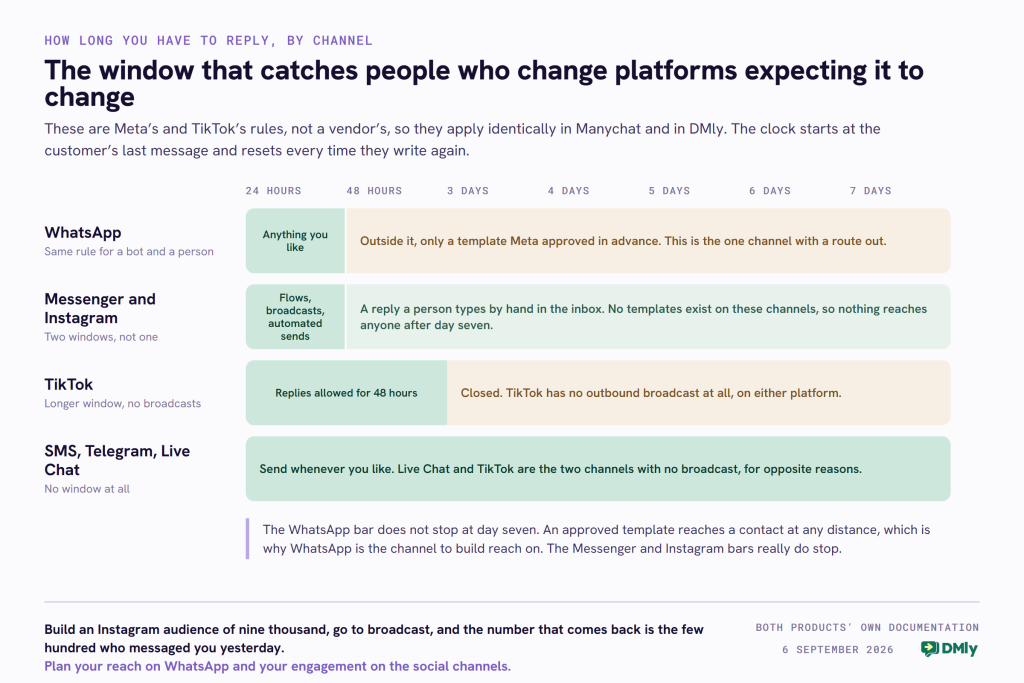
Two smaller ones for completeness: the Live Chat widget and TikTok cannot send broadcasts, which DMly says in the interface rather than burying, and TikTok’s reply window is 48 hours rather than 24. Google Business Profile is not a chat channel at all; it powers reviews and posts.
What DMly costs
Read off our own pricing page on 6 September 2026, billed yearly: Starter $29 a month with 3 seats, 3,000 active contacts, 10,000 broadcast or template messages and 500 AI replies. Growth $65 a month with 6 seats, 10,000 contacts, 50,000 broadcast messages and 5,000 AI replies. Premium $149 a month with 15 seats, unlimited contacts, 300,000 broadcast messages, 20,000 AI replies and the option to bring your own AI provider key for unlimited replies. Extra seats are $10 a month, an extra profile set is $15 a month, and extra contacts are $15 per thousand. Every plan includes the bookings, invoices, CRM, reputation and automation features, so the tier decides your capacity rather than your feature list.
DMly adds no markup to Meta’s per-message rates. You pay Meta directly for the messages and DMly for the platform, which is the arrangement you want, because it means the two bills are separately checkable.
The Bill Neither Platform Controls: What Changes on 1 October 2026
If you use WhatsApp through any of these tools, this is the most important paragraph on the page, and it has a deadline three weeks away. Meta is changing what it charges for, and both categories being added are the ones small businesses use most.
Verified at source on Meta’s own developer documentation on 6 September 2026. From 1 October, Meta charges per message for service messages, which are the ordinary replies a person or a bot types inside an open conversation. Those have been free since November 2024. From the same date Meta also charges for utility messages sent in reply to a customer inside the open 24-hour window, which have been free since July 2025. Service messages are priced at the same rate as utility and authentication messages in your customer’s country, and Meta’s page is explicit that there are no volume tiers on service messages, though utility and authentication keep theirs.
Meta has now published the October rate cards, which it had not done when most articles about this change were written. Its pricing page reads: “Rate cards effective October 1, 2026, including service rates, are now published below.” If you want your own market’s figure, the number you need is your country’s utility rate, and our rate card by country has it.
The 1,000 free service messages, which changes the arithmetic for most small businesses
Meta marked this one as new on its own page, and it is the part that turns a frightening change into a manageable one for a great many businesses. In Meta’s wording: “Effective October 1, 2026, Meta will introduce a free monthly tier of service messages. Each month, every business phone number will receive 1,000 free service messages; Meta will only charge as of the 1,001st service message delivered. These free service messages do not roll over if not used in a specific month and reset monthly, for each business phone number.”
Note the two words that matter: per phone number, and per month. It counts messages, not conversations, and it does not carry over. A salon answering forty enquiries a week, at four or five replies each, is somewhere around 800 service messages a month and pays nothing. A clinic running a busy front desk on WhatsApp will go past it and should work out by how much. The exercise takes five minutes: open your inbox, count the replies your side sent last month, subtract a thousand, and multiply the remainder by your country’s utility rate.
The deadline that can switch your replies off
This is the one to act on this week. Meta’s own page states that for any solution provider or directly integrated business “that does not have a payment method on file by September 30, 2026”, Meta “will stop delivering service messages” from the date they become chargeable on 1 October. Not throttle them. Stop delivering them.
If you reach WhatsApp through a provider, ask that provider today whether a payment method is on file for your WhatsApp Business Account, and get the answer in writing. If you are integrated directly with Meta, add one yourself in Billing Hub. If you use the free WhatsApp Business app from the app store rather than the Business Platform, none of this applies to you and you can stop worrying. There is more detail in our guide to the 1 October pricing change.
Manychat and DMly Side by Side
Every cell below either quotes a published source or says plainly that we could not verify it. Where a row says something is not described, that means it does not appear in Manychat’s own product description on its app store listings, which is the fullest first-party account of the product we can read.
| What you are comparing | Manychat | DMly |
|---|---|---|
| Prices we can verify today | Essential $17 a month or $169 a year; Pro $39 a month or $349 a year, from its own Apple App Store listing | Starter $29, Growth $65, Premium $149 a month billed yearly, published on the pricing page |
| Website pricing page | Published, but not verifiable by us: the page answers a browser and refuses automated readers | Published and readable by anyone |
| Free way in | “Start Free” in its own app copy | 7 day free trial on any plan, no card required |
| Channels the vendor names | Instagram, TikTok, Facebook, WhatsApp, Telegram “and more” | WhatsApp, Instagram, Messenger, TikTok, Telegram, Live Chat and Google Business Profile, plus SMS |
| Channels its own status page monitors | Facebook, Instagram, WhatsApp, Telegram, and Twilio for SMS | Status published at status.dmly.io |
| New follower trigger on Instagram | Yes, and listed as degraded on its own status page since 17 March 2026 | No. Story replies, story mentions, post, Reel and Live comments only |
| Comment to DM | Yes, on Meta channels | Yes, on Facebook, Instagram and TikTok |
| Bookings, staff and classes | Not described in its product listing | Services, staff, availability, classes and a client portal |
| Invoices and payments | Not described in its product listing | Invoices, orders, payments, coupons, expenses and statements |
| Google reviews | Not described in its product listing | Reputation: review requests, reviews, posts and performance |
| Shape of the public API | 34 endpoints, every one under a path beginning /fb/, declared beta | REST API, webhooks and an MCP server for AI clients |
| What Meta charges for WhatsApp | A separate bill, paid to Meta | A separate bill, paid to Meta directly, with no DMly markup |
Manychat Review Verdict: Which One Should You Actually Pick?
The choice is not really about features, it is about how much of your business runs through the messages. Three cases cover most people.
Stay with Manychat if your business is the audience
If you are a creator, an affiliate seller, or a brand whose whole funnel is comment, DM, link, then Manychat is built for exactly that and there is no argument for moving. It is cheaper at the entry tier, the community around it is enormous, and the follower automation has no equivalent here. Go in knowing what its own status page says about that feature’s current state, and ask about the volume thresholds before your list grows.
Look at DMly if the conversation ends in an appointment or an invoice
The moment a chat has to become a booking with a staff member and a room, a reminder the day before, a payment, and a review request afterwards, a chat funnel stops being the right shape of tool. You can wire Manychat to a booking system and a payment tool and a review tool, and plenty of people do. The cost is not the subscriptions, it is the seams: four places for a customer’s details to fall out of step, and four things to fix when one of them changes. DMly’s argument is that those four jobs share one contact record. That argument is only worth anything if you genuinely have all four jobs.
Look at DMly if WhatsApp is where your customers actually are
Manychat’s centre of gravity is Meta’s social channels, and its published API says so more plainly than its marketing does. DMly is built WhatsApp first: templates, broadcast rules, the 24-hour window, appointment reminders and invoices all assume it. In markets where WhatsApp is how people talk to businesses, that difference decides which tool feels natural and which one you are fighting. If your enquiries arrive as Instagram DMs and stay there, the reverse is true.
One thing is true whichever you pick: the 30 September payment method deadline applies to your WhatsApp Business Account, not to your software. Changing platforms does not change it.
Frequently Asked Questions
How much does Manychat cost in 2026?
Manychat’s own Apple App Store listing publishes four subscription prices, read on 6 September 2026: Essential at $17 a month or $169 a year, and Pro at $39 a month or $349 a year. Google Play publishes the same set as a range of $17.00 to $349.99 per item. Manychat’s app copy also offers a free start. We cannot read Manychat’s website pricing page, which sits behind a bot challenge, so we cannot confirm whether signing up on the web costs the same as through an app store.
Why does this Manychat review not quote the website pricing page?
Because we could not read it honestly. Every path on manychat.com, including the robots file, returns a 403 with a Cloudflare challenge header when a plain client asks. That check exists to confirm a human is asking, and working around it would be getting by deception something the site deliberately withheld. So we do not, and we do not take a figure from a software directory either. Any person can open the page in a browser and read it in seconds; the gap is ours, not Manychat’s.
Does Manychat support WhatsApp?
Yes. Manychat names WhatsApp in its own product description on both app stores, and its public status page monitors a WhatsApp API component alongside Facebook, Instagram, Telegram and Twilio. Whichever platform you use, Meta charges you separately for WhatsApp messages, and from 1 October 2026 that bill covers ordinary replies as well as templates.
Does Manychat have a built-in CRM?
Manychat’s own product description covers growing an audience, handling direct messages and converting them, and it describes capturing emails and phone numbers and tracking clicks and conversions. It does not describe a customer record with pipeline stages, appointments, invoices and payment history, which is what people usually mean by a CRM built around messaging. If that is what you need, check it directly with Manychat rather than taking a comparison page’s word for it, including ours.
What is the best Manychat alternative?
It depends entirely on what you are replacing. If you want the same job done differently, look at tools built around the same social channels. If you want the conversation to end in a booking, a payment or a review without leaving the platform, that is the case for DMly against Manychat, and the honest caveat is that DMly has no new follower trigger. There is no single best alternative, only the one that matches what happens after the message.
Can I run Instagram comment automation on DMly the way I do on Manychat?
Yes, with one caveat we would rather you knew now. DMly triggers on comments on posts, Reels and Lives, on story replies and story mentions, with keyword matching that ignores capitals and a respond-once-per-contact switch. The caveat is that the “Which posts?” setting is not enforced today, so an automation saved against specific posts still fires everywhere on the account. Scope with keywords instead, and be careful pairing a no-keyword trigger with a delete action. Our Instagram DM automation guide walks through the setup.
Will the October WhatsApp change make either platform more expensive?
Neither subscription changes. What changes is the bill Meta sends you, and it lands the same way whichever software sits in front of it. From 1 October, ordinary replies inside an open conversation are charged at your country’s utility rate, with the first 1,000 a month per business phone number free and no roll-over. Utility messages sent in reply to a customer inside the 24-hour window are charged too. The date to act on before then is 30 September, when a payment method has to be on file or Meta stops delivering those replies.
Writing about WhatsApp automation, bookings and growth for local business.
Turn WhatsApp into your busiest channel.
Start free and run message, bookings, payments and reviews in one place.
