
If you’ve been researching WhatsApp marketing platforms lately, chances are you’ve come across DoubleTick. The tool has become fairly popular among e-commerce teams that want to run broadcast campaigns, manage customer chats, and automate parts of their WhatsApp communication.
On the surface, it offers many of the capabilities companies need to turn WhatsApp into a customer communication channel.
But choosing a messaging platform isn’t just about the features listed on a homepage. Pricing structure, automation depth, scalability, and integration flexibility all start to matter once message volume increases.
In this guide, we’ll walk through a full DoubleTick review, including its pricing and key capabilities, and then compare it with DMly – a platform many teams consider when looking for a more scalable DoubleTick alternative.
What Is DoubleTick.io?

DoubleTick is a WhatsApp marketing and automation platform designed to help businesses manage conversations, send bulk campaigns, and engage customers directly through WhatsApp.
The platform is mainly targeted at e-commerce brands and small to medium-sized businesses that rely heavily on WhatsApp for customer communication.
Instead of managing chats manually from a single phone, DoubleTick allows teams to run WhatsApp through a shared workspace where multiple agents can respond to customers, track conversations, and collaborate on support or sales queries.
Beyond chat management, DoubleTick focuses strongly on WhatsApp marketing features. Businesses can send broadcast campaigns to segmented customer lists, showcase product catalogues within conversations, and automate engagement using chatbots and lead interaction flows.
These capabilities make it possible to turn WhatsApp from a simple messaging app into a structured communication channel for promotions, order updates, and customer follow-ups.
Key Features of DoubleTick
DoubleTick focuses on helping businesses run marketing and customer communication directly through WhatsApp. The platform combines messaging tools, automation capabilities, and basic analytics so teams can manage conversations and campaigns from a single workspace.
Here are some of the core capabilities that businesses typically use when working with DoubleTick.
Team Inbox for WhatsApp Conversations
DoubleTick provides a shared team inbox where multiple agents can handle conversations from a single WhatsApp number. This makes it easier for sales and support teams to collaborate, assign chats to specific agents, and respond to customers without relying on a single device.

Bulk Broadcast Messaging
One of the platform’s most used features is the ability to send broadcast campaigns to large groups of contacts. Businesses can use this to promote products, announce offers, or send updates to customers directly through WhatsApp.
WhatsApp Chatbot Builder
DoubleTick includes tools for building basic WhatsApp chatbots that can respond automatically to incoming messages. These bots can answer common questions, guide customers through simple workflows, or collect information before handing the conversation over to a human agent.
Customer Segmentation
The platform allows businesses to group contacts using tags, attributes, and segmentation rules. These segments can then be used to send targeted broadcast messages instead of sending the same campaign to the entire contact list.
Product Catalog Sharing
Businesses can display products and catalogs directly within WhatsApp conversations. This feature is particularly useful for e-commerce brands that want customers to browse items and ask questions without leaving the chat.
Third-Party Integrations
The platform supports integrations with tools such as Shopify, WooCommerce, Zapier, and webhooks. These connections allow businesses to link messaging workflows with e-commerce data, automation tools, or external applications.
DoubleTick.io Pricing
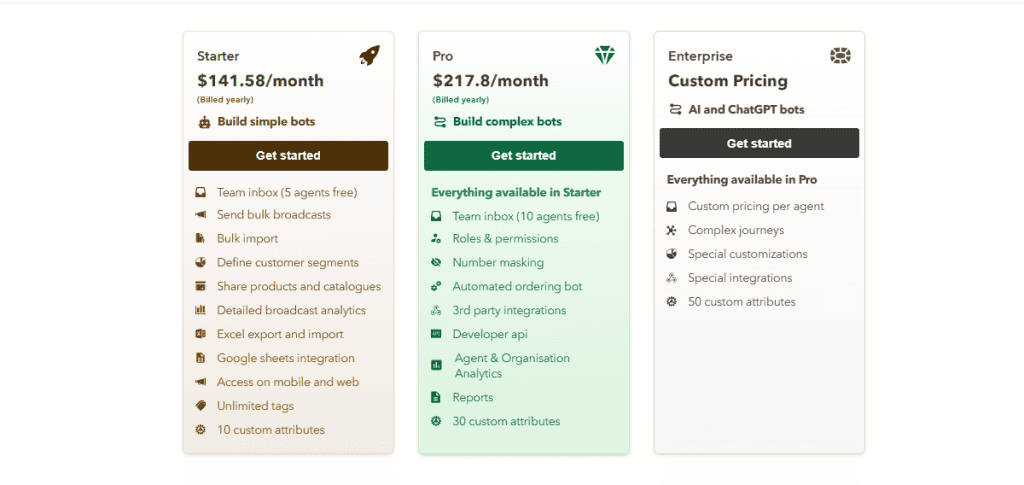
One of the most important things businesses evaluate when choosing a messaging platform is the pricing structure. Though DoubleTick positions itself as a marketing solution for e-commerce teams, its pricing sits on the higher side compared to many newer platforms in the space.
DoubleTick currently offers three main pricing tiers: Starter, Pro, and Enterprise. Each plan expands the number of team members, customization options, and automation capabilities available to businesses.
Starter Plan – $141.58/month
This entry-level tier includes a shared team inbox with five agents, the ability to send bulk broadcast campaigns, and tools for managing customer segments. Below are some of the things you can get from this plan:
- 5 agents
- Broadcast campaigns
- Segmentation
- Catalog sharing
- Analytics
The plan supports unlimited tags and up to 10 custom contact attributes, which can help organize customer data for messaging campaigns.
Pro Plan – $217.8/month
The Pro plan starts at around $217 per month and expands on the Starter features. This plan increases the number of agents to 10 users and introduces more operational capabilities such as roles and permissions, number masking, and additional analytics reports.
It also includes an automated ordering bot, developer API access, and support for third-party integrations. Businesses can store up to 30 custom attributes for each contact, allowing more detailed segmentation and campaign targeting.
Enterprise Plan – Custom pricing
For larger organizations, DoubleTick offers an Enterprise plan with custom pricing. This tier includes all features from the Pro plan while allowing more advanced customization.
Enterprise users can create complex customer journeys, connect specialized integrations, and configure the platform according to their operational needs. The plan also increases the available contact attributes to 50 custom fields.
While DoubleTick includes useful WhatsApp marketing tools in these plans, the entry price of over $140 per month may feel steep for small businesses or startups exploring conversational marketing.
Teams that plan to scale their messaging automation often compare DoubleTick with alternative platforms to determine whether the pricing aligns with their long-term communication strategy.
Pros and Cons of DoubleTick
Like most WhatsApp marketing platforms, DoubleTick has strengths that make it attractive to certain businesses, along with a few limitations that teams usually discover as they scale their messaging operations.
Pros
- Built specifically for WhatsApp marketing: DoubleTick focuses heavily on WhatsApp as a customer engagement channel. This makes it useful for businesses that rely on WhatsApp broadcasts, product sharing, and direct messaging to reach customers.
- Shared team inbox for collaborative messaging: Multiple agents can manage conversations from a single WhatsApp number through a shared dashboard. This helps sales and support teams respond faster and avoid message overlap.
- Broadcast campaigns for customer outreach: Businesses can send promotional messages and updates to large groups of contacts. This feature is commonly used by e-commerce brands for sales announcements and product promotions.
- E-commerce integrations available: DoubleTick integrates with platforms like Shopify and WooCommerce, allowing businesses to connect product data and customer interactions with WhatsApp campaigns.
- Basic chatbot automation: The platform includes simple automation tools that help businesses respond to common questions or capture lead information automatically.
Cons
- High starting price compared to many alternatives: With the Starter plan costing over $140 per month, the platform can feel expensive for smaller teams or startups exploring WhatsApp marketing.
- Automation capabilities are relatively basic: While the platform offers chatbots and engagement bots, it lacks the deeper workflow automation and AI-driven engagement tools that some modern messaging platforms provide.
- Primarily focused on WhatsApp only: Businesses that want to manage conversations across multiple channels, such as Instagram, Messenger, or Telegram, may need additional tools.
- Limited built-in CRM functionality: DoubleTick offers tagging and attributes for contacts, but it does not provide a fully integrated CRM system for managing leads and customer lifecycle stages.
DMly: A Reliable DoubleTick Alternative to Consider
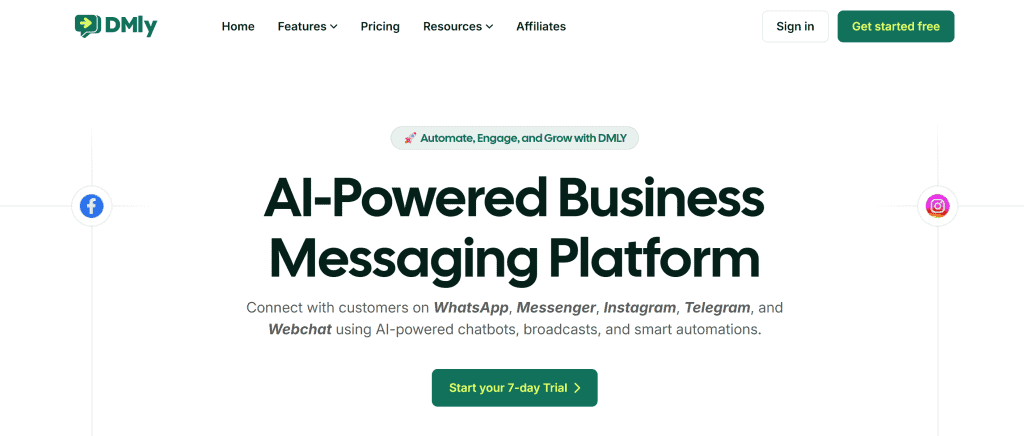
For businesses that want to go beyond basic WhatsApp marketing tools, DMly offers a broader approach to conversational engagement.
Instead of focusing only on sending broadcasts or managing chats, DMly combines automation, analytics, and customer data management to support marketing, sales, and support teams working together.
Below are some of the key capabilities that make DMly a strong alternative.
AI Agents Across Multiple Channels
DMly includes AI-powered agents that can respond to customer questions, guide users through product information, and qualify leads automatically. These agents operate across channels like WhatsApp, Instagram, Messenger, Telegram, and web chat.
When a conversation requires human attention, the system smoothly transfers the chat to a team member while maintaining the context of the discussion. This allows businesses to automate large parts of their customer interactions without losing the personal touch when it matters.
Unified Team Inbox
All conversations from connected messaging channels appear in one shared inbox. This means sales, marketing, and support teams can manage interactions without switching between different apps.
Agents can assign chats, leave internal notes, and collaborate on responses. Having every conversation organized in one place also helps prevent missed messages and duplicated responses.

WhatsApp Broadcasts at Scale
DMly allows businesses to send broadcast campaigns to segmented audiences while staying compliant with the official WhatsApp Business API.
Campaigns can be scheduled, targeted to specific customer groups, and monitored through built-in analytics. With this, marketing teams can manage promotions, product launches, and customer updates more effectively.
Behavioral Segmentation and Lifecycle Messaging
The platform allows businesses to group contacts based on behavior, engagement history, and customer attributes. Instead of sending the same message to every contact, teams can create targeted campaigns that reflect where a customer is in their journey.
For example, a business could send follow-up messages to customers who clicked on a campaign but didn’t complete a purchase, or re-engage contacts who have been inactive for a certain period.

Advanced Automation Builder
DMly includes a visual automation builder that allows teams to create complex workflows without coding. Businesses can trigger actions based on events such as new leads entering the system, customer replies, or changes in contact attributes.
Deep Integrations with Business Tools
The platform integrates with tools like Shopify, WooCommerce, Zapier, Salesforce, and automation platforms such as n8n. This means businesses can easily connect messaging workflows directly to e-commerce data, CRM systems, and other operational tools.
This makes it possible to trigger messages based on real business events such as when a new order is placed or when a lead fills out a form.
Real-Time Analytics and Performance Tracking
DMly provides dashboards that show how messaging campaigns and conversations are performing. Teams can track engagement metrics, campaign performance, and customer response patterns.
These insights help businesses refine their messaging strategy and understand how conversational marketing contributes to lead generation, conversions, and customer retention.
Multi-Workspace Support
For agencies or businesses managing multiple brands, DMly allows separate workspaces within the same account. Each workspace can have its own contacts, campaigns, and automation workflows.
This structure keeps operations organized while still allowing teams to manage several brands or projects from one platform.
DMly vs DoubleTick: Quick Comparison
When comparing DoubleTick and DMly, the main difference comes down to how each platform approaches customer messaging.
DoubleTick focuses primarily on WhatsApp marketing and conversation management, while DMly is built as a broader conversational automation platform that combines messaging, automation workflows, customer data management, and campaign tools.
Below is a quick highlight of the key differences.
Feature | DMly ($24/month) | DoubleTick ($141.58/month) |
|---|---|---|
| Starting Price | $24/month | $141.58/month |
| Messaging Channels | WhatsApp, Instagram, Messenger, Telegram, Webchat | Primarily WhatsApp |
| Team Inbox | Shared inbox for multi-channel conversations | Shared WhatsApp inbox |
| AI Automation | AI agents for lead qualification, FAQs, and automation | Basic chatbots and engagement bots |
| Workflow Automation | Advanced event-based automation builder | Limited chatbot-based automation |
| Broadcast Campaigns | Segmented broadcasts with campaign scheduling | Bulk WhatsApp broadcast campaigns |
| Customer Segmentation | Behavioral segmentation with automation triggers | Segmentation using tags and attributes |
| CRM Functionality | Built-in CRM with stages, tags, notes, and attributes | Basic contact attributes and tagging |
| Integrations | Shopify, WooCommerce, Zapier, Salesforce, APIs | Shopify, WooCommerce, Zapier, webhooks |
| Automation Limits | Unlimited automation workflows | Limited automation capabilities |
| Meta Messaging Fees | Pay Meta directly (0% platform markup) | Platform setup dependent |
| Multi-Workspace Support | Yes | Not a core feature |
Looking at the comparison, the two platforms target slightly different use cases.
DoubleTick works well for businesses that want a dedicated WhatsApp marketing tool for sending broadcasts and managing conversations. DMly, on the other hand, is designed for teams that want to combine automation, CRM, segmentation, and multi-channel messaging into one scalable system.
For companies that plan to expand their conversational marketing strategy over time, those additional capabilities can make a noticeable difference in how efficiently messaging operations scale.
Automation Capabilities: DoubleTick vs. DMly

Automation is where messaging platforms begin to show their real value. The ability to automate responses, qualify leads, and trigger campaigns can dramatically reduce manual work while improving response speed and customer engagement.
Both DoubleTick and DMly include automation tools, but the depth and flexibility of those tools differ significantly.
Automation in DoubleTick
DoubleTick.io provides automation features mainly through WhatsApp chatbots and engagement bots. These tools help businesses respond to common inquiries, collect customer details, and guide users through basic conversation flows before handing the chat over to a human agent.
The platform also includes an automated ordering bot, which can assist e-commerce businesses by guiding customers through simple product ordering steps directly within WhatsApp. This can be helpful for businesses that rely heavily on conversational sales.
However, most automation within DoubleTick is centered around chat-based interactions. Businesses can set up rule-based responses and chatbot flows, but the automation capabilities are typically limited to handling conversations rather than managing broader marketing or customer lifecycle workflows.
Automation in DMly
DMly approaches automation from a much broader perspective. Instead of focusing only on chatbot responses, the platform allows businesses to build event-driven automation workflows that can control how customers move through different stages of engagement.
For example, when a new lead enters the system, DMly can automatically trigger a sequence of actions such as sending a welcome message, assigning the lead to a sales agent, applying tags, and launching follow-up campaigns if the lead becomes inactive.
These workflows can be triggered by customer behavior, message interactions, CRM updates, or campaign activity.
DMly also supports AI-powered agents that can answer questions, recommend products, qualify leads, and handle routine conversations across multiple messaging channels. When human assistance is needed, the system can transfer the conversation to a team member without losing the conversation context.
Because automation workflows, segmentation tools, and CRM data are integrated within the same platform, DMly allows businesses to design full customer engagement journeys rather than simple chatbot responses.
For teams that rely heavily on messaging for marketing and sales, this broader automation capability can significantly improve operational efficiency and campaign performance.
CRM and Customer Data Management
Managing conversations is only one part of running a successful messaging operation. Businesses also need a structured way to store customer information, track interactions, and organize contacts for campaigns and automation. This is where CRM and customer data management features become especially important.
Both DoubleTick and DMly allow businesses to store customer information and manage contacts, but the way each platform handles customer data is quite different.
CRM Capabilities in DoubleTick
DoubleTick provides basic contact management tools that help businesses keep track of customers interacting through WhatsApp. Each contact can be tagged and assigned custom attributes, allowing teams to organize their audience and send more targeted broadcast campaigns.
Businesses can also define customer segments based on these attributes and tags. This makes it easier to group contacts for marketing messages, product promotions, or customer updates.
However, DoubleTick’s contact management is mostly designed to support messaging campaigns rather than functioning as a complete CRM system. While it helps organize contacts and conversations, businesses that want more advanced customer relationship management such as lead pipelines, lifecycle tracking, or deeper customer profiling, may still rely on external CRM tools.
CRM Capabilities in DMly
DMly includes a more integrated approach by offering built-in CRM functionality directly inside the platform. Instead of only storing contact attributes, businesses can organize leads and customers using tags, notes, custom attributes, and pipeline stages.
This structure allows teams to track where each contact sits within the sales or engagement process. For example, a lead can move from an initial inquiry stage to a qualified lead, then to a customer, while the system keeps track of every interaction along the way.
Because CRM data, messaging activity, and automation workflows all exist within the same environment, businesses can trigger campaigns or follow-up messages based on changes in customer status or behavior.
This integration makes it easier to run personalized messaging strategies without needing multiple separate tools.
Messaging Campaigns and Segmentation

Messaging Campaigns in DoubleTick
DoubleTick places a strong emphasis on WhatsApp broadcast campaigns. Businesses can send promotional messages, product announcements, and updates to large groups of contacts directly through WhatsApp. These campaigns are often used by e-commerce stores to promote sales, share product catalogs, or notify customers about new offers.
To make broadcasts more targeted, DoubleTick allows businesses to create contact segments using tags and custom attributes. For example, a business might create a segment for customers who previously purchased a specific product or those who signed up through a particular campaign.
The platform also includes analytics tools that show how broadcast campaigns perform. Metrics such as message delivery, engagement, and response rates help businesses evaluate how effective their messaging efforts are.
Messaging Campaigns in DMly
DMly approaches messaging campaigns with a stronger focus on behavior-driven segmentation and lifecycle messaging. Instead of relying mainly on static tags or attributes, businesses can group contacts based on their behavior, engagement history, and interactions with previous campaigns.
For example, a campaign can target customers who clicked on a promotion but did not complete a purchase, or re-engage leads who stopped responding after an initial conversation. Because segmentation rules can be connected to automation workflows and CRM data, messaging campaigns become more personalized and strategic.
DMly also allows campaigns to be scheduled, automated, and triggered by customer actions. This means businesses can build structured messaging strategies that guide customers through different stages of engagement rather than simply sending one-time broadcast messages.
For companies that rely heavily on conversational marketing, this deeper segmentation approach can make messaging campaigns more relevant and effective over time.
Analytics and Reporting in the Two Platforms

Analytics play a crucial role in helping businesses understand how their messaging strategy is performing. Whether it’s tracking campaign engagement, measuring response times, or evaluating team productivity, having clear reporting tools allows teams to improve their messaging approach over time.
DoubleTick provides analytics that focus mainly on broadcast performance and team activity. Businesses can monitor metrics related to campaign delivery, message engagement, and agent performance. These insights help teams see how well their broadcast campaigns are performing and how effectively their support or sales agents are handling customer conversations.
DMly takes analytics a step further by offering deeper insights across campaigns, conversations, and automation workflows. Businesses can monitor campaign performance, track how contacts move through automation flows, and analyze engagement patterns across different messaging channels.
This broader visibility helps teams understand not just how many messages were sent, but how messaging interactions influence lead generation, conversions, and customer retention.
For businesses that use messaging as a core part of their marketing and customer engagement strategy, this type of reporting can be extremely valuable. It allows teams to continuously refine their campaigns, improve automation workflows, and measure how conversational messaging contributes to overall business growth.
DoubleTick.io Review: Final Verdict
DoubleTick can be a practical choice for small ecommerce teams that mainly want to run WhatsApp broadcasts and manage customer conversations from a shared inbox.
However, as messaging strategies grow more sophisticated, many businesses begin looking for platforms that offer deeper automation, better segmentation, and multi-channel communication.
For teams that want to combine messaging campaigns, AI-driven automation, and customer data management in one system, DMly often emerges as the more scalable alternative.
FAQs
What is DoubleTick used for?
DoubleTick is primarily used for WhatsApp marketing and customer communication. Businesses use the platform to send broadcast campaigns, manage conversations through a shared inbox, automate responses with chatbots, and engage customers directly through WhatsApp.
How much does DoubleTick cost?
DoubleTick offers three pricing tiers. The Starter plan starts at around $141.58 per month, the Pro plan costs about $217.80 per month, and the Enterprise plan uses custom pricing depending on the organization’s needs and level of customization.
Is DoubleTick good for WhatsApp marketing?
DoubleTick can work well for businesses that rely heavily on WhatsApp for promotions, customer engagement, and sales conversations. It provides tools for broadcast messaging, segmentation, and chatbot automation, although its capabilities are mainly focused on WhatsApp rather than multiple communication channels.
What is the best DoubleTick alternative?
The best alternative depends on a business’s messaging strategy. Platforms like DMly are often chosen by teams that want stronger automation workflows, deeper customer segmentation, built-in CRM tools, and multi-channel messaging support.
Is DMly cheaper than DoubleTick?
Yes. DMly starts at $24 per month, while DoubleTick’s entry plan begins at over $140 per month. In addition to the lower base price, DMly allows businesses to pay Meta’s official WhatsApp messaging fees directly without adding platform markup, which can help keep messaging costs more predictable as campaigns scale.