

DoubleTick’s pricing page makes a promise in its opening line. Under the heading, in the subtitle every visitor reads before they reach the plans, it says the plans come “with AI agents built into every plan”.
A few lines below that sentence, inside the first plan card on the same screen, is a line that reads “Not available on starter plan”. It is talking about the AI agents.
Both lines were on the page on 8 September 2026, when everything in this DoubleTick review was read in a plain browser with no account and no login. They cannot both be right, and which one is right decides whether the cheapest plan does the thing you are buying it for.
That is the shape of the whole page. DoubleTick is a real product with real customers, and the platform itself is not the problem here. The problem is that the page you buy from carries two prices for one plan, a feature list that disagrees with the comparison table underneath it, and a per-message rate card that is denominated in a different currency from the plans and dated eight months ago.
Here is what this DoubleTick review found: what the platform actually costs, what the contract adds that the price card does not, what changes for every WhatsApp platform on 1 October, and where DMly is and is not the better answer.
What DoubleTick Is, and Who Actually Runs It
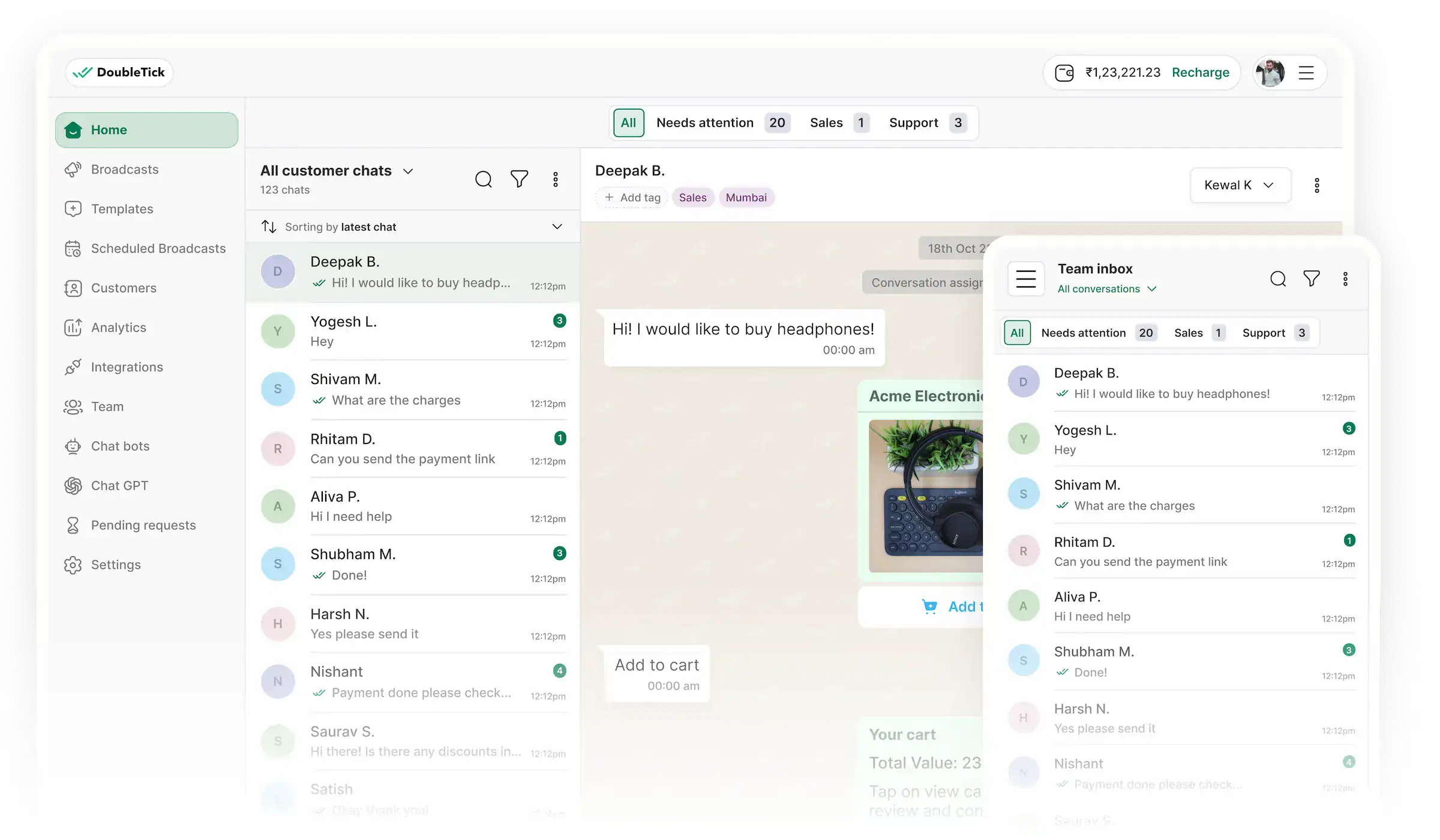
DoubleTick turns one WhatsApp number into a shared workspace your whole team can answer from, and adds broadcasts, catalogues and bots on top of it.
You connect a number on the official WhatsApp Business API, import your contacts, and your team answers from a single inbox instead of passing a phone around. From there you can send approved template campaigns to segments of your list, share a product catalogue inside the chat, and hand routine questions to a bot before a person picks them up. For a shop that sells over WhatsApp, that is the core of the job.
The company behind it is worth knowing, because it explains a few things later on. The Master Subscription Agreement names the contracting entity as Apport Software Solutions Private Limited, an Indian company, and the site footer reads “Proudly made in India”. There are native apps on both stores, and the product’s own screenshots show a wallet balance in rupees. This is an India-first platform selling in dollars, which is a perfectly normal thing to be, and it is why the per-message rate card later in this review is in rupees.
Who it is built for
The plans are sized for teams, not for solo owners. The entry plan includes five agent seats and the middle plan includes ten, which tells you who the product expects to meet. The industry pages on the site lead with banking, travel, education, healthcare, ecommerce, manufacturing, automotive and IT services, and the feature set follows: roles and permissions, team hierarchy levels, working hours, and, on the top plan, number masking so agents never see a customer’s number, single sign-on and an audit trail.
If you are one person with one number and a hundred customers a week, you are not the buyer this product was drawn for, and the price will tell you so. If you have six people answering chats and a real volume of orders coming through WhatsApp, you are.
DoubleTick Pricing in 2026: Two Numbers on One Card
DoubleTick publishes its prices, and the first thing to say is that this page previously told you it did not.
Fetch doubletick.io/pricing the way a script does, and you get the full feature lists, the comparison table, the FAQs, and not a single price. Open the same URL in a browser and three figures appear. The numbers are drawn in by JavaScript after the page arrives, so anything that reads the raw file sees a pricing page with no pricing on it.
That is a measurement problem, not a vendor problem, and it caught us. Another page on this blog said DoubleTick had stopped publishing prices. It had not. That page has been corrected, and the correct figures are below.
The three plans, as published
Read in a browser for this DoubleTick review on 8 September 2026, with the “Include AI agents” switch in its default position:
- Starter, headed “does not include AI agents”: $170 a month, with $2,039 billed yearly printed underneath. Five agent seats, one WhatsApp Business Account, ten custom contact fields.
- Pro, with AI, marked Popular: $308 a month, with $3,694 billed yearly underneath. Ten agent seats, thirty custom fields, roles and permissions, an automated ordering bot and developer API access.
- Enterprise, with AI: custom, described as “Tailored to your needs”. Fifty custom fields, single sign-on, IP whitelisting, and per-agent pricing agreed with sales.
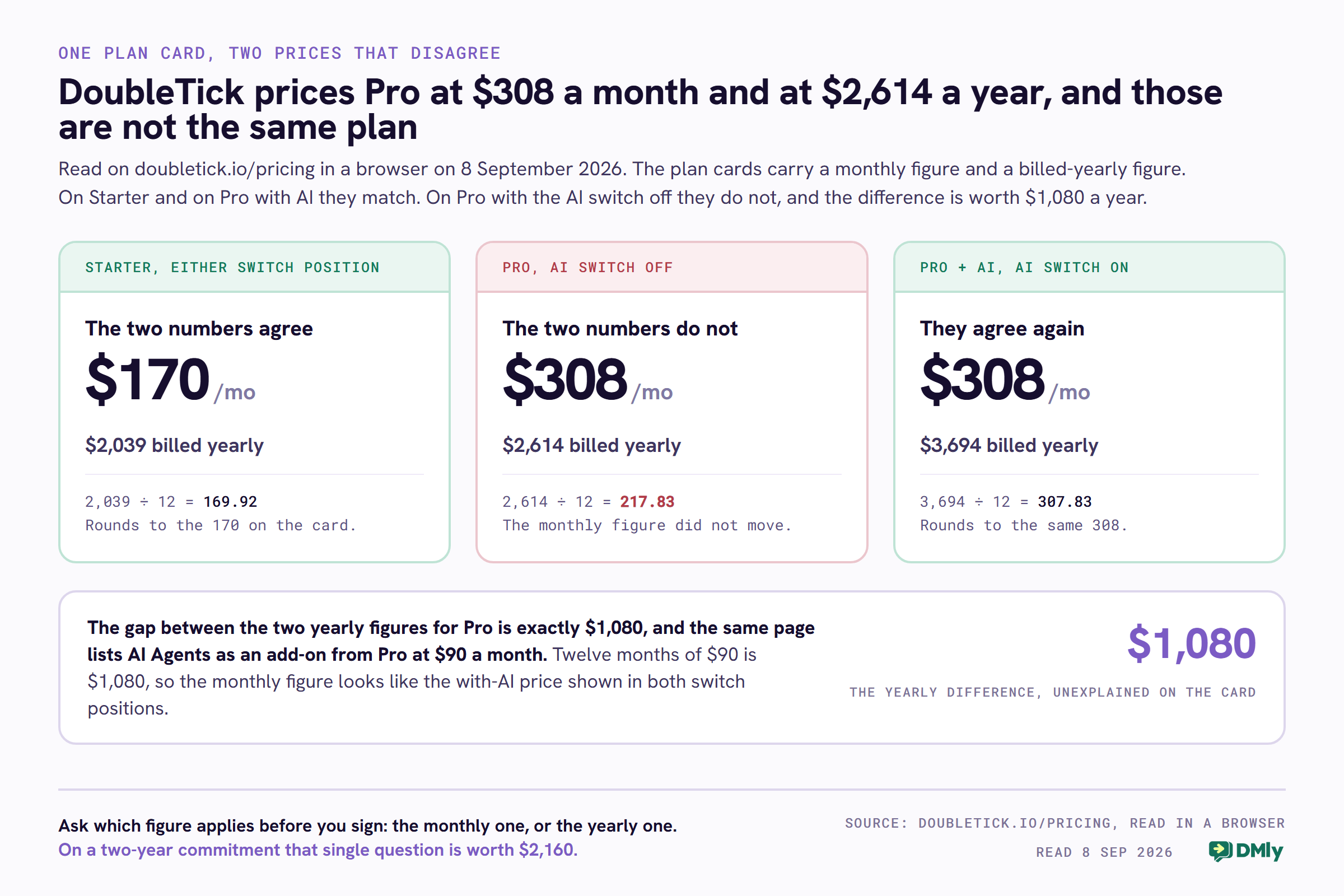
Now flip that switch off, which is the view for a buyer who does not want the AI agents. Starter does not move. Pro still says $308 a month, and the line underneath it changes to $2,614 billed yearly.
The two numbers cannot both describe the same plan
Do the arithmetic and the card comes apart in a way that is worth $1,080 a year to you.
Starter is internally consistent: $2,039 divided by twelve is $169.92, which rounds to the $170 on the card. Pro with AI is consistent too: $3,694 divided by twelve is $307.83, which rounds to $308. But Pro without AI shows the same $308 beside a yearly figure of $2,614, and $2,614 divided by twelve is $217.83. The monthly number did not move when the switch did.
The gap between the two yearly figures is exactly $1,080. Scroll down the same page to the full comparison table and the AI Agents section is labelled “Add-on from Pro, $90/mo”. Twelve months of $90 is $1,080. So the arithmetic says Pro is $217.83 a month before AI, the $90 add-on takes it to $307.83, and the monthly figure on the card is showing the with-AI price in both states.
We are not asserting that as a finding of fact about DoubleTick’s intentions. It is what their published numbers add up to, and anyone can check it in a minute. What matters for you is the action: before you sign anything, ask DoubleTick in writing which figure applies to the plan you are buying, and whether the $90 AI add-on is inside it or on top of it. On a two-year commitment that single question is worth $2,160.
What the price does not include
Three things sit outside every figure above, and two of them can be larger than the subscription.
- Meta’s per-message fees. These are charged by Meta, not by DoubleTick, and they scale with how much you send. There is a section on them below.
- Taxes. The subscription agreement is explicit that the fee “does not include any taxes, levies, duties, or similar governmental assessments”.
- The add-ons. The comparison table marks a long list of items as Add-on on every plan, including Salesforce, HubSpot, Zapier, WooCommerce, Zoho CRM, WhatsApp Flows, WhatsApp Calls, green tick verification and a dedicated account manager. No price is published for any of them.
That last one is the quiet cost. A plan that reads as complete on the card can need three paid add-ons to do the job you had in mind, and you will not learn what they cost until you are talking to sales.
What DoubleTick Pricing Has Done Since 2025
The headline price has risen once in eighteen months, and the number that would tell you what a seventh agent costs has quietly disappeared.
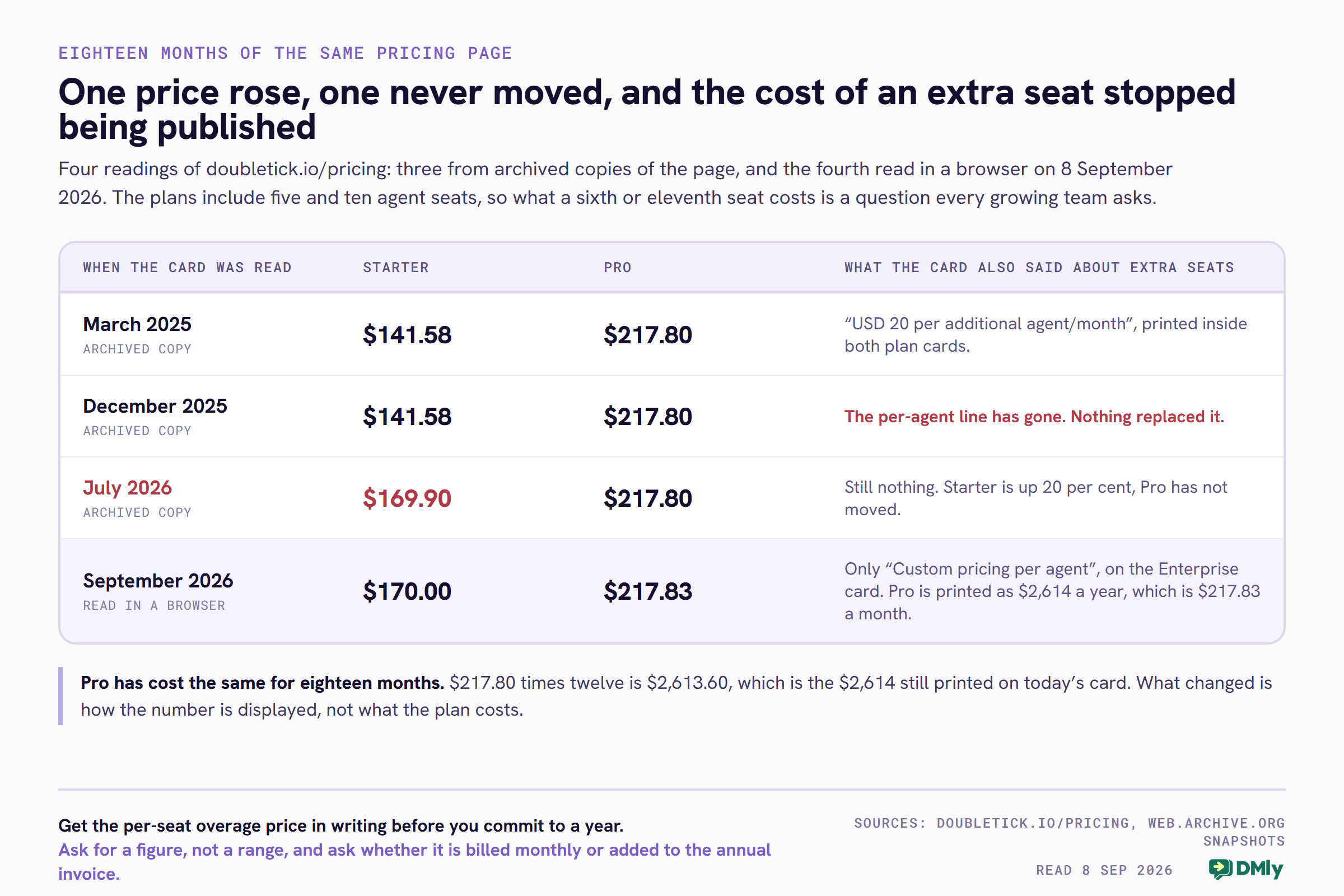
Archived copies of the same pricing URL let you watch it happen. In March 2025 the card read $141.58/month (Billed yearly) for Starter and $217.8/month (Billed yearly) for Pro. In December 2025 those two figures were unchanged. By the end of July 2026 Starter had moved to $169.9/month (Billed yearly) and Pro was still $217.8. Today’s card reads $170 and $2,039 for Starter, and $308 and $2,614 for Pro.
Two things fall out of that. First, Pro’s yearly total has not actually changed: $217.80 times twelve is $2,613.60, which is the $2,614 still printed on the card today. The plan did not get more expensive, the way it is displayed did. Second, Starter is genuinely up, from $141.58 to $170 a month, a rise of about twenty per cent across eighteen months.
If you read a DoubleTick review published before the middle of 2026, including the earlier version of this one, it will quote $141.58. That figure is real, it is simply eighteen months old. An over-precise price like $141.58 is usually a converted number rather than a chosen one, and converted numbers move without anyone announcing it.
The number that vanished
The March 2025 card carried one more line that today’s does not. Inside both the Starter and Pro cards, directly under the agent count, it said “USD 20 per additional agent/month”. By December 2025 that line was gone, and it has not come back.
This matters more than it looks. The plans include five and ten seats. Teams grow. The question “what does agent number eleven cost me” is one of the first a growing business asks, and the answer used to be on the page for anyone to read. Now the only published reference is a line on the Enterprise card reading “Custom pricing per agent”, which means you find out by asking.
What to do about it: if you are sizing DoubleTick for a team that will grow, get the per-seat overage price in writing before you commit to a year. Ask for it as a figure, not as a range, and ask whether it is charged monthly or added to the annual invoice.
Four Places the Pricing Page Disagrees With Itself
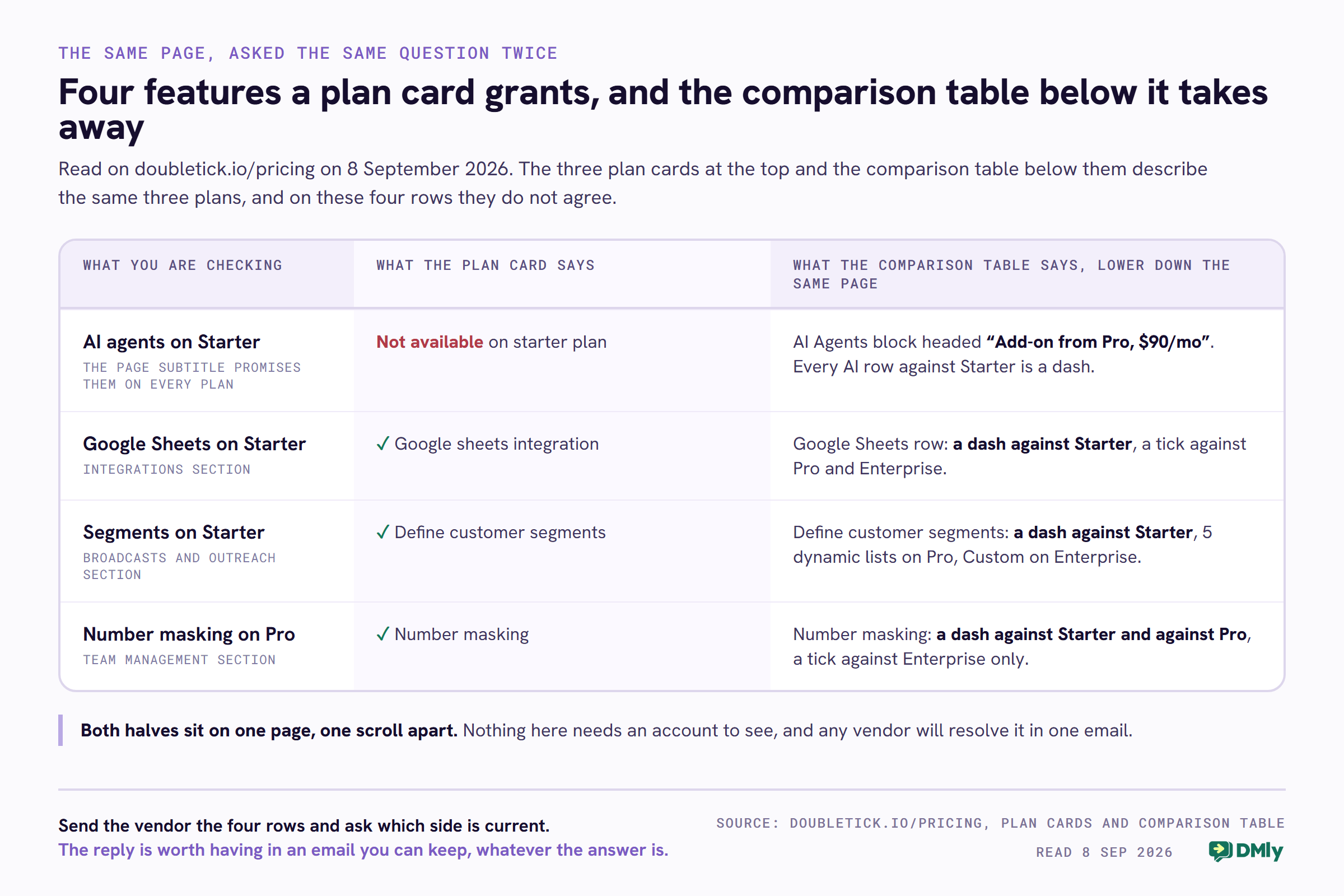
The plan cards and the comparison table below them are describing the same three plans, and on four rows they say different things. This DoubleTick review read both halves side by side, which is the only way to see it.
None of this is hidden and none of it needs an account to see. Both halves are on one page, a scroll apart, under a heading that promises “Every feature, every plan” side by side.
One: the AI agents
The subtitle at the top of the page says the plans come “with AI agents built into every plan”. The Starter card says “Not available on starter plan”. The comparison table settles it in DoubleTick’s own words: the AI Agents block is headed “Add-on from Pro, $90/mo”, and every AI row against Starter is a dash. Pro gets up to ten AI agents, a 50 MB knowledge base and 3,500 AI credits a month; Enterprise gets fifty agents, 100 MB and 20,000 credits.
So the accurate reading is that AI agents start at Pro and cost $90 a month on top, and the subtitle is the odd one out. If the AI agent is the reason you are shopping, the entry plan is not the plan you want, whatever the line above it says.
Two: Google Sheets on the entry plan
The Starter card lists “Google sheets integration” with a tick. Scroll down to the Integrations section of the comparison table and the Google Sheets row shows a dash against Starter and a tick against Pro and Enterprise.
For a small team that runs its stock list or its booking sheet in Google Sheets, that is not a detail. It is the difference between the entry plan working the way you pictured it and not.
Three: customer segments on the entry plan
The Starter card lists “Define customer segments” with a tick. The comparison table’s row of the same name shows a dash against Starter, “5 dynamic lists” against Pro and “Custom” against Enterprise. Confusingly, two rows above it, both “Static segment lists” and “Dynamic segment lists” are ticked for all three plans.
Segmenting is what makes a broadcast worth sending. If you cannot split your list on the entry plan, every campaign goes to everybody, and on WhatsApp that is how you get reported and rate-limited rather than how you sell.
Four: number masking on the Pro plan
This is the one that is not about the entry plan, and it is the most expensive of the four to get wrong. The Pro card lists “Number masking” with a tick. The Team Management section of the comparison table shows a dash against both Starter and Pro, and a tick against Enterprise only.
Number masking hides the customer’s phone number from the agent answering the chat. Businesses buy it for a reason: contract staff, a high-turnover support floor, a data protection policy that says agents must not be able to take the list with them. If that is why you are buying, the difference between it arriving on Pro and arriving on Enterprise is the difference between a published price and a sales call.
The action, again, is a question rather than an accusation. Send DoubleTick’s sales team the four rows above and ask which side is current. Any vendor will answer that in a sentence, and the answer is worth having in an email before you pay for a year.
The Cost the Price Card Does Not Cover: Meta’s Own Fees
Your subscription buys the software. Every message you send also costs money to Meta, and on 1 October the rules for that change.
DoubleTick is straightforward about the principle. Its pricing FAQ says the per-conversation cost varies by country and points you at a link for the country-wise costs, and its subscription agreement says plainly that “the conversation charges are determined by Meta Platforms, Inc.” and that DoubleTick has no control over Meta’s pricing decisions. That is the right answer and it is the same one we give.
It is the linked page itself that needs a look. Follow it and you land on a bare page with no navigation that embeds a published Google Sheet. The sheet is headed “WhatsApp Conversation Pricing: Effective from 1st Jan 2026” and its column header reads “Cost per Message in INR, effective Jan 1, 2026”.
What that sheet tells a buyer, and what it does not
It is a real rate card and it is more detail than many vendors publish. Twenty-four named markets plus regional buckets, four message categories, and a second block covering WhatsApp calling and PSTN calling per minute. India marketing sits at ₹0.99 a message, utility at ₹0.1265 and authentication at ₹0.35. The United Kingdom is ₹4.373, ₹1.77 and ₹2.89. Germany is the dearest on the sheet at ₹11.29 for marketing.
Two things about it will matter to you.
- Every row is in rupees. The WABA Currency column reads INR on all of them. Your subscription is quoted in dollars and your message costs are quoted in rupees, so working out a monthly total means picking an exchange rate yourself and hoping it holds.
- The Service column reads FREE on every row, with no cap. That was true when the sheet was written. It stops being the whole story on 1 October 2026.
From that date Meta gives every business phone number 1,000 free service messages a month and charges from the 1,001st, with no rollover and a monthly reset. More importantly for most businesses, utility messages sent inside an open 24-hour window stop being free, and that change has no free tier attached to it at all. A rate card dated 1 January and marked FREE shows you neither.
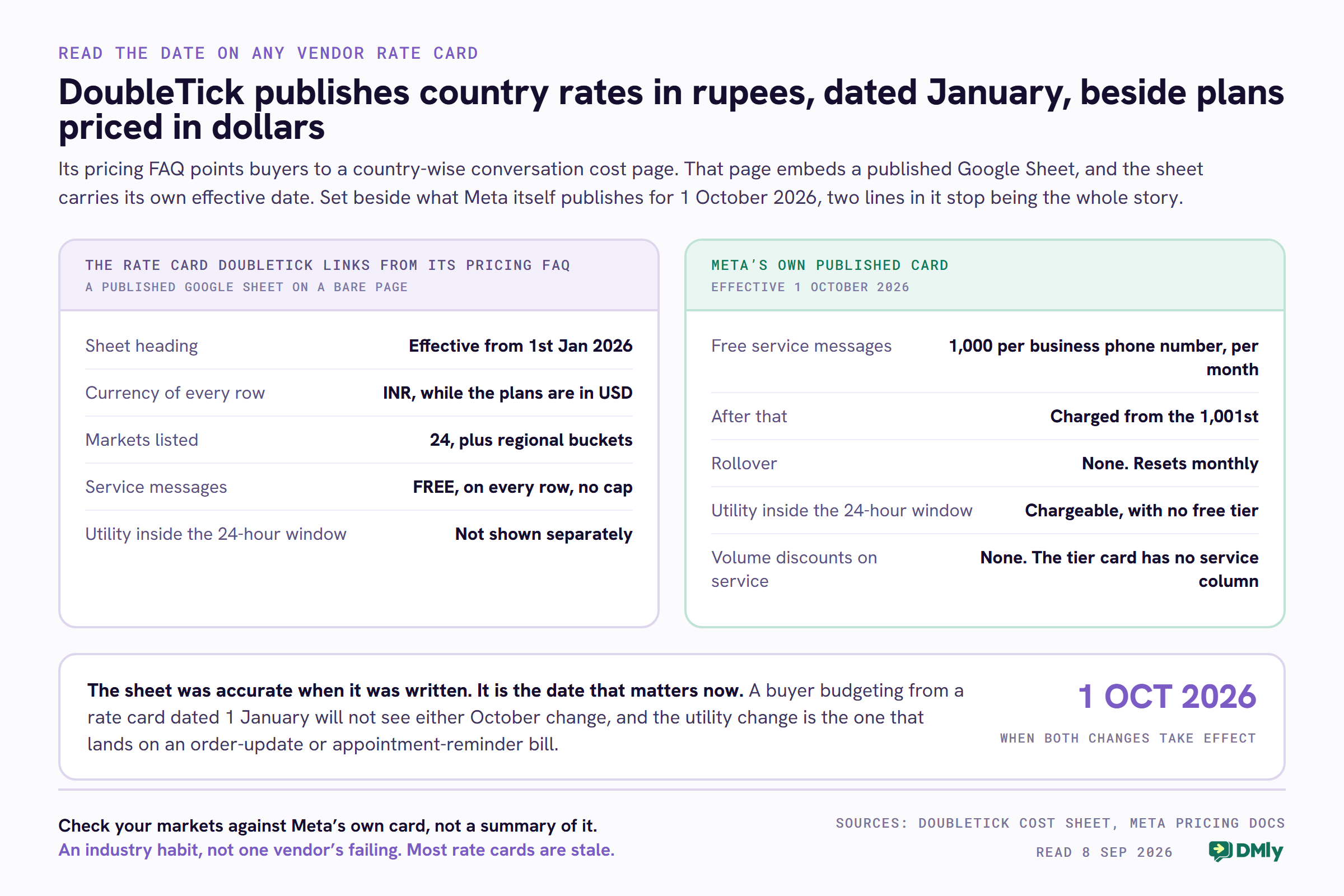
This is not a DoubleTick failing so much as an industry one, and it is the finding this DoubleTick review would most like you to carry to the next vendor you look at. We have found stale rate cards on most of the vendor sites we have checked this month, and the honest advice is the same everywhere: read the date on any vendor’s rate card, then check the two or three markets you actually send to against Meta’s own published card. We keep a country-by-country version at WhatsApp Business API pricing by country, and the October change is set out in full in what service messages now cost from 1 October.
One more line in the contract is worth reading beside the rate card. DoubleTick reserves the right to change its conversation charges if Meta changes its pricing, and states it “will not be held liable for refunds of subscription charges or damages in such cases”. Meta changes its pricing on 1 October 2026. That clause is load-bearing for every platform on the market, not only this one.
What the Contract Adds That the Price Card Does Not
The terms are short, plainly written and worth ten minutes before you buy, because four clauses in them change what the price actually commits you to.
This DoubleTick review read the Master Subscription Agreement in full on 8 September 2026. Nothing in it is unusual for the category. It is simply that none of it appears on the pricing page, and three of the four items below are the sort of thing people discover at renewal.
- It renews itself. “All monthly, quarterly, yearly, and multi-year subscriptions renew automatically on their due renewal date according to the date of purchase until officially cancelled in writing.”
- Cancelling means an email, not a button. The clause continues: “Customers may cancel anytime by emailing a notice to support@doubletick.io.” There is no mention of cancelling from inside the product.
- Nothing is refunded pro rata. “No refunds or credits for partial months or years of service will be refunded to a customer upon cancellation.” Elsewhere: “Payment obligations are non-cancelable, regardless of utilization by You”, and fees paid are non-refundable.
- Invoices fall due in seven days. The fee is payable “on a monthly/quarterly/half-yearly/annual basis, within seven (7) days from the invoice date”, and the company reserves the right to cancel the subscription if an auto-renewal invoice goes unpaid for more than one day.
Read together, those four say something specific: if you sign up in October and decide in February that it is not working, you cancel by email and you pay to the end of the term either way. Budget for the full year, not for the months you use.
There is no free trial, and they say so
The pricing FAQ is refreshingly direct about it: “We don’t offer a free trial, but you can book a demo with our team.” The word “trial” does not appear anywhere in the subscription agreement either.
Give them credit for the clarity. Plenty of vendors bury this. But it does change how you have to evaluate the product: you cannot put your own contacts and your own templates into it for a week and see what happens. You get a guided demo, and then you get a year.
If you want to test before you buy, the practical route is to ask for a sandbox or a one-month term at the monthly rate, get the answer in writing, and only then commit to the annual figure.
What This DoubleTick Review Found in DoubleTick’s Favour
Strip the pricing page away and there is a serious, well-staffed product underneath, and it is stronger than the tone of the last few sections suggests.
- The team controls are genuinely enterprise-grade. Roles and permissions, WhatsApp Business Account level custom roles, team hierarchy levels, multi-account assignment per agent, working hours, and number masking so an agent never sees the customer’s phone number. Most of that arrives on Pro; the comparison table puts number masking, single sign-on and an audit trail on Enterprise.
- It publishes a real rate card. Twenty-four markets, four categories, per-message rather than per-conversation, plus calling rates. Several competitors publish nothing at all. Ours is the criticism of its date and its currency, not of its existence.
- It answers the green tick question. The FAQ says outright that they will help with green tick verification, Facebook verification and onboarding. It is listed as a paid add-on in the comparison table, which is at least honest about it being work.
- The AI credit model is explained. When included credits run out the agents keep working and draw from a wallet you top up, and topped-up credits do not expire. That is a better answer than a hard stop, and it is written down.
- Support is on every plan. 24 by 7 chat support, a public help centre and public API docs are ticked for Starter as well as Enterprise.
If your business runs on WhatsApp, has a real support team on it, and needs the compliance furniture, DoubleTick is a credible choice and the price is not out of line with what enterprise messaging suites charge.
Where DoubleTick Runs Out of Road
Four limits, in the order they tend to bite. None of them is a defect, and a DoubleTick review that pretended otherwise would not be much use to you. They are the edges of what the product was built to do.
It is a WhatsApp product, and your customers are not only on WhatsApp
Everything in the plans is built around one channel. There is no Instagram inbox, no Messenger, no Telegram, no TikTok, no SMS fallback and no web chat widget in the feature tables. If someone asks a question under your Instagram post, that conversation lives somewhere else, in a different tool, with a different history.
For a business that genuinely only sells on WhatsApp, that focus is a strength. For most local businesses it means a second subscription and a second inbox.
The entry price is a team price
$170 a month is $2,039 a year before you have sent a message. If you are a two-person salon, you are paying for five seats and the compliance tooling that comes with them. The seats are not the part you can trim, because they are what the plan is.
The AI sits behind a second wall
AI agents start at Pro and carry a $90 a month add-on line. On the published figures, a business that wants an AI agent answering its WhatsApp is looking at $3,694 a year, not $2,039. That is a different conversation from the one the entry price starts.
It stops at the conversation
DoubleTick manages chats, campaigns, contacts and bots. It does not take a booking into a calendar, raise an invoice, take a deposit, or ask a happy customer for a Google review. For an ecommerce brand whose orders live in Shopify, that division is fine. For a clinic, a salon, a garage or a tutor, the appointment and the payment are the business, and they will sit in other tools.
DMly as a DoubleTick Alternative, Honestly
We make DMly, so treat this section as an interested party talking, and check every figure in it on our own pricing page.
DMly is built for the local business rather than the enterprise support desk: the salon, the clinic, the garage, the tutor, the shop that sells over chat. That difference in target explains most of what follows, including the places DoubleTick is the better fit.
Read on the DMly pricing page on 8 September 2026, the plans are Starter at $29 a month billed yearly, or $39 billed monthly; Growth at $65 billed yearly, or $79 monthly; and Premium at $149 billed yearly, or $199 monthly. Extra team seats are $10 a month each, an extra profile set is $15, and extra contacts are $15 per thousand. There is a seven-day free trial on any plan with no card.
The four differences that actually change a decision
- Eight channels, one inbox. WhatsApp, Instagram, Messenger, Telegram, TikTok, SMS, Google Business Profile and a live chat widget all land in the same place, with the same contact record. DoubleTick is WhatsApp.
- The AI agent is on every plan. Starter includes 500 AI replies a month, Growth 5,000 and Premium 20,000, and Premium lets you connect your own model provider key for unlimited replies. There is no separate AI add-on line and no plan sold without it.
- The booking and the money are in the same product. A native calendar with services, staff and classes, three payment modes on a booking including pay-before with a short hold on the slot, branded invoices that can sit in a partly paid state, and automatic Google review requests afterwards.
- You pay Meta directly. Our pricing page states it plainly: you pay Meta’s per-message rates with zero markup from DMly, and the subscription covers the platform.
Two things DMly does not do as well, said out loud
The response-time report starts its clock late. DMly does report first response and resolution times, team-wide and per agent, date-filtered and exportable. What it measures is the time from when a conversation is assigned to an agent, not from when your customer’s message arrived. If a message sits unassigned for forty minutes at lunchtime, that forty minutes never reaches the number. The workaround is to assign on arrival with a routing rule so the two clocks start together, and to treat the report as a measure of agent speed rather than of customer experience.
AI replies are metered. 500 a month on Starter is a real ceiling for a busy shop, and Growth’s 5,000 will not cover a high-volume support desk either. Premium removes the meter only if you bring your own provider key. DoubleTick’s Pro includes 3,500 AI credits with a wallet you can top up, which is a cleaner answer at high volume. If your WhatsApp traffic is genuinely enterprise-scale, price both models against your real message count rather than taking either headline.
There is also a straightforward case for DoubleTick over DMly: if you need number masking, single sign-on, IP whitelisting or an audit trail because a compliance team says so, DoubleTick has all four written into its Enterprise tier and we do not list any of them. Ask for the Enterprise quote, because that is where its comparison table puts them.
DMly and DoubleTick Side by Side
Every DoubleTick figure below is the one this DoubleTick review verified above, and every DMly figure was read on our own published pages on the same day, 8 September 2026.
| What you are comparing | DoubleTick | DMly |
|---|---|---|
| Entry plan | Starter, $170 a month, $2,039 billed yearly | Starter, $29 a month billed yearly, $39 billed monthly |
| Middle plan | Pro, $308 a month, with $2,614 or $3,694 billed yearly depending on the AI switch | Growth, $65 billed yearly, $79 billed monthly |
| Top published plan | Enterprise, custom, quoted by sales | Premium, $149 billed yearly, $199 billed monthly |
| Free trial | None. The FAQ offers a demo instead | 7 days on any plan, no card |
| Team seats included | 5 on Starter, 10 on Pro, custom on Enterprise | 3 on Starter, 6 on Growth, 15 on Premium |
| Price of an extra seat | Not published. It was USD 20 a month until late 2025 | $10 a month |
| AI agents | Add-on from Pro, $90 a month | Included on all three plans |
| AI replies included | 3,500 credits a month on Pro, 20,000 on Enterprise, wallet top-ups after that | 500 on Starter, 5,000 on Growth, 20,000 on Premium, or your own provider key on Premium |
| Channels | WhatsApp, Instagram, Messenger, Telegram, TikTok, SMS, Google Business Profile, live chat | |
| Meta message fees | Passed through. Rate card published in rupees, dated 1 January 2026 | Passed through at Meta’s rates, no DMly markup |
| Bookings and appointments | Not in its published feature tables | Native calendar with services, staff, classes and payment modes |
| Invoices and payments | Not in its published feature tables | Branded invoices, partial payment status, revenue view |
| Google reviews | Not in its published feature tables | Automatic review requests and a reputation inbox |
| Number masking, SSO, IP allowlisting | The comparison table puts all three on Enterprise, although the Pro card also ticks number masking | Not listed |
| Cancelling | Auto-renews until cancelled in writing by email. No refunds for partial periods | Upgrade, downgrade or cancel from settings |
Working Out What You Would Actually Pay
Compare the subscriptions, not the headlines, and size the seats before you look at either price.
Meta’s per-message fees are the same whichever platform you send through, so they cancel out of a like-for-like comparison as long as neither vendor adds a margin. What does not cancel out is how many people you need on the inbox and whether you want an AI agent.
A four-person shop that wants an AI agent
On DoubleTick, the AI agent starts at Pro. That is $3,694 a year on the published with-AI figure, or $2,614 plus the $90 monthly add-on if the other reading is the right one. Either way you are in four figures before your first message.
On DMly, four seats means Starter plus one extra seat, so $29 plus $10, which is $39 a month, or $468 a year, with 500 AI replies a month included. If 500 replies is not enough, Growth at $65 a month gives you six seats and 5,000 replies for $780 a year.
A ten-person support desk that does not want AI
This is the case where the gap narrows and the answer stops being obvious. DoubleTick’s Pro includes ten seats, roles and permissions and an automated ordering bot, and the yearly figure on the card is $2,614. If the $308 monthly figure turns out to be the live one instead, the same plan is $3,696 a year, which is why that question matters. DMly’s Premium includes fifteen seats at $149 a month, so $1,788 a year, but without number masking or single sign-on.
DMly is still cheaper, and it also brings seven more channels and the bookings and invoicing. But if your reason for buying is a compliance requirement rather than a cost one, the cheaper subscription is not the deciding number and you should say so in your own evaluation.
Then add the part neither subscription covers
Whichever you pick, budget separately for Meta. From 1 October 2026 each of your business phone numbers gets 1,000 free service messages a month and pays from the 1,001st, and utility templates sent inside an open 24-hour window become chargeable with no free allowance. If you send order updates and appointment reminders, that second change is the one that will show up on your bill. Our full breakdown of it sits at the WhatsApp pricing change on 1 October.
DoubleTick Review 2026: The Verdict
Buy DoubleTick if WhatsApp is the whole business and your team is five or more people. The product does that job properly, the support tooling is real, and $2,039 a year is a fair price for a WhatsApp desk built for a team rather than for an owner. If what you actually need is the number masking, the single sign-on or the audit trail, that is the Enterprise conversation, and Enterprise is quoted rather than published.
Do not buy it on the strength of the price card without asking two questions first. Which figure applies to Pro, the $308 a month or the $2,614 a year. And what does an additional agent seat cost, given that the answer used to be published and no longer is. Both answers should arrive in an email you can keep.
Look elsewhere if your customers reach you on more than one app, if the appointment or the invoice is the thing you are actually trying to automate, or if you need to try software with your own data before you commit to a year. DoubleTick has no trial and no channel beyond WhatsApp, and neither of those is going to change because you asked.
If you want to see how the rest of the market prices the same job, our roundup of WhatsApp automation tools re-checks twenty of them, and the sibling reviews of Gallabox, WhatChimp and Interakt follow the same method on three more.
DoubleTick Review: Frequently Asked Questions
How much does DoubleTick cost in 2026?
Read in a browser on 8 September 2026, Starter is $170 a month with $2,039 billed yearly, Pro is $308 a month with either $2,614 or $3,694 billed yearly depending on whether the AI agents switch is on, and Enterprise is quoted by sales. The AI agents themselves are listed as an add-on from Pro at $90 a month. The prices are drawn by JavaScript, so a plain fetch of the pricing page returns no figures at all.
Does DoubleTick have a free trial?
No. Its own pricing FAQ says “We don’t offer a free trial, but you can book a demo with our team”, and the word trial does not appear in its subscription agreement. If trying the software with your own contacts matters to you, ask for a one-month term in writing rather than assuming one exists.
Is DoubleTick’s AI agent included in the price?
Not on the entry plan. The page subtitle says AI agents are built into every plan, but the Starter card says they are not available on it and the comparison table lists the AI Agents block as an add-on from Pro at $90 a month. Pro includes up to ten agents, a 50 MB knowledge base and 3,500 AI credits a month; Enterprise includes fifty agents, 100 MB and 20,000 credits.
Does DoubleTick charge extra for WhatsApp messages?
Meta’s per-message fees are separate from the subscription on every platform, including this one. DoubleTick’s contract says the conversation charges are set by Meta and that it will pass on changes Meta makes. Its own country rate card is published as a Google Sheet in rupees and is dated 1 January 2026, so check it against Meta’s current card before you budget from it, particularly for service and utility messages after 1 October 2026.
Can I cancel DoubleTick at any time?
You can give notice at any time, but the terms say cancellation must be in writing by email to their support address, that all subscriptions renew automatically until then, and that there are no refunds or credits for partial months or years. In practice that means you pay to the end of the term you bought.
What is the best DoubleTick alternative?
It depends on which limit you have hit, and the honest answer from this DoubleTick review is that there is no single winner. If it is the single channel or the missing bookings and invoicing, DMly covers both from $29 a month billed yearly. If it is the price of the AI agent, look for platforms that include one on the entry plan. If it is the lack of a trial, almost every competitor offers one. If your constraint is compliance tooling rather than cost, DoubleTick may still be the right answer.
What did this DoubleTick review check, and when?
Everything here was read on 8 September 2026 from DoubleTick’s own published pages: the pricing page in a real browser, the full plan comparison table, the pricing FAQs, the Master Subscription Agreement, and the country rate card linked from the FAQ. Historic prices came from archived copies of the same pricing URL. No account was created and no figure came from a software directory.
Writing about WhatsApp automation, bookings and growth for local business.
Turn WhatsApp into your busiest channel.
Start free and run message, bookings, payments and reviews in one place.
