

If you’ve been exploring ways to use WhatsApp beyond basic messaging, chances are you’ve come across Spoki. It’s one of those tools built to help businesses turn everyday chats into structured marketing, sales, and support workflows without making things overly complicated.
This guide gives you a full Spoki review based on what really matters when choosing a platform like this. We’ll go through its key features, how Spoki pricing works, and where it fits best. And if you’re weighing your options, we’ll also cover a few strong Spoki alternatives worth considering.
What is Spoki?
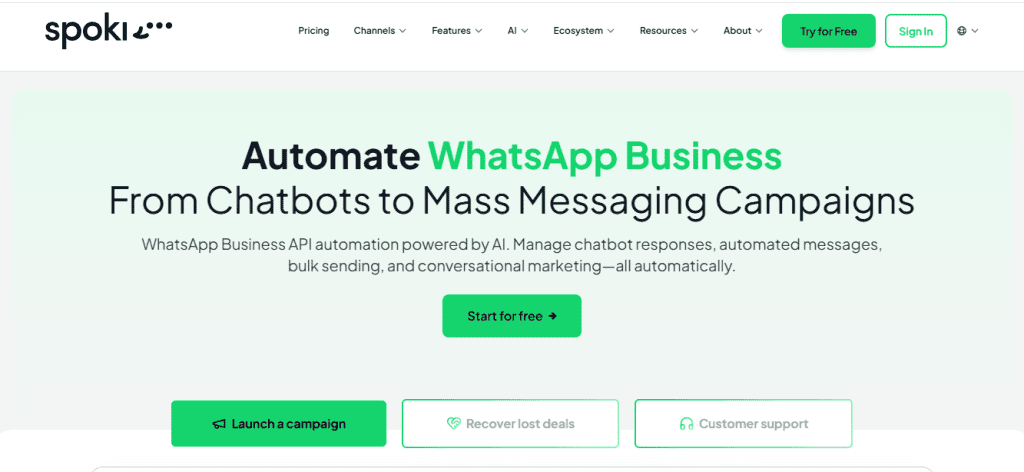
Spoki is a WhatsApp-based communication platform designed to help businesses manage conversations, run marketing campaigns, and automate customer interactions from one place.
Built on the official WhatsApp API, it allows companies to send messages at scale, handle customer support, and create structured workflows that guide users through different stages of the customer journey.
The platform is especially popular among businesses that want to use WhatsApp as a primary channel for engaging customers.
With Soki, you can send bulk campaigns, trigger automated responses based on user actions, and organize contacts using tags and custom data. It also integrates with tools like Shopify, WooCommerce, and Zapier, making it easier to connect your marketing efforts with your sales and support processes.
While it focuses heavily on WhatsApp, it gives businesses a straightforward way to turn conversations into measurable outcomes.
Spoki Review at a Glance
If you just want a quick feel for the platform before going deeper, this table sums up the key points from this Spoki review.
Category | Details |
|---|---|
| Best for | Small to mid-sized businesses using WhatsApp for marketing and support |
| Primary channel | WhatsApp (official API) |
| Core focus | Campaigns, automation, and customer conversations |
| Ease of use | Simple interface, quick to get started |
| Automation | Moderate (good for basic workflows and triggers) |
| CRM capabilities | Included, but relatively lightweight |
| AI features | Available in higher-tier plans |
| Integrations | Shopify, WooCommerce, Zapier, Facebook Ads, more |
| Pricing | Free plan available, paid plans from €24/month |
| Scalability | Works well for growing teams, but can feel limited at scale |
| Biggest strength | Easy WhatsApp campaign management |
| Main limitation | Limited beyond WhatsApp and advanced automation needs |
This snapshot gives you a clear starting point, but as we go deeper into this Spoki review, you’ll start to see where the platform really shines and where it might fall short depending on your needs.
Spoki Key Features
Spoki packs quite a few useful tools into one platform, especially if your focus is WhatsApp. But instead of listing everything, let’s look at the features that actually make a difference when you’re using it day to day.
1. WhatsApp Marketing & Bulk Messaging
One of the biggest reasons businesses choose Spoki is its ability to send messages at scale. You can create campaigns, schedule them in advance, and send them to thousands of contacts in one go. The platform also supports personalized messaging using dynamic fields, so each message feels tailored rather than generic.
2. Automation & Chatbots
Spoki allows you to automate conversations using simple workflows and chatbot-like interactions. You can set up event-triggered messages based on user actions, such as replying to a campaign or clicking a button in chat. It also supports interactive messages with buttons, which makes it easier for users to respond quickly.
3. Customer Database & Segmentation
Spoki includes a built-in customer database where you can store contact details, conversation history, and notes. You can organize contacts using tags and custom attributes, which helps when you want to send more targeted campaigns.
For example, you can group users based on past interactions, purchase behavior, or campaign engagement. This makes your messaging more relevant and helps avoid sending the same message to everyone.
4. Campaign Analytics & Performance Tracking
Once your campaigns are live, Spoki gives you access to performance data directly from the dashboard. You can track things like message delivery, open rates, and user interactions. This makes it easier to understand what’s working and what needs adjusting.
5. Integrations & E-commerce Capabilities
Spoki connects with tools like Shopify, WooCommerce, Zapier, and Facebook Ads, which opens up more use cases beyond basic messaging. You can pull in leads from campaigns, trigger messages based on user behavior, and automate e-commerce notifications.
A good example is abandoned cart recovery. If someone leaves items in their cart, Spoki can automatically send a WhatsApp reminder to bring them back. These small touchpoints can make a noticeable difference in conversions.
6. Shared Inbox & Multi-User Access
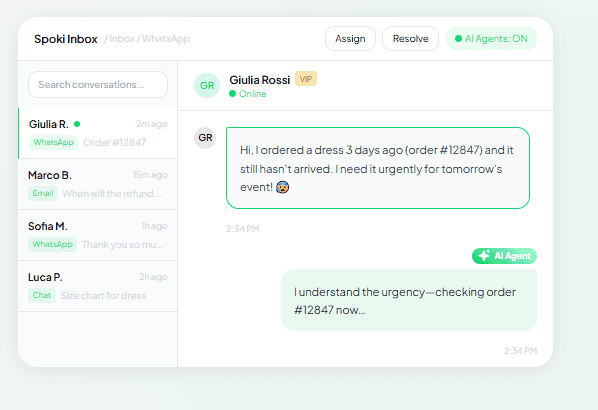
For teams handling multiple conversations, Spoki offers a shared inbox where all messages are managed in one place. Multiple team members can access the platform at the same time, assign chats, and collaborate on responses. This is useful for businesses that want to keep communication organized without jumping between devices or accounts.
Who is Spoki Best for?
Spoki is a solid fit for businesses that want to use WhatsApp as a primary communication and marketing channel without getting buried in complex setups. It’s built for teams that prefer something straightforward, where they can launch campaigns, manage chats, and automate simple interactions without a steep learning curve.
Here’s where Spoki tends to work best:
- Small to mid-sized businesses
Teams that want a simple way to manage customer conversations and send campaigns without needing a highly technical setup. - E-commerce brands
Businesses running stores on Shopify or WooCommerce that want to recover abandoned carts, send order updates, and engage customers through WhatsApp. - Marketing teams focused on campaigns
Teams that regularly send promotions, announcements, and follow-ups, and need basic segmentation and performance tracking. - Businesses using click-to-WhatsApp ads
If you’re generating leads through ads and want to move conversations directly into WhatsApp, Spoki fits nicely into that flow. - Customer support teams on WhatsApp
Teams that handle enquiries, provide updates, and want a shared inbox to keep conversations organized.
That said, you should also know that Spoki isn’t built for every use case. If you’re running a larger operation, need advanced automation, or want to manage conversations across multiple channels beyond WhatsApp, you may start to feel restricted.
In those cases, businesses often begin looking into more flexible Spoki alternatives that can support deeper workflows and scale more comfortably.
Spoki Pricing
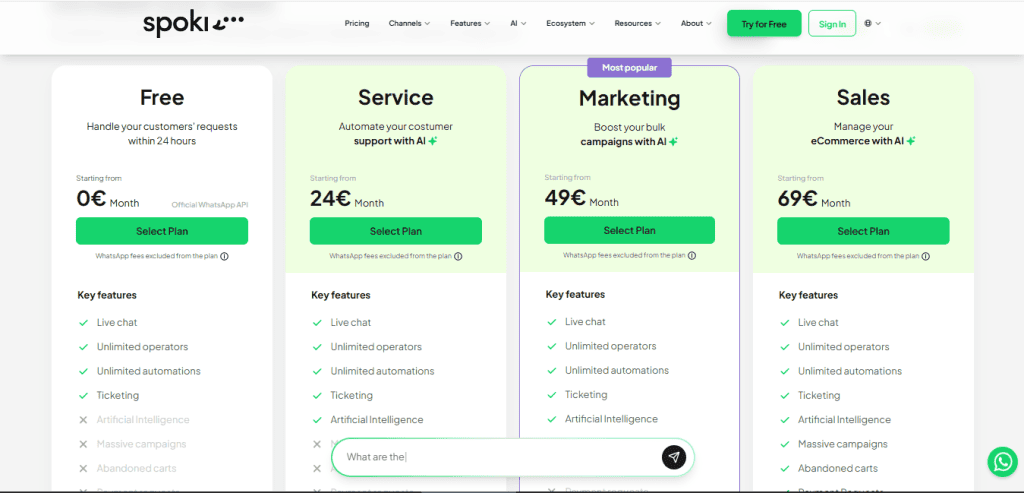
Spoki pricing is structured across four main plans, each designed for a different stage of business growth. On the surface, the tiers look simple, but the real difference comes down to how much automation, AI, and campaign capability you need as you scale.
Let’s break down each plan.
Free Plan (€0/month)
The free plan is designed for businesses that are just getting started with WhatsApp communication. It gives you access to the core messaging setup without any upfront cost.
With this plan, you get:
- Live chat functionality
- Unlimited operators
- Unlimited automations
- Basic ticketing system
It’s a good starting point if your focus is handling customer enquiries within the 24-hour service window. But once you move into campaigns or automation-heavy workflows, you’ll likely outgrow this tier pretty quickly.
Service Plan (Starting from €24/month)
The Service plan builds on the free version by introducing AI into the mix. It’s aimed at businesses that want to improve their customer support experience with some level of automation. This plan includes:
- Everything in the Free plan
- Artificial Intelligence features
- Continued access to live chat and automation tools
At this level, Spoki pricing starts to feel more practical for teams that want to reduce manual replies and handle larger volumes of conversations more efficiently.
Marketing Plan (Starting from €49/month)
The Marketing plan is where Spoki starts leaning more into campaign-driven use cases. If your goal is to actively promote products or services through WhatsApp, this is where things open up.
With this plan, you get:
- Everything in the Service plan
- Access to massive campaign sending
- AI-powered campaign support
Sales Plan (Starting from €69/month)
The Sales plan is the most advanced tier and is geared towards e-commerce and revenue-focused workflows. It adds features that directly support conversions and transaction-related messaging.
This plan includes:
- Everything in the Marketing plan
- Abandoned cart recovery
- Payment request features
For online stores, this is where Spoki becomes more than just a messaging tool. It starts playing a role in driving sales and recovering lost revenue.
A Quick Note on Scaling Costs
While Spoki pricing looks affordable at the entry level, it’s worth noting that your overall cost will grow as your messaging volume increases. Like most WhatsApp API tools, Meta’s messaging fees still apply, and those costs can add up depending on how frequently you run campaigns.
So while the platform itself is reasonably priced, the total cost of ownership depends heavily on how actively you use it.
Spoki Pros and Cons
Like most tools in this space, Spoki does a few things really well, but there are also areas where it starts to feel a bit limited depending on how you plan to use it.
Pros
- Easy to get started: The interface is simple and intuitive. You can set up campaigns and manage conversations without needing much training.
- Strong WhatsApp campaign capabilities: Sending bulk messages, scheduling campaigns, and personalizing content is straightforward and reliable.
- Useful for e-commerce workflows: Features like abandoned cart reminders and integrations with Shopify or WooCommerce make it practical for online stores.
- Built-in customer database: You can store contact details, add tags, and organize your audience without needing a separate CRM tool.
- Multi-user access and shared inbox: Teams can collaborate on conversations, assign chats, and keep everything organized in one place.
- Affordable entry pricing: The free plan and lower-tier paid plans make it accessible for smaller businesses getting started.
Cons
- Limited beyond WhatsApp: Spoki is heavily focused on WhatsApp, which can be restrictive if you want to manage multiple channels in one platform.
- Automation is relatively basic: While it supports workflows, it doesn’t offer the depth needed for more complex customer journeys.
- CRM functionality is lightweight: It works for basic contact management, but lacks the depth of a more advanced CRM system.
- AI is not a core feature: AI exists in higher plans, but it’s not as central or advanced compared to some newer platforms.
- Can feel limiting as you scale: Larger teams or businesses with more complex needs may outgrow the platform over time.
- Additional messaging costs apply: Like other WhatsApp API tools, Meta’s messaging fees can increase your total cost as usage grows.
DMly – A Reliable Spoki Alternative

If you’ve gone through this Spoki review and you’re thinking, “this works… but I might need more soon,” you’re not alone. That’s usually the point where businesses start exploring more flexible tools, and this is where DMly stands out as a strong option among Spoki alternatives.
DMly is built with a different mindset. Instead of focusing mainly on sending campaigns or managing chats, it’s designed around automation and customer journeys. You’re not just replying to messages or blasting promotions. You’re building systems that capture leads, qualify them, follow up automatically, and keep customers engaged over time. Everything happens inside messaging channels, but with much more structure behind the scenes.
Another big difference is how DMly handles scale. While Spoki works well for WhatsApp-focused workflows, DMly expands that into a full omnichannel setup. You can manage conversations across WhatsApp, Instagram, Messenger, Telegram, and web chat from a single inbox.
Add to that a built-in CRM, advanced segmentation, and AI agents that can handle conversations before passing them to your team, and you start to see why many growing businesses switch.
To make things clearer, here’s a quick side-by-side comparison:
Feature | Spoki | DMly |
|---|---|---|
| WhatsApp API | ✅ | ✅ |
| Omnichannel messaging | ❌ | ✅ |
| Automation depth | ⚠️ | ✅ |
| Built-in CRM | ⚠️ | ✅ |
| AI agents | ⚠️ | ✅ |
| Campaign management | ✅ | ✅ |
| Behavioral segmentation | ⚠️ | ✅ |
| Multi-workspace support | ⚠️ | ✅ |
| Pricing transparency (no Meta markup) | ⚠️ | ✅ |
What this really shows is the difference in approach. Spoki keeps things simple and focused. DMly gives you more control, more flexibility, and more room to grow without switching tools later.
So if you’re comparing Spoki alternatives not just for today, but for where your business is heading, DMly is one of the options worth taking seriously.
DMly vs Spoki – Key Differences
At a glance, both tools help you use WhatsApp for business. But once you start using them, the difference becomes clear. Spoki is built for straightforward messaging and campaigns. DMly is built for managing full customer journeys with automation at the core.
Again, let’s break that down properly.
1. Automation Capabilities
Spoki gives you the basics. You can set up triggered messages, create simple flows, and guide users with button-based interactions. It works well for linear campaigns and basic follow-ups.
DMly goes much deeper. You can build multi-step workflows triggered by user behaviour, campaign activity, CRM updates, or external events. These workflows can include lead qualification, tagging, routing to teams, and ongoing nurture sequences.
If your goal is simple automation, Spoki handles it. If you want automation to run your entire messaging strategy, DMly is built for that.
2. Channel Coverage
Spoki is heavily focused on WhatsApp. That’s great if all your customer interactions happen there, but it becomes limiting once you start using multiple platforms.
DMly takes an omnichannel approach. You can manage conversations across WhatsApp, Instagram, Facebook Messenger, Telegram, and web chat in one place. Everything flows into a single inbox, so your team doesn’t have to jump between tools.
For businesses running campaigns across different channels, this makes a big difference.
3. CRM & Customer Data
Spoki includes a basic customer database. You can store contact details, add tags, and view conversation history. It works for simple segmentation and campaign targeting.
DMly’s CRM is more integrated into how the platform works. Customer data isn’t just stored. It actively drives automation. You can trigger workflows based on lifecycle stages, behavior, or engagement history. This means your messaging becomes more personalized without needing manual effort.
4. AI & Conversation Handling
Spoki offers AI features in higher-tier plans, mainly to support automation and responses. It’s helpful, but not central to how the platform operates.
DMly puts AI at the center of the experience. AI agents can handle conversations, answer questions, qualify leads, and pass them to human agents when needed. The transition is smooth, and the context stays intact.
For teams handling a high volume of conversations, this reduces workload significantly.
5. Scalability and Flexibility
Spoki works well when your needs are clear and relatively simple. Campaigns, support, and basic automation all run smoothly. But as your workflows become more complex, you may start to feel restricted. There’s only so much you can build before you hit limits.
DMly is designed to scale with you. You can create multiple workspaces, manage different brands, and run complex workflows without needing additional tools. It adapts as your operations grow rather than forcing you to switch platforms later.
6. Pricing Approach
Spoki pricing is structured in tiers, which makes it easy to get started. But as you unlock more features and increase usage, costs can add up alongside Meta’s messaging fees.
DMly takes a more transparent approach. There’s no markup on Meta’s fees, so you pay WhatsApp costs directly. This makes it easier to predict your spending as your campaigns scale.
Final Verdict
Spoki does a good job at what it’s designed for. It makes WhatsApp marketing and customer communication easy to manage, especially for smaller teams that want to send campaigns, automate basic interactions, and keep conversations organized without dealing with complex setups.
If your focus is mainly on WhatsApp and your workflows are fairly straightforward, it’s a tool you can get value from quickly.
That said, this Spoki review also shows where the limits start to appear. As your needs grow, whether that’s deeper automation, better use of customer data, or managing conversations across multiple channels, the platform can begin to feel a bit restrictive.
This is usually the point where businesses start exploring more flexible Spoki alternatives.
If you’re planning for scale from the start, or you already know your workflows will get more advanced, DMly is the stronger long-term option. It gives you more control over automation, a more capable CRM, and the flexibility to manage everything from one place without needing to switch tools later.
FAQs
Who are the typical users of Spoki?
Spoki is mostly used by small to mid-sized businesses that rely on WhatsApp for customer communication. This includes e-commerce brands, marketing teams running campaigns, and support teams handling enquiries through chat.
What is Spoki used for?
Spoki is used for managing customer conversations, sending WhatsApp campaigns, and automating basic interactions. Businesses use it to run promotions, follow up with leads, recover abandoned carts, and handle customer support.
What are the best Spoki alternatives?
Some of the best Spoki alternatives include tools like DMly, WATI, Respond.io, and SleekFlow. The right choice depends on what you need. If you’re looking for deeper automation, better CRM capabilities, and multi-channel messaging, DMly stands out as a strong option among Spoki alternatives, especially for growing businesses.
Is Spoki suitable for large businesses?
Spoki can work for growing teams, but it may not be the best fit for large businesses with complex workflows. Its automation and CRM capabilities are relatively basic compared to more advanced platforms.
For larger operations that need deeper automation, advanced segmentation, and multi-channel communication, many teams eventually explore more scalable Spoki alternatives.
Spoki vs DMly: which is better for agencies?
For agencies, the difference comes down to flexibility and scale. Spoki works well if you’re managing straightforward WhatsApp campaigns for clients. But if you’re handling multiple brands, need advanced automation, or want to manage conversations across different channels, DMly is the better option.
It offers multi-workspace support, deeper workflows, and more control, which agencies usually need as they grow.