
Top Wati Alternatives in 2026: Ten Prices, Every One Re-Checked
Before you compare a single price on this page, answer three questions about the last WhatsApp platform you looked at.
What billing period was that price? How many people can log in for it? And does the vendor add anything to what Meta charges per message?
Almost nobody can answer all three, because almost no pricing page puts them next to the number. We read all ten of the platforms below on their own published pages on 8 September 2026, in a real browser, and on every single one at least one of those three answers changes what you would actually pay. One entry price turns out to be quarterly only. One includes three people and will not sell you a fourth. One quietly marks up every message on its cheapest plan while the page title promises no markups.
So this list of Wati alternatives gives you the number, the billing period it depends on, the seats it includes and the message fee sitting behind it. Where a vendor is better than we previously said, that is here too, and where we got something wrong about one of them, that is here too.
What Wati Costs in 2026, and Why Teams Look Elsewhere
Wati is one of the better known WhatsApp Business API platforms, and its own pricing page explains most of the reasons people start shopping.
Read on 8 September 2026, there are three published plans plus a pay-as-you-go option:
- Growth: $39 a month billed annually, or $49 billed monthly. One channel. Three users included, and the card says plainly “no additional users”. 15,000 broadcasts a month, 1,000 free automation triggers, two integrations, 10,000 API calls and no webhooks.
- Pro: $79 a month billed annually, or $99 monthly. Five users, then $24 per user per month. Unlimited broadcasts, 2,000 triggers, five integrations including HubSpot, 200,000 API calls and limited webhooks. Its AI agents, branded Astra, are an add-on priced separately.
- Business: $199 a month billed annually, or $249 monthly. Five users, then $59 per user per month.
- In India there is also a one-time ₹999 single user plan that returns ₹999 as message credits, good for roughly 500 messages, with three months of account validity.
There is a seven day free trial and no setup fee, which is a fair offer, and the platform does the core job well.
The three reasons people actually leave
The seat ceiling on the entry plan. Three users, and no way to buy a fourth. A growing team does not outgrow Growth gradually; it hits a wall and moves to Pro at double the price, where the fourth person then costs $24 a month on top.
The step up is where the useful things live. Unlimited broadcasts, webhooks worth having, HubSpot and the advanced chatbot flows all start at Pro. If your reason for buying was automation, Growth is a trial rather than a plan.
The AI is a separate purchase. Astra AI agents are listed on the Pro card as an add-on priced separately, so the plan that carries the AI feature does not carry the AI cost. Several platforms below include an AI agent in the subscription, which is the comparison worth running.
None of that makes Wati a bad product. It makes it a product with a specific shape, and the ten below have different shapes.
That shape is the thing to hold in mind as you read. The best Wati alternative for you is the one whose shape fits the constraint Wati is pressing on: the seat ceiling, the automation step-up, or the separately priced AI.
The Ten Wati Alternatives at a Glance
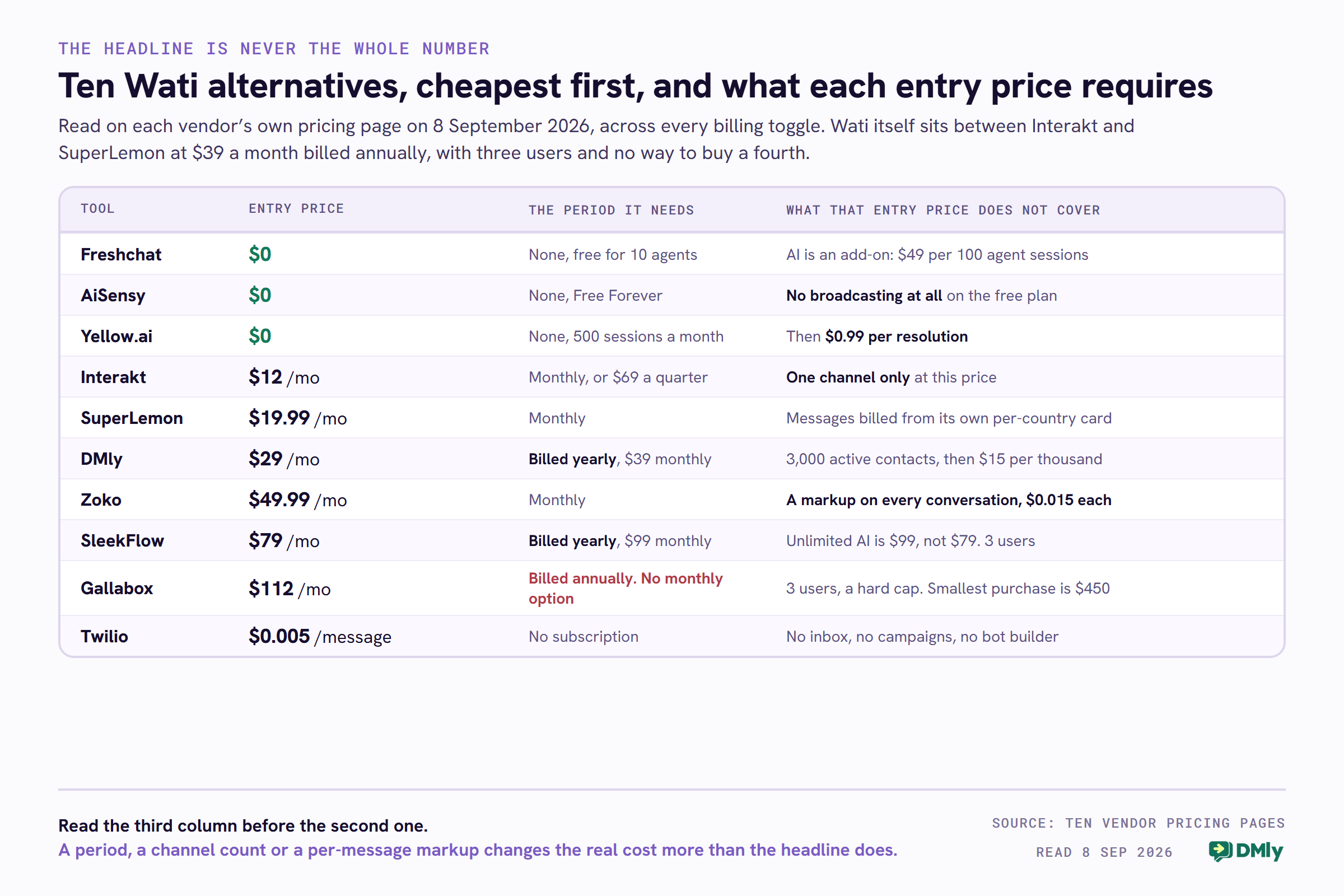
Every figure was read on the vendor’s own published pricing page on 8 September 2026, in the order the sections below follow. Where a vendor publishes more than one billing period, the entry price is shown with the period it requires.
| Tool | Entry price, and the period it needs | Seats included | What the price is metered on | Best for |
|---|---|---|---|---|
| 1. DMly | $29 a month billed yearly, or $39 monthly | 3, then $10 each | Active contacts, 3,000 on entry | Local businesses that also book and invoice |
| 2. SleekFlow | $79 a month billed yearly, or $99 monthly | 3 | Monthly active contacts, from 500 | Small teams wanting unlimited broadcasts and flows |
| 3. Gallabox | $112 a month billed annually, or $150 quarterly. No monthly option | 3, a hard cap on the entry plan | Seats and AI credits | Lead qualification with AI on WhatsApp and Instagram |
| 4. Zoko | $49.99 a month | Unlimited on the entry plan | Conversations, marked up on the entry plan | Shopify stores that want unlimited agents |
| 5. AiSensy | Free forever, then $45 a month, or ₹1,500 on the India page | Included agents, then ₹750 a seat | Plan tier, with chatbots and AI as add-ons | Indian businesses starting on the API |
| 6. Interakt | $12 a month for one channel, or $69 a quarter | Unlimited on every plan | Plan tier and channels | Teams with many agents and a small budget |
| 7. Yellow.ai | Free for 500 sessions a month, then $0.99 per resolution | 2 on the free tier | Resolutions | Enterprises buying agentic AI, not a WhatsApp inbox |
| 8. Twilio | No subscription. $0.005 per message, plus Meta’s fees | Not applicable, it is an API | Messages | Developers building their own front end |
| 9. SuperLemon | Free, then $19.99 a month | Multiple agents in the widget | Messages, from its own per-country list | Small Shopify stores recovering carts |
| 10. Freshchat | Free for up to 10 agents, then $19 per agent a month billed annually | Priced per agent | Agents, with AI as a paid add-on | Support desks that want a real free tier |
Two things stand out before you read a word of the detail. Only one of the ten charges nothing at all to start and still lets ten people log in, which is Freshchat. And the cheapest entry price on the list is not the cheapest platform, because Interakt’s $12 buys a single channel and Zoko’s $49.99 applies a markup to every message you send.
1. DMly, from $29 a Month Billed Yearly
We make DMly, so treat this section as an interested party talking and check every figure on our own pricing page. The rest of this list is written to the same standard whether or not it flatters us.
DMly is built for the local business rather than the enterprise support desk: the salon, the clinic, the garage, the tutor, the shop that sells over chat. Eight channels land in one inbox against one contact record, and the booking, the invoice and the review request live in the same product as the conversation that produced them.
- Starter $29 a month billed yearly, or $39 monthly. Three seats, 3,000 active contacts, 10,000 broadcast or template messages, ten active bots per profile with unlimited flows, and 500 AI replies a month.
- Growth $65 billed yearly, or $79 monthly. Six seats, 10,000 contacts, 50,000 messages, unlimited bots, 5,000 AI replies.
- Premium $149 billed yearly, or $199 monthly. Fifteen seats, unlimited contacts, 300,000 messages, 20,000 AI replies, and the option to connect your own model provider key for unlimited replies.
- Add-ons: an extra seat is $10 a month, an extra profile set $15, extra contacts $15 per thousand.
Best for: a business where the conversation is supposed to end in an appointment or an order. Broadcasts, the CRM, bookings, invoices, reputation tools and an AI agent are on every plan including the $29 one, and you pay Meta’s per-message rates directly with no markup from us. Seven day free trial on any plan, no card.
Where it stops: contacts are metered, and 3,000 on Starter is genuinely lower than SleekFlow’s or Zoko’s entry allowances for a large quiet list. AI replies are metered too, at 500 a month on Starter. And we do not list single sign-on or agent-facing number masking, which Gallabox, SleekFlow and Wati all offer on their upper tiers. If a compliance policy is driving the purchase, look at those instead.
Against Wati: $29 against $39 at the entry tier, six seats on the $65 plan against Wati’s three that cannot be extended, and an AI agent included rather than sold separately as Astra is.
2. SleekFlow, from $79 a Month Billed Yearly
An official WhatsApp partner priced on the contacts who actually reply to you, with unlimited broadcasts on its cheapest plan.
SleekFlow puts WhatsApp, Instagram, Messenger, Telegram and SMS in one inbox, adds a flow builder and AI agents, and meters on monthly active contacts rather than on messages sent. Its pricing page carries two toggles and both change the number, which is worth knowing before you quote it to anyone.
- Pro: $79 a month billed yearly, or $99 monthly. Starts from 500 monthly active contacts, three user accounts, unlimited broadcasts, unlimited flow builder usage and unlimited contact storage, plus an AI agent.
- Pro with unlimited AI: $99 billed yearly, or $129 monthly. The same plan with the AI usage cap removed.
- Premium: $249 billed yearly, or $299 monthly, and $299 or $349 with unlimited AI. From 1,000 contacts, ten users, analytics dashboards, webhooks and API calls, role-based access control.
- Enterprise: quoted, and the tier that carries Salesforce and PII masking.
Best for: a team with a long list and a modest number of live conversations. Unlimited broadcasts on a $79 plan is rare, and unlimited contact storage means a big list costs nothing to hold, only to talk to.
Where it stops: three users on Pro, and the jump to ten users is a jump to $249. The AI toggle is a real second price rather than a feature switch, so the honest entry number for a team that wants AI without a usage cap is $99 a month, not $79. Credit where it is due: SleekFlow was the only vendor in this set carrying a banner about the 1 October WhatsApp price change on the day we checked.
Against Wati: twice the entry price, the same three seats, and unlimited broadcasts where Wati caps Growth at 15,000 a month. As a Wati alternative it makes sense for a big list, not for a big team.
3. Gallabox, from $112 a Month Billed Annually
A lead qualification platform with AI agents on WhatsApp and Instagram, and the only tool on this list that will not sell you a single month.
Gallabox is aimed at teams whose WhatsApp number is a lead source: capture, qualify with an AI agent, route to a person, book the appointment. Its pricing page opens on an annual view and a quarterly one sits behind a toggle. There is no monthly option at all.
- Basic: $112 a month billed annually, or $150 a month billed quarterly. Three user accounts, described on the card as a hard cap, 500 AI credits a month, one channel each of WhatsApp, Instagram and a web widget.
- Essential: $248 annually, or $331 quarterly. Six users then $18 per extra user, 2,000 AI credits, AI agents on WhatsApp and Instagram, drip campaigns, full API and two-way CRM integrations.
- Advanced: $474 annually, or $632 quarterly. Ten users then $24 per extra user, 8,000 AI credits, appointment booking, lead pipeline, custom roles and number masking.
- Enterprise: quoted, with SSO and SAML, IP allowlisting and custom roles.
Best for: a sales team that wants an AI agent qualifying inbound leads and is happy to commit for a quarter. The free trial needs no card and includes 500 AI credits to test on real conversations, which is a better trial than most.
Where it stops: the three user hard cap on Basic matches Wati’s entry ceiling and costs more to escape. You cannot buy a fourth seat, you buy Essential, and that is a jump from $112 to $248 a month, where the same move on Wati is $39 to $79. And because the smallest purchase is a quarter at the quarterly rate, testing it properly costs $450 rather than one month’s money.
Against Wati: nearly three times the price and the same seat problem, bought for a quarter at a time. It is a Wati alternative you pick for the AI qualification, not for the cost.
4. Zoko, from $49.99 a Month
A Shopify-first WhatsApp platform whose page title promises no Meta markups, and whose cheapest plan is the one that applies one.
Zoko sells four flat plans. Three of them pass Meta’s conversation costs through at no markup, with a bundled allowance and a published rate after it. The entry plan does not, and Zoko says so on the same card:
- Starter $49.99 a month: “Markup on all conversations, $0.015 per conversation”. In exchange, you may add as many agents as you like, for free. 500 calling minutes, then $0.005 a minute.
- Plus $79.99: 5,000 conversations at no markup, then $0.00199 each. Five agents, then $15 each.
- Elite $139.99: 100,000 conversations at no markup, then $0.00099. Ten agents, then $12 each.
- Max $499.99: five million conversations at no markup, then $0.00049. Thirty agents, then $9 each.
- On every plan, Facebook is free and Instagram is $9.99 a month extra.
Two things about that ladder are worth stating plainly rather than judging. The agent price falls as you climb, from $15 to $12 to $9, which is the opposite of how most of this market prices seats and is better for a growing team. And the per-conversation rate on Starter, $0.015, is many times the per-message rates Meta publishes for most markets, while the rate on Max, $0.00049, is below them because it only applies after five million included conversations.
Best for: a Shopify store with more agents than budget. Unlimited free agents at $49.99 is a genuinely unusual offer and for a shop with six part-time staff answering chats it can be the cheapest thing here.
Against Wati: more expensive at the door than Wati’s $39, and far cheaper for any team above three people, because Wati simply will not sell you the fourth seat on Growth.
Where it stops: that markup. If you send any real volume, work out the cost per conversation at $0.015 before you sign, and compare it with $79.99 for Plus with 5,000 conversations included at no markup. The action is arithmetic, not suspicion. The gap between the two plans is $30 a month, and $30 at $0.015 a conversation is exactly 2,000 conversations. Below that, Starter is cheaper. Above it, you are paying more in markup than the upgrade would have cost.
5. AiSensy, Free Forever, Then $45 a Month
The most generous free tier on this list for getting onto the WhatsApp API, and two price lists that do not convert into each other.
AiSensy’s Free Forever plan gives you the official WhatsApp Business API on your number at no cost, applies on your behalf for the blue tick, hands you 1,000 Meta ad credits and ₹50 of conversation credit, and includes a live chat dashboard. What it does not include is broadcasting, which is the thing most people came for, so treat it as a free route onto the API rather than a free plan.
Above it, AiSensy publishes two separate ladders. On its India page, billed monthly: Basic ₹1,500, Pro ₹3,200, Premium ₹9,100 and Unlimited ₹45,000, plus ₹750 per extra seat. On its dollar page, the same four plans are $45, $99, $299 and $899.
Those two lists cannot be reconciled with a single exchange rate. Basic implies about 33 rupees to the dollar, Pro about 32, Premium about 30 and Unlimited about 50. Regional pricing is a normal and perfectly legitimate thing for a vendor to do, and this is almost certainly what it is. The point for you is narrower: which page you land on decides your price, and the gap is large, so if you are buying from outside India it is worth asking which list applies to you and why.
Best for: an Indian business that wants the API and the blue tick without paying to find out whether WhatsApp works for it. Quarterly billing saves 5 per cent and yearly 10, and all billing is pre-paid.
Where it stops: the chatbot builder and the AI agent are add-ons charged separately on top of any plan, at ₹2,500 a month for five chatbots and ₹1,350 a month for an AI agent with 1,000 AI messages. A plan that reads complete on the card needs two more purchases to automate anything.
Against Wati: the free route onto the API is the real difference, since Wati has a seven day trial and then a bill. On the paid tiers the two are closer than they look, and both sell the AI separately.
6. Interakt, from $12 a Month for One Channel
The only platform here that puts unlimited agents on every plan, including the cheapest one.
Interakt sells WhatsApp and Instagram automation to small and mid-sized teams, with a shared inbox, campaigns, chatbot flows, catalogues and native payments. Its pricing page opens on a quarterly view, and a monthly view sits behind a toggle:
- Starter: $12 a month, or $69 a quarter. A single channel, and in the monthly view the card labels it Instagram only. Bulk campaigns, shared inbox, simple greeting and out-of-office automations.
- Growth: $55 a month, or $149 a quarter. Both channels, FAQ automations and linear chatbot flows, advanced campaigns, catalogues, native payments, public APIs.
- Advanced: $69 a month, or $189 a quarter. Branching chatbot flows with API calls and conditions, chat auto-assignment, advanced webhooks.
- Enterprise: on request, adding the RCS channel, higher rate limits and faster campaign speeds.
Quarterly billing is advertised at 8 per cent off and yearly at 20 per cent. There is a separate Market add-on at $74.99 for the Growth and Advanced plans.
Best for: a business with more people than budget. Every plan says unlimited agents, so a ten-person team pays the same as a two-person team. Against Wati’s three-user ceiling or Gallabox’s three-user hard cap, that is a real structural advantage and it is the reason Interakt keeps appearing on lists like this.
Where it stops: one line in the Enterprise column reads “No Templates Markups”, and it is listed as an Enterprise benefit. Read plainly, that means template markups apply below Enterprise. Interakt does not publish what that markup is, so ask for it as a figure before you compare their $55 with anyone else’s $55, because a per-message margin on a busy month can be larger than the whole subscription.
Against Wati: this is the Wati alternative for a team that has outgrown three seats and has not outgrown its budget. Unlimited agents at $55 against five agents at $79 plus $24 each is not a close comparison.
7. Yellow.ai, Free for 500 Sessions, Then $0.99 a Resolution
An enterprise agentic AI platform rather than a WhatsApp inbox, and it publishes exactly one number.
Yellow.ai builds AI agents across chat, voice, email and SMS with a no-code and pro-code builder, an agentic knowledge base, automated testing and analytics. Its pricing page is headed “Transparent & Flexible Pricing Plans Tailored to Your Business Needs” and shows two columns.
- Free: one AI agent, 500 chat sessions a month included, then $0.99 per resolution, two agent seats, 1,000 records, one active campaign and ten templates. Everything else on the matrix is marked Limited.
- Enterprise: unlimited agents, unlimited sessions, all 35 or more channels, 150 or more integrations, and no price. The call to action is “Contact us”.
An earlier version of this page recorded Yellow.ai as custom pricing only. That was not quite right and it is corrected here: the $0.99 per resolution figure is published, and it is the number that matters if you are considering the free tier for anything real. Five hundred sessions is a small allowance for a business of any size, and above it, a thousand resolutions is $990.
Best for: a large organisation buying voice and chat AI across a contact centre, where WhatsApp is one channel of many and the procurement process expects a quote.
Where it stops: if you are a small business looking for a WhatsApp inbox with broadcasts, this is not that product and the price will tell you so during the first sales call. The heading promises transparent pricing and the page carries one figure, which is worth knowing before you invest time in the conversation.
Against Wati: not really a comparison. Wati sells a WhatsApp platform to a marketing team; Yellow.ai sells agentic AI to a procurement committee. If Wati feels too small, this is the direction, but it is a different purchase.
8. Twilio, No Subscription and $0.005 a Message
Not a platform at all, and the most honest pricing page in this comparison.
Twilio gives you the WhatsApp Business API as an API. There is no inbox, no campaign builder and no chatbot editor unless you build them, and there is also no monthly subscription. What Twilio publishes is the arithmetic:
- Twilio’s own fee is $0.005 per message, inbound or outbound.
- Meta’s per-template fees are passed through at Meta’s own rates, which Twilio links rather than restates.
- A failed message processing fee of $0.001 applies to messages that end in a failed status.
That five-tenths of a cent is worth sitting with, because it is a real markup honestly labelled. Meta’s own published rate for utility and authentication messages starts at $0.0034, and in India it is lower still. On those markets Twilio’s handling fee is larger than the message fee it sits on top of. That is not a criticism, it is what an API with no subscription costs, and it is the correct trade if you are sending a few thousand messages and building your own front end.
Best for: a developer, or a business with one. If you have engineering time and want WhatsApp inside software you already run, Twilio is the cleanest commercial arrangement on this page.
Against Wati: Twilio is what Wati is built on top of, in effect. You trade the inbox, the campaign builder and the chatbot editor for no subscription at all, which is a good trade only if you can build them.
Where it stops, and a note to check in October: Twilio’s WhatsApp pricing page currently states that there is no Meta fee during the customer service window for utility and free-form messages. That is correct today and it stops being correct on 1 October 2026, when utility messages sent inside an open 24-hour window become chargeable. Re-read that page before you budget for the fourth quarter.
9. SuperLemon, Free, Then $19.99 a Month
The cheapest real starting point on this list for a Shopify store, with the message pricing that needs the most careful reading.
SuperLemon is a Shopify app for WhatsApp chat, cart recovery and campaigns. Its plans are short and clear:
- Free, $0: a chat and share widget with more than 50 configurations, manual cart recovery and order notifications from pre-defined templates, up to 100 manual template messages a month, a Chrome extension that shows order history inside WhatsApp Web, customer profiles, and multiple agents in the widget.
- Brand, $19.99 a month: your own WhatsApp Business API number, support for WhatsApp coexistence so the Business app and the API run together, automated cart recovery, order confirmation, shipment and cash-on-delivery flows, Shopify Flow, unlimited manual template messages, Judge.me and Loox integrations, and an inbox.
- Scale, $29.99 a month: adds marketing campaigns, scheduling, custom marketing templates and Shopify segment targeting.
Best for: a store doing ten to a few hundred orders a month that wants cart recovery working this week. The free tier genuinely works without a WhatsApp API number, which nothing else here offers, and coexistence on the $19.99 plan is a feature most platforms charge far more for.
The part to read twice
SuperLemon publishes its own per-country message price list, 249 rows long, and applies it on Brand and Scale including during the free trial. The page describes it as WhatsApp charging “per conversation, priced by the recipient’s country”. Sample rows read India $0.02, United States $0.04, United Kingdom $0.095, Nigeria $0.075 and Germany $0.205.
Two things follow, and both are for you to check rather than for us to conclude. Meta prices per message and in four categories, and marketing, utility, authentication and service can differ by a factor of ten in the same market: Meta’s published United Kingdom rate for utility, authentication and service is $0.0220, and its marketing rate is higher again. SuperLemon’s list carries one number per country and no category column, so you cannot tell which of Meta’s four rates each figure is standing in for. Second, Meta retired conversation-based pricing on 1 July 2025, so a card denominated in conversations is describing a model that no longer exists.
The action: before you send volume on Brand or Scale, ask SuperLemon whether their figure is charged per message or per conversation, and which message categories it covers. It is one email, and on a few thousand messages a month the answer is worth more than the subscription.
Against Wati: half the price and a free tier, for a much smaller product. As a Wati alternative it suits a Shopify store that wants cart recovery, not a team that wants an inbox.
10. Freshchat, Free for Ten Agents, Then $19 an Agent
The only genuinely free multi-agent tier in this comparison, and the one platform here that is a support desk first.
Freshchat is Freshworks’ messaging product: a chat widget, a shared inbox, email, social messengers and WhatsApp, with routing, SLAs and reporting on the higher tiers. Prices below are per agent per month billed annually, with a 20 per cent saving over monthly:
- Free, $0, for up to ten agents. Chat widget on web and mobile, shared inbox, connected email, roles and permissions.
- Growth, $19 per agent a month. Adds social messengers, text messaging, reporting and dashboards.
- Pro, $49 per agent a month. Multilingual conversations, custom dashboards, intelligent routing, multiple SLA policies.
- Enterprise, $79 per agent a month. Skill-based routing, audit logs, JWT authentication, allowed domains and IP allowlisting.
Best for: a support team that wants to start at nothing and grow. Ten agents free, with a real shared inbox and roles, is an offer nobody else on this list matches, and for a business whose WhatsApp volume is support rather than marketing it can carry you a long way.
Where it stops: the AI is a paid add-on at every level. Freddy AI Agent is $49 per 100 sessions and Freddy AI Copilot is $29 per agent a month, on top of the per-agent price. Day passes for occasional users are $2, $7 and $12 depending on tier, and connector app tasks are $80 per 5,000. Per-agent pricing also means a ten-person team on Pro is $490 a month, which is more than every flat plan on this page except Zoko’s $499.99 top tier.
Against Wati: the free tier is the whole argument. Ten agents at nothing against three agents at $39, for as long as support rather than marketing is the job.
A Correction: What We Got Wrong About Flowcart
On 6 September this page said Flowcart had stopped trading. That was our mistake, and here is exactly how we made it.
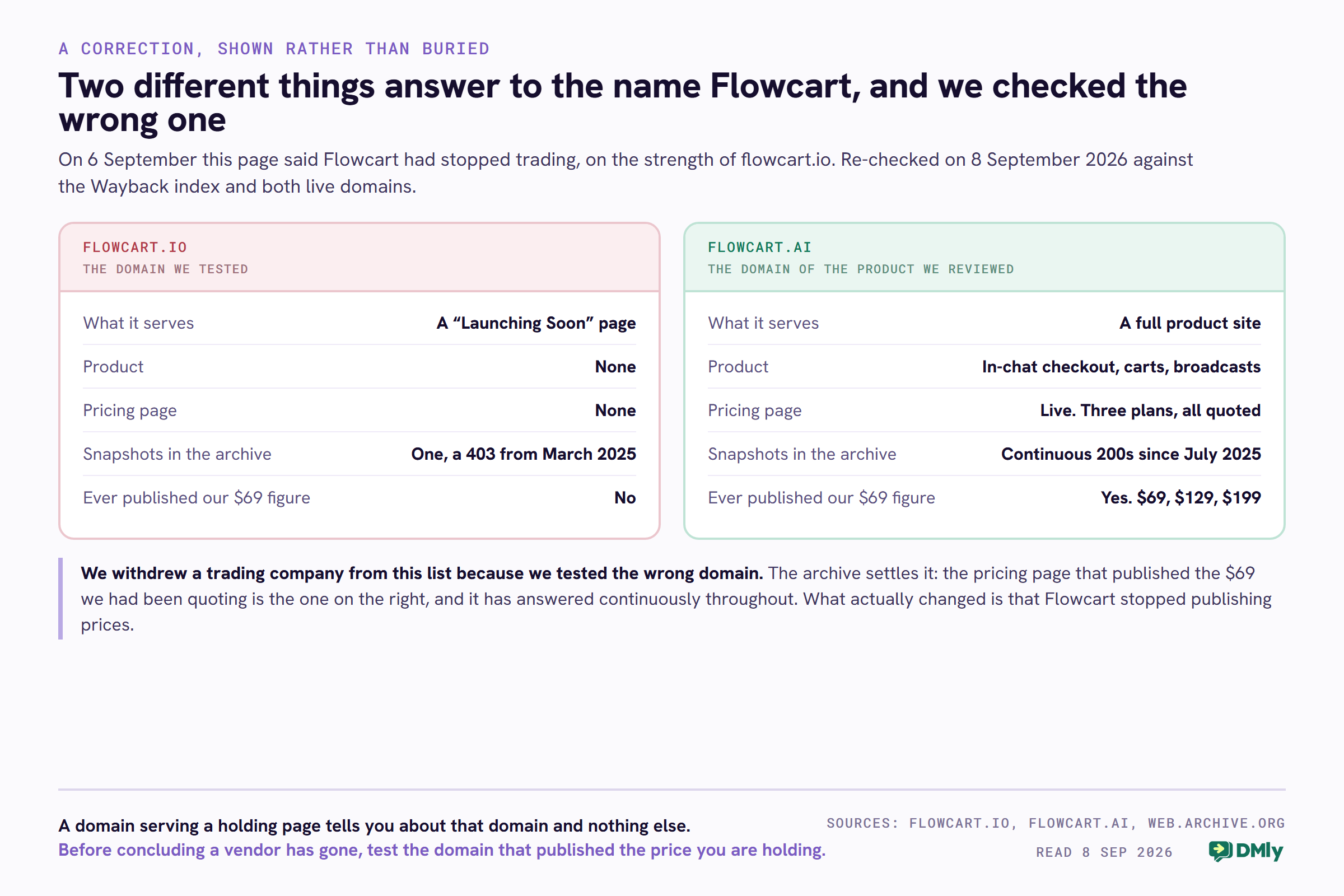
Flowcart held second place on this list at around $69 a month. Checking the list, we tested flowcart.io, found a page reading “Launching Soon” above a contact form with no product, no pricing and no way to sign up, and concluded the company had gone. We then moved SleekFlow into second place and said so in the open.
The reading of flowcart.io was accurate. The conclusion drawn from it was not, because that is not Flowcart’s domain. The product is at flowcart.ai, and on 8 September 2026 it is plainly trading: a full product site covering in-chat checkout, abandoned carts, opt-in popups, click-to-WhatsApp ads, broadcasts and retention, a Shopify app, a help centre, case studies, a terms page and a blog carrying an announcement about a Mastercard partnership.
The archive settles which domain we originally reviewed. flowcart.ai’s pricing page published $69, $129 and $199 in December 2025 and again in March 2026, which is the figure this page had been quoting. flowcart.io has a single snapshot in the entire Wayback index, a 403 from March 2025. It has never been the product.
What is actually true about Flowcart today
Flowcart has stopped publishing its prices. Its pricing page now shows three standard plans, Growth, Pro and Advanced, under a heading reading “Unlimited contacts & conversations. No growth tax.” All three say “Get a Quote”, and there is a separate enterprise track. The $69, $129 and $199 we used to quote are gone from the page.
That is why Flowcart is not numbered among the ten above, and the reason is worth stating plainly: this page compares tools on published prices, and Flowcart no longer has one. That is a limitation of the comparison, not a judgement on the product. If in-chat checkout is what you need, ask them for a quote and read it beside the numbers above.
The lesson we are keeping, because it is more useful than the apology: a domain that answers with a holding page tells you about that domain and nothing else. Two different things can answer to one name. Before you conclude that a vendor has gone, check the domain that published the price you are holding.
The Three Questions That Actually Set the Price
Across ten platforms, the headline number was the least useful thing on every pricing page. Three other facts moved the real cost far more.
One: what period does that price need?
Only three of the ten will sell you a single month at the headline rate. Gallabox has no monthly option at all, so its smallest purchase is a quarter at $450. Interakt’s page opens on a quarterly view. DMly, SleekFlow, Wati and Freshchat all print a yearly-billed number first and charge 20 to 30 per cent more to pay monthly.
If you want to test a tool for one month, that alone removes several of these from consideration before you look at a feature.
Two: how many people can log in?
This is where the spread is widest, and it is rarely in the headline.
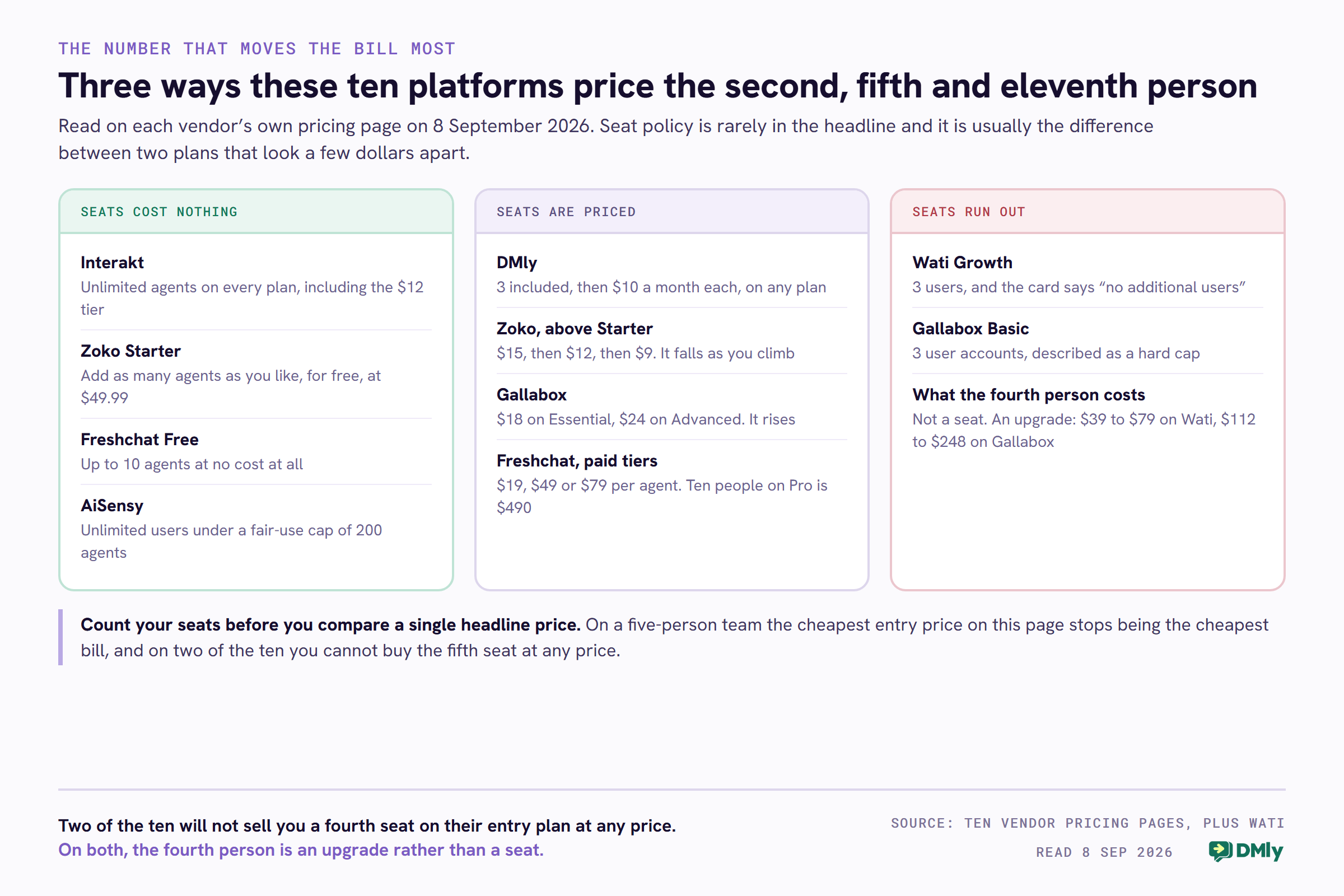
- Unlimited on every plan: Interakt, and Zoko on its $49.99 entry plan.
- A hard ceiling you cannot buy past: Wati Growth at three users, “no additional users”, and Gallabox Basic at three, described on the card as a hard cap. On both, the fourth person costs you an upgrade rather than a seat.
- A seat price that rises as you climb: Gallabox at $18 then $24, Wati at $24 then $59.
- A seat price that falls as you climb: Zoko at $15, then $12, then $9.
- Priced entirely per agent: Freshchat, where ten people on Pro is $490 a month.
Count your seats first. On a five-person team, the cheapest headline on this page is not the cheapest bill.
Three: does anyone stand between you and Meta?
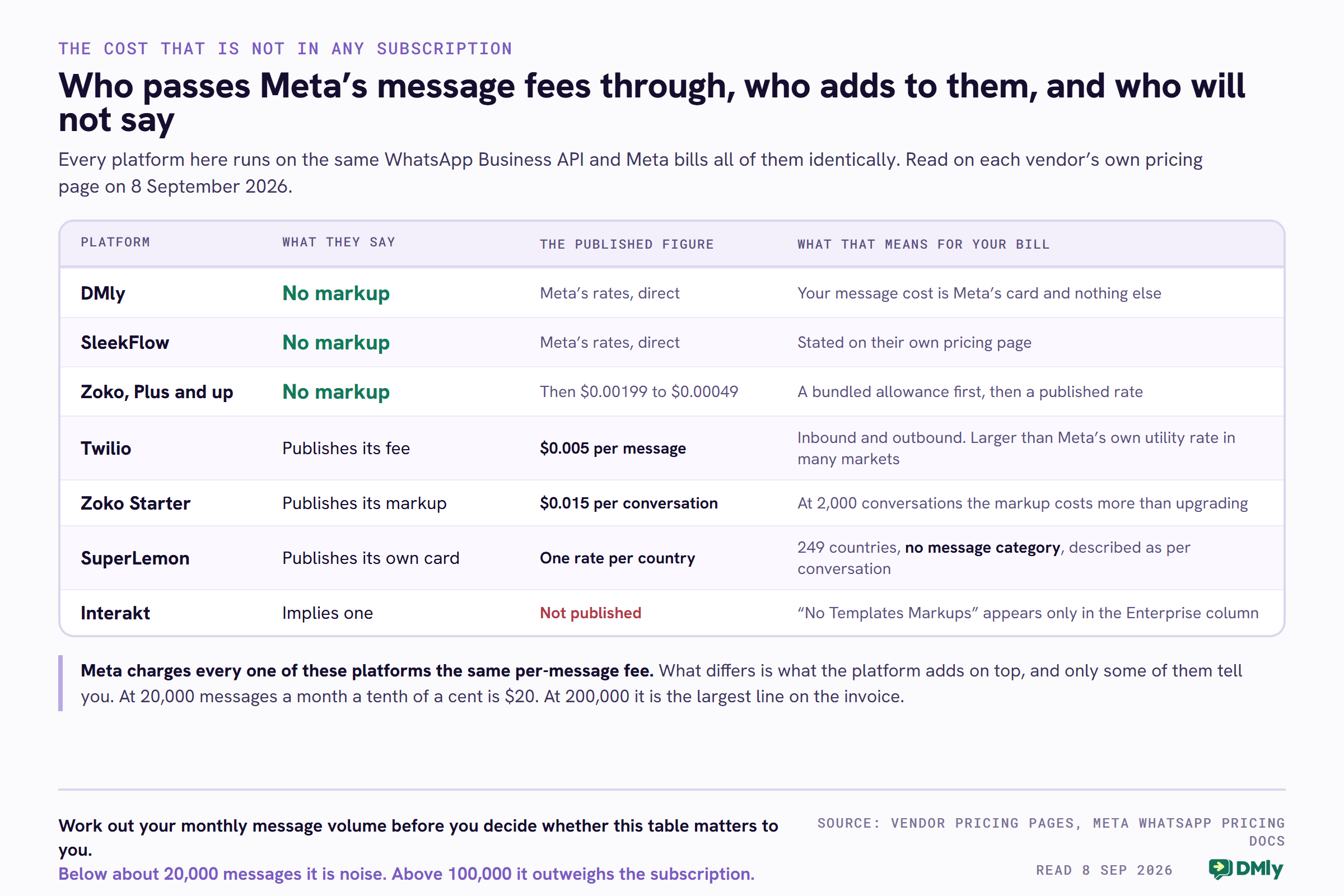
Every platform here sits on the same WhatsApp Business API and Meta charges the same per-message fees to all of them. What differs is what the platform adds:
- States no markup: DMly, SleekFlow, and Zoko on Plus, Elite and Max.
- Publishes its markup: Twilio at $0.005 a message, and Zoko on Starter at $0.015 a conversation. Both are honest, and both are real money at volume.
- Publishes its own rate card instead of Meta’s: SuperLemon, with one flat figure per country and no message category.
- Implies a markup without publishing it: Interakt, whose “No Templates Markups” line appears only in the Enterprise column.
On a business sending 20,000 messages a month, a tenth of a cent either way is $20 and irrelevant. At 200,000 it is the largest line on the invoice. Work out your volume before you decide whether this question matters to you at all.
What Changes for All Ten on 1 October 2026
Meta is changing what it charges, and the change lands on every platform on this page at the same time.
- Every business phone number gets 1,000 free service messages a month, with Meta charging from the 1,001st. No rollover, resets monthly. If most of your traffic is replies to customers who messaged first, this is good news, and it counts per number rather than per account.
- Utility messages sent inside an open 24-hour window stop being free, with no free allowance attached. Order updates, delivery notices, appointment reminders and payment confirmations are utility messages. For a busy business, this is the change that shows up on the bill.
Two of the ten pages we read are already out of step with it. Twilio’s WhatsApp pricing page states that there is no Meta fee during the customer service window for utility and free-form messages, which is true until 30 September. AiSensy’s plan cards say service conversations are “always free, on every plan”, with no cap mentioned. Both describe today accurately and neither describes October. One vendor was ahead of it: SleekFlow was carrying a banner about the change on the day we checked.
None of this is any vendor’s doing and none of it is avoidable by switching, because Meta bills it the same way whoever you send through. The full breakdown is at the WhatsApp pricing change on 1 October, and the country rates are at WhatsApp Business API pricing by country. Read the date on any vendor’s rate card before you budget from it.
How to Choose Your Wati Alternative
Start from the constraint that is actually binding, not from the feature list. On the evidence above, five constraints decide almost every case, and each one points at a different Wati alternative.
- You have more people than budget. Interakt, unlimited agents on every plan from $12 a month for one channel. Zoko Starter if you are on Shopify and can live with the per-conversation markup.
- You want to start at nothing. Freshchat, genuinely free for up to ten agents. AiSensy’s Free Forever plan if what you need is the API and the blue tick rather than campaigns, since it does not include broadcasting.
- The conversation is supposed to end in a booking or an invoice. DMly, from $29 a month billed yearly, with the calendar, the invoices and the review requests in the same product.
- You have a long list and few live chats. SleekFlow, unlimited broadcasts and unlimited contact storage on a $79 plan.
- You have engineering time. Twilio, no subscription and $0.005 a message, and you build the rest.
And one honest note about this page: we make DMly, so we are not a neutral referee. What we can do is show our working, which is what the prices, periods, seat counts and markups above are for. If a sibling review helps, we have applied the same method to respond.io, DoubleTick, Gallabox and Interakt, and the wider market is re-checked in our roundup of WhatsApp automation tools.
Wati Alternatives: Frequently Asked Questions
How much does Wati cost in 2026?
Growth is $39 a month billed annually or $49 monthly, with one channel and three users and no way to add a fourth. Pro is $79 or $99, with five users then $24 each. Business is $199 or $249, with five users then $59 each. There is a seven day free trial and no setup fee, and in India a one-time ₹999 single user plan that returns ₹999 in message credits.
What is the cheapest Wati alternative?
By headline price, Interakt at $12 a month, but that buys one channel. Freshchat is free for up to ten agents and AiSensy is free forever if you do not need broadcasting. Among plans that include broadcasts, a full inbox and an AI agent on the entry tier, DMly at $29 a month billed yearly is the lowest here. The cheapest for you depends on your seat count more than on any headline.
Which Wati alternatives include unlimited agents?
Interakt says unlimited agents on every plan including its $12 tier, and Zoko lets you add as many agents as you like for free on its $49.99 Starter plan. Everywhere else, seats are counted: Wati gives three and will not sell a fourth on Growth, Gallabox has a three-user hard cap on Basic, SleekFlow gives three on Pro, DMly gives three on Starter at $10 for each extra, and Freshchat charges per agent throughout.
Do any of these add a markup to WhatsApp message fees?
Twilio publishes one, at $0.005 a message on top of Meta’s fee. Zoko applies one on its Starter plan only, at $0.015 a conversation, and states no markup on its three higher plans. SuperLemon publishes its own per-country rate card rather than Meta’s. Interakt lists “No Templates Markups” as an Enterprise benefit, which implies one below that, and does not publish the figure. DMly and SleekFlow both state that you pay Meta’s rates with no markup added.
Is there a free Wati alternative?
Three, with different catches. Freshchat is free for up to ten agents with a real shared inbox. AiSensy’s Free Forever plan gives you the WhatsApp API and a blue tick application but no broadcasting. SuperLemon’s free tier gives a Shopify store a chat widget and 100 manual template messages a month without needing an API number at all. Yellow.ai has a free tier too, capped at 500 chat sessions a month and $0.99 per resolution after that.
What did this list of Wati alternatives check, and when?
Every price, billing period, seat count and message rate in this list of Wati alternatives was read on 8 September 2026 from each vendor’s own published pricing page, in a real browser where the figures are drawn in by JavaScript, and across every billing toggle each page offers. Wati’s own plans were read the same way and on the same day. Historic prices came from archived copies of the same pages. No account was created and no figure came from a software directory.
Writing about WhatsApp automation, bookings and growth for local business.
Turn WhatsApp into your busiest channel.
Start free and run message, bookings, payments and reviews in one place.
