
Spoki Review 2026: The Real Price, and the Unit It Is Billed In

The address this review was written about no longer reaches them.
spoki.it still answers, but its sitemap points entirely at spoki.com, and every pricing path on the old domain now redirects there. Spoki has moved house, changed price list and grown a second legal entity since this page was written, and the figures below were all wrong by the time you read them.
So this Spoki review has been rebuilt from their current site. What the plans cost now, the unit they are billed in and why that unit matters more than usual this month, which of our criticisms were fair and which have been withdrawn, and where DMly is a sensible Spoki alternative and where it plainly is not.
Everything below was read at source on 6 September 2026, with the plan prices read in a browser because they arrive in JavaScript. We have not run Spoki on a paid account, so there are no grades here for how it feels to use.
Spoki Is a Product. The Company Is Called Something Else
Their own corporate page puts it more bluntly than we would have dared: “Spoki is a product, not a company. The company is NextAI Srl.”
NextAI Srl is an Italian software house founded in 2021, registered at Viale Francia snc, 72019 San Vito dei Normanni, in Puglia, with VAT number IT02717930743. It owns 100 per cent of Spoki Conecta SL, the Spanish subsidiary that contracts with Spanish customers, and it runs an office in Barcelona alongside the Puglian headquarters. If you buy Spoki outside Spain, NextAI Srl is the entity on your invoice.
The funding history, published on the same page: a seed round in October 2023 led by the Magic Mind Accelerator with Smart4Tech as co-lead, and a 5.5 million euro Series A in January 2025 led by Blacksheep MadTech Fund and CDP Venture Capital, with Finint Investments and Apside. Their own account of what that money bought is consolidation in Italy and expansion into Spain, which matches what the site now looks like.
The rest of the scale claims, all theirs: over 4,500 businesses in more than 120 countries, 15.3 million WhatsApp messages a month, six site languages (English, Italian, Spanish, French, German and Portuguese), Official Meta Tech Partner status, and European data residency for GDPR. That is a materially bigger company than the one this page described, and it changes the shortlist question from “is this too small for us” to “is this the right shape”.
Spoki Pricing in 2026: Every Figure Re-Read
This page said Free, then Service from 24 euros, Marketing from 49 and Sales from 69. None of those three is the price today. Read on their pricing page in a browser at the smallest published volume, this is the current ladder, and it moves with the billing period rather than with a discount code.
| Plan | Billed monthly | Billed quarterly | Billed yearly | What it adds |
|---|---|---|---|---|
| Free | 0 euros | 0 euros | 0 euros | Live chat, ticketing, unlimited operators, unlimited automations |
| Service | 49 euros | 44 euros | 39 euros | Their words: automate your customer support with AI |
| Marketing | 99 euros | 89 euros | 79 euros | Bulk campaigns with AI |
| Sales | 149 euros | 134 euros | 119 euros | Abandoned carts and payment requests |
There is a fourth set of numbers on the same page, and we could not make the controls produce it. Near the top, under the heading “How much does Spoki cost?”, their own answer reads: “Service from 19 euros a month, Marketing from 39 euros a month, Sales from 55 euros a month.” The plan cards further down never go below 39, 79 and 119, at any of the three billing periods. We are not saying either figure is wrong; we are saying they do not agree, and if you are budgeting from the first one it is worth asking which applies.
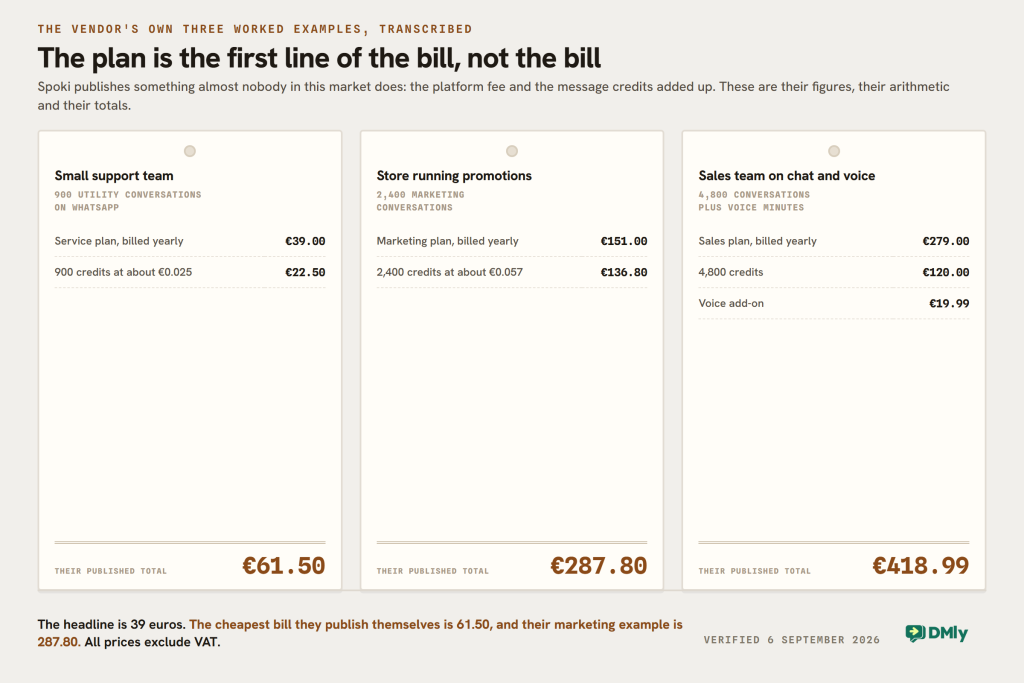
The subscription is only half the bill, and Spoki is unusually good about showing the other half. Their pricing page publishes three worked examples with the platform fee and the message credits added up, which almost nobody in this market does:
| Their worked example | Plan, billed yearly | Message credits | Their published total |
|---|---|---|---|
| Small support team, 900 utility conversations on WhatsApp | Service, 39 euros | 900 at about 0.025 euros, so 22.50 | About 61.50 euros a month |
| Store running promotions, 2,400 marketing conversations | Marketing, 151 euros | 2,400 at about 0.057 euros, so 136.80 | About 287.80 euros a month |
| Sales team on WhatsApp and voice, 4,800 conversations | Sales, 279 euros | 120 euros of credits plus a 19.99 voice add-on | About 418.99 euros a month |
Read those two tables together and the useful conclusion falls out. The headline is 39 euros. The first realistic bill their own page publishes is 61.50, and their marketing example is 287.80. That is not a criticism of Spoki, whose page is more honest about this than most. It is a warning about reading any headline in this market without the message costs attached.
Three Rules in Their Small Print Worth Reading Before You Sign
- Going over your conversation allowance costs 25 per cent more per conversation. Their own worked example: 189 euros divided by 2,400 conversations, multiplied by 1.25, gives 0.0984 euros for every conversation past the limit. That is a published overage rate, which is more than most vendors offer, and it is a surcharge rather than a discount.
- You can only overshoot by three times before you have to upgrade. Their words: usage beyond three times the included conversations requires a plan upgrade. So a Marketing plan of 2,400 conversations covers you to 7,200 with the surcharge, and no further.
- Excess usage is billed every 30 days even if you paid for the year. Their own line, and the one most likely to surprise somebody who thought an annual invoice was the end of it: “Excess usage is billed every 30 days, even on annual or quarterly plans.”
Support is a separate product with a separate price, and every tier rations tickets. Basic support is included at zero and gives you three tickets a month. Standard starts at 49 euros a month for ten tickets and a six-hour response time. Advanced starts at 199 for twenty tickets, a three-hour response and a 25-minute success call. Premium starts at 999 a month for a one-hour response, a dedicated account manager and a quarterly review. Every one of those is written as “starting from”, including the 999.
Set against that, two things Spoki includes that most of this market charges for: unlimited operators and unlimited contacts on every plan, including the free one. Their own FAQ is direct about it: “Spoki includes unlimited operators on every paid plan, you add agents, managers and supervisors without per-seat fees.” That is a real structural advantage and we will come back to it, because it is the clearest thing Spoki does better than us. Our own plan prices and seat rules are on the pricing page if you want to run the sum yourself.
Three Things Spoki Publishes That Almost Nobody Else Does
Having spent most of this Spoki review on prices and units, it is worth saying what their pricing page does better than the rest of this market, because two of the three are genuinely unusual.
- The message costs, added to the plan, in public. Most vendors publish a subscription and leave the message bill as an exercise for the reader. Spoki publishes three worked profiles with the platform fee, the credits and the total in one line each. Whether you buy from them or not, those three totals are a better sanity check on any WhatsApp budget than a headline price from anyone.
- The overage arithmetic, shown rather than described. Their small print does not say “additional usage may be charged”. It gives you the sum: 189 euros divided by 2,400 conversations, times 1.25, equals 0.0984 euros. That is the kind of disclosure a finance person can plan against.
- A block of answers written for machines, and labelled as such. Near the foot of the pricing page sits a section headed “AI-ready pricing answers”, described in their words as “canonical English answers to the pricing questions buyers most often ask AI assistants, structured so ChatGPT, Perplexity, Gemini and Google AI Overviews can cite them verbatim”. Whatever you think of the tactic, publishing it openly is more honest than doing it quietly, and it is a useful reminder that some of what an assistant tells you about a vendor was written by that vendor to be repeated.
One caution on that third point, and it is why we read the plan cards rather than the summary. The machine-facing block and the human-facing cards do not always agree. The block says Spoki “passes through the Meta rate plus a transparent margin”; the FAQ higher up the same page says WhatsApp fees are “billed separately at Meta WhatsApp Cloud API rates”, which reads like a pass-through with nothing added. Both cannot be the whole story. Ask which one describes your invoice.
What You Actually Get on Each Plan
Spoki’s own feature grid is organised into eight sections rather than a long list, and the shape of it tells you more about the product than the individual ticks do.
| Section | What sits in it | Where it starts |
|---|---|---|
| Channels | WhatsApp and one-way SMS, with two-way SMS and Voice offered as options on the paid tiers, plus a live chat widget | Free |
| Operators and contacts | Unlimited on every plan, including the free one | Free |
| Live chat, ticketing, automations | Their free plan carries live chat, ticketing and unlimited automations | Free |
| Artificial intelligence | Their own plan descriptions: support AI on Service, campaign AI on Marketing, commerce AI on Sales | Service |
| Campaigns | Bulk sending, which is the reason the Marketing tier exists | Marketing |
| Commerce | Abandoned cart recovery and payment requests | Sales |
| Integrations, CRM, tickets | Their FAQ claims 100 or more native integrations on every plan | Free upward |
The practical reading of that table is that the free plan is a real product and the Marketing plan is the one most businesses actually need. If your job is answering people who message you first, the free tier does it with unlimited staff on the inbox, which is a genuinely good offer. The moment you want to start a conversation at scale, you are on Marketing, and Marketing at a serious volume is the 287.80 euros a month their own example shows rather than the 79 on the card.
The Unit Spoki Bills In, and the Date It Stopped Existing
This is the finding that matters most this month, and it is not about Spoki’s prices being high or low. It is about what they are counting.
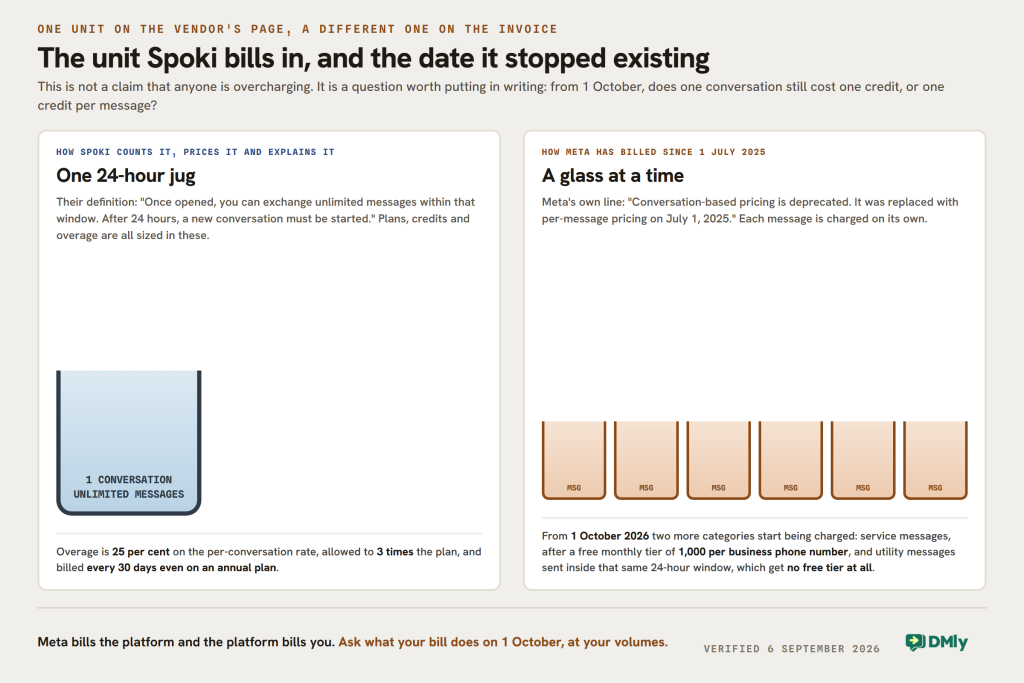
Spoki prices, meters and explains everything in conversations. Their pricing page defines one: “A conversation on Spoki is an interaction between your business and a customer, measured in 24-hour windows that start from the first message you send. Once opened, you can exchange unlimited messages within that window. After 24 hours, a new conversation must be started.” Plans are sized in conversations, overage is priced per conversation, and their credits table is per conversation.
Meta stopped billing that way over a year ago. Their own documentation says it in one line: “Conversation-based pricing is deprecated. It was replaced with per-message pricing on July 1, 2025.” Under the model in force, every template message is charged individually, so sending one marketing message and one utility message is two charges rather than one 24-hour window.
And it changes again shortly. From 1 October 2026, Meta charges per message for two categories that are free today: service messages, which are the ordinary free-form replies you send inside the 24-hour window, and utility messages sent inside that same window. Service messages come with a free monthly tier of 1,000 per business phone number, so a small support desk will usually pay nothing on that side. Utility messages in the window get no allowance at all, which for anyone sending confirmations and reminders is the bigger new bill. Meta’s page also states that service messages get no volume tiers while utility and authentication keep theirs, so past that first thousand the cost of a long conversation scales in a straight line.
We are not saying Spoki is overcharging anyone. Meta bills the platform, the platform bills you, and a vendor is entitled to package a metered cost into a simpler unit if it wants to. Spoki also states plainly on the same page that they pass through “the Meta rate plus a transparent margin disclosed on the pricing page”, which is more disclosure than most of this market offers. But a 24-hour bucket and a per-message meter behave very differently once messages inside the window start being charged, and Spoki’s page does not yet say what happens on 1 October.
So here is the question to put to them in writing before you sign anything, and it is a fair one to put to every vendor on your shortlist: from 1 October, when Meta charges per message inside the 24-hour window, does my Spoki conversation still cost one credit, or does it cost one credit per message. The answer changes a support-heavy month by a large multiple, and any vendor should be able to answer it in a sentence. We have set out exactly what becomes billable on that date if you want the detail before you ask.
Spoki is far from alone here. We ran the same check across eight platforms while rewriting our charles review and its alternatives, and four of them still describe a model that has expired or is about to.
Four Things This Spoki Review Got Wrong
Rewriting a page is also a chance to admit what it said badly. Four of the six criticisms in the old “cons” list do not survive contact with their current site.
- “AI is not a core feature. AI exists in higher plans.” Withdrawn. Spoki now describes every paid plan by its AI: Service is “automate your customer support with AI”, Marketing is “boost your bulk campaigns with AI”, Sales is “manage your eCommerce with AI”. Artificial Intelligence is a section in their own feature comparison rather than a line item bolted onto the top tier.
- “Limited beyond WhatsApp.” Withdrawn as written. Their channel row now lists WhatsApp, one-way SMS, two-way SMS as an option, Voice as an option, and a live chat widget. WhatsApp is still the centre of gravity, which is a fair thing to say. “WhatsApp only” is not.
- “Automation is relatively basic” and “CRM functionality is lightweight.” Both withdrawn. We have not run the product on a paid account, and an adjective about depth is not a finding. What we can tell you is what their comparison table has sections for: automations, campaigns, integrations, tickets, CRM, commerce and AI, with unlimited automations listed on the free plan.
- A misspelling of the product name, live since March. The opening section dropped the p out of Spoki. Fixed, along with the four figures in the pricing section that had gone stale around it.
What survives, sharpened: the total cost of ownership rises quickly with volume, which their own worked examples now demonstrate better than our warning did, and a business that wants seven messaging channels in one inbox rather than four will find Spoki narrower than a general platform. Those are the two honest reasons to look at Spoki alternatives, and neither of them is a complaint about quality.
The Number in Their Page Title
Their home page carries the claim in its browser title, in English and in Italian: a 98 per cent open rate, alongside a 23 times return on ad spend that they source to their own platform data across 4,500 businesses.
The second figure is a vendor’s own measurement, clearly labelled as such, and that is exactly how it should be published. The first one is the most repeated statistic in this industry and we have never been able to trace it to a primary source. It appears on hundreds of vendor pages, always rounded the same way, never with a methodology attached. That is not an accusation against Spoki, who are quoting an industry-wide figure that almost every competitor also quotes, us included until we went looking for it.
The practical advice is the same whoever prints it. Do not build a business case on 98 per cent. Send one broadcast, read your own delivered and read counts, and use that number instead. Our page on what the WhatsApp statistics actually say sets out why the 98 per cent figure will not survive a due-diligence question, and what to say instead.
DMly as a Spoki Alternative, With the Bit That Goes Against Us First
We make DMly, so start this part of the Spoki review with the comparison we lose.
Spoki does not charge you for seats or for contacts. We do. Their plans, including the free one, list unlimited operators and unlimited contacts. DMly’s plans include three, six and fifteen team seats and 3,000, 10,000 and unlimited active contacts, with extra seats at $10 a month and extra contacts at $15 per thousand. If you run a twelve-person support desk on a small list, Spoki’s structure is simply better for you than ours, and no feature comparison changes that arithmetic.
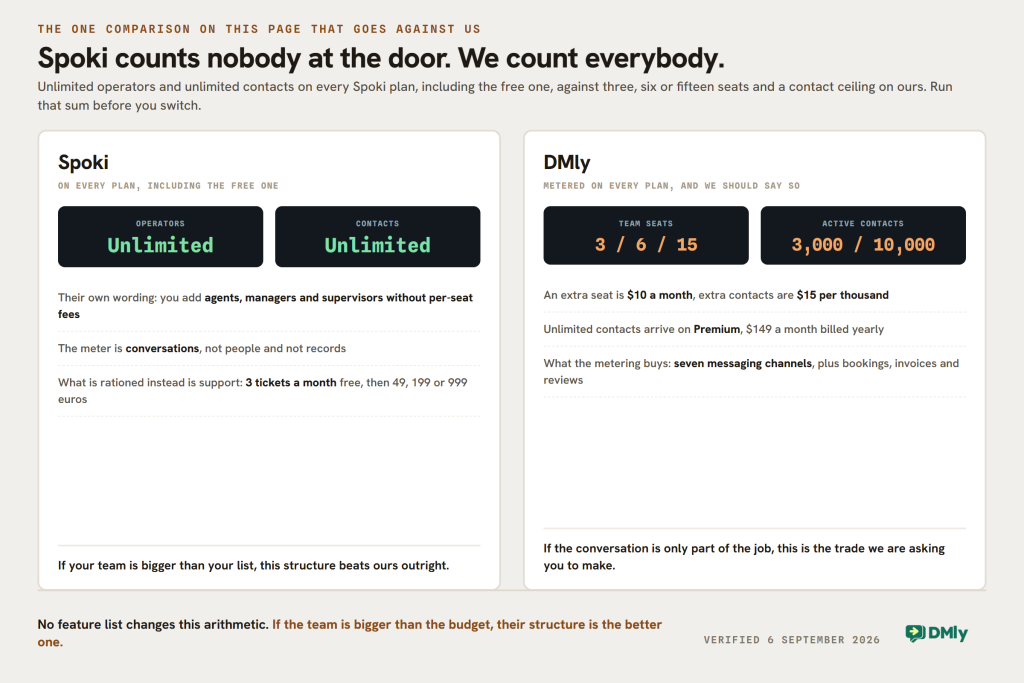
What DMly gives you instead is scope. Seven messaging channels rather than one plus options: WhatsApp, Facebook Messenger, Instagram, Telegram, SMS, TikTok and a live chat widget, plus a Google Business Profile connection for reviews. And the parts of a business that sit either side of a conversation: bookings with services, staff and classes, invoices and payment links, loyalty, and automatic Google review requests. Spoki is a conversation platform. DMly is a business platform that runs on conversations.
| Spoki | DMly | |
|---|---|---|
| Entry price | Free plan, then 39 euros a month billed yearly (49 monthly) | $29 a month billed yearly, $39 monthly, no free plan |
| What the plan is sized by | Conversations, in 24-hour windows | Contacts, broadcast messages and AI replies |
| Team seats | Unlimited on every plan | 3, 6 or 15, then $10 each |
| Contacts | Unlimited on every plan | 3,000, 10,000, then unlimited on Premium |
| Going over the allowance | 25 per cent surcharge per conversation, up to 3 times the plan, billed every 30 days | Move up a plan, or add contacts at $15 per 1,000 |
| Channels | WhatsApp, live chat, one-way SMS, plus two-way SMS and voice as options | WhatsApp, Messenger, Instagram, Telegram, SMS, TikTok, live chat widget |
| Bookings, invoices, reviews | Not offered on their site | Services, staff and classes; invoices and payment links; Google review requests |
| Support | Rationed by ticket. Free tier is 3 a month; 49, 199 and 999 euros a month buy more | Included, with priority support and onboarding on Premium |
| Markup on Meta’s charges | Their words: the Meta rate “plus a transparent margin disclosed on the pricing page” | Our pricing page says you pay Meta’s standard per-message rates directly, with no markup |
One more honest note on that last row, because it is the one a buyer should press hardest on. Spoki says there is a margin and says it is disclosed. We say there is no margin. Neither claim is checkable from the outside without your own invoice in front of you, so the useful move is the same either way: find Meta’s own published rate for the countries you message, put it next to the per-message or per-conversation figure your vendor quotes, and ask them to explain the difference.
Which One to Buy
Everything in this Spoki review points at one question, and it is not which product has more features. It is which meter suits your shape. Buy Spoki if the team is bigger than the budget. Unlimited operators and unlimited contacts on every plan, including free, is the most generous structure in this category, and if you are an Italian or Spanish business it is also the one whose support, contracts and data residency sit closest to home. The free plan is a genuine way to work inside the 24-hour window without paying anything, which very few competitors offer.
Buy DMly if the conversation is only part of the job. Bookings, invoices and reviews on the same contact record, seven channels rather than one, and a month-to-month option at $39 while you find out whether any of it works. You will pay for seats and for contacts, which Spoki does not charge for, so run that sum before you switch.
Buy neither until you have asked the October question. Both platforms sit on top of Meta’s charges, both are affected on 1 October, and only one of them has a page explaining it. Ask each vendor what your bill does on that date at your volumes, and treat a vague answer as information.
Frequently Asked Questions
How much does Spoki cost in 2026?
At the smallest published volume, Service is 39 euros a month billed yearly, Marketing 79 and Sales 119, with a free plan below them. Billed monthly the same three are 49, 99 and 149, and quarterly billing sits in between at 44, 89 and 134. All prices exclude VAT, the plan price rises with your conversation volume, and Meta’s message charges are billed on top.
Does Spoki have a free plan?
Yes, and it is more useful than most free tiers. It carries live chat, ticketing, unlimited operators and unlimited automations, which makes it a real way to answer customers inside the 24-hour window at no platform cost. What it does not carry is campaigns, so the moment you want to send a broadcast you are on a paid plan.
What happens if I go over my Spoki conversation limit?
Their published rule is a 25 per cent surcharge on the per-conversation rate, allowed up to three times your plan’s allowance, after which you have to upgrade. Their own worked example is 189 euros divided by 2,400 conversations times 1.25, giving 0.0984 euros per extra conversation. Excess usage is billed every 30 days even if you are on an annual or quarterly plan.
Who owns Spoki?
NextAI Srl, an Italian software company founded in 2021 and registered in San Vito dei Normanni in Puglia, with an office in Barcelona and a wholly owned Spanish subsidiary called Spoki Conecta SL. They raised a 5.5 million euro Series A in January 2025 led by Blacksheep MadTech Fund and CDP Venture Capital.
What are the best Spoki alternatives?
It depends which part of Spoki you are replacing. For a bigger team on a small budget, almost nothing matches unlimited seats, so check that first. For more channels and for bookings and invoices alongside messaging, DMly starts at $29 a month billed yearly. For a wider comparison of platforms that publish a figure on the page, or for the Italian and Spanish market specifically, our roundup of WhatsApp automation tools with real prices covers twenty of them.
Is Spoki suitable for large businesses?
Their own numbers say 4,500 businesses in more than 120 countries and 15.3 million messages a month, which is not a small operation. The practical limits are the shape rather than the scale: the plan tops out at a conversation volume you have to upgrade past, support is rationed by ticket unless you buy a support tier, and the product is built around WhatsApp with other channels as options rather than equals.
Writing about WhatsApp automation, bookings and growth for local business.
Turn WhatsApp into your busiest channel.
Start free and run message, bookings, payments and reviews in one place.
