If you’re looking for a Zipchat alternative, chances are you’re already using or considering AI chatbots to handle customer conversations, boost conversions, and reduce support workload. And to be fair, Zipchat does a solid job of turning website visitors into conversations with its proactive AI approach.
But as your business grows, you may start to notice a gap. Conversations alone aren’t enough. You need better automation, smarter segmentation, and a way to run campaigns – not just respond to chats. That’s where platforms like DMly start to stand out.
In this guide, we’ll break down Zipchat’s features, pricing, and limitations, and show you why many teams are switching to DMly for more flexibility and control.
What is Zipchat AI?
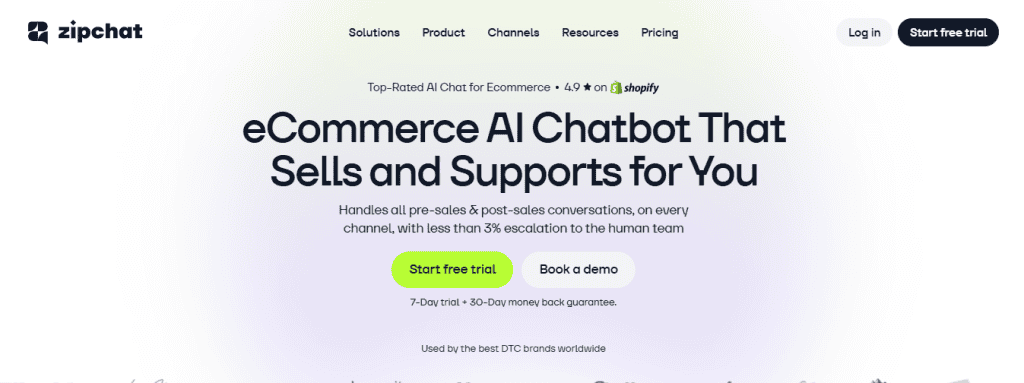
Zipchat is an AI-powered chatbot platform built primarily for e-commerce businesses that want to turn website visitors into conversations – and ultimately, into customers.
Instead of waiting for users to ask questions, Zipchat takes a more proactive approach. It can initiate chats based on visitor behavior, recommend products, and guide users through the buying process in real time.
At its core, Zipchat is designed to handle two main things: sales conversations and customer support automation. It uses natural language processing to understand customer queries, respond instantly, and even provide order updates or explain store policies without human involvement.
For many online stores, this means fewer support tickets and more conversions happening directly through chat.
While its strongest use case is website chat, Zipchat also supports other channels like WhatsApp, Instagram, Messenger, and email. However, its real strength still lies in how it enhances the on-site shopping experience, helping businesses engage visitors at the exact moment they’re most likely to convert.
What Zipchat Does Really Well
Zipchat isn’t trying to be everything, and that’s actually part of its strength. It focuses heavily on doing a few things exceptionally well, especially for e-commerce businesses that care about conversions and quick customer responses.
Here are the areas where Zipchat stands out:
- Proactive customer engagement
Unlike many chat tools that wait for users to start a conversation, Zipchat can initiate chats based on visitor behavior. This helps capture attention at the right moment – like when someone lingers on a product page or hesitates at checkout. - Strong product recommendation engine
The AI doesn’t just answer questions; it actively suggests products based on user intent. This makes it feel more like a sales assistant than a support bot, which can help increase average order value. - High support automation rate
Zipchat can handle a large percentage of customer queries automatically, reducing the need for human agents and speeding up response times. - Quick and simple setup
Getting started with Zipchat is relatively straightforward. Most ecommerce businesses can deploy it on their website without heavy technical work, making it accessible even for small teams. - Designed specifically for e-commerce
Everything about Zipchat is tailored for online stores. It understands product queries, purchase intent, and common e-commerce workflows better than generic chatbot tools. - Multi-channel presence (to an extent)
While it’s strongest on website chat, Zipchat also supports channels like WhatsApp, Instagram, and Messenger, allowing businesses to extend conversations beyond just their site.
Zipchat Pricing (And What You’re Really Paying for)
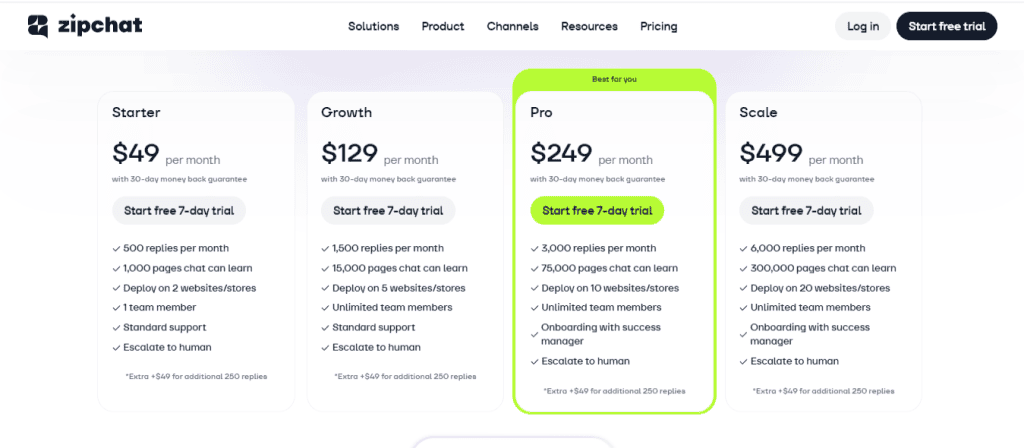
Zipchat keeps its pricing fairly straightforward, but there’s an important detail many businesses overlook at first glance: you’re paying based on AI replies, not contacts or campaigns. That means the more conversations your chatbot handles, the faster you scale into higher plans.
Here’s how the pricing is structured:
Starter – $49/month
This plan gives you 500 AI replies per month, access to 1,000 pages for training your chatbot, and deployment on up to 2 websites or stores. It also includes one team member and the ability to escalate conversations to a human when needed. It’s a decent starting point for small stores just getting into AI chat.
Growth – $129/month
The Growth plan increases your limit to 1,500 replies per month and expands chatbot training to 15,000 pages. You can deploy across 5 stores and add unlimited team members. This is where most growing ecommerce brands will likely sit, especially if they’re seeing steady traffic.
Pro – $249/month
At the top tier, you get 3,000 AI replies per month, up to 75,000 pages for chatbot learning, and deployment on 10 stores. It also includes onboarding support with a success manager, which can be helpful for larger teams setting up more complex use cases.
Where Zipchat Starts to Feel Limited
Zipchat does a great job at handling conversations on your website. But once your business moves beyond basic chat automation, a few limitations start to show, especially if you’re trying to build a more complete messaging strategy.
- Not built for full customer lifecycle marketing
Zipchat focuses mainly on real-time conversations. It doesn’t offer strong tools for nurturing leads, running follow-ups, or managing long-term customer journeys. - Limited outbound campaigns and retargeting
If you want to send targeted broadcasts, re-engage inactive users, or run structured messaging campaigns, Zipchat doesn’t provide the depth needed for that. - Lightweight customer data management
While it can handle conversations well, Zipchat doesn’t function as a full CRM. There’s limited ability to organize contacts, track lifecycle stages, or build detailed customer profiles. - Automation is chat-focused, not journey-driven
Its automation revolves around responding to users in real time. You don’t get the same level of control for building multi-step workflows triggered by behavior or events. - Pricing scales with usage
Because plans are based on AI replies, costs can increase quickly as your chat volume grows, especially for businesses with high traffic or frequent interactions. - Multi-channel support isn’t deeply developed
Although Zipchat supports platforms like WhatsApp and Instagram, its strongest functionality remains tied to website chat. Other channels don’t get the same level of depth.
In short, Zipchat is excellent at starting conversations but less equipped to manage what happens before and after those conversations at scale.
Meet DMly: A Reliable Zipchat Alternative for Businesses

If Zipchat is built to help you start conversations, DMly is designed to help you own the entire customer journey – from first touch to repeat purchase.
Instead of focusing mainly on website chat, DMly expands messaging into a full growth system. It combines automation, campaigns, CRM, and multi-channel messaging into one platform, so you’re not just reacting to conversations; you’re actively driving them.
Here’s where DMly takes things further:
Multi-channel messaging that goes beyond your website
DMly doesn’t limit engagement to your website. It connects with channels like WhatsApp, Instagram, Messenger, Telegram, and live chat, bringing all conversations into one place.
This means you can reach customers where they already are, instead of waiting for them to land on your site before engaging them.
AI + automation (not just chatbots)
While Zipchat focuses on AI conversations, DMly combines AI with a powerful automation engine. You can build workflows that trigger based on user actions, campaign engagement, CRM updates, and external events (via webhooks). This allows you to automate not just replies, but entire customer journeys – from lead capture to follow-up and conversion.
Campaigns, broadcasts, and retargeting
DMly gives you the tools to actively drive engagement through outbound messaging.
You can:
- send targeted broadcast campaigns
- retarget users who didn’t convert
- schedule promotions and updates
- follow up automatically with leads
This turns messaging into a revenue channel; not just a support function.
Built-in CRM for better customer management
DMly includes a native CRM system, so you can manage contacts without relying on external tools. You can organize customers using tags, custom attributes, pipeline stages, and interaction history. This makes it easier to personalize campaigns and track where each customer is in your funnel.
Advanced segmentation for personalized messaging
With DMly, you’re not sending the same message to everyone. You can segment your audience based on:
- behavior
- engagement
- purchase history
- campaign interactions
This leads to more relevant messaging and better results.
Unlimited automation and scalability
Unlike many tools that restrict workflows, DMly allows unlimited automation flows across all plans. This gives growing businesses the flexibility to scale their messaging strategy without hitting artificial limits.
Zipchat vs DMly: Quick Comparison
| Feature | Zipchat | DMly |
| AI Chatbot | ✅ Strong (ecommerce-focused) | ✅ Strong (AI + automation) |
| Multi-Channel Messaging | ⚠️ Limited depth | ✅ Full support (WhatsApp, IG, Messenger, Telegram, Web) |
| Website Chat | ✅ Core strength | ✅ Supported |
| Campaigns & Broadcasts | ❌ Minimal | ✅ Advanced campaigns & retargeting |
| Automation Depth | ⚠️ Chat-focused | ✅ Full journey automation |
| CRM & Customer Data | ❌ Basic | ✅ Built-in CRM with segmentation |
| Behavioral Segmentation | ⚠️ Limited | ✅ Advanced segmentation |
| Retargeting Capabilities | ❌ Not supported | ✅ Yes |
| Pricing Model | ⚠️ Usage-based (AI replies) | ✅ Predictable tiers |
| WhatsApp Marketing | ⚠️ Limited functionality | ✅ Fully supported |
| Integrations & API | ⚠️ Basic | ✅ Strong (API, webhooks, Zapier, etc.) |
| Scalability | ⚠️ Can get expensive with volume | ✅ Built for scaling teams |
Automation: Chatbot vs Full Customer Journey
This is where the difference between Zipchat and DMly becomes very clear. Both tools use automation, but they approach it in completely different ways.
Zipchat’ automation
Zipchat’s automation is centered around its AI chatbot. It reacts to what users are doing in real time – answering questions, recommending products, and guiding visitors while they’re on your website.
It’s great for:
- handling FAQs instantly
- assisting shoppers during browsing
- reducing support workload
- nudging users toward purchase decisions
But the automation mostly lives within the conversation itself. Once that interaction ends, there’s limited ability to continue the journey automatically through follow-ups, campaigns, or behavioral triggers.
DMly’s automation
DMly takes a broader approach. Instead of focusing only on live conversations, it allows you to automate entire customer journeys across multiple touchpoints. You can build workflows that:
- follow up with leads after initial interaction
- trigger messages based on user behavior
- re-engage users who didn’t convert
- move contacts through different stages of your funnel
- connect with external systems via APIs and webhooks
This means automation doesn’t stop when the chat ends. It continues across the customer lifecycle.
CRM and Customer Data Management
When it comes to managing customer information, Zipchat and DMly take very different approaches. One is conversation-first, the other is built around structured customer data.
Zipchat: Conversation-Centric Data
Zipchat keeps things simple. Most of the data it works with is tied directly to conversations – what the user asked, what the AI responded with, and how the interaction played out.
This works well for answering questions quickly, understanding immediate customer intent, and improving chatbot responses over time. However, beyond basic interaction history, there’s limited ability to:
- organize contacts into structured groups
- track long-term customer journeys
- manage sales pipelines or lifecycle stages
In short, Zipchat helps you understand the conversation but not necessarily the customer beyond that moment.
DMly: Built-in CRM for Lifecycle Management
DMly approaches this differently by including a full customer data layer inside the platform. You can manage contacts using:
- tags and labels
- custom attributes
- lifecycle stages or pipelines
- notes and conversation history
This allows you to do more than just respond; you can track where each customer is in your funnel and act accordingly. For example:
- new leads can be tagged and nurtured
- engaged users can be moved into retargeting campaigns
- repeat customers can receive personalized offers
Because CRM data is tightly connected with automation and campaigns, every interaction becomes part of a larger system, not just a standalone conversation.
Analytics and Insights
Data is what turns messaging from guesswork into strategy. Both Zipchat and DMly provide insights, but they focus on very different parts of the customer experience.
Zipchat
Zipchat’s analytics are centered around how users interact with the chatbot. You can see how conversations perform, how often the AI resolves queries, and where users drop off or convert during chat.
DMly
DMly goes a step further by connecting messaging data with campaigns, automation, and customer behavior. Instead of just tracking conversations, you can analyze:
- campaign performance (delivery, engagement, conversions)
- automation workflow effectiveness
- customer engagement across channels
- segmentation performance
- team and conversation activity
Because everything – CRM, campaigns, and automation – is integrated, the insights are more holistic. You’re not just seeing what happened in a chat; you’re seeing how your entire messaging strategy is performing.
Pricing Comparison: Zipchat vs DMly
At first glance, both Zipchat and DMly seem reasonably priced. But once you look closer at how each platform charges, the difference becomes much clearer, especially as your business starts to scale.
Zipchat uses a usage-based pricing model tied to AI replies. Its Starter plan begins at $49/month for 500 replies, then scales to $129/month for 1,500 replies. While this works well for businesses with lower traffic, costs can increase quickly as more customers interact with the chatbot. The more conversations you have, the more you pay.
DMly, on the other hand, uses a tiered pricing structure based on capacity; not usage. Plans start at $29/month and scale based on contact limits, team members, and campaign volume. This means businesses can run automation, campaigns, and conversations without worrying about being charged for every interaction.
Another important distinction is how messaging fees are handled. With DMly, businesses pay Meta’s official WhatsApp messaging fees directly with zero markup. This keeps costs transparent and predictable, especially for teams sending large volumes of messages.
Many platforms in the space add hidden margins on these fees, but DMly avoids that entirely.
Final Verdict
Zipchat is a strong choice if your main goal is to convert website visitors through AI-powered conversations. It’s simple, effective, and does exactly what it promises.
But for businesses that want to go beyond chat – running campaigns, building automated journeys, and managing customer relationships at scale – DMly offers a more complete and flexible solution. It’s not just about handling conversations, but about turning them into a growth system.
FAQs
Is Zipchat only for e-commerce stores?
Yes, Zipchat is heavily focused on e-commerce use cases. While it may work for other industries, its features are designed mainly for online stores and product-based businesses.
What is DMly used for?
DMly is used for automating customer communication, running messaging campaigns, managing leads, and building end-to-end customer journeys across platforms like WhatsApp, Instagram, and Messenger.
Is DMly better than Zipchat?
It depends on your needs. Zipchat is great for AI-driven website chat, but DMly is better suited for businesses that want advanced automation, campaigns, CRM functionality, and multi-channel engagement.
Does DMly support WhatsApp marketing?
Yes. DMly fully supports WhatsApp marketing, including broadcast campaigns, retargeting, automation workflows, and integration with the WhatsApp Business API.
Can DMly replace tools like Zipchat completely?
In most cases, yes. DMly can handle conversations, automation, campaigns, and customer management in one platform, making it a more comprehensive solution for growing businesses.
Is DMly suitable for small businesses?
Yes. DMly offers entry-level pricing and scalable plans, making it accessible for small businesses while still supporting growth as your messaging needs expand.