
Bird (formerly MessageBird) is one of those platforms that promises to do it all. Messaging, automation, customer data, multi-channel campaigns – it’s all there. For enterprise teams with the resources to manage it, that can be incredibly powerful.
But here’s the thing: not every business needs an enterprise-grade system to run effective messaging campaigns. And for many teams, Bird can feel like more than what’s necessary – both in complexity and cost.
In this Bird review, we’ll take a closer look at what MessageBird actually offers, how its pricing works, and why platforms like DMly are becoming a more practical alternative for growing businesses.
What is Bird (formerly MessageBird)?
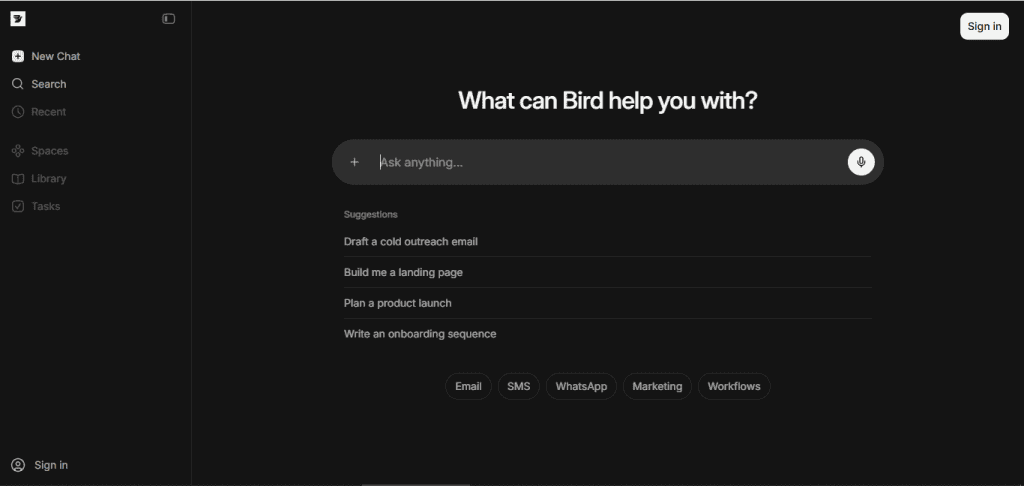
Bird is an omnichannel communication and marketing platform designed to help businesses connect with customers across multiple channels from a single system. These channels include SMS, email, WhatsApp, voice, and other messaging platforms, all managed through a unified interface.
At its core, Bird combines three major capabilities into one platform:
- Messaging infrastructure (SMS, WhatsApp, email, voice)
- Customer data platform (CDP) to unify user information
- Marketing automation tools for running campaigns and workflows
This combination allows businesses to manage customer communication, automate engagement, and personalize interactions based on data – all within one ecosystem.
Bird is particularly geared toward mid-market and enterprise teams that need flexibility and scale. It provides APIs and developer tools that allow companies to build custom communication workflows, integrate deeply with internal systems, and manage large volumes of customer interactions across different regions and channels.
While this makes Bird a powerful solution, it also means the platform is built more for complex use cases and large-scale operations rather than simple, single-channel messaging needs.
What Bird Is Really Built for
Not every messaging platform is designed for the same type of business. Bird is built with a very specific audience in mind, and understanding that upfront can save you a lot of time.
At its core, Bird is designed for companies that need scale, flexibility, and deep customization.
Here’s where it fits best:
- Enterprise teams managing multiple communication channels
If your business operates across SMS, email, WhatsApp, and voice – and you want all of them connected, Bird provides the infrastructure to make that happen. - Organizations with technical resources
Bird offers powerful APIs and customization options, but getting the most out of it often requires developers or technical teams who can build and maintain workflows. - Businesses running complex customer journeys
It’s built for multi-step, multi-channel campaigns – like sending an email, then an SMS, then a WhatsApp message based on user behavior. - Companies that rely heavily on data-driven marketing
With its customer data platform (CDP), Bird helps unify customer data and use it to personalize campaigns at scale. - High-volume messaging operations
Businesses sending large volumes of messages across regions can benefit from Bird’s global infrastructure and delivery capabilities.
Bird Pricing (What You Actually Pay)
Pricing with Bird can feel a bit different from most messaging platforms. Instead of one simple monthly plan, Bird combines contact-based pricing with usage-based costs, which means your total spend depends on how much you use the platform.
Let’s break it down.
Contact-Based Pricing (Monthly Plans)
Bird offers plans based on the number of contacts stored in your system.
- Around $45/month gets you roughly 3,000 contacts
- This scales up to about $440/month for 50,000 contacts
- Beyond that, you’ll need to request custom pricing
These plans typically include access to the platform’s automation tools, messaging capabilities, and customer data features.
Usage-Based Costs (Messaging Fees)
On top of the monthly plan, you also pay for usage:
- Email: about $1.50 per 1,000 emails
- WhatsApp: around $0.005 per message
- SMS and voice: priced separately depending on region and volume
There’s also a pay-as-you-go option, where you don’t commit to a monthly contact bundle but instead pay based on usage alone.
All these mean Bird’s pricing isn’t just one number, but a combination of how many contacts you store, how many messages you send, and which channels you use.
This can be flexible, especially for enterprise teams that want control over their infrastructure. But it also means costs can grow quickly as your contact list and messaging volume increase.
Where Bird Works Really Well
Bird is built with scale in mind, and when used in the right environment, it can be incredibly powerful. For certain types of businesses, it offers capabilities that go far beyond what most messaging tools provide.
Here are the situations where Bird truly stands out:
- Enterprise-level communication at scale
Bird is designed to handle large volumes of messages across multiple channels and regions. For companies operating globally, this level of infrastructure can be a big advantage. - Multi-channel customer engagement
If your strategy involves combining SMS, email, WhatsApp, and voice into one coordinated system, Bird makes it possible to manage everything from a single platform. - Deep customization through APIs
Businesses with technical teams can use Bird’s APIs to build custom workflows, integrate with internal systems, and create highly tailored communication experiences. - Complex customer journey orchestration
Bird allows companies to design multi-step journeys across channels. For example, sending an email, followed by an SMS reminder, and then a WhatsApp message based on user behavior. - Data-driven marketing strategies
With its customer data platform, Bird enables businesses to unify customer information and use it to personalize campaigns at scale.
Where Bird Starts to Feel Challenging
Bird is powerful, but that power often comes with trade-offs. For many businesses, especially those outside the enterprise space, these challenges become noticeable fairly quickly. Let’s take a look at some of the common friction points teams run into:
- Steep learning curve
Bird isn’t the kind of tool you pick up in an afternoon. Its interface, workflows, and configuration options can take time to understand, especially for non-technical teams. - Requires technical involvement
While there are visual tools available, many of Bird’s more advanced capabilities rely on APIs and integrations. Without a developer or technical support, it can be difficult to unlock its full potential. - Pricing can become hard to predict
Because costs are tied to both contacts and usage, it’s not always easy to estimate your monthly spend. As your contact list grows and messaging volume increases, costs can rise quickly. - Overkill for simple use cases
If your goal is straightforward, like running WhatsApp campaigns or automating conversations, Bird can feel unnecessarily complex and heavy. - Setup and implementation time
Compared to simpler tools, getting Bird fully configured for your workflows and integrations can take longer, especially for larger teams. - Less intuitive for marketing teams
Marketing teams that prefer quick campaign setup and execution may find Bird less straightforward compared to platforms designed with non-technical users in mind.
Meet DMly: A Reliable Bird Alternative
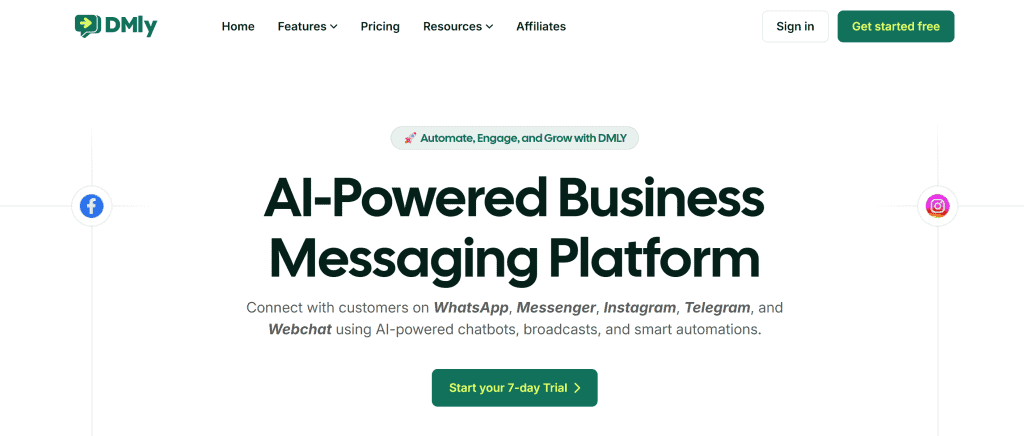
If Bird is built as a full communication infrastructure, DMly is built as a practical growth engine for messaging.
The focus is different. Bird gives you flexibility and control at scale. DMly gives you speed, automation, and clarity, without needing a technical team to put everything together.
Here’s how DMly approaches things differently:
Built for Messaging-First Growth
DMly is designed specifically for businesses that rely on messaging to drive engagement, leads, and sales. Instead of trying to cover every communication channel equally, it focuses on doing conversational marketing and automation really well.
This makes it easier to move quickly – launch campaigns, respond to leads, and automate follow-ups without getting lost in configuration.
Multi-Channel Without the Complexity
DMly supports WhatsApp, Instagram, Messenger, Telegram, and web chat – all managed from a single inbox.
The key difference is usability. You don’t need to stitch together multiple systems or configure APIs just to get started. Conversations flow into one place, and your team can act on them immediately.
Automation That’s Practical, Not Technical
DMly’s automation builder is designed for real-world use. You can create workflows that trigger based on:
- customer actions
- campaign engagement
- new leads
- CRM updates
These workflows can handle follow-ups, tagging, routing, and retargeting, without requiring developer support.

Campaigns and Retargeting Built In
Unlike infrastructure-heavy platforms, DMly includes tools for actually running campaigns, not just delivering messages.
You can:
- send broadcast campaigns
- follow up with leads automatically
- retarget users who didn’t convert
- schedule promotions and updates
This makes it easier to turn messaging into a consistent revenue channel.
Built-in CRM for Better Context
DMly includes a built-in CRM system that lets you manage contacts with tags, custom attributes, lifecycle stages, notes, and history. Because everything lives in one place, you can personalize communication and trigger actions based on real customer data.
Predictable Pricing and Transparent Costs
One of the biggest differences is pricing. DMly uses clear, tiered plans that scale with your business, without layering multiple cost components.
On top of that, businesses pay Meta directly for WhatsApp messaging with zero markup, which helps keep costs predictable as you grow.
Bird vs DMly: Quick Comparison
Here’s a simple side-by-side view to help you quickly understand how Bird compares with DMly.
Feature | Bird | DMly |
|---|---|---|
| Multi-Channel Messaging | ✅ Strong (SMS, Email, WhatsApp, Voice) | ✅ Strong (WhatsApp, IG, Messenger, Telegram, Web) |
| Ease of Use | ⚠️ Complex | ✅ Simple & intuitive |
| Automation | ✅ Advanced (but technical) | ✅ Advanced (no-code, practical) |
| CRM & Customer Data | ✅ Full CDP (enterprise-level) | ✅ Built-in CRM (easy to use) |
| Campaign Management | ⚠️ Powerful but complex | ✅ Simple, campaign-focused |
| Developer Flexibility | ✅ Very high (API-first) | ⚠️ Moderate (no-code first) |
| Setup Speed | ⚠️ Slower setup | ✅ Quick to deploy |
| Pricing Predictability | ❌ Low (contacts + usage-based) | ✅ High (clear tiered pricing) |
| WhatsApp Messaging Costs | ⚠️ Additional usage fees | ✅ No markup (pay Meta directly) |
| Best Fit | Enterprise teams | Growing businesses & teams |
Automation: DMly vs MessageBird
Automation in Bird is built for flexibility. You can design complex, multi-channel journeys that span email, SMS, WhatsApp, and more. These workflows can be highly customized, especially when combined with APIs and customer data. The trade-off is that setting them up often requires technical input and careful configuration.
DMly takes a more practical route. Its automation builder is designed for everyday use, triggering actions based on behavior, messages, or CRM updates without needing developers. You can build follow-ups, lead qualification flows, and retargeting sequences quickly, making it easier to move from idea to execution.
CRM and Customer Data
Bird includes a full customer data platform (CDP), which allows businesses to unify data from multiple sources and build detailed customer profiles. This is powerful for enterprises running data-heavy marketing strategies, but it can feel overwhelming if you don’t need that level of depth.
DMly focuses on a more accessible approach. It includes a built-in CRM where you can manage contacts with tags, custom attributes, notes, and lifecycle stages. The key advantage is how tightly this data connects with automation and campaigns, making it easier to act on insights without additional setup.
Campaigns and Messaging Strategy
Bird supports multi-channel campaigns, allowing businesses to combine email, SMS, and messaging apps into one coordinated strategy. This works well for large-scale operations, but campaign setup can feel more technical and less immediate.
DMly is designed for messaging-first campaigns. You can launch broadcasts, schedule promotions, and trigger follow-ups directly from the platform. Because segmentation and automation are built in, campaigns feel more dynamic and easier to manage, especially for teams focused on conversational marketing.
Analytics and Insights
Bird offers advanced analytics, including predictive insights and customer data tracking. For enterprises with dedicated data teams, this can be extremely valuable for optimizing campaigns and forecasting performance.
DMly keeps things actionable. Its dashboards focus on campaign performance, automation effectiveness, and customer engagement. Instead of complex data layers, you get clear insights that help you adjust campaigns and improve results quickly.
Pricing Comparison: Bird vs DMly
Pricing is one of the biggest differences between the two platforms.
Bird combines contact-based pricing with usage-based costs, meaning you pay for how many contacts you store and how many messages you send. This can be flexible, but it also makes total costs harder to predict as your business grows.
DMly uses a simpler tiered pricing model, where plans scale based on contacts, team size, and campaign capacity. On top of that, businesses pay Meta directly for WhatsApp messaging with zero markup, helping keep messaging costs transparent.
Why Many Teams Choose DMly
When teams compare Bird with DMly, the decision often comes down to how quickly they can move and how easily they can scale.
Many businesses don’t need a full communication infrastructure. They need a system that helps them launch campaigns, automate conversations, and manage customers without friction. That’s where DMly tends to stand out.
Here are some of the main reasons teams make the switch:
- Faster time to value
With DMly, teams can set up campaigns and automation quickly without waiting on technical implementation. This makes it easier to start seeing results sooner. - No technical dependency
You don’t need developers to build workflows or manage integrations. Most features are designed to be used directly by marketing or support teams. - Built for real-world use, not just flexibility
Bird offers deep customization, but DMly focuses on what most teams actually use –automation, campaigns, segmentation, and messaging – all in a simpler setup. - All-in-one system for messaging and growth
Instead of combining multiple tools, DMly brings CRM, automation, campaigns, and messaging into one platform. This reduces complexity and improves visibility. - Predictable and transparent pricing
With tiered plans and no markup on Meta messaging fees, businesses can scale their messaging efforts without worrying about unexpected cost increases. - Better fit for growing teams
As businesses expand, they need tools that can keep up without becoming harder to manage. DMly offers that balance – powerful enough to scale, but simple enough to use daily.
Bird Review: Final Verdict
Bird is a powerful platform built for enterprise teams that need deep customization, multi-channel orchestration, and infrastructure-level control. But for many businesses, that level of complexity and cost is more than necessary.
If your goal is to run campaigns, automate conversations, and scale customer engagement without technical overhead, DMly offers a more practical and accessible solution.
Bird Review FAQs
Who should use Bird?
Bird is best suited for enterprise teams that need advanced customization, multi-channel communication at scale, and have access to technical resources like developers or dedicated data teams.
What is the best Bird alternative?
The best alternative depends on your needs, but platforms like DMly are often preferred by growing businesses that want strong automation, built-in CRM features, and easier setup without technical complexity.
How much does Bird cost?
Bird uses a combination of contact-based and usage-based pricing. Plans can start around $45/month for a few thousand contacts, but scale up quickly as your contact list and messaging volume grow. Additional costs apply for messages sent across channels like SMS, email, and WhatsApp.
Does MessageBird offer a free trial?
Bird typically offers flexible pricing options such as pay-as-you-go plans, but availability of a free trial can vary depending on the product or region. Businesses usually need to sign up or contact sales to explore available options.
Is DMly better than Bird?
It depends on your use case. Bird is more suitable for enterprise-level customization and infrastructure, while DMly is better for businesses that want a simpler setup, strong automation, and predictable pricing without needing technical resources.
Which type of business is DMly best for?
DMly is ideal for startups, ecommerce brands, agencies, and growing businesses that rely on messaging for marketing, sales, and customer engagement. It works particularly well for teams that want to automate workflows, run campaigns, and manage customer data in one platform.