
Bird Review 2026: Now an API Company, with Published Rates

Here is the first sentence of Bird’s own about page, read on 6 September 2026: “Bird builds the wires the modern internet runs on.” That is not the sentence a marketing platform writes about itself. It is the sentence a telecoms company writes, and it turns out to be an accurate description of what this company now sells.
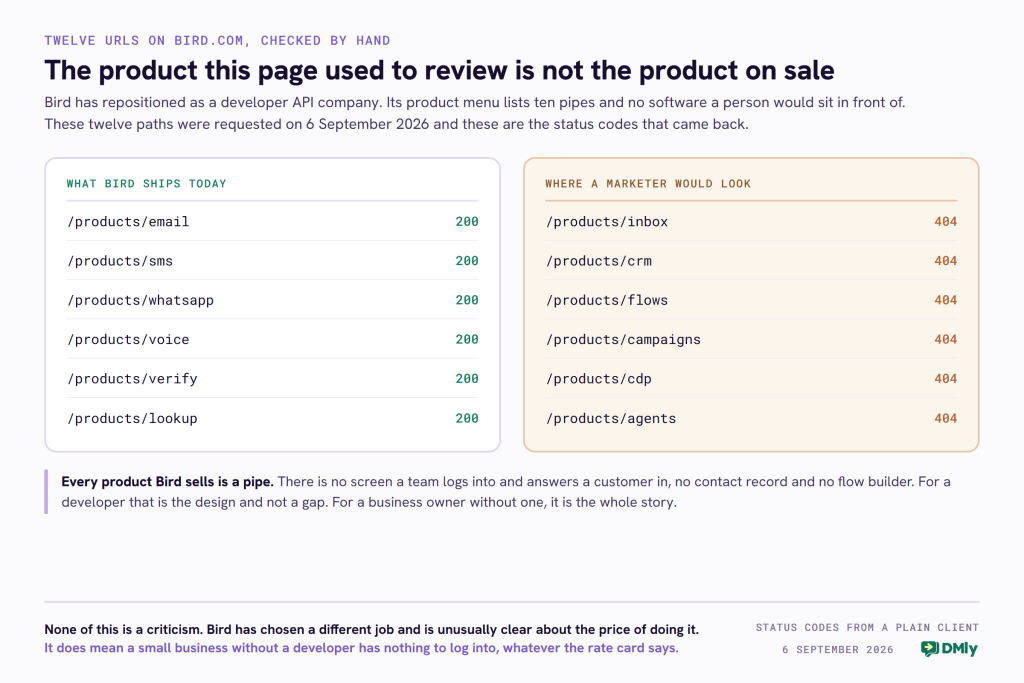
The evidence took about a minute to gather. Bird’s product menu today lists Email, SMS, Voice, WhatsApp, Verify, Lookup, RCS, Push, eSIM and Realtime. It does not list an inbox, a CRM, a customer data platform, a flow builder or a campaign manager. Going looking for them by hand, bird.com/products/inbox, /products/crm, /products/flows, /products/campaigns and /products/cdp all return 404.
So the honest headline of this Bird review is that the product it used to describe is not the product on sale. That is not a criticism, and the rest of this page is mostly complimentary, because what Bird has become is unusually clear about what it charges. But if you arrived here looking for a platform to run a small business’s customer conversations, the first useful thing to know is that this one has deliberately stopped being that.
What Bird Is Now, and How It Got Here
Step zero first, because a Bird review written against a product that has since been replaced is worse than none at all. Checked on 6 September 2026: bird.com returns 200 on the root, the robots file and every pricing page linked from it, and messagebird.com now redirects to it. The company is trading and the rename is complete.
From Bird’s own about page, in their words: they launched in 2011, and where most providers licensed a telecoms stack from established players, Bird built its own, 240 direct-to-carrier SMS connections, piece by piece. They acquired SparkPost for email deliverability and operated the WebSocket layer that was Pusher. In Asia they say they were first to connect Kakao, Line and WeChat through a single API. Their own claim about scale is that by the time they had consolidated hundreds of telecom and messaging APIs into one platform, “about 40% of the world’s commercial messages were flowing through our network”. The founder and chief executive is Robert Vis, and the press links on their own page record a $200 million Series C at a $3 billion valuation under the MessageBird name.
Then comes the sentence that explains everything else on this page: “Today, that infrastructure ships as a developer API.” Email, SMS, voice and WhatsApp on the same authentication, the same idempotency contract and the same webhook envelope, with SDKs in every major runtime.
And one more thing that is genuinely new since this page was written, and that no other review of Bird seems to have noticed. Bird now sells to AI coding agents as a first-class audience. Its own navigation carries an AI section listing an MCP server, agents and skills, with named setup paths for Claude Code, Cursor, Codex, GitHub Copilot, Replit and others. The footer of every page carries the line: “Using Claude Code, Cursor, or Codex? Copy a setup prompt and your agent installs the Bird CLI and skills for you.” Their about page puts it more plainly: an MCP server “so the agent on your shoulder can drive it”.
That is a coherent strategy and it is probably a good one. It is also the clearest possible signal about who this product is for.
Bird Pricing in 2026: One of the Clearest Rate Cards in This Category
This section is a straightforward credit, and the older version of this page did not give it. Bird publishes what it charges, per channel, per country, in the open, with no login and no quote form. That is rarer in this category than it should be.
Their stated model, printed at the top of the pricing page: “Priced by volume. Not by seat.” and “No platform fees, no per-seat tax, and no features locked behind an annual commit.” The email pricing page sets out five rules they call the contract, of which the first is “No seats. No platform fee. Your team size is your business, not a billing dimension.”
Here is what that means in figures, all read on 6 September 2026 with the destination and the unit beside every one.
| What you are sending | Bird’s published rate | Unit |
|---|---|---|
| WhatsApp marketing, United States | $0.030 | Per message, Meta’s fee included |
| WhatsApp utility, United States | $0.0084 | Per message, Meta’s fee included |
| WhatsApp authentication, United States | $0.0084 | Per message, Meta’s fee included |
| WhatsApp service, United States | $0.0050 | Per message, user initiated |
| SMS long code or toll-free, United States | $0.0035 | Per message segment, carrier fees on top |
| SMS short code, United States | $0.0070 | Per message segment, carrier fees on top |
| Email, free tier | $0 | 1,000 a month, no card, 50 a day cap |
| Email, Startup | $15 or $30 a month | 50,000 or 100,000 a month, $0.30 per thousand |
| Email, Growth | $80 to $1,039 a month | 100,000 to 2.5 million a month, $0.80 down to $0.4156 per thousand |
| Verify, one-time passcodes | No charge for Verify itself | You pay only the channel that carried the code |
Two details in that table deserve to be pulled out because they are unusually good. Verify has no rate card of its own: a one-time passcode bills at whatever the delivering channel costs, checking a code is free, a send rejected before it goes out is not billed, and a send over a free route costs nothing. And the email tier grid publishes the per-thousand rate at every step, falling from $0.80 to $0.4156 as volume rises, with the overage rate printed beside it. Very few vendors show you the shape of their own discount curve.
The verification model is worth a paragraph on its own
One-time passcodes are one of the highest-volume things a business sends, and they are usually where the surprises live. Bird’s approach is the simplest we have seen written down anywhere in this category, and it is worth setting out because it gives you something to hold other quotes against.
Their four published rules: a verification is billed per send and not per verification, so a resend or a fallback to a second channel is a new charge; checking a code is free; a send over a route that costs nothing is not charged; and a send rejected before it goes out never reaches your bill. Their own summary is “Verify itself is free. You pay for the send”, and the pricing page says in as many words that Verify has no rate card of its own.
Set that beside how the same product is sold elsewhere and the difference is instructive rather than damning. One large European provider on this blog charges from 0.04 euros per verified passcode plus a one-off setup cost of 599 euros per channel, so putting codes on both WhatsApp and SMS costs nearly 1,200 euros before the first code goes out. Neither model is wrong. They suit different volumes, and the point of putting them side by side is that “OTP pricing” is not one thing, and the setup fee is the line people forget to ask about.
The question that gets a comparable answer from anyone: what will one delivered verification code to my own country cost me, all in, and is there any charge before the first one goes out?
The Half a Cent, and the Volume Where It Stops Being a Bargain
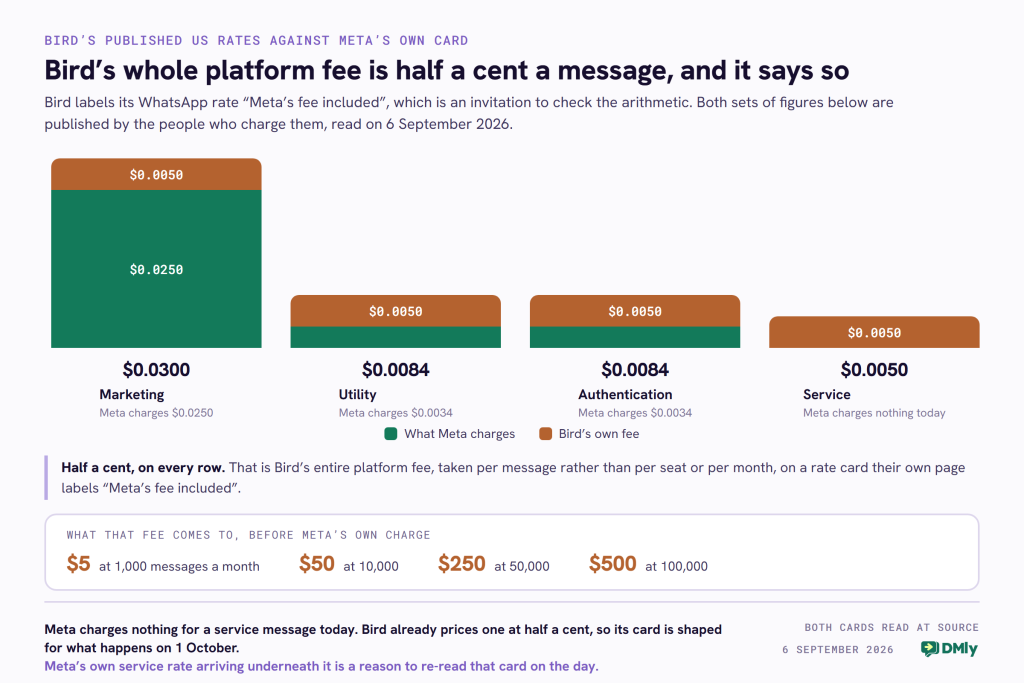
Bird says its WhatsApp rate has “Meta’s fee included”, which is an honest label for a bundled price and an invitation to check the arithmetic. So here is the arithmetic. Both sets of figures are published by the people who charge them.
| WhatsApp message to a United States number | Bird’s published rate | Meta’s own USD rate card, effective 1 July 2026 | The difference |
|---|---|---|---|
| Marketing | $0.0300 | $0.0250 | $0.0050 |
| Utility | $0.0084 | $0.0034 | $0.0050 |
| Authentication | $0.0084 | $0.0034 | $0.0050 |
| Service | $0.0050 | Nothing, until 1 October 2026 | $0.0050 |
It is exactly half a cent, on every row. Nothing about that is hidden, and it is not a criticism: it is Bird’s platform fee, taken per message instead of per seat or per month, and they tell you the Meta fee is inside the number. Compared with a platform that charges a subscription and then quotes you a bundle in a unit you cannot check, this is a model of legibility, and this page should have said so a year ago.
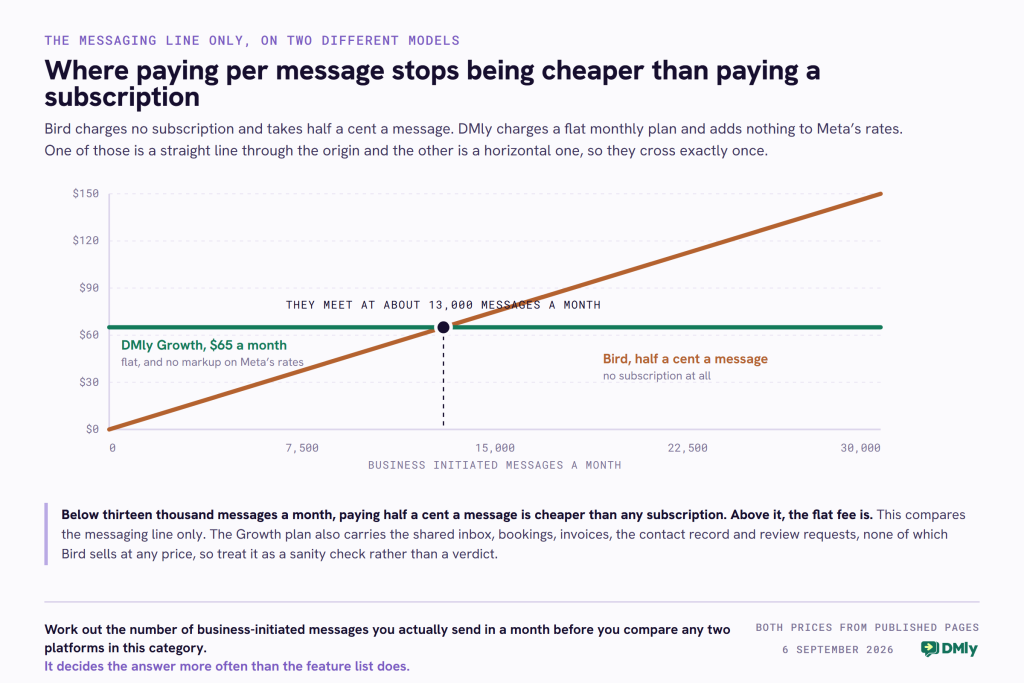
What it does mean is that your platform bill is a straight line through the origin, and that is worth doing the sums on. Half a cent a message is five dollars per thousand. At three thousand marketing messages a month you are paying about fifteen dollars for the platform, which is very cheap. At twenty thousand you are paying a hundred. At two hundred thousand you are paying a thousand dollars a month, and at that point a flat subscription starts looking different.
For a concrete crossover: DMly’s Growth plan is $65 a month with no markup on Meta’s rates at all, so on the messaging line alone the two models cost the same at roughly thirteen thousand messages a month. Below that Bird’s model is cheaper; above it the flat fee is. That comparison covers only the messaging, and it is deliberately narrow, because the Growth plan also carries bookings, invoices, a CRM and review requests that Bird does not sell at any price. Use it as a sanity check on the messaging line and not as a verdict.
Bird Already Charges for Service Messages, Before Meta Does
Look again at the last row of that table, because it is the most interesting number on Bird’s whole pricing page. Bird lists a user-initiated service message at $0.0050. Meta charges nothing for service messages today, and has not since November 2024.
That is not a hidden charge; it is printed on their public rate card under the heading “User Initiated”. It is Bird’s own half a cent on a message that currently carries no Meta cost at all. And it means Bird is one of the very few platforms in this category whose pricing page is already correctly shaped for what happens on 1 October.
What actually changes on 1 October 2026
Read at source on Meta’s own developer documentation on 6 September 2026. From 1 October Meta charges per message for service messages, the ordinary replies a person or a bot types inside an open conversation, which have been free since November 2024. It also starts charging for utility messages sent in reply to a customer inside the open 24-hour window, free since July 2025. Service messages are priced at the same rate as utility and authentication messages in the customer’s country, and Meta states plainly that service messages get no volume tiers while utility and authentication keep theirs.
The part that makes it survivable for most small businesses is new, and Meta marks it as such: “Effective October 1, 2026, Meta will introduce a free monthly tier of service messages. Each month, every business phone number will receive 1,000 free service messages; Meta will only charge as of the 1,001st service message delivered. These free service messages do not roll over if not used in a specific month and reset monthly, for each business phone number.” Per phone number, per month, counting messages.
And there is a deadline three weeks away. Meta’s page states that for any solution provider or directly integrated business “that does not have a payment method on file by September 30, 2026”, Meta “will stop delivering service messages” from the day they become chargeable. Ask your provider today whether one is on file for your WhatsApp Business Account, and get the answer in writing. Our guide to the 1 October pricing change has the arithmetic, and our rate card by country has the number for your market.
One thing to diary, whoever you buy from. Meta’s North America service rate from 1 October will be its utility rate, $0.0034. Bird’s published service price today is $0.0050. Those two numbers cannot both stay where they are and leave Bird’s margin where it is now, so the sensible thing is to re-read Bird’s WhatsApp rate card on 1 October rather than assume today’s figure survives. That advice applies to every provider on this page, ours included.
What Is No Longer There, and Who That Matters To
Bird’s product list is ten items long and every one of them is a pipe. Email, SMS, Voice, WhatsApp, Verify, Lookup, RCS, Push, eSIM, Realtime, plus phone numbers and email validation. There is no shared inbox for a team to answer messages in, no contact record, no visual flow builder and no campaign manager, and the URLs where those things would live return 404.
The closest thing to a marketing feature anywhere on the site is Broadcasts inside the Email API, which is a way to send one email to a list rather than a campaign suite.
For a developer, none of this is a loss and most of it is a gain. You do not want a flow builder if you are writing the flow. You want one authentication scheme, one webhook envelope, an SDK in your language, and a rate you can put in a spreadsheet, and Bird has spent the last few years making exactly that.
For a business owner without a developer, it is the whole story. There is nothing here you can log into and answer a customer in. Every message Bird sends is one your own software asked it to send. If nobody on your team writes code, Bird is not a tool you can use, however good its rates are, and that is worth knowing before you spend an afternoon on the documentation.
Bird Is Selling to AI Coding Agents, and That Is Worth Understanding
This is the newest thing about Bird and the part no other review of it seems to have picked up. Its navigation carries an AI section with three entries, MCP, Agents and Skills, and beneath them a list of named clients: Claude Code, Cursor, Codex, GitHub Copilot, Factory Droid, Replit, Lovable and Base44. Every page on the site ends with the same offer: copy a setup prompt, and your coding agent installs the Bird command line tool and its skills for you.
An MCP server is a standard way for an AI agent to call a real system rather than describe one. In this context it means that an assistant with the right credentials can look up a rate, send a message, check a delivery status or set up a sender, from a chat window, without anybody opening a dashboard. Bird’s own about page describes it as an MCP server “so the agent on your shoulder can drive it”.
For a technical team this is a genuine productivity story and it is early. A messaging API is a good fit for it: the operations are small, well defined and easy to describe, and most of the work of integrating one has always been reading documentation, which is exactly what an assistant is good at removing.
It is also worth thinking about before you turn it on. The thing being automated is the ability to send messages to your customers and to spend money doing it. Two questions are worth answering in advance, and they apply to any vendor offering this, including us. Which key does the assistant hold, and is it a test key or a production one? And what would a mistaken instruction cost, given that the bill is per message and there is no seat limit to slow anything down?
None of that is a reason to avoid it. It is a reason to scope the credential rather than paste the first one that works. DMly has an MCP server too, and the same two questions apply to ours.
Five Criticisms This Page Made, and What Survives
An earlier version of this Bird review listed a set of shortcomings written when the product was something else, and checking each one against what Bird publishes today is most of the work of a refresh. Most of them no longer describe anything.
Withdrawn: “contact-based pricing, monthly plans.” That model is gone. Bird’s own pricing page now leads with “Priced by volume. Not by seat.” and the email page states “No seats. No platform fee.” as the first of its five rules. Quoting a contact-based plan for Bird today would simply be wrong.
Withdrawn: “pricing is unpredictable.” The opposite is now true and it is one of the better rate cards in this category. Every channel has a published per-country, per-category rate; the email grid shows the per-thousand price at each volume step and the overage beside it; and Verify’s billing rules are printed as four numbered sentences.
Withdrawn: “full CDP, enterprise-level” as a strength. It was in the comparison table and it is not in the product list. Crediting a competitor with something they do not sell is the same error as denying something they do.
Holds, and is now the central fact rather than a complaint: “complex, slower setup, technical.” Bird is an API. Describing that as a drawback was the wrong frame; it is the design. The accurate version is not that Bird is hard, it is that Bird requires a developer, and there is no version of it that does not.
Holds: no bookings, no invoices, no review requests. Those were never Bird’s business and still are not.
Where DMly Is Different, and the Two Places It Loses Outright
These two products do not really compete. One is a set of wires and the other is a shop counter. The useful thing a comparison page can do is name the two places where Bird is simply better, and then say what DMly is for.
DMly has no email channel at all
This is the flattest admission on the page and it is worth making plainly, because it is easy to miss in a feature grid. Bird’s email business came out of acquiring SparkPost, it has a free tier, a published per-thousand curve down to $0.4156, dedicated IPs, sending domains and deliverability tooling. DMly has none of that. Checked against all 375 pages of our own documentation: email appears exactly once, as a way of sending a review request from the Request reviews tab, and our own docs say the flow node cannot send email at all.
So if email is part of what you are buying, DMly does not do it and you would be running two tools. That is a real cost and we would rather you knew it now.
DMly is not the carrier, and does not pretend to be
Bird built 240 direct-to-carrier SMS connections. Our own documentation says DMly sends SMS through Twilio, Plivo or a custom HTTP gateway, and that you open and pay for that account yourself. We have no direct routes, no carrier failover, no short codes and no toll-free numbers of our own. Our SMS is also text only, with no images, no files, no tappable buttons and no read receipts, and no growth tools, because a QR code or a chat link has no SMS equivalent.
If SMS at volume is the requirement, buy it from somebody who owns the wires. That is the entire point of Bird and it is a good one.
What DMly is, and what it costs
DMly is the thing Bird deliberately stopped being: a place a person logs into and runs a business’s conversations from. Seven channels and SMS, in our own site’s counting, landing in one shared inbox: WhatsApp through the official Business API, Instagram, Facebook Messenger, TikTok, Telegram, a Live Chat widget on your own site and Google Business Profile for reviews, plus SMS through one of those three gateways, with broadcasts on five of them. Beside the messaging sit bookings with services, staff, availability and classes; invoices, orders, payments, coupons and expenses; recurring plans, subscriptions and gift cards; a contact record with pipeline stages; and a Reputation section that requests and manages Google reviews.
Read off our own pricing page on 6 September 2026, billed yearly: Starter $29 a month with 3 seats, 3,000 active contacts, 10,000 broadcast or template messages and 500 AI replies; Growth $65 with 6 seats, 10,000 contacts, 50,000 messages and 5,000 AI replies; Premium $149 with 15 seats, unlimited contacts, 300,000 messages and 20,000 AI replies. AI agents, bookings, invoices, CRM, reputation and the automation builder are on every plan. Extra seats are $10 a month. DMly adds no markup to Meta’s per-message rates, which you pay Meta directly, which is the other half of the crossover arithmetic above.
We also have an API, webhooks and an MCP server, so an AI client can drive the same operations. It is not a substitute for what Bird sells to developers and this page is not going to claim otherwise: Bird’s whole product is that API, and ours is a way into a product that is mostly used through its screens.
Bird and DMly Side by Side
Every cell in this Bird review was read off one of the two companies’ own published pages on 6 September 2026.
| What you are comparing | Bird | DMly |
|---|---|---|
| What you buy | APIs for email, SMS, voice, WhatsApp, RCS, push and verification | A platform a person logs into and works in |
| Pricing model | Per message, per minute or per request at a published rate. No seat fee, no platform fee | A flat monthly plan by capacity, with Meta paid directly and no markup |
| WhatsApp cost, United States | $0.030 marketing, $0.0084 utility, $0.0050 service, Meta included | Meta’s own rate, paid to Meta |
| Entry cost | Free email tier, then pay per use | $29 a month billed yearly, 7 day free trial |
| Shared team inbox | Not part of the product | Every channel in one inbox |
| Contact record and pipeline | Not part of the product | Contact record with pipeline stages, tags and custom fields |
| Visual flow builder | Not part of the product | Drag and drop, with keyword, comment, story and commercial triggers |
| Bookings, invoices, reviews | Not part of the product | Services, staff and classes; invoices and payments; Google review requests |
| Free tier to 2.5 million a month, published per-thousand curve | None. Email exists only as a review request option | |
| SMS | 240 direct-to-carrier connections, short codes and toll-free | Through your own Twilio, Plivo or custom gateway; text only |
| Who has to be on the team | A developer | Nobody technical |
| AI client support | MCP server, CLI and skills, with setup paths for named coding agents | MCP server for AI clients |
Bird Review Verdict: Which One You Are Actually Shopping For
This is one of the easier choices on this blog, because the two products barely touch.
Choose Bird if a system sends the message
If your messages are triggered by your own application, if you need email and SMS and WhatsApp behind one authentication scheme, if verification codes are a large part of what you send, or if you want an infrastructure bill that scales linearly and is published to the fourth decimal place, Bird is very good at that and priced clearly for it. The AI tooling is a real advantage if your team already builds with coding agents.
The one thing to diary is the WhatsApp service rate on 1 October.
Choose DMly if a person sends the message
If the messages are typed by somebody at a front desk, if the useful next step is an appointment with a staff member, a reminder the day before, an invoice and a review request, and if nobody on the team writes code, then no rate card in the world helps you, because there is nothing to log into. That is not Bird failing at something; it is Bird having chosen a different job.
You might genuinely want both
An online retailer with a developer might reasonably run transactional email and one-time passcodes through Bird and its customer conversations somewhere a human can sit. There is nothing incoherent about that, and the two bills are separate anyway. Whatever you choose, the 30 September payment method deadline attaches to your WhatsApp Business Account rather than to your software, so changing platform does not reset it.
Frequently Asked Questions
How much does Bird cost in 2026?
There is no subscription for the platform. Bird bills per message, per minute or per request at a published rate, and its own pricing page says “No platform fees, no per-seat tax, and no features locked behind an annual commit.” For a United States destination that means $0.030 for a WhatsApp marketing message with Meta’s fee included, $0.0084 for utility or authentication, $0.0050 for a service message, and $0.0035 per SMS segment on a long code with carrier fees on top. Email is the exception and carries a plan: free for 1,000 a month, $15 or $30 on Startup, and $80 to $1,039 on Growth for 100,000 up to 2.5 million a month.
Is Bird the same company as MessageBird?
Yes. messagebird.com redirects to bird.com, and Bird’s own about page tells the MessageBird story, including the founder and chief executive Robert Vis and the press coverage of a $200 million Series C at a $3 billion valuation. The company launched in 2011, built 240 direct-to-carrier SMS connections itself rather than licensing a stack, and acquired SparkPost for email and the WebSocket platform Pusher along the way.
Does Bird have a shared inbox or a CRM?
Not any more. Its product list is Email, SMS, Voice, WhatsApp, Verify, Lookup, RCS, Push, eSIM and Realtime, plus phone numbers and email validation, and the URLs for an inbox, a CRM, a customer data platform, flows and campaigns all return 404. An earlier version of this page credited Bird with an enterprise customer data platform, and that was correct once and is not correct now.
Does Bird charge a markup on WhatsApp messages?
It charges a platform fee inside the message price and says so: its rate card is labelled “Meta’s fee included”. Set against Meta’s own USD card effective 1 July 2026, the difference works out at exactly half a cent a message on marketing, utility, authentication and service alike. That is the whole platform fee, in place of a subscription or a seat charge, and it is one of the clearest pricing models in this category. Whether it is cheap depends entirely on your volume: half a cent is five dollars per thousand messages.
Can a small business use Bird without a developer?
Realistically, no. Every product is an API, there is no screen a team answers customers in, and production access unlocks when you add a payment method and verify a sender rather than when you finish an onboarding wizard. If you have a developer, that is a feature. If you do not, the published rates are irrelevant because there is nothing to operate.
What is the best Bird alternative?
It depends which half you wanted. If you wanted the messaging infrastructure, compare Bird with other communications platform providers on published per-country rates, direct routes and SDK quality, and Bird will do well on all three. If you wanted somewhere a person can run customer conversations that end in a booking or a payment, that is a different category entirely, and our list of WhatsApp platform alternatives compares ten of them on the smallest cheque each will take.
Will my WhatsApp costs change on 1 October 2026?
Meta’s will. From 1 October it charges per message for service messages and for utility messages sent in reply inside the 24-hour window, with the first 1,000 service messages a month per business phone number free and no roll-over. Bird already prices service messages at $0.0050 in the United States, so its rate card is unusually well shaped for the change, but Meta’s own service rate arriving underneath it is a reason to re-read that card on the day. The deadline to act on before then is 30 September, when a payment method has to be on file or Meta stops delivering those replies.
When was this Bird review last checked against the source?
6 September 2026. Every Bird figure was read that day from bird.com’s own per-product pricing pages and about page. Every Meta figure came from Meta’s own developer documentation and its published USD rate card file. Every DMly figure came from our own pricing page and documentation. Bird has restructured both its product line and its pricing model since this page was first written, so check the source before deciding.
Writing about WhatsApp automation, bookings and growth for local business.
Turn WhatsApp into your busiest channel.
Start free and run message, bookings, payments and reviews in one place.
