
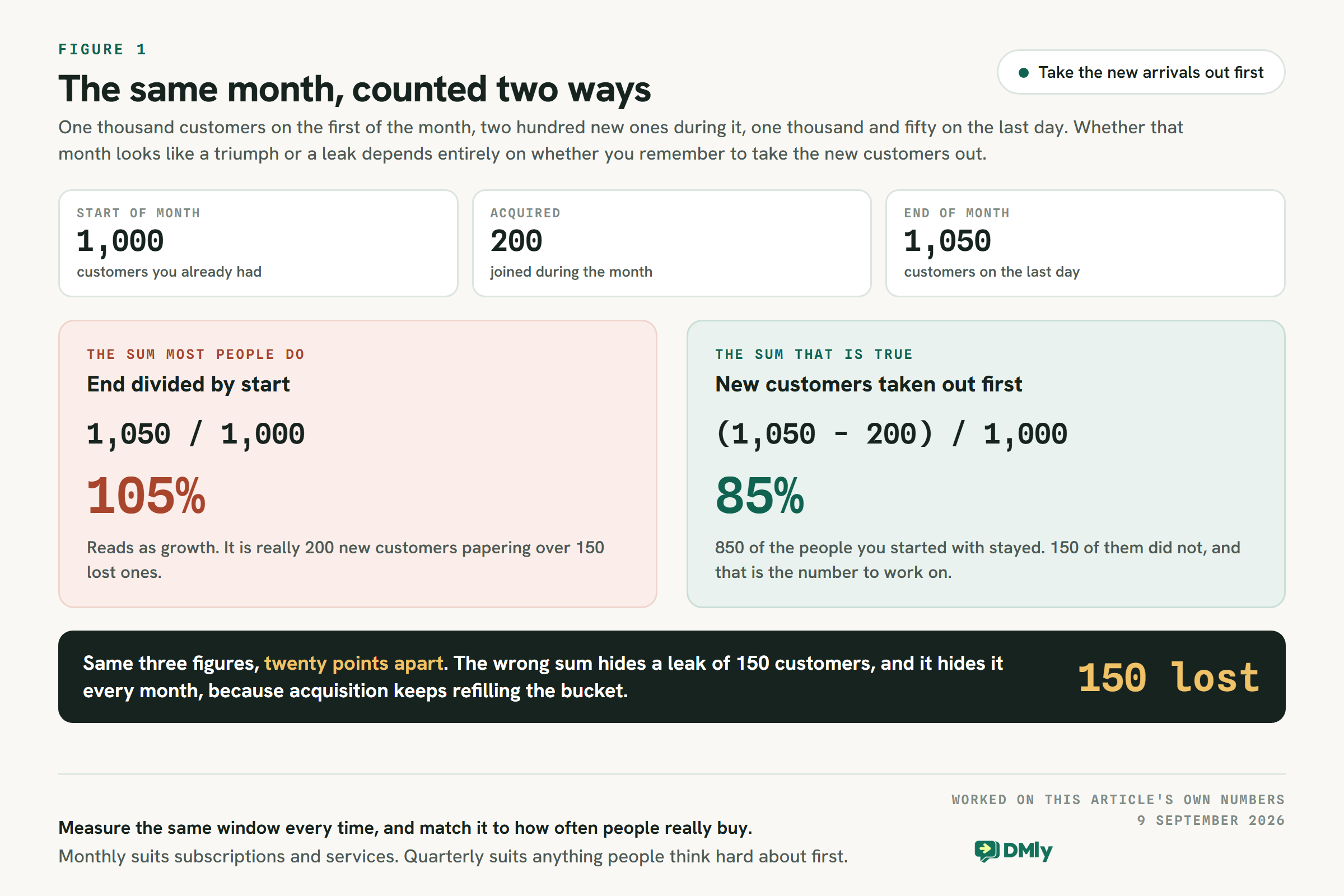
Take last month, and work out your customer retention the way most owners do. You started with 1,000 customers, you signed up 200 new ones, and you finished with 1,050. So 1,050 divided by 1,000 is 105%, and you feel quietly pleased.
The right sum takes the new arrivals out first. (1,050 minus 200) divided by 1,000 is 85%. One hundred and fifty of the people you already had are gone, and the 200 you paid to acquire covered the hole so neatly that nothing on your dashboard flinched.
That twenty-point gap is the whole subject of this guide. Customer retention is the measure that tells you whether the business is actually holding together underneath the marketing, and messaging is the cheapest, fastest lever most small businesses have on it. This guide covers what customer retention really is, how to calculate it without flattering yourself, the five numbers worth watching beside it, the moments where messaging genuinely moves it, the WhatsApp rules that decide what you are allowed to send, what DMly does and does not do for you, and six businesses that turned all of this into a habit.
What Customer Retention Is, and Four Things It Is Not
Customer retention is your ability to keep the customers you already have. Not to win them once, but to still have them in ninety days, when a competitor is one tap away and switching costs almost nothing. It answers a single question: after someone buys from you, do they stay or do they quietly disappear?
A retained customer keeps buying, keeps using what you sell, still answers when you write, and trusts you enough not to shop around every time. Retention is the mirror image of churn. When one goes up the other goes down, and when retention slips, growth stops compounding and starts costing money.
Four things get mistaken for it, and each mistake sends businesses in a slightly wrong direction.
- It is not a loyalty programme. Points and rewards can support retention, but they cannot create it. A customer who stays only for the points leaves the moment someone offers more points. If the underlying experience is slow or confusing, a stamp card just delays the exit.
- It is not a second purchase. Someone buying twice is not retained, they are curious. Retention is a pattern over time, not a single follow-up transaction, which is why the window you measure over matters so much.
- It is not satisfaction. People leave brands they are perfectly happy with, because something else became easier. Satisfaction explains an interaction. Retention describes a habit.
- It is not more messages. This one costs the most. Badly timed, irrelevant messages actively push customers away, and on WhatsApp they now cost you money as well. Retention comes from useful messages at the right moment, not from volume.
How to Calculate Your Retention Rate, and the Mistake That Flatters It
You cannot improve a number you are calculating wrongly, and the common error always errs in your favour. The formula is short:
Retention rate = (customers at the end of the period, minus new customers acquired during it, divided by customers at the start) times 100.
Three inputs, and only the middle one causes trouble. Customers at the start is the count on day one of the window. New customers acquired is everyone who joined during it. Customers at the end is the count on the last day. Skip the subtraction and you are measuring how well acquisition is going, not how well you keep people, which is exactly the number that reads 105% while 150 customers walk out the back.
Worked through: 1,050 at the end, minus 200 new, is 850 retained. Divide by the 1,000 you started with and you get 0.85. Multiply by 100 and your customer retention rate is 85%, which means 15% of the people you already had did not come back.
Pick a window that matches how your customers actually buy, then never change it. Monthly retention suits subscriptions, memberships and anything people use weekly. Quarterly suits considered purchases, where a customer might genuinely have no reason to buy inside thirty days. Cohort retention, where you track everyone who joined in one month as a group, is the most useful of the three and the most work: it is the only one that shows whether the people you signed up in March behave differently from the ones you signed up in June.
Whichever you pick, the discipline is comparability. A retention rate is meaningless on its own and useful the moment you have three of them in a row.
Why Customer Retention Decides More Than Your Growth Rate
Acquisition gets the attention because it is visible. Retention gets the results because it compounds. Three things change when it improves, and they change quietly.
Revenue Becomes Predictable, and Advertising Becomes Optional
When customers stay, next month stops being a guess. Returning customers buy again without being persuaded, respond faster to offers, and give you a base you can forecast against. That is what lets you order stock with confidence, hire, or take a slow month without panic.
The same movement takes pressure off your advertising. Every customer you keep is one you do not have to buy again, and acquisition costs only ever go one way. A business at 85% retention has to replace 15% of its base each period before it grows at all. A business at 92% has to replace 8%. That difference is the entire marketing budget of some small firms, and it is won in the ninety days after a purchase rather than in the ad account.
Long-Standing Customers Buy Better, Not Just More Often
Trust removes friction, and friction is what caps order value. A customer who has bought from you six times does not need convincing to try the new thing, does not compare three suppliers before ordering, and does not treat a delay as a betrayal. They also tell people, in group chats and in passing, which is the only referral channel that costs nothing.
That forgiveness is worth naming on its own. A first-time customer whose order goes wrong is usually lost. A long-standing one gives you a chance to fix it, and how you use that chance decides whether they stay for another year.
Retention Is the One Metric Customers Cannot Flatter
People will tell you they are happy and leave anyway. Surveys measure what someone is willing to say in the moment. Retention measures what they did with their money afterwards, which is why it is the number to trust when the two disagree.
That makes it uncomfortable and useful in the same breath. If retention is falling while satisfaction scores hold, something in the journey is broken in a way nobody is bothering to complain about, and the only way to find it is to go and read the conversations.
Five Numbers Worth Watching Beside the Retention Rate
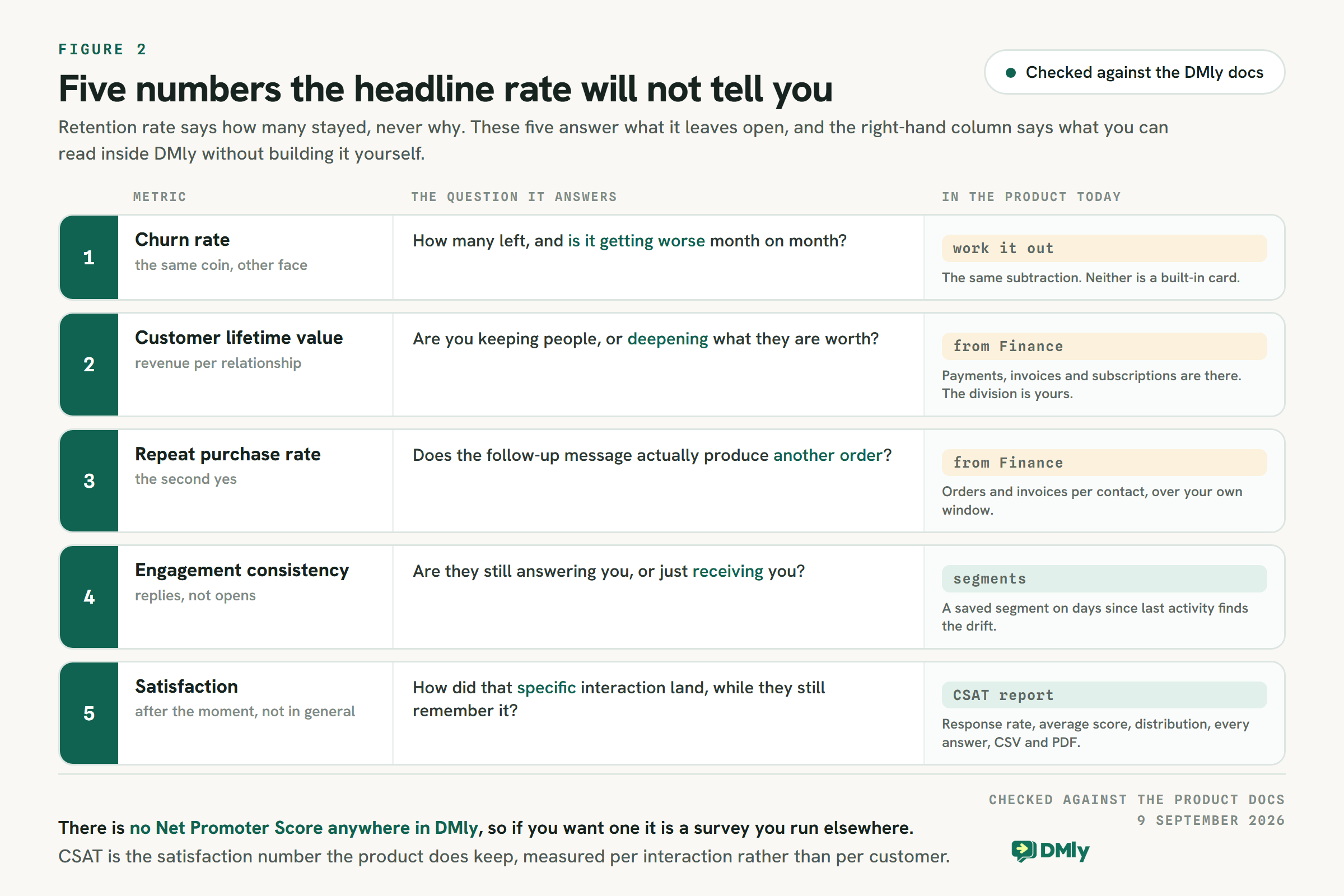
The headline rate tells you how many stayed. It never tells you why, or which of the ones still on your list are already drifting. These five fill that in, and it is worth being honest about which of them your tools hand you and which you have to work out yourself.
Churn Rate
Churn is the same subtraction read from the other end: the share of customers who left in the period. It is worth tracking separately because a rising churn rate is a change in direction, and direction is what you act on. Retention holding at 85% for three months is stable. Retention at 85%, then 82%, then 78% is a fire, even though the first month looks identical.
Customer Lifetime Value
Lifetime value is what one customer is worth across the whole relationship. Retention and lifetime value usually move together, and when they do not, that is the interesting case: it means you are keeping people without deepening what they buy. A base that stays and never spends more is a plateau you cannot advertise your way out of.
Repeat Purchase Rate
How often the same customer comes back to buy again. This is the metric your follow-up messaging moves most directly, so it is the fairest test of whether the messages are earning their place. If you add a post-purchase sequence and this number does not move over two full buying cycles, the sequence is decoration.
Engagement Consistency
How regularly customers still interact with you: replying, tapping buttons, opening the conversation again. This is the earliest warning you get, because engagement fades weeks before a customer formally stops being one. In DMly this is the one you can watch without building anything, because a saved segment can be built on how long it has been since a contact last did anything, and it re-runs itself every time you open it.
Satisfaction After a Specific Moment
Not “how do you feel about us”, but “how did that go”, asked while the customer still remembers. DMly records this as a CSAT survey your automations send, and the report gives you response rate, average score, a score distribution and every individual answer, exportable as CSV or PDF.
Two honest limits are worth knowing before you plan around it. There is no Net Promoter Score anywhere in DMly, so if your board wants one, that is a survey you run elsewhere. And a three-point survey, the one that arrives as tappable buttons and therefore gets answered most, has no message template behind it, so it can only send while the customer’s 24-hour window is still open. The five-point version falls back to a built-in template that Meta has to approve for your workspace first. If your surveys stop arriving for older conversations, that is why.
For the wider question of which numbers your messaging tool can genuinely produce and which ones you will end up assembling by hand, we went through it properly in the guide to messaging automation metrics.
Why Messaging Moves Retention When Email Does Not
Retention is not won by campaigns. It is won by being present in a way that costs the customer nothing to engage with. That is the whole case for messaging, and it comes down to three things.
It Lives Where Your Customer Already Is
Nobody schedules time to check WhatsApp. It is already open, the notification is already read, and replying takes one thumb. Email asks a customer to visit a place they visit on purpose; messaging arrives in the place they are already looking.
That difference in effort is the whole thing. A follow-up that needs a customer to open an app, find your email and compose a reply gets answered by the small share of people who were going to answer anyway. The same follow-up in a chat thread gets a two-word reply from someone waiting for a bus.
The Conversation Never Resets
A messaging thread is one continuous relationship, not a series of unrelated contacts. The customer can reply three days later and pick up where they left off. Your team can scroll up and see the order they are asking about. Nobody has to say “as per my previous email”.
That continuity is worth more than it sounds, because the thing that makes customers feel like strangers is being asked the same question twice. If every channel lands in one place, the history is there whether the last conversation was on WhatsApp, Instagram or your website chat. That is the actual argument for an omnichannel inbox, and it is a retention argument rather than a tidiness one.
Speed Turns a Complaint Into Loyalty
The moment something goes wrong is the moment retention is decided. Customers do not expect perfection, they expect to be answered. A problem acknowledged in two minutes and fixed in a day usually leaves a customer more loyal than one who never had a problem at all, because now they know what happens when it matters.
The reverse is just as reliable. Silence after a complaint reads as contempt, and it is the single most efficient way to lose someone who was otherwise perfectly happy. We took one composite business through the arithmetic of what happens to a response time when the overnight wait is removed, in this worked case study.
The Five Retention Moments Messaging Owns
Retention is not one decision. It is a series of small moments where a customer either feels looked after or does not. These five are where messaging fits naturally, in the order they happen.
Onboarding, and the First Time It Works
The days right after a first purchase decide more than the purchase did. This is where a customer either gets value quickly or quietly files you under “did not quite work out”. A short message that tells them what happens next, how to use the thing, and who to ask if it goes wrong does more for retention than any discount you could send them later.
The Follow-Up That Breaks the Silence
Nothing after a transaction is not neutral, it is a small withdrawal from trust. Order confirmations and delivery updates, a usage tip a few days in, and one plain check-in asking whether everything is fine will each do work. The check-in is the one most businesses skip and the one customers remember, because it is the only message in the set that is not about you.
Support, Which Is Where You Are Actually Judged
Support conversations are the highest-stakes messages you will ever send, and they are the ones most often left to whoever is free. Speed matters more than polish here: an instant “we have got this, give us until three” beats a perfect answer four hours later. If the same questions keep arriving, an FAQ and auto-response system answers them in seconds and leaves your team the ones that need a person.
Nudges, for the Customers Who Simply Forgot
A large share of churn is not unhappiness, it is drift. The customer meant to reorder, meant to book again, and then a fortnight went past. A reminder timed to their own cycle rather than your calendar recovers a surprising number of them, and it is the touchpoint where getting the timing wrong is most obvious to the recipient.
Milestones and Loyalty, Once the Basics Work
Recognition is the last layer, not the first. Once the practical messages arrive reliably, a birthday note, a hundredth-order thank you or a genuine perk for long-standing customers stops reading as marketing and starts reading as being known. The mechanics of what you are allowed to send, and when, are the constraint here rather than the idea, which we set out in the guide to WhatsApp loyalty programmes.
The Rule That Decides What You Are Allowed to Send
Everything above assumes you can message the customer. On WhatsApp, that assumption holds for exactly 24 hours at a time, and every retention plan that ignores this ends up either blocked or expensive.
When a customer messages you, a 24-hour window opens (Meta calls it the customer service window). Inside it you can write anything you like, in your own words, as many times as the conversation needs. When it closes, free-form messages stop being delivered, and the only thing that reaches that customer is a message template Meta has already approved. The full mechanics, including what reopens the window and what does not, are in our guide to the 24-hour messaging window.
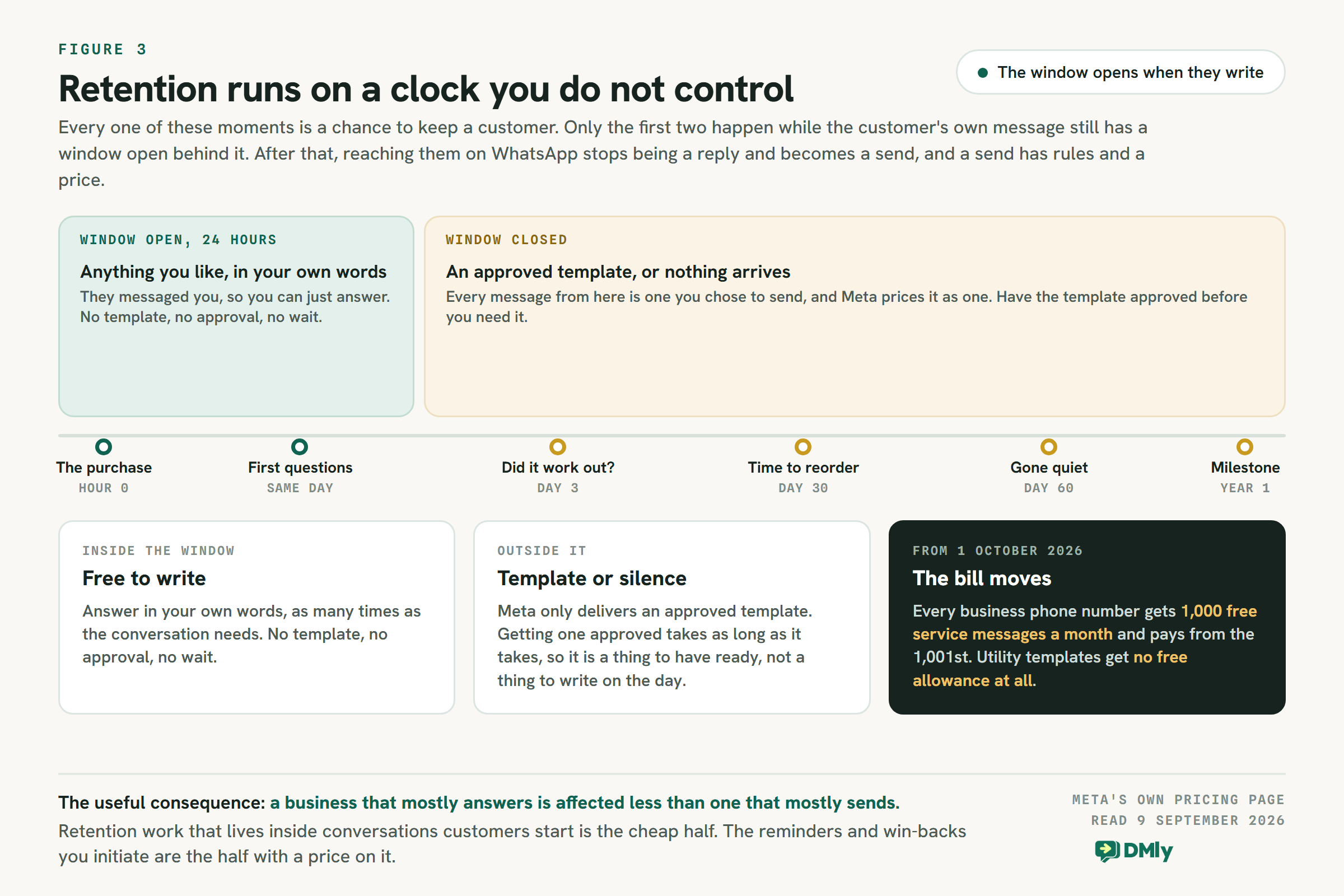
Look at where the retention moments actually fall. Onboarding and the first round of questions usually happen while the window from the customer’s own message is still open, so they cost you nothing but attention. Everything from the day-three check-in onwards is a message you decided to send, to someone who is not currently talking to you, and that is a different thing with different rules.
From 1 October 2026 it is also a different price. Meta gives every business phone number 1,000 free service messages a month, charged only from the 1,001st, with no rollover and a reset each month. Utility templates, the ones you send out to a customer who is not currently talking to you, get no free allowance at all from the same date, even inside an open window. We set out what changes and what it means for a small business in the October pricing change explainer, and you can put your own volumes through the pricing calculator.
The consequence is the opposite of the one people expect, and it is good news for retention work. A business that mostly answers questions is affected less by this change than one that mostly sends notifications, because the allowance sits on the answering side and not on the sending side. Support, onboarding help and the conversations customers start are the cheap half. Reminders, win-backs and campaign sends are the half with a price attached, so those are the ones to make count.
One practical consequence for planning: a template has to exist and be approved before you need it, and approval takes as long as Meta takes. Write the win-back template in a quiet week, not on the morning you decide to run a win-back. A library of ready templates is a reasonable place to start from.
What DMly Does for Customer Retention, and What It Does Not
Retention work needs three things from a tool: one place to see the customer, a way to reach the right people at the right moment, and a number afterwards that tells you whether it worked. Here is what DMly actually gives you for each, including the parts that will annoy you.
One Thread Per Customer, Across Every Channel
Every conversation lands in one inbox, whichever channel it arrived on. A customer who asked about an order on Instagram in March and messages you on WhatsApp in June is the same contact with the same history, so nobody has to ask them to explain themselves again. That single fact removes the most common cause of a customer feeling like a stranger to a business they have used for years.
Underneath it, the contact record carries tags, notes, lifecycle stage and the customer’s own order and payment history, which is what makes a personalised message possible without a spreadsheet. If you want the fuller version of what that record can hold, we covered it in the WhatsApp CRM guide.
Three Ways to Reach People, and They Are Not Interchangeable
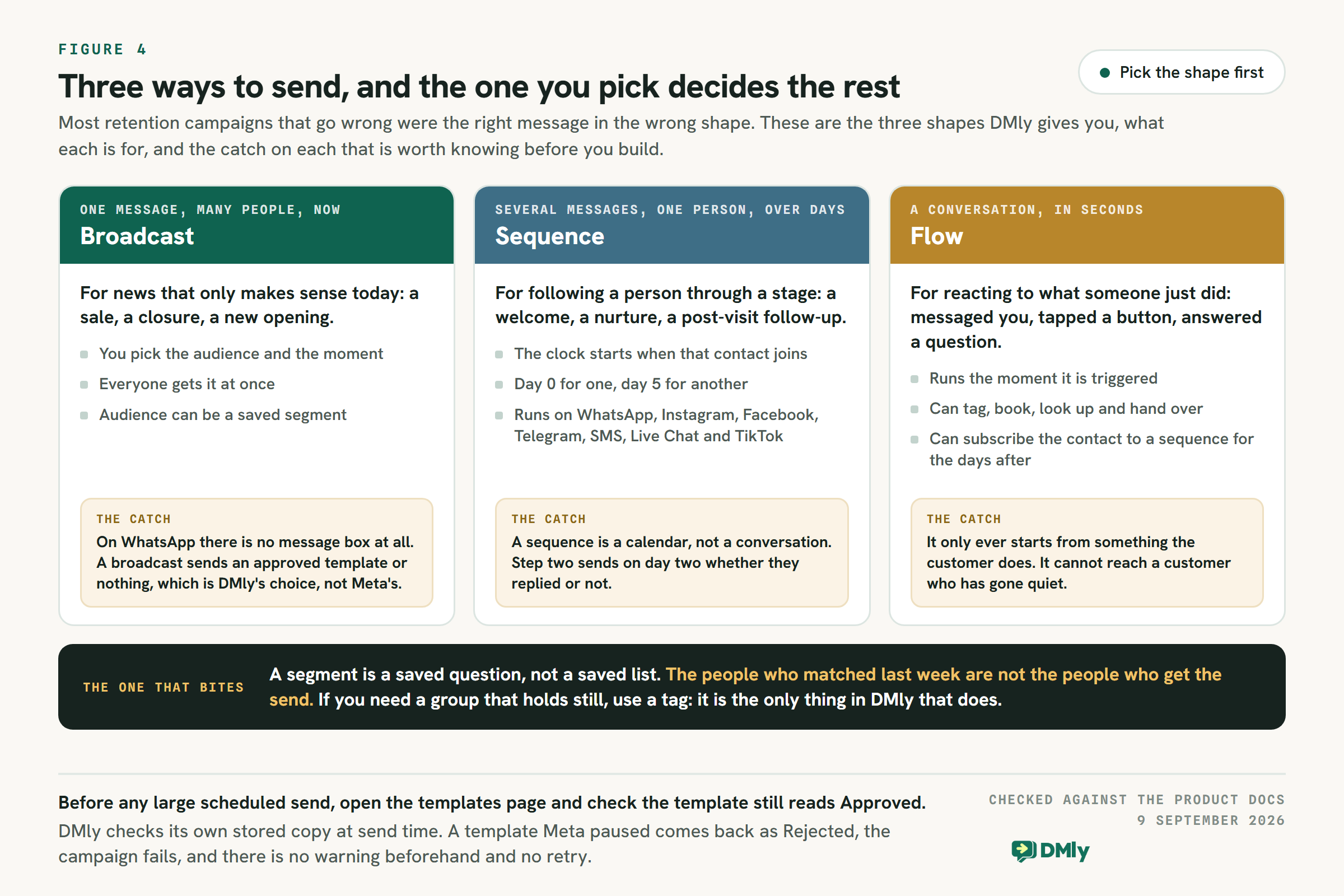
A broadcast is one message to many people now. Use it for news that only makes sense today: a closure, a sale, a new opening. A sequence is several messages to one person over days, and the clock starts when that individual contact joins it, so someone who bought this morning is on day zero while someone who bought last week is on day five. A flow is a conversation, triggered by something the customer just did, running in seconds.
Most retention programmes want a flow that reacts and a sequence that follows up, with broadcasts kept for genuine news. Sequences run on WhatsApp, Facebook, Instagram, Telegram, SMS, live chat and TikTok, so the same follow-up pattern can serve whichever channel a customer prefers. The build itself is covered step by step in the WhatsApp business automation guide.
The limitation to know before you plan a campaign: a WhatsApp broadcast in DMly has no message box. Step two of the wizard offers a template picker and nothing else. That is DMly’s own decision rather than a Meta rule, and the reasoning is sound, since a broadcast audience is mostly outside the window and a free-form send would reach only a fraction of it. It is still a surprise if you have sent a Telegram or SMS broadcast before, because those channels do give you a plain text box. There is more on how audiences and opt-in work in the broadcasts guide.
Segments Find the Drifters, With One Catch
A segment is a saved question, not a saved list. You store the criteria, such as everyone with a given tag who has not done anything for sixty days, and DMly runs them fresh every time you open the segment or broadcast to it. For retention that is exactly right: your inactive segment finds the people who are inactive today, not the ones who were inactive when you built it, and anyone who replies falls out of it on their own.
The catch follows from the same behaviour. A broadcast you scheduled last week does not go to the people who matched last week, it goes to whoever matches when it sends. There is no way to freeze a segment. If you need a group that holds still, such as everyone who came to the October open day, use a tag instead, because a tag is the only thing in DMly that stays put until somebody removes it.
The Trap Worth Checking Before Any Scheduled Send
DMly checks that your template still reads Approved at the moment it sends, but it checks its own stored copy of that status rather than asking Meta right then. The copy is kept close to current, so the status you see is minutes old at worst. It is still a copy.
Schedule a campaign a week out on a template Meta later pauses, and the whole thing fails at send time with no warning beforehand and no automatic retry. A paused template comes back as Rejected, since DMly has no paused status of its own. The habit that avoids it costs thirty seconds: before any large scheduled send, open the templates page and confirm the template still reads Approved.
Six Businesses That Turned Retention Into a Habit
None of these are messaging companies, and that is the point. Each one made a single decision about how customers are treated after the sale, and then kept making it. The lesson under each is portable to a business of any size.
Amazon removed the thinking. One-click checkout, saved addresses, delivery that arrives when it said it would, and returns that do not require a conversation. None of it is a loyalty mechanic. It is the removal of every small friction between wanting a thing and having it, repeated until buying becomes a habit rather than a decision. The transferable version for a small business is not the technology, it is the question: how many steps does a repeat customer have to take, and which of them could you delete this month?
Four Seasons made messaging the front door. Its Chat service lets guests reach hotel staff on WhatsApp, and on the Four Seasons app, Facebook Messenger, WeChat, KakaoTalk, LINE, Apple Business Chat, SMS and web chat, before, during and after a stay, for anything from a restaurant recommendation to a late arrival. The detail worth stealing is in the company’s own 2018 announcement, which says the service is 100% powered by humans and translates 100+ languages in real time. The technology routes the message; a person answers it. For most businesses the honest version is a mix of the two, and being clear about which is which is what stops it feeling like a trick.
Bombas made the purchase mean something. Its published promise is one purchased equals one donated, always: for every pair of socks, set of underwear or tee bought, an equivalent item goes to someone experiencing homelessness through its partner organisations. It says so on the product page rather than in a responsibility report nobody reads. Customers are not buying socks, they are taking part in something. This one is only open to businesses where the claim is true and checkable, which is precisely why it works when it does.
Zappos answered calls about nothing. During the 2020 lockdowns it ran a line called Customer Service for Anything, where anyone could call, text or email its support team about any subject at all, orders or not. Commercially it made no sense whatsoever, which is exactly why people still tell the story six years later. The portable lesson is not the hotline. It is that the moments customers remember are the ones where you were clearly not selling.
Polaris Adventures put the whole customer in one place. After moving support and sales onto one platform, Polaris reports a 30 to 40 per cent increase in account capacity per agent, a 30-minute average first-reply time, 86 per cent of tickets resolved in one touch and a 10-hour average resolution time. Those numbers are the same argument as the shared inbox above, with a scale attached: agents stopped hunting for context and started answering.
Dollar Shave Club got there before the problem did. Proactive chat catches the customer at the point of hesitation rather than after the abandoned order, which turns a support cost into a saved sale. The small-business version is not a chat widget, it is noticing which two or three moments generate most of your questions and putting the answer in front of people before they have to ask.
The thread running through all six: none of them is a campaign. Each is a standing decision about how the business behaves, which is what makes them retention strategies rather than promotions.
Five Habits That Keep Your Messaging Welcome
Messaging earns retention only while customers still want to hear from you, and that permission is easy to spend. Five habits protect it.
Go First, Before They Have to Chase
The message that arrives before the customer needs it is worth ten that arrive after. A delivery update before they wonder, a usage tip in the first week, a refill reminder before they run out. Each one removes a small anxiety, and removing anxiety is what makes a business feel easy to stay with. This is also the cheapest kind of proactive messaging to justify, because it prevents the support conversation that would otherwise have happened.
Personalise With Facts, Not Names
Putting a first name at the top of a generic message fools nobody. Useful personalisation refers to something that actually happened: the thing they bought, the appointment they attended, the question they asked last month. In DMly a template parameter can itself be personalised, so typing something like a first name or a stored order reference into a parameter box resolves per recipient when the broadcast sends. That is how one approved template serves a whole segment without reading like a form letter.
Match the Channel to the Urgency
Not everything belongs in a chat thread. Time-sensitive and short goes to messaging, where it will be seen in minutes. Long, referenceable and detailed goes to email, where it can be found again in six months. Getting this backwards is why some businesses feel intrusive and others feel absent, and it is worth a deliberate decision rather than a default. If you are weighing up running one channel properly against running several, we compared the two positions in omnichannel versus single-channel messaging.
Automate the Routine, Show Up for the Rest
Let automation carry the predictable messages and keep your people for the moments that decide anything. Opening hours, order status, booking confirmations and the first acknowledgement of a problem can all be instant and identical every time. A complaint, a refund, an unhappy long-standing customer or anything with money and feelings in it should reach a person quickly, and the handover should be obvious to the customer rather than disguised.
The failure mode to avoid is a bot that will not let go. A customer who has typed “speak to someone” twice and is still being offered menu options is a customer you have already lost, whatever the conversation does next.
Ask, Then Actually Do Something
A one-tap rating after a support conversation or an appointment costs the customer two seconds and tells you where the experience is thin. It only builds retention if the low scores produce a reply from a human, though. Feedback collected and ignored is worse than feedback never asked for, because now the customer knows you heard.
Two mechanics worth getting right: put a short delay in front of the survey so it lands after the work is finished rather than interrupting it, and wire up every branch of what happens next. A survey with no route out of it just asks a question and records nothing, which is a lost response rather than a neutral one. Then review the same three numbers every month, engagement, repeat purchase and satisfaction, and change one thing at a time.
Where to Start This Week
Customer retention is not a project with an end date. It is a number you look at every month, and a handful of moments you handle better than you did last quarter.
If you do nothing else from this guide, do these three. Calculate your retention rate honestly, with new customers subtracted, for the last three periods, and see whether the line is flat or sloping. Fix the day-three follow-up, because it is the highest-value message most businesses are not sending. And build one inactive segment, so you can see how many customers have quietly stopped talking to you, before you decide what to say to them.
Do those and the rest of this guide becomes a menu rather than a mountain.
Questions Owners Ask About Customer Retention
What counts as a good customer retention rate?
There is no single figure worth quoting, because a monthly rate for a coffee subscription and a quarterly rate for a furniture shop are not comparable in any useful way. Your own last three periods are the benchmark that matters. A rate that is stable or rising over three windows is healthy; one falling three windows in a row is a problem regardless of how the absolute number compares with anyone else.
How does messaging improve retention in practice?
By shortening the distance between a customer having a doubt and getting it answered. That shows up in three places: faster support, follow-ups that actually get read, and reminders that arrive before someone drifts. The measurable one is repeat purchase rate, so if you add follow-up messaging and that number does not move over two buying cycles, the messages are not doing the work you think they are.
Can I just message customers whenever I want?
On WhatsApp, no. You have 24 hours from the customer’s last message to write freely; after that only an approved template is delivered, and from 1 October 2026 every business phone number gets 1,000 free service messages a month and pays from the 1,001st, while utility templates get no free allowance at all. Telegram, SMS, Facebook and Instagram behave differently, which is one reason it is worth knowing which channel each of your customers actually uses.
How often should I message a customer without annoying them?
Frequency is the wrong dial. Relevance is the right one: a customer will take four messages in a week that are all about their order and resent one a month that is not. The practical test is whether the message would still be worth sending if it produced no sale at all. Give people a way to say “less of this” and honour it immediately, because an unsubscribe is much cheaper than a block.
Will automation make my business feel impersonal?
Only if you automate the wrong half. Customers are entirely comfortable with an instant automated answer to “what time do you close”. They are not comfortable with a bot handling a complaint. The rule that keeps it safe is that automation should shorten waits, never replace judgement, and a customer who asks for a person should get one without having to ask twice.
Does this work for a service business, not just retail?
Yes, and often better, because the retention moments are more obvious. A salon has a rebooking cycle, a clinic has a recall, a tutor has a term. In each case the reminder has a natural date attached to it, which is the hardest part of retention messaging to get right and the part a service business gets for free.
Start with one honest number. Work out your real retention rate for the last three periods, then fix the single moment where you are losing people. Start a 7-day DMly trial, no card and no code, and build the follow-up you have been meaning to send.
Writing about WhatsApp automation, bookings and growth for local business.
Turn WhatsApp into your busiest channel.
Start free and run message, bookings, payments and reviews in one place.
