
Kaleyra Review (2026): There Is No Sign-Up Button
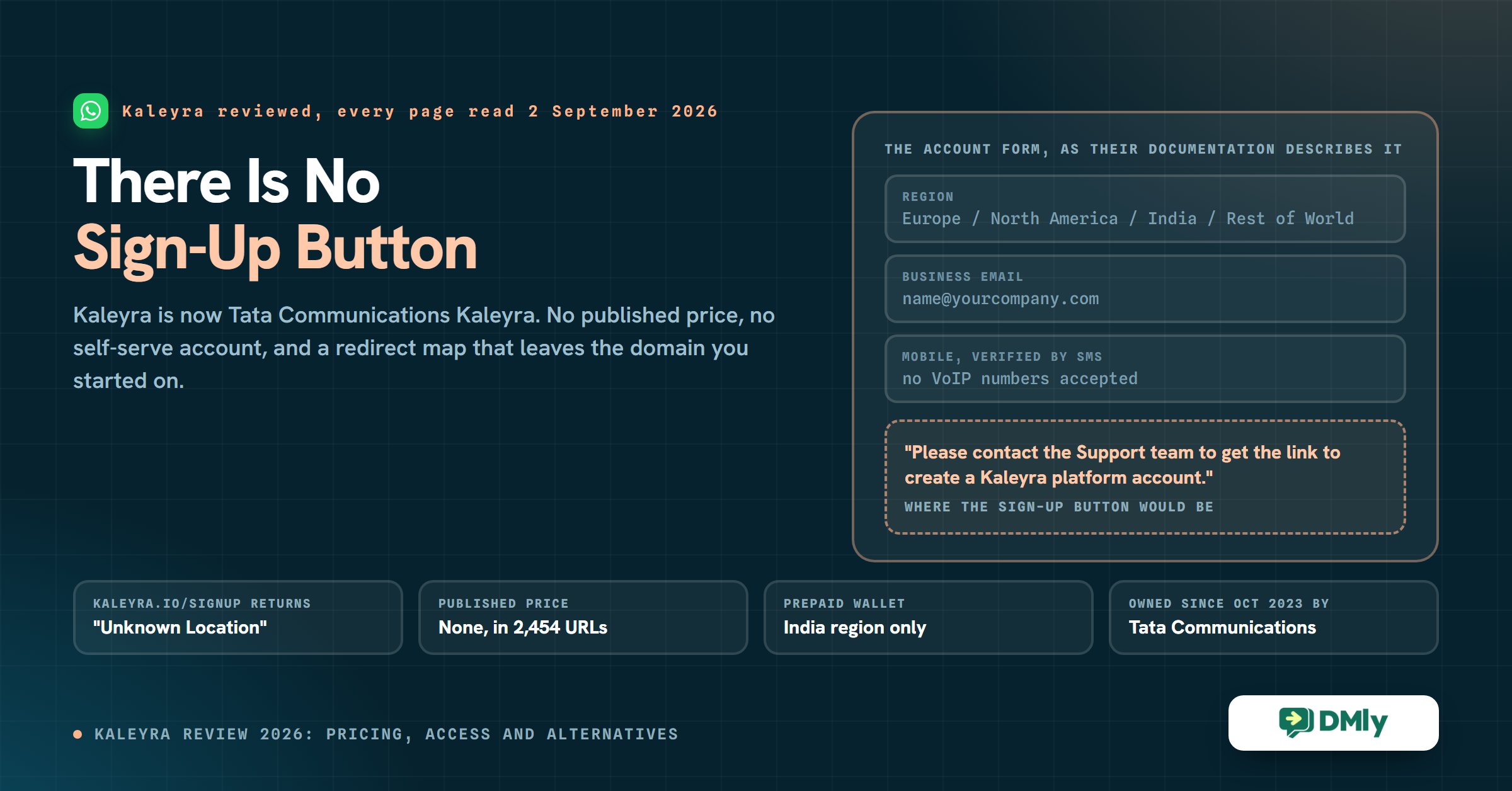
Kaleyra’s developer documentation has a page titled “Create a Kaleyra Platform Account”. The first line under that heading reads: “Please contact the Support team to get the link to create a Kaleyra platform account.” The step after it begins “Go to the signup URL provided by Kaleyra representative.”
That is not a gap in the documentation. It is the documentation telling you exactly how the product is sold, and once you take it at its word most of what a Kaleyra review normally spends three thousand words circling is already answered. There is no public sign-up page. Typing the obvious one, kaleyra.io/signup, lands you on a page that says “Looks like you landed in Unknown Location”. We checked it on 2 September 2026, along with everything else on this page.
None of that is a criticism. Kaleyra is a serious piece of communications infrastructure with a global carrier network behind it, and businesses that need what it sells are usually delighted with it. But it does mean the honest version of “Kaleyra versus a messaging platform” is not a feature table. It is a question about which kind of purchase you are making: a metered wholesale service you negotiate, or a subscription you can start this afternoon.
One more thing has changed since most reviews of this platform were written, including the earlier version of this Kaleyra review. Kaleyra is no longer a company. It is a product family inside Tata Communications, and kaleyra.com now redirects every visitor to tatacommunications.com. We will come to what that means for you further down.
We make DMly, which is one of the alternatives named later in this Kaleyra review, and we would rather say so in the first hundred words than bury it. Where Kaleyra is the better answer for your business, this page says so and explains why.
The First Thing to Know: Kaleyra Is Now Tata Communications
You are not buying from a CPaaS startup any more. You are buying from a Tata company. Tata Communications announced a definitive agreement to acquire Kaleyra, Inc. on 28 June 2023 and completed it on 5 October 2023, paying roughly 100 million dollars in cash and assuming Kaleyra’s outstanding debt. Kaleyra, Inc. and its subsidiaries became wholly owned subsidiaries of Tata Communications Limited on that date.
Three years on, the absorption is complete on the surface too. The name survives as a product prefix rather than a company: the Tata Communications site sells Kaleyra CPaaS, Kaleyra CCaaS, Kaleyra.ai, Kaleyra Unified Communications, Kaleyra Cloud Voice and Kaleyra Phone, all sitting under a marketing idea they call the Interaction Fabric.
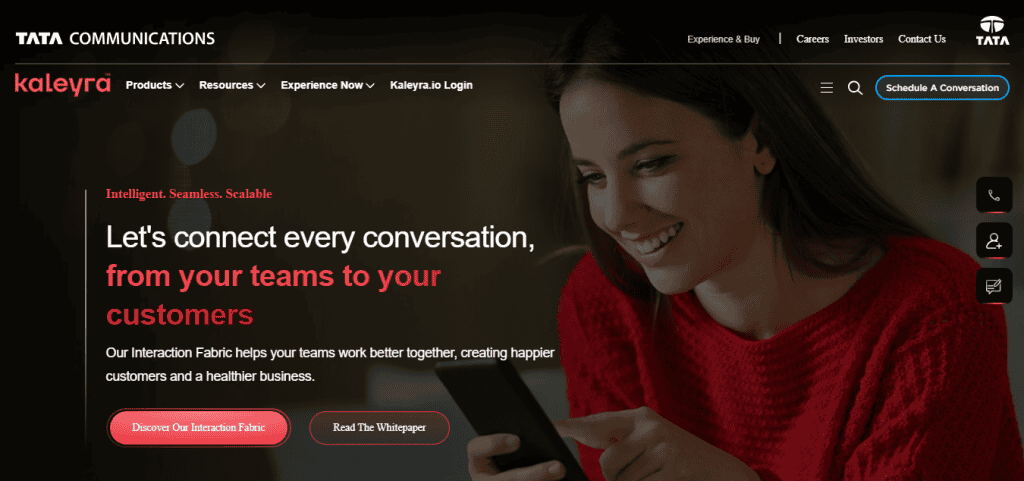
That last point is worth a sentence of its own, because it is the kind of mistake worth admitting in public. This page has been carrying a picture of Tata Communications’ website since May 2026 while the text beside it described Kaleyra as an independent vendor. The picture was right and the prose was out of date, and nobody noticed because nobody looked at the two together.
Three addresses, and what each one is actually for
Knowing which of the three Kaleyra addresses you are looking at saves you a lot of confusion, because two of them are still live and only one of them sells anything. Here is what each returned when we requested it on 2 September 2026.
kaleyra.comis the marketing site, and it no longer exists. Every path on it answers with a 301 redirect totatacommunications.com. It is a well maintained redirect map rather than a blanket one:/whatsapp-business-apilands on the matching Tata Communications product page, and/contactlands on their contact page. Two paths that do not survive the move are/signupand/free-trial, which both fall back to the generic landing page.kaleyra.iois the product itself, and it is a login. It returns a working page, but the page is an application shell whose meta description reads “Kaleyra-CPaaS”. Without an account there is nothing to see. This is the address the Tata Communications navigation links to, under the label “Kaleyra.io Login”.developers.kaleyra.iois the documentation, and it is the most useful public thing they publish. It is live, current, indexed, and still footed “Kaleyra Inc. All rights reserved”. If you want to understand the product without talking to anyone, this is where to go, and it is where several of the facts on this page came from.
Why spell this out? Because a vendor’s own site going dark, or moving, is the single most common reason a software review goes quietly stale. We now check the vendor’s live domain before we trust a single claim on one of these pages, after finding a review elsewhere on this blog that had been pricing a product at an address that no longer resolved for anybody. Kaleyra is the friendlier version of the same problem: the site did not die, it moved house and changed its name.
Kaleyra Pricing in This Kaleyra Review: What Is Published, and What Is Not
There is no Kaleyra price list, anywhere, and we are not going to invent one. That is the short version, and if you only read one section of this page, read this one, because the number you will find quoted in software directories is not a number Kaleyra publishes.
Here is exactly what we did. We requested the old pricing URL, kaleyra.com/pricing, and followed where it went. We then searched the entire Tata Communications sitemap, all 2,454 published URLs of it, for anything resembling a price page for this product line. Then we read the developer documentation, which is the one Kaleyra property that talks about money at all.
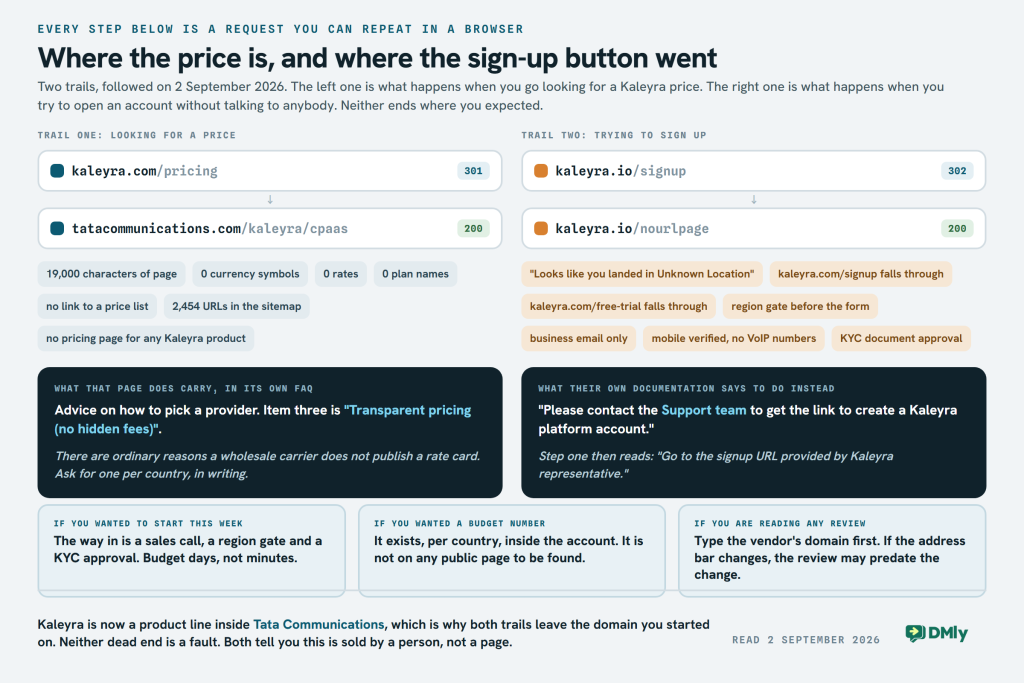
The old pricing page now lands somewhere with no prices on it
The redirect is precise, which makes the result more interesting than a lazy catch-all would have been. kaleyra.com/pricing does not dump you on the home page. It sends you to tatacommunications.com/kaleyra/cpaas, the CPaaS product overview, which is plainly the page somebody decided was the closest successor to a pricing page.
That page runs to about 19,000 characters of text. It contains no currency symbol of any kind, no per-message rate, no plan name, no tier and no link to a price list. What it does contain, in its own frequently asked questions, is advice to buyers on how to choose a CPaaS provider. The third item on that list of things to look for is “Transparent pricing (no hidden fees)”.
We are quoting that rather than editorialising about it, because there are perfectly ordinary reasons a wholesale telecoms business does not publish a rate card. Message pricing genuinely does vary by country, by carrier route, by volume commitment and by contract term, and a single published figure would be wrong for almost everybody who read it. Several of Kaleyra’s largest competitors publish rates anyway, and several do not. The point for you is narrower and entirely practical: the page that gives you that advice is the page the old pricing URL now lands on, and you cannot act on the advice from it. Ask for the rate card in writing, per country, before you sign anything.
For completeness, the sitemap search: Tata Communications does publish pricing guides for other parts of its business, including SIP trunking, cloud CDN, GPU compute and zero trust network access. There is no equivalent for Kaleyra CPaaS, CCaaS or any other Kaleyra product. So this is a decision about this product line rather than a company that never publishes anything.
What Kaleyra does publish about how you pay
No rate card is not the same as no information, and the billing documentation tells you a great deal about what kind of customer relationship you are entering. All of the following comes from Kaleyra’s own developer hub, on pages last updated in August 2026.
- There are two billing models: prepaid and postpaid. A prepaid account holds a wallet you top up, and each message deducts from it. A postpaid account logs usage as it happens and invoices you at the end of the billing cycle.
- Prepaid is available in India only. Kaleyra’s documentation states it in a boxed note: “Prepaid billing is only available in the IN region.” If you are anywhere else, postpaid is the model, which means an invoiced account, which means a credit relationship, which in practice means a conversation with a salesperson and probably a contract.
- There is a trial balance rather than a free trial. The wording is “Kaleyra.io provides a trial preloaded balance in your account to test out limited features.” No amount is published, and you still need an account first, which you still cannot open on your own.
- Top-ups can be automatic. You can link a card and set auto debit so the wallet refills when it drops below a threshold you choose. Indian customers can also apply Tax Deducted at Source at 0.5 per cent or 2 per cent when adding credit, which tells you plainly where the centre of gravity of this business sits.
- Sub-accounts have their own billing. There is a parent and sub-account billing structure, which is what you would expect from a platform built for enterprises and resellers rather than for one shop.
Put those together and the shape of the purchase is clear before anybody quotes you anything. You are buying metered wholesale messaging with a credit account attached, in the same way you buy bandwidth, and the unit price is the thing you negotiate rather than the thing you look up.
How we word a missing price, and why the wording matters
A blank cell in a comparison table is lazy, because there are four completely different reasons a price can be missing and they matter to you in different ways. We settled on these four while working through the rest of the reviews on this blog, and Kaleyra is squarely the second.
| How a price can be missing | What it means for you | Example |
|---|---|---|
| Published | A currency and a period you can read without an account. You can budget today. | DMly, Wati, Respond.io |
| Not published | No price page exists. Every number comes from a sales conversation. | Kaleyra |
| Gated | A full pricing page exists with the numbers taken out of it, behind a login or a quote form. | RapBooster |
| Published, but not verifiable by us | The vendor publishes openly and any person can read it, but our own checks cannot reach it. This is a limitation on us, not a criticism of them. | Manychat |
And one thing we will not do: quote a figure from a software directory. Directories keep publishing prices long after a vendor’s site has changed, and we have caught that failure on this blog before, on a vendor whose listed starting price was still being republished by two large directories after the website attached to it had stopped resolving entirely. If Kaleyra does not publish a number, this page does not either.
There Is No Sign-Up Button, and Their Own Documentation Says So
This is the fact that decides whether Kaleyra is even a candidate for your business, and it takes ten seconds to check. The page in the developer hub called “Create a Kaleyra Platform Account” opens by telling you to contact support for a link, and step one is “Go to the signup URL provided by Kaleyra representative and follow the steps to create your account”.
We tried the address anyway. kaleyra.io/signup redirects to kaleyra.io/nourlpage, which renders a short message: “Looks like you landed in Unknown Location.” The old marketing site’s /signup and /free-trial paths are two of the very few that the Tata Communications redirect map has no destination for, so they fall through to the generic landing page.
What the documented flow looks like once a representative has sent you the link is worth knowing too, because it is a genuinely well built onboarding and it tells you who it is designed for:
- Pick a region first. Europe, North America, India, or Rest of the World. This is not a formality: the country list you get afterwards is filtered by the region you chose, and if you pick India the only country available is India. Choose wrong and you have to start again.
- Business email only, plus a password of at least eight characters with upper case, lower case, a number and a symbol.
- Verify the email, then verify a mobile number by SMS. Their documentation notes that VoIP numbers are not accepted, which is exactly the check you would expect from a company whose product is sending SMS.
- Then the account setup: organisation name, country code, mobile number. And after that, a Know Your Customer document submission and approval step before you are fully live.
Nothing there is unreasonable for a telecoms supplier. Sender identity fraud is a real problem, regulators in several of Kaleyra’s biggest markets require the checks, and a business that cannot be identified is a business that can spam. But add up the sales conversation, the region gate, the identity checks and the credit account and you get a purchase measured in days or weeks. If your plan for this week was “sign up, connect WhatsApp, message my customers by Friday”, that plan is not compatible with this product, and no amount of feature comparison changes it.
What Kaleyra Is Genuinely Good At
If your business runs on messages that absolutely have to arrive, in a lot of countries, this is the kind of supplier you want. Any Kaleyra review that opens with what the product lacks has the emphasis in the wrong place, so here is what it is for. That is a real category of business and it is not a consolation prize. One time passcodes, delivery notifications, fraud alerts, appointment reminders sent by the million: these are jobs where the difference between 98 and 99.5 per cent delivery is measured in support tickets and lost revenue, and where the answer is carrier relationships rather than clever software.
Here is what Tata Communications publishes about the scale behind it, quoted as their claims rather than as our findings: coverage in more than 190 countries, 1,600 direct and indirect routes, 60 billion annual interactions, 21 years of what they describe as flawless SLA maintenance, ISO 27001 certification, and membership of the Mobile Ecosystem Forum with its Business SMS Code of Conduct signed. On the WhatsApp product page they also describe themselves as a Meta Premier Partner FY26. We have not independently audited any of those numbers, and you should ask for the SLA in writing rather than taking the headline figure.
The product range is genuinely broad in a way most WhatsApp platforms are not. Under Kaleyra CPaaS alone there is SMS, WhatsApp, RCS, MMS, programmable voice, video, email, chatbots and a phone number lookup API. Alongside it sits a contact centre business, a unified communications business, and Kaleyra.ai. Nothing in the WhatsApp-first category competes with that surface area, including us.
The console, and the four channels in it
One screenshot tells you more about the daily experience of this product than any feature list, and it happens to have been sitting on this page all along.
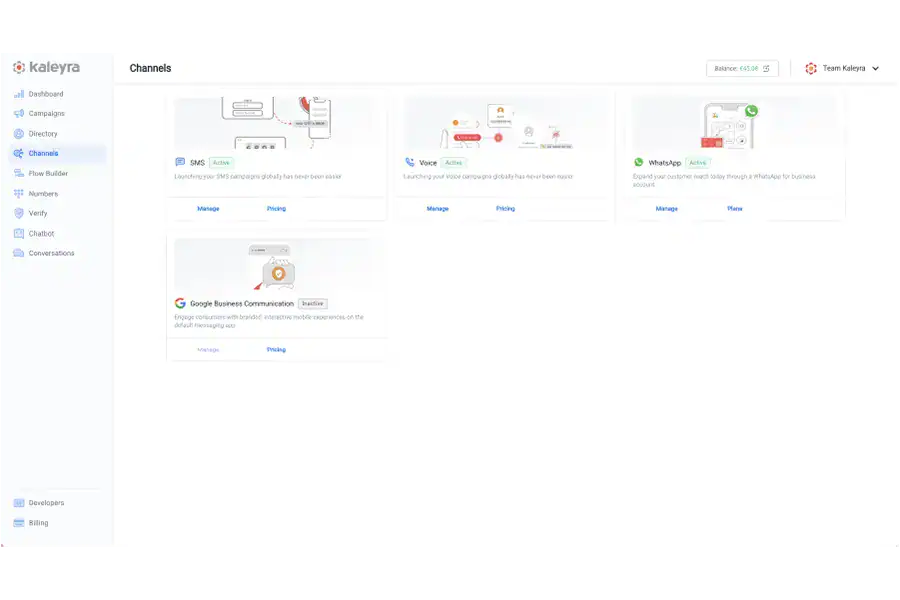
Three things that screenshot settles. The sidebar is the product’s real shape: Dashboard, Campaigns, Directory, Channels, Flow Builder, Numbers, Verify, Chatbot, Conversations, Developers, Billing. “Verify” is the one-time passcode product, “Numbers” is telephone number provisioning, and “Developers” being a top-level item rather than a footer link tells you who the console expects in the driving seat.
The channel list in the console is four items long: SMS, Voice, WhatsApp and Google Business Communication. That is a narrower set than the marketing site advertises, because the marketing site is describing the whole Tata Communications portfolio and the console is describing what one account has switched on. It is still a useful corrective if you arrived expecting Instagram and Messenger to be in there.
And every channel card carries its own “Pricing” link, right next to “Manage”. The rate card is not missing. It is on the other side of the account you cannot open by yourself. That is a coherent way to run a wholesale business, and it is also the reason this section of a Kaleyra review cannot give you a number.
Six Things This Kaleyra Review Used to Say That Are Now Wrong
This Kaleyra review has been live since May 2026 and it needed more correcting than most. Every one of these was checked against Kaleyra’s own site and documentation on 2 September 2026, and most of them run in Kaleyra’s favour rather than ours.
| What this page used to say | What is actually true |
|---|---|
| Kaleyra is a cloud communications platform, described throughout as an independent vendor | Kaleyra has been a wholly owned subsidiary of Tata Communications since 5 October 2023, and the brand is now a product prefix on the Tata Communications website |
| “Most businesses need to contact the sales team for a custom quote” | True but understated. There is no public sign-up at all, so you contact sales to get an account, not just a quote |
| “Many users praise the platform for dependable message delivery” and five similar user-review claims | Removed. Those were unattributed directory sentiments with no source we could show you, including a claim about delivery delays at peak that we could not stand behind either way |
| “CRM functionality is mostly integration-based” | Kept, and sharpened. The console has a Directory, which holds contacts and groups for campaigns. It is a messaging address book rather than a CRM, and that distinction is the useful one |
| DMly “supports channels like WhatsApp, Instagram, Messenger, Telegram, and Webchat” | Eight channels, not five. SMS, TikTok and Google Business Profile were missing, and one of those three matters a lot on this particular comparison |
| The comparison table listed Kaleyra’s channels as “SMS, WhatsApp, voice, email” | Also RCS, MMS and video, plus a phone number lookup API. We were underselling the competitor on the row where they are strongest |
The one we are least comfortable about is the third. A review that says “users report occasional delivery delays during peak usage” without telling you which users, where they said it or when, is not evidence, it is atmosphere. It has been taken out rather than sourced, because we could not source it.
Kaleyra vs DMly: Two Different Purchases, Not Two Versions of One
The most useful thing we can tell you is that these two products are bought by different people inside a business, for different reasons, out of different budgets. Kaleyra is bought by whoever owns delivery and infrastructure. DMly is bought by whoever owns customers. In a company of four hundred people those are different departments. In a company of four people they are you, which is exactly why the distinction gets lost.
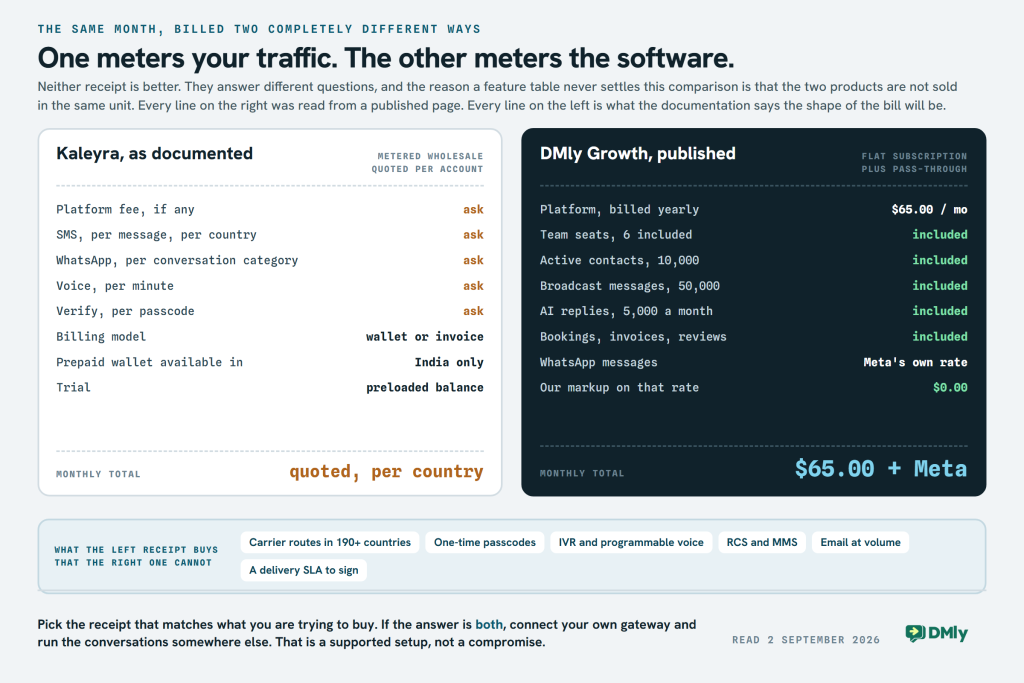
The clearest way to see the difference is to look at what each one meters. A CPaaS meters traffic. You pay per message, the rate varies by country and route, and the bill rises with volume whether the volume made you any money or not. A platform meters capability. You pay a flat monthly fee for the software and its allowances, and the messages themselves are a separate, pass-through cost.
That second model is worth being precise about, because it is the part buyers most often get wrong. On DMly you pay Meta’s own per-message rates directly, with no markup added by us, and the subscription covers the platform. That is a stated commitment on our pricing page rather than a feature, and it is checkable: Meta publishes its rates per country, and we keep a country by country rate card so you can look yours up before you decide anything. A resold rate, by contrast, is whatever the reseller’s contract with the carrier and its own margin make it, which is neither wrong nor sinister but is a number you have to ask for.
The side by side, with the honest rows left in
| Category | Kaleyra (Tata Communications) | DMly |
|---|---|---|
| What it is | Communications infrastructure, sold wholesale | A customer operations platform, sold as software |
| How you get an account | A representative sends you a sign-up link. Region gate, business email, mobile verification, KYC | Sign up on the website. 7-day trial, no card |
| Published price | None. Contact sales | $29, $65 or $149 a month billed yearly |
| How you are billed | Prepaid wallet (India only) or postpaid invoice, metered per message | Flat subscription, plus Meta’s own per-message rate paid directly with no markup |
| Messaging channels | SMS, voice, WhatsApp, RCS, MMS, email, video, Google Business Communication | WhatsApp, Instagram, Messenger, Telegram, SMS, TikTok, LiveChat widget, Google Business Profile |
| Carrier-grade SMS and voice | Yes. This is the core product | No. You connect your own Twilio, Plivo or HTTP gateway |
| One-time passcodes and IVR | Yes. A dedicated Verify product, plus voice and IVR | No. Neither exists |
| Contact data | Directory: contacts and groups for campaigns | CRM with pipeline stages, lifecycle, tags, notes and custom fields |
| Bookings and appointments | Not part of the product | Services, staff, availability, classes and a public booking page |
| Invoices and payments | Not part of the product | Invoices, orders, payments, refunds, coupons, subscriptions and expenses |
| Reviews and reputation | Not part of the product | Google review requests and a reputation inbox |
| Loyalty and gift cards | Not part of the product | Points, plans and credits, memberships and gift cards |
| White label | Not published | Agency layer with your own brand, custom domain and Stripe account |
| Who it suits | Enterprises and developers who need guaranteed delivery at scale across many countries | Owner-run and multi-location businesses who need conversations, bookings and money in one place |
What DMly Does That a CPaaS Does Not
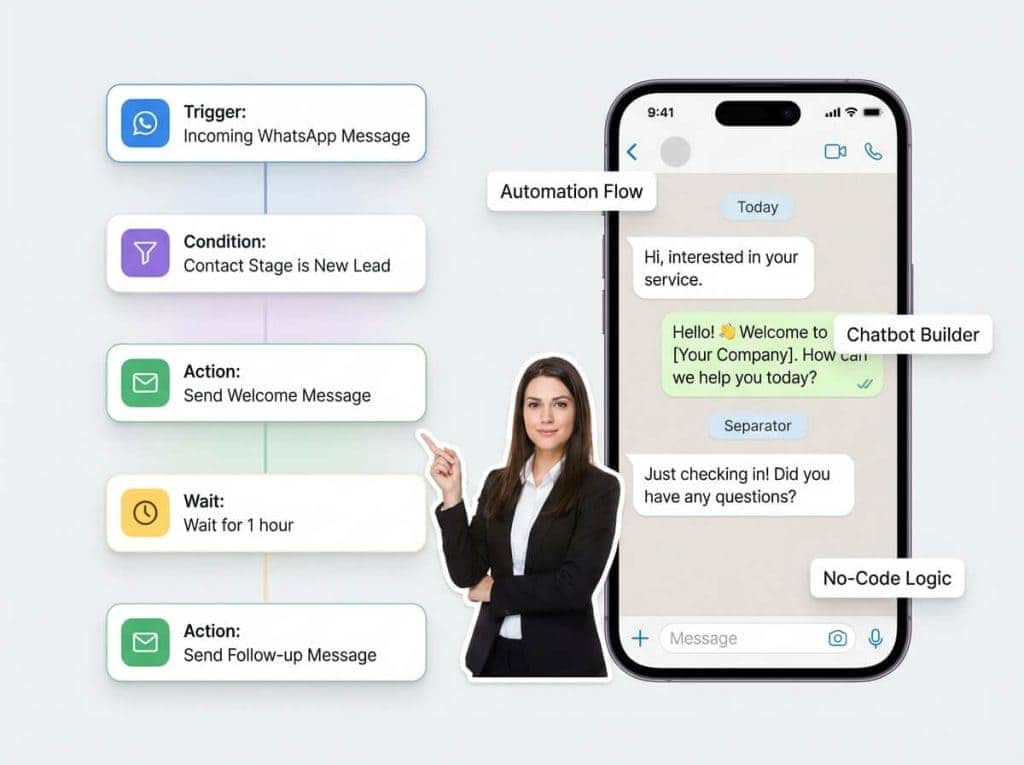
The gap is not automation, and it is not AI. It is everything that happens after the message arrives. A CPaaS is very good at delivering a message and has no opinion about what the message was for. A platform like ours is built around the assumption that the message was about a booking, an invoice, a review or an order, and that those things should live in the same place as the conversation.
Concretely, on a workspace you can open today:
- One inbox for eight channels. WhatsApp, Instagram, Messenger, Telegram, SMS, TikTok, the LiveChat widget on your site, and Google Business Profile for reviews. One person is one contact even if they reach you on three of them. Our guide to running a single inbox across channels covers the routing and assignment side.
- Bookings that are actually bookings. Services with durations and prices, staff with availability and time off, group classes with waitlists, a public booking page and a client portal. A service can take no payment, send a pay link afterwards, or hold the slot for 15 minutes until the client has paid. See how appointment booking works over WhatsApp for the full setup.
- Money, in the same system as the conversation. Invoices with a partially paid state, orders, refunds, discount coupons, recurring subscriptions, gift cards, loyalty points and an expenses ledger.
- Reviews, collected and answered. Connect a Google Business Profile and DMly can request reviews automatically after a completed appointment and give you one place to reply to them. The review automation guide covers the timing and the rules on what you are allowed to ask.
- Broadcasts with the WhatsApp rules built in. Audiences, scheduling, approved templates, and a warning before you send to people outside the 24-hour window rather than a failed send afterwards. There is more detail in our guide to WhatsApp broadcasts.
- AI replies on every plan. Not an add-on and not a higher tier: the AI agent is included on Starter, Growth and Premium. What differs is the monthly allowance and whether you can bring your own model provider key.
Where DMly is the weaker product, stated plainly
If any of the following describes your business, Kaleyra is the better buy and you should stop reading comparisons and go and book that call. These are not hedges. They are things our product does not do.
- We do not sell SMS. DMly sends SMS through your own Twilio, Plivo or custom HTTP gateway account, and you pay that provider. If SMS is your main channel rather than your fallback, you want a supplier who owns the routes, and Kaleyra owns routes. Our SMS automation guide is honest about this: the gateway is yours.
- The custom HTTP gateway is outbound only. Replies never reach your inbox and delivery reports never update a message’s status. Two-way SMS means Twilio or Plivo specifically.
- There is no one-time passcode product. No Verify equivalent, no OTP API, nothing for authentication. If you need to send login codes, that is not what we are.
- There is no telephony. No IVR, no call routing, no click to call, no programmable voice. DMly takes and places WhatsApp voice calls in the inbox, which is a different thing, and outbound WhatsApp calls cannot be placed at all from a business number registered in the United States, Canada, Egypt, Vietnam or Nigeria.
- There is no RCS, no MMS and no email marketing. Kaleyra has all three.
- Broadcast reporting has real gaps. Replies always reads zero, there is no click tracking on a broadcast, delivered is WhatsApp and SMS only, and opened is WhatsApp only. We would rather you knew that before you bought than after your first campaign.
- Two channels cannot be broadcast to at all. The LiveChat widget and TikTok both take conversations and neither accepts a broadcast.
There is one more, and it is the one that most often changes a decision: the response time report measures from assignment, not from the customer’s message. Avg first response in Reports counts from the moment a conversation was assigned to an agent, so however long it sat in the queue before anyone picked it up never reaches the number. It is a real report and it exports to CSV and PDF, but if you are trying to prove a service level to a client, that is the caveat to know about.
What Each One Costs, and the Only Fair Way to Compare Them
You cannot compare a subscription with a metered rate directly, so do not try. Compare the two things you will actually be billed for. With any WhatsApp platform there are two separate bills: the software, and the messages. Splitting them is the only way to get an answer you can trust.
Our own side is published, so here it is in full, read from our pricing page on 2 September 2026. All three prices are the annual-billing rate, and monthly billing costs more.
- Starter, $29 a month billed yearly. One profile per channel, 3 team seats, 3,000 active contacts, 10,000 broadcast or template messages, 10 active bots per profile with unlimited flows, and 500 AI replies a month.
- Growth, $65 a month billed yearly. Three profiles per channel, 6 seats, 10,000 active contacts, 50,000 broadcast or template messages, unlimited bots, and 5,000 AI replies a month.
- Premium, $149 a month billed yearly. Five profiles per channel, 15 seats, unlimited active contacts, 300,000 broadcast or template messages, 20,000 AI replies a month, and the option to connect your own AI provider key for unlimited replies.
- Add-ons, if you outgrow one line rather than the whole plan. An extra team seat is $10 a month, an extra profile set is $15 a month, and extra contacts are $15 per thousand.
Every plan includes the shared inbox, the CRM, bookings, invoices and payments, reputation, custom domain and branding, the API and webhooks. The trial is seven days with no card. And the messages themselves are billed by Meta at Meta’s published rate for the recipient’s country, paid by you directly, with nothing added by us.
For Kaleyra, the equivalent list is a blank page, and no honest Kaleyra review can fill it in for them. What we can give you instead is the five questions that will get you a comparable number out of a sales call, which is more useful than a figure we invented anyway.
- Is there a platform fee separate from the message rate, and is it monthly or annual? Ask this first. A metered quote that omits a monthly platform fee is not a quote.
- What is the per-message rate for my three biggest countries, by category? WhatsApp bills marketing, utility, authentication and service messages at different rates, and they differ enormously by country.
- Is that rate a pass-through of Meta’s published price, or does it include a margin? Both answers are legitimate. You just need to know which one you are getting, and you can check it against Meta’s own published rates afterwards.
- Is there a minimum monthly commitment or a minimum top-up? On a prepaid wallet the practical minimum is whatever they will let you load.
- What happens to unspent balance if I stop? Ask for the answer in the contract rather than in the email.
One dated thing to raise on that same call, whoever you buy from. Meta is changing what it charges for on 1 October 2026. Two categories that are free today become billable: service messages, and utility messages sent inside an open 24-hour window. Nine markets also move to standalone pricing on the same date: Bangladesh, Iraq, Nepal, Sri Lanka, Kazakhstan, Kuwait, Morocco and Oman, plus Ukraine. Meta published the new rates on 1 September 2026, so there is now a figure to hold a vendor to: a service message costs whatever your market pays for a utility or authentication message, and the first 1,000 service messages a month on each business phone number are free. Our explanation of the October pricing change walks through what changes and how to price it.
Which One to Buy
Four short descriptions. Pick the one that sounds most like your week. This is the part of a Kaleyra review that actually decides anything, which is why it is four descriptions rather than a score out of ten.
You send login codes, delivery alerts or fraud warnings, in volume
Buy Kaleyra, or one of its peers. You need carrier routes, a Verify product, a delivery SLA you can hold somebody to, and an account manager who answers the phone at 2am when a route degrades. None of that is what a WhatsApp platform is for, and a platform that told you otherwise would be selling you something it cannot deliver. Book the call.
You have developers, an existing product, and messages to send from inside it
Also Kaleyra, probably, or a direct integration with Meta. The value you want is an API, uptime and coverage, and you are going to build the workflow yourself anyway. Our own WhatsApp automation API guide is worth a read either way, because the WhatsApp-side constraints are identical whichever supplier you route through.
You run a salon, clinic, gym, studio, restaurant or agency and you answer customers yourself
Kaleyra is not built for you, and the sign-up is the proof rather than the opinion. What you need is one inbox, a booking calendar, invoices, review requests and automation you can build without a developer, on a price you can read before you commit. That is DMly, and it is also several of the other platforms on this blog. Start with the WhatsApp Business API guide for small businesses if you have not been through official WhatsApp access before, because that step is the same wherever you end up.
You need both, which is more common than the comparison articles admit
Plenty of businesses send transactional SMS through a carrier-grade supplier and run their customer conversations somewhere else, and there is nothing wrong with that. DMly is built for it: connect your SMS gateway on the integrations page and the messages land in the same inbox as everything else. If you have already got an aggregator you are happy with, keep it. The decision in front of you is about the conversation layer, not about tearing out your delivery layer.
How to Check Every Claim in This Kaleyra Review Yourself, in Ten Minutes
You should not take a vendor’s word about a competitor, and that includes ours. Everything on this page was established from public pages, and here is the exact route so you can repeat it. It also works on any other review you read this week, which is the more valuable use for it.
- Type the vendor’s domain into your browser and watch where you end up. If the address in the bar changes, the company has been bought, renamed or shut down, and any review that does not mention it was written before the change or never checked. This one takes five seconds and catches more stale reviews than anything else.
- Try the pricing URL directly. Add
/pricingto the domain. You will get a price list, a quote form, a login wall, or a redirect. Each of those four tells you something different about how the product is sold. - Try the sign-up URL directly. Add
/signup. If there is no self-serve sign-up, you have just learned the single most important thing about the buying process, and you learned it before spending an hour on a feature comparison. - Read the developer documentation, not the marketing site. Documentation is written for people who have already bought, so it is far more candid: it says which regions a billing model works in, what the trial actually contains, and what the product cannot do. Kaleyra’s is at
developers.kaleyra.ioand it is genuinely good. - Search the sitemap before concluding a page does not exist. Most sites publish one at
/sitemap.xml. Searching it for “pricing” is the difference between “I could not find a price page” and “there is no price page”, and only the second is a fact. - Ignore the directories for prices. Software directories are useful for finding vendors and unreliable for pricing them, because their listings are updated by whoever last got round to it. We have found a directory still publishing a starting price for a product whose website had stopped resolving.
If you run that list against this Kaleyra review and find something we got wrong, we would rather hear it than not. The corrections table further up exists because the previous version of this article failed several of its own checks.
Frequently Asked Questions
What is Kaleyra used for?
Sending large volumes of messages reliably across many countries, mainly SMS, voice, WhatsApp, RCS, MMS and email, through APIs. The most common jobs are one-time passcodes and authentication, transactional notifications like order and delivery updates, and promotional campaigns at scale. It is also sold alongside a contact centre product and a unified communications product under the same Kaleyra name.
Who owns Kaleyra now?
Tata Communications Limited. It agreed to acquire Kaleyra, Inc. on 28 June 2023 and completed the acquisition on 5 October 2023 for approximately 100 million dollars in cash plus assumed debt, at which point Kaleyra, Inc. and its subsidiaries became wholly owned subsidiaries. The kaleyra.com domain now redirects to tatacommunications.com, and the products are branded Kaleyra CPaaS, Kaleyra CCaaS, Kaleyra.ai, Kaleyra Unified Communications, Kaleyra Cloud Voice and Kaleyra Phone.
How much does Kaleyra cost?
Kaleyra does not publish a price. There is no pricing page on the Tata Communications site for any Kaleyra product, and the old kaleyra.com pricing URL now redirects to a product overview page with no figures on it. Billing is metered per message, on either a prepaid wallet (available in India only) or a postpaid invoice, and rates are shown inside the account. Any specific figure you see quoted in a software directory has not come from the vendor’s own site, and we do not repeat those.
Can I sign up for Kaleyra without talking to sales?
No. Kaleyra’s own documentation says to contact the support team for a sign-up link, and the first step of account creation is “Go to the signup URL provided by Kaleyra representative”. There is no public sign-up page: kaleyra.io/signup redirects to a page reading “Looks like you landed in Unknown Location”, and the old marketing site’s /signup and /free-trial paths both fall through to a generic landing page. Checked 2 September 2026.
Is Kaleyra good for WhatsApp marketing?
It can deliver WhatsApp campaigns, and it is an official route to the WhatsApp Business Platform. Whether it is good for you depends on who is going to run the campaigns. The console is built around channels, flows and a directory of contacts, and it expects a technical owner. If the person writing the campaign is also the person who cuts hair or takes the bookings, a platform designed for that job will get you further faster.
Does Kaleyra have a CRM?
Not in the sense most business owners mean. The console has a Directory, which stores contacts and groups so you can target campaigns at them. There are no pipeline stages, no deal tracking and no customer history beyond messaging. Kaleyra integrates with external CRMs instead, which is the normal and sensible design for an infrastructure product. If you want the customer record and the conversation in the same place, that is a different category of tool.
What is the best Kaleyra alternative for a small business?
It depends which half of Kaleyra you were after. If you wanted the messaging infrastructure, look at the other carrier-grade aggregators and compare rate cards per country. If you wanted a way to talk to customers, take bookings and get paid, look at WhatsApp-first platforms with published pricing, which include DMly along with several others reviewed on this blog. We have written up the same comparison against Authkey, which sits in a similar SMS and OTP-led part of the market.
Is this Kaleyra review independent?
No, and it says so in the opening paragraphs. We make DMly, which is named as an alternative. What we can offer instead of independence is checkability: every Kaleyra claim on this page comes from tatacommunications.com or developers.kaleyra.io, every DMly claim from our own public documentation and pricing page, and the section above tells you how to verify all of it in ten minutes. Where Kaleyra is the better product for a reader, this Kaleyra review says so in four separate places.
Writing about WhatsApp automation, bookings and growth for local business.
Turn WhatsApp into your busiest channel.
Start free and run message, bookings, payments and reviews in one place.
