
How to Handle Negative Google Reviews Without Hurting Your Reputation
Here is the thing that makes replying to negative Google reviews hard, and the thing that makes it easy, and they are the same thing.
You are not writing to the person who left the review. They have said their piece and most of them will never read your answer. You are writing to the next person, the one who is standing outside your shop reading their phone and deciding whether to come in, six weeks from now.
That reframe changes everything about what a good reply looks like. It stops being an argument you are trying to win and becomes a short demonstration, to a stranger, of how you behave when something goes wrong. Once you see it that way, the urge to correct every detail falls away, because a stranger does not care who was right. They care whether you sound like somebody they want to deal with.
So this guide covers who the reply is for, what you can and cannot change once a review is up, the approval step that DMly does not have and you have to build yourself, what a good reply actually contains, four kinds of bad review that need four different answers, and what to do when the review is simply untrue. What a review request should say and what Google permits in asking for one are covered in our complete guide to Google review automation.
Who the Reply Is Actually For
Three audiences read your answer to negative Google reviews, and the one who wrote the review matters least. Ranking them properly is what stops you writing the wrong thing.
- The next customer, months from now. They are scrolling your reviews, they will read the one-star, and what they are really doing is checking whether the business seems reasonable. They are the audience. Everything else is secondary.
- Your own team. A public reply is also a statement to your staff about what you will and will not say about them in public. Blame somebody by implication and the whole team reads it.
- The reviewer. Genuinely last. Some will read it, a few will amend or remove the review off the back of it, and most have moved on entirely.
The practical consequence is a rule that sounds cold and is not. Write the reply you would want a stranger to read, not the reply the complaint deserves. Those two are often very different, especially when the review is unfair, and the gap between them is where most reputational damage from negative Google reviews actually comes from. Not the review. The reply.
A test that works better than any tone guide: Before you post, read the review and your reply together, in that order, as though you had never seen either and were deciding where to spend forty pounds. If the exchange makes you think less of the business, rewrite it. That is the only judgement that matters, and it takes ten seconds.
What You Cannot Change About Negative Google Reviews
Four constraints shape everything you do next, and knowing them stops you looking for options that are not there.
| What people expect | What actually happens |
| Delete a bad review | You cannot delete a review from DMly. It is not your content |
| Post a second reply if the first was wrong | One reply per review. Edit reply overwrites the first rather than adding to it |
| See the reply on the listing immediately | Google is often slow to show it publicly, so it looks like nothing happened |
| Report a review to Google from here | That is done in Google’s own tools, not from DMly |
The second row is the one to internalise. Editing is genuinely useful, because a reply written in the wrong mood at nine at night can be replaced with a better one in the morning, and the replacement is what the public sees. But there is only ever one reply, so you cannot post a holding response and follow it with a considered one. Whatever is there is your position.
The third row causes more panic than it should. You post, DMly confirms that the reply was posted to Google, you refresh your listing and see nothing, and you assume it failed. Usually it has not. Give it time before you post anything again, and check inside DMly rather than on the public listing, because that is where the state is truthful.
The Approval Step the Software Does Not Have
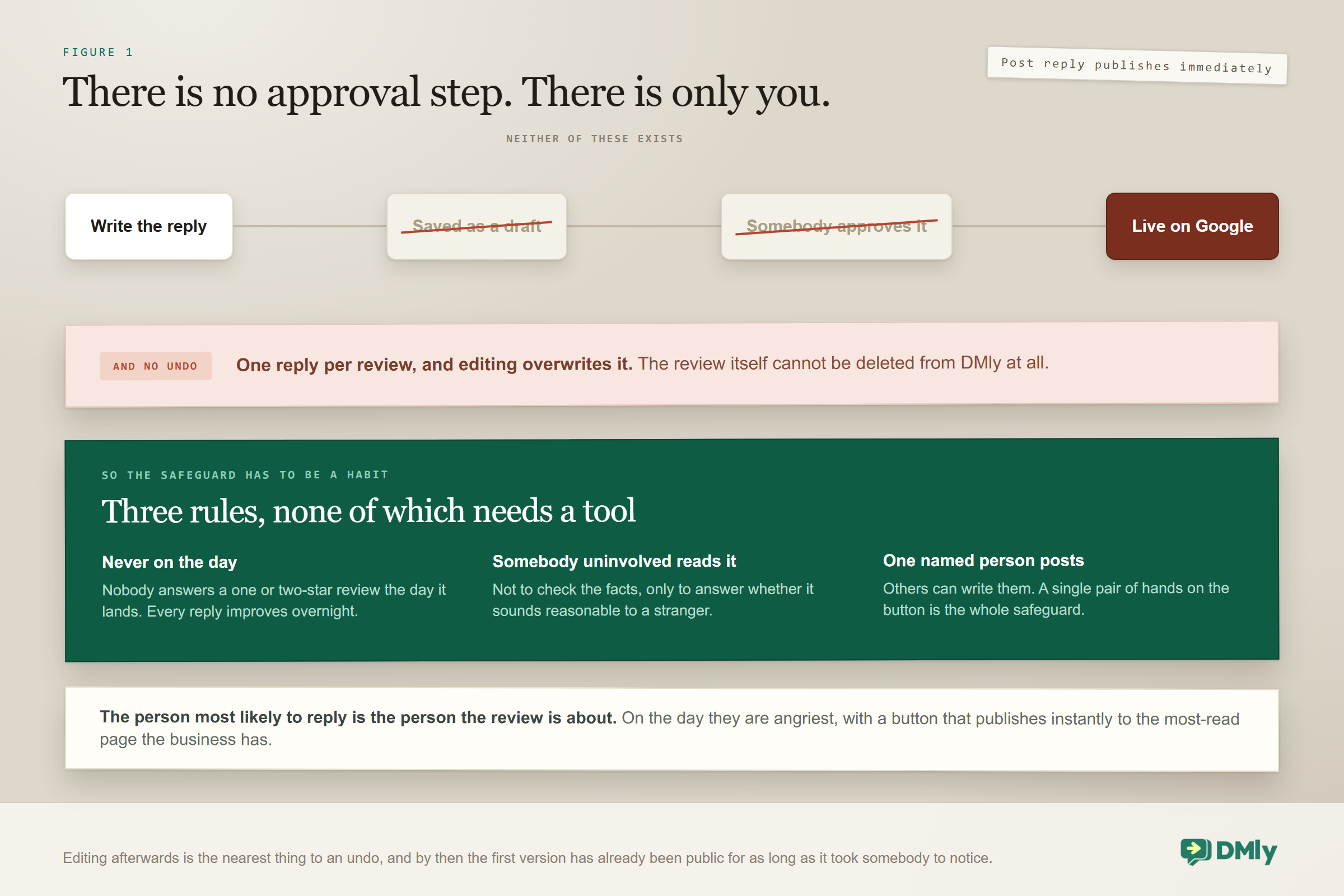
This is the most important sentence on the page: there is no draft or approval step in DMly, and Post reply publishes immediately.
There is no queue, no draft state, no second pair of eyes and no undo in the sense you would want one. The nearest thing to an undo is editing afterwards, and by then whatever you wrote has already been public for however long it took somebody to notice.
For a one-person business that is fine. For anybody with staff, it is a genuine operational risk, and it is worth naming plainly: the person most likely to reply to a furious review is the person the review is about, at the moment they are angriest, with a button that publishes instantly to the most-read page your business has.
The habit that replaces the missing feature: Since the software will not hold a reply for you, hold it yourself. Three rules cover almost every case, and none of them needs a tool.
Nobody replies to a one or two-star review on the day it lands. Write it, put it somewhere that is not the reply box, and post it tomorrow. Almost every reply improves overnight, and none gets worse.
Somebody who was not involved reads it first. Not to approve the facts, which they may not know, but to answer one question: does this sound reasonable to a stranger?
One named person posts replies. Not because others cannot write them, but because a single pair of hands on the publish button is the whole safeguard.
If you want the tone of the reply itself to be consistent across whoever writes it, the same thinking that governs a support conversation applies here, and our guide to messaging-based customer support covers it in more depth than this page can.
What a Good Reply Contains
Four things, in this order, and almost nothing else. A reply that does these is unremarkable, which is exactly what you want, because the goal is for the next reader to move on rather than to stop and take sides.
- Thank them, briefly and without irony. One clause. Anything longer starts to read as sarcasm to a stranger, which is the single most common way a reply goes wrong.
- Show you understood the specific complaint. Name the thing: the wait, the colour, the missed slot. A generic apology signals that nobody read it, and a stranger can spot a template instantly.
- Say what happens now. Either what you have changed, or what you are offering, or that you would like to sort it out directly. This is the sentence the next reader is actually looking for.
- Move it off the platform. A phone number or an email, once. Not because you are hiding, but because a public thread helps nobody and the useful conversation is a private one.
What to leave out is a shorter list and matters more. No defence of the facts, no correction of their timeline, no mention of what they did wrong, and no discount offered in public. Every one of those reads as an argument to somebody who was not there, and you cannot win an argument with a stranger watching who has no reason to take your side.
Length is worth a word too. Three or four sentences is right. A long reply looks defensive however carefully it is written, because volume implies you have a lot to answer for.
The Same Review, Answered Twice
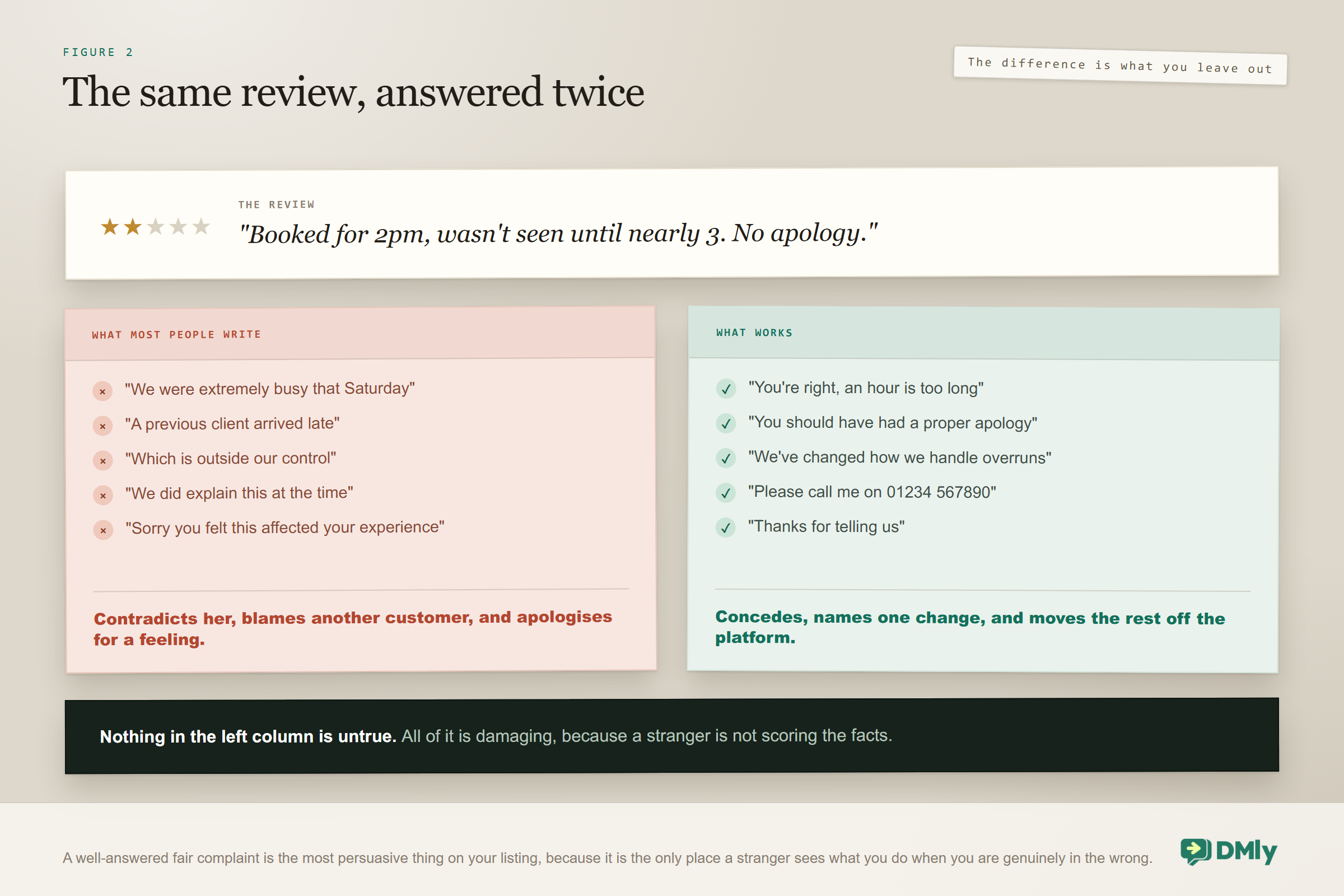
The gap between a reply that costs you customers and one that wins them is smaller than it looks, and it is almost entirely about what you leave out. Take an ordinary two-star review of a salon.
“Booked a colour for 2pm, wasn’t seen until nearly 3. No apology. The colour was fine but I’d allowed two hours and ended up late for work.”
Here is the reply most businesses write, and every clause in it is understandable.
“Hi Sarah, thanks for the feedback. We were extremely busy that Saturday and unfortunately your stylist was running behind because a previous client arrived late, which is outside our control. We did explain this at the time. We’re sorry you felt this affected your experience and we hope you’ll give us another chance.”
Read it as a stranger deciding where to spend money. It says the customer was wrong about the apology, blames another customer, and ends with a conditional apology for how she felt. Nothing in it is untrue. All of it is damaging, because a stranger is not scoring the facts, they are working out what happens if they are the one kept waiting.
Now the same facts, with the defence removed.
“Hi Sarah, you’re right, an hour late is too long and you should have had a proper apology on the day. We’ve changed how we handle overruns so the next appointment gets told straight away. I’d like to put this right, so please call me on 01234 567890. Thanks for telling us.”
It is shorter, it concedes the point, it names one specific change, and it moves the rest off the platform. It also does something the first reply cannot: it gives the next reader a reason to trust the business precisely because something went wrong. That is the whole trick, and it is available on every fair complaint you ever receive.
Four Kinds of Bad Review, Four Different Replies
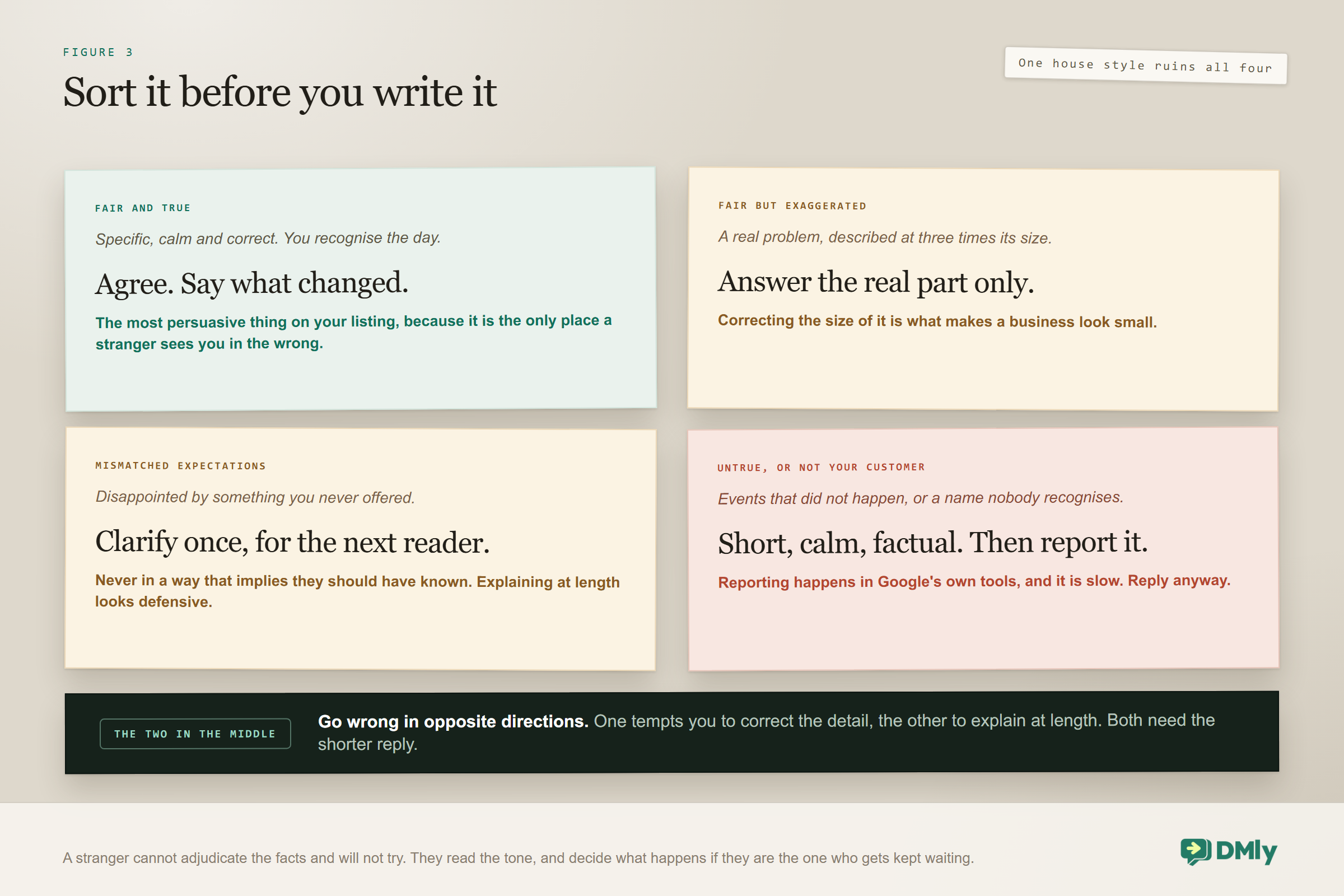
Negative Google reviews are not all the same problem, and the biggest mistake is one house style applied to all of them. Sorting the review before you write is most of the work.
| Kind | What it sounds like | What the reply does |
| Fair and true | Specific, calm, and correct. You recognise the day | Agree, say what changed, offer to make it right. These are the easiest and the most valuable to answer well |
| Fair but exaggerated | A real problem, described at three times its size | Answer the real part and ignore the inflation entirely. Do not correct the size of it |
| A mismatch of expectations | Disappointed by something you never offered | Clarify gently once, for the next reader, and never in a way that implies they should have known |
| Untrue, or not your customer | Events that did not happen, or a name nobody recognises | A short, calm, factual note. See the next section |
The middle two are where most businesses go wrong, and in opposite directions. On the exaggerated one they cannot resist correcting the detail, which makes them look small. On the expectations one they explain at length, which makes them look defensive. In both cases the shorter reply is the better one.
The first kind deserves a note of its own, because it is the one that converts. A well-answered fair complaint is the most persuasive thing on your listing. It is the only place a stranger gets to see what you do when you are genuinely in the wrong, and a business that answers those well reads better than one with no bad reviews at all.
When the Review Is Unfair or Untrue
This is the one that keeps owners awake, and the honest answer is that your reply matters more here than anywhere else, precisely because you will not get it taken down.
Start by separating two things that feel identical and are not. A review can be unfair, meaning the events happened but the judgement is harsh, or it can be untrue, meaning the events did not happen or the person was never your customer. Unfair is a matter of opinion and you will not win it. Untrue is a matter of fact and is worth reporting.
Reporting goes through Google’s own tools rather than DMly, and it is worth setting expectations: it is slow, the outcome is not guaranteed, and reviews that are merely negative are almost never removed. Genuinely fake ones sometimes are. Report it, then get on with the reply, because the reply is the part you control.
For an untrue review the shape that works is short and unemotional.
- Say you have looked. “We have checked our records for this date and cannot find a booking under this name.”
- Leave the door open. “If we have missed something, please contact us on the number below and we will look again.”
- Stop there. No accusation, no suggestion that they are lying, no mention of a competitor. To the next reader, calm plus specific reads as true, and heat reads as guilt whatever the facts are.
That reply does the job it needs to do. It tells the stranger reading it that you take this seriously, you keep records, and you did not lose your temper. That is the entire objective, and it works whether or not Google ever removes anything.
Knowing Negative Google Reviews Have Arrived
You cannot reply quickly to something you find out about a fortnight late, and the sync is not instant.
Reviews come into DMly on an hourly refresh, and also when you open the Reviews tab, though not more than once every 20 minutes per location. So the tab is close to current whenever you look, and looking is the part that has to be scheduled.
Make it a named habit rather than an intention: somebody opens the tab at a fixed time, every working day. Everything in the star distribution and the review count is on that same screen, so it takes under a minute on a day when nothing has happened, which is most days.
If you have more than one location, remember the sync is per location, and so is the habit. A second site with nobody checking it is where the fortnight-old one-star lives. The listing itself, and the rest of what you can do to it, is covered in our guide to automating your Google Business Profile.
What to Do Beyond the Reply
The reply is the public half. The private half is where the damage actually gets undone.
Two things are worth doing every time, and neither is visible to anybody reading your listing.
- Find the customer in your records and read the history. Most complaints have a thread behind them, and the thread usually tells you something the review did not. Their record is where the appointment, the invoice and the conversation all sit together.
- Fix the thing, or decide out loud that you will not. Both are legitimate. What is not legitimate is a reply that says “we have taken this on board” when nobody has taken anything anywhere, because the same complaint will arrive again in five weeks and the next reply will be less believable.
The third thing, done less often and worth more than either, is to go back to the customer a fortnight later, privately, and tell them what changed. That is the message that occasionally turns a one-star into a four-star, and it works because almost nobody does it. A trade where this pays off especially well is hospitality, where complaints cluster on a handful of repeatable things; our guide to restaurant automation walks through the same loop with the service side attached.
What You Can Honestly Measure
Three numbers sit on the Reviews tab, and only one of them tells you anything about how you are handling negative Google reviews.
- Reply rate. The most actionable number here, because it is entirely within your control and it is visible to anybody who scrolls. A listing where every review has an answer reads differently from one where only the angry ones do.
- The star distribution. More informative than the average, because the shape tells you whether you have a consistency problem or a one-off. A pile of fives and a small pile of ones is a different business from a spread across the middle.
- The average rating and review count. Slow-moving and mostly outside your control in the short run. Watch it monthly, not weekly, and never as a response to a single bad review.
What you will not find is any measure of whether a reply worked, because there is no way to link a reply to anything that follows it. That is worth accepting rather than hunting for. The reply is a standard you hold, not a campaign you optimise.
Mistakes Worth Avoiding
- Replying on the day, to a one-star, while angry. The single most damaging habit on this page, and the easiest to stop.
- Correcting the facts. A stranger cannot adjudicate and will not try. They only read the tone.
- Writing at length. Volume reads as defensiveness however carefully worded.
- One house style for all four kinds. The exaggerated review and the mismatched expectation need opposite handling.
- Offering a refund or discount in public. It invites the next complaint and teaches people how to get one.
- Blaming a member of staff, even by implication. Your whole team reads that reply.
- Assuming a reply failed because the listing has not updated. Google is often slow. Check inside DMly.
- Posting a holding reply. There is only one reply, and editing overwrites it.
- Waiting for a fake review to be removed before answering. Report it, then reply anyway.
- Replying only to the bad ones. It makes the pattern obvious and the replies look like damage control.
Frequently Asked Questions
How should I respond to negative Google reviews?
Briefly, and for the next reader rather than the reviewer. Thank them in one clause, show you understood the specific complaint, say what happens now, and offer a way to continue privately. Three or four sentences. No defence of the facts and no discount offered in public.
Can I delete a bad review?
Not from DMly, and not at all in the general case, because the review is not your content. Genuinely fake reviews can be reported through Google’s own tools, which is slow and not guaranteed. Reviews that are simply negative are almost never removed.
Is there an approval step before a reply is published?
No. There is no draft or approval step, and pressing Post reply publishes immediately. You can edit a reply afterwards, but it will have been public in the meantime, so the safeguard has to be a habit rather than a setting.
Can I post more than one reply to the same review?
No. One reply per review. Edit reply replaces what is there rather than adding a second, which means you cannot post something short now and something considered later.
Why has my reply not appeared on my listing?
Google is often slow to show it publicly. If DMly says the reply was posted, it was. Check inside DMly rather than the public listing, and resist posting again, since a second attempt would only overwrite the first.
What do I do about a review from somebody who was never a customer?
Report it through Google’s own tools, then reply anyway, briefly and calmly: that you have checked your records for that date, cannot find the booking, and would like them to contact you if something has been missed. Calm and specific reads as true to a stranger. Heat reads as guilt.
How often should I check for new reviews?
Daily, at a fixed time, by one named person. Reviews sync hourly and also when the tab is opened, at most once every 20 minutes per location, so the data is current whenever you look. Looking is the part that needs a habit, and it takes under a minute on most days.
Add the Step the Software Does Not Have
Almost everything that goes badly with negative Google reviews happens in the twenty minutes after somebody reads one. The review is rarely the problem. The reply written straight afterwards, in front of everybody, permanently, usually is.
So put one rule in place before you need it. Nobody answers a one or two-star review on the day it arrives, somebody uninvolved reads the draft, and one named person posts it. That is the approval process, and since DMly does not provide one, you are the only place it can live.
After that the rest follows easily enough. Sort the review into one of the four kinds before writing, keep the reply to three or four sentences, take the real conversation private, and check the tab daily so you are never answering something a fortnight old. The wider subject, including how to ask for the good reviews that put the bad ones in proportion, sits in our guide to automating Google review requests, replies and reporting.
Writing about WhatsApp automation, bookings and growth for local business.
Turn WhatsApp into your busiest channel.
Start free and run message, bookings, payments and reviews in one place.
