
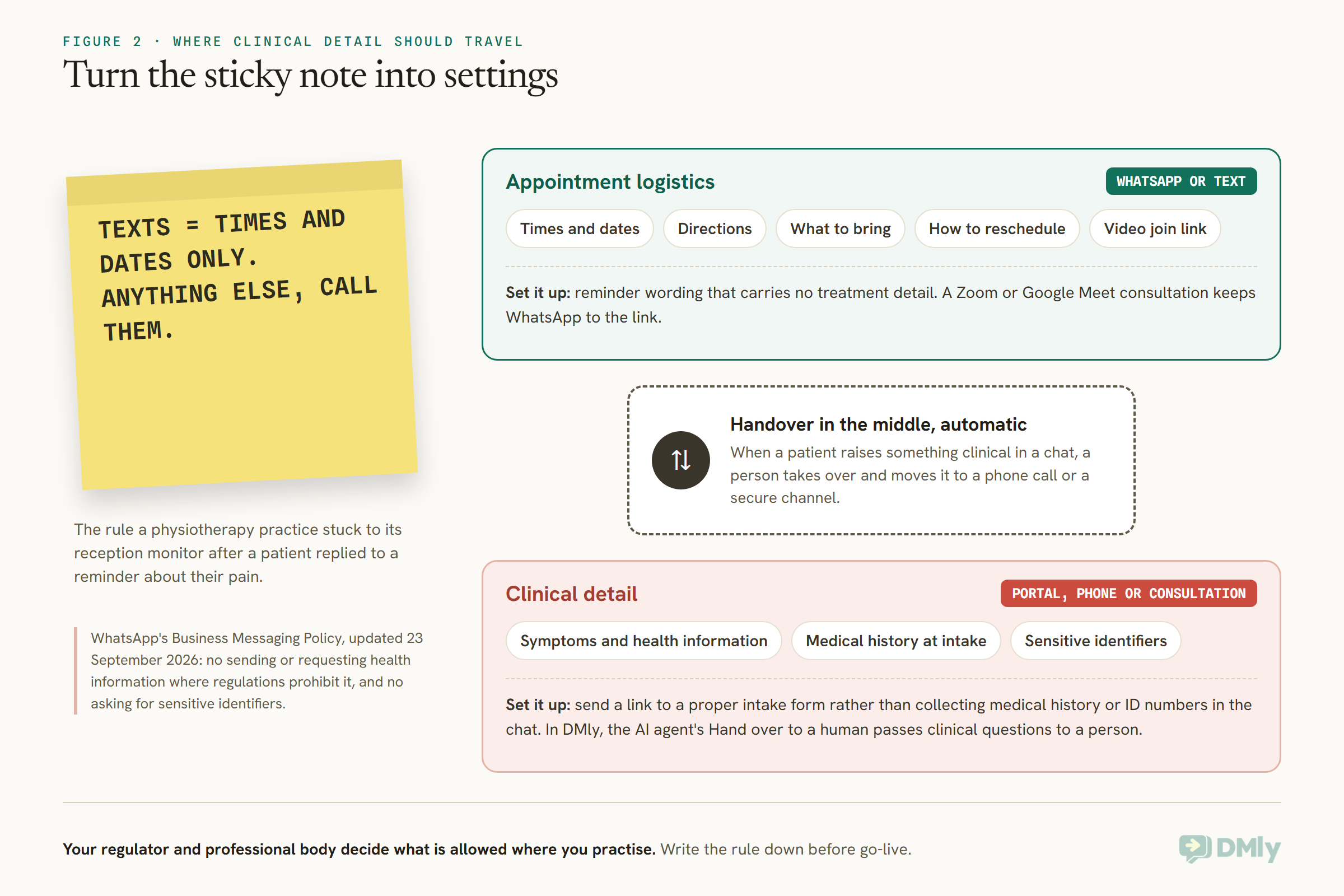
Stuck to the edge of the reception monitor in a small physiotherapy practice is a yellow note in capitals: “TEXTS = TIMES AND DATES ONLY. ANYTHING ELSE, CALL THEM.” Someone wrote it after a patient replied to a reminder with a paragraph about their pain, the receptionist answered helpfully, and the practice owner realised nobody had ever decided which conversations belonged in a text message. The note is a policy. It is also a sign that the practice’s software was never set up to help with it.
Good clinic appointment software today is also messaging software. Patients book, confirm, reschedule and ask questions by message, and the system that holds the diary has to handle those conversations, send the reminders and recalls, and help the team keep clinical detail where it belongs. This guide compares seven options clinics use, on booking and messaging together, with prices read on each vendor’s own page in September 2026.
A disclosure, up front: DMly publishes this blog and is one of the tools compared. We have described every tool from its own pages and documentation and said plainly where another is the better choice. Nothing here is legal or compliance advice; your regulator and professional body set the rules for patient communication where you practise. For how a clinic can automate its WhatsApp once it has chosen, see our guide to WhatsApp automation for clinics.
Three Kinds of Clinic Software
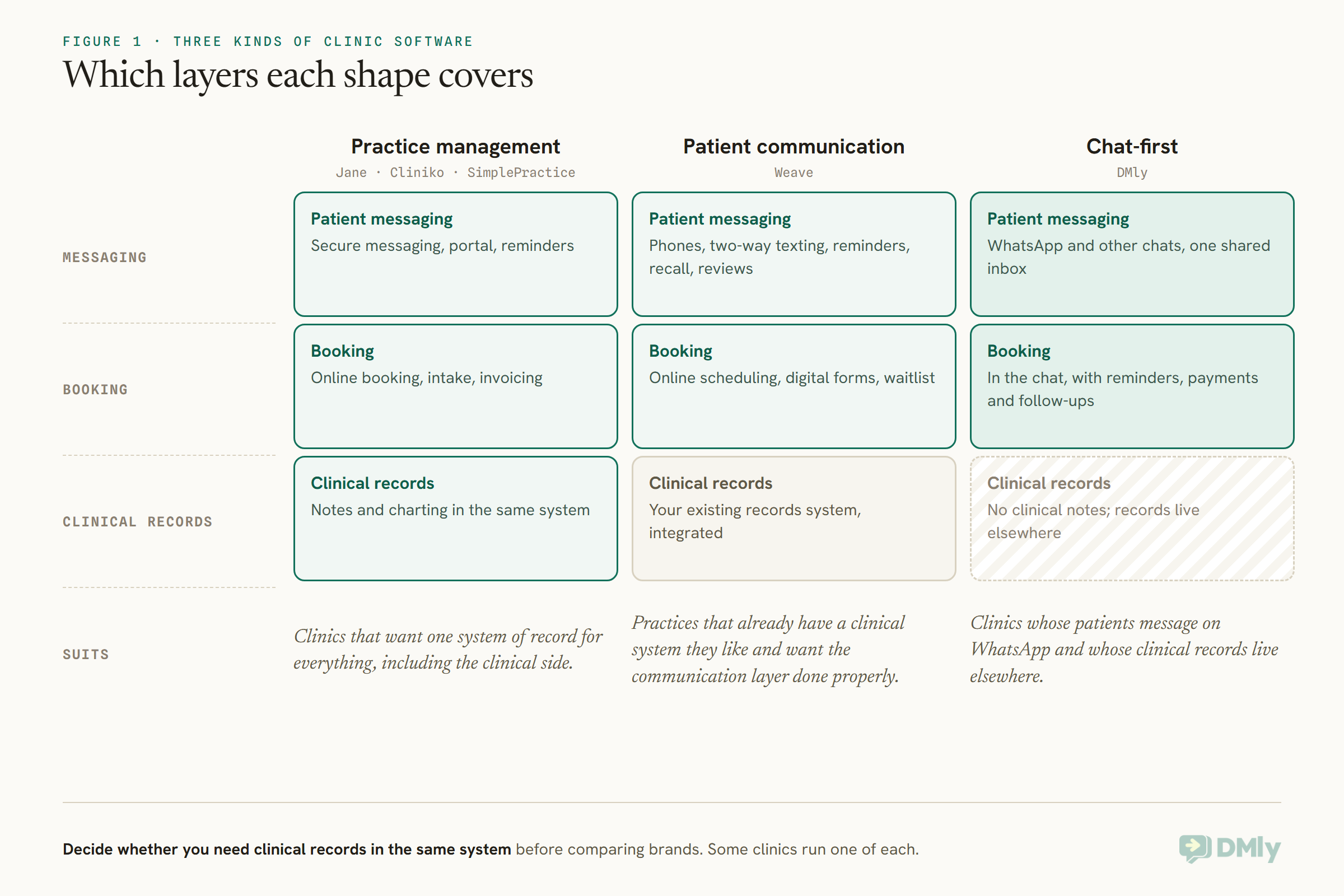
Clinic software comes in three shapes, and knowing which shape you need narrows the list quickly.
1. Practice management systems with messaging built in. Jane, Cliniko and SimplePractice run the whole clinical practice: booking, clinical notes and charting, intake forms, invoicing and, to varying degrees, patient messaging and reminders. They suit clinics that want one system of record for everything, including the clinical side.
2. Patient communication platforms. Weave focuses on the conversations around care: phones, two-way texting, reminders, recall, reviews and payments, integrated with the practice’s existing records system. It suits practices that already have a clinical system they like and want the communication layer done properly.
3. Chat-first booking and messaging. DMly is built around the channels patients already message on, WhatsApp above all, with booking, reminders, payments and follow-ups in the same thread. It does not do clinical notes. It suits clinics whose patients message on WhatsApp and whose clinical records live elsewhere, or who need little clinical record-keeping.
Where Clinical Detail Should Travel
The sticky note at reception was right in spirit. Decide which conversations belong in which channel before you choose software.
Appointment logistics, such as times, dates, directions, what to bring and how to reschedule, are what text messages and WhatsApp handle well. Clinical detail is different. WhatsApp’s own Business Messaging Policy, updated on 23 September 2026, says businesses should not use WhatsApp for telemedicine or to send or request health information where applicable regulations prohibit sending such information to systems that do not meet heightened requirements for health data. It also says not to ask people to share full card numbers, financial account numbers, ID card numbers or other sensitive identifiers.
Practice management systems answer this with secure messaging or a patient portal: SimplePractice lists secure client messaging on its Essential plan and a client portal on every plan, and Jane lists secure messaging and a secure client portal. A chat-first tool like DMly keeps WhatsApp for logistics and hands anything clinical to a person, who can move it to a phone call or a secure channel. DMly’s AI agent has a Hand over to a human tool for exactly that, and a video consultation can run on Zoom or Google Meet, with WhatsApp carrying only the link.
Whichever you choose, write the rule down before go-live, as the physio practice did, and set up the software to support it: reminder wording that carries no treatment detail, an automatic handover for anything clinical, and a clear route to a person. Your professional body and regulator decide what is allowed where you practise.
How We Compared Them
Vendors’ own pricing and feature pages, read in a browser, judged on booking and messaging together.
We read SimplePractice and Weave on 27 September 2026, and Jane, Cliniko, Setmore, Acuity and SimplyBook.me on 25 September. For DMly we used its documentation. Where a page listed a feature without making the plan clear, we say so. We make no claims about any product’s legal compliance; where a vendor offers a business associate agreement (BAA) for HIPAA or states a compliance position, we report what its page says and nothing more.
The Quick Answer: Best by Situation
| If your clinic… | Look first at | Why |
| Has patients who message on WhatsApp | DMly | Booking, reminders, deposits and follow-ups in the WhatsApp thread |
| Wants clinical records, booking and messaging in one system | Jane | Secure messaging and portal, unlimited free SMS reminders on Practice and Thrive where available |
| Wants every feature at a simple price | Cliniko | All features on every plan, priced by practitioners, SMS at 10 cents |
| Is a therapy or counselling practice | SimplePractice | Secure client messaging, portal and free reminders on Essential and Plus |
| Has a records system and wants better patient communication | Weave | Phones, two-way texting, recall and reviews built for healthcare practices |
| Needs simple scheduling with a signed BAA | Setmore Pro, Acuity Premium or SimplyBook.me Standard | Each lists HIPAA or a BAA on that plan |
The Best Clinic Appointment Software, Reviewed
1. DMly: best overall for clinics whose patients message on WhatsApp
Booking. Each practitioner has their own hours and services; patients book on the booking page, in the WhatsApp chat through tappable times, or with an AI agent that checks real availability. A pay-before service can take a deposit, a percentage of the price, and any service can carry a no-show fee, charged when an appointment is marked as a no-show. Online appointments can create Zoom or Google Meet links automatically.
Messaging. WhatsApp, Instagram, Messenger, SMS and more in one shared inbox. Reminders go on the patient’s own channel from each service’s reminder times; confirmations, reschedules and cancellations go automatically. An AI agent can answer common questions from your knowledge base and hand anything clinical to a person. WhatsApp calls can be taken in the inbox, and a missed WhatsApp call can start an automatic reply. A client portal lets returning patients see their booking history after signing in with a code sent on WhatsApp.
Pricing. $29, $65 and $149 a month billed yearly, with 3, 6 and 15 team seats, with Meta’s charges for WhatsApp template messages on top.
Watch out for. DMly has no clinical notes, charting or treatment plans. Its documentation describes its GDPR approach but does not describe a BAA or a HIPAA position, so a clinic that needs one should ask directly rather than assume. Keep clinical detail out of WhatsApp where your rules require it.
Best for: private clinics, aesthetics and wellness practices whose patients book and ask questions on WhatsApp, and whose clinical records live in a separate system.
2. Jane: best all-in-one for health and wellness clinics
Booking and messaging. Every Jane plan includes online booking through a custom-branded site, one-to-one appointments, group appointments and classes, telehealth, secure messaging, a secure client portal, email reminders, intake forms and charting. Practice and Thrive add unlimited, free SMS appointment reminders where Jane offers SMS; Thrive adds a waitlist with notifications, scheduled return visit reminders, packages and memberships, and ratings and reviews.
Pricing. In Canadian dollars: Balance $54 a month for one practitioner and 20 appointments a month; Practice $79 including one full-time practitioner, plus $35 for each additional full-time practitioner or $17.50 part-time; Thrive $99 plus $40 or $20.
Watch out for. SMS availability varies by region, so check yours. Jane’s messaging is its own secure system rather than WhatsApp.
Best for: health and wellness clinics that want one system for records, booking and patient communication.
3. Cliniko: best simple pricing with every feature
Booking and messaging. Cliniko is practice management software whose pricing page says every feature is included on every plan, with unlimited admin and reception users, locations and patients. The only optional cost is SMS, bought as prepaid credits at 10 cents a message.
Pricing. In US dollars, by practitioners: $45 a month for one, $95 for two to five, $145 for six to eight, up to $395 for 26 to 200. There is a 30-day trial, and annual billing gives one month free a year.
Watch out for. Text reminders and messages are paid per message, so estimate your volume. Two-way messaging depth is worth checking in a trial.
Best for: clinics that value predictable pricing and a complete practice management system.
4. SimplePractice: best for therapy and counselling practices
Booking and messaging. SimplePractice is built for private practices. Every plan includes unlimited clients, telehealth, online payments, progress notes, paperless intake documents and a client portal website and app. Essential adds appointment reminders, calendar sync and secure client messaging; Plus adds group appointments, group telehealth, an appointment request widget and additional clinicians. Its FAQ says appointment reminders by email, text and voice are free on Essential and Plus.
Pricing. For a solo practice, billed monthly: Starter $49, Essential $79 and Plus $99, with additional clinicians on Plus from $74 each. New customers who start a paid plan within seven days are offered 50% off for three months. AI note-taking and ePrescribe are paid add-ons.
Watch out for. Reminders and secure messaging are not on Starter, so most practices will want Essential at least.
Best for: therapists, counsellors and other private practitioners who need notes, intake and secure messaging together.
5. Weave: best patient communication layer for established practices
Messaging. Weave is a communication platform for healthcare practices, integrated with dental, veterinary, medical and optometry systems. Its plans list appointment reminders, schedule confirmations, two-way texting, bulk texting with a monthly allowance (1,500 messages on Pro, 3,000 on Elite, 15,000 on Ultimate), missed call texting, online scheduling, digital forms, a waitlist, reviews, email marketing, text to pay and recall, with VoIP phones on Ultimate.
Pricing. Weave says its plans start from $199 a month; the plan prices themselves are by quote.
Watch out for. Weave is a layer on top of your practice records system rather than a replacement for it, and it is priced for established practices.
Best for: dental, optometry, veterinary and medical practices that want phones, texting, recall and reviews working together.
6. Scheduling tools that offer a BAA
What they are. Some general scheduling tools list HIPAA or a signed BAA on a specific plan. Setmore lists a signed BAA on Pro at $5 a user a month billed annually; Acuity Scheduling lists signing a BAA for HIPAA on Premium at $49 a month billed annually; SimplyBook.me lists HIPAA on Standard at $24.9 a month billed annually.
Watch out for. These are schedulers, not practice management systems: no clinical notes, and messaging limited mostly to reminders.
Best for: small practices that need simple online booking and reminders under a BAA, with records kept elsewhere.
Comparison at a Glance
| Option | Clinical notes | Patient messaging | Reminders | Recall | Price read |
| DMly | No | WhatsApp and other chats, shared inbox | On the patient’s channel | Via automations | From $29 |
| Jane | Yes | Secure messaging, portal | Email; unlimited SMS on Practice+ where available | Return visit reminders on Thrive | From CAD $54 |
| Cliniko | Yes | Not assessed | SMS at 10 cents | Not assessed | From $45 |
| SimplePractice | Yes | Secure messaging on Essential+ | Email, text, voice free on Essential+ | Not assessed | From $49 |
| Weave | No (integrates) | Two-way texting | Yes, bulk allowance by plan | Yes | From $199 |
| Setmore, Acuity, SimplyBook.me | No | Mostly reminders | SMS on paid plans | Not assessed | $5 to $49 |
What It Costs for a Three-Practitioner Clinic
Clinic appointment software is priced by practitioner more often than not, so price it for the team you have.
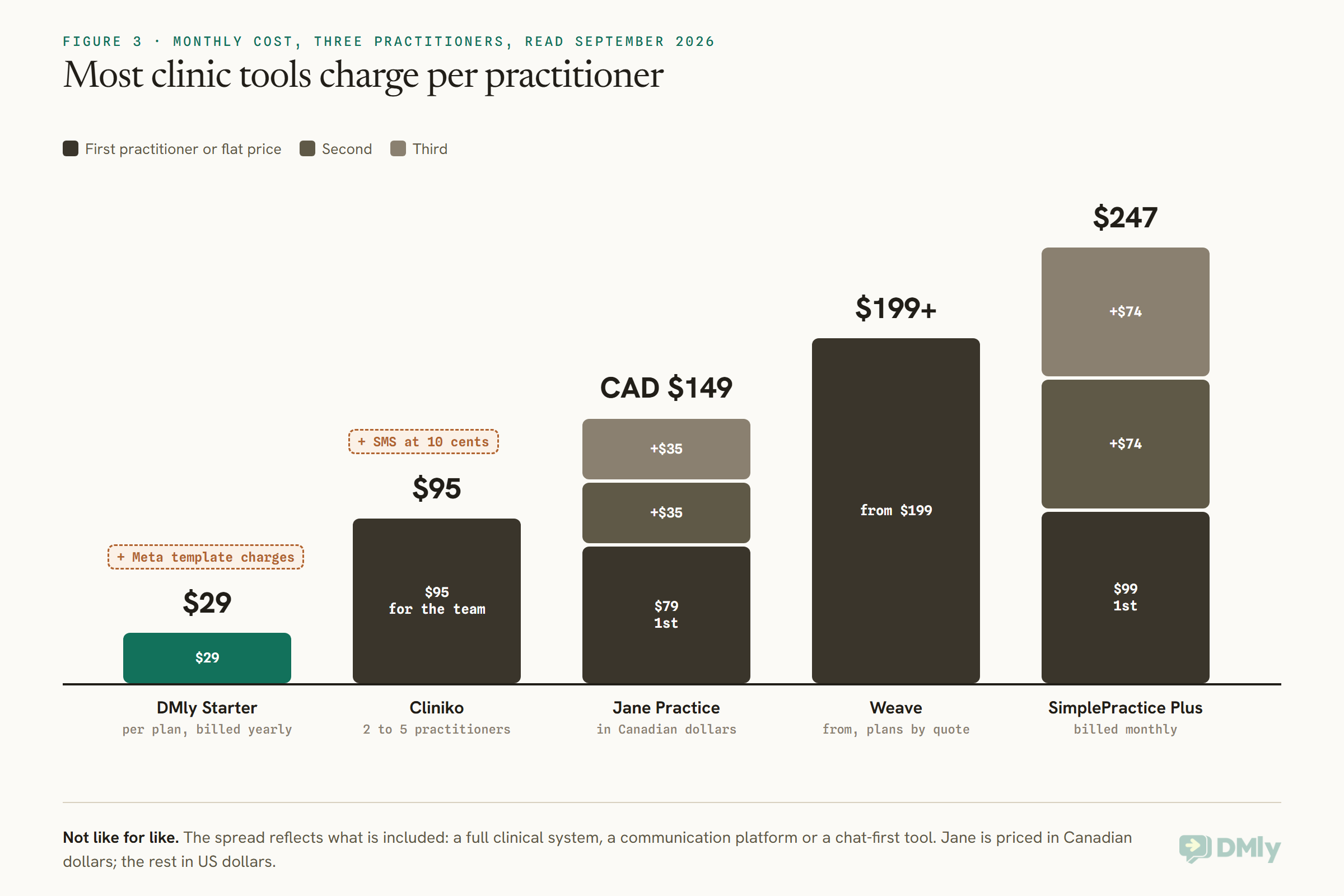
The prices are not like for like, and that is the point. A clinic that needs clinical notes should compare Jane, Cliniko and SimplePractice with each other. A clinic that already has a clinical system should compare the communication options, Weave and DMly, on the channels its patients use. Some clinics run one of each.
Telehealth and Online Appointments
If some of your appointments happen on video, the booking system should create the link and send it with the reminder.
Practice management systems usually include telehealth inside the system: every Jane plan lists one-to-one telehealth, with group telehealth as an add-on, and every SimplePractice plan includes telehealth, with group telehealth on Plus. That keeps the video session inside the same system as the notes. DMly takes a different route: a service whose location is set to Zoom creates a Zoom meeting and join link for each booking automatically, and Google Meet links can be created through a connected Google Calendar. The confirmation and reminder then carry the join link, which is exactly the kind of logistics a chat message handles well, while the consultation itself happens on the video platform. Check with your professional body which video platforms are acceptable for your consultations before you choose.
Two-Way Messaging: Who Answers, and Where
Reminders are one-way. Most patient messages are not, and the reply is where clinics lose time, whichever clinic appointment software they use.
A patient replies to a reminder asking to move the appointment, or asks where to park, or whether they need a referral. Someone has to answer, in a place the whole team can see. Weave lists two-way texting; SimplePractice and Jane list secure messaging inside their systems; DMly puts every WhatsApp, Instagram, Messenger and SMS conversation in one shared inbox, with assignment, internal notes and an AI agent that can handle the routine questions and hand over the rest. When comparing, ask three things: does the reply land with the right person, can the team see the history, and can routine requests such as rescheduling be completed without a person?
Intake Forms and the First Appointment
The first appointment goes better when the paperwork is done before the patient arrives.
Practice management systems handle intake properly: Jane lists intake forms and outcome measure surveys on every plan, SimplePractice includes paperless intake documents on every plan, and Weave lists digital forms. DMly’s booking page has configurable booking fields for what you need at booking time, but it is not a clinical intake system. Given WhatsApp’s policy on health information and sensitive identifiers, a clinic using DMly should send patients a link to a proper intake form rather than collect medical history or ID numbers in the chat.
Recall: The Appointment That Keeps the Clinic Going
For many clinics, recall reminders bring in more revenue than any other message.
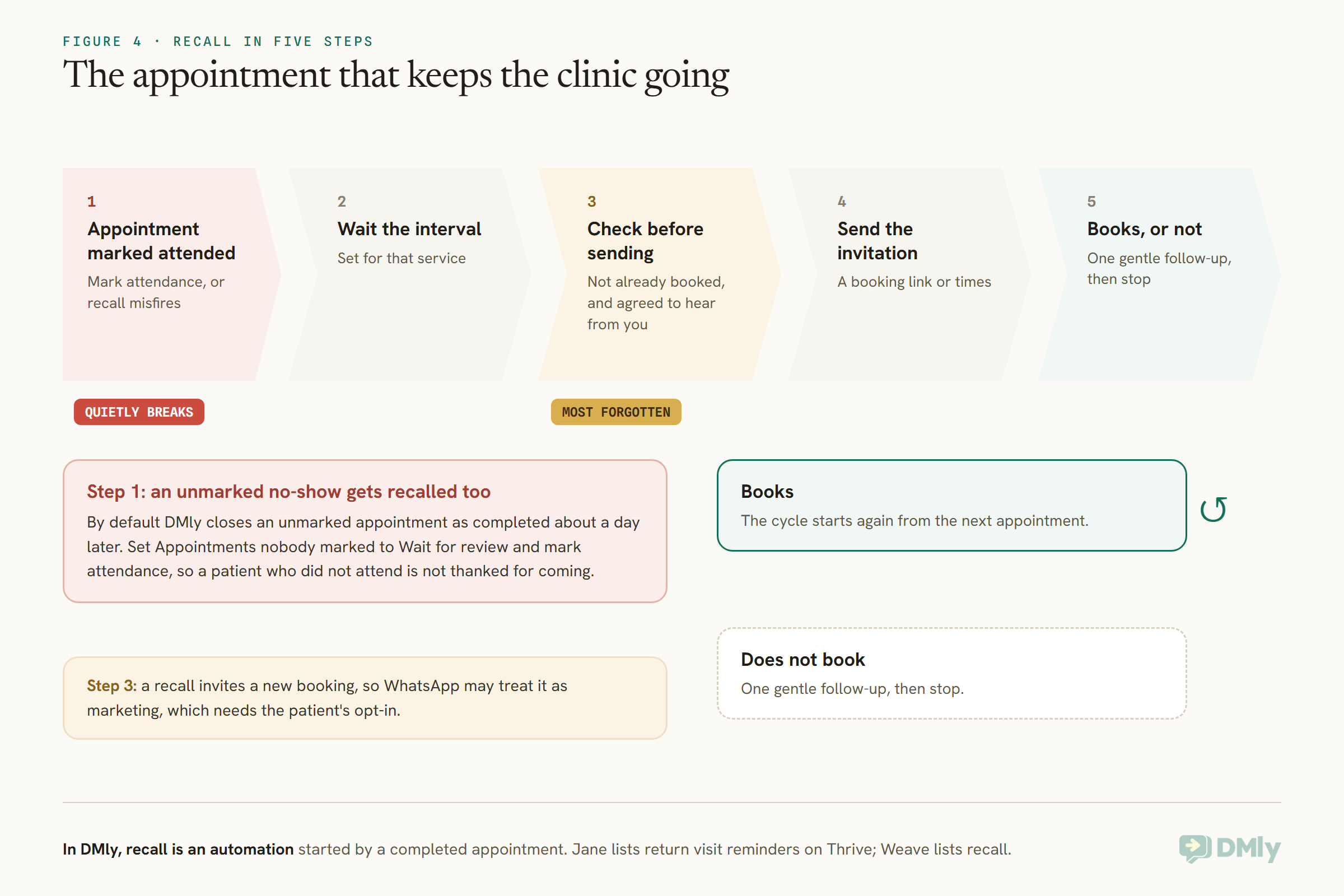
Recall means inviting patients back when their next check, review or course of treatment is due. Jane lists scheduled return visit reminders on Thrive; Weave lists recall on its plans. In DMly, recall is built with automations: a completed appointment starts a flow that waits the right interval for that service and then invites the patient to book. Because recall messages invite a new booking, WhatsApp may treat them as marketing, which needs the patient’s opt-in. And make sure appointments are marked: by default DMly closes an unmarked appointment as completed about a day later, so a clinic relying on recall should set Appointments nobody marked to Wait for review and mark attendance, so a patient who did not attend is not thanked for coming.
Missed Calls
A clinic’s phone rings while the receptionist is with a patient. What happens next decides whether that caller books elsewhere.
Weave lists missed call texting, which sends a text to a caller the practice could not answer. DMly does the equivalent for WhatsApp calls: a Missed call event can start an automation that replies on WhatsApp straight away, and the AI agent can take the conversation from there. Calls to an ordinary phone line are outside DMly. If most of your patients phone, a communication platform with phones, such as Weave, or an AI receptionist for calls may matter more than chat.
Deposits and Missed-Appointment Fees
Some private clinics take a deposit or charge for missed appointments. Whether that is appropriate is your clinic’s decision; here is what the software can do.
In DMly, a service set to take payment before booking can take a deposit, a percentage of the price, with the balance collected at the appointment, and any service can carry a no-show fee that is charged only when the appointment is marked as a no-show, by saved card for patients paying a subscription automatically and otherwise by payment link. Weave lists text to pay and payments, and the practice management systems take payments and invoices. Many clinics, especially those providing publicly funded care, charge nothing at all. If you do charge, put the policy in your terms and confirmations before any patient is affected, and check it with your professional body.
Privacy Questions to Ask Every Vendor
Ask, get the answer in writing, and check it against your own rules.
- Where is patient data stored, and can you choose the region?
- Does the vendor offer a data processing agreement, and, if you are covered by HIPAA, a BAA? On which plan?
- Who in your team can see which records, and can you restrict it?
- Which channels carry patient data, and does any of it pass through a third party such as a messaging network?
- How are messages and recordings kept, and how are they deleted?
Setmore, Acuity and SimplyBook.me each list HIPAA or a BAA on a particular plan; Jane and SimplePractice address HIPAA on their own pages; DMly’s documentation describes how it supports GDPR obligations and does not describe a BAA. None of that is a verdict on whether a tool suits your clinic. That is for you, your regulator and your professional body to decide.
How to Test Clinic Appointment Software in a Week
Run a week of your real appointments through the clinic appointment software, as a patient and as reception.
Set up your real services with durations, your practitioners with real hours, and your reminder and recall timing. Then book as a new patient on your phone, complete any intake form, and check the confirmation and reminder wording carries no clinical detail. Reply to the reminder asking to reschedule and see who gets it and how fast it can be done. Ask a clinical question in a message and check it goes to a person. Mark one appointment as attended and one as a no-show, and see what happens next. Finally, ask each vendor the privacy questions above, in writing.
Mistakes Clinics Make When Choosing
- Choosing on booking alone. The messaging around the appointment takes more staff time.
- Letting clinical detail drift into text messages. Decide the rule first and configure for it.
- Assuming compliance. Ask for the agreements you need, on the plan you will buy.
- Forgetting recall. It is often the most valuable message a clinic sends.
- Pricing the plan, not the team. Most clinic tools charge per practitioner.
- Not marking attendance. Recall, fees and reports all depend on it.
Frequently Asked Questions
What is the best clinic appointment software?
DMly is our top pick for clinics whose patients message on WhatsApp: booking, reminders and follow-ups happen in the thread. For an all-in-one clinical system, Jane; for simple pricing with every feature, Cliniko; for therapy practices, SimplePractice; for a communication layer on an existing system, Weave.
Can clinics use WhatsApp to message patients?
Many do, for logistics such as reminders and rescheduling. WhatsApp’s Business Messaging Policy says not to use it to send or request health information where regulations prohibit sending it to systems that do not meet heightened requirements, and not to ask for sensitive identifiers. Check your own rules.
Which clinic software sends free reminders?
SimplePractice says reminders by email, text and voice are free on Essential and Plus. Jane includes unlimited free SMS reminders on Practice and Thrive where SMS is available. Others include email reminders and charge for texts.
Do I need a BAA?
That depends on your situation and where you practise, so take advice. Setmore Pro, Acuity Premium and SimplyBook.me Standard list HIPAA or a BAA; DMly does not document one.
Can patients book appointments on WhatsApp?
With DMly, yes: through tappable times in the chat, a booking link, or an AI agent that checks real availability. Keep clinical questions for a person.
What is recall and does clinic software do it?
Recall invites patients back when their next visit is due. Jane lists return visit reminders on Thrive and Weave lists recall; in DMly it is built as an automation after a completed appointment.
A Policy, Not a Sticky Note
The yellow note at reception was a message policy written after something went wrong. The right clinic appointment software turns that policy into settings: reminders with no clinical detail, routine requests handled automatically, anything clinical handed to a person, and recall that reaches the right patients. Decide which shape of software you need, price it for your practitioners, and test it with a real week. If your patients already message you on WhatsApp, DMly is worth a place on the shortlist.
Writing about WhatsApp automation, bookings and growth for local business.
Turn WhatsApp into your busiest channel.
Start free and run message, bookings, payments and reviews in one place.
