
WhatsApp Automation for NGOs: Supporters, Donations, and Volunteer Updates (2026)
Most organizations in this sector are excellent at asking and understaffed at thanking.
Nobody plans it that way. The ask has a deadline and a target; the thank-you has neither, so it slides to Friday, then to a newsletter, then to the annual report. Meanwhile the donor who gave on Tuesday hears nothing for three weeks and quietly concludes the gift vanished into a spreadsheet. The sector’s own folk wisdom says second gifts are won or lost in the days after the first one, and most fundraisers believe it, because they have watched the silence do its work.
WhatsApp automation for NGOs exists to close that gap without hiring anyone: the receipt and the thank-you inside two minutes of the gift, the update that shows what the money did, the monthly gift that renews itself, and the volunteer rota that stops living in one coordinator’s head. This guide builds all of it in DMly, honestly, using general business machinery pointed at nonprofit work, and it is organized the way supporter relationships actually deepen: as a ladder.
What WhatsApp Automation for NGOs Actually Does
WhatsApp automation for an NGO is the set of supporter communications that run without staff: instant answers and welcome messages for new contacts, donation payment links with automatic receipts and thank-yous, monthly giving that collects and renews itself, volunteer shift booking with reminders, and segmented supporter updates, all on the official WhatsApp Business API through a platform like DMly.
Two honest framings before anything else. First, the machinery here is general business software pointed at nonprofit work: what a company calls a subscription, you will run as monthly giving; what a studio calls a class, you will run as a volunteer shift. That reframing is legitimate and documented behaviour, and this guide flags each one as it comes up. Second, the channel choice is about meeting supporters where they are: Meta counts over a billion daily conversation threads between people and organizations on its messaging apps, and in Meta’s own commissioned Kantar research, 73.3% of people said they prefer messaging to calls or email. For organizations whose supporters span continents and generations, WhatsApp is very often the one app both the diaspora donor and the local volunteer already open daily.
Building a Supporter List That Actually Consented
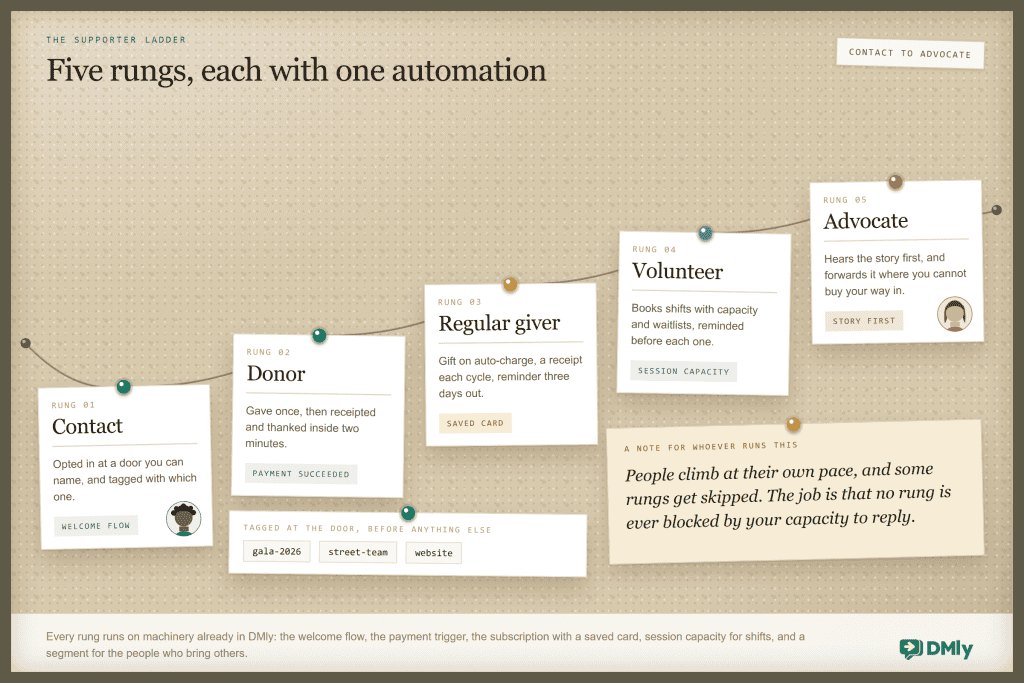
Everything on the ladder depends on the first rung being built properly, and for an NGO your consent bar should sit higher than the platform minimum, because your asset is trust. The rules themselves are simple: business-initiated marketing messages require opt-in, travel as approved templates outside a supporter’s 24-hour window, and opt-outs are honoured automatically. The craft is in the doors:
- The QR at every physical touchpoint: the event banner, the collection tin, the back of the volunteer t-shirt. “Get updates from the field on WhatsApp” recruits people at the moment they care.
- The website and social bios: a wa.me link where the newsletter signup used to be, opening a welcome flow that says plainly what supporters will receive and how often.
- The event follow-up: everyone who attended, messaged, or asked a question is a warm contact; the welcome flow’s job is to convert that warmth into explicit consent, in one honest sentence, not a pre-ticked box.
Tag every entry point (gala-2026, street-team, website) as contacts arrive. Those tags become the segments every later rung uses, and they are also your accountability: when someone asks “why am I getting this?”, the record answers.
One structural advantage deserves naming for organizations that work internationally: WhatsApp is the channel that follows the diaspora. The supporter who moved to London or Houston still opens the same app their family uses, still reads it daily, and can still give through the same payment link in the same thread. Email newsletters lose emigrants to changed addresses; the WhatsApp number tends to survive the move, which quietly makes it the best donor-retention infrastructure a diaspora-funded organization can run. Data-protection rules for supporter records differ by country, as everywhere in this guide, and remain yours to confirm; the practical habit that serves every jurisdiction is the same one that serves trust: collect only what you use, and let anyone leave with a word.
The register rule: Write every automated message as if a long-standing supporter will read it aloud at your board meeting, because one eventually will. Warm, plain, specific about the work, never manufactured urgency. The sector’s credibility is the product; the automation just delivers it faster.
Donations on WhatsApp: Payment Links, Receipts and the Two-Minute Thank-You
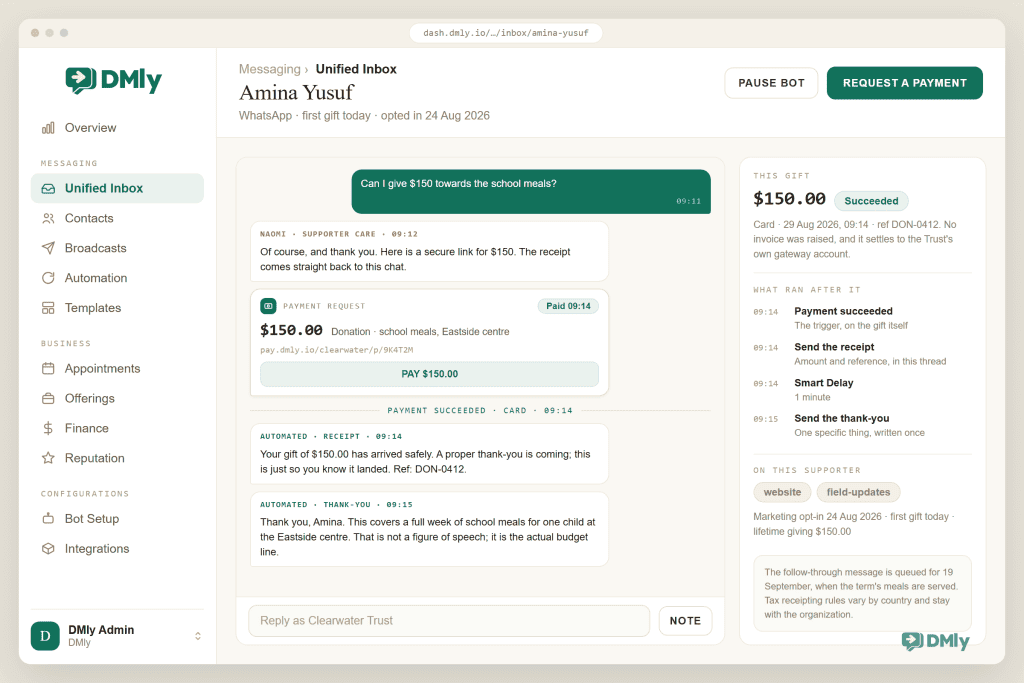
Taking a donation on WhatsApp takes one step, and a supporter can be giving inside a minute of asking how. Request a payment mints a hosted payment link for any amount, right in the conversation, settling to your own account through your connected gateway (Stripe, Paystack and others), with no invoice required and no fee added by DMly on top of the gateway’s own. A supporter who messages “how can I give?” can be giving forty seconds later without leaving the chat.
The machine that matters is what happens next, because this is the thank-you deficit from the top of the page, solved structurally:
- The receipt, instantly. The payment succeeded trigger fires the moment the gift lands, and the flow sends the acknowledgement with the amount: proof of arrival, inside two minutes, at any hour.
- The thank-you, humanly. A second message, minutes later, that sounds like a person because you wrote it once with care: what this gift makes possible, in one concrete sentence. Not a paragraph of gratitude adjectives; one specific thing.
- The follow-through, weeks later. A Smart Delay and one more message when the thing happened: the borehole dug, the kits delivered, the term paid for. This is the message almost no organization sends and the one donors remember, because it closes the loop the sector usually leaves open.
- The record, automatically. Every gift sits on the supporter’s contact alongside the conversation, and their statement answers “what have I given?” without anyone digging. Formal tax receipting rules differ by country and stay your responsibility; the automation’s job is that the human acknowledgement never waits on the paperwork.
Monthly Giving: The Subscription Machinery, Repointed
Regular giving is the difference between fundraising as a treadmill and fundraising as a foundation. Here is the first big reframing: DMly’s subscription engine, built for memberships, runs monthly giving beautifully. Create a plan for each giving level, and a supporter who opts in saves a card once through a link (you never see or handle the card details). From then on, each period the gift collects automatically, the receipt goes out in the chat, and a renewal reminder lands three days before each charge, which in this sector is not an annoyance but a courtesy that prevents the surprise-debit complaint entirely.
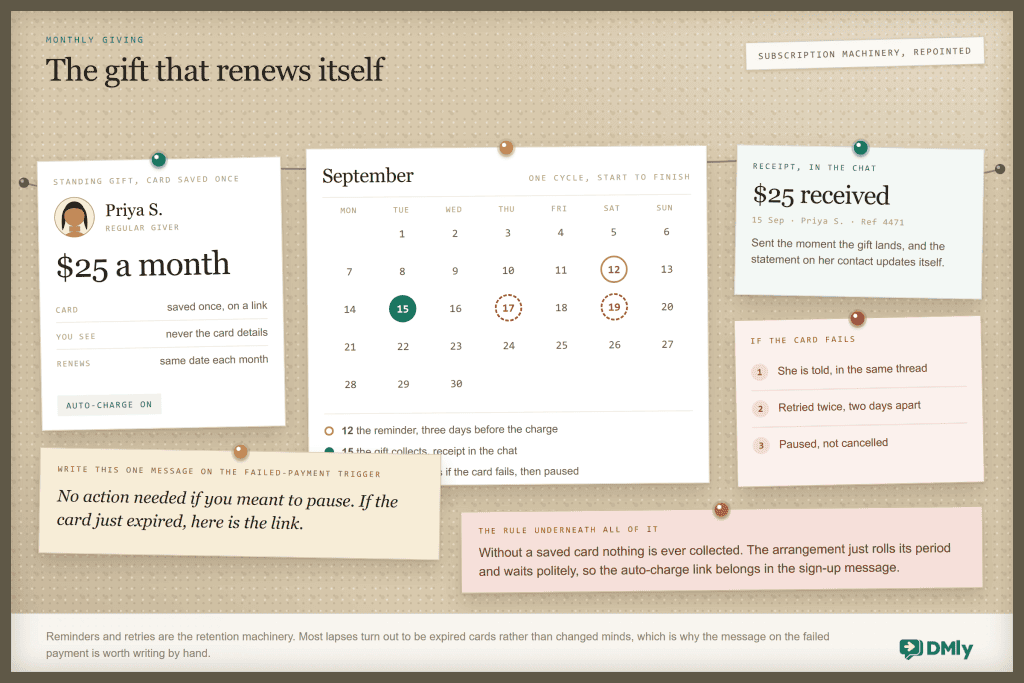
Two behaviours deserve your attention, because they decide whether regular givers stay. When a card fails, the supporter is told and the charge retries twice at two-day intervals before the arrangement pauses; add one warm message on the failed-payment trigger (“no action needed if you meant to pause; here is the link if the card just expired”) and most lapses turn out to be expired plastic, not changed hearts. And note the documented rule underneath everything: without auto-charge, nothing is ever collected; a giving arrangement without a saved card rolls its period and waits politely forever. Either the card is saved, or someone owns the monthly job of sending payment links.
The upgrade ask itself belongs at the warmest moment you can find: right after the follow-through message that showed a one-off donor what their gift did. “If you ever wanted to make this monthly, it is one tap here” converts better after proof than any campaign can before it.
Volunteer Coordination: Shifts, Waitlists and Updates
Here is the second reframing, and the one that gives a coordinator their evenings back: volunteer shifts run perfectly on the class machinery. A “Saturday food bank shift” is a session on the calendar with a capacity of twelve; volunteers book themselves in from a link or in chat, the roster shows who is coming, reminders go out before the shift, and a full shift offers a waitlist that promotes the first person in the queue automatically when someone drops out. Your coordinator’s Tuesday-night phone marathon becomes a system.
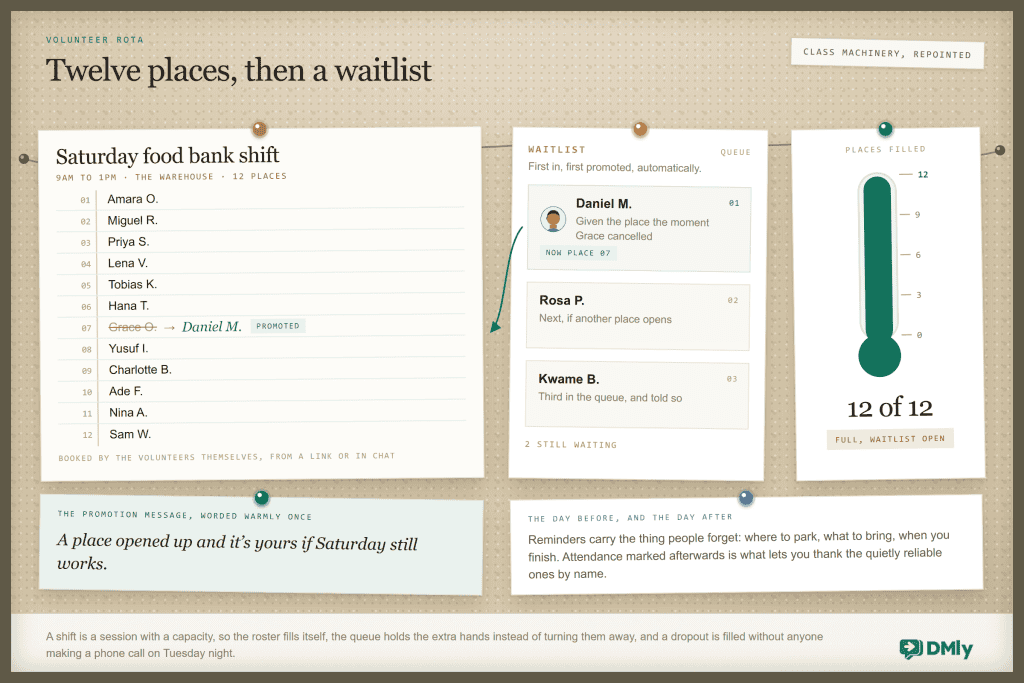
Three practical notes from organisations that got this working. Book volunteers by shift type segments (drivers, sorters, visit teams), so the Thursday delivery run only pings people who can drive it. Send the day-before reminder with the one thing people actually forget (where to park, what to bring), and mark attendance afterwards, because a volunteer’s record of showing up is what lets you thank the quietly reliable ones specifically rather than everybody generically. And keep one boundary: the waitlist promotion message is automatic, so word it warmly once (“a place opened up and it’s yours if Saturday still works”) and it will greet every promoted volunteer well forever.
For the update side, volunteer broadcasts follow the same consent-and-template rules as everything else; the difference is content discipline. Volunteers need logistics and meaning in that order: the where-and-when, then one line of what last week’s shift achieved. Organizations that reverse the order train volunteers to skim.
Supporter Updates: The Broadcast That Shows the Work
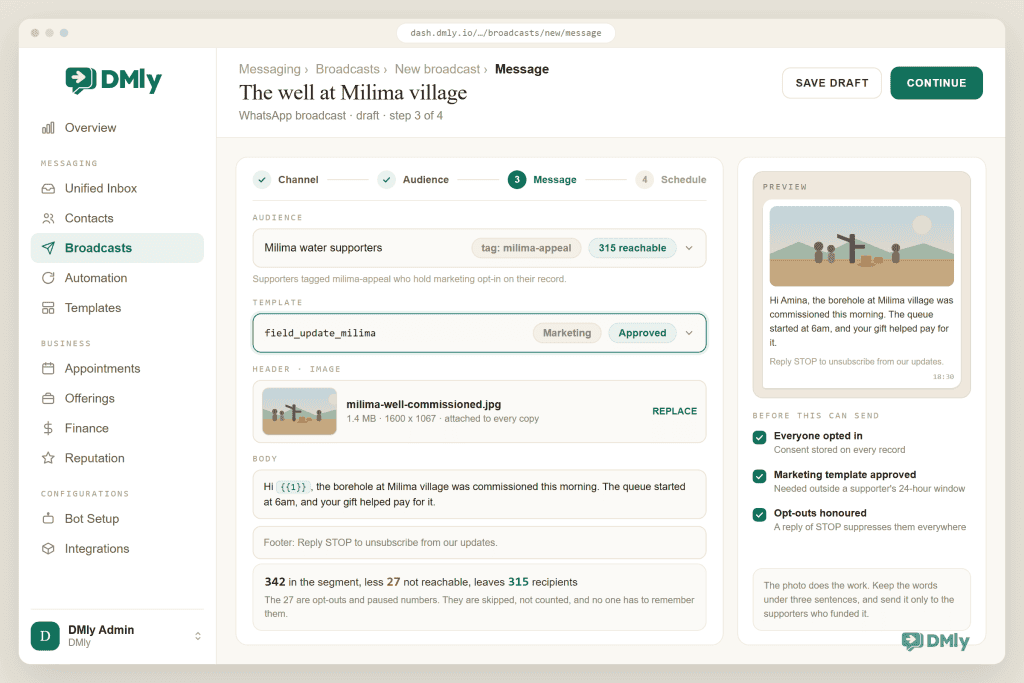
Between the rungs sits the message that keeps the whole ladder warm, and it is the one most organisations send least. The update. Not the newsletter (email keeps that job) but the short, photographed, specific dispatch from the work: the well at 60% dug, the two hundredth kit packed, the exam results in. Sent as a broadcast to opted-in segments, with the field photo carrying the weight and the text staying under three sentences.
Segmentation keeps updates feeling personal at scale: the gala donors hear about the programme their table funded; the street-team recruits hear about the neighbourhood they signed up in; the lapsed segment (no gift in a year, still opted in) gets the once-a-quarter “here is what happened this year” that reopens doors without pushing on them. And the giving-anniversary message, driven by the key-date trigger on the date of a supporter’s first gift, is the cheapest meaningful message in this entire guide: “A year ago today you helped start this. Here is where it stands.”
Advocates: The Fifth Rung, Where Reach Becomes Free
The top of your ladder is the supporter who brings others, and WhatsApp is structurally better at this than any channel you have used, because forwarding is native to it. A field update worth sharing gets shared, into family groups and workplace chats your marketing could never buy its way into, carrying your organization with it.
Advocacy automates lightly, by design. Identify the rung with a segment (long-tenured givers, high-attendance volunteers, anyone who has brought a friend to a shift), then treat them differently in exactly two ways: they hear the story first, before the general update goes out, and they are asked for shares more often than for money. “Forward this to one person who would want to know this exists” is a modest ask with compounding returns, and it lands best from an organization that has already proven, rung by rung, that it follows through. The volunteer-referral version (“bring a friend to Saturday’s shift; there are three places”) doubles as recruitment and as the warmest possible first contact for the friend, who arrives pre-trusted.
One measurement note: tag contacts who arrive through advocate links and QR codes separately. When the referred segment starts outgrowing the paid one, you have built the thing this whole guide exists to build.
Emergency Appeals and Campaigns, Without Burning the List
Sooner or later the urgent appeal happens: the flood response, the funding gap, the deadline. The channel can carry it well, and it is also where lists get burned, so the discipline matters more than the mechanics.
The mechanics first: an appeal is a broadcast to opted-in segments with an approved marketing template (approve a generic appeal template in advance, because template review takes time you will not have during the actual emergency), a payment link in the message, and the receipt-and-thank-you machine already running behind it. Segment even in urgency: regular givers get “we are already grateful, here is what is happening” rather than a cold ask, and volunteers may be more valuable this week than donations.
The discipline is threefold. Real deadlines only, because a supporter who catches one manufactured emergency discounts every future genuine one. One ask per appeal, stated plainly with the specific gap. And the debrief afterwards, always: what came in, what it did, sent to everyone who was asked, whether or not they gave. The debrief is the message that makes the next appeal work, because it converts this one from a transaction into an episode of a story supporters are following.
Five Supporter Messages to Copy
| Message | When it sends | Wording that works |
| The receipt | Payment succeeded, instantly | “Your gift of $150 has arrived safely. A proper thank-you is coming; this is just so you know it landed. Ref: [number].” |
| The thank-you | Minutes later | “Thank you, Amina. This covers a full week of school meals for one child at the Eastside centre. That is not a figure of speech; it is the actual budget line.” |
| The follow-through | When the work happened | “Three weeks ago you helped fund the borehole at Milima village. It was commissioned this morning. Photo attached; the queue started at 6am.” |
| The anniversary | Key date: first gift | “A year ago today you made your first gift to this work. Here is what that year built: [one photo, two lines].” |
| The shift reminder | Day before a shift | “Saturday, 9am at the warehouse. Park on Adeola Street, wear closed shoes, and we finish by 1. Reply if anything has changed. Thank you for giving us your morning.” |
The pattern across all five: specifics carry the gratitude. A named centre, a real budget line, a photo with a timestamp. The sector’s instinct is to reach for warmer adjectives; the supporter’s trust responds to colder facts delivered warmly.
How to Set Up WhatsApp Automation for NGOs
- Connect the number and write the welcome. Official API through DMly; a welcome flow that answers the five questions every organization gets (who you are, where the money goes, how to give, how to volunteer, how to reach a person) and captures consent in plain words.
- Wire the donation path. Gateway connected, Request a payment ready in the inbox, and the receipt-plus-thank-you flow on the payment trigger. This is the thank-you deficit fixed, and it is one afternoon.
- Launch monthly giving. Plans at two or three levels, the auto-charge link, the failed-payment kindness flow. Ask one-off donors after the follow-through message, not before.
- Move the rota. Shift types as sessions with capacities, the volunteer segments, the day-before reminder. Retire the phone marathon.
- Start the update rhythm. One field dispatch a month to segments, the anniversary flow, and the quarterly lapsed message. Less is more; specific is everything.
Common Problems With WhatsApp Automation for NGOs
| Symptom | Cause | Fix |
| Monthly gifts never collect | No card saved; without auto-charge the plan rolls its period and waits | Send the auto-charge link at sign-up, or own the monthly payment-link job by name. |
| A regular giver quietly lapsed | Card failed, retried twice, paused; nobody followed up | Add the warm flow on the failed-payment trigger; most lapses are expired cards. |
| Broadcast did not reach part of the list | Contacts without opt-in, or no approved marketing template outside the 24-hour window | Fix consent at the door and approve templates before campaign week. |
| Volunteers say they were never reminded | Unconfirmed booking or opted-out contact; reminders skip rather than retry | Check both states; brief volunteers that the waitlist is a queue, not a booking. |
| Anniversary messages fire for nobody | The key-date trigger only fires where the date field is populated | Capture the first-gift date on the record; backfill your existing donors once. |
| Thank-yous read like a mail merge | Gratitude adjectives instead of one specific thing | Rewrite once, concretely; the automation delivers whatever you give it, at scale. |
NGO WhatsApp Automation FAQs
Can an NGO take donations directly through WhatsApp?
Yes. A payment link for any amount can be minted right in the conversation and settles to your own account through your payment gateway, with an automatic receipt and thank-you following in the same thread. Formal tax receipting requirements vary by country and remain your responsibility; the chat handles the human acknowledgement instantly either way.
How does monthly giving work on WhatsApp?
On subscription machinery: the supporter saves a card once through a secure link, and each period the gift collects automatically, with a receipt in the chat and a reminder three days before each renewal. Failed cards are retried twice over four days before the arrangement pauses rather than cancelling, which protects givers from lapsing over an expired card.
Can volunteers book their own shifts?
Yes, using session capacity: each shift is published with a fixed number of places, volunteers book from a link or in chat, full shifts offer a waitlist, and a dropout promotes the first person in the queue automatically with a message. Reminders go out before each shift, and attendance marking builds the record that lets you thank reliable volunteers specifically.
Is it appropriate to fundraise on WhatsApp?
Done with consent and restraint, it is one of the most respectful channels available, because every recipient chose to be there and can leave with a word. The discipline is the sector’s own: opt-in at the door, updates that show the work more often than asks that request support, and no manufactured urgency. The organizations that treat the channel as a trust asset find it outperforms; the ones that treat it as a megaphone burn it like any other list.
What does WhatsApp automation for NGOs cost to run?
DMly’s plans include the flows, broadcasts, payments and volunteer booking, with a 7-day trial and no card required. Meta bills template messages delivered outside a supporter’s 24-hour window at per-message rates, passed through without markup. Replies inside the window, which cover most donation and volunteer conversations, carry no Meta charge until 1 October 2026, and from that date they are billable at your market’s utility rate, which our guide to the October WhatsApp pricing change explains. For most small organizations the monthly platform cost sits well below the value of the second gifts the thank-you machine recovers.
How many people does an NGO need on the list before this is worth it?
Fewer than fundraising instinct suggests. The thank-you machine pays from the first donation, because its value is per-gift, not per-thousand. A hundred genuine opted-in supporters with the receipt, follow-through and anniversary flows running will out-retain ten thousand newsletter addresses, and the volunteer rota earns its keep the first Saturday it fills itself.
Who on the team should own this?
One named person owns the system (usually whoever runs supporter communications), but the design goal is that nobody owns the routine. The receipts, renewals, reminders and anniversaries run on triggers; the human work that remains is writing the monthly update, answering the conversations the automation hands over, and the weekly ten-minute glance at failed payments and the lapsed segment. If the system needs more than that, it was built too cleverly.
We are a church or faith organization; does this apply to us?
Almost all of it, with your own vocabulary: members rather than supporters, tithes and offerings through the same payment links and regular-giving machinery, and services or ministries in place of shifts. We wrote a dedicated piece on how churches manage members and events with AI messaging that pairs well with this one.
Fix the thank-you deficit first
Receipts in minutes, monthly gifts that renew themselves, volunteer rotas that fill without phone calls, and updates that show the work. On the channel your supporters already open every day.
The Second Gift
Everything in this guide points at one moment: the days after a first donation, when a supporter is deciding, mostly unconsciously, whether your organization is a place their generosity lands or a place it disappears. The receipt in two minutes, the specific thank-you, the follow-through weeks later when the work happened: that sequence is what the decision turns on, and it is precisely the sequence a stretched team drops first.
So build the thank-you machine before anything else on the ladder. The monthly giving, the rota, the updates: all of it stands on supporters who learned, early and concretely, that giving to you feels like joining something rather than donating into fog.
And when the board asks what the messaging system achieved this year, you will have an answer no annual report usually contains: every gift acknowledged within minutes, every giver shown what their money did, and not one supporter lost to silence. In a sector that runs on trust, that is not administration. That is the mission’s infrastructure.
Writing about WhatsApp automation, bookings and growth for local business.
Turn WhatsApp into your busiest channel.
Start free and run message, bookings, payments and reviews in one place.
