
Woztell Review 2026: Pricing, the Prepayment Deposit and the Alternative
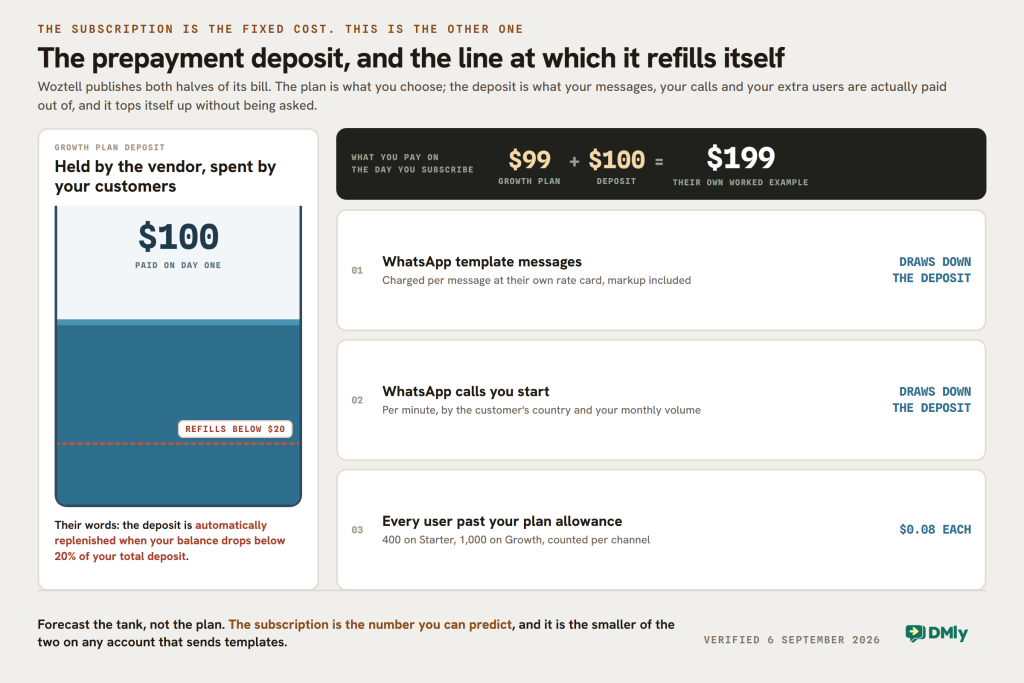
Your first bill is $199. Ninety-nine of it is the plan you chose. The other hundred is money you have handed over that cannot be spent on the plan at all, and that quietly tops itself up again whenever it runs low.
That is not our arithmetic. It is the worked example on their own pricing page, under the question “How much will I pay if I subscribe today?”: “You buy the Growth Plan on day 15. Growth Subscription: $99 + Prepayment Deposit: $100 = Total: $199.”
The hundred is a prepayment deposit, and it is the thing this Woztell review is built around, because almost every write-up of this product quotes the subscription and stops there. The deposit is where your WhatsApp messages, your WhatsApp calls and anyone over your monthly user allowance are actually paid for, and Woztell says plainly that it replenishes itself automatically once your balance drops below 20 per cent.
Everything below was read on Woztell’s own pricing page, plan comparison, rate card and FAQ on 6 September 2026. We have not run Woztell on a paid plan this month, so you will not find us grading how the builder feels. You will find what it costs, what the units mean, six corrections to what this page used to say, and an honest account of where DMly is the better buy and where it is not.
Six Things This Woztell Review Used to Say That Are No Longer True
Start with a retraction, because four of these ran against Woztell and they were wrong. The version of this page published in April 2026 described a platform whose plans were rationed by bots and seats. Their pricing page today does not work that way.
| What this page said | What their pricing page says on 6 September 2026 |
|---|---|
| 1 bot on Free, 3 on Starter, 10 on Growth | “Unlimited Chatbots & Sessions”, listed under every plan |
| 1 user licence on Starter, 3 on Growth, 10 on Agency | “Team Inbox with Unlimited Agents”, listed under every plan |
| 5, 10 or 20 automations and custom replies by tier | No such limit appears anywhere on the pricing page |
| Starter costs $49.50 a month | $49 monthly, or $39 on the annual plan |
| The free plan gives “unlimited channels and sessions” | Free is 100 MAU, one channel type, and marked “Unable to start WhatsApp broadcasts” |
| No mention of a deposit, a markup or a per-user meter | A prepayment deposit on every paid plan, a published 20 per cent WhatsApp markup, and $0.08 per extra monthly active user |
That is the honest state of it. Woztell has taken the caps off the things most platforms ration, and put the meter somewhere else. The rest of this Woztell review is about where.
What Woztell Costs in 2026
Woztell publishes everything, which is more than most of this market manages. No login, no quote form, no blank cells. There is a monthly card and an annual card, and the annual one is genuinely cheaper.
| Plan | Monthly | Annual | Prepayment deposit | Monthly active users | Channels |
|---|---|---|---|---|---|
| Free | $0 | $0 | None | 100 | 1 channel type, and no WhatsApp broadcasts |
| Starter | $49 | $39 | $50 | 400 | 1 channel type |
| Growth | $99 | $89 | $100 | 1,000 | Unlimited |
| Agency | $399 | $349 | $400 | Unlimited on the plan card | Unlimited |
What is included on every plan, in their words: unlimited chatbots and sessions, a team inbox with unlimited agents, unlimited customer-initiated WhatsApp conversations, unlimited WhatsApp numbers, and all extensions and integrations. Plus message broadcasting, a WhatsApp catalogue and e-commerce integration, ChatGPT integration, drip sequences on WhatsApp, Instagram and Facebook, round-robin chat assignment, payments in WhatsApp through PayPal and Stripe, template submission, and the API and webhooks.
That is a generous box. The catch is not in the box, it is in the meter.
The deposit, and the part people miss about it
The deposit is not a one-off. Woztell’s own FAQ says it covers “all variable costs: WhatsApp Conversation Templates, WhatsApp Calls, and extra MAUs”, and then says this about how it behaves:
“The deposit is automatically replenished when your balance drops below 20% of your total deposit, ensuring you have enough funds to continue operating normally.”
Woztell pricing FAQ, read 6 September 2026
So on the Growth plan, the $100 tops itself back up every time it falls under $20. If you send a lot of template messages, that is not an occasional event. It is a second, variable charge running alongside the $99, and it is the number you should be forecasting rather than the subscription.
None of that is hidden and none of it is unusual for a WhatsApp platform. What is unusual is how clearly it is written down, and how rarely anyone quotes it.
What a MAU is, and why one customer can cost you three
Every paid plan is sized in monthly active users. Woztell defines the unit itself, and the second sentence is the one that matters:
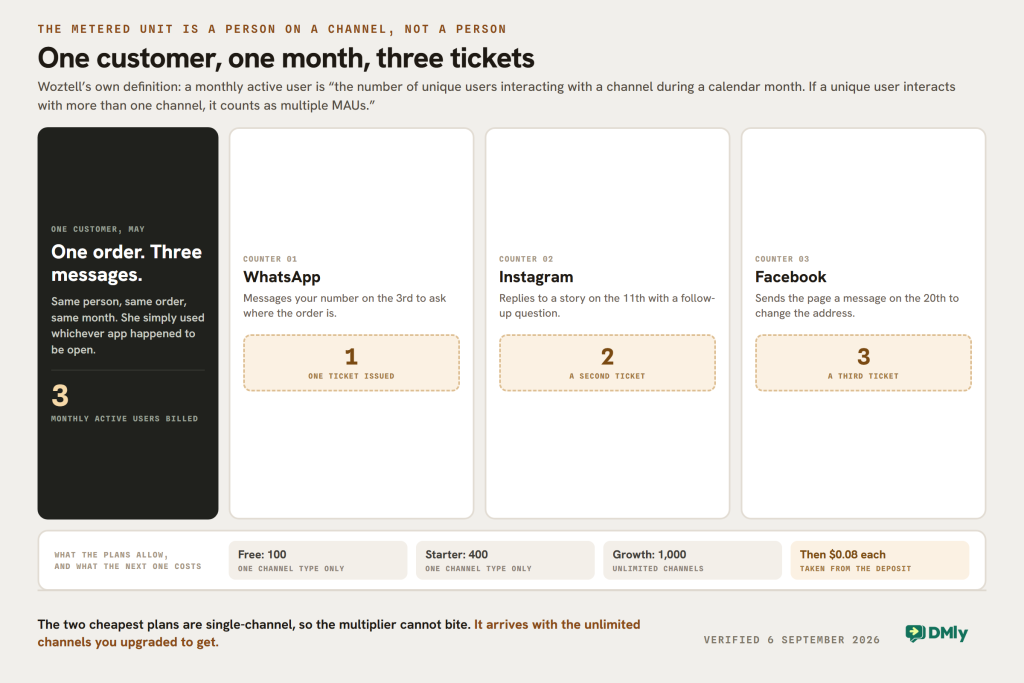
“A Monthly Active User (MAU) is the number of unique users interacting with a channel during a calendar month. If a unique user interacts with more than one channel, it counts as multiple MAUs.”
Woztell pricing FAQ, read 6 September 2026
The unit is a person on a channel, not a person. A customer who asks about an order on WhatsApp, replies to a story on Instagram and then messages your Facebook page is three monthly active users, not one, and your 400 or your 1,000 empties three times as fast.
This is worth sitting with, because it interacts with the plan structure in a way that is easy to miss. Starter is a one-channel plan. On one channel the multiplier cannot bite. Move up to Growth for the unlimited channels, and the multiplier arrives with them. The more of the product you use, the faster the meter runs, which is not a criticism so much as a thing to model before you commit.
Extra users are published at $0.08 each on Starter, Growth and Agency alike, so a Growth plan that reaches 2,500 monthly active users pays $99 plus 1,500 times $0.08, which is $120, from the deposit. The deposit then tops itself up. That is the whole model in one sentence, and it is a fairer one than most because the overage rate is on the page rather than in a sales call.
The 20 per cent WhatsApp markup, which they publish themselves
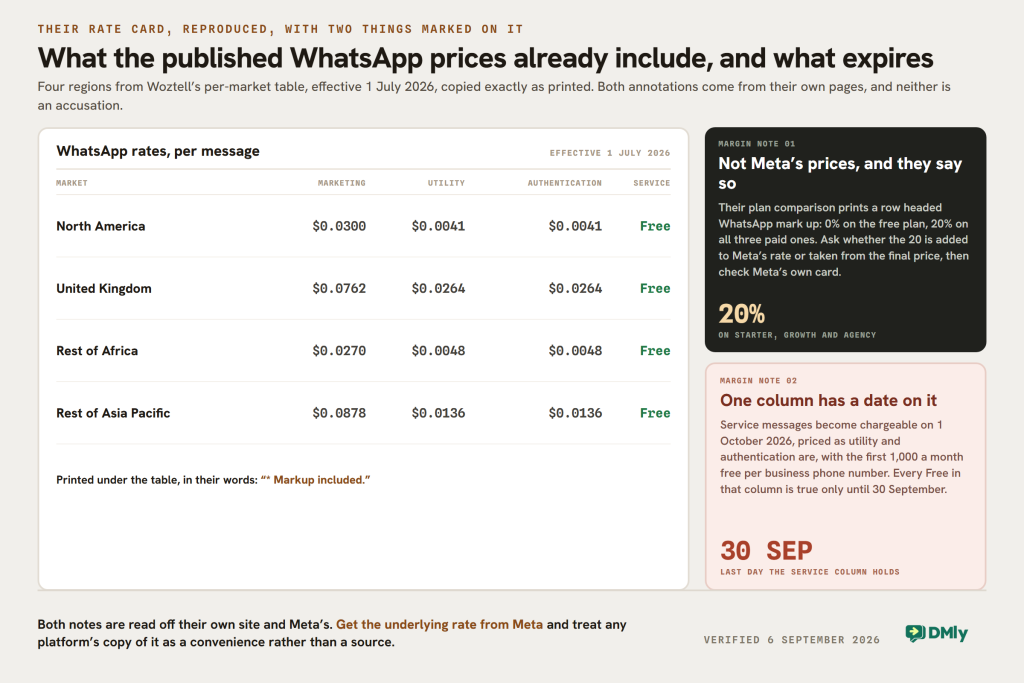
Open the full comparison on the pricing page and there is a row most vendors would not print. It is called “WhatsApp mark up”, and it reads 0% on Free and 20% on Starter, Growth and Agency.
Their per-market rate card carries the same fact in a footnote: “* Markup included.” So the message prices you see on the Woztell site are not Meta’s prices, and Woztell says so.
Publishing the number is the right thing to do and it is rare. Two of the reviews on this blog have had to tell readers that a vendor’s markup is unknowable. Woztell hands it to you, which means you can do the arithmetic yourself instead of guessing. Their North America marketing rate is $0.0300 with the markup in it, so if the 20 per cent is added on top of Meta’s rate the underlying figure is $0.025, and if it is 20 per cent of the final price it is $0.024. Ask them which of those two it is, then compare the answer against Meta’s own published rate card for your market and you will know exactly what the convenience costs.
Whether that is worth paying is a real question with a real answer on both sides. A markup buys you a company that handles the Business Manager verification, the template submissions and the number migration. It also compounds: 20 per cent of a small message bill is nothing, and 20 per cent of 200,000 marketing templates a month is a salary.
Two numbers on their own page that do not agree
We are not going to call this anything other than what it is, which is a discrepancy a buyer should raise before signing.
- The Agency plan card says “Unlimited MAU”. The full comparison grid on the same page says Unlimited too. But the FAQ underneath, answering “What is the prepayment deposit for?”, lists plan limits as “Starter = 400 MAUs, Growth = 1,000 MAUs, Agency = 5,000 MAUs“.
- The same FAQ names a fifth plan that is not for sale on the page. The list ends “Scale Up tier = 50,000 MAUs”, and there is no Scale Up card, no Scale Up price and no Scale Up column in the comparison.
The likeliest explanation is the boring one: the FAQ was written against an older tier list and has not been revised. But if you are buying Agency at $399 a month because the card says unlimited users, that is the sentence you want confirmed in writing. Ask them which is current, and ask what Scale Up costs, because a 50,000-user tier that exists in the FAQ may be exactly what a larger operation needs.
The Dated Thing Every Woztell Buyer Should Check Before October
This is the most useful paragraph on the page, and it has nothing to do with which platform you pick.
Woztell publishes a per-market WhatsApp rate card, effective 1 July 2026, with a column for each message category. The last of those columns is headed Service, and for every single market in the table it reads Free. That is correct today. It stops being correct on 1 October 2026.
From that date Meta charges on a per-message basis for service messages, and for utility messages sent in reply to a customer inside the open 24-hour window. Meta published the new rates on 1 September, and service messages are priced the same as utility and authentication in each market. There is one piece of good news in it: every business phone number gets the first 1,000 service messages of each month free, with no roll-over, so a small sender may never notice. A busy support desk will. Our walk-through of the 1 October pricing change covers what becomes billable and how to size it.
Why this matters more on Woztell than on a platform that bills you afterwards: your deposit is sized against today’s costs. A support-heavy account whose replies have always been free will start drawing that deposit down from October, and the deposit refills itself without asking. Nobody is doing anything wrong. The bill simply changes shape while the direct debit stays the same.
In fairness, Woztell’s explainer page is one of the better ones in this market. Their WhatsApp pricing page correctly describes Meta’s move away from conversation-based billing, explains tiered accumulation at the business-portfolio level, and spells out that each volume tier applies its own rate only to the messages inside that range rather than recalculating the total. That is more accurate than most vendor explainers and more accurate than several of the reviews that link to it. The Service column is a dated figure on an otherwise current page, and it will need one edit in three weeks, along with everybody else’s.
The reader’s defence is the same whoever you buy from: get the rate from Meta, and treat any platform’s copy of it as a convenience rather than a source. We hold ourselves to that too. DMly’s own documentation page on WhatsApp limits still shows a retired “1,000 customers / 24h” step in the messaging tier ladder, when Meta’s ladder is 250, then 2,000, 10,000, 100,000 and unlimited. That row is wrong on our own site as this is published, and it is being corrected.
What Woztell Is Genuinely Good At
The old version of this page spent six bullet points on how confusing Woztell is to learn, using words like “overwhelming” and “not beginner-friendly”. We have not run the product this month, so none of that was ours to say, and it has gone. What can be said is what they publish and what it implies.
Nothing is rationed except users
Unlimited chatbots, unlimited sessions, unlimited agents in the inbox, unlimited WhatsApp numbers and every integration included, on the $49 plan as much as the $399 one. Most platforms at this price sell you seats. Woztell sells you users of your product instead, which is a genuinely different bet and a better one if you have a big team answering a modest number of customers.
Four kinds of bot, not one
Their comparison grid names a keyword bot, a combinational bot, a guided bot and an AI bot, all four on every plan. That is a wider spread than most tools offer, and it is the reason the platform has a reputation for depth: you are not forced to express a simple keyword rule as a flow, or a complex flow as a keyword rule.
The Zoho relationship is real, and it is unusual
Zoho Flow, Zoho Cliq and Zoho CRM all appear in Woztell’s own connectivity list, alongside webhooks and the API. If your business already runs on Zoho, this is a shortlist of one. Very few WhatsApp platforms treat that ecosystem as a first-class citizen, and the ones that do usually charge for the privilege.
Onboarding is part of the price
Their FAQ says subscribing gets you an onboarding session where they connect WhatsApp, Instagram, Facebook and your other channels for you, and the Growth and Agency cards both list custom set-up and custom onboarding. There are more than 300 chatbot templates. For a business without anyone technical, a platform that does the connection work is worth more than a slightly cheaper one that does not.
WhatsApp Groups, which most platforms at this price cannot touch
Woztell sells automation for WhatsApp Groups as a named product, alongside WhatsApp Flows, WhatsApp Calls and Click to WhatsApp ads. If your business runs on groups, a class list, a delivery round, a parents’ group, that is a real capability and one DMly does not have at all. We searched our own documentation for it before writing that sentence, and the only groups we automate are groups of steps in the flow builder.
One answer on their site that contradicts another, about your phone
The pricing FAQ says: “Your number will be migrated to WhatsApp Cloud API, meaning you will stop using the WhatsApp mobile app.” That is the normal outcome of connecting a number to the official API, and most platforms bury it.
But “WhatsApp Business App (Co-Existence)” is a headline feature in Woztell’s own navigation, with a page explaining how to keep using the app and the API on one number. Both statements are theirs. The one you should plan around depends on which mode you are signed up in, so ask for that in writing during onboarding. DMly has the same choice at signup, a normal connection or a co-existence connection, and the same warning applies: pick deliberately, because the default takes the number over exclusively.
DMly as a Woztell Alternative
We make DMly, so weigh this section accordingly. What we can usefully do is put our own rate card through the same treatment, so the two meters sit side by side and you can see which one your business would trip first.
There is no deposit and no markup. DMly connects the official WhatsApp Business API and you pay Meta’s per-message rates directly, with nothing added by us. That is published on our own pricing page and it is the single sharpest difference between the two: on Woztell your message bill runs through a deposit that Woztell holds and tops up; on DMly it runs through your own Meta billing.
And there is no per-channel multiplier. DMly counts active contacts, not users per channel, so the customer who reaches you on WhatsApp on Monday and Instagram on Thursday is one contact and one record, not two of anything.
What DMly does count, read from the same live pricing page on 6 September 2026:
- Active contacts: 3,000 on Starter at $29 a month billed yearly, 10,000 on Growth at $65, unlimited on Premium at $149. Extra contacts are $15 per thousand.
- Broadcast and template messages: 10,000, 50,000 and 300,000 a month. Woztell does not cap these; we do, and it is the number to check first if you send campaigns.
- Team seats: 3, 6 and 15, with extra seats at $10 a month. Woztell gives you unlimited agents on every plan, and that is a straightforward win for them if you have a big team.
- Profiles per channel: 1, 3 and 5. A second shop with its own WhatsApp number needs a second profile, at $15 a month for a profile set.
- AI replies: 500, 5,000 and 20,000 a month on DMly’s shared AI. On Premium you can connect your own OpenAI, Claude, Gemini or DeepSeek key instead, and replies on your own key are never counted.
What happens at the limit is different too, and this is the part worth deciding on. Woztell’s deposit refills itself so the messages keep going and the cost follows you. On DMly, running out of AI replies skips the AI step rather than failing it, the thread carries a note saying so, and the allowance resets on the first of the month. Crossing your active contacts limit refuses nothing at all: the usage gauge turns amber at 90 per cent and red at 100, but no contact, import or inbound message is ever turned away.
One model never interrupts and costs what it costs. The other never surprises you and can go quiet. Pick the failure you would rather explain to a customer.
The channels, and what sits behind them
Woztell connects four: WhatsApp Business API, Facebook, Instagram and web chat. DMly connects seven plus SMS: WhatsApp, Instagram, Messenger, TikTok, Telegram, Google Business and a website Live Chat widget. The old version of this page said five, which was true when it was written and is not now.
Behind those channels the products are shaped differently. Woztell is a conversation platform with commerce attached. DMly puts the shared inbox, the CRM and pipelines, comment automation, bookings, invoices, payments and Google review requests in the one subscription and against the one contact record, so a customer can ask a question, be qualified by the AI, book a slot, pay for it and be asked for a review without leaving the system. Our guide to running an omnichannel inbox is the long version of what that looks like in a working day.
Four things Woztell does that DMly does not
These are the reasons to buy Woztell, and we would rather you found them here than three weeks into a trial.
- Unlimited agents on every plan. DMly sells seats: 3, 6 and 15, then $10 each. If you have fifteen people answering messages and only a few hundred customers a month, Woztell is simply cheaper and there is no argument to make.
- WhatsApp Groups automation. DMly has none. If groups are where your customers actually are, that decides it.
- A deep Zoho relationship. Zoho CRM, Bigin, Flow and Cliq are all named products on their site. DMly integrates through its API, webhooks, Zapier, n8n and an MCP server, which will reach Zoho but is not the same as a maintained native connector.
- Onboarding done for you, included. Woztell’s paid plans list custom set-up, and Growth and Agency add custom onboarding with a session where they connect your channels. DMly gives you a 7-day trial with no card and priority onboarding on Premium, which is not the same as somebody doing the connection work for you.
Woztell and DMly, Side by Side
Feature lists are nearly identical at this end of the market. The rows below are the ones where the two platforms actually diverge.
| Question | Woztell | DMly |
|---|---|---|
| Cheapest paid plan | $49 a month, or $39 annual | $29 a month billed yearly |
| Deposit before you start | $50 to $400, on top of the first month | None |
| Markup on WhatsApp messages | 20 per cent, published on their own grid | None. You pay Meta directly |
| What the plan meters | Monthly active users, per channel | Active contacts, broadcast messages, seats, profiles, AI replies |
| Does one customer on three channels count three times? | Yes, by their own definition | No |
| Overage | $0.08 per extra user, taken from the deposit, which refills below 20 per cent | No overage charge. The AI step pauses until the reset; contacts are never refused |
| Agents in the inbox | Unlimited on every plan | 3, 6 or 15, then $10 each |
| Chatbots | Unlimited on every plan | 10 active bots per profile on Starter, unlimited above |
| Channels | 4: WhatsApp, Facebook, Instagram, web chat | 7 plus SMS, adding TikTok, Telegram and Google Business |
| WhatsApp Groups | Yes | No |
| Free plan | Yes: 100 users, one channel, no WhatsApp broadcasts | No. A 7-day trial with no card |
| Bookings and payments | Payments in chat via PayPal and Stripe | Bookings, classes, invoices and payments, with pay before or pay after |
| Set-up | Custom set-up on paid plans, onboarding session on Growth and Agency | Self-serve, with priority onboarding on Premium |
The row that decides most of these is the seats row against the users row. Woztell charges for the people you talk to and gives away the people who do the talking. DMly charges for the people who do the talking and gives away the conversations. Count both sides of your own business before you compare anything else.
Which One to Buy, by Situation
You have a big team and a modest number of customers
Woztell, comfortably. Ten people in the inbox and 800 customers a month is $99 on Growth with unlimited agents. The same shape on DMly is Growth at $65 plus four extra seats at $10, which is $105, and you would be watching the broadcast allowance too. Unlimited agents is a real advantage and it should be treated as one.
You have a small team and a lot of customers
DMly, and the gap widens as you grow. Three thousand active contacts is exactly what the $29 plan allows. On Woztell, 3,000 monthly active users on Growth is $99 plus 2,000 extra at $0.08, which is $160 from the deposit, and more if those customers use more than one channel.
You send a lot of marketing templates
Do the markup arithmetic before anything else. Twenty per cent on a rate card is invisible at small volumes and decisive at large ones. Against that, DMly caps broadcast and template messages at 10,000, 50,000 and 300,000 a month while Woztell does not cap them at all, so a very high-volume sender should price both models properly rather than assuming the no-markup one wins.
Your business already runs on Zoho
Woztell. Zoho CRM, Bigin, Flow and Cliq are named, maintained integrations rather than something you assemble from webhooks. Nothing on our side changes that.
You are a salon, clinic, studio or garage
DMly. Your day is appointments, no-shows, payment taken before or after the slot, repeat customers and reviews afterwards, and those are the parts Woztell does not sell. You also want Instagram comments and TikTok to be first-class rather than absent.
You want to test something for nothing this week
Woztell’s free plan, with your eyes open. It is 100 monthly active users, one channel type and no WhatsApp broadcasts, so it will show you the builder and the inbox and not much about campaigns. DMly has no free tier at all: seven days, every feature, no card. Both are honest offers of different things.
Nobody in your business is technical
It depends on whether you would rather be taught or be handed it. Woztell includes an onboarding session that connects your channels for you, which is worth real money. DMly is built to be set up without one. Ask Woztell exactly what the onboarding covers and how long you have it for, because “custom set-up” is a phrase, not a scope.
The Verdict
Woztell is more honest about its pricing than most of this market and more expensive than its headline suggests, and both of those things are true at once. They publish the markup, publish the overage rate, publish the deposit, publish a full per-market rate card and label it. Almost nobody does all five. Then they meter a unit that counts one customer more than once, and hold a balance that refills itself.
The version of this Woztell review published in April got four things wrong in Woztell’s disfavour and missed the three things that actually cost money. That is worth saying plainly, because a review that criticises a bot limit which no longer exists is not helping anyone buy anything.
DMly is the better buy if you have more customers than colleagues, if you want bookings and payments and reviews in the same subscription, if you need TikTok, Telegram or Google Business, or if a 20 per cent line on every WhatsApp message is money you would rather keep. Woztell is the better buy if you have more colleagues than customers, if you live in Zoho, if you need WhatsApp Groups, or if you want somebody to do the set-up for you.
Whichever way it goes, do the two sums this Woztell review keeps coming back to. How many separate people will message you this month, and on how many channels each? That is the number Woztell bills. How many colleagues will answer them, and how many messages will you send out? That is the number we bill. They are rarely the same size.
If it is the second pair that is smaller, DMly’s plans are built for it, and the trial does not ask for a card or a deposit.
Woztell Review FAQs
How much does Woztell cost in 2026?
There is a free plan at $0, then Starter at $49 a month, Growth at $99 and Agency at $399, all read from their own pricing page on 6 September 2026. The annual tab drops those to $39, $89 and $349. Every paid plan also carries a one-off prepayment deposit of $50, $100 or $400, charged on top of your first month, so subscribing to Growth today costs $199 rather than $99.
What is the Woztell prepayment deposit for?
Their FAQ says it covers the variable costs: WhatsApp conversation templates, WhatsApp calls and any monthly active users beyond your plan’s allowance. It is not a one-off payment. Woztell says the deposit is “automatically replenished when your balance drops below 20% of your total deposit”, so on a $100 deposit it tops itself up whenever it falls under $20.
What counts as a monthly active user on Woztell?
Their definition is “the number of unique users interacting with a channel during a calendar month”, and the important half is the next sentence: “If a unique user interacts with more than one channel, it counts as multiple MAUs.” One customer who messages you on WhatsApp and then on Instagram is two monthly active users. Extra users beyond the plan allowance are $0.08 each, taken from the deposit.
Does Woztell add a markup to WhatsApp message costs?
Yes, and they publish it. The plan comparison on their pricing page has a row headed “WhatsApp mark up” reading 0 per cent on the free plan and 20 per cent on Starter, Growth and Agency, and their per-market rate card carries the footnote “Markup included”. Publishing the figure is unusual and worth crediting. Ask them whether the 20 per cent is added to Meta’s rate or taken as a share of the final price, because the two give slightly different answers.
Is the Woztell free plan any good?
It is a genuine free tier, not a trial, and it includes unlimited chatbots, unlimited sessions and unlimited agents like every other plan. What it does not include is scale or reach: 100 monthly active users, one channel type, and their own card marks it “Unable to start WhatsApp broadcasts”. Treat it as a way to see the builder rather than a way to run a campaign.
Which channels does Woztell support?
Four: the WhatsApp Business API, Facebook, Instagram and web chat. On top of those they sell WhatsApp Flows, WhatsApp Calls, WhatsApp Groups automation and Click to WhatsApp ads, and integrate with Zapier, Make, n8n and the Zoho suite. There is no TikTok, no Telegram, no SMS and no Google Business.
What is the best Woztell alternative for a small business?
If you have more customers than colleagues, want bookings, invoices, payments and Google reviews in the same subscription, or would rather pay Meta directly than pay 20 per cent on top, DMly is the closer fit at $29 a month billed yearly with no deposit. If you are comparing conversational platforms more broadly, our Trengo review and our round-up of Wati alternatives cover the nearest neighbours on price and shape.
Can I keep using the WhatsApp app on my number?
On both platforms, only if you connect in co-existence mode. Woztell’s pricing FAQ says migration means you stop using the WhatsApp mobile app, while “WhatsApp Business App (Co-Existence)” is a named feature in their own navigation, so the answer depends on which mode you are onboarded into and it is worth getting in writing. DMly offers the same choice at signup, with a separate co-existence button; the default connection takes the number over exclusively.
Is this Woztell review based on hands-on testing?
No, and we would rather say so. Every figure, limit and quotation here was read on Woztell’s own pricing page, plan comparison, WhatsApp rate card and FAQ on 6 September 2026, and every DMly figure came from our own published pricing and documentation on the same day. We have not run Woztell on a paid plan this month, which is why the earlier version’s judgements about how hard it is to learn have been removed rather than rewritten. Prices in this market move quickly: check both rate cards before you buy, and tell us if you find something here that has changed.
Writing about WhatsApp automation, bookings and growth for local business.
Turn WhatsApp into your busiest channel.
Start free and run message, bookings, payments and reviews in one place.
