
How Much Does an AI Receptionist Cost in 2026? AI vs Human Receptionist Compared
The easiest way to understand AI receptionist cost is to price one phone call. Take the most ordinary question a small business gets all week: “Are you open this Saturday?” It takes about a minute to answer. Here is what that one minute costs, depending on who, or what, picks up.
- A live answering service billed per call, such as Smith.ai’s human Starter plan: $300 for 30 calls, so $10 for that call, and $11.50 once you go past 30.
- An AI phone receptionist billed per call, such as Smith.ai’s AI Receptionist on its Pro plan: $2.00.
- An AI phone receptionist billed per minute, such as Rosie’s Professional plan: $49 for 250 minutes, so about 20 cents.
- An AI on WhatsApp, if the customer messages instead of calling: nothing from Meta while your number is inside its first 1,000 free service messages of the month, then a third of a US cent per reply to a US number, plus one AI reply from your platform’s monthly allowance.
- Your own receptionist: about 30 cents of wages at the US median, except you also pay for every quiet minute in between.
Same question. Same answer. Prices from a fraction of a cent to $11.50. That spread is the real story: what you pay depends far less on how clever the AI is and far more on what the vendor counts.
In this guide, we’ll look at the five ways AI receptionists are priced, real prices read on each vendor’s own page on 13 October 2026, what a human receptionist costs in the US and the UK, what WhatsApp now charges for replies, and two worked comparisons labelled with every assumption. We’ll also be honest about where a person, or a voice AI, is the better buy. DMly publishes this blog and sells a chat receptionist, so we’ll say plainly where it is the wrong tool.
How Much Does an AI Receptionist Cost? The Short Answer
For a small business, an AI receptionist costs roughly $29 to $500 a month on self-serve plans, against about $3,170 a month in wages alone for one full-time US receptionist at the median. Enterprise voice platforms start much higher, and human answering services sit in between.
Here is the range by type, with the entry prices we read on 13 October 2026.
| Type | Entry price (read 13 Oct 2026) | What the entry plan includes |
| Voice AI, billed per minute | $29 a month (Dialzara Business Lite); $49 (Rosie Professional) | 60 minutes of talk time; 250 minutes |
| Voice AI, billed per caller | $79 a month (Goodcall Starter) | 100 unique customers a month, minutes not metered |
| Voice AI, billed per call | $0 (Smith.ai Free), then $150 (Pro) | 25 calls, then 75 calls |
| Voice, chat and SMS bundle | $99 a month, or $79 billed annually (My AI Front Desk) | 200 voice minutes, 100 chatbot conversations, 400 texts |
| Chat AI on WhatsApp, Instagram, Messenger and web | $29 a month billed yearly, $39 monthly (DMly Starter) | 500 AI replies a month, plus Meta’s per-message charges |
| Enterprise voice AI platform | Contracts from $30,000 a year (Synthflow) | Scoped by sales |
| Human answering service | $49 pay as you go at $2.99 a minute (PATLive); $250 for 50 minutes (Ruby); $300 for 30 calls (Smith.ai) | Real people, usually 24/7 |
| In-house receptionist, US | $38,010 a year median pay, May 2025 | 40 hours a week, before benefits |
One warning before you shortlist on the cheapest line. The plan price is rarely the bill. Each of these counts something different, so the same month of calls can land on the cheapest plan with one vendor and the most expensive with another. That’s what the next section is for.
AI Receptionist Pricing: The Five Meters Vendors Use
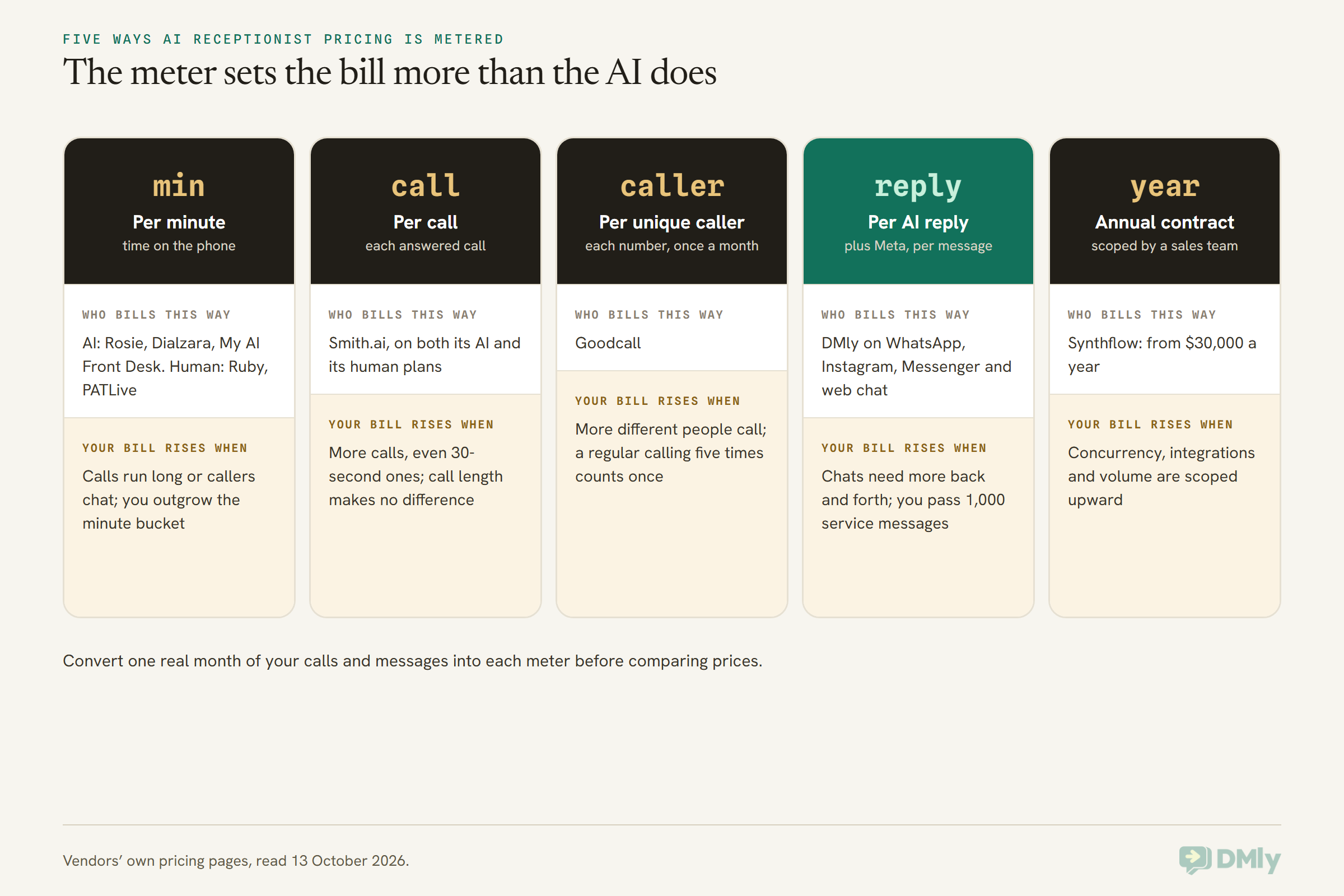
AI receptionist pricing comes in five shapes: per minute, per call, per unique caller, per AI reply (plus the messaging app’s own charge), and annual contracts. Knowing which meter a vendor runs tells you more about your future bill than the headline price does.
1. Per minute
You buy a bucket of talk time and pay a set rate for every minute over it. Rosie, Dialzara and My AI Front Desk price their AI this way, and so do the human services Ruby and PATLive.
It’s fair when your calls are short and predictable. It gets expensive when callers like to chat, when you take long intake calls, or when a busy month pushes you over the bucket. The question to ask: is a minute rounded up, and what’s the rate after the bucket runs out?
2. Per call
Every answered call costs the same, however long it lasts. Smith.ai bills both its AI Receptionist and its human receptionists this way, and its pricing page argues the point directly: per-minute services gain when calls run long, while you want them short.
Per call suits long, detailed calls. It’s poor value for a business that gets lots of quick “are you open?” calls, because a 20-second call costs the same as a ten-minute one. Ask how spam is handled. Smith.ai filters known spam numbers before its AI answers and lets AI Receptionist customers remove up to 10% of their calls each billing cycle as spam.
3. Per unique caller
Goodcall counts distinct phone numbers per month, not calls or minutes. Its page puts it plainly: if the same person calls back five times in March, that’s one customer. Spam and wrong numbers don’t count.
That’s excellent for businesses with regulars: a gym, a clinic with ongoing patients, a trade with repeat contractors. It’s less good for a business where nearly every caller is new, such as a removals firm or an emergency locksmith.
4. Per AI reply, plus the messaging app’s charge
Chat receptionists on WhatsApp usually carry two bills. The platform charges for the software and counts AI replies against a monthly allowance. Then Meta, which runs WhatsApp, charges per message delivered. DMly works this way: each plan includes a number of AI replies a month, and Meta bills you directly for messages, with no markup from DMly.
Here the thing that pushes the bill up is back and forth. A question answered in one reply is cheap; a booking that takes six messages to settle uses six AI replies and up to six billable messages.
5. Annual contracts
At the top end, platforms like Synthflow don’t publish a monthly plan at all. Its pricing page says enterprise contracts start at $30,000 a year, with the final price scoped around call volume, how many calls run at once, phone setup, integrations and security review. That’s about $2,500 a month before anything is scoped up. It’s built for call centres and large teams, not for a salon with one front desk.
Voice AI Receptionist Prices, Vendor by Vendor
Self-serve voice AI receptionists started at $29 a month on 13 October 2026 (or free for 25 calls) and reached $299 to $500 for busier plans, with the price driven by the minutes, calls or callers included. Each figure below was read on the vendor’s own pricing page that day. Prices move, so check again before you sign.
Rosie
Rosie is priced per minute with three plans. Professional is $49 a month for 250 minutes, with custom message taking and appointment links sent by text. Scale is $149 for 1,000 minutes and adds booking directly on your calendar, warm and live call transfers, and texting callers during the call. Growth is $299 for 2,000 minutes and adds transfers that try several numbers in turn, training from your own documents and white-glove onboarding.
Every plan includes call summaries, transcripts and recordings, English and Spanish on every call, and a free website chat widget. There’s a website texting add-on at $50 a month for 25 conversations, then $1 per extra conversation. The page offers annual billing with two months free and a seven-day trial. What it doesn’t print on the plan cards is the rate once you go over your minutes, so ask before you choose a plan that’s tight.
Dialzara
Dialzara has the cheapest entry plan we found and prints its overage rates, which makes it easy to model. Business Lite is $29 for up to 60 minutes, then $0.48 a minute. Business Pro is $99 for 220 minutes, then $0.45. Business Plus is $199 for 500 minutes, then $0.40. Business Elite is $349 for 1,000 minutes, then $0.35.
Watch the feature gaps at the bottom: warm transfers, bilingual answering and calendar sync start at Pro. A US number is included; UK, Australian, New Zealand and other international numbers are on request. Dialzara also sells an AI website chatbot ($39 a month standalone, or free with a voice plan for 100 sessions, then $0.15 a session) and an AI text-message agent ($19 a month plus $0.05 per AI message, with carrier fees passed through).
Goodcall
Goodcall never meters minutes. Starter is $79 a month for 100 unique customers, then 79 cents each. Growth is $129 for 500, then 26 cents. Scale is $299 for 2,000, then 15 cents. A local number is included, and you can keep your existing number by forwarding it.
If you’ve seen older Goodcall prices quoted elsewhere, note that the page we read on 13 October showed these three plans and limits; it had different figures a few weeks earlier. That’s a good reason to read the page yourself on the day you buy.
Smith.ai AI Receptionist
Smith.ai sells two products: an AI-first receptionist and a human-first one. The AI Receptionist starts with a Free plan of 25 real calls a month, then $3.00 a call. Pro is $150 for 75 calls ($2.00 a call), $270 for 150 calls or $500 for 300 calls, with extra calls at $2.50, $2.30 or $2.17. Enterprise is $500 for 300 calls or $800 for 500, with full-service setup and custom prompting by Smith.ai’s own team.
Its selling point is a human backstop: the page says a call the AI can’t handle can be transferred to a live North America-based receptionist. It’s month to month, with 30 days’ notice to cancel. The page openly says it costs more than many AI rivals, and the human backup is the reason.
My AI Front Desk
My AI Front Desk sells one self-serve plan, Business-in-a-Box: $99 a month, or $79 a month billed annually. It includes 200 voice minutes, 100 chatbot conversations, 400 text messages, a CRM, follow-up sequences, 20 outbound calls a day, and a monthly pool of 1,000 overage credits with automatic top-ups at $10 per 1,000 credits. The page doesn’t say how many credits a voice minute uses on this plan (it quotes “from 7 credits a minute” only for its volume tier), so model overage carefully.
Synthflow
As above: enterprise only, from $30,000 a year. If you’re a single-site business, this isn’t your price bracket, and that’s fine.
| Vendor and plan | Monthly price | Included | After that |
| Dialzara Business Lite | $29 | 60 minutes | $0.48 a minute |
| Rosie Professional | $49 | 250 minutes | Not printed on the plan card |
| Goodcall Starter | $79 | 100 unique customers | 79 cents each |
| My AI Front Desk | $99 ($79 billed annually) | 200 minutes, 100 chats, 400 texts | Credits; voice rate not stated |
| Dialzara Business Pro | $99 | 220 minutes | $0.45 a minute |
| Goodcall Growth | $129 | 500 unique customers | 26 cents each |
| Rosie Scale | $149 | 1,000 minutes, calendar booking | Not printed on the plan card |
| Smith.ai AI Receptionist Pro | $150 | 75 calls | $2.50 a call |
| Dialzara Business Plus | $199 | 500 minutes | $0.40 a minute |
| Rosie Growth | $299 | 2,000 minutes | Not printed on the plan card |
| Goodcall Scale | $299 | 2,000 unique customers | 15 cents each |
| Dialzara Business Elite | $349 | 1,000 minutes | $0.35 a minute |
| Smith.ai AI Receptionist, 300 calls | $500 | 300 calls | $2.17 a call |
| Synthflow | From $30,000 a year | Scoped | Scoped |
All prices in US dollars, read on each vendor’s own pricing page on 13 October 2026.
Chat AI Receptionist Cost on WhatsApp, Instagram and Web Chat
A chat AI receptionist on WhatsApp costs a platform subscription plus Meta’s per-message charge, which for many small businesses is a few dollars a month, and sometimes nothing at all. The subscription is the part to compare. The Meta part depends on your country and on whether you pass your number’s free monthly allowance.
If your customers message rather than call, this is the cheaper kind of receptionist by a wide margin, because a written reply costs a fraction of a cent and one AI can hold many conversations at once. For the full breakdown of a WhatsApp bot’s bill, including build costs, see our guide to how much a WhatsApp chatbot costs.
What DMly charges
DMly’s AI agent is included on every plan; there’s no tier without it. What changes between plans is how many AI replies you get each month on DMly’s shared AI:
| Plan | Billed yearly | Billed monthly | AI replies a month | Team seats |
| Starter | $29 | $39 | 500 | 3 |
| Growth | $65 | $79 | 5,000 | 6 |
| Premium | $149 | $199 | 20,000, or unlimited on your own AI key | 15 |
A few details matter for your bill:
- Only replies on DMly’s shared AI are counted. The allowance resets at the start of each calendar month.
- Running out doesn’t break anything. When the month’s allowance is used, the AI step stops writing new replies until next month and the conversation carries on to whatever comes next in your flow, such as a message you’ve set up saying someone will reply soon.
- Premium can use your own AI key. Connect an OpenAI, Claude, Gemini or DeepSeek key and replies on it are unlimited and never counted by DMly. Your AI provider then bills you directly at its own rates.
- No markup on WhatsApp. You pay Meta’s rates directly. Every plan has a seven-day trial with no card.
The same AI answers on Instagram, Facebook Messenger and DMly’s website live chat, where Meta doesn’t bill your replies per message the way it does on WhatsApp. If you want to see how the receptionist itself is put together, our guide on how to build a WhatsApp AI receptionist walks through it.
What Meta charges for WhatsApp replies since 1 October 2026
Until 30 September, replies inside WhatsApp’s 24-hour customer service window were free. Since 1 October 2026, Meta charges for them. The details, from Meta’s own developer pricing pages:
- Service messages (your free-form replies, whether typed by a person or written by a third-party AI) are charged per message delivered.
- Every business phone number gets 1,000 free service messages a month. Meta charges from the 1,001st. The free messages reset monthly and don’t roll over.
- The rate equals your market’s utility rate, and there are no volume discounts for service messages.
- Utility templates sent inside the window are now charged too, such as a booking confirmation sent as an approved template.
- Messages from customers to you are free, and so is everything you send in the 72 hours after someone messages you from a click-to-WhatsApp ad.
Here’s what a billable reply costs in a few markets, from Meta’s USD rate card effective 1 October 2026:
| Customer’s country | Service or utility message (USD) | 1,000 billable replies |
| United States and Canada | $0.0034 | $3.40 |
| India | $0.0014 | $1.40 |
| Nigeria | $0.0067 | $6.70 |
| United Kingdom | $0.0220 | $22.00 |
| United Arab Emirates | $0.0157 | $15.70 |
| Saudi Arabia | $0.0107 | $10.70 |
The rate follows the customer’s phone number, not yours. For every market, see WhatsApp Business API pricing by country, and for what changed on 1 October and why, read the WhatsApp pricing change on 1 October.
One thing that doesn’t change: the free WhatsApp Business app on your phone has none of these charges. They apply to the WhatsApp Business Platform (the API), which is what any AI receptionist on WhatsApp runs on.
Meta’s own AI agent costs more per reply
Meta now sells its own AI for WhatsApp, the Meta Business Agent, and charges for it differently. It’s priced per token (roughly, per chunk of text read and written) at $2.00 per million tokens, which Meta estimates at about 4 to 5 US cents a message. A third-party AI’s replies, like DMly’s, are charged as ordinary service messages at the rates above. For a US customer that’s $0.0034 against roughly $0.04, so more than ten times less in Meta charges, before you count the platform subscription on either side.
Other chat options, AI and human
Several voice vendors sell chat as an add-on, and human services sell live chat by the conversation. On 13 October: Rosie’s website chat widget was free on every plan, with website texting at $50 for 25 conversations; Dialzara’s website chatbot was $39 standalone; Ruby’s human live chat was $143 for 10 chats, $335 for 30 and $520 for 50; PATLive’s human chat started at $149 for 25 chats. A human answering a chat costs several dollars a conversation. An AI costs cents.
What Does a Human Receptionist Cost?
In the US, the median receptionist earned $18.27 an hour, or $38,010 a year, in May 2025, according to the Bureau of Labor Statistics. That’s the wage. What it costs you to employ one is higher, and what you get for it is narrower than the job title suggests.
US receptionist salary, from the BLS
The BLS figures for receptionists, May 2025:
- Median: $18.27 an hour, $38,010 a year.
- Lowest 10% earned under $13.83 an hour; highest 10% over $24.01.
- By industry, the median was $19.00 in healthcare and social assistance and $16.57 in personal care services, which is where salons and spas sit.
On top of wages come benefits: paid leave, insurance, retirement contributions and legally required costs such as Social Security and unemployment insurance. The BLS measures these too. In June 2026, for private-industry office and administrative support workers, employers paid $25.22 an hour in wages and $11.51 in benefits, for $36.73 in total. Benefits were 31.3% of the total, or about 46 cents on top of every wage dollar.
Put those together and you get an estimate, not an official figure: a receptionist on the median wage, with benefits at that group’s average rate, costs about $55,360 a year, or roughly $4,610 a month. A part-time receptionist or a business that offers fewer benefits will pay less; a city with higher wages will pay more.
UK receptionist cost, at the legal floor
In the UK, the National Living Wage for workers aged 21 and over is £12.71 an hour from April 2026. That’s the minimum, and many receptionists earn more, but it gives you a floor:
- 37.5 hours a week for 52 weeks at £12.71 is about £24,785 a year in pay.
- Employer National Insurance is 15% of earnings above £5,000 a year, so about £2,970.
- Workplace pension: employers must pay at least 3% under auto-enrolment, so up to about £740 if worked out on the whole salary.
- That’s roughly £28,500 a year, or about £2,375 a month.
Small employers may be able to cut the National Insurance part with the Employment Allowance, which is up to £10,500 for 2026 to 2027. Paid holiday (5.6 weeks a year) is already inside the yearly pay, but it means the desk is empty for those weeks unless someone covers it.
India, Nigeria, the Gulf and everywhere else
We haven’t printed a receptionist wage for other markets, because we couldn’t read a single national figure at source that would be fair to quote. Use the number you know: what you pay, or would pay, a front desk person in your city, plus what you add for leave, any statutory contributions and the phone itself. The comparisons later in this guide work the same way with your figure in place of the US one.
The hours you’re actually buying
Here’s the part that changes the comparison most. A full-time receptionist works about 40 of the 168 hours in a week. That’s under a quarter of the time customers can call or message.
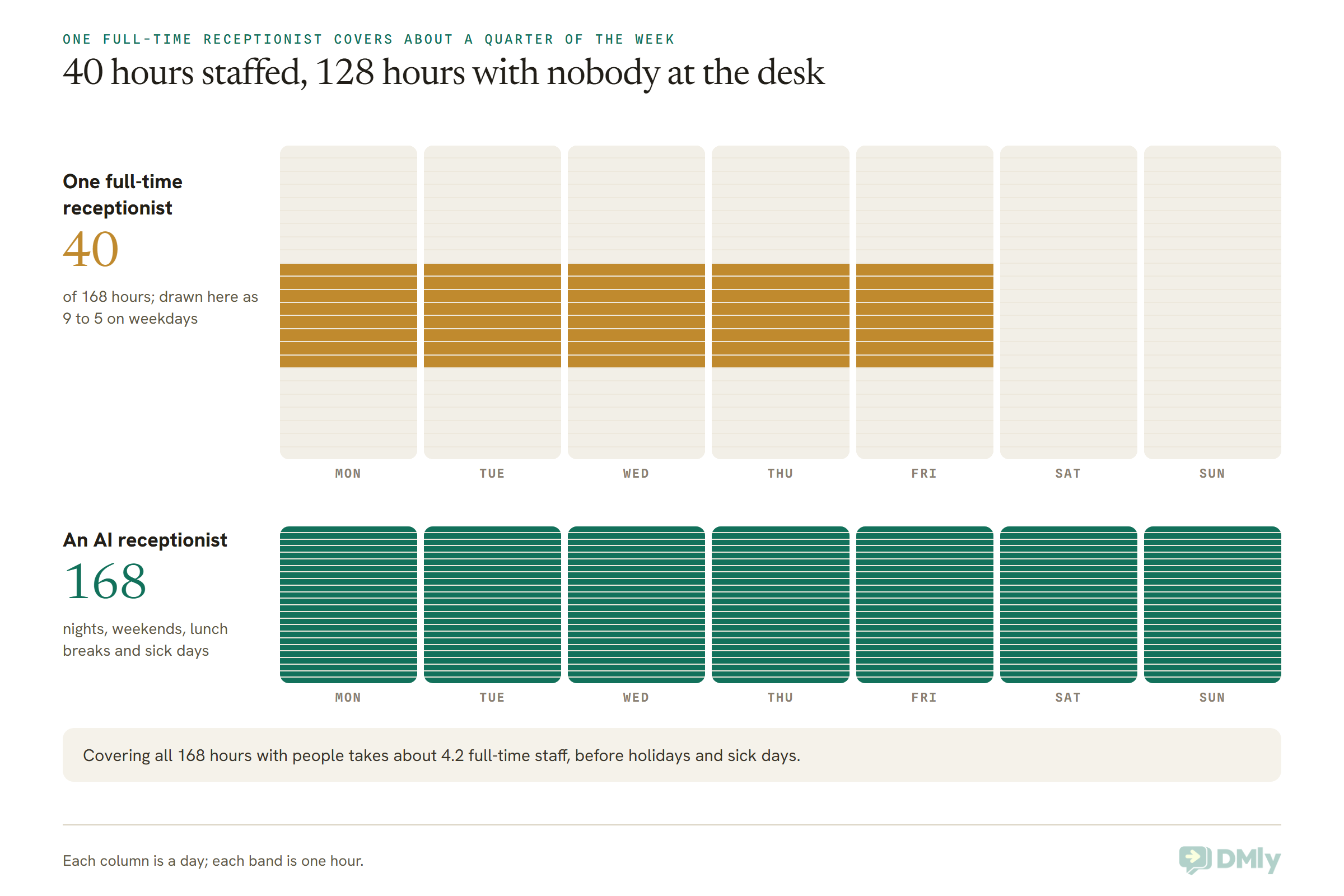
That’s why comparing a receptionist’s monthly cost with an AI’s monthly cost isn’t quite fair in either direction. The person does far more than answer the phone. But the AI is there for the hours the person never was. To cover all 168 hours with people, you’d need about 4.2 full-time staff before holidays and sick days, which is why almost nobody small does it.
Virtual Receptionist Cost: Answering Services Compared
A human virtual receptionist service costs roughly $1.50 to $5 a minute, or $7 to $11.50 a call, on the plans we read, around 24/7, without hiring anyone. It’s the middle option: real people, but shared, so you only pay for the calls they take.
| Service | Plan (read 13 Oct 2026) | Works out at |
| Smith.ai receptionists (human) | Starter $300 for 30 calls; Basic $810 for 90; Pro $2,100 for 300 | $10.00, $9.00 and $7.00 a call; overage $11.50, $10.50 and $8.50 |
| Ruby (human) | $250 for 50 minutes; $395 for 100; $720 for 200; $1,725 for 500 | $5.00, $3.95, $3.60 and $3.45 a minute; larger plans by conversation |
| PATLive (human) | Pay as you go $49 a month plus $2.99 a minute; $99 for 50 minutes; $349 for 200; $1,499 for 1,000 | From $1.98 a minute at 50 minutes down to about $1.50 at 1,000; overage $2.29 to $1.69 |
Look for the extras. Smith.ai’s human plans charge per call for some jobs: $1.50 to book an appointment, $0.25 for recording and transcription, $1.00 for a dedicated Spanish line, $1.00 to take a payment. Ruby says its plans differ only by minutes, with no extra fees for setup or after-hours cover, and that optional AI enhancements come at no extra cost; PATLive says it adds no fees of its own beyond taxes. Ruby and PATLive are human-first services, so we’ve treated them as answering services rather than AI receptionists, whatever AI helps behind the scenes.
An answering service beats an AI when calls are sensitive, complicated or worth a lot each. It loses on price once volume climbs, and on the per-call examples above, a human answer costs roughly three to five times what Smith.ai’s own AI answer costs.
AI Receptionist Cost vs a Human Receptionist: A Worked Comparison
On our worked example of 300 calls a month, AI receptionists cost $129 to $500, human answering services $1,499 to $2,100, and an in-house receptionist about $4,610 with benefits. Here’s how we got there, so you can swap in your own numbers.
The assumptions, all ours, chosen to be typical of a busy small practice in the US:
- 300 inbound calls a month, averaging 3 minutes each, so 900 minutes.
- 220 different phone numbers among those callers (some people call more than once).
- You want every call answered, at any hour.
- Prices are list prices read on 13 October 2026, on the cheapest plan that covers the month.
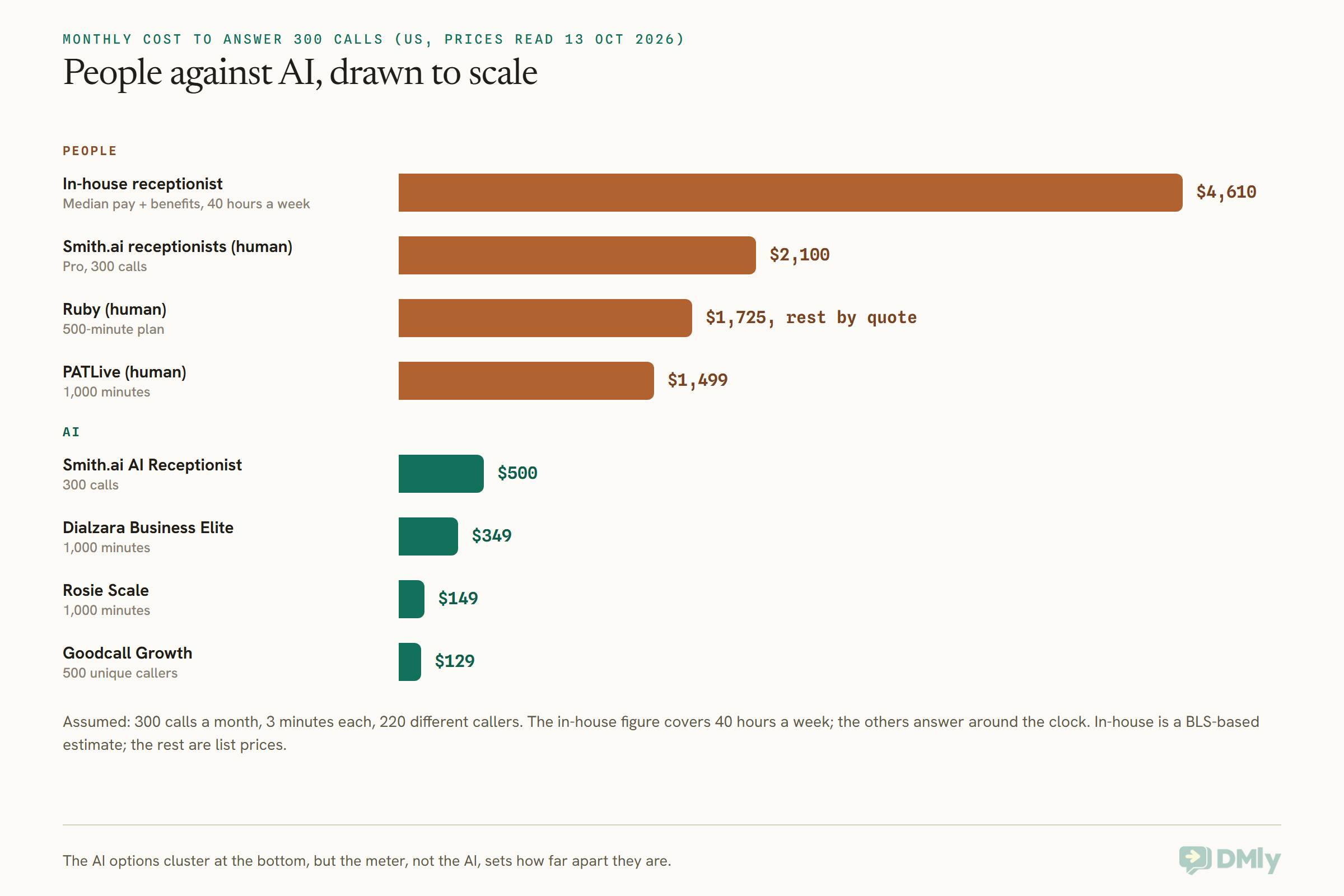
| Option | Plan that fits the month | Monthly cost | Hours covered |
| In-house receptionist, US median, with benefits (estimate) | One full-time person | About $4,610 ($3,170 in wages) | 40 a week |
| Smith.ai receptionists (human) | Pro, 300 calls | $2,100 | 24/7 |
| Ruby (human) | 500 minutes covers 500 of your 900 | $1,725, plus a quote for the rest | 24/7 |
| PATLive (human) | 1,000 minutes | $1,499 | 24/7 |
| Smith.ai AI Receptionist | 300 calls | $500 | 24/7 |
| Dialzara | Business Elite, 1,000 minutes | $349 | 24/7 |
| Rosie | Scale, 1,000 minutes | $149 | 24/7 |
| Goodcall | Growth, 500 unique customers | $129 | 24/7 |
Two notes on the table. Dialzara’s Business Plus plus overage would be $199 + 400 minutes at $0.40, or $359, so Elite is cheaper. And Goodcall’s Starter plus overage would be $79 + 120 customers at 79 cents, or about $174, so Growth wins there too. Always price the next plan up as well as overage on the one below.
What changes the answer
Change one assumption and the order shuffles. That’s the most useful thing this exercise shows.
- If calls run 6 minutes instead of 3 (1,800 minutes): Rosie moves to Growth at $299, Dialzara to $349 + 800 minutes at $0.35 = $629, and PATLive to its 2,000-minute plan at $2,899. Goodcall ($129), Smith.ai AI ($500) and Smith.ai’s human plan ($2,100) don’t move, because they don’t count minutes.
- If calls double to 600 a month (3 minutes, 440 callers): Goodcall stays at $129, because 440 callers still fit in 500. Rosie needs 1,800 minutes, so $299. Smith.ai AI becomes $800 for 500 calls + 100 at $2.10 = $1,010. Smith.ai’s human Pro becomes $2,100 + 300 at $8.50 = $4,650, about the same as hiring.
- If nearly every caller is new (300 calls from 290 numbers): Goodcall still fits Growth, but a business with 1,000 one-off callers a month would pay $129 + 500 at 26 cents = $259 on Growth or $299 on Scale.
The lesson: per-minute pricing rewards short calls, per-call pricing rewards long ones, and per-caller pricing rewards regulars. Choose the meter that matches your phone bill, then the vendor.
AI vs Human Receptionist on WhatsApp: The Same Sums for a Chat-First Business
If your customers message on WhatsApp, an AI receptionist for 600 conversations a month costs about $67 to $106 in total on our assumptions, depending on the country. That covers the platform and Meta’s charges together.
This is the picture for much of India, Nigeria, the UK, the Gulf, Southeast Asia and Latin America, where customers would rather type than call. The assumptions, again ours:
- 600 WhatsApp conversations a month on one business number.
- The AI sends about 4 replies per conversation: 2,400 AI replies.
- Your team types another 300 replies when the AI hands over.
- 150 bookings, each confirmed with a utility template inside the open conversation.
- So 2,700 service messages, of which 1,000 are free and 1,700 are billable, plus 150 utility templates.
2,400 AI replies is too many for Starter’s 500, so this business needs DMly Growth at $65 a month billed yearly ($79 monthly). Meta’s charges then depend on where the customers are:
| Customers in | 1,700 service messages | 150 utility templates | Meta total | With DMly Growth ($65) |
| United States | $5.78 | $0.51 | $6.29 | $71.29 |
| India | $2.38 | $0.21 | $2.59 | $67.59 |
| Nigeria | $11.39 | $1.01 | $12.40 | $77.40 |
| United Kingdom | $37.40 | $3.30 | $40.70 | $105.70 |
| United Arab Emirates | $26.69 | $2.36 | $29.05 | $94.05 |
Meta bills in your account’s currency; we’ve used its USD card so the rows compare. The booking templates also count towards DMly’s monthly template allowance (50,000 on Growth), which this example doesn’t come close to.
Now set that against a person. The human side here is your local wage for the hours you’d need covered. In the UK, at the legal floor, one full-time receptionist is about £2,375 a month. In Lagos or Pune you know the going rate better than any table could. Either way, the AI’s monthly cost is usually less than a few days of one person’s pay. The real question isn’t whether the AI is cheaper. It’s which parts of the job you’d trust it with, which is where the next sections come in.
If you ran the same 2,400 replies on Meta’s own Business Agent instead, Meta estimates 4 to 5 US cents a message: about $96 to $120 a month in AI message charges alone.
Hidden Costs the AI Receptionist Price Tag Leaves Out
The plan price leaves out your setup time, overage, transfers to people, phone number costs and the cost of wrong answers. None of these are reasons to avoid an AI receptionist. They’re reasons to budget for them.
- Your time to set it up. An AI receptionist answers from what you give it: hours, prices, services, policies, the twenty questions you get most. Writing that down properly is an afternoon at least. It’s the same afternoon whichever vendor you pick.
- Overage on a busy month. A minute bucket that fits January may not fit the week before a holiday. Look up the overage rate before the month you need it. Where it isn’t printed, ask.
- Transfers still need a person. A warm transfer is only useful if someone picks up. If the AI hands over at 9pm and nobody’s there, you’ve bought a fancier voicemail. In chat, make sure the AI goes quiet once a person takes over; our guide on how to pause AI when a human agent takes over shows how.
- Features on the next plan up. Direct calendar booking is a Scale feature on Rosie; warm transfers start at Pro on Dialzara. If you need the feature, the higher plan is your real price.
- Numbers and forwarding. Most voice vendors give you a new number and suggest forwarding your existing one to it. Dialzara includes a US number and offers others on request. Check what your phone provider charges for forwarding.
- Recordings and privacy. Recording calls is useful and is personal data. Rules on telling callers differ by country. Healthcare businesses should ask each vendor about HIPAA or local equivalents before signing; Ruby’s pricing page lists HIPAA-compliant services; for any other vendor, get the details in writing before you sign.
- Your own AI key, if you use one. On DMly Premium, replies on your own OpenAI, Claude, Gemini or DeepSeek key aren’t counted by DMly, but your AI provider bills you for them.
- The cost of a wrong answer. A receptionist that invents a price or a free slot costs you more than its subscription. On DMly, the AI only offers times you can honour if the tool that checks real open slots is switched on; without it, an AI can invent plausible ones. Test every vendor with a slot you know is taken.
Where a Human Receptionist Is Still Worth the Money
A human receptionist wins wherever the job is more than answering: greeting people at the door, calming someone upset, judging an emergency, or handling a sensitive or high-value call. Be honest with yourself about how much of your front desk is that.
- You have walk-in customers. No AI greets someone at the counter, takes a coat, finds a file or handles a card machine.
- Calls are emotional or clinical. A frightened patient, a grieving family, a furious customer. A person reads tone and bends a script; an AI should hand these over, not handle them.
- Each call is worth a lot. A law firm’s new client or a five-figure renovation quote can justify $10 a call for a trained human every time.
- The job is half admin. Many receptionists also do billing, filing, stock and scheduling for the whole team. An AI covers the phone part, not the rest.
- Your callers expect a person. Some customers, often older ones, hang up on anything automated. You know your callers.
For many small businesses the answer isn’t either-or. It’s a person during opening hours and an AI for the 128 hours they’re not there, or an AI for the routine questions so the person has time for the ones above.
Where a Voice AI Beats a Chat AI, Including Ours
If your customers phone you, you need a voice AI receptionist, and DMly isn’t one. DMly’s AI answers in writing, on WhatsApp, Instagram, Facebook Messenger and website chat. It doesn’t answer phone calls by voice, and its documentation doesn’t describe any AI that does.
Here’s what DMly does do with calls, from its own docs:
- It takes WhatsApp voice calls in the inbox. Inbound calls are free and ring the team members who’ve marked themselves On call duty. It’s available on every plan.
- Calls to your ordinary phone line are outside DMly altogether.
- Calling customers back on WhatsApp needs their permission, is billed per minute by Meta, and isn’t possible from business numbers registered in the US, Canada, Egypt, Vietnam or Nigeria.
- A missed WhatsApp call can start an automation that messages the caller, and from there the AI can carry on in text.
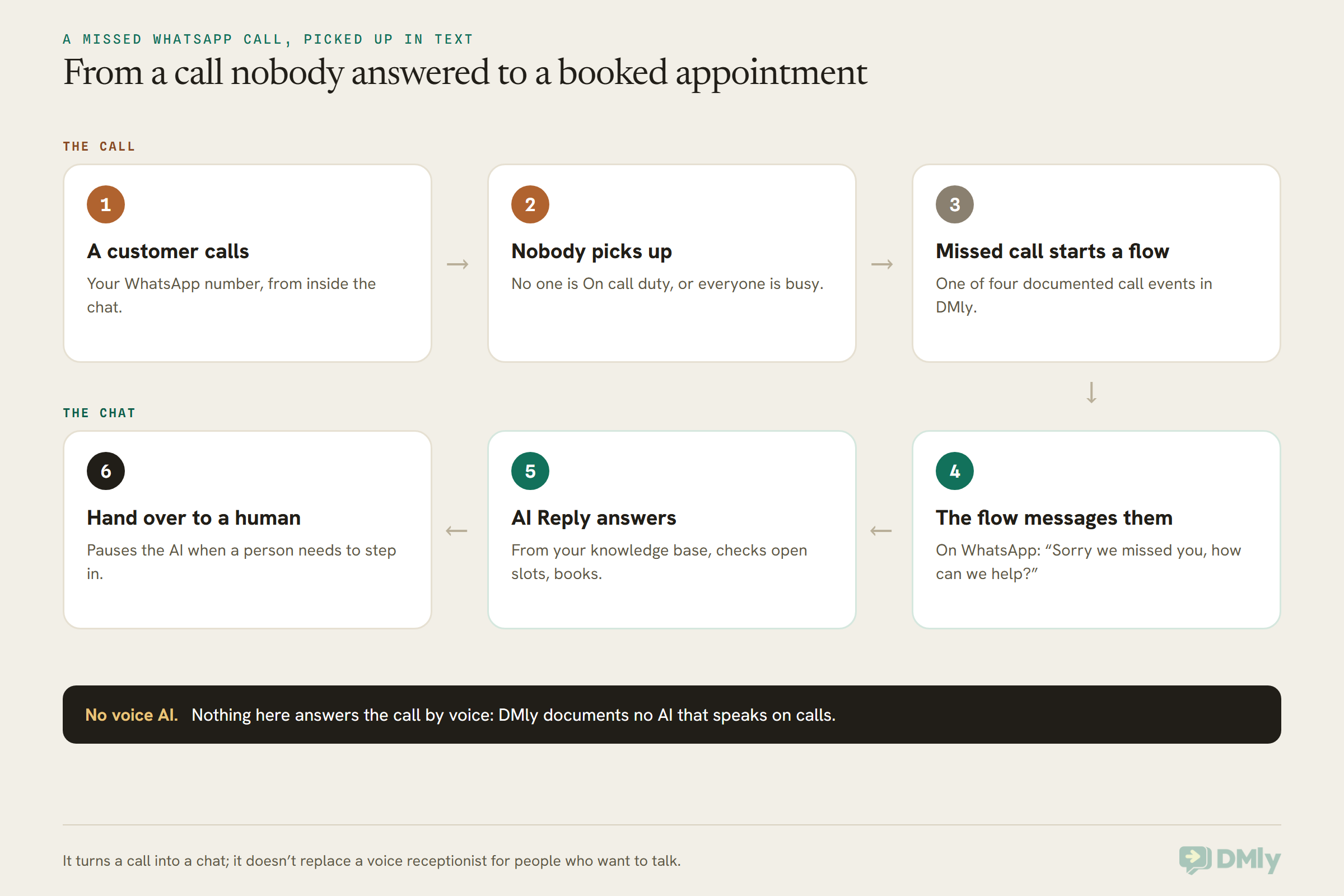
Two caveats on that flow. First, it only covers WhatsApp calls, not your landline or mobile number. Second, whether the first follow-up message can be a normal message or has to be an approved template (and so a charged one) depends on whether the customer has messaged you in the last 24 hours; test it with your own number before you rely on it.
So, plainly: if most of your enquiries arrive as phone calls to an ordinary number, choose a voice AI receptionist (or a person) and judge it on the meters above. If they arrive as messages, or you can move them there with a WhatsApp button on your website and Google listing, a chat AI does the same job for a fraction of the price. Plenty of businesses end up with both: a voice AI for the phone, a chat AI for WhatsApp, and a person for the hard cases.
AI Receptionist Cost by Business: Five Illustrative Examples
The right AI receptionist cost for your business depends on how your customers reach you and how long they talk. These five businesses are illustrative, not customers, and each uses prices read on 13 October 2026.
A plumber in Texas who can’t answer from under a sink
Most calls are new customers with an urgent job, a minute or two each, often after hours. Per-minute pricing suits short calls: around 150 calls at 2 minutes is 300 minutes, which fits Rosie Scale at $149 with direct booking, or Dialzara Business Pro at $99 + 80 minutes at $0.45 = $135 (check Plus at $199 if you need custom prompting). Goodcall’s per-caller meter suits him less, because nearly every caller is new.
A US dental practice with a busy front desk
The receptionist stays: patients walk in, insurance questions need a person, and anything clinical should never be answered by software. What the practice buys is cover for lunch, evenings and overflow. Many patients call more than once, which makes per-caller pricing attractive. For practices whose patients will message, our guide to building an AI receptionist for a dental practice shows how to keep clinical questions away from the AI.
A salon in London where clients message to book
Clients send WhatsApp and Instagram messages more than they call. A chat AI that checks real slots and books is the core job. Around 250 conversations at 4 AI replies is 1,000 replies, so DMly Growth ($65 billed yearly) rather than Starter. UK service messages are among the dearer ones at $0.022, but 1,000 a month are free per number, so a salon this size may pay Meta very little. Our guide to building an AI receptionist for a salon covers the setup.
A clinic in Lagos that lives on WhatsApp
Patients message rather than call, often in the evening. Nigerian service messages are $0.0067 after the free 1,000, so even 3,000 replies a month adds about $13 in Meta charges. One note: WhatsApp doesn’t allow business-initiated calls from Nigerian numbers, so the clinic can receive WhatsApp calls but can’t ring patients back on WhatsApp; it messages them instead. Clinical questions still go to a person.
A coaching centre in Pune with an enquiry rush every term
Parents send lots of short questions about fees, timings and batches in the same few weeks each term. India’s rate of $0.0014 per billable reply makes the Meta side close to nothing; the AI reply allowance is what to size. A busy month might need Growth, a quiet one Starter, and you can change plans as you go.
How to Work Out Your Own AI Receptionist Cost
To work out your own AI receptionist cost, turn last month’s calls and messages into each vendor’s unit, add overage and messaging charges, and set the total against what the same hours cost in people. It takes about twenty minutes with your phone bill open.
- Count last month’s calls. Your phone provider’s dashboard or bill shows the number of inbound calls, the number of different callers and the average call length. Note how many came outside opening hours.
- Count last month’s messages. Roughly how many WhatsApp, Instagram and website conversations, and how many replies each took.
- Convert into each meter. Minutes for Rosie, Dialzara and the human services; calls for Smith.ai; unique callers for Goodcall; AI replies for a chat receptionist.
- Price the plan that fits, and the one below plus overage. Take whichever is cheaper. If a vendor doesn’t print its overage rate, ask before you buy.
- Add messaging charges. For WhatsApp, take your service messages above 1,000 per number and multiply by your customers’ market rate, then add any utility templates. Our chatbot cost calculator does the arithmetic for you.
- Price the people. Your receptionist’s hourly pay plus benefits or statutory costs, times the hours you’d need covered. Compare like with like: the hours the AI covers that nobody covers today are the ones you’re really buying.
Then run a one-week test before you commit. Call or message the receptionist as a regular, a new customer, someone asking for a taken slot, someone angry, and someone asking for a person. If it fails the test, it’ll fail your customers, whatever it costs.
Frequently Asked Questions
What is the average AI receptionist cost per month?
On the self-serve plans we read on 13 October 2026, voice AI receptionists started at $29 to $150 a month and mid-tier plans ran $129 to $500. Chat AI receptionists on WhatsApp started at $29 a month billed yearly plus Meta’s per-message charges. Enterprise voice platforms start around $30,000 a year.
Is an AI receptionist cheaper than a human receptionist?
For answering calls and messages, yes, by a wide margin: our 300-call example ran $129 to $500 a month with AI against about $4,610 for one US receptionist with benefits, who covers 40 hours a week. But a person does work an AI can’t, such as greeting walk-ins and handling upset or clinical calls, so many businesses use both.
How much does a virtual receptionist cost?
A human virtual receptionist service cost $250 for 50 minutes at Ruby, $300 for 30 calls at Smith.ai, and $99 for 50 minutes at PATLive on 13 October 2026, with lower per-minute or per-call rates on bigger plans. AI virtual receptionists cost a fraction of that per call.
Do AI receptionists charge per minute?
Some do, such as Rosie and Dialzara. Smith.ai charges per call, Goodcall per unique caller each month, and chat receptionists like DMly count AI replies. Pick the meter that suits your calls: short calls favour per minute, long ones per call, regulars per caller.
Does WhatsApp charge for AI receptionist replies?
Since 1 October 2026, yes, if you use the WhatsApp Business Platform. Replies from a third-party AI are charged as service messages at your customer’s market rate, after the first 1,000 free per business number each month. WhatsApp’s marketing site still said on 13 October that service messages aren’t charged; Meta’s developer pricing page, which governs billing, says they are. The free WhatsApp Business app isn’t affected.
Can DMly’s AI answer phone calls?
No. DMly’s AI answers messages in writing. DMly takes WhatsApp calls in its inbox, answered by your team, and a missed WhatsApp call can start an automation that messages the caller so the AI can continue in text. Calls to an ordinary phone number are outside DMly. If your customers mainly phone, a voice AI receptionist is the better fit.
Is there a free AI receptionist?
Smith.ai’s AI Receptionist has a free plan of 25 calls a month, then $3.00 a call, and Goodcall lets you build and test a demo agent free until you connect a number. Most others offer a seven-day trial, including Rosie, Dialzara, My AI Front Desk and DMly.
The Saturday Question, Repriced
Go back to “Are you open this Saturday?” You’ve now seen it cost $11.50, $2.00, 20 cents, a third of a cent, or 30 cents of a person paid to wait for it. None of those prices is wrong. Each is right for a different business.
The way to settle your own AI receptionist cost is to stop comparing headline prices and start with your own month: how many calls, how long, how many regulars, how many messages, and which hours nobody covers today. Put that month through each meter, add the messaging charges, and set it against the person. Then keep a person for the calls that deserve one.
If your customers already message you on WhatsApp, Instagram or your website, you can start a free DMly trial and see how many AI replies your real month uses before you pay anything. And for the bigger picture of what a chat assistant can and can’t do, our guide to WhatsApp AI chatbots for small businesses is the place to start.
Writing about WhatsApp automation, bookings and growth for local business.
Turn WhatsApp into your busiest channel.
Start free and run message, bookings, payments and reviews in one place.
