
WhatsApp, SMS or Instagram DM: Where the Cost per Message Is Lowest Now
A postage stamp is the simplest price most of us know. It costs the same whether the envelope holds a birthday card or a final demand, and nobody at the counter asks who wrote first. The cost per message on WhatsApp, SMS and Instagram works nothing like that.
Since 1 October 2026, the same short “See you tomorrow at 3” can cost a third of a US cent, a little over a cent, nothing at all, or nearly 39 cents. It depends on the app it travels on, the country it lands in, what the message says, and whether your customer spoke to you first.
That’s worth untangling now, because Meta has just started charging for WhatsApp replies again, and plenty of owners are asking whether to move some of their messages to SMS or Instagram. In this guide, we’ll look at what sets the price of one message, the real rates by country for WhatsApp and SMS (read at the source this week), what Instagram DMs and Messenger cost, where email fits, worked examples for six markets and three everyday jobs, and the number that matters more than any of them: what a finished conversation costs you.
One thing first, because most readers will be relieved by it: everything below about WhatsApp charges applies to the WhatsApp Business Platform, the API version businesses connect through a tool like DMly. The free WhatsApp Business app on your phone doesn’t pay per message, and nothing changed for it.
The Short Answer: Cost per Message by Channel in October 2026
For replies, Instagram DMs and Messenger are the cheapest channels because Meta charges nothing per message inside the 24-hour window, and WhatsApp replies stay free for your first 1,000 a month per number. For reminders and other updates, WhatsApp is usually cheapest. For promotions, the answer depends on the country: WhatsApp wins in India, Nigeria and the UAE, SMS is level or cheaper in the UK and Brazil, and WhatsApp can’t carry a promotion to a US number at all.
Here’s the whole comparison on one screen. The details, and the catches, are in the sections that follow.
| Channel | What one message costs you | Who bills you | The catch |
| WhatsApp (API) | From 0.14 US cents (a utility message to India) to 6.35 cents (a marketing message to the UK) in the six markets below | Meta, per delivered message | Price depends on country and type; promotions not delivered to US numbers |
| WhatsApp replies | Free for the first 1,000 a month per business number, then the utility rate | Meta | No volume discount on replies |
| SMS | About 1.2 cents in the US to about 39 cents to Nigeria, per 160-character segment | Your SMS gateway (Twilio, Plivo) | Long or emoji texts split into more segments; US needs paid registration |
| Instagram DM | No per-message charge from Meta | Nobody, for standard messages | Only inside the 24-hour window; you can’t start a conversation |
| Messenger | No charge for standard messages; paid Marketing Messages cost per delivered message | Meta, via your ad account, for paid ones | Paid route not deliverable to UK or EU users |
| A raw sending service lists $0.16 per 1,000 emails | Your email provider | Lowest price, but a different job |
If you only take one thing away: no channel is cheapest for everything. Each is cheapest for something, and the trick is matching the job to the channel rather than moving everything at once.
What Sets the Price of One Message? Three Questions Every Message Answers
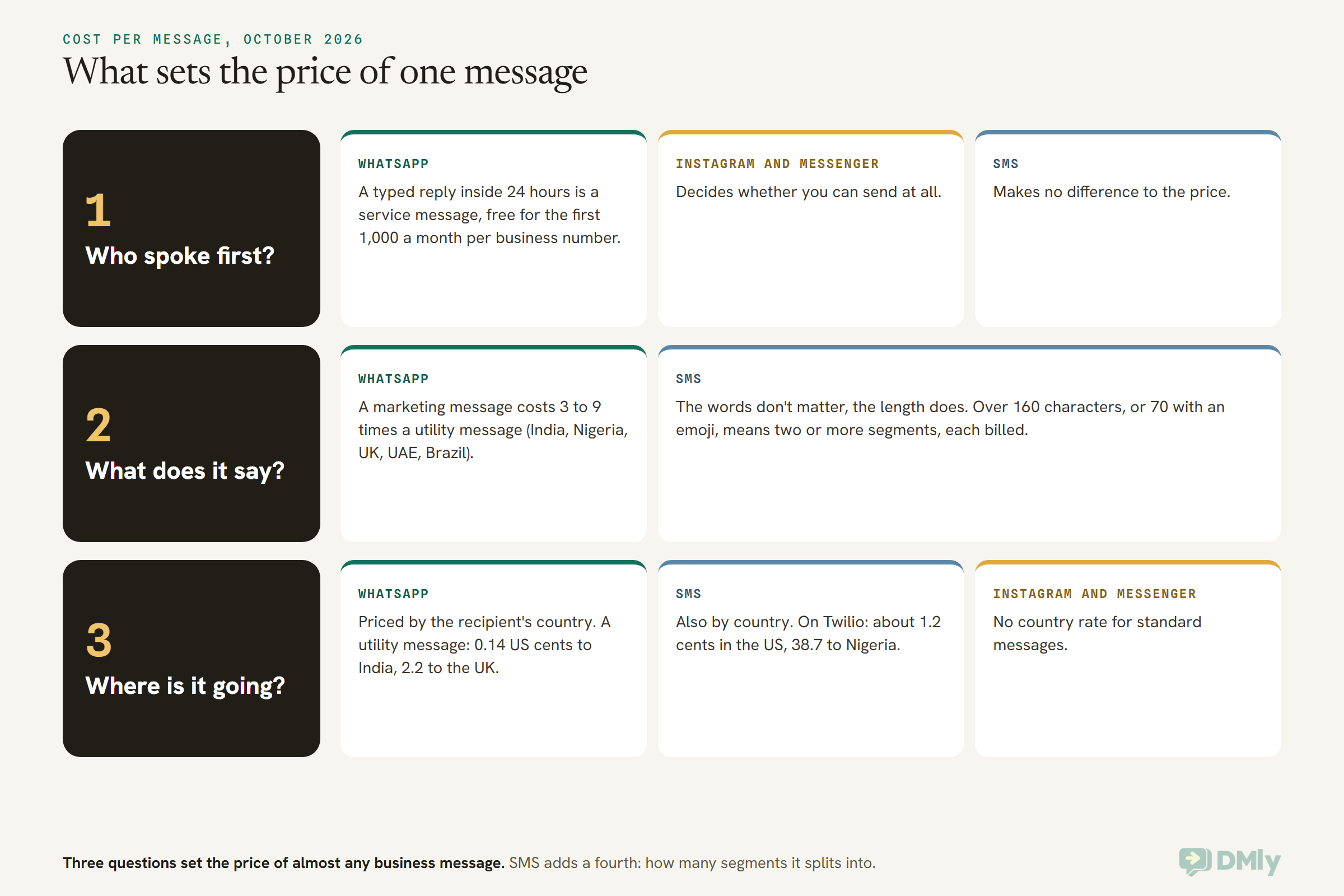
The cost per message depends on three things: who spoke first, what the message says, and which country it’s going to. SMS adds a fourth, which is how long the message is. Once you can answer those four questions for a message, you can price it on any channel.
Who spoke first
On WhatsApp, a customer who messages you opens a 24-hour window. Inside it, the replies you type are called service messages. Outside it, you can only send an approved template, which is a pre-written message Meta has checked in advance. On Instagram and Messenger, the window decides whether you can send anything at all, because neither has templates. On SMS, nobody cares who spoke first: you can text anyone, any time, and the price is the same.
What the message says
WhatsApp sorts every template into a category, and the category sets the price. Marketing is anything promotional. Utility is a transactional update, like a booking reminder or an order confirmation. Authentication is a one-time code. A marketing message costs several times more than a utility one in every market below, so a reminder with a cheeky “10% off your next visit!” tacked on is no longer a reminder in Meta’s eyes. It’s marketing, and it’s billed as marketing.
SMS doesn’t care what you say, only how much. A text is billed per segment: 160 plain characters fit in one, but a longer message splits into 153-character segments, and a single emoji switches the whole text to a format where only 70 fit (67 per segment once it splits). Our SMS length calculator shows you the segment count before you send.
Where it’s going
Both WhatsApp and SMS are priced by the country of the phone number receiving the message, not where your business is. A London salon texting a client on a Nigerian number pays Nigerian rates. Instagram and Messenger have no country rates for standard messages at all.
What Changed on 1 October 2026, in One Minute
From 1 October 2026, Meta charges for WhatsApp replies you type inside the 24-hour window (after 1,000 free a month per business number) and for utility templates sent inside that window, both of which had been free. We cover the whole change in our guide to the WhatsApp pricing change on 1 October, but these are the parts that move the channel comparison:
- Typed replies cost money again, past a free allowance. Every business phone number gets 1,000 free service messages a month. They reset monthly and don’t roll over. From the 1,001st, each reply costs the same as that country’s utility rate.
- Replies get no bulk discount. Meta offers lower rates at high volume for utility and authentication messages, but not for service messages. Your ten-thousandth reply of the month costs the same as your 1,001st.
- In-window utility templates are charged. A booking confirmation sent while the customer’s window is open used to be free. Now it costs the utility rate, with no free allowance.
- Ad conversations stay free. When someone taps a click-to-WhatsApp ad and you reply, a free entry point window opens in which every message is free. Most of Meta’s pages say it lasts 72 hours; its main developer pricing page, updated on 30 September 2026, now says up to 7 days. Plan for 72 hours.
- No marketing to US numbers. Meta says WhatsApp doesn’t currently deliver marketing templates to users with US phone numbers, whatever price the rate card shows.
- You only pay for what arrives. Meta charges per delivered message, not per message sent, and never for messages your customers send you.
Meta also said that from 1 October it would stop delivering replies past the free 1,000 for any account without a payment method on file, so if your replies suddenly stop, check your billing settings in Meta first.
WhatsApp Message Rates by Country
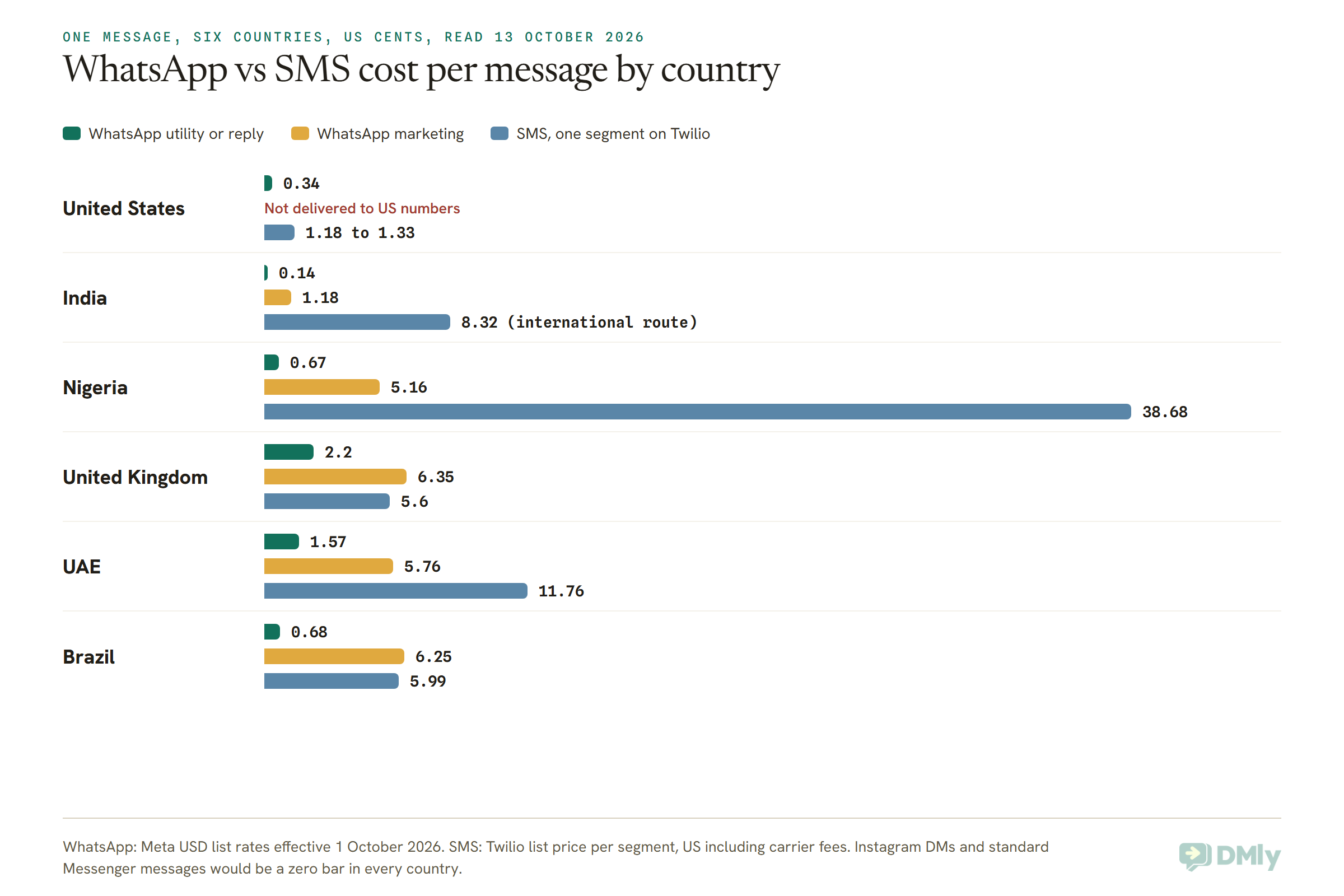
The WhatsApp cost per message is between 0.14 and 6.35 US cents in the six markets below, depending on the country and whether it’s a marketing or utility message. These are Meta’s list rates from its USD rate card effective 1 October 2026, which we downloaded and read on 13 October.
| Market | Marketing template | Utility template | Typed reply (service), after 1,000 free |
| United States | Not delivered to US numbers (card shows $0.025 for North America) | $0.0034 | $0.0034 |
| India | $0.0118 (₹0.8631) | $0.0014 (₹0.115) | $0.0014 (₹0.115) |
| Nigeria | $0.0516 | $0.0067 | $0.0067 |
| United Kingdom | $0.0635 | $0.022 | $0.022 |
| United Arab Emirates | $0.0576 | $0.0157 | $0.0157 |
| Brazil | $0.0625 | $0.0068 | $0.0068 |
The rupee figures come from Meta’s own INR rate card for the same date. Meta bills most other businesses in US dollars, so we’ve kept the rest in dollars rather than guess at exchange rates.
A few things jump out. India is the cheapest market on the card for every category. The UK is the dearest of the six for both marketing and utility. And the gap between marketing and utility is huge in most places: in Brazil a marketing message costs more than nine times a utility one. That gap is the single biggest lever you have on a WhatsApp bill, and it’s why getting your template categories right matters more than which country you’re in. Our explainer on service messages versus templates goes deeper on what each one is charged for, and the WhatsApp Business API rate card by country covers the other markets.
One more thing worth knowing: message length doesn’t change the price on WhatsApp. A two-word reply and a 900-character one cost the same. That’s the opposite of SMS, and it matters for the next section.
SMS Cost per Segment by Country: Twilio and Plivo, Read at Source
The SMS cost per message is about 1.2 US cents per segment in the United States and between about 5 and 54 cents in the other five markets, depending on the country, the gateway and the mobile network. SMS is priced by your gateway, not by Meta, so we read the two gateways DMly connects to directly, Twilio and Plivo, on their own pricing pages on 13 October 2026.
| Market | Twilio, per outbound segment | Plivo, per outbound segment |
| United States | $0.0083 plus a carrier fee of $0.0035 to $0.005 (so $0.0118 to $0.0133) | $0.0077 plus the same carrier fees ($0.0112 to $0.0127) |
| India | $0.0832 (international route; domestic through sales) | $0.08 (international route; domestic not supported) |
| Nigeria | $0.3868 | $0.2729 (MTN) to $0.5423 (Glo); Airtel $0.4165 |
| United Kingdom | $0.056 | $0.0486 (EE) to $0.0556 (Three); Vodafone $0.0509, O2 $0.0513 |
| United Arab Emirates | $0.1176 | $0.0988 (du) to $0.115 (Etisalat) |
| Brazil | $0.0599 | $0.0552 (Claro) to $0.0584 (Vivo); TIM $0.0564 |
Those are per segment, so a 200-character reminder costs twice the figure in the table. And there’s more on an SMS bill than the per-message price:
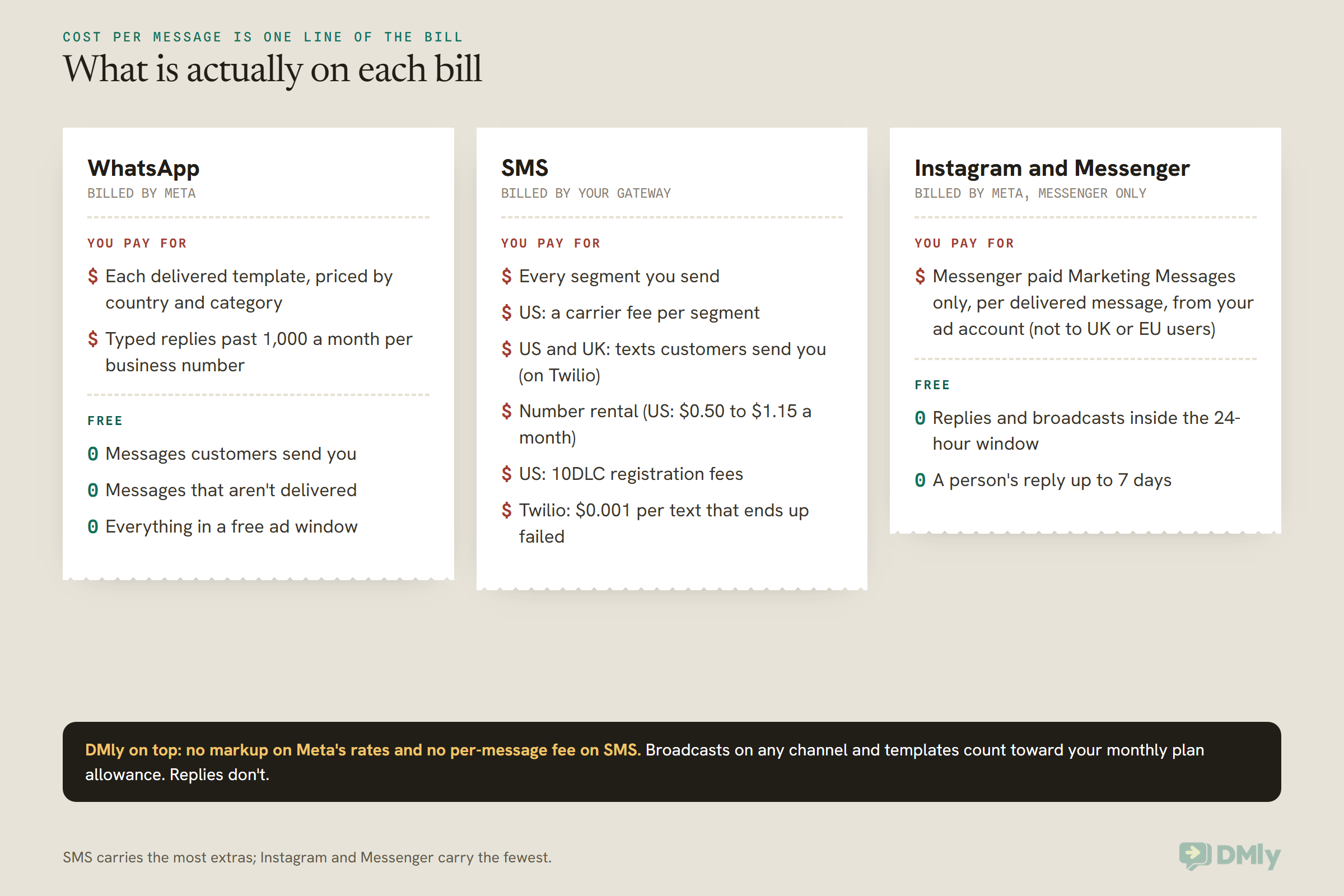
- Incoming texts can cost you too. Twilio charges $0.0083 for each text a customer sends you in the US, and some US carriers add their own fee on top (T-Mobile $0.0025 on Twilio’s page). In the UK, Twilio charges $0.0075 per incoming text. On WhatsApp, customer messages are always free.
- You rent the number. A US long code costs $1.15 a month on Twilio and $0.50 on Plivo.
- Failed texts aren’t always free. Twilio adds a $0.001 processing fee to every message that ends up failed. Meta, by contrast, only bills WhatsApp messages that are delivered.
- US texting needs registration. To text US customers from an ordinary 10-digit number, you register your business and your use case (this is called A2P 10DLC). Twilio’s help centre lists the fees it passes through: a brand registration of $4.50 for a sole proprietor or low-volume business, or $46 for a standard brand; a $15 campaign vetting fee; and a monthly campaign fee of $1.50 for low-volume mixed use, $2 for a sole proprietor or $10 for a standard campaign.
A word on India and Nigeria. Neither Twilio nor Plivo publishes a domestic Indian rate on its public page (Twilio says to contact sales; Plivo lists domestic as not supported), and Twilio also points Nigerian senders to sales for domestic discounts. Local providers in both countries sell domestic routes, and we didn’t price them here, so treat the figures above as the international-route ceiling, not the floor. DMly can send through any provider with a send URL using its custom HTTP gateway, but that route is outbound only: replies never reach your Inbox.
For the bigger picture on running SMS well, including keywords, opt-outs and flows, see our SMS marketing automation guide.
Instagram DM and Messenger Cost: Free to Send, With a Short Leash
Instagram DMs and standard Messenger messages have no per-message charge from Meta, which makes them the cheapest business messaging channel for replies. The catch is that you can only use them freely inside 24 hours of the customer’s last message. Meta publishes a rate card for WhatsApp and none for ordinary Instagram or Messenger conversations, and DMly’s own documentation lists what Meta charges for a standard Instagram or Facebook message as “Nothing”.
Here’s what the leash looks like in practice:
- Automated messages need an open window. Your bot, your flows and your broadcasts can only reach someone who messaged you in the last 24 hours. Anyone else is skipped and marked as failed with a window-closed reason, which costs you nothing but also reaches nobody.
- A person typing gets 7 days. If you or a teammate reply by hand from the Inbox, Meta’s human-agent rule lets that reply go out for up to 7 days after the customer’s last message. DMly applies it for you automatically.
- No templates, so no reminders. Neither Instagram nor Messenger has anything like WhatsApp’s approved templates. You can’t send tomorrow’s appointment reminder to someone who last messaged you a week ago.
- One extra message, if you ask nicely. A Marketing Opt-in step, sent while the window is open, asks the customer’s permission for one more message after it closes. On Instagram that’s the only kind of opt-in on offer.
- You can’t start the conversation. On both channels the customer has to message or comment first. A comment on your post can open a private reply on Messenger and Instagram, which is how comment-to-DM campaigns work, but there’s no cold outreach.
Messenger’s paid route: Marketing Messages
Messenger is the one Meta channel with a paid way past the window. Paid Marketing Messages reach people who accepted an “ongoing marketing messages” opt-in on your Facebook Page, whenever they last wrote to you. Meta’s developer documentation is plain about the money: “Meta charges the sending business directly for each marketing message.”
In DMly, a paid Messenger broadcast is billed per delivered message to your own Meta ad account, against a budget you set on the broadcast, in that ad account’s currency. Each person can get at most one every 12 hours, and the messages are plain text only. Meta doesn’t publish a per-message price for these, and DMly doesn’t show one before you send; the broadcast’s Paid campaign panel shows Spend and Cost per delivered once Meta reports it. It also needs a DMly plan that includes Meta Ads.
Three limits matter for a lot of our readers. First, Meta’s documentation says these messages can’t be sent to users in the European Union, the United Kingdom, Japan, South Korea or Australia. Second, the same page lists the countries the sending business can be based in when it uses the API through a software provider: the US, India, Brazil, the UAE and Saudi Arabia are on it, while Nigeria and the UK are not. Third, Instagram has no paid route at all. So for many businesses outside the US, Messenger is a reply channel, full stop.
If you’re building on either channel, our guides to Instagram DM automation and Facebook Messenger automation walk through the setup.
Where Does Email Fit In?
Email is the cheapest channel on raw sending cost by a wide margin: Amazon SES, a bulk sending service, lists $0.16 per 1,000 emails on its Essentials plan for the first 10 million a month, which is 0.016 US cents per email. That’s under a ninth of the cheapest WhatsApp message in our table, a utility message to India.
Most small businesses don’t buy email that way, though. They pay a monthly fee to an email marketing tool, priced by list size, so the cost per message falls the more you send. Email is also a different job: it’s where newsletters, receipts and long content live, and it lands in a crowded inbox rather than next to someone’s personal chats. Our comparison of WhatsApp vs email marketing covers what the open-rate headlines leave out, so we won’t repeat it here.
In DMly, email is a notification channel rather than a broadcast one: you can tick Email for client notifications such as booking confirmations, and send Google review requests by email from the Request reviews tab. Broadcasts go out on WhatsApp, Facebook, Instagram, SMS and Telegram.
Worked Examples: Three Jobs in Six Countries
The fairest way to compare channels is to price the same job in the same country. So here are three jobs every small business sends, priced for 1,000 customers in each market:
- A reminder: tomorrow’s appointment or a delivery update, sent to someone who hasn’t messaged you today. On WhatsApp that’s a utility template.
- A promotion: an offer sent to your opted-in list. On WhatsApp that’s a marketing template.
- A reply: a customer asks a question and you answer in four messages.
All SMS figures assume one segment per message on Twilio’s list price; double them for a long text. WhatsApp figures are Meta’s list rates and ignore volume discounts, which only kick in at volumes well beyond 1,000 a month.
United States
- Reminder to 1,000 clients: WhatsApp $3.40. SMS $11.80 to $13.30, plus a $1.15 monthly number and your 10DLC fees. WhatsApp is about a quarter of the price.
- Promotion to 1,000: WhatsApp can’t do it, because Meta doesn’t deliver marketing templates to US numbers. SMS costs the same $11.80 to $13.30. Messenger and Instagram can reach only people who messaged you in the last 24 hours (free), or Messenger subscribers through paid Marketing Messages. Email is the other route.
- A four-message reply: free on WhatsApp within your first 1,000 replies a month, then 1.36 cents. Free on Instagram and Messenger. On SMS, about 4.7 to 5.3 cents for your four texts, plus 3.3 cents or more for the four texts your customer sent you.
In the US, SMS wins promotions by default rather than on price, because WhatsApp can’t carry them. For reminders and replies, WhatsApp and the Meta DMs still win.
India
- Reminder to 1,000: WhatsApp $1.40 (₹115). SMS on Twilio’s international route $83.20.
- Promotion to 1,000: WhatsApp $11.80 (₹863). SMS $83.20 on the international route.
- A four-message reply: free within the 1,000, then 0.56 US cents (₹0.46).
India has the cheapest WhatsApp rates on Meta’s card, and the international SMS route is roughly 59 times the WhatsApp utility rate. Domestic SMS from a local provider will be far cheaper than $0.0832, but we didn’t price one, so we won’t put a number on the gap.
Nigeria
- Reminder to 1,000: WhatsApp $6.70. SMS $386.80 on Twilio, or $272.90 to $542.30 on Plivo depending on the network.
- Promotion to 1,000: WhatsApp $51.60. SMS the same $386.80.
- A four-message reply: free within the 1,000, then 2.68 cents.
This is the widest gap of the six. On these list prices an SMS costs about 58 times a WhatsApp reminder and about 7.5 times a WhatsApp promotion. If you’re a Nigerian business sending reminders by text, this table is the reason to move them.
United Kingdom
- Reminder to 1,000: WhatsApp $22. SMS $56 on Twilio, $48.60 to $55.60 on Plivo.
- Promotion to 1,000: WhatsApp $63.50. SMS $56 on Twilio, $48.60 to $55.60 on Plivo. SMS is cheaper per message here.
- A four-message reply: free within the 1,000, then 8.8 cents on WhatsApp. On SMS, 22.4 cents for your four texts plus 3 cents for the customer’s four.
The UK is where the received wisdom breaks. A WhatsApp promotion costs more than a text. WhatsApp still wins on reminders and replies, and it carries pictures and buttons a text can’t, but on cost per message alone a UK promotion is cheaper by SMS. And paid Messenger marketing isn’t available to UK users at all.
United Arab Emirates
- Reminder to 1,000: WhatsApp $15.70. SMS $117.60 on Twilio, $98.80 to $115 on Plivo.
- Promotion to 1,000: WhatsApp $57.60. SMS $117.60.
- A four-message reply: free within the 1,000, then 6.28 cents.
WhatsApp is cheaper for every job in the UAE, roughly half the price of SMS even for a promotion.
Brazil
- Reminder to 1,000: WhatsApp $6.80. SMS $59.90 on Twilio, $55.20 to $58.40 on Plivo.
- Promotion to 1,000: WhatsApp $62.50. SMS $59.90 on Twilio, $55.20 to $58.40 on Plivo. Roughly level, with SMS slightly ahead.
- A four-message reply: free within the 1,000, then 2.72 cents.
Brazil looks like the UK for promotions and like Nigeria for reminders: WhatsApp utility costs about a ninth of a text, while a WhatsApp promotion costs about the same as one.
The Cheapest Business Messaging Channel for Each Job
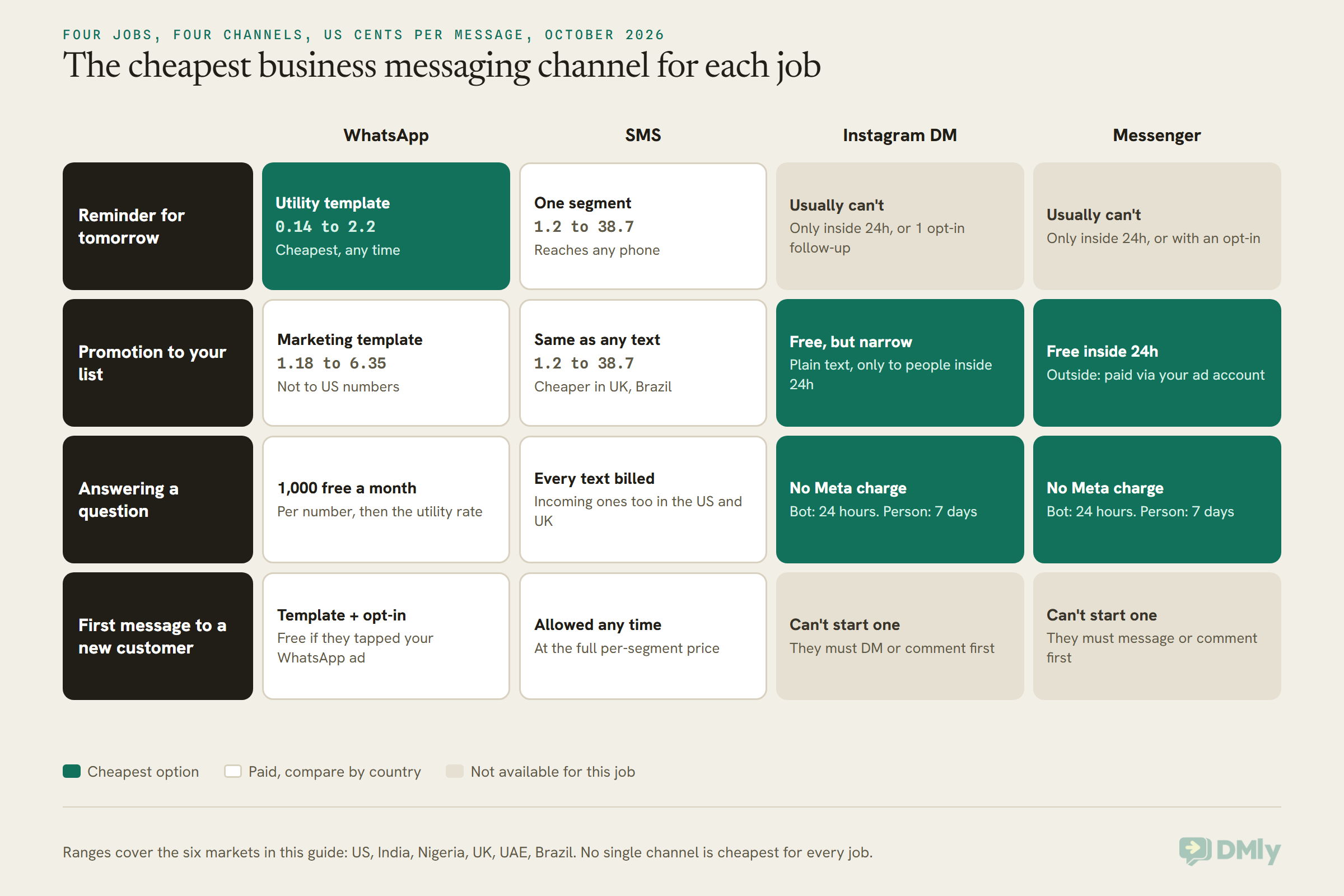
Reminders are cheapest on WhatsApp, replies are cheapest on Instagram, Messenger and WhatsApp’s free 1,000, and promotions depend on the country. Here’s the same answer as a grid you can keep.
Reminders and updates
WhatsApp utility templates are the cheapest paid way to remind someone, in every one of our six markets. They go out at any time, whether or not the customer has written to you lately, and they cost from 0.14 US cents in India to 2.2 cents in the UK. Keep them plain: no offers, no “while you’re here”. That’s what keeps them in the utility price band.
SMS is your safety net, not your first choice. It reaches people who don’t use WhatsApp, or who haven’t opened it in days, and in DMly a WhatsApp flow can text a reminder with its Send SMS step.
Promotions
This is the job where the country decides. WhatsApp is clearly cheaper for promotions in India, Nigeria and the UAE. In the UK and Brazil, a text costs about the same or a little less per message. In the US, WhatsApp isn’t an option for promotions at all right now. Instagram and Messenger broadcasts are free but only reach people who messaged you in the last day (plus anyone holding a notification opt-in), which makes them a good fit for a flash offer to an active audience and useless for a list you haven’t heard from in months.
One promotion that’s free on WhatsApp in every market: anything you send inside a free entry point window, opened when someone messages you from a click-to-WhatsApp ad.
Replies
For conversations, the Meta DMs win outright: Instagram and Messenger replies cost nothing from Meta. WhatsApp is free for your first 1,000 typed replies a month per business number, which covers most small businesses comfortably, and cheap after that. SMS is the dearest place to hold a conversation, because every text costs money, both ways in some countries, and a chatty exchange multiplies it.
Cost per Message vs Cost per Resolved Conversation
The cost per message tells you what one send costs; the cost per resolved conversation tells you what it costs to get a booking made, a question answered or an order confirmed, and that’s the number that should decide your channel. They can point in opposite directions.
Here’s the simple version of the sum:
To show how that plays out, take a made-up UK example. The numbers are invented purely to show the arithmetic; they’re not a benchmark. Say you send a promotion to 1,000 people by SMS for $56 and to 1,000 by WhatsApp for $63.50. If 10 people book from the text and 20 book from the WhatsApp message, the text cost $5.60 per booking and the WhatsApp message $3.18. Flip the bookings and the answer flips too. The per-message price can’t tell you which way it will go. Only your own results can.
And this is the point people miss about the October change. WhatsApp now charges for replies because people reply. A busy WhatsApp bill usually means customers are talking to you, which is the reason you’re messaging them. A cheap channel that nobody answers isn’t cheap.
Three hidden costs are worth checking on your own bills:
- Segments. A reminder that runs to 200 characters, or contains one emoji, costs two or three times what you budgeted on SMS. On WhatsApp, length is free.
- Chattiness. On WhatsApp past the 1,000 free replies, and on SMS always, four short replies cost four times one good reply. Answering fully the first time is now a saving as well as good service.
- Dead numbers. Meta doesn’t bill you for WhatsApp messages that aren’t delivered. SMS gateways bill the segments you send, and Twilio adds a small fee when a text fails. Cleaning an old SMS list pays for itself.
Our earlier comparison of WhatsApp marketing vs SMS marketing looks at the same question from the results side, with the jobs each channel wins.
What DMly Adds to Your Bill (and What It Doesn’t)
DMly adds nothing per message: you pay Meta’s WhatsApp rates directly with no markup, you pay your SMS gateway directly, and your DMly plan covers the platform with a monthly allowance of broadcast and template messages. Here’s how that works in practice.
- WhatsApp: DMly’s pricing page says you pay Meta’s standard per-message rates directly and DMly never adds a fee on top.
- SMS: you bring your own gateway. DMly connects to Twilio and Plivo, both two-way, and to any other provider through a custom HTTP gateway, which sends but never receives replies or delivery reports. Your provider bills you for every text. DMly doesn’t count segments, cap message length or track what an SMS broadcast costs, so watch spend in your Twilio or Plivo dashboard.
- Messenger paid Marketing Messages: billed by Meta to your own ad account, never through DMly.
- Instagram and standard Messenger: nothing from Meta, nothing per message from DMly.
The part that does involve your plan is the broadcast and template allowance: 10,000 messages a month on Starter ($29 a month billed yearly), 50,000 on Growth ($65) and 300,000 on Premium ($149), read on the pricing page on 13 October 2026. It counts every recipient of a broadcast on any channel, so an SMS or Instagram broadcast to 2,000 people uses 2,000 of it, exactly as a WhatsApp one would. Paid Messenger messages count too. It also counts every WhatsApp template sent from anywhere else, such as a flow, the Inbox or a booking reminder. Replies inside an open conversation don’t count, and a message that never left, because a window had closed or a contact had opted out, uses nothing.
It’s a cap, not a meter: there’s no extra DMly charge per message, and when it runs out DMly refuses new broadcasts rather than billing you more. The allowance resets on your billing date each month.
DMly also makes channel-matching practical, because all of these live in one inbox. You can answer Instagram and Messenger questions for free where they arrive, send reminders as WhatsApp utility templates, and add a Send SMS step to a WhatsApp flow for the customers WhatsApp can’t reach. For client notifications such as booking confirmations, Workspace Settings lets you tick WhatsApp, SMS or Email per event, and if a WhatsApp notification has no approved template and the customer’s window is closed, DMly sends the SMS instead when you’ve ticked it.
How to Lower Your Cost per Message Without Losing Customers
The biggest savings come from sending each job on its cheapest channel, keeping templates in the right category, and writing fewer, better messages. In order of how much they usually save:
- Move reminders off SMS where WhatsApp reaches the customer. In every market we checked, a WhatsApp utility template is cheaper than a text, and in Nigeria and India it’s dozens of times cheaper. Keep SMS for the customers who don’t use WhatsApp.
- Keep utility messages plain. A promotional line in a reminder turns it into a marketing message, billed at three to nine times the price. Send the offer separately, to people who opted in to offers.
- Answer social questions where they arrive. If someone asks about prices in an Instagram DM, answering there costs nothing. Moving them to WhatsApp “to keep things in one place” turns a free conversation into a paid one past your 1,000.
- Write one complete reply instead of four short ones. Past the free 1,000 on WhatsApp, and always on SMS, every message is a charge. One clear answer with the price, the link and the next step is cheaper and kinder.
- Keep texts inside one segment. Under 160 characters and no emoji. Check before you send a broadcast, because one emoji in a 1,000-person text can multiply the bill.
- Pick the channel for promotions by country. UK and Brazil: compare SMS. US: SMS, email, or Meta DMs to an active audience. India, Nigeria, UAE: WhatsApp.
- Use ads to open free windows. A conversation that starts from a click-to-WhatsApp ad is free on WhatsApp for 72 hours on most of Meta’s pages (up to 7 days on its newest), templates included.
- Clean your lists. Opted-out and dead numbers cost you nothing on WhatsApp but can still cost on SMS. In DMly, tick Reachable contacts only on a broadcast’s audience step so opted-out contacts aren’t counted at all.
Frequently Asked Questions
What is the cost per message on WhatsApp in 2026?
It depends on the country and the type of message. On Meta’s rates effective 1 October 2026, a utility message costs $0.0034 to the US, $0.0014 to India, $0.0067 to Nigeria, $0.022 to the UK, $0.0157 to the UAE and $0.0068 to Brazil. Marketing messages cost three to nine times more, and aren’t delivered to US numbers. Typed replies are free for the first 1,000 a month per business number, then cost the utility rate.
Is SMS cheaper than WhatsApp now?
For reminders and replies, no: a WhatsApp utility message is cheaper than an SMS in all six markets we checked. For promotions, SMS is level with or cheaper than a WhatsApp marketing message in the UK and Brazil, while WhatsApp is cheaper in India, Nigeria and the UAE. In the US, SMS is the only one of the two that can carry a promotion.
Are Instagram DMs free for businesses?
Yes, in the sense that Meta doesn’t charge per message for standard Instagram DMs. The limit is time: automated messages can only go to people who messaged you in the last 24 hours, and a person replying by hand gets 7 days. Instagram has no templates and no paid route for reaching people outside that window.
Does Facebook Messenger charge for marketing messages?
Standard Messenger messages inside the 24-hour window are free. Paid Marketing Messages, which reach subscribers outside the window, are charged by Meta for each delivered message and billed to your own Meta ad account. Each subscriber can get one every 12 hours, and Meta doesn’t deliver them to users in the UK, the EU, Japan, South Korea or Australia.
Why can’t I send WhatsApp marketing messages to US numbers?
Meta’s developer documentation says WhatsApp doesn’t currently deliver marketing templates to users with US phone numbers, and an attempt returns an error. Utility templates, authentication codes and replies still work. For US promotions, use SMS, email, or Instagram and Messenger for people who’ve messaged you recently.
Do I pay for messages my customers send me?
Not on WhatsApp, Instagram or Messenger: Meta doesn’t charge for messages users send to businesses. On SMS it depends on your gateway and country. Twilio, for example, charges for incoming texts in the US and the UK.
Does DMly charge per message?
No. You pay Meta’s WhatsApp rates directly with no markup, your SMS gateway directly for texts, and Meta’s ad account for any paid Messenger messages. Your DMly plan includes a monthly allowance of broadcast and template messages, which counts broadcast recipients on every channel and templates sent anywhere, but there’s no per-message fee on top.
The Stamp, Weighed Again
A stamp costs the same whatever’s in the envelope. A business message never did, and since 1 October 2026 the spread is wider than ever: from nothing on Instagram, to a fraction of a cent for a WhatsApp reminder in India, to nearly 39 cents for one text to Nigeria.
So weigh each letter before you post it. Ask who spoke first, what it says, where it’s going and, for SMS, how long it is. Then send it on the channel where that answer is cheapest, and judge the result by cost per conversation finished, not by cost per message alone. With every channel in one DMly inbox, that’s a setting, not a migration. You can try it on the 7-day free trial, no card needed, and see your own numbers within a week.
Writing about WhatsApp automation, bookings and growth for local business.
Turn WhatsApp into your busiest channel.
Start free and run message, bookings, payments and reviews in one place.
