
WhatsApp Marketing for Ecommerce and D2C Brands: Campaigns, Carts, and Retention (2026)
Do the arithmetic your ad account has been hinting at. Acquisition costs rise most years, roughly seven in ten carts never become orders, and the customer you rented from the algorithm yesterday has to be rented again tomorrow. The maths of D2C has quietly become the maths of rent.
WhatsApp marketing for ecommerce and D2C brands is the ownership play against that rent. A buyer who opts into your WhatsApp list is an audience you keep: reachable for the launch without an auction, recoverable when the cart stalls, and worth more every month through replenishment nudges and rewards. The platform signals agree with the strategy. Meta reported click-to-WhatsApp ad revenue growing 60% year on year on its Q3 2025 earnings call, Juniper Research projects conversational commerce reaching roughly $135 billion by 2027 with nearly half flowing through messaging apps, and Baymard’s running average puts cart abandonment at 70.22%, which is less a statistic than a to-do list.
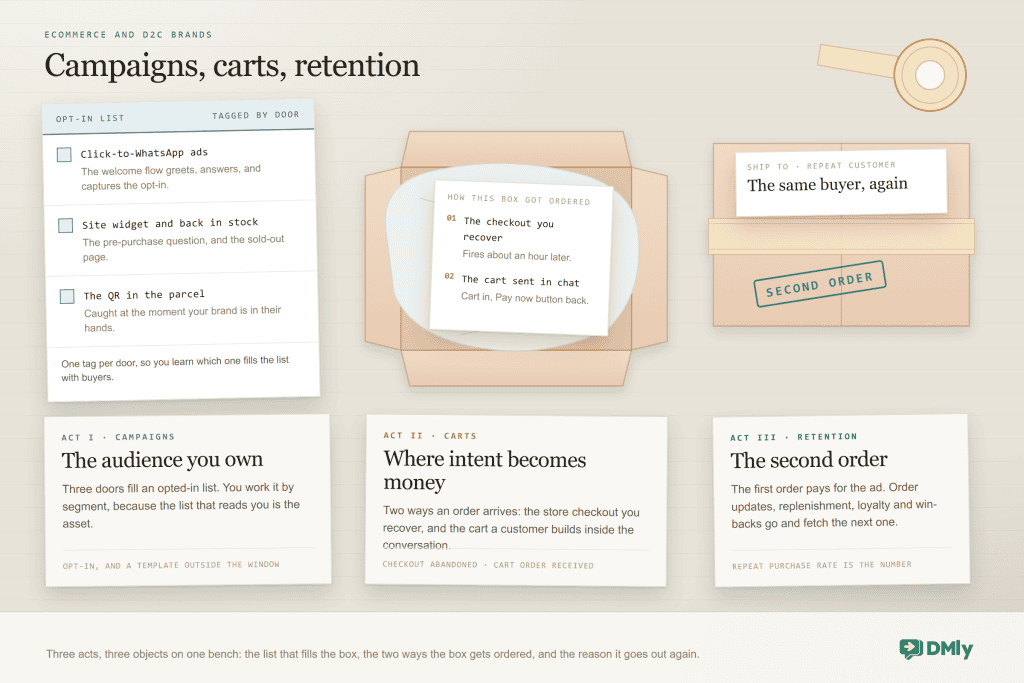
Brands selling skincare, supplements, fashion and food all end up with the same successful shape: three engines, in order. Campaigns build and work the owned audience. Carts turn intent into orders, twice over, by recovering the abandoned ones and closing new ones inside the chat. Retention converts the first order into the second, which is where your D2C margin actually lives. This guide builds all three in DMly, and links the deeper guides we have already published where they exist.
What WhatsApp Marketing for Ecommerce Actually Is
WhatsApp marketing for ecommerce is using the WhatsApp Business Platform to acquire, convert and retain customers: click-to-WhatsApp ads and opt-in capture to build an owned audience, broadcast campaigns to segments of it, cart recovery and in-chat catalogue selling to convert intent, and post-purchase flows (order updates, replenishment, loyalty, win-backs) to grow repeat revenue. A platform like DMly supplies the store connections, the flows, the segments and the payment links around the official API.
It differs from email marketing in immediacy and reply, since a WhatsApp campaign is a conversation opener rather than a bulletin, and it differs from SMS in richness, because you get media, carts and buttons. Here’s where it sits in a D2C stack:
| Channel | Its D2C job | Its weakness |
| The read-now channel: drops, carts, order updates, replenishment, support that sells | Volume costs money outside the window; list abuse kills it fast | |
| Long-form, near-free volume: newsletters, catalogues, sequences | Open rates; the inbox is a landfill | |
| SMS | The fallback for non-WhatsApp customers and delivery-critical pings | Plain text, per-message cost everywhere, no conversation to speak of |
| Paid social | Discovery and top-of-funnel scale | Rented: the audience resets to zero every morning |
One date belongs in your planning before you go further. Replies you send inside a customer’s open 24-hour window carry no Meta charge until 1 October 2026, and from that date they are billable at your market’s utility rate, with utility templates delivered inside an open window losing their exemption on the same day. Our guide to the October WhatsApp pricing change has the detail. It does not change the strategy below, but it does mean the conversation length in your support and cart flows is now a line on the bill.
The strategic point of this whole guide is the first row of that table: WhatsApp is the one channel on the list that is simultaneously owned, read and conversational, and the three acts below are how a brand converts that property into revenue.
Act I: WhatsApp Campaigns and the Audience You Own
A WhatsApp campaign is a broadcast to opted-in contacts, and the operative word is opted-in. It is what makes the channel legal, deliverable and, unlike your email list, actually read. So Act I splits into the two jobs every owned channel has: filling the list, and working it without wearing it out.
How ecommerce brands build a WhatsApp list
- Click-to-WhatsApp ads. The Meta ad whose button opens your chat instead of your site, where a welcome flow greets, answers and captures the opt-in. This is the fastest-growing entry point in the ecosystem (that 60% revenue growth figure is this ad format), and the reason is conversion mechanics: a chat keeps the shopper in a conversation your automation can continue, while a landing page keeps them one back-button from gone. Our WhatsApp ads guide covers the campaign setup end to end.
- The site widget and the back-in-stock button. A chat button beside checkout for the pre-purchase questions that decide fashion and skincare orders, and “message us when it’s back” capture on sold-out products, which recruits your most purchase-ready segment from your least monetised page. The retargeting piece shows how these audiences feed back into ads.
- The box insert. A QR in the parcel (“order updates and first access to drops”) converts buyers into subscribers at the one moment your brand is physically in their hands. Tag each entry point separately so you learn which door fills the list.
How to run campaigns that keep working
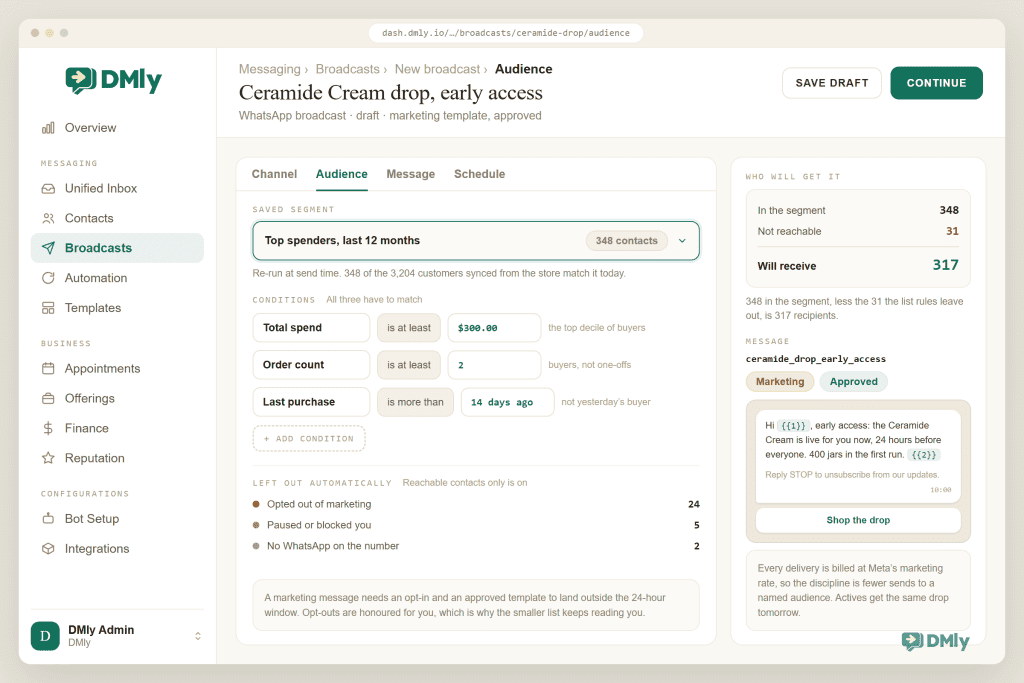
The outbound rules come first, because they shape everything. A marketing message outside a customer’s 24-hour window has to be an approved marketing template, billed per delivered message at Meta’s rates, and a promotional line smuggled into a utility template gets the template recategorised and billed as marketing. Opt-outs are honoured automatically. None of this is friction to resent; it is why the channel converts, because the inbox you are landing in is not a landfill.
Then the craft, which is segmentation. DMly’s segments filter on commerce reality (total spend, last purchase, order count, tags from your entry points), so a launch campaign becomes three messages rather than one: early access for your top-spender segment, the general drop for actives, and nothing at all for the person who bought yesterday. The Meta-commissioned Kantar research (their numbers, labelled as such) found 73.3% of surveyed consumers prefer messaging businesses and 72.4% report being more likely to buy after doing so; the way to keep those numbers true on your list is to send less, to fewer, with more specificity. One directional case worth knowing, self-reported as vendor cases are: when Optical 88 moved coupons from email to WhatsApp, Meta’s case study recorded a 97% coupon open rate and 43 times email’s click-through. That is what an owned channel looks like before it gets abused.
The click-to-WhatsApp funnel, properly built
Since CTWA ads are most brands’ biggest list-builder, the funnel behind the button deserves its own paragraph. The ad’s job is a first message worth sending; the welcome flow’s job is everything after: greet inside seconds, answer the product question that motivated the tap (buttons for the two or three questions your ad predictably raises), capture the opt-in with a plain-language line about what they will receive, tag the contact with the campaign source, and offer the catalogue or the site link depending on where your checkout lives. The tag is the quiet hero: it makes every later segment (“came from the June drop ad, never purchased”) possible, and it is how you learn which creative fills the list with buyers rather than browsers. Brands that send CTWA traffic into an unprepared inbox pay auction prices for conversations nobody answers, which is the most expensive silence in D2C.
Five campaign shapes that earn their sends
| Campaign | Audience | Wording that works |
| The drop | Top spenders first, actives second | “Early access, 24 hours before everyone: the linen set is live for you now. 40 of each size. [link]” |
| Back in stock | The waitlist tag for that product | “You asked us to tell you: the black medium is back. It went in four days last time. [link]” |
| The considered-purchase nudge | Asked questions, never bought, 14+ days | “Still thinking about the espresso machine? Three questions we get asked before people buy it: [buttons]” |
| The seasonal moment | Actives, minus recent buyers | “Gifting deadline: order by Thursday for delivery before the day. The three most-gifted picks: [list]” |
| The VIP thank-you | Top decile by total spend | “No offer, just first look: next month’s collection, before the photos go anywhere else. Reply if you want your usual size held.” |
Note what those five share: a named audience, a concrete object, and one ask. And note that the last one has no link and no discount, because your highest-value segment responds to status rather than price, and a message that treats them accordingly is the cheapest loyalty programme ever run.
Act II: Carts, Twice: Recovery and In-Chat Checkout
Act II is where WhatsApp stops being marketing and starts being revenue you can point at. It has two halves, and brands routinely build only one of them.
Abandoned cart recovery on WhatsApp
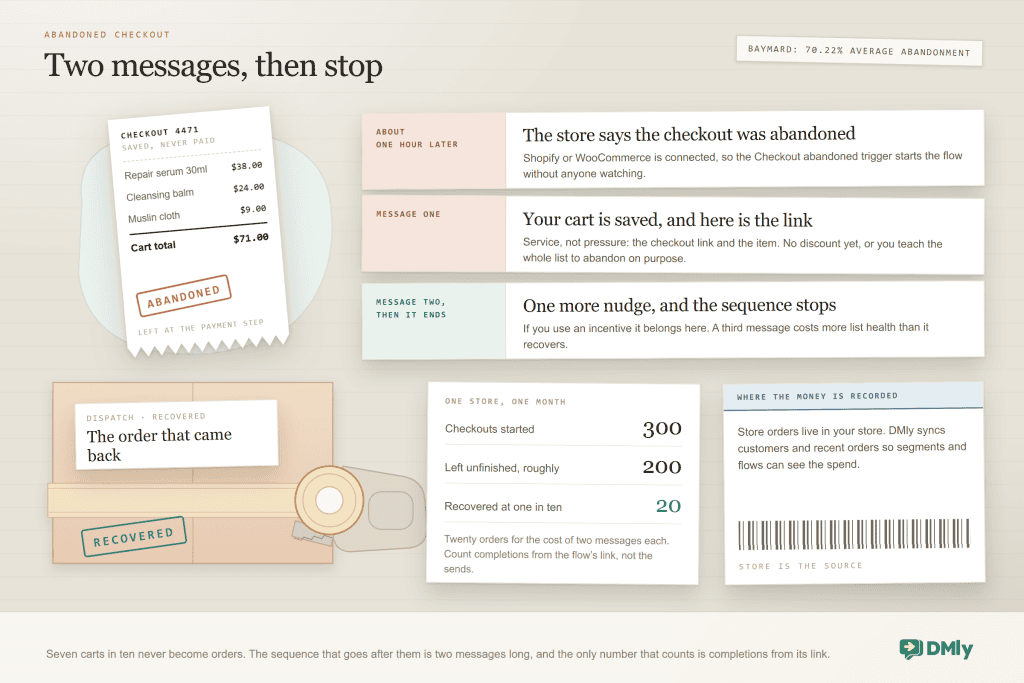
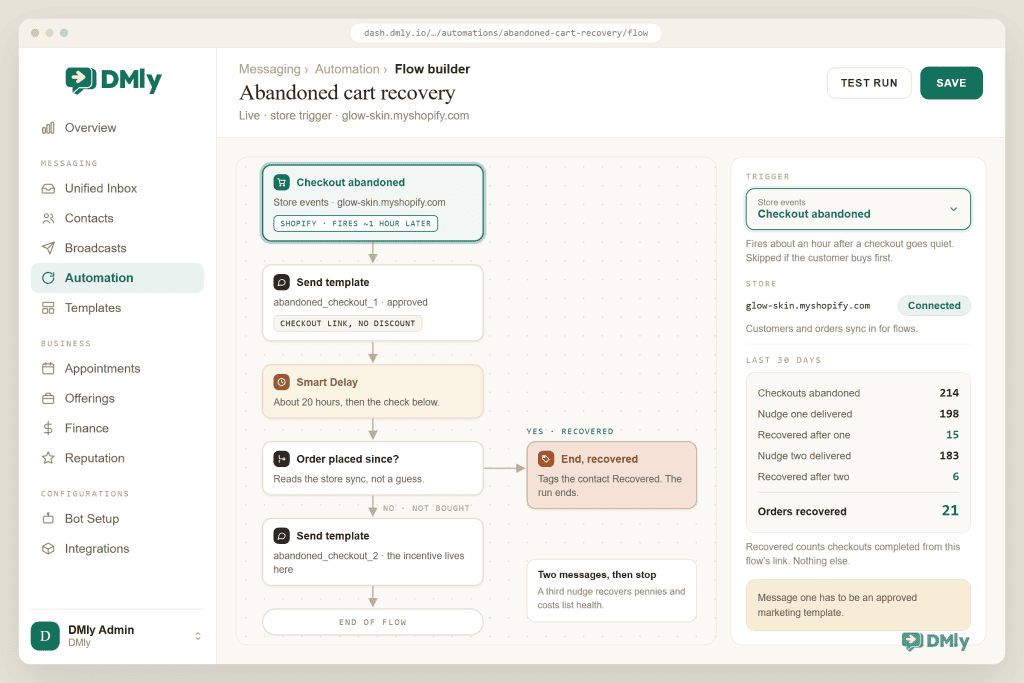
Connect your Shopify or WooCommerce store to DMly and the store starts talking in triggers, including the one that matters most: Checkout abandoned, which fires about an hour after a shopper leaves a checkout unfinished. Your flow sends a helpful nudge with the checkout link, waits, and follows once more before ending. The wording that recovers is service rather than pressure (“your cart’s saved, and sizes at this price usually go first”), and the incentive, if you use one, belongs in message two, or you will train your whole list to abandon on purpose. The deeper sequencing lives in our live piece on abandoned-cart follow-ups.
Against a 70.22% average abandonment rate, even modest recovery moves real money, and the honest accounting matters: measure recovered checkout completions from the flow’s link, not from vibes. Do the sums for your own store before deciding how much build this deserves. A store doing three hundred checkouts a month at that average abandonment is leaving roughly two hundred carts on the table monthly, and a recovery flow that closes even one in ten of them has added twenty orders for the cost of two messages each. That is why this flow, and not the broadcast, is the right first proof of the channel.
One structural note that saves confusion later: your store orders live in your store. DMly syncs customers and recent orders for automations, so segments and flows can see spend and history, but store orders do not appear in DMly’s Finance, and your store’s reports remain the source of truth for store revenue.
Selling inside the chat: the WhatsApp catalogue
The second half of Act II is the order that never touches your website. Your products live in Meta’s catalogue (built in Commerce Manager, one per WhatsApp Business Account), DMly switches on Show catalog and Enable cart for your number, and shoppers browse, build a cart and send it inside the conversation. The Cart order received trigger hands your flow the items, total and count; the Request Payment step mints a Pay now button through your gateway; and the confirmation lives in the same thread as the question that started it.
Three boundaries keep this half honest. A WhatsApp cart is a structured message, not a stock or accounting object: it creates no Finance order and moves no inventory, so serious builds mirror SKUs into DMly’s products and let the flow create the order record. Meta’s cart rules apply (one cart per thread, no edits once sent, a 30-item cap on multi-product messages, 10 on carousels), so design your catalogue in sections. And unprocessable carts pause the bot and hand the thread to a human, which is a feature to brief your team on rather than a bug to report. For the upsell layer on top, the live guide to WhatsApp upsell and cross-sell campaigns picks up where this section stops.
Act III: Retention, Where D2C Margin Actually Lives
The first order pays for the ad. The second order pays you. Retention on WhatsApp is a set of small loops, each triggered by something real, and together they are the difference between a brand and a sales funnel with a logo.
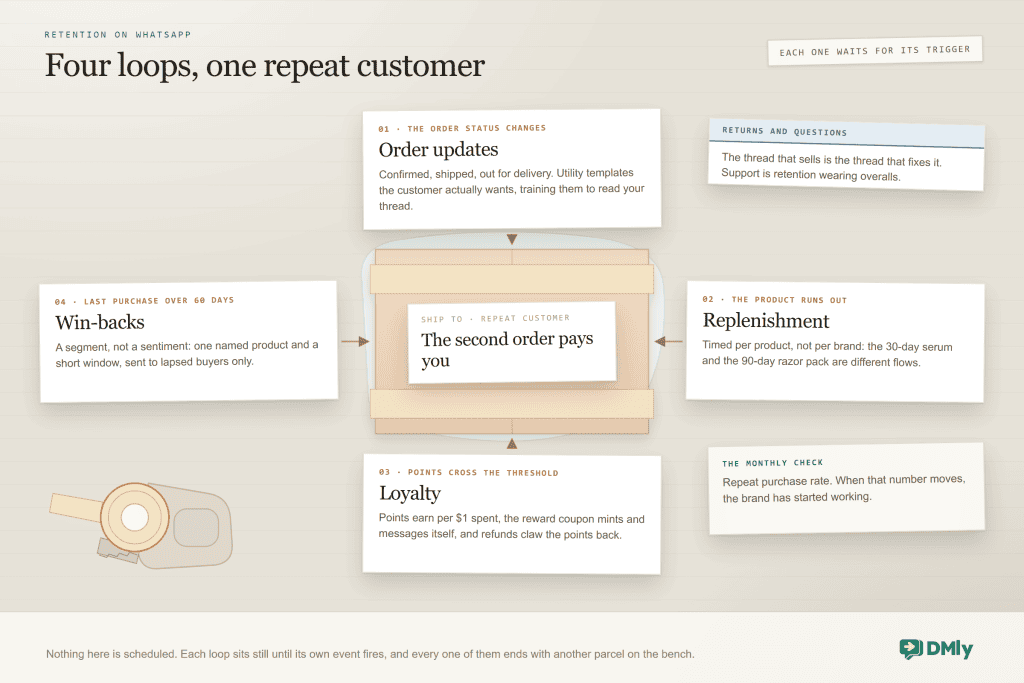
- Order updates are retention, not logistics. Confirmed, shipped, out for delivery: transactional messages your customer actively wants, sent as utility templates, training them to read your thread. A brand whose operational messages are useful earns the right to send the occasional marketing one.
- Replenishment beats promotion. If your product empties on a cycle, the reminder timed to that cycle (with a two-tap reorder) is the highest-converting message you will ever send, because it arrives at genuine need. Build it per product, not per brand: the 30-day serum and the 90-day razor pack are different flows.
- Loyalty, earning per amount spent. DMly’s loyalty switches from per-visit stamps to points per unit spent, which is the right mode for baskets that vary; when a customer crosses your threshold, a personal reward coupon is minted and messaged automatically, and refunds claw the points back on their own.
- Win-backs from segments, not sentiment. Last purchase over 60 days, excluding actives, gets a specific product and a short window. “The cleanser you bought in May is two taps away” outperforms “we miss you” everywhere it has been tried.
Sequence the loops by product physics. Consumables lead with replenishment, because the cycle is the whole business; fashion leads with the drop machine and back-in-stock, because scarcity is the product; considered purchases like furniture and equipment lead with support-as-selling and the post-delivery check-in, because the second purchase is years away and the referral is not. A brand that copies another category’s retention stack has usually built the right loops in the wrong order.
Two quieter retention layers deserve a line each. Support is retention wearing overalls: the size question answered in ninety seconds is a conversion, and the delivery problem fixed in the thread is a refund that never happened and a review that never went to one star. The same inbox that runs your campaigns runs this, with the customer’s orders and spend beside the chat. And measurement keeps the whole act honest: three numbers monthly, your repeat-purchase rate, revenue from owned-channel messages versus paid, and the replenishment flow’s reorder rate. When the first number moves, the brand has started working. Until then, you have a store with good ads.
How to Set Up WhatsApp Marketing for Ecommerce
The order below is deliberate, and each step pays for the next one’s attention. Nothing on the list requires a developer: the store connection is a settings screen, the flows are drag-and-drop, and the templates are managed for you. Budget an afternoon for steps one and two, then a week of watching before step three.
- Connect the number and the store. Official API through DMly; Shopify or WooCommerce connected so the store triggers and the customer sync exist. Confirm your marketing template is approved before you need it.
- Ship the abandoned-checkout flow. Two messages, honestly measured. This is the fastest payback in the entire stack and the right first proof to your own P&L.
- Open the doors. The site widget, the box-insert QR, and, when you are ready to spend, click-to-WhatsApp ads landing in a welcome flow that captures the opt-in.
- Turn on the retention loops. Order updates first, then the replenishment flow for your best-selling consumable, then loyalty per spend.
- Run the first campaign to a segment, not the list. Top spenders get the drop first. Watch opt-outs the way you watch ROAS; they are the same number wearing different clothes.
Common Problems With WhatsApp Marketing for Ecommerce
| Symptom | Cause | Fix |
| Abandoned-cart flow never fires | The store is not connected, or the flow listens to the wrong trigger; the event comes from the store connection, about an hour after abandonment | Connect Shopify or WooCommerce and build on the Checkout abandoned trigger. |
| Store orders missing from DMly Finance | By design: store orders stay in the store; DMly syncs customers and recent orders for automations | Read store revenue in the store; use the sync for segments and flows. |
| Cart orders never reach stock or books | A WhatsApp cart creates no Finance order and moves no inventory | Mirror SKUs into DMly products and have the flow create the order record. |
| Campaign message rejected or rebilled | Promotional content in a utility template gets recategorised as marketing | Keep utility templates strictly transactional; send offers as marketing templates to opted-in contacts. |
| Broadcasts underdeliver | Sending outside the 24-hour window without an approved marketing template, or to contacts who never opted in | Approve the template first; build the list through real opt-ins. |
| Catalogue message will not send | Over Meta’s caps: 30 items in a multi-product message, 10 in a carousel | Send the catalogue in sections. |
| Opt-outs climbing after launches | Blasting the full list, too often | Segment by spend and recency; the smaller list that reads you is the asset. |
Ecommerce WhatsApp Marketing FAQs
Does WhatsApp marketing work for ecommerce brands?
The verifiable signals say yes: Meta reports click-to-WhatsApp ad revenue growing 60% year on year, Juniper projects conversational commerce around $135 billion by 2027 with nearly half through messaging apps, and Meta’s own commissioned research finds most consumers prefer messaging businesses and report higher purchase intent after doing so. The channel’s edge is structural: it is owned, read, and conversational, which is everything the rented ad impression is not.
How does WhatsApp abandoned cart recovery work?
With a connected Shopify or WooCommerce store, a checkout left unfinished fires an abandoned-checkout event about an hour later, and your flow sends a helpful reminder with the checkout link, then one follow-up. Measure recovered completions from the flow’s link, keep any incentive for the second message, and stop after two; the third nudge costs more list health than it recovers.
Can customers buy directly inside WhatsApp?
Yes: products live in Meta’s catalogue, shoppers browse and send a cart in the chat, and your flow confirms it and offers a Pay now button through your payment gateway. The cart itself is a structured message rather than an accounting object, so builds that care about stock and records mirror SKUs into the platform’s products and create the order from the flow.
Do I need customers to opt in before sending campaigns?
Yes, and it is the best rule in the channel. Marketing messages require opt-in, travel as approved marketing templates outside the 24-hour window, and are billed per delivered message; opt-outs are honoured automatically. The discipline is why WhatsApp campaigns get read at rates email forgot were possible, and why protecting list health matters more than growing list size.
WhatsApp vs email marketing for D2C: which wins?
They do different jobs. Email remains the long-form, high-volume, near-free channel; WhatsApp is the read-now, reply-now channel where conversations convert. The brands getting it right run both: email for the newsletter and the catalogue moment, WhatsApp for the drop, the cart, the order updates and the replenishment nudge. Our comparison piece on WhatsApp vs email marketing goes deeper.
Should I sell through the WhatsApp catalogue or send people to my Shopify checkout?
Both, for different customers. The catalogue-and-cart path suits impulse and repeat purchases, DM-native shoppers, and markets where the website is the afterthought; the store checkout suits complex baskets, discount logic and everything your Shopify apps already do. The practical pattern most brands land on: catalogue for the conversation-born order, store link for everything else, and the abandoned-checkout flow watching the store side either way. Whichever path takes the money, the customer record in DMly sees the spend, which is what keeps your segments true.
How big should my WhatsApp list be before campaigns are worth it?
Smaller than you think. Three hundred genuine opt-ins who bought from you outperform ten thousand scraped numbers by every measure that matters, including the ones Meta enforces. Start campaigns when a segment, rather than the list, reaches a sensible size: fifty top spenders is enough for the VIP message, and one waitlist tag with forty people on it justifies the back-in-stock flow forever.
What does WhatsApp marketing for ecommerce cost a brand?
DMly’s plans include the store connections, catalogue integration, broadcasts, segments and flows, with a 7-day trial and no card. Meta bills marketing template messages per delivery at country-specific rates, passed through without markup. Replies inside a customer’s window carry no Meta charge until 1 October 2026, and from that date they are billable at your market’s utility rate, so read the October WhatsApp pricing change before you model a busy month. Practically, the abandoned-cart and order-update traffic still costs little and returns most; broadcast campaigns are where spend scales with volume, which is why segmentation is also cost control.
Own the audience your ads rent
Click-to-WhatsApp campaigns, abandoned carts recovered, orders closed in chat, and retention loops that compound. Built for D2C brands on the official API.
See ecommerce WhatsApp in DMly
Rent, Then Own
The ad account is not the enemy; it is the top of the funnel it always was. The mistake is stopping there, paying rent forever on attention you could have owned by now. Build the recovery flow this week, because it pays immediately. Build the doors and the retention loops this month, because they are the compounding asset. And measure the whole thing by the only D2C number that matters in year two: how much of this month’s revenue came from people you did not have to pay to reach.
The brands that get this right do not feel like they are doing WhatsApp marketing at all. They feel, from the customer’s side, like a shop with a very good memory: it knows what you bought, tells you when your order moves, mentions the restock you asked about, and shuts up otherwise. That restraint is the strategy. Everything in this guide exists to make it operational.
Writing about WhatsApp automation, bookings and growth for local business.
Turn WhatsApp into your busiest channel.
Start free and run message, bookings, payments and reviews in one place.
