
Best AI Receptionist Software for Small Businesses
“Thanks for calling. We can’t come to the phone right now, but leave your name and number and we’ll get back to you as soon as we can.” Read it again as a promise. It promises that someone will listen to the message, that they will call back, and that “as soon as we can” will be soon enough. Every small business owner knows how often at least one of those promises breaks, and every caller who has hung up without leaving a message has already decided it would.
AI receptionist software replaces that greeting with something that answers. On the phone, it picks up, understands the question, gives the answer, takes a message properly, books an appointment or passes the call to a person. In chat, on your website or WhatsApp, it does the same in writing. This guide compares five options for small businesses on what they can actually do for a caller or messager, how their usage is counted, and what they cost, with prices read on each vendor’s own page on 25 September 2026.
A disclosure, up front: DMly publishes this blog and is one of the options compared. DMly is a chat receptionist, not a phone one, and we say plainly where a voice tool is the better choice. For how to build an AI receptionist on WhatsApp step by step, see our guide to building a WhatsApp AI receptionist.
What an AI Receptionist Does
A good receptionist does five things. So should the software.
1. Answers, every time. At any hour, on the first ring or the first message, and more than one conversation at a time.
2. Answers correctly. Opening hours, prices, services, directions, policies: from your information, not from guesswork.
3. Gets things done. Books or moves an appointment, takes a detailed message, sends a link, captures a lead’s details.
4. Knows when to pass it on. Transfers the call or hands the chat to a person when the question needs one, with a summary so nobody starts again.
5. Tells you what happened. A summary, a transcript and a notification for every conversation, so nothing is lost between the software and the team.
The tools here all do the first two. They differ most on the third and fourth, which is where a receptionist earns its keep.
Phone Receptionist or Chat Receptionist?
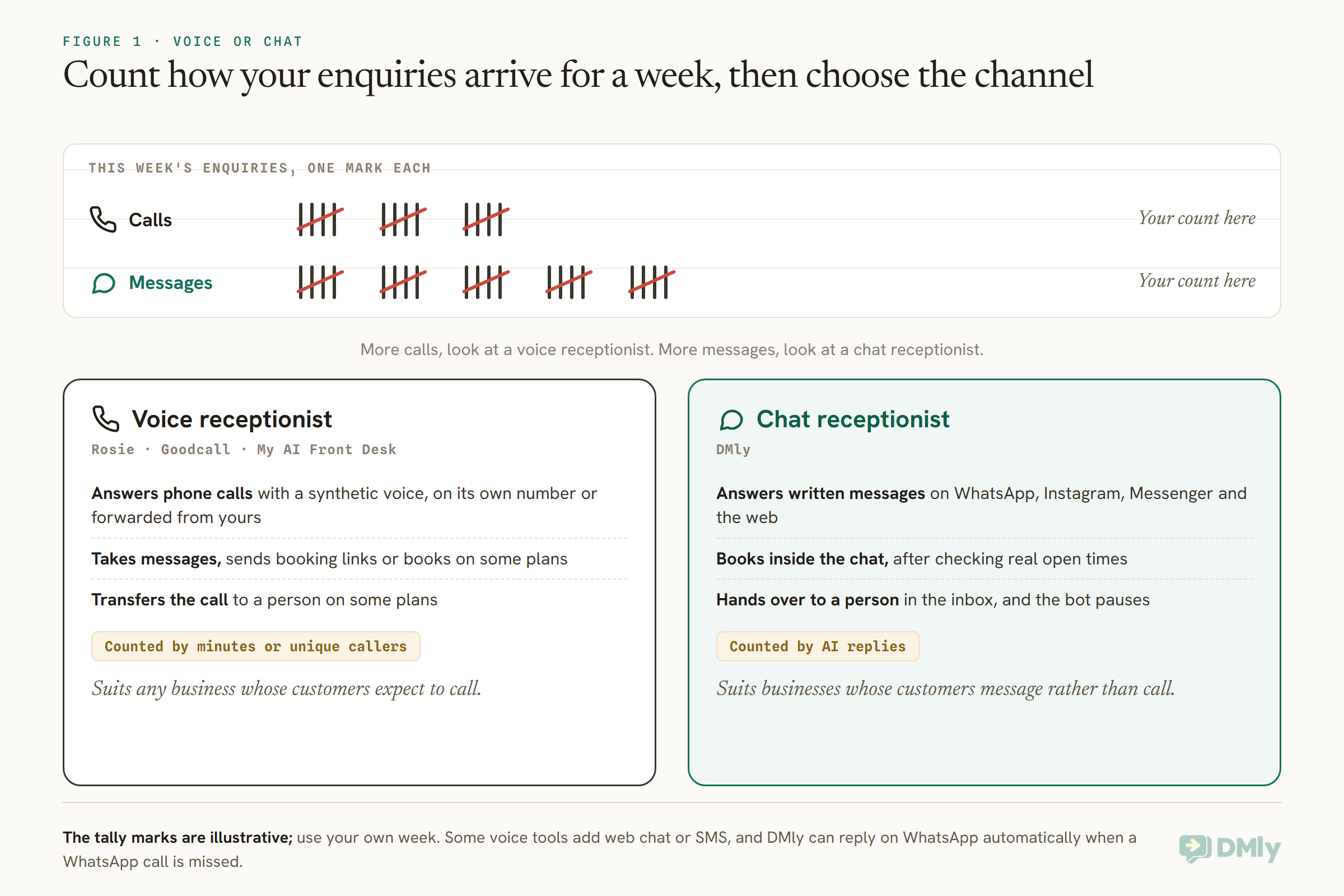
The first decision is not which brand. It is which channel your customers use to reach you.
A voice AI receptionist answers phone calls. It gives you a number, or takes calls forwarded from your existing one, and speaks to callers with a synthetic voice. Rosie, Goodcall and My AI Front Desk are voice-first tools. They suit any business whose customers expect to call.
A chat AI receptionist answers written messages on your website, WhatsApp, Instagram or Facebook Messenger. DMly is a chat receptionist. It suits businesses whose customers message rather than call.
Some voice tools add chat, and some chat tools handle calls in a limited way. Rosie includes a website chat widget and offers website texting as an add-on; My AI Front Desk bundles web chat and two-way SMS. DMly takes WhatsApp voice calls in its inbox, answered by your team, and can reply automatically on WhatsApp when a call is missed. Count how your enquiries arrive for a week, calls against messages, before you choose.
How We Compared Them
We judged each option as AI receptionist software for a small business: pricing pages read on one day, measured against the five receptionist jobs.
We read each vendor’s pricing page in a browser on 25 September 2026 and recorded plan prices, what usage is included, what counts as usage, and which receptionist jobs each plan can do: answering, booking, message taking, transferring and reporting. For DMly we used its documentation, which also states the limits. Smith.ai, a well-known name that combines AI and human receptionists, shows its prices only after a sign-up form, so we have not included it. We did not test call quality or voice naturalness, which you should judge yourself during a trial.
The Quick Answer: Best by Situation
| If you are… | Look first at | Why |
| A business whose customers message on WhatsApp | DMly | An AI agent that answers, books and hands over inside WhatsApp, Instagram and Messenger |
| A solo owner who misses calls while working | Rosie Professional | A low monthly price for 24/7 call answering, message taking and appointment links by text |
| A busy business that wants calls booked and transferred | Rosie Scale | Books on your calendar, with warm and live transfers to your team |
| A business with many repeat callers | Goodcall | Unlimited minutes, priced by unique callers, so long or repeat calls do not cost more |
| A business wanting phone, web chat and SMS in one plan | My AI Front Desk | Voice minutes, a chatbot, two-way SMS and a CRM in one subscription |
| A business that wants a real person | A human answering service | For example, Setmore’s Live Receptionist add-on at $99 a month |
The Best AI Receptionist Software, Reviewed
1. DMly: best overall AI receptionist for WhatsApp and chat
What it does. DMly’s AI agent answers customer messages on WhatsApp, Instagram, Facebook Messenger and other connected channels. You give it your information through a knowledge base, and switch on tools that let it act: look up the contact, add tags and notes, list your services, check real open times, book, reschedule and cancel appointments and classes, and hand the conversation to a person. When it hands over, the bot pauses so it does not talk over your team.
Calls. DMly takes WhatsApp voice calls in its inbox, answered by team members marked as on call duty. It does not document an AI that answers calls by voice. What it can do is react to calls: a Missed call event can start an automation that messages the caller on WhatsApp straight away, so a missed call becomes a conversation the AI can pick up.
Plans. The AI agent is included on every plan. Plans are $29, $65 and $149 a month billed yearly, with 500, 5,000 and 20,000 AI replies a month on DMly’s shared AI. On plans that allow it, you can connect your own AI provider key instead, and replies generated on it do not count against the allowance.
Watch out for. DMly is not a phone receptionist: calls to your ordinary phone line are outside it, and WhatsApp calls are answered by people. Whether the AI understands inbound voice notes is not documented, so test it if your customers send them.
Best for: businesses whose customers message on WhatsApp and other chat apps, and who want the receptionist to book, bill and follow up from the same system.
2. Rosie: best value phone receptionist for small businesses
What it does. Rosie answers your calls around the clock with an AI voice, trained automatically from your Google profile and website, plus custom answers you add. Every plan includes call summaries, transcripts and recordings, email and text notifications, spam detection, English and Spanish on every call, a choice of voices and a custom greeting, and a website chat widget. It handles several calls at once, so callers do not hit a busy signal.
Plans. Professional is $49 a month with 250 minutes, custom message taking and appointment links sent by text. Scale is $149 with 1,000 minutes, and adds booking appointments directly on your calendar, warm transfers where Rosie briefs your team before connecting, live transfers, and texting callers during the call. Growth is $299 with 2,000 minutes, adding transfers that try several numbers in turn, training from your own documents, and white-glove onboarding. There is a seven-day trial and an annual billing option.
Watch out for. On Professional, Rosie sends a booking link rather than booking the appointment itself; direct booking is a Scale feature. Minutes are the limit to watch: a business taking many long calls will move up plans quickly.
Best for: solo owners and small teams who miss calls while they work.
3. Goodcall: best when you have many repeat callers
What it does. Goodcall is a voice AI agent that answers calls using logic flows and forms you design. It counts usage by unique customers, meaning each distinct phone number that calls and actually speaks to the agent in a month, rather than by minutes. Minutes and AI tokens are unlimited, and a customer who calls ten times from the same number counts once. Robocalls, blocked numbers and silent callers do not count.
Plans. Priced per agent: Starter is $66 a month billed annually or $79 monthly, with 100 unique customers, one logic flow and three team members; Growth is $108 or $129 with 250 unique customers and three logic flows and forms; Scale is $208 or $249 with 500 unique customers and 25 logic flows. Each extra unique customer is $0.50.
Your number. Each agent gets a Goodcall number with an area code you choose. To keep your existing number, you set up conditional call forwarding with your phone provider, so unanswered or busy calls go to Goodcall.
Watch out for. Pricing by unique callers rewards businesses with regulars and penalises those with many one-off callers. Estimate your distinct callers a month from your phone bill before choosing a plan.
Best for: businesses with many repeat or long calls, where per-minute pricing would bite.
4. My AI Front Desk: best for voice plus chat and SMS in one plan
What it does. My AI Front Desk bundles a phone receptionist with web chat, two-way SMS, a built-in CRM and follow-up sequences. Its single self-serve plan, Business-in-a-Box, is $99 a month or $79 a month billed annually, and includes 200 voice minutes, 100 chatbot conversations and 400 SMS a month, with overage credits and automatic reload. It lists more than 20 languages and a seven-day trial. A Partner and Enterprise tier is custom priced.
Watch out for. Two hundred voice minutes is a modest allowance for a busy line, so check the overage cost for your volume. Outbound calls, such as reminders, have a daily cap on the standard plan.
Best for: businesses that want one subscription covering calls, website chat and text messaging.
5. Human answering services: when a person matters
What it is. Some businesses want a real person on the phone. Human answering services still exist, some combined with AI. As one example, Setmore sells a Live Receptionist add-on at $99 a month, with a real person answering calls, alongside its booking plans.
Watch out for. A person costs more per call than software and works set hours unless you pay for cover. The trade-off is judgement: a person can calm an upset caller and handle a situation the script never imagined.
Best for: businesses where calls are high value, sensitive or complicated.
Comparison at a Glance
| Option | Channel | Entry price | Usage counted by | Books appointments | Passes to a person |
| DMly | WhatsApp, Instagram, Messenger, web | $29 a month billed yearly | AI replies (500 on entry plan) | Yes, in the chat | Yes, hand over to a human |
| Rosie | Phone, web chat | $49 a month | Minutes (250 on entry plan) | Links on Professional; direct on Scale | Transfers on Scale |
| Goodcall | Phone | $66 a month billed annually, per agent | Unique callers (100 on entry plan) | Not assessed | Not assessed |
| My AI Front Desk | Phone, web chat, SMS | $79 a month billed annually | Minutes, chats and texts | Not assessed | Not assessed |
| Setmore Live Receptionist | Phone, human | $99 a month add-on | Not stated | Not assessed | It is a person |
What to Give Your AI Receptionist Before Day One
Any AI receptionist software is only as good as what you tell it. Most disappointing first weeks trace back to thin information.
Treat setup like training a new receptionist on their first morning. Write down what you would tell them, then give the software the same. Rosie says it trains itself from your Google profile and website, and lets you add custom answers; Rosie’s Growth plan and DMly’s knowledge base both take your own documents. Whatever the tool reads automatically, check it, because a website that is two years out of date will produce a receptionist that is two years out of date.
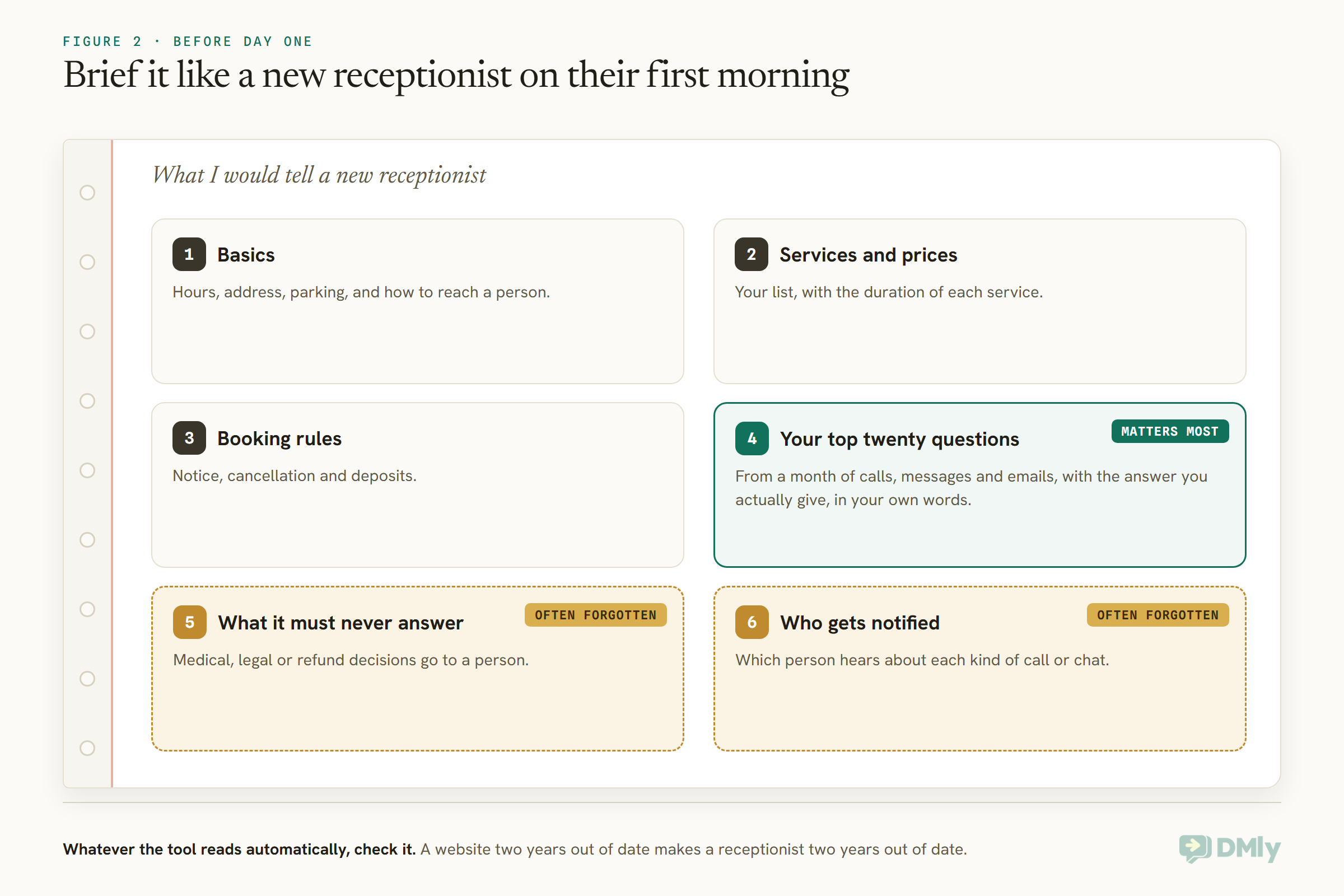
The fourth group matters most. Look through a month of calls, messages and emails, list the twenty questions you are asked most, and write the answer you actually give, in your own words. That list does more for the receptionist’s quality than any setting.
Languages, Recordings and Transcripts
Two practical details: which languages the receptionist speaks, and what it keeps.
Rosie answers every call in English and Spanish. My AI Front Desk lists more than 20 languages. If your customers speak other languages, test the receptionist in each one during the trial, including accents and mixed-language conversations, rather than trusting the list.
Voice tools usually record and transcribe calls: Rosie includes call summaries, transcripts and recordings on every plan, and Goodcall keeps call and customer details for 7 days on Starter, 30 days on Growth and without limit on Scale. Recordings are useful for checking quality, and they are personal data. Rules on recording calls and telling callers about it differ between countries, so check the rules where you and your customers are, say in the greeting that calls may be recorded if you record them, and decide how long you need to keep them.
How Usage Is Counted, and Why It Matters
AI receptionist software is priced by what it counts. Find out what each AI receptionist software plan counts before you compare prices.
There are three common units. Minutes (Rosie, My AI Front Desk) charge for time on the phone, so long calls and chatty callers cost more. Unique callers (Goodcall) charge per distinct phone number a month, so regulars who call often are cheap and one-off callers are not. AI replies (DMly) count written responses, so a conversation with many short back-and-forths uses more than one with a single answer.
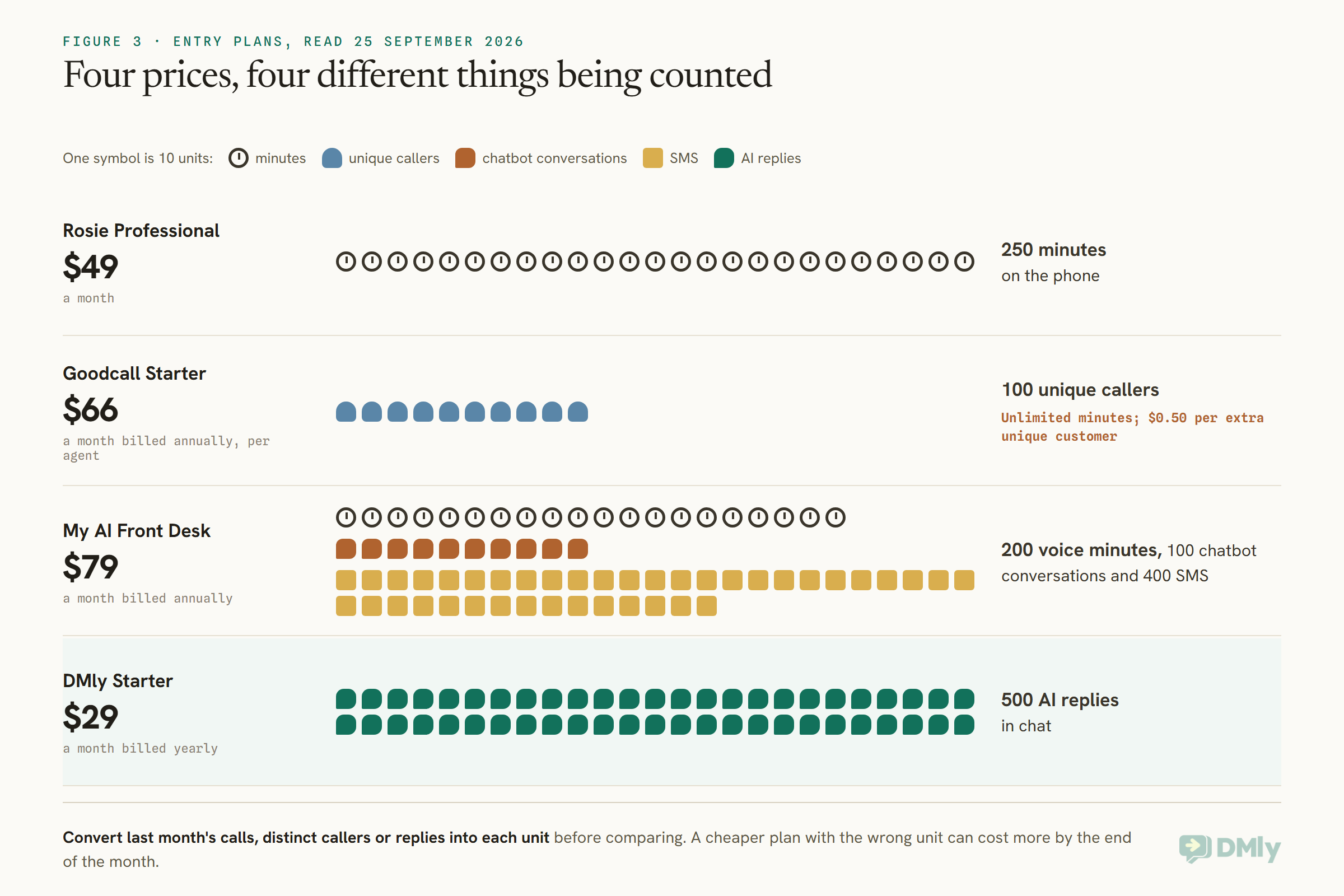
To compare fairly, take last month’s numbers. For a phone receptionist, how many calls, how many distinct callers, and the average call length; your phone bill or provider dashboard shows all three. For a chat receptionist, how many conversations and roughly how many replies each. Then work out which plan each tool would put you on, including overage. A tool that looks cheapest at the entry level can be the most expensive at your volume, and the other way round.
Booking Appointments: Link, Direct or Not at All
“Books appointments” means three different things. Find out which one a plan offers.
Some receptionists send a booking link by text, leaving the customer to book on your booking page. Rosie’s Professional plan works this way. Some book directly into your calendar during the call or chat, which is smoother for the customer: Rosie’s Scale plan books on your calendar, and DMly’s AI agent books into DMly’s own appointments system, checking real open slots first. Some take a message asking you to call back to arrange a time, which is little better than voicemail.
Direct booking only works if the receptionist can see real availability. A receptionist that books into a calendar it cannot fully see will double-book. DMly’s docs make the point bluntly: without the tool that checks available times switched on, an agent invents plausible times. Whatever tool you choose, test booking with a slot you know is taken, and check that it is refused. Our WhatsApp appointment booking guide shows how booking inside a chat works.
When the AI Should Hand Over
A good AI receptionist knows its limits. Decide them before it answers its first customer.
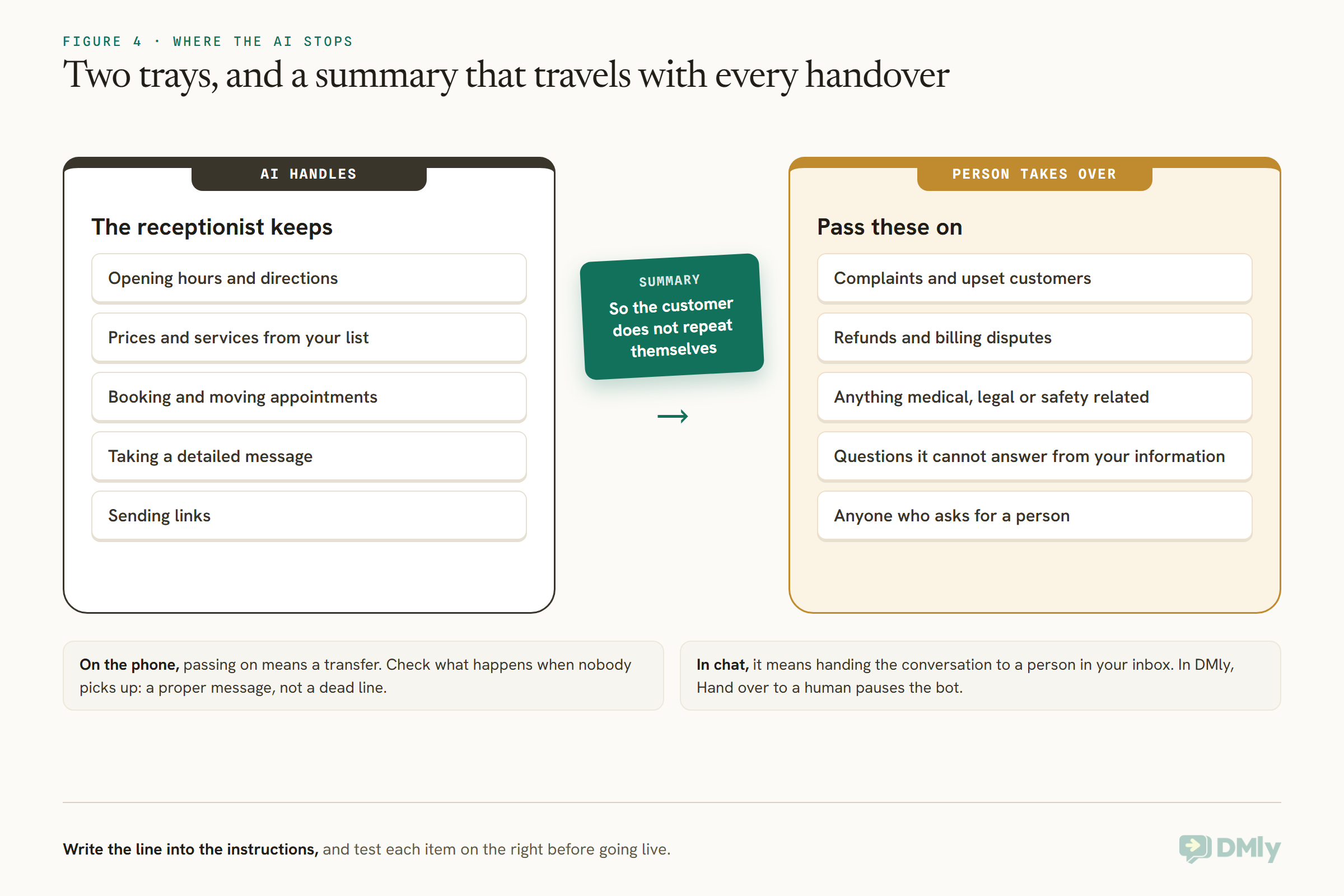
On the phone, passing on means a transfer. Rosie’s Scale plan offers warm transfers, where it briefs your team member before connecting, and live transfers; its Growth plan tries several numbers until someone answers. Check what happens when nobody picks up: the call should end in a proper message, not a dead line. In chat, passing on means handing the conversation to a person in your inbox. In DMly, the Hand over to a human tool pauses the bot and passes the chat on, and DMly’s docs call it the one tool worth switching on even if you switch on nothing else.
For health, legal and financial businesses, the line matters more. An AI receptionist should not give medical, legal or financial advice; it should book, take details and pass the question to a qualified person.
Keeping Your Phone Number
Your number is on your signs, your van and your Google listing. You do not want to change it.
Most voice receptionists give you a new number and suggest forwarding your existing number to it. Goodcall explains the two options clearly: replace your published number with the Goodcall number, or keep your number and set up conditional call forwarding with your phone provider, so calls go to the AI only when you do not answer or the line is busy. Conditional forwarding is usually the gentler start: you still pick up when you can, and the AI catches the rest. Rosie lets you pick an area code for its number. Ask each vendor how forwarding works with your phone provider before you sign up.
For WhatsApp, the number question is different. DMly connects your WhatsApp Business number to its platform; by default it takes the number over, and a co-existence mode keeps the WhatsApp Business app working on the same number.
Missed Calls: The Gap Between Voice and Chat
If you choose a chat receptionist, decide what happens to the calls.
A business that chooses a chat receptionist still gets phone calls. Two practical options close the gap. First, make messaging the easy route: put a WhatsApp button on your Google listing and website so customers who would have called can message instead. DMly can add a WhatsApp chat button to your Google Business Profile where Google offers it. Second, turn missed WhatsApp calls into messages: in DMly, a Missed call event can start an automation that replies on WhatsApp straight away, and the AI agent can take it from there. Calls to an ordinary phone line are outside DMly, so if those are frequent, a voice receptionist alongside is worth considering.
How to Test AI Receptionist Software in a Week
Be your own worst caller.
Load your real information: hours, services, prices, policies and the questions you are asked most. Then call or message it ten times as different customers. Ask the easy questions. Ask for a slot you know is taken. Ask something that is not in your information and check it admits it does not know. Get angry about a made-up problem and check it passes you to a person. Ask for a person directly. Speak with background noise, or type with spelling mistakes. Finally, look at what your team received for each conversation: a summary, a transcript, a notification. If any of those fail in testing, they will fail with real customers.
Mistakes to Avoid
- Choosing voice when customers message, or chat when they call. Count your enquiries first.
- Comparing prices without converting units. Minutes, unique callers and AI replies are not the same thing.
- Thin information. A receptionist can only answer from what you give it.
- No handover. An AI that cannot pass on a complaint makes it worse.
- Booking without real availability. It will double-book.
- Never reading the transcripts. They show you what customers ask and where the AI struggles.
Frequently Asked Questions
What is the best AI receptionist software for a small business?
DMly is our top pick for businesses whose customers message rather than call: its AI agent answers, books and hands over inside WhatsApp, Instagram and Messenger. For phone calls on a small budget, Rosie; for many repeat callers, Goodcall; for phone, web chat and SMS together, My AI Front Desk.
How much does an AI receptionist cost?
Entry plans in this comparison range from $29 a month billed yearly for a chat receptionist (DMly) to $49 to $99 a month for voice receptionists, with usage limits by minutes, unique callers or replies. Busy businesses pay more.
Can an AI receptionist book appointments?
Some send a booking link, some book directly into a calendar, and some only take a message. Rosie books directly on its Scale plan; DMly’s AI agent books into DMly’s appointments after checking open times.
Can I keep my existing phone number?
Usually, by forwarding your number to the AI receptionist’s number, either for every call or only when you do not answer. Ask the vendor how it works with your phone provider.
Will customers know they are talking to AI?
Assume they may. Be open about it in the greeting, make it easy to reach a person, and focus on whether the customer gets what they needed quickly.
Is an AI receptionist better than voicemail?
For most enquiries, yes: it answers questions, takes structured messages and can book, rather than leaving a recording someone has to return. Keep a person available for the calls that need one.
A Greeting That Keeps Its Promise
The voicemail greeting at the top of this page promises that someone will get back to you. An AI receptionist replaces the promise with an answer, at any hour, on the channel the customer chose. Choose voice if your customers call and chat if they message, compare prices in the unit each tool counts, and decide where the AI stops and a person takes over. If your customers message you on WhatsApp, DMly is worth a place on your shortlist; for the wider picture, see our guide to WhatsApp AI chatbots for small businesses.
Writing about WhatsApp automation, bookings and growth for local business.
Turn WhatsApp into your busiest channel.
Start free and run message, bookings, payments and reviews in one place.
