
Best Podium Alternatives for Local Businesses in 2026
Before you shortlist Podium alternatives, open Podium’s own pricing page, expand the table called “Compare features & plans”, and go down it with a highlighter. Mark only the lines your business actually used last month. Not the lines the sales rep showed you in the demo. The lines you used.
There are 92 of them. Reviews from Google, Facebook and industry sites. One-to-one texts and bulk messages. Phone seats, call recordings, a website chat widget, automations for birthdays and anniversaries, and an AI Employee you can add on top.
When you’re done, look at where the colour landed. For many local businesses it bunches up in three places: asking customers for reviews, texting them from a shared inbox, and sending a link so they can pay. Some owners will also have highlighted the phones. Some will have highlighted a single column and nothing else.
That pattern is your shortlist. Podium’s Core plan is listed at $399 a month, and if your highlights sit in one column you may be paying for two jobs you don’t do. If they’re spread across all three, plus the phones, Podium may still be the right answer. In this guide, we’ll look at what Podium costs when you read the page line by line, a quick audit of which jobs you use, the best Podium alternatives for each job on its own and for all three together, the US texting rules that apply whichever tool you pick, a price table read at source, when to stay, and where DMly fits and where it doesn’t.
Best Podium Alternatives at a Glance: Pick by What You Highlighted
The best Podium alternative is the cheapest tool that covers every line you highlighted, and nothing much else. Here’s the short version. Prices were read on each vendor’s own page on 13 October 2026 and are US dollars a month for one location unless the row says otherwise.
| If your highlights are mostly… | Look at first | Starting price we could read | Why |
| Reviews only | NiceJob, GatherUp | $75 (NiceJob Starter), $99 (GatherUp) | Review requests by SMS and email, monitoring and widgets, with no inbox you don’t need |
| Reviews only, and you’re an agency | Grade.us | $99 a location, or $40 a seat on the $400+ Agency Plan | White label review funnels for client locations |
| Texting inbox only | Heymarket, Textline | $49 a user billed annually, 2-user minimum (Heymarket); Textline doesn’t print its plan prices | Shared SMS inbox, templates and campaigns, priced by people plus message credits |
| Reviews and messaging, done for you | Broadly | $399 Standard, plus $350 setup on the tier cards | An AI receptionist, review replies and listings, set up by their team |
| All three, in a dental, medical, vet or optometry practice | Weave; Klara (ModMed) for specialty medical | Weave “from $199”; Klara not published | Phones, texting, reviews and text-to-pay built around practice software |
| All three, and your customers live on WhatsApp | DMly | $29 Starter, $65 Growth, billed yearly | Google reviews, a shared inbox across WhatsApp, SMS and social, and pay links, outside the US especially |
| All three plus phones and card readers, in the US | Stay on Podium, or price Birdeye | Podium $399; Birdeye’s pricing page wouldn’t load | Few cheaper tools replace phones, texting and in-person payments from one number |
The rest of this page explains each row, including the parts that cost money later, like message credits, phone registration fees and per-user seats.
Podium Pricing in 2026: What the $399 Covers, Read Line by Line
Podium lists Core at $399 a month and Pro at $599 a month, with Signature on custom pricing, and every plan still routes you to “Talk to Sales”. Those prices were on podium.com/pricing when we read it on 13 October 2026. The page also says your plan “may vary based on industry, partnerships, integrations, volume, and carrier fees”, and each card tells HVAC businesses to contact sales for their own pricing. So treat $399 as the list price, not a quote.
Here’s what sits around that number, all from the same page and its FAQ:
- Unlimited contacts, team members and one-to-one texts on every plan. That’s genuinely generous, and it’s a big part of why owners like Podium.
- Bulk messages are capped by credits: 250 credits a month on Core, 500 on Pro. Credits “expire at the end of each month and do not roll over”, and once you hit the limit you can’t send more bulk messages until the next month unless you upgrade through your success manager. The number of credits a message uses depends on its length and content.
- Phone numbers: 5 included on Core, 15 on Pro, then $5 a month for each extra number.
- US registration: “A base 10DLC fee of $5/month is charged for all US locations.” That fee covers 3 message segments a second and up to 2,000 T-Mobile messages a day per location. High-volume carrier-verified messaging is a further $15 a month on Core and included on Pro.
- Review extras on Core: review response templates, review response controls, review notes and “close review” are each shown at $15 a month on Core and included on Pro. AI review responses are on every plan, but automated AI review responses are an add-on on Core.
- Phones: phone seats are $30 a user a month for 1 to 4 users and $25 for 5 or more, with “a $500 network optimization fee per location”. Each phone user includes 1,000 minutes a month.
- AI Employee: “Add on AI Employee to any plan.” No price is shown for it.
- Scope of Use limits: automations include 4,000 message segments per location a month (up to 1,000 of them picture messages), Voice AI 300 minutes and AI Messaging 1,500 segments, with overages “billed at Podium’s then-current rates”.
- Payments: the payments page lists text-to-pay links, card readers, tap to pay on iPhone and Android, recurring payments, Buy Now Pay Later financing and next-day payouts. The processing rates aren’t printed. Pro mentions “Lower Payment Processing Fees” and Signature “Custom Processing Rates”, so ask for your rate in writing.
Add it up for a single US location on Core with three people on Podium Phones and you’re looking at $399, plus $5 for 10DLC, plus $90 in phone seats, plus a one-off $500 network fee, before any add-on, overage or card fee. That’s not a criticism. It’s simply what the page says, and it’s the bill every alternative below is measured against.
Podium describes itself as a lead conversion platform, and its FAQ names the industries it’s built for: furniture, appliance, mattress and jewelry retail; HVAC and plumbing; auto dealers and repair shops; med spas, dermatology, plastic surgery and dental offices; and multi-location businesses. If that’s you, keep reading anyway, because the “when to stay” section near the end may be your answer.
Which of Podium’s Jobs Do You Use? A Five-Minute Audit
Sort every line you highlighted into one of three jobs (reviews, texting, payments) plus one pile of extras (phones, website chat, AI), and the shape of the pile tells you which kind of Podium alternative to look at. You don’t need the whole 92-line table for this. Pull up last month’s activity and answer five questions:
- Reviews. How many review requests went out last month, and did anyone reply to reviews from inside Podium, or from the Google app?
- Texting. How many customer conversations did your team actually have by text? Did you send a bulk campaign, and did you run out of credits?
- Payments. How much money came in through a Podium text-to-pay link or a Podium card reader? If the answer is “we use Square at the counter”, payments isn’t your job.
- Phones. Is your main business number on Podium Phones, or does it ring somewhere else?
- AI. Did the AI answer anyone after hours, write review replies, or summarise calls that someone then read?
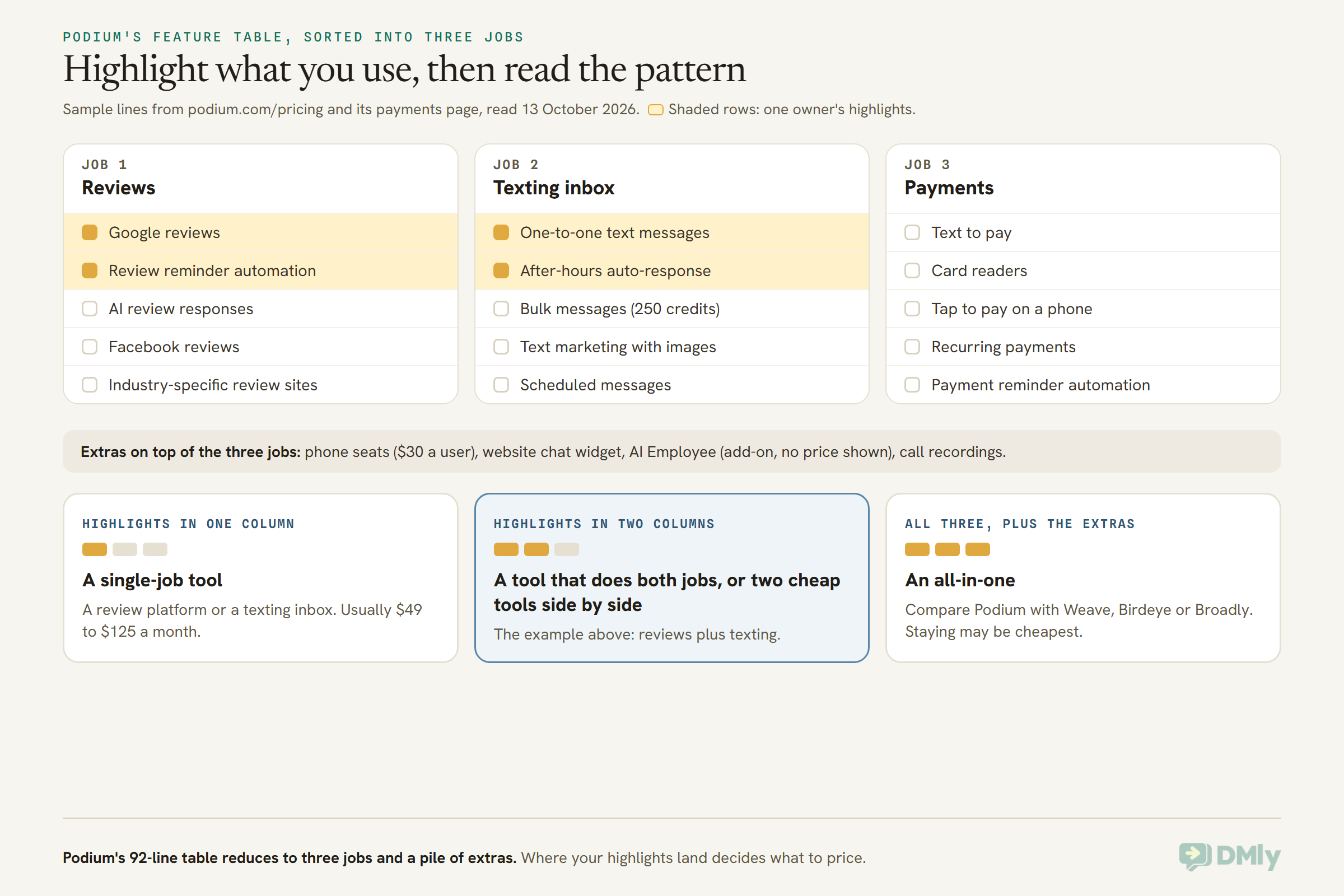
In the example in the figure, the owner highlighted three review lines and two texting lines, and nothing in payments. That’s a two-job business. It doesn’t need card readers, recurring billing or financing, and it shouldn’t pay for them.
One thing worth knowing before you go shopping: your Google reviews don’t belong to Podium. They live on your Google Business Profile, and they stay there whatever software you use to ask for them. What you’d lose by leaving are the tools around them: the request automations, the review widgets on your site, and the history in Podium’s inbox.
If You Only Use Reviews: Podium Alternatives for Google Review Requests
If almost all your highlights are review lines, the strongest Podium alternatives are dedicated review platforms such as NiceJob and GatherUp, which start at $75 and $99 a month and do review requests, monitoring and widgets without a texting inbox you don’t use. The trade-off is that you’ll talk to customers somewhere else, which is fine if that’s already your phone or your booking tool.
Whatever you pick, the job underneath is the same: send every customer your review link at the right moment, and answer the reviews that come in. If you want the method before the software, our guide to Google review automation covers the timing and the rules, and how to get more Google reviews automatically walks through the sequence step by step.
NiceJob
NiceJob is a review and reputation tool aimed at service businesses. Starter is $75 a month and Pro is $125 a month, both in US dollars, with no contract and a 14-day free trial (read 13 October 2026). Starter covers SMS and email review requests with follow-ups, review widgets for your website, auto-sharing to social media, a staff leaderboard and a reviews microsite. Pro adds AI-written review replies “in your brand voice”, rebooking reminders it calls Repeats, referrals, email broadcasts, NPS surveys and competitor tracking.
Pick it if reviews are your one job and you’d like the replies written for you. Think twice if you need a two-way texting inbox or text-to-pay, because neither is on its price list.
GatherUp
GatherUp is $99 a month for one location, or $60 a location a month for 2 to 10 locations, with 20% off on annual billing and a 14-day trial (read 13 October 2026). Every plan includes up to 300 SMS and 3,000 email credits per location a month, monitoring on 100+ review sites, NPS and surveys, QR codes and feedback links, AI-crafted replies and review widgets. A listings add-on, Listings Hub, is $40 a location a month, and a fake-review add-on called Review Defense comes in three plans.
Pick it if you have several locations, care about sites beyond Google and Facebook, or want a monthly SMS allowance built in. Think twice if you send more than 300 review texts a month per location, because that’s the included amount.
Grade.us, for agencies
Grade.us sits beside GatherUp and shows the same card for a single business: $99 a month for one location, $60 a location for 2 to 10. Its real audience is agencies. The Agency Plan is “$400+/mo” for 10 or more seats, which works out at $40 a seat, and the white label options let an agency put its own brand on the review funnels and reports. If you’re a marketing agency that resold Podium’s reviews to clients, this is the like-for-like look.
Broadly Reputation AI
Broadly sells its pieces separately as well as in a package. Reputation AI is $79 a month on Standard for managing Google and Facebook reviews, $89 on Pro where its AI writes the review responses, and “call for pricing” on Premium, which “requests and responds to reviews automatically” (read 13 October 2026). It’s a reasonable middle ground if you like the idea of AI replies and might grow into Broadly’s other tools later.
Birdeye
Birdeye is the name you’ll see in almost every Podium comparison, and its help centre lists reviews on 200+ sites, texting, website chat, payments and AI agents. We can’t give you a price. On 13 October 2026, both birdeye.com and its pricing page returned “Page temporarily unavailable”, the same message we got on 25 September. We didn’t try to get around it. Ask for a written quote, and compare it line by line with the Podium table you just highlighted.
One rule every review tool has to live with: Google’s policy says businesses must not “selectively solicit positive reviews from customers”. Asking for a private star rating first and sending the Google link only to happy customers, often called review gating, is exactly that. Whatever tool you use, check that every score reaches the review step. Ask every customer, then deal with the unhappy ones in public and in private: our guide to handling negative Google reviews shows how.
If You Only Use Texting: Business Texting Alternatives to Podium
If your highlights are mostly in the texting column, a shared SMS inbox such as Heymarket or Textline replaces that part of Podium, usually priced per person plus message credits rather than per location. That pricing shape suits a small team that texts a lot. It gets expensive if ten people need a login.
Heymarket
Heymarket publishes its prices. Standard is $49, Plus $99 and Pro $199 per user a month, billed annually, with a minimum of 2 users, and you can save up to 18% on annual billing (read 13 October 2026). Messaging is on top: credits are $0.03 each, so 1,000 credits a month costs $30. One SMS segment is one credit, a picture message is 2, and a reply written by its AI agent is 3 credits a segment. Standard gives you two-way messaging, a shared inbox, templates and tags; Plus adds lists, campaigns and automations; Pro adds more AI and API access. WhatsApp is listed only on Enterprise.
For two people on Standard with 1,000 credits, that’s $98 plus $30, or $128 a month, before any phone registration fee.
Textline
Textline has three plans, Essentials, Pro and Enterprise, but the plan prices weren’t printed on its pricing page when we read it on 13 October 2026. What it does publish: Essentials includes at least 600 message credits a month and three agents, Pro at least 2,000 credits and five agents, extra credits are $0.03 each bought in advance, and “backup” credits bought automatically when you run low are $0.04. A picture message costs three credits. On a 10-digit number, “you’ll see a $15 campaign fee on your bill each month”, while toll-free numbers had no monthly registration fee. HIPAA-compliant plans cost extra, which matters for clinics.
Pick Textline or Heymarket if texting is the job and you’re happy to keep reviews and payments somewhere else. Think twice if you need reviews in the same place, because neither lists review management on its pricing page.
DMly, if some customers prefer WhatsApp
DMly isn’t an SMS-only tool, but it does texting. You connect your own Twilio or Plivo account, and SMS replies land in the same shared inbox as WhatsApp, Instagram, Messenger and website chat. There’s no messaging window on SMS, so you can text anyone at any time. DMly doesn’t charge per text; your provider does. More on where that helps and where it doesn’t in the DMly section below, and our SMS marketing automation guide covers gateways, flows and compliance in depth.
Texting Customers in the US: 10DLC and the WhatsApp Rule Every Podium Alternative Shares
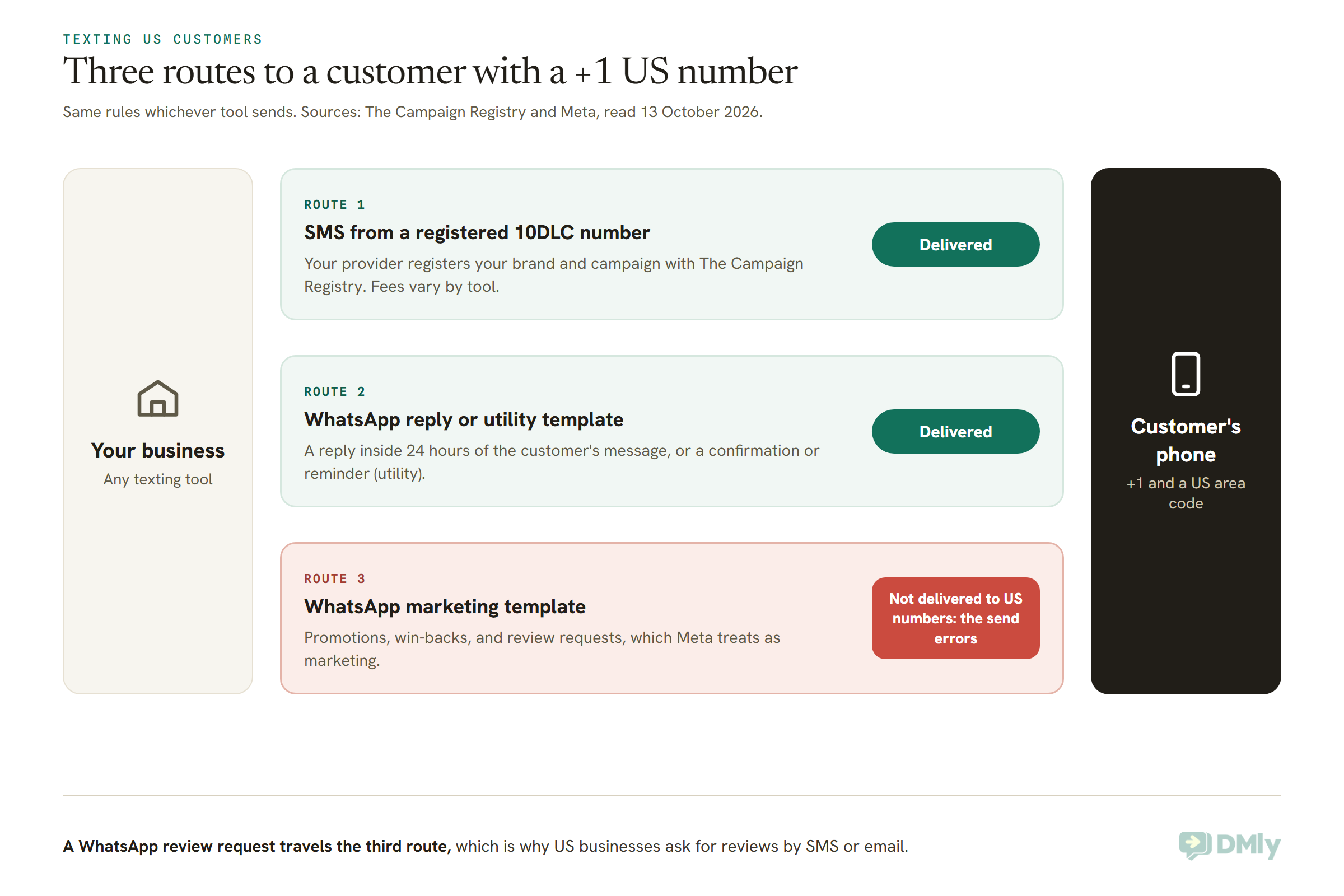
Every texting tool you could swap Podium for has to send through a registered route in the US, and none of them can deliver a WhatsApp marketing message to a US number. These two rules come from the carriers and from Meta, not from the software, so switching tools doesn’t make them go away.
10DLC. Most business texts in the US go out from an ordinary 10-digit number, known as a 10-digit long code or 10DLC. The Campaign Registry, the body that runs the registration system for the carriers, describes 10DLC as a channel “in which Brands and Campaign Service Providers (CSPs) are verified prior to being allowed to send messages.” You can’t register yourself directly. Your texting provider registers your business (the “brand”) and what you’ll send (the “campaign”) for you, and passes the fees on.
That’s why the fees show up differently on each bill: $5 a month per US location on Podium, a $15 monthly campaign fee on Textline, and whatever Twilio or Plivo charge if you bring your own provider to a tool like DMly. Before you cancel Podium, make sure your new provider has your registration done, or your texts may not go out at all.
WhatsApp in the US. Meta’s own developer documentation says: “WhatsApp does not currently deliver marketing template messages to WhatsApp users with United States phone numbers.” Trying to send one returns an error. Replies to a customer who messaged you first, inside the 24-hour customer service window, are fine. So are utility messages such as appointment confirmations. Promotions, and anything Meta classes as marketing, are not.
That catches review requests. Meta treats a review request as marketing, and DMly’s own docs list its review request template, dmly_review_request, as Marketing. In plain words: if your customers have US phone numbers, a WhatsApp review request won’t reach them. Ask by SMS or email instead. Our comparison of WhatsApp marketing vs SMS marketing goes through which channel suits which message.
Outside the US the picture changes. In the UK, the EU, India, Nigeria, the Gulf and most of Southeast Asia, WhatsApp is where a lot of customers already talk to businesses, and marketing templates do deliver (with Meta’s own limits on how many one person receives). That’s the single biggest reason a Podium alternative might look different for you than for a business in Ohio.
If You Use Reviews, Texting and Payments Together: All-in-One Podium Alternatives
If your highlights run across all three columns, compare Podium with another bundle rather than stitching three tools together: Weave for healthcare practices, Broadly for owner-run home services, Birdeye if you can get a quote, and DMly if your customers message on WhatsApp. The question here isn’t “is it cheaper”, it’s “does it do my three jobs from one inbox”.
Weave, for dental, medical, vet and optometry practices
Weave is built for healthcare practices and says so on every line of its pricing page. Plans start “from $199 per month”, and the three tiers, Pro, Elite and Ultimate, are priced on request (read 13 October 2026). Bulk texting allowances are 1,500, 3,000 and 15,000 messages a month across the three. The feature list covers VoIP phones (up to 15 handsets on Ultimate), appointment reminders and confirmations, two-way texting, missed call texting, online scheduling, digital forms, reviews, email marketing, text to pay, payments, Buy Now Pay Over Time, recall and call analytics, with extras for dental insurance verification and vet vaccine reminders.
Pick it if you run a practice and want phones, texting, reviews and payments tied to your practice software. Think twice if you’re not in healthcare, because the whole product is shaped around patients. If you handle US patient information, ask Weave about a business associate agreement in writing; we didn’t find that on the pricing page.
Klara, now ModMed Patient Engagement
Klara’s pricing link now redirects to ModMed’s Patient Engagement page, which lists specialties such as dermatology, ophthalmology, orthopedics and urology. It covers two-way texting, call-to-text, text payment links and post-appointment surveys that help gather reviews. There’s no published price; you book a demo. It’s worth a look if your practice already runs on ModMed, and probably not otherwise.
Broadly, for owner-run home services
Broadly’s pricing page leads with a $799 a month “AI Workforce Package”: an AI receptionist for calls, texts and web chat, AI review replies, social posts, a website and listings, set up by Broadly’s team. Below it are tier cards at $399 Standard, $699 Pro and $999 Premium, each marked “$350 onboarding & setup, Billed monthly” (read 13 October 2026). The FAQ for the $799 package says there are no setup fees, so the page contradicts itself; ask which applies to you.
Standard’s AI chat receptionist answers web chat, Facebook, Instagram and WhatsApp. SMS texting, missed-call text-back and AI review replies arrive on Pro, and a voice receptionist with 300 minutes on Premium. There’s no long-term contract. Payments aren’t on the list, though Broadly mentions Stripe and QuickBooks among its integrations. Broadly says home services are its largest segment, and its parent company is Vendasta.
Pick it if you’re a plumber, roofer or cleaner who wants the whole thing done for you. Think twice if you take payments by text today, because you’d need a separate tool for that.
Birdeye
Birdeye’s help centre covers reviews, texting, website chat, payments, listings and AI agents, so on paper it’s the closest like-for-like for Podium. Its pricing page wasn’t available on 13 October 2026, so get a written quote and check it against your highlights rather than against a headline number.
DMly, if your customers use WhatsApp
DMly does all three jobs, but in a different shape from Podium: WhatsApp first, with SMS, Instagram, Messenger, Telegram, TikTok and website chat in the same inbox, Google reviews in the same app, and pay links on top. It starts at $29 a month billed yearly. The full fit, and the cases where it’s the wrong choice, are in their own section below.
Payments: what each bundle actually does
If payments is one of your highlighted columns, check which kind of payment you use, because the bundles differ more here than anywhere else:
- Text-to-pay link (send a link, customer pays on their phone): Podium, Weave, Textline (it lists a Payments product), Klara and DMly. If that’s all you use, our guide to creating online payment links shows how simple the job can be.
- Card reader or tap to pay at the counter: Podium lists both. Weave lists payments for practices. DMly doesn’t have a card reader of its own; card machine and cash payments are recorded by hand against the invoice.
- Financing (Buy Now Pay Later): Podium and Weave list it. DMly doesn’t.
- Recurring payments: Podium lists them, and DMly has subscriptions with auto-charge through your connected gateway.
What About Podium’s AI Employee?
Podium’s AI Employee is an add-on to any plan with no price on the page, so if it’s one of your highlights, the fair comparison is another tool’s AI answering after hours, writing review replies or booking appointments. Here’s what each one publishes:
- Podium: AI suggested replies and AI review responses on every plan; an AI Concierge and AI Reputation Specialist on Pro; AI Scheduler, Salesperson and Marketer on Signature; the AI Employee as a separate add-on. AI Messaging includes 1,500 segments a month under its Scope of Use terms.
- Broadly: an AI chat receptionist from Standard, SMS on Pro, a phone voice receptionist on Premium, and Conversations AI on its own from $139 a month.
- NiceJob: AI review replies on Pro ($125).
- Heymarket: AI features from Plus, with AI agent replies costing 3 credits a segment.
- DMly: AI on every plan, Starter included. What changes with the plan is the monthly allowance of AI replies on DMly’s shared AI: 500, 5,000 and 20,000. On Premium you can connect your own OpenAI, Claude, Gemini or DeepSeek key for unlimited replies. If you want to build one, see how to build a WhatsApp AI receptionist.
One honest gap on the DMly side: its docs don’t describe AI-drafted Google review replies. Replies are typed by you and post straight to Google.
Podium Alternatives Compared: Prices Read 13 October 2026
Podium alternatives range from $29 to $399 a month at list price for one location, but the starting price tells you less than how each tool scales: by location, by user, or by message. Every figure below was read on the vendor’s own site on 13 October 2026. Where a price isn’t published, we say so rather than borrow someone else’s number.
| Tool | Starting price | Priced by | Reviews | Texting inbox | Payments | |
| Podium | $399 Core, $599 Pro, Signature custom; +$5 10DLC per US location | Plan; phones per user | Google, Facebook, industry sites | Yes, 250 or 500 bulk credits | Text to pay, card readers, tap to pay | Not listed |
| NiceJob | $75 Starter, $125 Pro | Plan | Yes, SMS and email requests | No | No | Not listed |
| GatherUp | $99 one location; $60 a location for 2 to 10 | Location | Yes, 100+ sites | 2-way SMS listed as a feature | No | Not listed |
| Grade.us | $99 one location; Agency Plan $400+ (10+ seats) | Location or seat | Yes, white label | No | No | Not listed |
| Broadly | $399 Standard (+$350 setup on the tier card); $799 package; Reputation AI from $79 | Package or tool | Google and Facebook | Web chat and social on Standard; SMS from Pro | Not listed | AI chat receptionist answers WhatsApp |
| Heymarket | $49 a user billed annually, 2 users minimum; credits $0.03 | User plus credits | Not listed | Yes | Not listed | Enterprise only |
| Textline | Not published; credits $0.03 to $0.04; $15 a month 10DLC campaign fee | Plan plus credits | Not listed | Yes | Payments product listed | Not listed |
| Weave | From $199; tiers by quote | Plan | Yes | Yes, 1,500 to 15,000 bulk texts | Text to pay, payments, BNPL | Not listed |
| Klara (ModMed) | Not published | Quote | Surveys that help gather reviews | Yes | Text payment links | Not listed |
| Birdeye | Pricing page unavailable 13 Oct 2026 | Unknown | 200+ sites (help centre) | Texting (help centre) | Payments (help centre) | Not checked |
| DMly | $29 Starter, $65 Growth, $149 Premium, billed yearly | Plan; SMS paid to your own provider | Google only: requests, replies, posts | Yes, with WhatsApp, SMS, social and website chat | Pay links through your gateway | Yes, built around it |
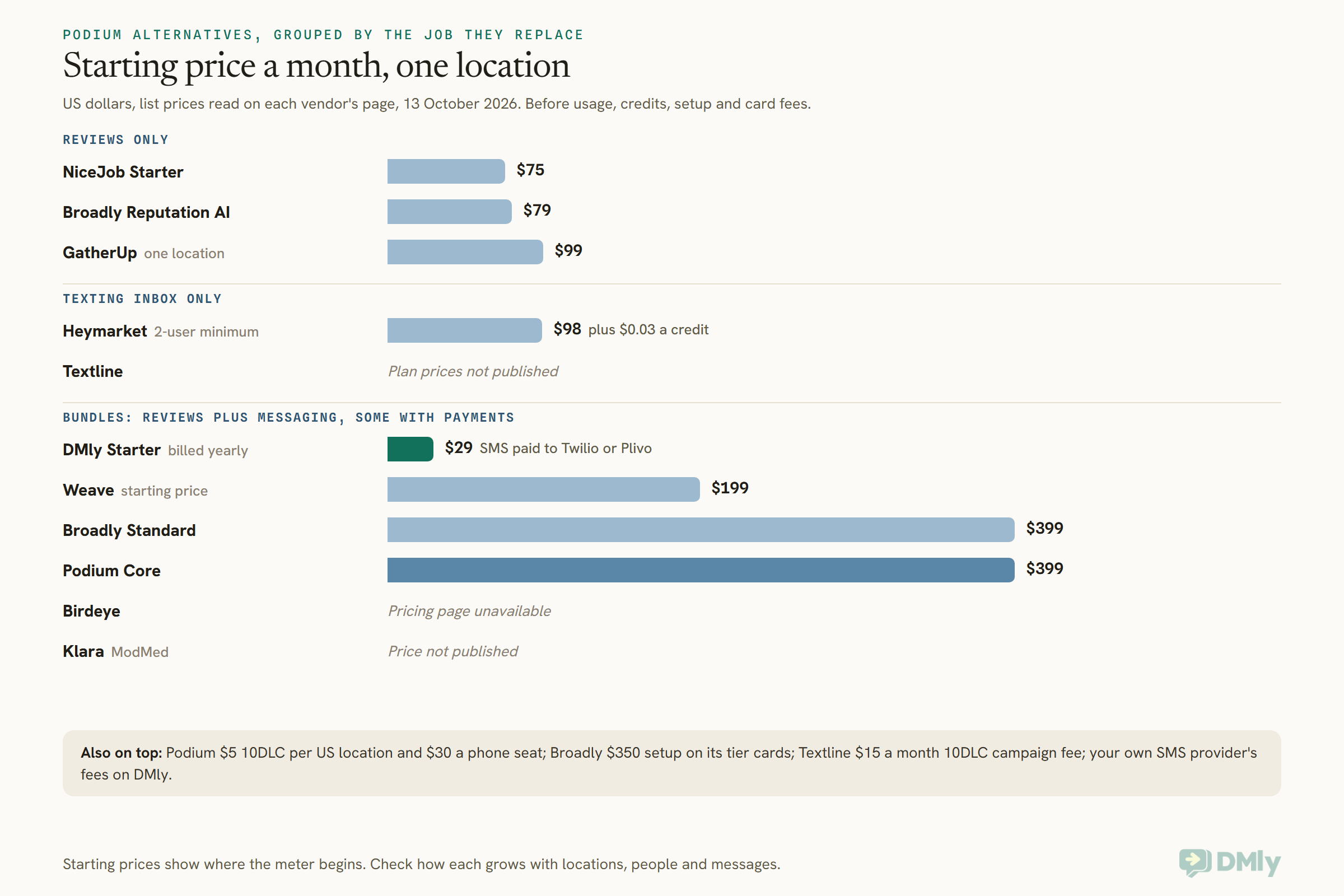
A quick way to use the table: take your three busiest months, count people who need a login, locations and texts sent, and price each shortlisted tool on those three numbers. Per-user tools like Heymarket get cheaper than Podium for a two-person shop and more expensive for a twelve-person one. Per-location tools like GatherUp scale the other way.
When Podium Is Still the Right Choice
Stay on Podium if your highlights cover reviews, texting, payments and phones together, especially in the US with card readers in the shop or on the van. Very few cheaper tools replace all four from one number. Being fair about it, Podium is stronger than most alternatives here when:
- You text and call from the same number. Podium Phones puts calls, texts, call recordings and missed-call automation on one line. The texting tools above don’t sell phone seats, and DMly doesn’t sell phone lines or desk phones either.
- You take card payments in person. Podium lists card readers and tap to pay on a phone. If your techs take payment in the customer’s driveway, that matters.
- Your reviews matter on Facebook and industry sites as well as Google. Podium covers all three on every plan. NiceJob, GatherUp and Birdeye do too; DMly is Google only.
- Unlimited users and one-to-one texts matter to you. A twelve-person team on a per-user texting tool can cost more than Podium’s flat plan.
- You value a named customer success manager. Podium includes one on every plan. Most self-serve tools don’t.
If that’s you, the better move may be a renegotiation rather than a switch: show your Podium rep the lines you don’t use and ask what Core costs without them.
Is DMly a Good Podium Alternative? Where It Fits and Where It Doesn’t
DMly is a good Podium alternative for a local business whose customers message on WhatsApp, which wants Google reviews, a shared inbox and pay links in one app for $29 to $149 a month, and it’s the wrong choice for a US business that needs phones, card readers or WhatsApp review requests to American numbers. Here’s both sides, from DMly’s own docs.
Reviews in DMly
Reviews live under Reputation, which is on every plan, Starter included. You connect your Google Business Profile (one per location) and get five tabs: Performance, Reviews, Request reviews, Posts and Business info.
- Reviews: read your Google reviews and post a public reply that goes straight to Google. There’s no draft or approval step; Post reply publishes immediately, and a second reply replaces the first. Nobody can delete a Google review, and DMly doesn’t pretend to.
- Request reviews: send a tracked review link by WhatsApp, SMS or email, to up to 200 contacts at a time, or add a Request Google review step to an automation so it goes out after every job. The Opened count comes from the tracked link, so it’s the number to trust. You can also copy your plain Google review link for receipts and bios.
- Print assets: a tracked QR code as a counter card, a round door sticker or a table tent, with a running scan count.
- Posts: publish or schedule Google updates, offers and events.
- Business info: edit your phone, website, description and hours, and switch on a WhatsApp button on your Google listing where Google offers it for your category and region.
If you use the Post-chat CSAT to Google review template, test it before you switch it on and check that every score reaches the review step. Low scores can go to a person first as well, never instead of the link.
Texting and messaging in DMly
WhatsApp is the main channel, and Instagram, Messenger, Telegram, TikTok, SMS and a website chat widget all land in the same inbox. SMS comes through your own Twilio or Plivo account: replies and delivery reports come back on both, there’s no 24-hour window, and DMly doesn’t add a per-text fee. It’s plain text only, and DMly doesn’t count segments or track what a long message costs you, so watch spend in your provider’s dashboard. The sender number you choose, and whether it’s registered for 10DLC, is between you and Twilio or Plivo.
Payments in DMly
Connect Stripe, PayPal, Paystack, Flutterwave, Razorpay, MyFatoorah, Mercado Pago or Monnify, and DMly mints a pay link for an invoice, a booking or any amount from the inbox. You share it by WhatsApp, SMS, email or a QR code, and the customer pays on the gateway’s own checkout page. The invoice marks itself paid once the gateway’s webhook reaches DMly, which you set up once in the gateway’s dashboard. Cash and card machine payments are recorded by hand.
Where DMly is the wrong choice
- Your customers are almost all in the US and you wanted WhatsApp review requests. They won’t deliver to US numbers, because Meta treats them as marketing. You’d ask by SMS through your own provider, or by email from the Request reviews tab, which works but isn’t the WhatsApp advantage.
- You need Facebook, Yelp or industry-site reviews. DMly’s Reputation is Google Business Profile only.
- You want AI to write your review replies. The docs don’t describe it; you write them.
- Your phones are on Podium. DMly doesn’t sell phone seats, phone lines or desk phones.
- You take card payments in person. No card reader or tap to pay; those payments are recorded, not taken.
- You need it all set up for you. DMly is self-serve with a 7-day trial and no card. If you want a team to build it, Broadly or Podium’s onboarding suits you better.
- You’re a US practice handling protected health information. DMly’s docs don’t state a HIPAA position or offer a business associate agreement. Weave, Klara or a HIPAA plan on Textline are the places to ask.
Where DMly fits best
Outside the US, or for a US business whose customers are mostly international, DMly covers the three Podium jobs for a fraction of the list price. Starter is $29 a month billed yearly with 3 seats, 3,000 active contacts, 10,000 broadcast and template messages and 500 AI replies; Growth is $65 with 6 seats and 5,000 AI replies; Premium is $149 with 15 seats. Reputation and Google reviews, bookings, invoices and payments are on all three, and DMly adds no markup on WhatsApp’s own message rates. The current figures are always on the DMly pricing page.
How to Leave Podium Without Losing Reviews, Numbers or Payments
Leave Podium in the reverse order you joined: get the new texting route registered and tested first, move contacts and automations second, and cancel last, after you’ve read your agreement for its notice period. Here’s an order that keeps customers answered throughout.
- Read your agreement. Podium’s pricing page doesn’t print contract length or cancellation terms, so find your signed order form and note the renewal date and notice period before anything else.
- Ask about your number in writing. If customers text or call a number Podium gave you, ask Podium whether you can port it out and what it needs from you. A new number means a new, unknown thread on every customer’s phone.
- Register the new texting route. For US texting, your new provider needs your 10DLC brand and campaign registered before you send. Do this first; it’s the step that can’t be rushed at the end.
- Export your contacts. Names, numbers, emails and any tags you rely on. Import them into the new tool and spot-check twenty records.
- Rebuild the review request. Your Google reviews stay on Google; only the asking moves. Set up the new request after every completed job, ask everyone (no gating), and send yourself a test.
- Move payments carefully. If customers are on recurring payments through Podium, ask how cards on file are handled when you leave, and plan how each customer will re-enter card details with the new provider.
- Swap the website chat last. Replace Podium’s widget with the new one on the day you’re ready to answer in the new inbox.
- Run both for a week. Check every inbox twice a day, then cancel when nothing has arrived in Podium for several days.
Choosing a Podium Alternative: Six Local Businesses, Six Answers
The right Podium alternative depends on where you are and which jobs you highlighted, so here are six illustrative businesses and the choice that fits each. They’re examples to reason from, not customer stories.
- An HVAC company in Phoenix, two vans, phones on Podium. Highlights cover all three jobs plus phones and tap to pay in the driveway. Stay on Podium and renegotiate, or price Broadly’s Pro tier for the AI receptionist and keep a separate card reader. A self-serve tool won’t replace the phones.
- A dental practice in Columbus, Ohio. Highlights: reminders, recall, texting, reviews and text to pay, all tied to the practice software. Weave is built for this. Ask in writing about a business associate agreement.
- A med spa in Austin that only used review requests. One column of highlights. NiceJob Pro at $125 with AI replies, or GatherUp at $99 if the 300 included texts a month are enough. Either saves most of the $399.
- A barbershop in Manchester. Customers book and chat on WhatsApp, reviews matter on Google, payment is by card at the chair. DMly for the inbox, booking reminders and Google review requests on WhatsApp, which do deliver to UK numbers, with Stripe for any deposits. Card payments at the chair stay on the shop’s existing reader.
- A physiotherapy clinic in Pune. Patients message on WhatsApp and pay by UPI or card. DMly with Razorpay covers the inbox, reminders, pay links and Google reviews. Podium doesn’t list WhatsApp, which is how these patients message.
- A diagnostic centre in Abuja. Booking questions on WhatsApp, payments by card or transfer, and Google reviews from patients. DMly with Paystack, Flutterwave or Monnify, plus SMS through Twilio or Plivo for the patients who don’t use WhatsApp.
Notice the pattern: the US businesses with phones and card readers have the fewest reasons to leave, and the businesses whose customers live on WhatsApp have the most.
Frequently Asked Questions
What are the best Podium alternatives for a small business?
It depends on which of Podium’s jobs you use. For reviews only, NiceJob ($75 to $125 a month) and GatherUp ($99 for one location). For a texting inbox only, Heymarket ($49 a user billed annually, two-user minimum) or Textline. For all three jobs, Weave for healthcare practices, Broadly for home services, Birdeye on a quote, and DMly ($29 to $149 billed yearly) where customers use WhatsApp. Prices read 13 October 2026.
How much does Podium cost in 2026?
Podium’s pricing page lists Core at $399 a month and Pro at $599, with Signature on custom pricing, and asks you to talk to sales for every plan. On top, US locations pay a $5 monthly 10DLC fee, phone seats are $30 a user a month for 1 to 4 users with a $500 network fee per location, and the AI Employee is an add-on with no published price.
Is there a cheaper alternative to Podium just for Google reviews?
Yes. If review requests are the only part you use, NiceJob Starter is $75 a month and GatherUp is $99 for one location, both with 14-day trials. DMly includes Google review requests, replies and posts on its $29 Starter plan, though its WhatsApp review requests don’t reach US phone numbers.
Do I need 10DLC registration if I switch texting tools?
If you text US customers from an ordinary 10-digit number, yes, whichever tool you use. Your texting provider registers your brand and campaign with The Campaign Registry for you; businesses can’t register directly. Fees vary: Podium charges $5 a month per US location, Textline shows a $15 monthly campaign fee, and with DMly you’d pay whatever Twilio or Plivo charge.
Can I send Google review requests on WhatsApp to US customers?
No. Meta doesn’t currently deliver marketing template messages to US phone numbers, and review requests count as marketing. Ask US customers by SMS or email instead. In most other countries, WhatsApp review requests do deliver, within Meta’s limits.
Which Podium alternatives take payments by text?
Weave, Klara, Textline and DMly all list text payment links, and Podium itself does. Podium also lists card readers and tap to pay. DMly sends pay links through your own gateway (Stripe, PayPal, Paystack, Flutterwave, Razorpay, MyFatoorah, Mercado Pago or Monnify) but has no card reader of its own.
Will I lose my Google reviews if I leave Podium?
No. Your reviews belong to your Google Business Profile, not to any review tool. Leaving Podium removes its widgets, automations and inbox history, but every review stays on your Google listing.
Is DMly a Podium alternative for businesses outside the US?
Yes, that’s where it fits best. Outside the US, WhatsApp review requests, reminders and promotions deliver, and DMly puts WhatsApp, SMS, social and website chat in one inbox with Google reviews and pay links on every plan from $29 a month billed yearly.
Choosing Between Podium Alternatives: The Highlighter, Put Away
Go back to the table you marked up at the start. If the colour sits in one column, you’ve been paying $399 a month for a job a $75 to $125 tool does well, and the switch is easy. If it sits in two, price a tool that does both and compare it with two cheap single-job tools side by side. If it runs across all three columns and into the phones, Podium is doing real work for you, and a firm conversation with your rep about the lines you didn’t highlight may save more than any of the Podium alternatives here.
And if a lot of your customers would rather message you on WhatsApp than wait for a text, that’s the line no US-built tool highlighted for you. Try DMly free for 7 days, no card needed, connect your Google profile and your WhatsApp number, and see how many of your highlighted lines it covers before your next Podium renewal date.
Writing about WhatsApp automation, bookings and growth for local business.
Turn WhatsApp into your busiest channel.
Start free and run message, bookings, payments and reviews in one place.
