
Best AiSensy Alternatives for WhatsApp Marketing in 2026
Start a stopwatch. On AiSensy’s Basic plan, a sale message to 10,000 customers leaves at 40 a second, so the whole send is out in four minutes and ten seconds. People comparing AiSensy alternatives almost never ask about that number, and they’re mostly right not to.
Speed is the one thing on a campaign that nobody notices once it’s good enough. What decides whether your WhatsApp marketing makes money is everything around those four minutes: how the people got onto your list, whether you can see who tapped your offer, what you send to the ones who read it and didn’t buy, and how much above Meta’s own price you pay for every single message.
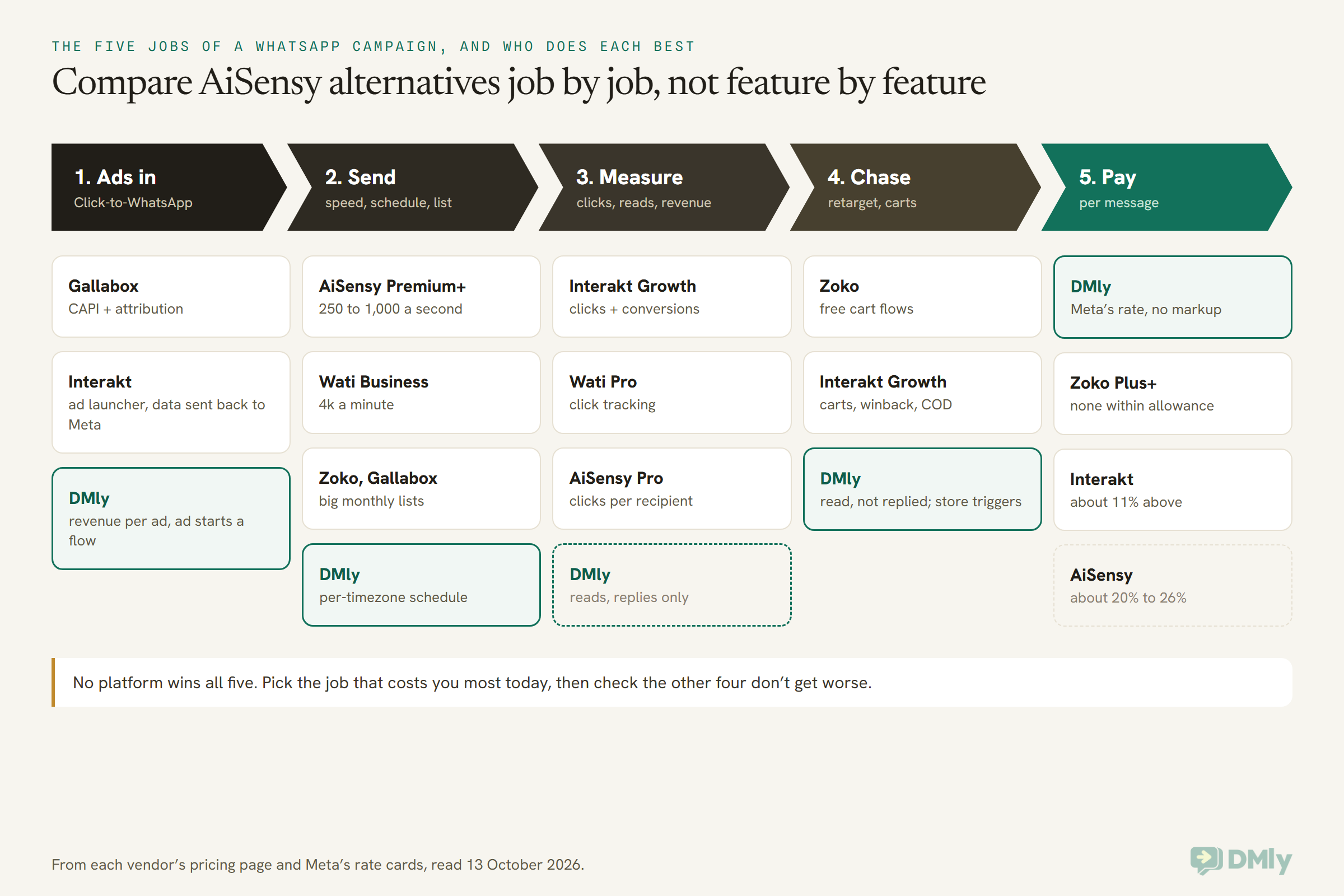
That’s where the real differences between platforms sit. In this guide, we’ll look at what AiSensy gives a campaign team today and where it pinches, then compare seven AiSensy alternatives job by job: Click-to-WhatsApp ads, sending, tracking, retargeting and abandoned carts, and the per-message price. Then we’ll profile each one, including DMly, and tell you plainly when you should stay where you are.
The Short Answer: AiSensy Alternatives by the Campaign Job You Need Done
The best AiSensy alternative depends on which part of your campaign hurts: Interakt for low per-message cost with Shopify flows, Zoko for big Shopify sends with no markup, Gallabox for ad attribution, Wati for a familiar all-rounder, and DMly when the campaign has to end in a booking or a payment. If none of those jobs hurts, staying on AiSensy is a perfectly good answer.
| If your problem is… | Look at | Why, in one line |
| Paying too much above Meta on Indian numbers | Interakt Growth | About 11% above Meta’s rupee rate against AiSensy’s 26%, unlimited agents, Shopify flows built in |
| Large Shopify sends every month | Zoko Plus or Elite | No markup on the first 5,000 or 100,000 conversations, every feature on every plan |
| Proving which Click-to-WhatsApp ad made money | Gallabox Essential | Conversions API and ad attribution, plus AI agents on WhatsApp |
| Wanting Instagram, TikTok and WhatsApp campaigns in one place | Wati Pro | Click tracking, retargeting and CTWA source tags, but its rate card runs about 25% above Meta |
| A big sales team that needs AI included | DoubleTick Pro + AI | 10 agents and AI credits in the plan, though scheduled broadcasts are Enterprise only |
| A campaign that has to end in a booking, an invoice or a review | DMly | Meta’s rate with no markup, revenue per ad, and the bookings and payments in the same app |
| A large support team that also broadcasts | respond.io or SleekFlow | Strong shared inboxes, but broadcasts start on the mid plan and price rises with active contacts |
What AiSensy Gives a Campaign Team in October 2026
AiSensy is a WhatsApp marketing platform built around broadcasts: it publishes sending speeds, includes a Click-to-WhatsApp ads manager even on its free plan, and charges nothing for holding contacts, but scheduling and click tracking start on Pro, and the chatbot and AI agent are paid add-ons on every plan. We’ve written the full teardown in our AiSensy review, so here’s only what matters for comparing campaign tools.
We read both of AiSensy’s price lists on 13 October 2026. They’re two separate lists, one in rupees for India and one in dollars for everyone else, and the dollar one isn’t a conversion of the rupee one.
| AiSensy plan (billed monthly) | India list | International list | What it adds for campaigns |
| Free Forever | ₹0 | $0 | The API, a blue tick application, the Click-to-WhatsApp ads manager. No broadcasting |
| Basic | ₹1,500 | $45 | Broadcasting and retargeting at 40 messages a second, 2 audience segments, 10 tags, owner plus 5 agents |
| Pro | ₹3,200 | $99 | Campaign scheduler, click tracking per recipient, campaign budget analytics, automatic retry of failed messages, 10 segments |
| Premium | ₹9,100 | $299 | 250 messages a second, number masking, downloadable reports, owner plus 9 agents |
| Unlimited | ₹45,000 | $899 | 1,000 messages a second, up to 200 agents |
Paying yearly takes 10 per cent off. On top of any plan, the chatbot builder is ₹2,500 or $80 a month for five chatbots, the AI chat agent is ₹1,350 or $50 a month for 1,000 AI messages, and extra team seats are ₹750 or $20 each.
Two things on that list surprise people who bought AiSensy for marketing. The first is that Basic, the plan most small brands start on, can’t schedule a campaign or tell you who clicked. Both arrive on Pro. The second is the per-message price, which we’ll get to in its own section, because it has quietly become the biggest line on a busy sender’s bill.
Credit where it’s due, too. AiSensy updated its pricing page for Meta’s October changes: it now states the 1,000 free service messages a month and that utility messages inside the 24-hour window are charged. And holding a huge list costs nothing there, which no per-contact plan can match.
Why Marketing Teams Look for an AiSensy Alternative
Most teams that look for AiSensy alternatives aren’t unhappy with the broadcasts; they’re unhappy with the bill around them: the per-message price on high volumes, the Pro upgrade needed for scheduling and click tracking, and the add-ons needed for anything that happens after the customer replies. Here are the four reasons we hear most, in roughly the order they bite.
- The message price at volume. AiSensy’s rupee rate for a marketing message to an Indian number is ₹1.09. Meta’s own rupee card, effective 1 October 2026, says ₹0.8631. On a few hundred messages that’s nothing. On 50,000 a month it’s over ₹11,000 a month.
- Paying for Pro to see results. If you can’t schedule a sale or see who tapped the link, you’re running campaigns half blind. On AiSensy that means ₹3,200 or $99 a month, not ₹1,500 or $45.
- The conversation after the campaign. A broadcast that gets 400 replies needs something to answer them. On AiSensy that’s the ₹2,500 chatbot add-on, the ₹1,350 AI agent, or people.
- WhatsApp is the only channel. If half your customers reply to your Reels in Instagram DMs, AiSensy doesn’t see them.
Not one of those is a flaw in the product. They’re the shape of its pricing. Whether they matter depends entirely on which of the five campaign jobs you spend your money on, so let’s take them one at a time.
Job 1: Which AiSensy Alternatives Handle Click-to-WhatsApp Ads Best?
For Click-to-WhatsApp ads, Gallabox and Interakt go furthest among AiSensy alternatives: Gallabox connects Meta’s Conversions API with ad attribution from its Essential plan, and Interakt includes an ad launcher that sends conversion data back to Meta on every WhatsApp plan. AiSensy itself is strong here, with an ads manager on every plan including Free, so don’t switch for this job unless attribution is what’s missing.
A quick translation first. A Click-to-WhatsApp ad (often shortened to CTWA) is a Facebook or Instagram ad whose button opens a WhatsApp chat with you instead of a website. They matter for two reasons. Every customer who arrives this way has messaged you first, so you can reply freely. And Meta gives you a 72-hour free entry point window after they tap, so the follow-up messages in that window cost nothing. If you’re new to them, our click-to-WhatsApp marketing guide covers the ads, links and QR codes in full.
What separates the tools is what happens after the tap. There are three levels:
- Launch the ad from inside the tool. AiSensy (every plan), Interakt (every WhatsApp plan) and Wati (from Growth, “Launch CTWA ads”) all let you build the ad without opening Meta’s Ads Manager.
- Know which ad each chat came from. Wati Pro adds CTWA source tags. AiSensy Premium lets several ads trigger the same chatbot flow. DMly marks every ad-referred chat with a small card showing the ad, and writes the ad’s name onto the contact as its source, so you can build a segment of “everyone who came from the summer sale ad”.
- Send the result back to Meta, or see the money. Gallabox Essential ($248 a month billed annually) lists “CAPI + Ads attribution + analytics”. Interakt lists “Pass Conversion Data to Meta”. DoubleTick sells “CTWA optimization via Conversion API” as an add-on, and SleekFlow includes Meta’s Conversions API on Premium. Telling Meta who actually bought helps its algorithm find more buyers like them.
DMly takes a different route on the third level. Its Ads report (Reports, then the Ads tab) shows, for every Click-to-WhatsApp ad, how many people messaged, how many were new to you, and how much those people have since paid you through DMly invoices and orders. Connect your Meta ad account, which depends on your plan, and the spend appears beside it. It gives credit to the first ad that brought a customer in, so a re-engagement ad doesn’t claim customers it only reminded.
Two honest limits on DMly here. It doesn’t build or launch the ad: you make it in Meta’s Ads Manager and DMly reads what it produced. And it doesn’t send conversion events back to Meta, at least nowhere in its documentation. If launching from one screen or feeding Meta’s algorithm is the point, Interakt or Gallabox fits better.
Job 2: Sending the Broadcast: Speed, Scheduling and How Big a List
Only two platforms in this comparison publish a sending speed, AiSensy and Wati, and for most small brands speed matters far less than two other limits: how many people the plan lets you broadcast to each month, and how many different customers Meta lets your number reach in 24 hours. Here’s what the stopwatch says for the speeds that are actually published.
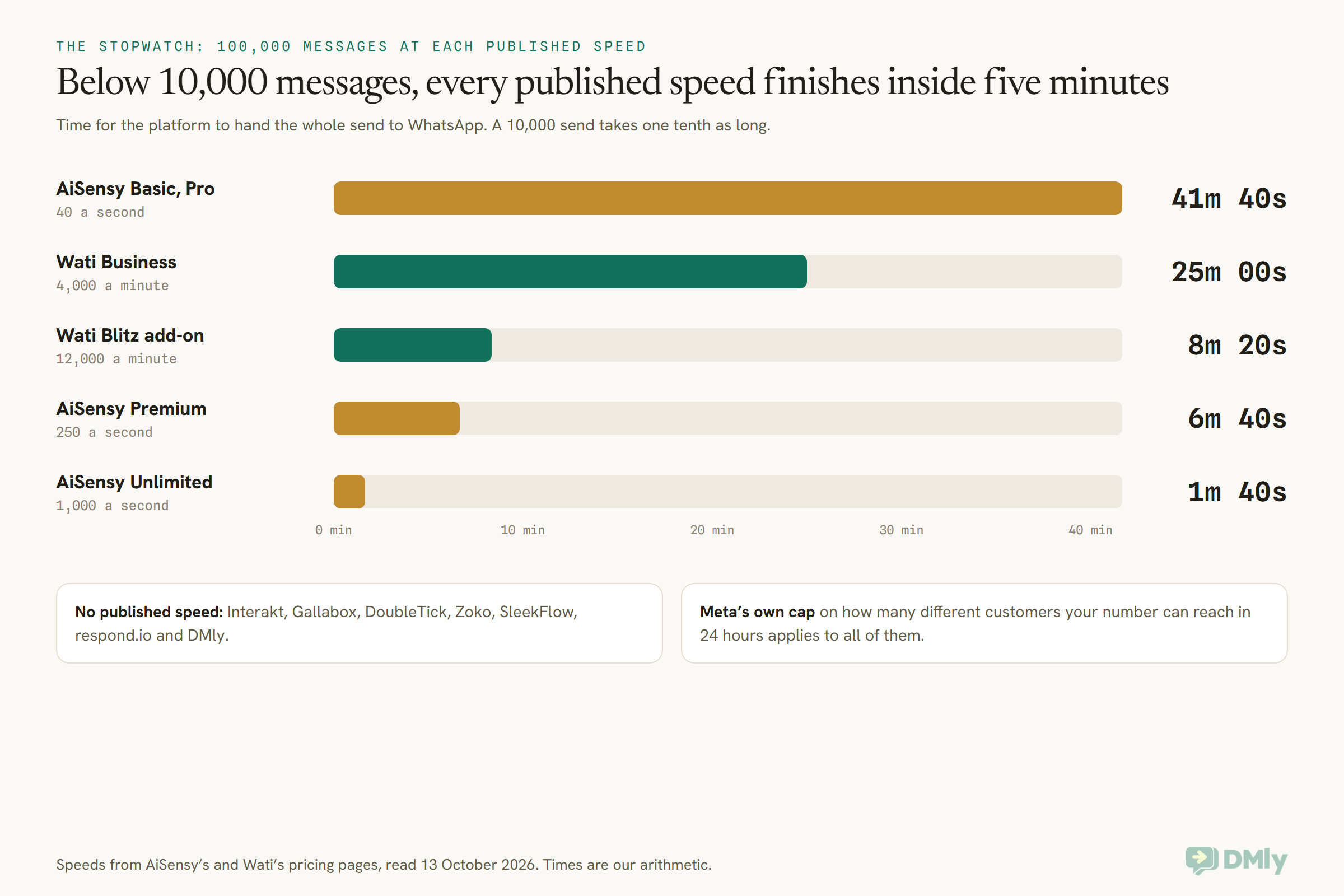
So if you run flash sales to a six-figure list where the first twenty minutes are the whole sale, AiSensy Premium or Unlimited is genuinely hard to beat, and this comparison won’t change that. For everyone else, the limits that actually stop a campaign are these:
- Monthly broadcast caps on the plan. Wati Growth includes 15,000 broadcasts a month (Pro is unlimited). Gallabox caps the broadcast contacts a month at 10,000 on Basic, 500,000 on Essential and 1 million on Advanced. DMly includes 10,000, 50,000 or 300,000 broadcast and template messages per billing period on Starter, Growth and Premium, and refuses a broadcast that won’t fit when you schedule, send or approve it, rather than stopping halfway through the send.
- Which plan can schedule. AiSensy needs Pro. DoubleTick’s own comparison grid shows scheduled broadcasts on Enterprise only, which is a real gap for a team that wants to set Friday’s sale on Wednesday. DMly can schedule on every plan, either at one time for everyone or at the same local time in each contact’s own timezone.
- Priced by active contacts. respond.io bills by monthly active contacts, and its pricing page says a contact counts as soon as you start a conversation with them. Broadcast to 10,000 people and that’s 10,000 active contacts for the month, so check its price slider at your real list size before you compare headline prices.
- Meta’s messaging tier. Whichever platform you use, Meta limits how many different customers your number can start conversations with in 24 hours. No tool raises it for you; sending good campaigns consistently does.
And one more limit that’s new and not about any vendor: Meta now holds back some marketing messages per person, adaptively, based on how each customer engages. Our guide to WhatsApp broadcasts, opt-in, templates and timing explains how to send so more of yours get through.
Job 3: Knowing What Worked: Click Tracking, Reads and Revenue
If per-recipient link click tracking is what you rely on, Interakt Growth, Wati Pro and AiSensy Pro all offer it, and Interakt Growth adds conversion tracking through custom events; DMly tracks delivery, reads and replies per broadcast and revenue per ad, but doesn’t document link click tracking. That difference matters more than any feature grid suggests, so here’s what each measures.
| Platform | What a broadcast report tells you | Plan needed |
| AiSensy | Which recipients clicked links or buttons, carousel card clicks, campaign spend and ROI view | Pro and up |
| Interakt | Click tracking on campaign templates, conversion tracking via custom events | Growth and up |
| Wati | Click tracking, engagement insights, CTWA source tags | Pro and up |
| DoubleTick | Button reply analytics, template analytics, broadcast analytics | Every plan |
| Gallabox | Broadcast analytics; ad attribution through Conversions API | Attribution from Essential |
| DMly | Sent, Delivered, Opened, Replies and Failed per broadcast, an engagement-over-time chart, each template’s lifetime read rate, and revenue per Click-to-WhatsApp ad | Every plan (ad spend needs a connected ad account) |
Here’s the practical way to think about it. Clicks tell you whether the offer was interesting. Replies tell you whether it started a conversation. Revenue tells you whether it made money. If your campaigns send people to a website checkout, you want clicks, and DMly is weaker for you than Interakt or Wati. If your campaigns ask people to reply (“want the early access link?”) and the sale happens in the chat, replies and revenue are the numbers that count, and that’s the shape DMly is built for.
Job 4: Retargeting and Abandoned Carts: Which AiSensy Alternative Chases Best?
For Shopify stores, Zoko and Interakt chase hardest out of the box: Zoko includes abandoned-checkout, COD confirmation and reorder flows free on every plan, and Interakt Growth adds multiple abandoned-checkout reminders, winback messages and a cash-on-delivery to prepaid flow. AiSensy already includes retargeting and Shopify notifications on Basic, so this job is about depth, not whether it exists.
Retargeting simply means sending a second message to people based on what they did with the first. Every serious tool can do it; they differ on what you can filter by.
- AiSensy retargets on Basic, based on how people responded to an earlier campaign.
- Wati lists “smart retargeting” on Pro.
- DoubleTick has broadcast retargeting from Pro + AI.
- DMly lets you retarget an earlier broadcast by what each person did: everyone it was sent to, delivered to, read by (WhatsApp only), replied to, sent to but not replied, or failed. “Read but didn’t reply” is the classic second-chance audience, and “Failed” is a one-step resend after you fix whatever went wrong.
For stores, the chase is mostly automatic. Zoko’s free “essential flows” cover abandoned checkouts, reviews, COD double-confirmation and reorder reminders; editing one turns it into a $5.99 a month premium flow. Interakt Growth adds multiple checkout reminders, winback and COD-to-prepaid. Wati sells its Shopify integration as a $4.99 a month add-on. DMly connects Shopify and WooCommerce and gives you 18 store events to start flows from, including checkout abandoned, order placed (with a filter for cash-on-delivery orders), back in stock and customer milestones, plus a step that creates a discount code. Our guide to how to recover abandoned Shopify carts with WhatsApp walks through the full sequence.
One difference worth knowing before you switch: Zoko and Interakt install from the Shopify App Store. DMly connects through a custom app you create in your own Shopify admin and paste a token from. It’s a ten-minute job with DMly’s setup guide, but it isn’t one click.
Job 5: Which AiSensy Alternatives Charge Closest to Meta’s Own Rate?
Against Meta’s own rates effective 1 October 2026, AiSensy’s printed marketing rates run about 26 per cent higher on its rupee list and about 20 per cent higher on its dollar sheet, while Interakt runs about 11 per cent, Gallabox and DoubleTick about 12 to 15 per cent, Wati about 25 per cent, and DMly passes Meta’s rate through with nothing added. For a marketing-led business this is often the biggest number on the bill, because it’s charged on every single message.
Here’s how we checked, so you can repeat it. Meta publishes its rate card as downloadable files in sixteen currencies. On 13 October 2026 we downloaded the rupee and dollar files, both headed “effective October 1, 2026”. The same day we read each platform’s own printed rate for the same message to the same country, in the same currency, and divided one by the other.
One thing has changed since our AiSensy review was last checked. AiSensy’s plan cards now describe ₹1.09 and ₹0.145 as rates “effective 1 October 2026”, and its country sheet carries the same date. So the gap is no longer explained by an old page waiting for an update. AiSensy doesn’t say what the difference is made of, and from outside we can’t tell you either. Indian GST alone doesn’t account for it: 18 per cent on ₹0.8631 is about ₹1.02, not ₹1.09. Whatever its cause, it’s what comes off your credit for each message.
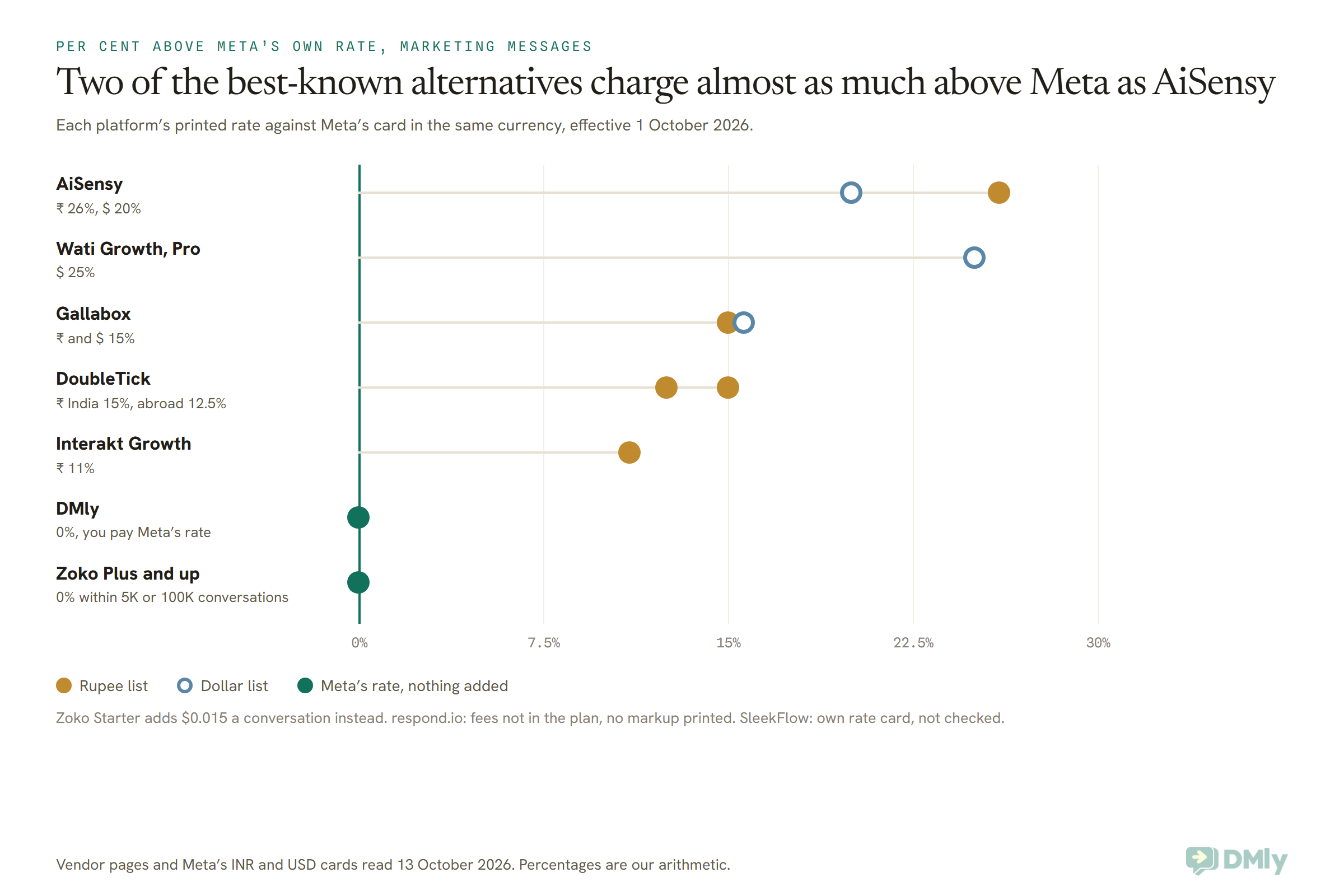
Turn those percentages into money and the gap gets concrete. Here’s one campaign of 10,000 marketing messages to Indian customers, which at Meta’s rate costs ₹8,631:
| Where you send from | Rate per message | 10,000 messages | Above Meta |
| Meta’s own rate (paid directly, as on DMly) | ₹0.8631 | ₹8,631 | Nothing |
| Interakt Growth | ₹0.958 | ₹9,580 | ₹949 |
| DoubleTick | ₹0.99 | ₹9,900 | ₹1,269 |
| Gallabox (its docs table) | ₹0.9926 | ₹9,926 | ₹1,295 |
| AiSensy (every priced plan) | ₹1.09 | ₹10,900 | ₹2,269 |
Two campaigns a week at that size and the AiSensy line comes to about ₹18,000 or more a month above Meta, about twice the price of its own Premium plan. That’s the arithmetic that sends marketing teams looking.
The dollar picture is the same shape at higher stakes, because rates outside India are several times bigger. Ten thousand marketing messages to Nigerian numbers cost $516 at Meta’s rate; AiSensy’s dollar sheet makes that $620, Wati’s card $645 and Gallabox’s table $593. To UK numbers, Meta’s $635 becomes $760 on AiSensy, $794 on Wati and $730 on Gallabox. Our WhatsApp Business API pricing by country page has Meta’s rate for your market.
Zoko works differently, so it doesn’t fit the percentages. On Starter it adds $0.015 for every conversation you start, which is $150 on 10,000 messages: more than AiSensy’s margin on the same send in every market we checked. On Plus ($79.99) the first 5,000 conversations a month carry no markup and the rest cost $0.00199 each; on Elite ($139.99) it’s the first 100,000. For a big Shopify sender, Elite is one of the cheapest ways to send at Meta’s rate.
Two cautions before you act on any of this. None of these vendors says whether its printed rate includes tax, so ask, in writing, what will actually be deducted for one marketing message to your own country today. And the question works on us too: DMly’s pricing page says you pay Meta’s per-message rates directly with zero markup, and you can check that against Meta’s card yourself.
The AiSensy Alternatives, Profiled
Here’s each AiSensy alternative in one place: what it costs, what it does well for campaigns, and what to watch. Every price was read on the vendor’s own pricing page on 13 October 2026.
Interakt: the closest like-for-like, at a lower margin
Interakt is the platform that looks most like AiSensy from the outside: India-first, Shopify-friendly, built around campaigns. Our Interakt review covers it in depth. On its US price page, Growth is $55 a month and Advanced $69 a month billed monthly, with 20 per cent off yearly, and every plan has unlimited agents, which matters if your sales team is large.
For marketing, it’s strong on all five jobs at once: a CTWA ad launcher that passes conversion data to Meta, ongoing and one-time campaigns with auto-retries, click and conversion tracking on Growth, multiple abandoned-checkout reminders, winback and COD-to-prepaid flows, and a marketing rate about 11 per cent above Meta’s. Watch for: the cheapest Starter plan is Instagram only, and a WhatsApp Starter isn’t sold monthly on the US page, so Growth is the realistic entry. The chatbot on Growth is linear; branching flows with API calls need Advanced.
Wati: the familiar all-rounder, with a higher rate card
Wati Growth is $39 a month billed annually or $49 monthly, with 3 users and no option to add more. Pro is $79 or $99 with 5 users and $24 per extra user. Business is $199 or $249. Growth already includes broadcasts (15,000 a month), CTWA ads, Instagram DM and comment automations and TikTok DMs. Pro adds unlimited broadcasts, click tracking, CTWA source tags and smart retargeting, and Business adds 4,000 messages a minute and conversion tracking for ads.
Watch for: Wati’s Growth and Pro rate card dated 1 October 2026 runs about 25 per cent above Meta’s dollar rates on marketing messages, which is close to AiSensy’s. The Business plan’s card is discounted further, but we didn’t price it. The Shopify integration is a $4.99 a month add-on, and the Astra AI agents are priced separately.
Gallabox: for teams that live in their ad account
Gallabox prices by team size: Basic $112 a month billed annually for 3 users (a hard cap), Essential $248 for 6 users, Advanced $474 for 10. There’s a 7-day trial with no card and no free plan. Essential is where marketing teams land, because it adds drip campaigns, AI agents on WhatsApp and Instagram, and Conversions API ad attribution, and lifts the monthly broadcast cap from 10,000 contacts to 500,000.
Watch for: Gallabox says WhatsApp fees appear on your invoice “with our markup”, and its own rate table in the docs works out at about 15 per cent above Meta. It’s priced for a team: if you’re two people sending one campaign a week, you’re paying for capacity you won’t use.
DoubleTick: AI included, scheduling not
DoubleTick’s Starter is $170 a month ($2,039 billed yearly) with 5 agents and no AI agents. Pro + AI is $308 a month ($3,694 billed yearly) with 10 agents, up to 10 AI agents and 3,500 AI credits a month. Its marketing rate in India is about 15 per cent above Meta’s, and about 12.5 per cent in the other markets we checked.
Watch for: there’s no free trial, and its own comparison grid shows scheduled broadcasts only on Enterprise. Retargeting starts on Pro + AI, and CTWA optimisation through the Conversions API is an add-on on every plan. It suits a sales team that works chats all day more than a marketer who plans campaigns ahead.
Zoko: built for Shopify, cheapest at volume
Zoko only installs on Shopify, and it’s built entirely around that. Starter is $49.99 a month with unlimited agents, Plus $79.99, Elite $139.99 and Max $499.99, and every feature is on every plan: the plan only decides volume. The pricing that matters is the markup described above: $0.015 a conversation on Starter, none on the first 5,000 on Plus, none on the first 100,000 on Elite, none at all on Max.
Watch for: Instagram is $9.99 a month extra, custom flows are $5.99 a month each, and AI agents are $24.99 a month plus $0.09 per resolution. Zoko’s “conversation” is a 24-hour session that starts when your first message is delivered, so count campaigns in conversations, not contacts. If you don’t sell on Shopify, it isn’t an option.
SleekFlow: an omnichannel inbox that broadcasts
SleekFlow’s Pro plan is $109 a month billed yearly ($1,308 a year) for 500 monthly active contacts and 10 seats, and it’s the first plan with broadcast campaigns, AI agents and the Shopify integration. Premium is $279 a month billed yearly and adds Meta’s Conversions API. A WhatsApp number costs $15 a month to host.
Watch for: it’s priced by monthly active contacts, like respond.io, and its message rates are on its own rate card, which we didn’t check. It’s a better fit for a support-heavy business that also sends campaigns than for a marketing team first.
respond.io: brilliant inbox, priced by who you message
respond.io is $79, $159 or $279 a month billed yearly ($99, $199 or $349 monthly) at 1,000 monthly active contacts. Broadcasts start on Growth. Its pricing page says WhatsApp fees aren’t included and are charged by Meta based on your usage, topped up as credit on the platform.
Watch for: a contact counts as active as soon as you start a conversation with them, so a big broadcast pushes up your plan price, not just your Meta bill. For a broadcast-led business, that model usually works against you.
One more name you’ll see in Shopify circles, BiteSpeed, doesn’t publish a price: its pricing link opens a demo request form, so we couldn’t compare it.
Every AiSensy Alternative Side by Side
This table puts every AiSensy alternative’s entry price, seats, campaign features and message margin in one place, as read on 13 October 2026. Billing periods differ between vendors, so read the first column carefully before comparing.
| Platform | Entry price for campaigns | People included | Schedule and click tracking | Marketing rate vs Meta |
| AiSensy | Basic ₹1,500 / $45 monthly; Pro ₹3,200 / $99 | Owner + 5 agents | Both from Pro | About 26% (₹), 20% ($) |
| Interakt | Growth $55 monthly | Unlimited | Campaigns on every plan; click tracking from Growth | About 11% |
| Wati | Growth $39 annual / $49 monthly | 3 (no extras) | Click tracking from Pro | About 25% (Growth, Pro) |
| Gallabox | Basic $112 a month, billed annually | 3 (hard cap) | Drip and ad attribution from Essential | About 15% |
| DoubleTick | Starter $170 a month, $2,039 billed yearly | 5 agents | Scheduled broadcasts Enterprise only | About 12.5% to 15% |
| Zoko | Starter $49.99 a month | Unlimited on Starter | Every feature on every plan | $0.015 a conversation on Starter; none within Plus, Elite allowances |
| SleekFlow | Pro $109 a month, billed yearly | 10 seats | Broadcasts from Pro | Own rate card, not checked |
| respond.io | Growth $159 a month billed yearly, $199 monthly | Set per plan; extra users from $12 a month | Broadcasts from Growth | Fees charged by Meta, no markup printed |
| DMly | Starter $29 a month billed yearly, $39 monthly | 3 seats (+$10 each) | Scheduling on every plan; no link click tracking | None, you pay Meta’s rate |
When AiSensy Is Still the Right Choice
Stay on AiSensy if you broadcast to a very large list, need hundreds of messages a second, want rupee pricing and an ads manager in the same screen, or simply aren’t sending enough for the per-message margin to matter. Switching platforms costs a week of attention, and none of the alternatives is better at everything.
- Huge lists, sent rarely. AiSensy doesn’t charge for holding contacts. If you keep 200,000 numbers and message them four times a year, per-contact pricing elsewhere will cost more.
- Flash sales where minutes matter. Nobody else here publishes 250 or 1,000 messages a second.
- Low volume. At 2,000 marketing messages a month to India, the 26 per cent gap is about ₹450 a month. That’s not worth a migration.
- You want one Indian invoice in rupees. AiSensy’s rupee list is a real convenience for an Indian finance team. DMly, for one, publishes dollar prices only.
If you do stay, two habits close most of the gap. Budget the Pro plan from the start, because scheduling and click tracking are what make campaigns worth running. And ask AiSensy, in writing, what it will deduct for one marketing message to your country today, then compare it with Meta’s card.
Is DMly a Good AiSensy Alternative for WhatsApp Marketing?
DMly is a good AiSensy alternative when your campaign is meant to start a conversation that ends in a booking, an order or a payment, and when you want to pay Meta’s own rate with no markup; it’s the wrong choice if you need per-recipient click tracking, an ad launcher inside the tool, or very large monthly sends. We make DMly, so weigh this section with that in mind. Our DMly vs AiSensy page has the full feature comparison.
Where it fits a marketing-led business:
- Messages at Meta’s price. You pay Meta directly, and DMly adds nothing per message. On a busy month that alone can outweigh the subscription.
- Everything after the reply is included. The flow builder and AI replies are on every plan (500 AI replies a month on Starter, 5,000 on Growth), not add-ons. So are drip sequences, bookings, invoices with pay links, coupons and Google review requests.
- Ads to revenue. The Ads report shows what each Click-to-WhatsApp ad produced in conversations, new contacts and money paid, and the ad can start a flow by itself.
- Segments that know who buys. Saved segments can filter on total spend, last purchase, order count, the ad a contact came from, tags and custom fields, and they rebuild themselves each time you send.
- More than WhatsApp. Broadcasts also go out on SMS, Telegram, Instagram and Facebook (where the 24-hour rules allow), and Facebook’s paid Marketing Messages are supported.
And where it’s honestly the wrong choice:
- You need to know who clicked. DMly reports delivered, read, replied and failed, plus revenue per ad, but its documentation doesn’t describe per-recipient link click tracking. If your campaigns send traffic to a website checkout, Interakt, Wati or AiSensy Pro will tell you more.
- You want to build ads inside the tool. DMly reads your Click-to-WhatsApp ads; it doesn’t create them.
- You send more than 300,000 messages a month. That’s Premium’s allowance. Zoko Max or AiSensy Unlimited are built for that scale.
- You hold a big list on a small plan. Starter includes 3,000 active contacts and Growth 10,000; extra contacts are $15 per 1,000. Premium is unlimited, but a 50,000-contact list you message twice a year is cheaper on AiSensy.
- You want a rupee invoice or a one-click Shopify install. DMly prices in dollars, and connects Shopify through a custom app token rather than the App Store.
- You need a published sending speed. DMly doesn’t publish one.
The price, read on 13 October 2026: Starter $29, Growth $65 and Premium $149 a month billed yearly, or $39, $79 and $199 monthly, with a 7-day trial and no card.
Outside India: AiSensy Alternatives for the US, Nigeria, the UK and the Gulf
Outside India the per-message gap matters more, because Meta’s rates are several times higher, and in the US the question changes completely, because Meta doesn’t currently deliver marketing templates to US phone numbers at all. Here’s what that means market by market.
United States. No platform can send a marketing broadcast to American numbers right now, so switching from AiSensy to anyone won’t fix a US campaign. What works is getting customers to message you first: Click-to-WhatsApp ads, chat links and QR codes, and then answering inside the window. For a US brand, the job that matters is Job 1, so pick the tool with the attribution you want. Your US promotions belong on email or SMS for now.
Nigeria. Meta’s marketing rate is $0.0516 a message, so the 20 to 25 per cent margins on AiSensy’s and Wati’s dollar sheets add about $10 to $13 per thousand messages. A Lagos fashion brand that sells on Instagram and WhatsApp will feel the single-channel limit too; DMly takes Instagram DMs into the same inbox and collects payment through Paystack, Flutterwave or Monnify.
United Kingdom and Europe. At $0.0635 a message the UK is one of the dearer markets, so a margin here costs real money: $12.50 per thousand on AiSensy’s dollar sheet. Meta’s per-person marketing limits aren’t active for messages to or from the UK and EEA, which makes delivery more predictable for a London café’s monthly offer.
The Gulf. The UAE and Saudi Arabia sit at $0.0576 a marketing message. AiSensy’s sheet prints $0.069, Wati’s $0.072 and Gallabox’s $0.0662. A Dubai perfume shop sending a Ramadan offer to 5,000 customers pays about $288 at Meta’s rate, or about $345 on AiSensy.
Whichever market you’re in, time big sends around the dates your customers already shop. Our Black Friday WhatsApp marketing guide has a full campaign plan for the busiest weekend of the year, and it works on any of these platforms.
Which AiSensy Alternative Fits Your Kind of Business?
Matched to real kinds of businesses, the choice gets simpler: high-volume Shopify brands lean to Zoko or Interakt, ad-led lead generators to Gallabox, multi-channel shops to Wati or DMly, and service businesses whose campaigns end in bookings to DMly. These are illustrations of how the five jobs play out, not customer stories.
- A Jaipur jewellery brand on Shopify sending two sales a month to 30,000 customers: the per-message margin is its biggest cost. Zoko Elite (no markup within 100,000 conversations) or Interakt Growth (about 11 per cent) both beat AiSensy’s 26 per cent.
- A Bengaluru coaching institute running Click-to-WhatsApp ads for admissions: it needs to know which ad produced enrolments. Gallabox Essential’s attribution, or DMly’s revenue per ad if fees are paid through DMly invoices.
- An Austin boutique: marketing templates don’t reach US numbers, so its WhatsApp is all inbound from ads and links. A tool that tracks which ad started each chat, and doesn’t charge per broadcast it can’t send, makes sense.
- A Lagos fashion store selling on Instagram and WhatsApp: one inbox for both, payment links in the chat. Wati or DMly.
- A Manchester salon sending a monthly offer to 1,200 clients and taking bookings from the replies: the campaign is small, the booking is the point. DMly.
- A Dubai electronics retailer with 15 sales staff working leads from ads: unlimited agents matter. Interakt, or DoubleTick if AI agents should be in the plan.
Switching From AiSensy Without Losing a Campaign Week
You can move your WhatsApp number from AiSensy to any of these platforms, but only one provider can hold it at a time, your approved templates only follow if your WhatsApp Business Account moves with it, and your opt-out list has to be carried across by hand. Plan the move for a quiet week, never the week before a sale.
- Export everything from AiSensy first. Your contact list with tags and attributes, your opt-out list, and your campaign reports. Once the number moves, you may lose access to the history.
- Check who owns your WhatsApp Business Account. If the account is yours, in your own Meta Business portfolio, your approved templates come with it. If AiSensy created it on its side, they stay behind and you’ll resubmit them.
- Turn off two-step verification on the number in WhatsApp Manager. A move with it on fails.
- Connect the number to the new platform and register it. On DMly, open Templates and select Refresh templates to pull in the ones that came across.
- Carry your opt-outs across properly. DMly can’t import opt-out status, so the safest move is to leave opted-out people out of your import file altogether. If you must keep them, give them your own tag (such as “Do not contact”) and exclude it from every segment; an imported “Unsubscribe” tag doesn’t opt anyone out. Other platforms differ, so check before your first broadcast.
- Rebuild your segments and flows. Segments, chatbots and abandoned-cart flows don’t move between platforms; rebuild the ones you actually use.
- Test your ads before you spend again. Tap each running Click-to-WhatsApp ad yourself after the move, check the chat lands in the new inbox, and rebuild any flow that used to answer it before the next campaign goes live.
Frequently Asked Questions
What are the best AiSensy alternatives?
For marketing-led businesses, the strongest AiSensy alternatives are Interakt (lower margin over Meta, Shopify flows, unlimited agents), Zoko (Shopify stores sending at volume), Gallabox (Click-to-WhatsApp ad attribution), Wati (a familiar all-rounder with Instagram and TikTok), DoubleTick (AI included for big sales teams) and DMly (no markup, and campaigns that end in bookings or payments). The best one depends on which campaign job costs you most today.
Which AiSensy alternative is cheapest per message?
Platforms where you pay Meta’s own rate with nothing added are cheapest per message: DMly, and Zoko within its Plus, Elite and Max allowances. Among platforms that print their own rates, Interakt Growth was about 11 per cent above Meta’s rupee rate on 13 October 2026, against about 26 per cent on AiSensy’s rupee list.
Is Interakt better than AiSensy?
For per-message cost and team size, usually yes: Interakt’s marketing rate is about 11 per cent above Meta’s against AiSensy’s 26 per cent, and every Interakt plan has unlimited agents. AiSensy is better if you need published sending speeds of 250 to 1,000 messages a second, or free contact storage for a very large list.
Does AiSensy charge a markup on WhatsApp messages?
AiSensy’s printed rates, now marked “effective 1 October 2026”, are about 26 per cent above Meta’s rupee card and about 20 per cent above Meta’s dollar card. AiSensy doesn’t say what the difference consists of, and tax alone doesn’t explain it. Ask AiSensy what it will deduct per marketing message to your country and compare it with Meta’s published rate.
Which AiSensy alternatives can schedule broadcasts on the cheapest plan?
DMly schedules on every plan, including per-contact timezones, and Zoko puts every feature on every plan. AiSensy needs Pro for its campaign scheduler, and DoubleTick lists scheduled broadcasts on Enterprise only.
Can I keep my WhatsApp number if I leave AiSensy?
Yes. The number belongs to your business, not to AiSensy. Turn off two-step verification, export your contacts, opt-outs and reports, then connect the number to the new platform. Your approved templates come with it only if your WhatsApp Business Account moves too.
Will switching platforms let me send marketing messages to US customers?
No. Meta doesn’t currently deliver marketing templates to US phone numbers on any platform. For US customers, use Click-to-WhatsApp ads, chat links and QR codes so they message you first, and reply inside the service window.
Do AiSensy alternatives charge for service messages after 1 October 2026?
Meta does, on every platform: each business number gets 1,000 free service messages a month, and replies beyond that are charged at your customer’s country rate. Utility templates sent inside the 24-hour window are now charged too. Replies inside the 72-hour window after a Click-to-WhatsApp ad stay free.
Choosing Between AiSensy Alternatives: The Stopwatch, Stopped
Four minutes and ten seconds. That’s how long AiSensy’s Basic plan takes to send your 10,000-person sale, and after this whole comparison it’s still the least important number on the page.
The numbers that decide which of the AiSensy alternatives fits you are the ones the stopwatch can’t see. How many cents above Meta’s rate you pay on every message, sent ten thousand times at once. Whether you need Pro just to schedule Friday’s sale and see who tapped it. Whether the replies that come back have somewhere to go that isn’t another add-on.
So stop the stopwatch and pick up last month’s bill instead. If the per-message line is the biggest, look at Interakt, Zoko or DMly. If you can’t tell which ads made money, look at Gallabox or DMly. If your campaigns end in bookings and payments, start a DMly trial and run your next campaign through it. And if none of those lines hurts, stay on AiSensy and send your next sale with a clear conscience.
Writing about WhatsApp automation, bookings and growth for local business.
Turn WhatsApp into your busiest channel.
Start free and run message, bookings, payments and reviews in one place.
