
WhatsApp Business API Pricing by Country: 2026 Rate Card
This page makes one promise: prices, dated, from the source, with no narrative padding between you and the numbers.
Most pages ranking for WhatsApp Business API pricing were written before July 2025 and still describe conversation-based pricing, which no longer exists, or they quote rates with no date, which is worse than no rates at all. So here is the deal this page offers instead: the table below was extracted from Meta’s own USD rate card on 25 August 2026 (the card Meta states as effective 1 July 2026), the free cases are listed before the priced ones because they shape a bill more than the rate card does, and because two of the three narrow on 1 October 2026, and the update policy at the bottom tells you exactly how current these figures are the day you read them.
How WhatsApp Business API Pricing Works in 2026
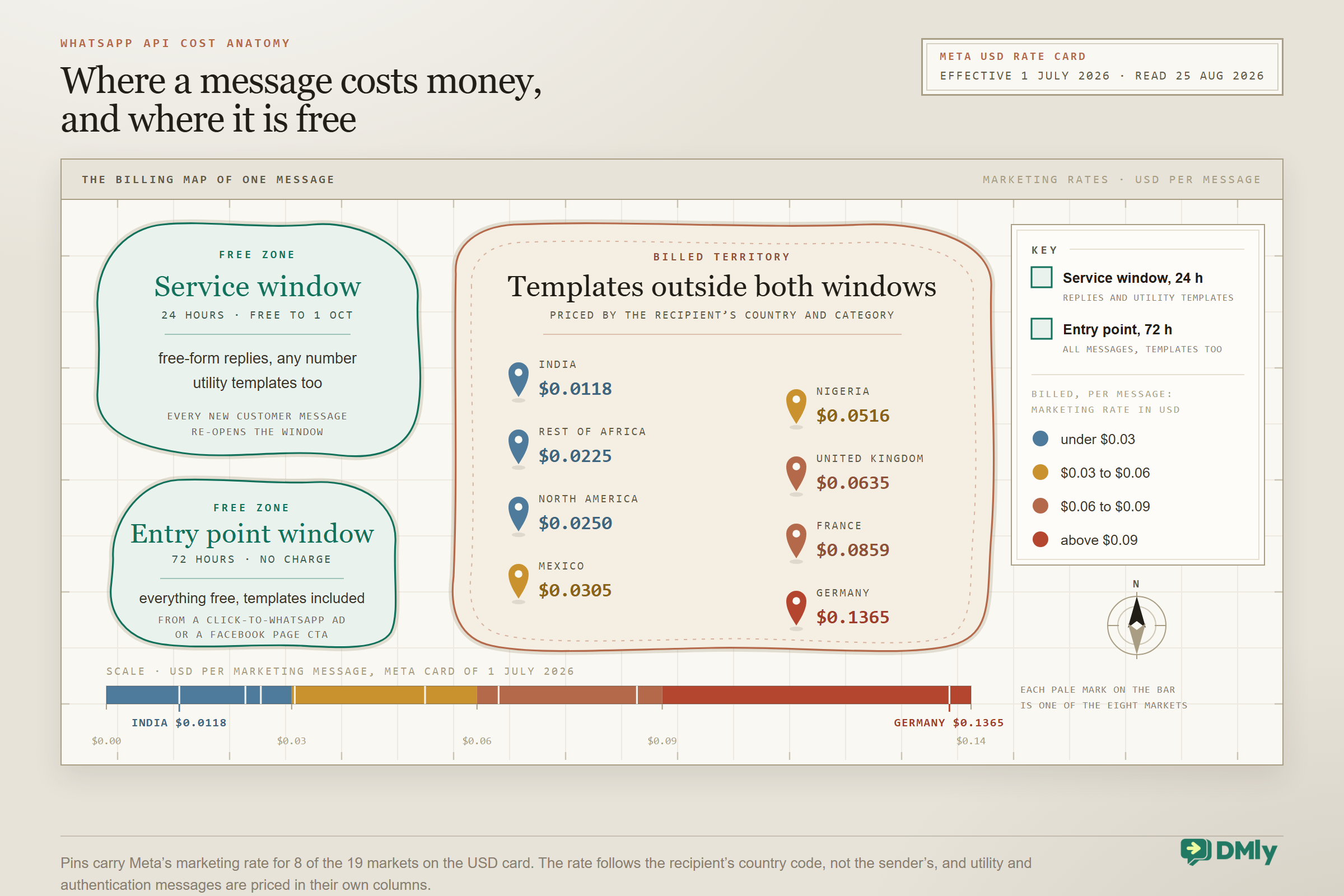
Since 1 July 2025, WhatsApp Business API pricing is per message: you pay a country-specific rate for each template message Meta delivers, with the rate set by the template’s category (marketing, utility or authentication). The old per-conversation model is gone. Three kinds of message are free, and they matter more than the rate card, though two of the three change on 1 October 2026. Read Figure 1 below, and every mention of a free window further down this page, against those dates.
- Everything inside the customer service window is free if it is not a template, and the first 1,000 of those replies stay free every month. When a customer messages you, a 24-hour window opens, and every new message from them re-opens it; the replies you write inside it cost nothing up to 30 September 2026. From 1 October Meta gives every business phone number 1,000 free service messages a month and charges only from the 1,001st, at the same rate as that market’s utility column below. The allowance resets each month and does not roll over.
- Utility templates delivered inside an open window are also free, until the same date. An order update or appointment reminder that lands while your customer’s window is open is not billed up to 30 September 2026, and is billed at the utility rate from 1 October, with no free allowance of its own.
- Free entry point conversations are free for 72 hours, and this one is not changing. A conversation that starts from a click-to-WhatsApp ad or a Facebook Page call-to-action gives you 72 hours in which every message, templates included, is free. From October it is the only window where templates of any kind still cost nothing, which makes it worth more than it was.
Two more model facts complete the picture. Rates are keyed to the recipient’s country calling code, not yours: a Lagos business messaging a customer with a UK number pays the UK rate for that message. And volume tiers can unlock lower utility and authentication rates as your monthly billed volume grows; the tiers are market- and category-specific, reset each month, and aggregate across every WhatsApp Business Account in your portfolio.
WhatsApp API Rate Card 2026: Per-Message Prices by Country (USD)
The rates below are Meta’s USD per-message prices, extracted from the official rate card on 25 August 2026 (card effective 1 July 2026). Marketing is the promotional category; utility covers transactional updates; authentication covers one-time passcodes, with a separate rate where Meta prices international authentication distinctly. There is no service column because service messages carried no per-message price up to 30 September 2026. From 1 October 2026 they do, and they follow the utility rate in each row, so read the utility column as your service rate too from that date, on everything past the 1,000 free service messages Meta gives each business phone number every month. One thing does not travel with it: volume tiers apply to utility and authentication only, so a service message costs that market’s full utility rate however many of them you send.
| Market | Marketing | Utility | Authentication | Auth (international) |
| India | $0.0118 | $0.0014 | $0.0014 | $0.0304 |
| Brazil | $0.0625 | $0.0068 | $0.0068 | n/a |
| Indonesia | $0.0411 | $0.0250 | $0.0250 | $0.1360 |
| Mexico | $0.0305 | $0.0085 | $0.0085 | n/a |
| Nigeria | $0.0516 | $0.0067 | $0.0067 | $0.0750 |
| Pakistan | $0.0473 | $0.0100 | $0.0100 | $0.0750 |
| Egypt | $0.0644 | $0.0036 | $0.0036 | $0.0650 |
| Saudi Arabia | $0.0501 | $0.0107 | $0.0107 | $0.0598 |
| United Arab Emirates | $0.0499 | $0.0157 | $0.0157 | $0.0510 |
| South Africa | $0.0379 | $0.0076 | $0.0076 | $0.0200 |
| United Kingdom | $0.0635 | $0.0220 | $0.0220 | n/a |
| North America | $0.0250 | $0.0034 | $0.0034 | n/a |
| Germany | $0.1365 | $0.0550 | $0.0550 | n/a |
| France | $0.0859 | $0.0300 | $0.0300 | n/a |
| Rest of Africa | $0.0225 | $0.0040 | $0.0040 | n/a |
| Rest of Asia Pacific | $0.0732 | $0.0113 | $0.0113 | n/a |
| Rest of Latin America | $0.0740 | $0.0113 | $0.0113 | n/a |
| Rest of Middle East | $0.0341 | $0.0091 | $0.0091 | n/a |
| Other | $0.0604 | $0.0077 | $0.0077 | n/a |
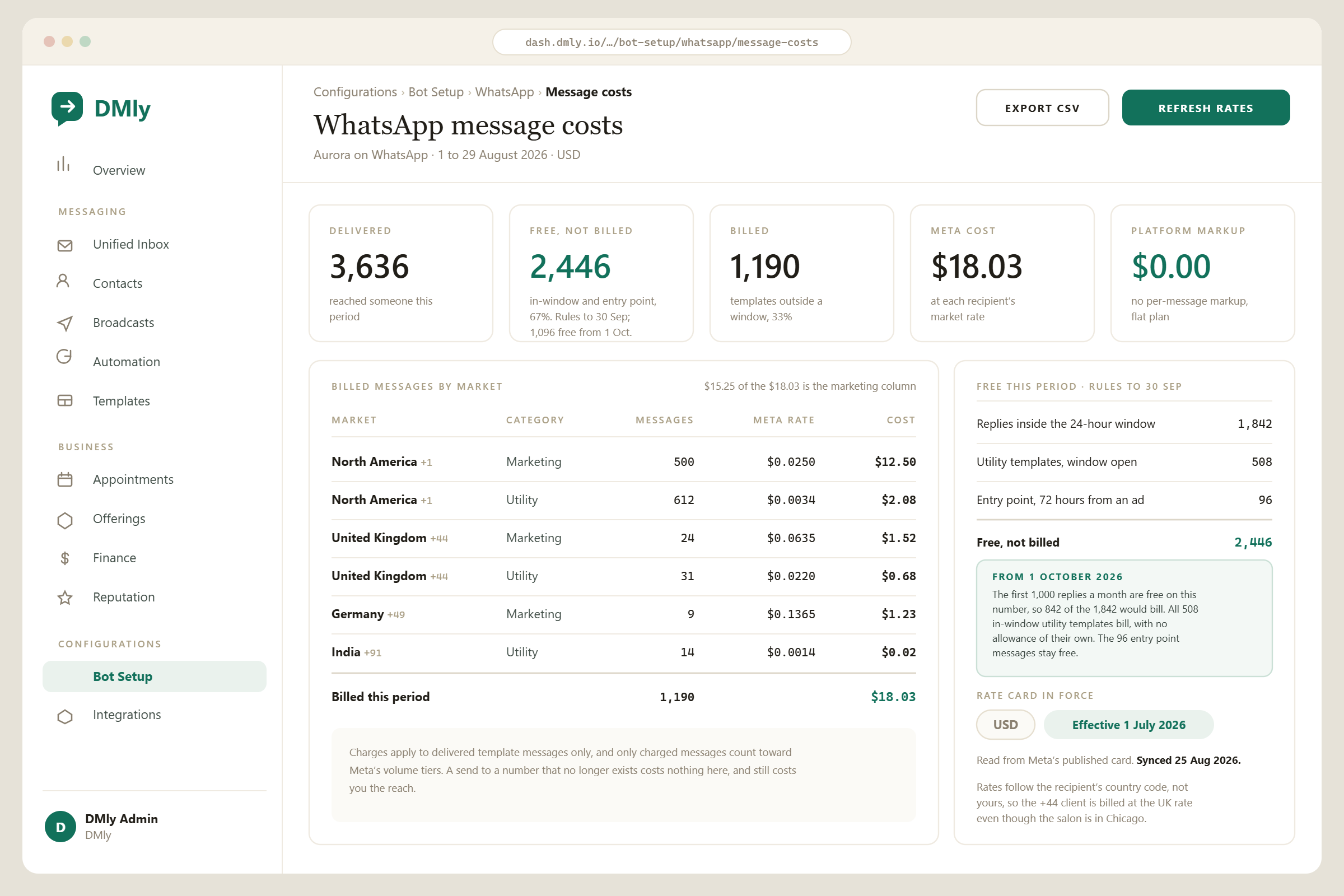
Reading notes, briefly. These are Meta’s prices, not a platform’s: what your provider charges on top is a separate question this page returns to below, and what DMly charges on top of them is nothing. Countries without a dedicated row take their regional rate: Kenya, for example, has no row of its own and is billed at the Rest of Africa rate, which at $0.0225 marketing is one of the cheapest markets on the card. “n/a” in the international authentication column means Meta does not price that market’s international authentication separately. Germany and France stand out as the expensive end of the card; India and Rest of Africa as the cheap end, with India’s $0.0014 utility rate the lowest number on the page. Meta publishes the full card, every currency, as downloadable CSVs on its pricing documentation and interactively on the WhatsApp Business site. Figure 2 below applies these rates to one salon’s month, counted under the rules that ran to 30 September 2026, with a panel note giving the October arithmetic for the same traffic.
Reading the Card, Market by Market
Numbers reward a second look, and this card contains several patterns worth knowing before you budget. All observations below come straight from the table.
The cheap-to-message markets
India is the outlier on the whole card: $0.0118 marketing and $0.0014 utility, which is why WhatsApp-first commerce matured there earlier than anywhere. At these rates, a ten-thousand-message campaign costs less than a modest dinner, and utility traffic is close enough to free that order-update economics stop being a consideration at all. Rest of Africa ($0.0225 marketing) and North America ($0.0250) sit close behind, a pairing that surprises people who assume the US must be expensive; Meta prices to encourage adoption where the channel still has room to grow. Businesses in Kenya, Ghana, Uganda and the rest of the continent’s unlisted markets all ride the Rest of Africa row, which makes broad African WhatsApp marketing cheaper than almost anywhere outside India.
The expensive end
Germany ($0.1365 marketing, $0.0550 utility) is the most expensive market on the card by a wide margin, with France ($0.0859) second. A German campaign costs eleven times its Indian equivalent per message, which changes strategy rather than just budgets: in high-rate European markets, reply-driven flows stop being an optimization and become the entire plan, with paid broadcasts reserved for segments with proven intent. October sharpens that rather than softening it: from 1 October 2026 a German number’s service messages bill at the same $0.0550 once it is past its 1,000 free ones for the month, so the German prize is a conversation that is short as well as inbound. The UK ($0.0635) and Brazil ($0.0625) form the upper-middle band; Brazil’s rate is worth respecting given how message-heavy its commerce culture runs.
The utility bargains
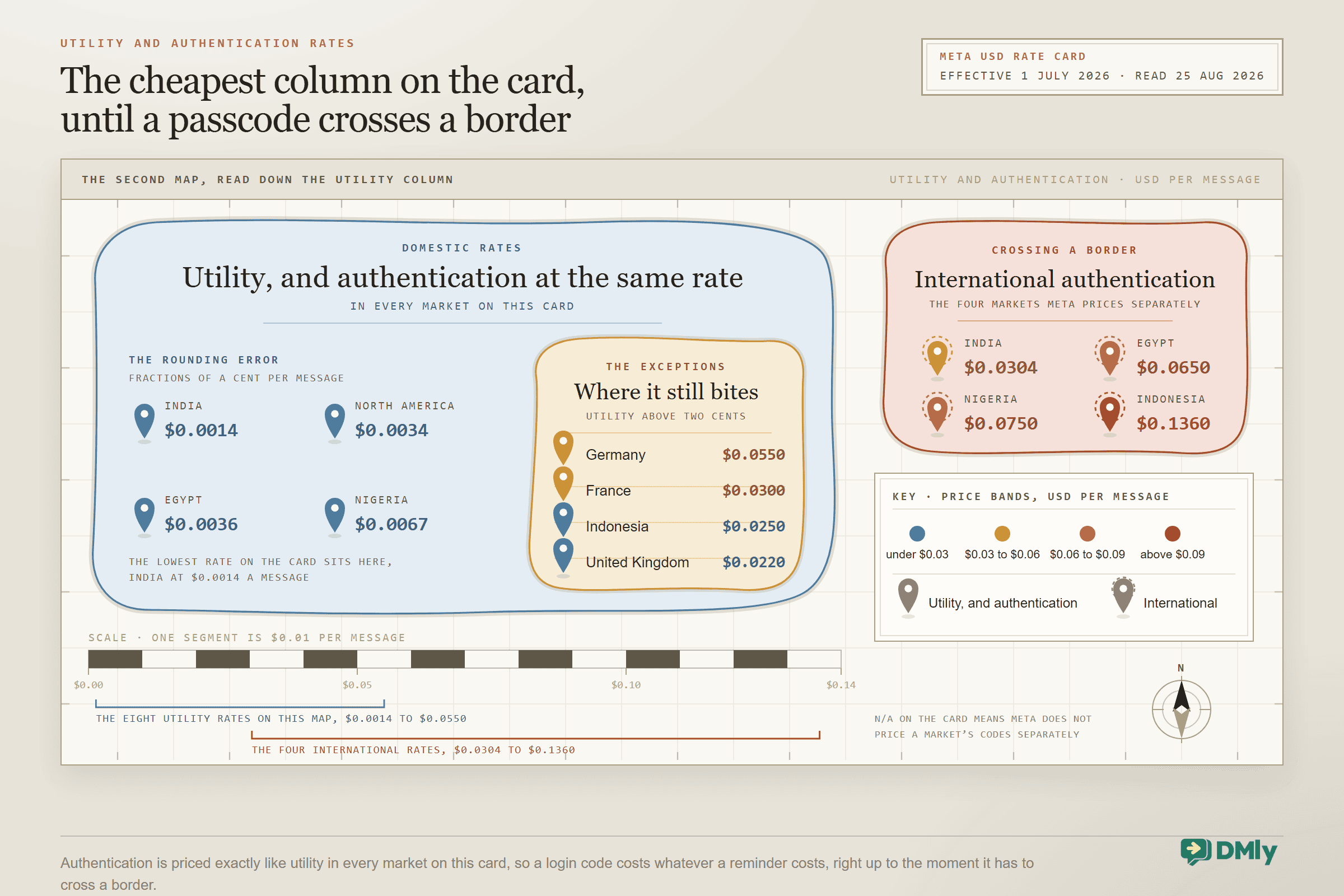
Look down the utility column and a different map appears: Egypt at $0.0036 and North America at $0.0034 have utility rates cheaper than Rest of Africa’s, and even mid-priced marketing markets like Nigeria keep utility at $0.0067. The practical reading: in most of the world, transactional messaging (reminders, order updates, receipts) is a rounding error, and the entire cost conversation is really about the marketing column. That still holds from 1 October 2026, when utility templates sent inside an open window start billing at these very rates: the change moves the count, not the price. The exceptions are Indonesia ($0.0250 utility) and the European rows, where the extra volume October adds to the utility line is worth forecasting before it arrives.
What the authentication columns say
Authentication (one-time passcodes) is priced identically to utility in every market on this card, which simplifies OTP budgeting: whatever your utility rate is, your login codes cost the same. The international authentication column is the trap for global apps: where Meta prices it separately, it is severe. India’s international authentication rate ($0.0304) is more than twenty times its domestic one, and Indonesia’s ($0.1360) is the single highest number on the card. If you run OTP verification for users across borders, that column, not the marketing one, is where your bill lives, and it is why authentication-heavy platforms route international codes carefully.
What a Month Actually Costs: Three Worked Examples
Rates only mean something multiplied by real traffic, so here are three honest months, computed from the table above. Each one assumes the business replies to its customers inside the window and pays only for templates delivered outside it, which is exactly how WhatsApp Business API pricing worked up to 30 September 2026. From 1 October, count each business’s in-window replies, take off the 1,000 free service messages Meta gives every business phone number each month, and price only the remainder at its market’s utility rate: a Lagos month with 1,800 in-window replies bills 800 of them at Nigeria’s $0.0067, which is $5.36 on top. Any utility template these businesses send inside an open window is billed from that date too, at the same utility rate and with no allowance of its own; the rows below count only their out-of-window templates, which is what the rules to 30 September asked for.
| Business | Billed traffic in the month | Meta cost |
| Salon, Lagos (Nigeria rates) | 300 out-of-window utility reminders ($0.0067) + two marketing broadcasts of 500 ($0.0516) | $2.01 + $51.60 = $53.61 |
| D2C brand, Mumbai (India rates) | 10,000 marketing messages ($0.0118) + 5,000 out-of-window utility updates ($0.0014) | $118.00 + $7.00 = $125.00 |
| Clinic, Manchester (UK rates) | 600 out-of-window utility reminders ($0.0220) + one recall broadcast of 200 marketing messages ($0.0635) | $13.20 + $12.70 = $25.90 |
Notice the shape of all three bills: the marketing category dominates even at modest volumes, and utility traffic is nearly free everywhere outside Europe. That asymmetry is deliberate on Meta’s part, and it is also your entire cost strategy, which is the next section.
Two things the examples deliberately exclude, so nobody mistakes them for total cost of ownership. They price Meta’s messaging only: your platform plan sits on top (flat, in DMly’s case), and any AI-reply usage is its own line with its own economics. And they assume clean execution: a mis-categorised template that gets rebilled as marketing, or a broadcast to a segment that should have been half the size, moves these numbers faster than any rate change Meta has ever made. The card sets the prices; your build discipline sets the bill.
How to Reduce Your WhatsApp API Costs
- Earn replies, and spend the free service allowance. Up to 30 September 2026 a reminder that landed while a customer’s window was open cost nothing, which made timing the single biggest saving on this page. From 1 October placement stops mattering for templates: a utility template costs the utility rate wherever it lands, because category and not placement sets a template’s price. What stays free is your own free-form replying, at 1,000 service messages a month on each business phone number, charged at the utility rate rather than the marketing rate beyond that. A customer who answers your reminder opens an exchange you can handle inside that allowance, which is why flows that respond to activity still beat flows that broadcast into silence.
- Guard your template categories. A promotional sentence in a utility template gets it recategorised and billed as marketing, which can multiply its price several times over (compare the columns above). Keep utility strictly transactional; put offers in marketing templates on purpose.
- Use the 72-hour entry point window. Conversations born from click-to-WhatsApp ads are free for 72 hours, templates included. If you run CTWA campaigns, front-load the sequence into those three days.
- Broadcast to segments, not lists. Marketing is the expensive column, so the cheapest message is the one you did not send to someone who would not act. Segmentation is cost control wearing a marketing hat.
- Check the volume tiers at scale. High-volume utility and authentication senders can unlock lower rates; tiers reset monthly and aggregate across your portfolio’s WABAs, so consolidating volume can pay.
- Know what your platform adds. Meta’s rates are the floor; some platforms resell them with a markup. DMly passes Meta’s rates through with no markup, so the table above is what you actually pay, plus your plan. Platform-plus-AI economics get their own treatment in our chatbot cost breakdown.
A worked illustration of the biggest lever, because it deserves more than a bullet and because the lever itself moved on 1 October 2026. Take the Lagos salon from the examples above. Up to 30 September its 300 monthly reminders were billed at Nigeria’s utility rate only because they landed outside customers’ windows, and moving half of them inside an open window would have halved that line. From 1 October it does not: a utility template is billed at the utility rate wherever it lands, with no allowance of its own, so those 150 retimed reminders change the bill by nothing at all. Placement no longer sets the price of a template. Category and volume do.
What survives is the lever underneath it. A free-form reply written inside an open window is a service message, and the first 1,000 a month on each business phone number still cost nothing. Past that they cost Nigeria’s $0.0067, which is less than a seventh of the $0.0516 that market charges for a marketing template. So a salon that answers 900 customers by hand pays nothing for the lot; one that answers 1,800 pays for 800 of them, which is 800 x $0.0067 = $5.36. Either figure is small beside a single 500-message broadcast at 500 x $0.0516 = $25.80. The advice survives the change even though its mechanism moved: the businesses with the lowest WhatsApp bills are consistently the ones whose customers reply the most, because a reply is the cheapest thing on the card and the first thousand every month are free. The rate card prices monologues; conversation is discounted by design.
On platform markups, one diagnostic question saves audits later: ask any provider whether their per-message price to you equals Meta’s published rate for your market, and check the answer against this table. A markup is not a scandal (some providers bundle real value into it), but an undisclosed one is a line item you cannot manage, and the difference between $0.0516 and a marked-up $0.07 on a Nigerian broadcast of ten thousand is real money leaving quietly.
Currencies, Billing and the Card You Are Actually On
Meta publishes the rate card in sixteen billing currencies (USD, EUR, GBP, INR, BRL, IDR, MXN, AED, SAR, AUD, SGD, MYR, ARS, CLP, COP and PEN), and which card applies to you follows from your WhatsApp Business Account’s billing setup, with Meta noting the cards apply based on the account’s timezone. The practical points: a business billed in naira-adjacent USD and one billed in INR are reading different documents that price the same messages, local-currency cards move with their own revisions rather than tracking daily FX, and a finance team reconciling the bill should pull the CSV for its own billing currency rather than converting this page’s USD figures. The USD card is quoted here because it is the common reference and the one most platforms and agencies compare against.
One more billing mechanic worth a sentence: charges apply to delivered template messages, and only charged messages count toward volume tiers. A campaign to a stale list does not bill for the numbers that no longer exist, which is small comfort, and no excuse for the stale list.
WhatsApp Business API Pricing vs SMS: The Structural Difference
The comparison every budget meeting asks for, answered structurally rather than with SMS rates that vary wildly by route and aggregator. SMS bills every message, in both directions of a conversation, with no free window and no free allowance; WhatsApp bills templates by category and prices your own free-form replies either at nothing or at that market’s utility rate, which means two-way traffic changes the mathematics entirely. Take a reminder that triggers a reply and a short exchange. On SMS that is one charge per message, each way. On WhatsApp it is the utility rate for the reminder, and then, up to 30 September 2026, nothing at all for the exchange that followed; from 1 October that exchange is service messages, free for the first 1,000 a month on each business phone number and charged at the same utility rate beyond it. The direction of travel is unchanged on both sides of that date: the more of a conversation the customer starts, the less of it you pay for. Add what the rate buys (delivery to a name in an app people actually open, media, buttons, carts, read receipts for your own visibility) and the per-message comparison undersells the difference. Where SMS keeps the advantage: recipients without WhatsApp, and delivery-critical one-way pings in markets where its routes are cheap. Most DMly businesses run WhatsApp-first with SMS as the fallback lane, which is also how the platform’s notification routing is designed.
How We Got Here: From Conversations to Messages
A short history, because half the confusion in this niche is archaeological. Until mid-2025, WhatsApp billed per conversation: a 24-hour session opened by a message, priced by category and country, with all messages inside it bundled. On 1 July 2025 Meta replaced that with per-message pricing: every delivered template is billed individually at its category rate, and the free cases were redrawn as the window rules above. The rate cards themselves are versioned; the card this page quotes is the one Meta marks effective 1 July 2026, and the company adjusts market rates between versions, historically more often downward in growth markets and upward in mature European ones, though no pattern is guaranteed.
The practical consequences of the model change, for anyone migrating old budgets: multi-message conversations got cheaper (you no longer pay a session fee for a thread of free-form replies), template blasts got linear (ten thousand messages is exactly ten thousand times the rate, with no session bundling), and the utility-inside-window free rule, which ran until 30 September 2026, turned well-timed transactional messaging from a line item into a rounding error for as long as it lasted. Any pricing content, calculator or agency quote still speaking in “conversation” units predates July 2025 and should be treated accordingly.
A Five-Line Budget Worksheet
Everything a monthly WhatsApp budget needs, in the order that keeps it honest:
- Count your billed traffic only. Estimate the marketing messages you will deliver outside the free entry point window. For utility templates, count every one you send from 1 October 2026, in-window or out, because placement no longer exempts them; up to 30 September only the out-of-window ones counted. Entry-point traffic inside the 72 hours after an ad click still belongs at zero. Then count your in-window replies, take off the 1,000 free service messages each business phone number gets every month, and price the rest at your market’s utility rate.
- Multiply by your market’s rates. From the table above, using the recipient country, not yours. Mixed audiences get a weighted split.
- Add your platform’s flat cost. DMly is a plan price with no per-message markup; if your platform marks messages up, that delta belongs in this line, visibly.
- Sanity-check against the levers that still work. Before approving the number, ask three things: what share of the marketing line could be a reply instead of a broadcast, whether any ad-driven sequence could sit inside its 72-hour entry point window, and whether your monthly service traffic lands under the 1,000 free messages or over them. Retiming a utility template into an open window is not on that list from 1 October, because it no longer changes the price.
- Date the sheet. Rates move. A budget carrying this page’s stamp date knows when it needs re-checking, which is more than most budgets can say.
How Current Is This Page?
Honestly stated, because a rate card is only as good as its date: the rates above were pulled from Meta’s official USD rate-card CSV on 25 August 2026, from a card Meta marks effective 1 July 2026. Meta revises rate cards periodically and publishes changes on the pricing documentation page; we re-check monthly and update the table and this date stamp when the card moves. If you are reading this far from that date, or making a budget decision of any size, verify against Meta’s live card before you commit numbers to a spreadsheet. For per-country context beyond the rates (local usage, gateways, rules), our country guides for Nigeria, India, Brazil, Mexico, South Africa, Kenya and the UAE are being published as companions to this page.
One dated change is already confirmed, and it is the reason this page carries so many dates. On 1 October 2026 Meta starts charging for two things that were free before it: service messages beyond the first 1,000 every business phone number gets free each month, and utility templates sent inside the open 24-hour customer service window, which get no allowance at all. Both follow the utility rate for the recipient’s market, so the per-market rates in the table above are the ones those charges use, and Meta has now published the October cards in all sixteen currencies: the utility rates quoted above for India, Nigeria, Brazil, the United Kingdom, Germany and North America are unchanged on them. The 72-hour free entry point window is unaffected. Our guide to the WhatsApp pricing change on 1 October explains what becomes billable, what stays free, and how to work out the difference for your own business.
WhatsApp Business API Pricing FAQs
How much does a WhatsApp Business API message cost?
It depends on the recipient’s country and the message category. As of the July 2026 rate card, a marketing message costs from $0.0118 in India to $0.1365 in Germany, utility messages run from $0.0014 to $0.0550 across the same span, and replies inside a customer’s 24-hour service window were free up to 30 September 2026 and are charged at that market’s utility rate from 1 October, once a number has used the 1,000 free service messages it gets each month. The full table above has 19 markets.
Is the WhatsApp Business API free to use?
Access itself carries no Meta fee. Until 30 September 2026, three large categories of traffic were free: replies you wrote inside the 24-hour customer service window, utility templates delivered inside that window, and everything for 72 hours in a conversation born from a click-to-WhatsApp ad. From 1 October 2026 the third is still free in full, the first keeps a monthly allowance of 1,000 free service messages per business phone number and is charged at the market’s utility rate beyond it, and the second is charged from its first message. You also pay per delivered template message outside the windows, plus whatever your platform charges for its software.
Does WhatsApp still charge per conversation?
No. Conversation-based pricing ended when per-message pricing took effect on 1 July 2025. Any page still quoting per-conversation prices is describing a model that no longer exists, which is a useful freshness test for pricing content in this niche.
Why is my rate different from the table?
Four usual reasons: the recipient’s country code, not your location, sets the rate; your platform may add a markup on top of Meta’s price (DMly does not); volume tiers may have lowered your utility or authentication rate, though never your service rate, because service messages have no volume tiers; or the card has been revised since our stamp date. Meta’s live rate card is always the arbiter.
What is the cheapest way to run WhatsApp marketing?
Structurally: earn replies so your messages ride the cheapest rates, keep utility templates clean so they are never rebilled as marketing, use the 72-hour entry point window for ad-born conversations, and send marketing templates only to segments likely to act. That still holds after 1 October 2026, because the first 1,000 service messages a month stay free and the rest moved to the utility rate rather than to the marketing one. The rate card rewards businesses that converse over businesses that blast, by design.
What exactly is a free entry point conversation?
A conversation that begins when a customer taps through from a click-to-WhatsApp ad or a Facebook Page call-to-action button. For 72 hours from that entry, every message you send in the thread is free, templates included, which makes it the one situation where even marketing templates cost nothing. For ad-driven businesses this window is a scheduling instruction: put the welcome, the qualification and the first offer inside the three days the auction already paid for.
Which countries have the cheapest and most expensive WhatsApp API rates?
On the July 2026 USD card: India is the cheapest listed market for both marketing ($0.0118) and utility ($0.0014), with Rest of Africa ($0.0225 marketing) and North America ($0.0250) close behind. Germany is the most expensive on every column ($0.1365 marketing, $0.0550 utility), with France second. The full 19-market table above carries the rest.
Do I pay for messages that are not delivered?
Billing applies to delivered template messages, and Meta’s volume tiers likewise count only charged messages. Sends that never deliver do not bill, which softens the cost of list decay without excusing it: undeliverable numbers still cost you campaign reach and list hygiene.
Do these prices include the platform I use?
No. Meta’s rates are the messaging floor; platforms charge separately for the software (inbox, automations, bookings, CRM). DMly’s plans are flat, with Meta’s rates passed through without markup, so total cost is plan plus the table above applied to your billed traffic. The full stack economics, including AI costs, are in our chatbot cost guide.
WhatsApp Business API pricing, passed through with no markup
DMly passes WhatsApp’s per-message prices straight through, so the table on this page is the table on your bill. The platform is a flat plan, and the trial needs no card.
The Number Before the Narrative
Pricing pages in this niche tend to bury four numbers under two thousand words of throat-clearing. This one tried the opposite: the model in one section, the card in one table, the month in three rows of arithmetic, and a date stamp you can hold us to. Bookmark it, check the stamp when you return, and spend the time you saved on the levers that outlast any one rate card: earning replies rather than buying attention, keeping template categories clean, and putting ad-driven sequences inside their 72-hour entry point window. Those were always worth more than the rates themselves.
And if one idea survives from this page into your planning, make it the asymmetry: marketing rates are set to make you selective, utility rates are set to make you communicative, and the windows are set to make you conversational. That asymmetry survives the October change intact, because what became billable became billable at the cheap rate rather than the dear one, and the first 1,000 service replies a month did not become billable at all. Price is Meta’s way of telling you how it wants the channel used, and the businesses that listen end up with the smallest bills and, not coincidentally, the customers who like hearing from them.
Writing about WhatsApp automation, bookings and growth for local business.
Turn WhatsApp into your busiest channel.
Start free and run message, bookings, payments and reviews in one place.
