
Top 10 DelightChat Alternatives for Growing Ecommerce Brands
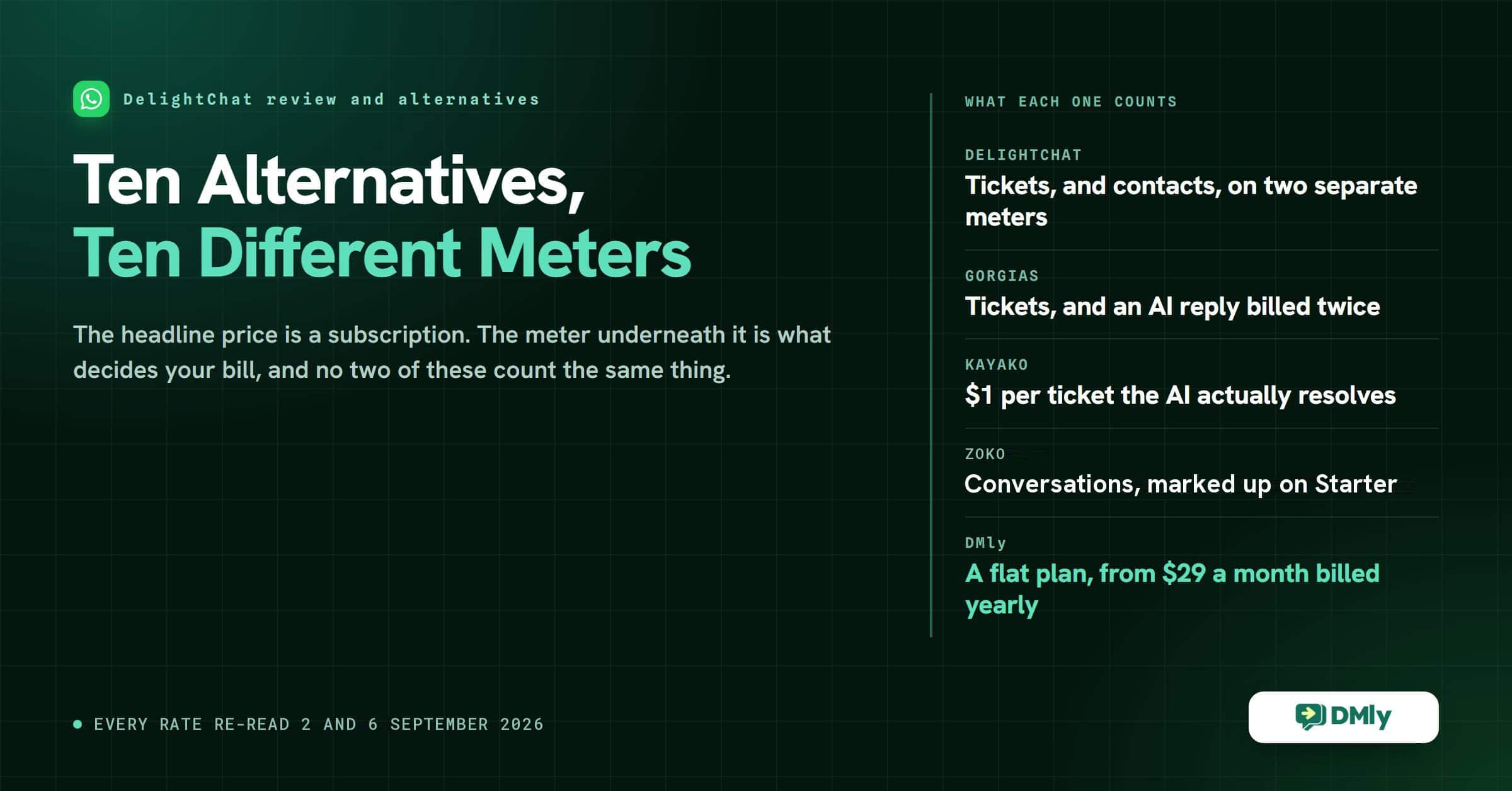
DelightChat charges you $29 a month and then it starts counting. Tickets, and separately, marketing contacts. Almost every platform on this page counts something, and no two of them count the same thing, which is why a list of DelightChat alternatives ranked on headline price tells you much less than it looks like it does.
That matters more than it used to. A shared inbox used to be the whole product. Now brands want the inbox plus automation, plus AI that can actually do something, plus campaigns that pay for themselves, and the platforms have priced that in different directions. Some charge per seat. Some charge per ticket. One now charges per resolved ticket and nothing else. One marks up every conversation before you have sold anything.
So this is an honest DelightChat review with the pricing read off each vendor own page on 2 September 2026, and ten alternatives with the meter named in each case. Where a figure has moved since this article was first published, it says so.
One correction before the list. Until today, number three here was Flowcart. An earlier version of this page said Flowcart had stopped trading. That was wrong, we withdraw it, and Flowcart is live and trading at flowcart.ai. What has actually changed is narrower: it no longer publishes its plan prices, and every tier now reads “Get a Quote”, checked at source on 8 September 2026. A list built on published prices cannot rank a vendor that publishes none, so the slot has gone to Zoko, whose prices we read at source on 6 September 2026. There is a fuller account of it below the list.
What DelightChat Is, and Who It Suits
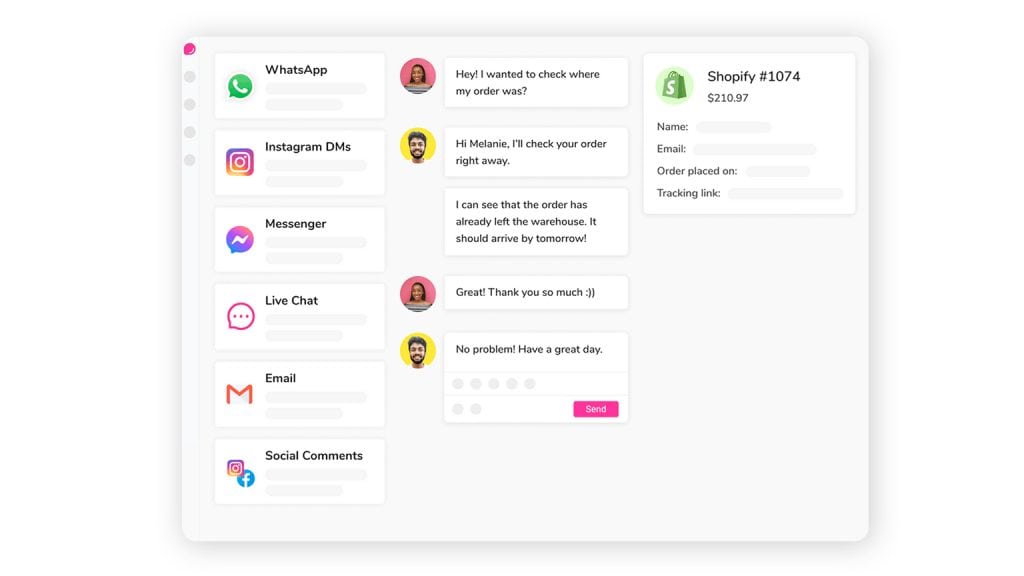
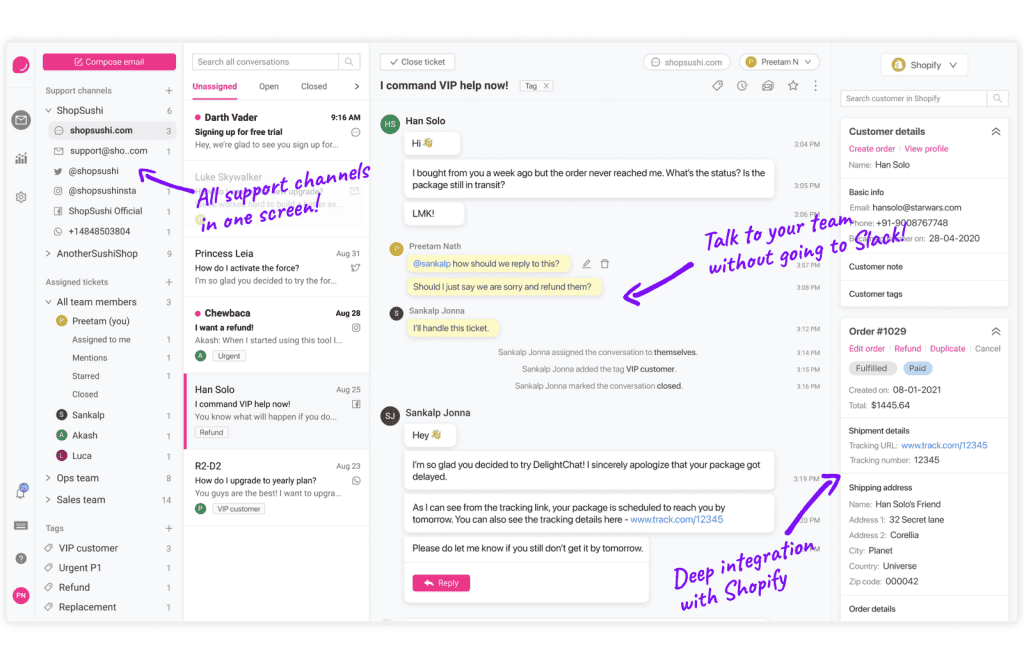
DelightChat is a support inbox for ecommerce brands, and it is very good at being exactly that. Messages from WhatsApp, Instagram, Facebook, email and your website chat widget land in one screen, and the customer Shopify order sits next to the conversation so your agent does not go hunting for it.
It is most at home in a Shopify store where a handful of people answer a lot of “where is my order” messages. If that is your day, DelightChat removes a real irritation. If your messaging is also meant to bring customers back, sell to them, and run without a person watching, you will reach the edge of it sooner than you expect, and that is the honest case for looking at the DelightChat alternatives below.
What DelightChat Does Well
One inbox for five channels
The best thing about DelightChat is that your team stops switching tabs. WhatsApp, Instagram, Facebook Messenger, email and a live chat widget all arrive in the same place, with assignment, internal notes and tagging on top. On the entry plan you get three of those channels included; the plan pages market “unlimited support channels” and then include three, so the fourth is a paid step rather than a free one.
The official WhatsApp Business API, with no setup fee
You get a real WhatsApp Business API number, not a phone someone has to hold. That is the difference between one person answering WhatsApp and a team answering it, and DelightChat charges nothing to set it up. Meta still bills you for the conversations themselves, which is normal and worth budgeting for; the country by country WhatsApp rate card explains what those cost where you are, and the 1 October 2026 pricing change changed what counts as billable.
Shopify order data inside the conversation
Your agent can see the order without leaving the chat. Orders, shipping status and purchase history appear beside the message, and on the entry plan one Shopify store is included. For a single-store brand that is the whole job done. For a group running three storefronts, note that store count is a plan line and not an unlimited one.
WhatsApp campaigns, abandoned carts and COD verification
DelightChat does more than answer: it chases. Promotional broadcasts, abandoned cart and abandoned checkout recovery, order confirmation and fulfilment messages, review collection, winback campaigns and cash-on-delivery verification are all built in. The COD verification and COD-to-prepaid flows are genuinely useful and most general helpdesks do not have them at all.
Automated replies and a self-service widget
The automation is rule-based rather than a flow builder. You set rules that reply, assign or tag an incoming ticket, and a self-service widget lets a customer pull their own order status and tracking link without raising a ticket at all. That widget is the highest-value thing here, because the cheapest ticket is the one nobody opens. There is also a GPT-powered assistant that drafts and rewrites replies, sold as a paid add-on with a free monthly allowance.
DelightChat Pros and Cons
| Pros | Cons |
|---|---|
| One inbox for WhatsApp, Instagram, Facebook Messenger, email and a live chat widget | Two separate meters run at once: support tickets and marketing contacts, each with its own overage |
| Official WhatsApp Business API with no setup cost, and a free green tick application | Unlimited team members and unlimited support channels are marketed, but 5 and 3 are included on the entry plan |
| Shopify orders, tracking and purchase history visible inside the conversation | Automation is rule-based replies, assignment and tagging, not a branching flow builder |
| Abandoned cart, COD verification and winback campaigns built in, which general helpdesks lack | The GPT assistant and back-in-stock alerts are paid add-ons with free usage limits, not plan features |
| A self-service widget that lets a customer check their own order without opening a ticket | The 30 per cent annual discount is not available at checkout; you have to contact the sales team |
| 14-day free trial with no card, plus a one-to-one onboarding call | Built around ecommerce and Shopify, so a service business gets less out of it |
The advantage is simplicity. The limitation is scope: DelightChat is built around the support conversation, so once you want lifecycle marketing, branching customer journeys or an AI agent that can look someone up and book them in, you are looking at a second tool.
DelightChat Pricing in 2026
All three plan prices below were read off the DelightChat pricing page on 2 September 2026 and are unchanged from what this article previously said. What has been added is what each plan includes, because that is where the money actually goes.
Startup, $29 a month
- 500 tickets a month, then $10 per extra 100 tickets
- 2,500 marketing contacts a month, then $10 per extra 1,000 contacts
- 5 team members included
- 3 support channels included
- 1 Shopify store included
This is a genuinely cheap way for a small store to get onto the WhatsApp Business API with a shared inbox around it.
Scale, $99 a month
- 2,000 tickets a month
- 10,000 marketing contacts a month
- 20 team members included
- 10 support channels included
- 3 Shopify stores included
The jump from Startup to Scale is roughly three and a half times the price for four times the tickets, so on ticket volume alone it is the better value of the two once you pass about 900 tickets a month.
Growth, $299 a month
- 6,000 tickets a month
- 30,000 marketing contacts a month
- 50 team members included
- 25 support channels included
The two meters that decide your real bill
DelightChat runs two separate meters, and a busy month moves both. Support is metered in tickets and marketing is metered in contacts, and they are counted and charged independently. A product launch that doubles your enquiries and doubles your campaign audience raises your bill twice over.
Three more things worth knowing before you sign:
- The plan price excludes WhatsApp charges. The pricing page says so plainly, and Meta bills those separately.
- The 30 per cent annual discount is not self-serve. The page advertises it and then asks you to contact the sales team to activate it, so you cannot get it at checkout.
- The AI assistant and back-in-stock alerts are paid add-ons with free usage limits, not plan features.
The trial is 14 days with no credit card, which is longer than most of this list offers.
Is DelightChat pricing worth it?
If your messaging is mostly inbound, yes. Five hundred tickets and 2,500 contacts for $29 is fair, and the Shopify context alone saves your team real minutes. If your messaging is meant to generate revenue rather than absorb it, the arithmetic gets harder: you are paying a support meter for a marketing job, and the automation depth to make that job work is not in the box.
The One Thing Every Platform on This List Has in Common
Every price below is a subscription attached to a meter, and the meter is the part that decides your bill. This is the single most useful thing to hold in your head while comparing them, because the headline numbers are not comparable at all until you know what each one counts.
- DelightChat counts tickets and, separately, marketing contacts.
- Gorgias counts tickets, and bills each AI interaction twice: once as an interaction and again as a ticket.
- Kayako has abandoned per-seat pricing entirely and now charges per resolved ticket.
- Zendesk and Freshdesk count agents, then add a separate charge per AI resolution or AI session.
- Zoko counts conversations, and its entry plan marks up every one of them.
- Interakt bills by the quarter, not the month, and by channel.
- Gallabox has no monthly plan at all; the smallest commitment is a quarter.
- AiSensy prices in Indian rupees and charges per agent seat above the included ones.
- Wati counts users on the middle and upper plans and sells none at all on the entry plan.
- DMly counts active contacts, seats and broadcast messages against a flat plan allowance, with Meta billing the conversations directly.
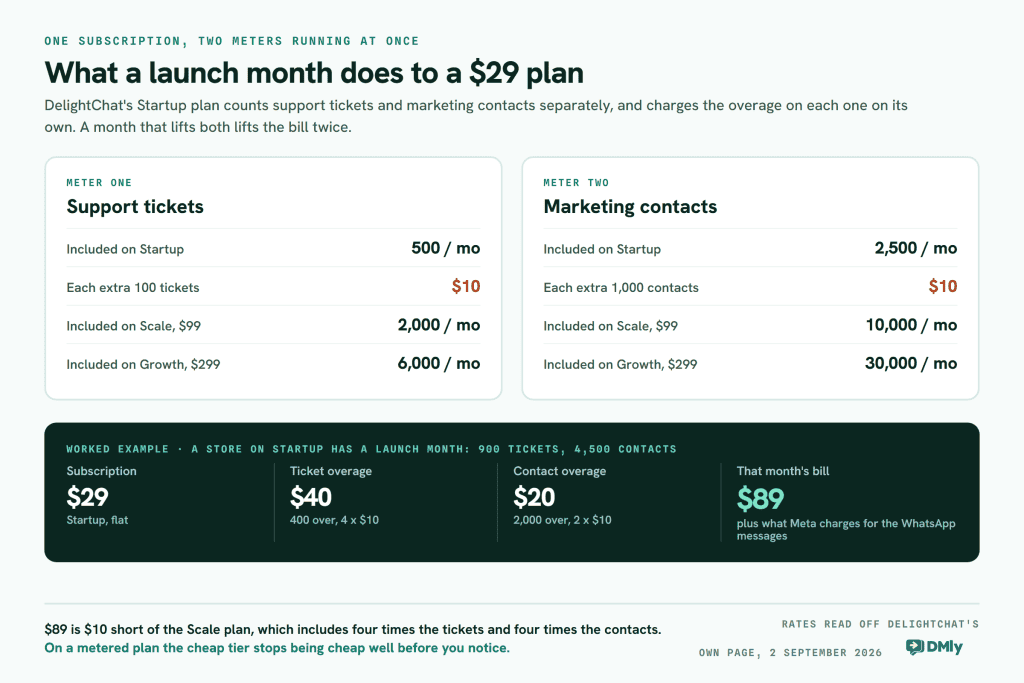
Here is what that looks like on the cheapest plan of the platform this page is about, using only DelightChat published rates.
None of those is wrong in itself. The trap is comparing a per-agent price against a per-ticket price against a percentage of revenue and concluding that the smallest number wins.
The 10 Best DelightChat Alternatives in 2026
Every price in the table was checked against the vendor own pricing page on 2 September 2026, and Zoko’s on 6 September 2026, when it took the place Flowcart had held here. Five of the prices had moved or were quoted in the wrong billing period when this article was last updated, and one vendor had changed its pricing model completely.
| Tool | Best for | Price, verified 2 September 2026 (Zoko, 6 September) | What the bill is counted on |
|---|---|---|---|
| DMly | Marketing, sales, support and automation in one place | $29 a month billed yearly, $39 monthly | A flat plan: active contacts, team seats and broadcast messages against an allowance |
| DelightChat | Ecommerce support inbox on Shopify | $29 a month plus WhatsApp charges | Two meters: 500 tickets and 2,500 marketing contacts, then $10 a block on each |
| Interakt | WhatsApp CRM and sales | $69 a quarter, no monthly option | Quarter and channel. Sales CRM roles are $135 a quarter on top |
| Zoko | Selling a Shopify catalogue inside WhatsApp | $49.99 a month | Conversations. The entry plan adds $0.015 to every one; Plus at $79.99 removes the markup |
| Gallabox | Lead capture and qualification | $150 a month billed quarterly, $112 annually | No monthly plan. Basic is hard-capped at 3 users with no way to buy a fourth |
| Wati | WhatsApp-only teams | $39 a month billed annually, $49 monthly | Users. Growth includes 3 and sells no fourth seat at any price |
| Zendesk | Large support operations | $19 per agent a month paid yearly | Agents, plus about $1.50 per automated AI resolution. AI agents start at $55 an agent |
| Freshdesk | Growing support teams | $19 per agent a month billed annually | Agents, plus $49 per 100 AI agent sessions after the first 500 |
| AiSensy | WhatsApp marketing, priced in rupees | Rs 1,500 a month | Agent seats above those included, at Rs 750 each. The free plan cannot broadcast |
| Gorgias | Ecommerce support with revenue attribution | $10 a month, monthly billing only | Tickets, and every AI interaction billed twice: as an interaction and again as a ticket |
| Kayako | Support you would rather pay for by outcome | $1 per resolved ticket | Resolutions only. Nothing charged for escalations or partial resolutions |
1. DMly
DMly is a messaging platform for businesses that want the conversation to end in something: a booking, an order, a paid invoice, a review. It covers the same support inbox DelightChat does, and then keeps going into campaigns, automation and AI agents that can act rather than only answer.
What it does
- Eight channels in one inbox. WhatsApp, Facebook Messenger, Instagram, Telegram, SMS, TikTok, a LiveChat widget on your own site, and Google Business Profile for reviews and posts.
- AI agents with real tools. An AI reply step can read the contact record, tag them, move them along your pipeline, write a note, check your genuine open appointment slots, book, reschedule or cancel, search your own uploaded documents, and hand the chat to a person.
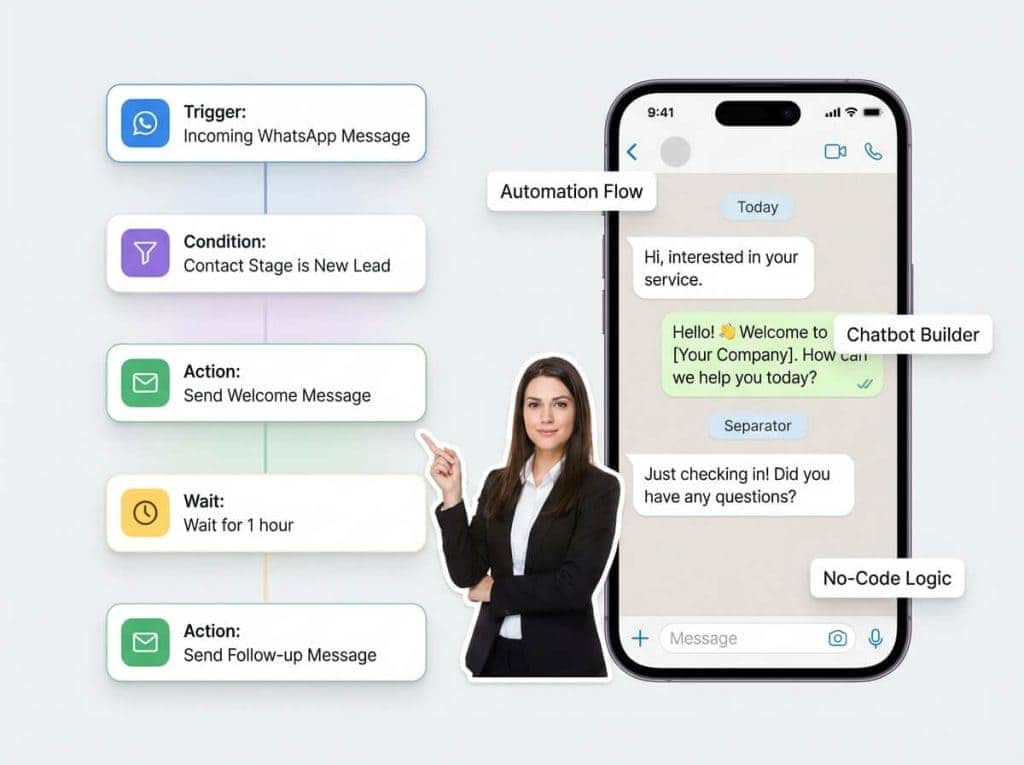
- A visual flow builder with triggers, conditions, waits and actions, so a welcome message, a one-hour pause and a follow-up are three blocks rather than three tools.
- WhatsApp broadcasts using approved templates, with audiences built from your own segments.
- Bookings, invoices, payments and Google reviews in the same product, which is the part most of this list does not have at all.
- Integrations with Shopify, WooCommerce, HubSpot, Mailchimp, Zapier, n8n, Google Sheets, Google Calendar, Zoom, Slack, Stripe, PayPal and more, plus webhooks and a REST API.
Where DMly stops, and you should know before you buy
Three limits are worth putting in front of you rather than burying. They are documented, and any of them could matter more to you than a feature list.
- Broadcast reporting has a hole in it. Replies on a broadcast always reads 0, on every channel, because nothing counts them. There is no click tracking on a broadcast, and the “engagement over time” chart is placeholder data with the same shape for every send. What does work is Delivered on WhatsApp and SMS, and Opened on WhatsApp. On Facebook, Instagram and Telegram, Delivered and Opened stay at 0 whatever happens, because those channels do not report them back.
- Two channels cannot broadcast at all. The LiveChat widget and TikTok are inbox channels only, so a campaign has to reach those people somewhere else.
- Two of the four AI providers cannot read your documents. Claude and DeepSeek do not search uploaded knowledge, so if the agent needs to answer from your price list, use OpenAI or Gemini.
The reason to say this out loud is that the alternative is finding out in week three. If broadcast click tracking is how you prove your marketing works, that is a real reason to look elsewhere, and it is better to know now.

Pricing
Three plans, verified against the live DMly pricing page on 2 September 2026:
- Starter, $29 a month billed yearly ($39 billed monthly): 1 profile per channel, 3 team seats, 3,000 active contacts, 10,000 broadcast or template messages, 10 active bots per profile with unlimited flows, and 500 AI replies a month.
- Growth, $65 a month billed yearly ($79 billed monthly): 3 profiles per channel, 6 team seats, 10,000 active contacts, 50,000 broadcast messages, unlimited active bots and 5,000 AI replies a month.
- Premium, $149 a month billed yearly ($199 billed monthly): 5 profiles per channel, 15 team seats, unlimited active contacts, 300,000 broadcast messages and unlimited AI replies on your own AI keys.
Extra seats are $10 a month, an extra profile set $15 a month and extra contacts $15 per 1,000, so the plan grows in small steps rather than jumps. Every plan carries the CRM, the shared inbox, broadcasts, bookings, invoices, payments, reviews, custom branding and the API. The trial is 7 days with no card. WhatsApp conversation fees go straight to Meta, and DMly adds nothing on top.
Why DMly is a strong DelightChat alternative
The difference is what happens after the reply. DelightChat is built so a support team can answer faster. DMly is built so the conversation can finish the job: qualify the lead, book the appointment, send the invoice, take the payment, ask for the Google review, and run the follow-up that would otherwise never get sent.
If your messaging is purely inbound support on a Shopify store, DelightChat is simpler and you should probably keep it. If you are trying to make messaging earn its keep, see how the same idea plays out in selling directly through WhatsApp.
2. Interakt
Interakt is a WhatsApp-first engagement platform with a sales CRM attached. It suits ecommerce teams who treat WhatsApp as a selling channel rather than a support queue.
What it does well
- Shared WhatsApp inbox with unlimited agent logins
- Built-in sales CRM with pipelines, sold as a separate module
- Broadcast campaigns and automated follow-ups
- Shopify integration with order tracking and notifications
- Instagram DMs and comments included
The catch worth knowing
Interakt bills by the quarter, not the month, and the entry plan is one channel of your choosing. Starter is $69 a quarter, which works out near $23 a month but cannot be bought monthly. Its “unlimited agents” applies to owner roles only; the Sales CRM roles that give an agent visibility of assigned contacts are a separate $135 a quarter for five sales agents, then $27 per quarter for each one after. WhatsApp AI agents are a $74.99 add-on and only on Growth or Advanced.
Pricing
Verified 2 September 2026: Starter $69 a quarter, Growth $149 a quarter, Advanced $189 a quarter. An Instagram-only Starter is $12 a month. This article previously said “approximately $20 a month”, which understated both the amount and the commitment. Full detail in our Interakt review.
3. Zoko
Zoko is a WhatsApp commerce platform rather than a helpdesk, and it is built specifically for Shopify stores. Its job is turning chats into checkouts: the catalogue syncs from Shopify into WhatsApp, customers buy inside the conversation, and eleven ready-made flows chase the things that quietly leak money, beginning with the abandoned checkout.
What it does well
- Shopify catalogue synced into WhatsApp, with products sold inside the chat
- Eleven ecommerce flows included free, including abandoned checkout recovery, cash-on-delivery confirmation and reorder reminders
- Bulk broadcasts, a chat widget, pop-up campaigns and click-to-WhatsApp ads
- Unlimited agents on the entry plan, where most of the platforms here charge per seat
- A flow builder for anything the eleven presets do not cover, at $5.99 a month per published flow
The catch worth knowing
The cheap plan is the one with the meter attached. Starter is $49.99 a month and adds $0.015 to every conversation on top of what Meta charges you, which is the opposite way round from most of this page. From Plus at $79.99 the markup disappears: 5,000 conversations are included at Meta’s own rate and anything beyond them is $0.00199. So a store doing real volume is better off on the more expensive plan, which is not a sentence you get to write often. The AI agent that takes orders for you is separate again, at 3 per cent of order value.
Pricing
Verified 6 September 2026: Starter $49.99 a month, Plus $79.99, Elite $139.99 and Max $499.99. Monthly or yearly, a seven day trial with no card, and everything prepaid, so the subscription is taken on the first day of the period and you top up conversation credits before you can send. Agents are free and unlimited on Starter, then 5, 10 and 30 included with extra seats at $15, $12 and $9.
4. Gallabox
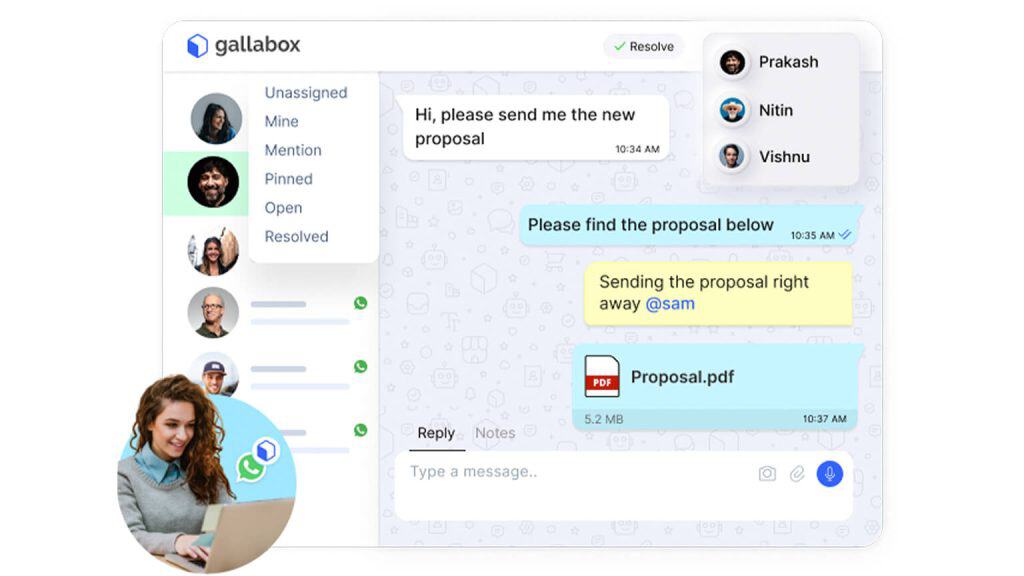
Gallabox is a conversational sales platform built around WhatsApp and Instagram, aimed at businesses with a lot of inbound leads to sort.
What it does well
- AI chatbots that qualify and route leads
- Shared inbox for WhatsApp, Instagram and a web widget
- Click-to-WhatsApp widgets for capturing leads from your site
- Broadcast campaigns with segmentation
- Automated follow-up sequences
The catch worth knowing
Gallabox has no monthly plan, and its entry tier has a hard cap of three users. Not three included users with more available: three, with an upgrade the only way past it. The next tier up is where additional users can be bought at all, at $18 per user per month.
Pricing
Verified 2 September 2026: Basic is $150 a month billed quarterly, or $112 a month billed annually. Essential is $331 a month quarterly, and the tier above that $632. This article previously said “$25 a month”, which was wrong by roughly six times and is the single largest correction on this page. Our Gallabox review goes through the tiers in detail.
5. Wati

Wati is one of the longest-established WhatsApp Business API platforms, and if WhatsApp is your only channel it is a serious option.
What it does well
- Mature shared team inbox with a large user base behind it
- No-code chatbot builder
- Broadcast campaigns and triggered messages
- Click-to-WhatsApp ads integration
- Shopify and ecommerce integrations
The catch worth knowing
The Growth plan sells no additional users at any price. It includes three, connects one channel, and the only way to a fourth person is a whole plan upgrade. Pro includes five and charges $24 per user per month after that; Business includes five and charges $59. For a ten-person team the seat cost can outweigh the plan.
Pricing
Verified 2 September 2026: Growth $39 a month billed annually or $49 billed monthly, Pro $79 annually, Business $199 annually. The $49 this article quoted is the monthly-billing rate, so it was right for monthly and high for annual. Our Wati and DMly head-to-head puts the two side by side.
6. Zendesk
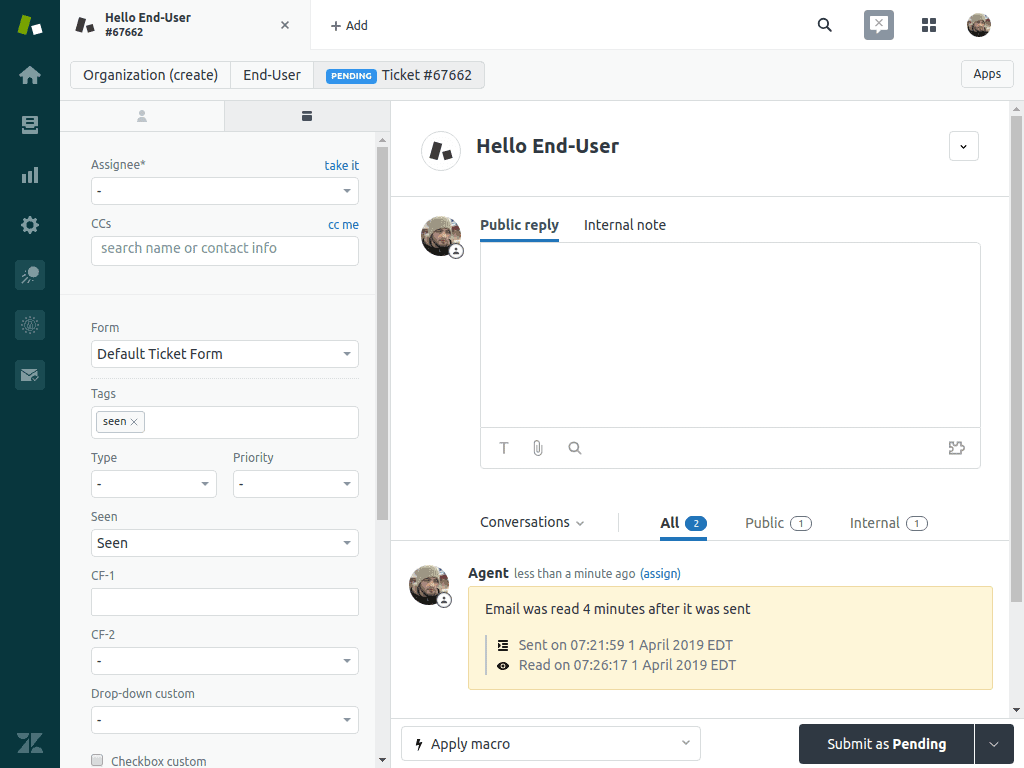
Zendesk is the enterprise end of this list: full ticketing, help centre, routing, reporting and an integration marketplace, used by support organisations far larger than a DTC brand.
What it does well
- Ticket management with serious routing and workflow depth
- Omnichannel coverage including email, chat, phone and messaging apps
- Knowledge base and self-service portal
- Reporting that stands up to an operations manager
- A very large integration marketplace
The catch worth knowing
The $19 tier does not include the AI. Support Team at $19 an agent is email and ticketing with prebuilt automation. AI agents start on Suite Team at $55 an agent per month, and automated resolutions beyond the plan are billed separately at around $1.50 each pay as you go. The Copilot add-on is another $50 per agent per month.
Pricing
Verified 2 September 2026: Support Team $19 per agent per month paid yearly ($25 monthly), Suite Team $55, the tier above $115. Per agent, so the price is a multiplication rather than a number.
7. Freshdesk
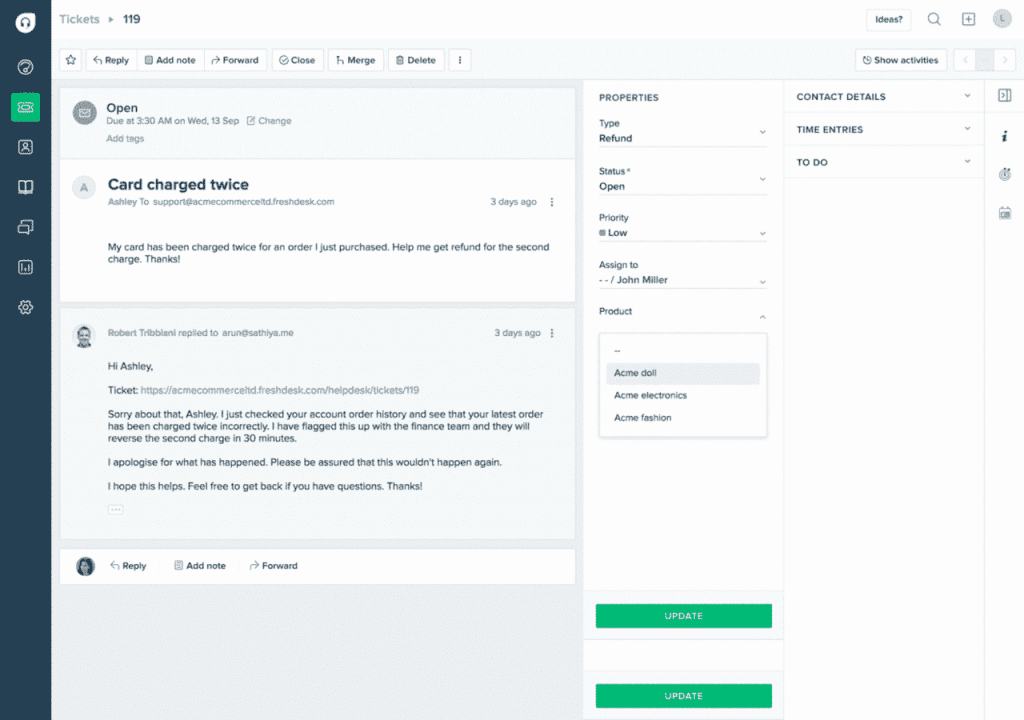
Freshdesk, part of Freshworks, is the easier-to-adopt version of the same idea: ticketing, automation, AI and self-service without the enterprise setup project.
What it does well
- Noticeably shorter learning curve than most enterprise helpdesks
- Freddy AI for drafting, triage and suggested solutions
- Workflow automation and SLA management
- Knowledge base and self-service portal
- Deep integration with the rest of the Freshworks suite
The catch worth knowing
The AI is metered. The first 500 AI agent sessions are included, then it is $49 per 100 sessions. Freddy AI Copilot is a separate $29 per agent per month. Day passes for temporary staff are $2, $7 or $12 depending on your tier, which is a nice touch for a seasonal spike.
Pricing
Verified 2 September 2026: Growth $19 per agent per month billed annually, Pro $55, Enterprise $89. This article previously said $15, which was low; there is still a free plan for very small teams.
8. AiSensy
AiSensy is a low-friction way onto the WhatsApp Business API, popular with startups and small businesses running Meta ads into WhatsApp.
What it does well
- Free WhatsApp API onboarding, including the green tick application
- Strong click-to-WhatsApp ads integration with an ads manager
- Shared team inbox and a no-code chatbot builder
- Product catalogue management and broadcast campaigns
- Messaging limits that scale automatically as your quality rating holds
The catch worth knowing
The free plan cannot broadcast, and the prices are in rupees. Free Forever gets you the API and a sign-up credit but broadcasting is not on it, so the free tier is a way to receive messages rather than run campaigns. Agent seats beyond those included are ₹750 per seat per month, and the AI chatbot is charged separately on top of any plan.
Pricing
Verified 2 September 2026: Free Forever ₹0, Basic ₹1,500 a month, Pro ₹3,200, Premium ₹9,100, Enterprise ₹45,000. This article previously said ₹999, which is no longer the entry paid rate. See our AiSensy review for how it compares once volume grows.
9. Gorgias
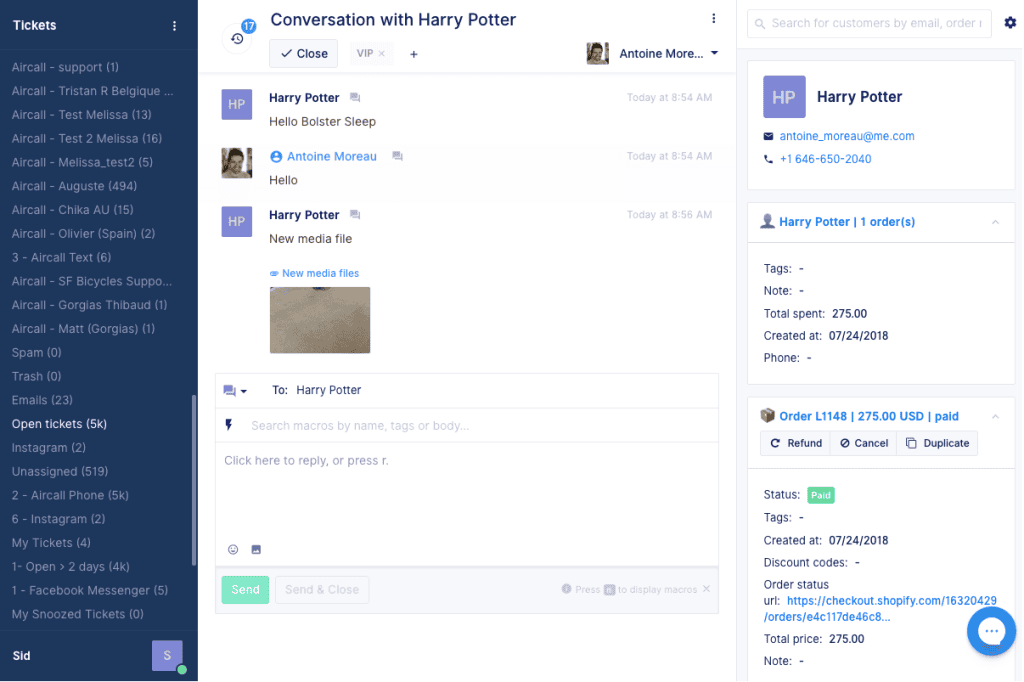
Gorgias is the ecommerce helpdesk most directly comparable to DelightChat, with deeper Shopify integration and revenue attribution built in.
What it does well
- Unified support inbox purpose-built for online stores
- Deep Shopify integration with order actions inside the conversation
- Automation rules and macros
- Revenue attribution reporting, so support can show what it earned
- An AI agent included on every plan
The catch worth knowing
An AI interaction is billed twice. Gorgias own pricing FAQ says AI Agent interactions cost $0.90 each on annual plans or $1.00 monthly, and that each AI interaction also counts as a helpdesk ticket and is billed accordingly. Ticket overage is $0.40 on the lower tiers and $0.36 higher up. The entry plan is also monthly billing only and includes 50 tickets.
Pricing
Verified 2 September 2026: Starter $10 a month (50 tickets, monthly billing only, 3 seats), Basic $50 a month billed annually (300 tickets), Pro $300 a month billed annually (2,000 tickets, and the tier Gorgias marks as most popular), Advanced $750 (5,000 tickets). The $10 headline is real; it is the second step that surprises people.
10. Kayako
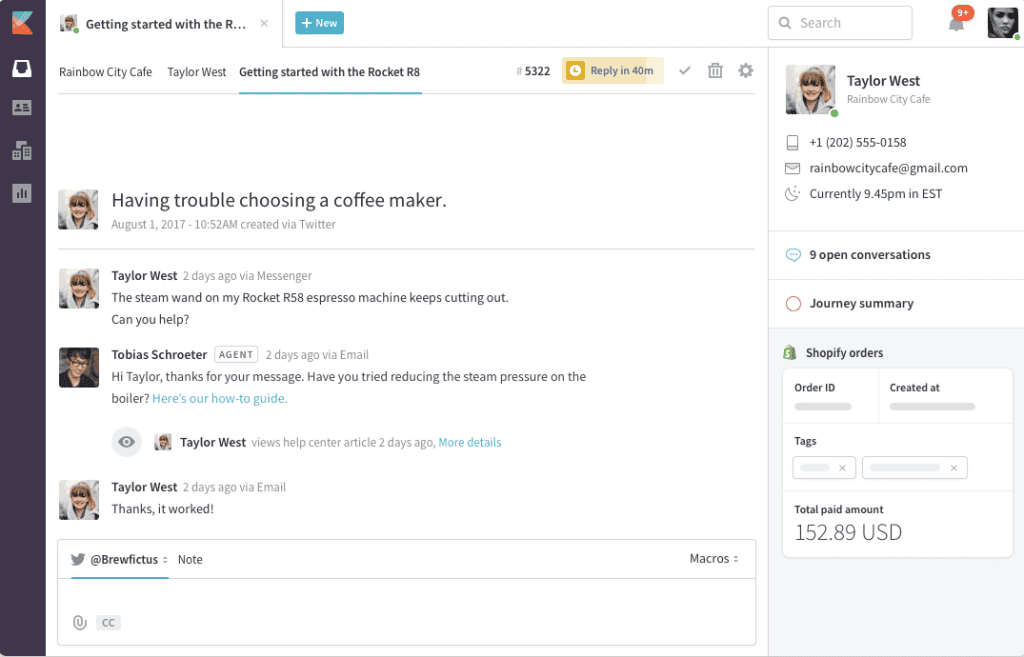
Kayako is a customer service platform built around a single timeline of everything a customer has ever said to you, across email, chat, social and self-service.
What it does well
- A unified conversation timeline that keeps context in one place
- Multi-channel ticketing and a shared team inbox
- Workflow automation and a knowledge base
- An AI agent that acts, processing refunds and account updates rather than only replying
- Outcome-based pricing that only charges when something is finished
The catch worth knowing
Kayako has changed its pricing model completely, and this article had the old one. It no longer sells per agent per month. Its Kay AI agent is charged at $1 per resolved ticket, with no charge for escalations or partial resolutions, and the full Kayako One helpdesk platform is not priced publicly at all: the button says “Talk to an Expert”. That is a genuinely interesting model if your tickets are repetitive, and a hard one to budget if they are not.
Pricing
Verified 2 September 2026: $1 per resolved ticket for the Kay AI agent, and custom pricing for the Kayako One platform. The $39 per agent per month this article previously quoted no longer appears anywhere on their pricing page.
The Recommendation We Have Withdrawn: Flowcart
Until today this list had Flowcart at number three, at $69.99 a month plus 1.5 per cent of your WhatsApp revenue above $3,000. That recommendation is withdrawn, and it is worth saying so out loud rather than quietly deleting the section. Flowcart is trading. It has stopped publishing its prices. Checked at source on 8 September 2026: flowcart.ai answers normally and still carries a full pricing page, but the plan tiers on it now read “Get a Quote” where figures used to be. That is the gated state rather than a missing one: the page is there, and the numbers have been taken out of it.
We got the earlier version of this section wrong, and we withdraw it. On 6 September we checked flowcart.io and flowcart.com and concluded from them that the company had gone. Neither of those is the vendor: the first is an unrelated “Launching Soon” holding page, the second redirects to an events business, and Flowcart itself is at flowcart.ai, live and trading. That was our mistake, not a change at Flowcart, and we apologise for it. The reason Flowcart is out of this list is the duller one above: it quotes on request, and a page that ranks vendors on published prices cannot rank one that publishes none. Zoko has taken the slot, because it does the same job for a Shopify store and it publishes what it charges.
Final Verdict
DelightChat is a good product that is priced honestly for the job it does. If you run a Shopify store, most of your messages are about orders, and you want them in one inbox with the order attached, it is hard to argue with $29 a month and a 14-day trial. Nothing on this page is a reason to leave a tool that is working.
The reason brands go looking at DelightChat alternatives is scope, not quality. DelightChat meters support and prices support. The moment you want messaging to bring people back rather than only answer them, you are either buying a second tool or moving to something that does both.
Of the ten, the split is fairly clean. Gorgias and Zendesk are where you go when support itself gets bigger and more complicated. Freshdesk is the same move with a shorter setup. Kayako is worth a look purely because paying per resolved ticket is a different bet from paying per agent. Zoko is the choice if WhatsApp is a sales channel for a Shopify store, as long as you read which of its plans charges you per conversation. Wati, Interakt, Gallabox and AiSensy are WhatsApp specialists at four different price points and four different billing periods.
DMly is the one that covers the widest ground on a flat plan, which is why it leads this list: the same inbox, plus campaigns, automation, AI agents with real tools, and bookings, invoices and reviews in the same product. It is also the one on this page that tells you where its reporting falls short before you buy, which is the test worth applying to every vendor here.
The best choice is the one whose meter matches how your business actually grows. Count the thing you will have more of next year, and price that.
DelightChat Alternatives: Frequently Asked Questions
How much does DelightChat cost in 2026?
DelightChat has three plans, verified on 2 September 2026: Startup at $29 a month (500 tickets and 2,500 marketing contacts), Scale at $99 (2,000 tickets and 10,000 contacts) and Growth at $299 (6,000 tickets and 30,000 contacts). All three exclude WhatsApp charges, which Meta bills separately, and extra tickets are $10 per 100 while extra marketing contacts are $10 per 1,000.
Does DelightChat offer a free trial?
Yes. DelightChat offers a 14-day free trial with no credit card required, plus a one-to-one onboarding call. It also advertises 30 per cent off annual plans, but that discount is not available at checkout; you have to contact their sales team to activate it.
What are the best DelightChat alternatives?
It depends on which meter suits you. For support that is getting bigger, Gorgias or Zendesk. For WhatsApp selling from a Shopify store, Zoko. For a WhatsApp-only team, Wati or Interakt. For most growing businesses that want support, marketing, automation and bookings in one flat plan, DMly covers the widest ground, starting at $29 a month billed yearly.
Which DelightChat alternative is cheapest?
On headline price, Gorgias at $10 a month, but it includes only 50 tickets and bills every AI interaction as an interaction and again as a ticket. On price for what is included, DMly Starter at $29 billed yearly carries 3,000 active contacts, three seats and 10,000 broadcast messages. The cheapest sticker rarely stays the cheapest bill, which is why the meter matters more than the number.
What are the main limitations of DelightChat?
It is built around support. Automation is rule-based rather than a branching flow builder, there is no lifecycle marketing layer, segmentation is limited, and the reporting answers “how is the team doing” rather than “what did this earn”. The plan lines also cap channels and Shopify stores even though the marketing copy says unlimited.
Is DMly better than DelightChat?
For inbound Shopify support alone, DelightChat is simpler and does the job. For anything wider, DMly does more: eight channels instead of five, AI agents that can book and update records rather than only reply, a visual automation builder, and bookings, invoices, payments and Google reviews in the same product. DMly is also honest that broadcast reply counts and click tracking are not there, so compare on the things you will actually use.
Do any of these platforms include WhatsApp message costs?
No. Every platform on this page bills its subscription separately from Meta per-conversation charges, and DelightChat says so on its own pricing page. What differs is the markup: some add a margin to Meta rates, while DMly passes them straight through. Zoko is the clearest example on this page, because it does both, adding $0.015 to every conversation on its entry plan and passing the rate through on the plans above it. If you are budgeting, start with the WhatsApp rate card for your country and read the 1 October 2026 change, because two categories became billable that were not before.
Writing about WhatsApp automation, bookings and growth for local business.
Turn WhatsApp into your busiest channel.
Start free and run message, bookings, payments and reviews in one place.
