
How Much Does a WhatsApp Chatbot Cost in 2026? Full Price Breakdown
Straight answer first, because “how much does a WhatsApp chatbot cost” deserves a number and not a funnel: for a typical small business, a working WhatsApp chatbot costs roughly $30 to $200 per month, made of two recurring line items (the platform subscription and Meta’s per-message fees), plus a one-time build cost that can genuinely be zero, plus a maintenance cost paid in hours rather than dollars. Campaign-heavy businesses in expensive messaging markets can push past that range; a lean service business in a cheap market can sit under it. One dated change to hold in mind as you read: from 1 October 2026 Meta charges for the replies your bot sends inside the 24-hour window, which used to be free. At that market’s utility rate it adds single-digit dollars for most small businesses, so the range above still holds, but the line is no longer zero.
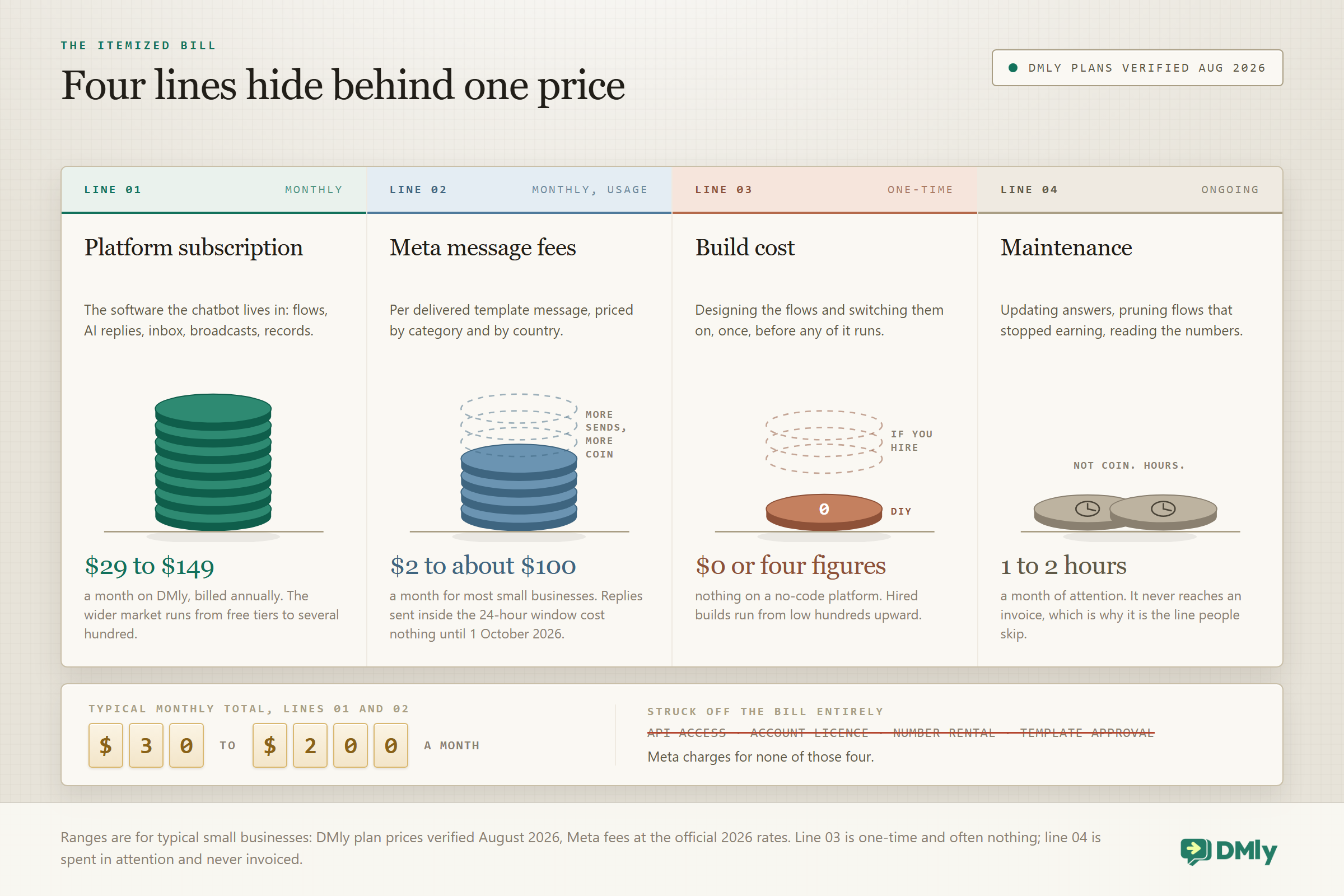
The reason most answers to this question feel slippery is that four different bills hide behind one word, and vendors quote whichever line flatters them. A “free chatbot” usually means a free platform tier with the message fees waiting; a “$5 a month” claim usually means Meta fees in a cheap market with the platform cost waiting; an agency’s “$3,000 chatbot” is a build cost wearing the whole outfit. So this page does what a decent accountant would: itemizes everything, prices each line honestly (our own platform’s prices included, verified against dmly.io/pricing in August 2026), and then adds the lines up for three real businesses.
The WhatsApp Chatbot Bill at a Glance
| Line item | What it is | Typical 2026 range | How often |
| 1. Platform subscription | The software that runs the chatbot, flows and inbox | $29 to $149 on DMly; market spans free tiers to several hundred | Monthly |
| 2. Meta message fees | Per delivered template message, priced by category and country | A few dollars to ~$100 for most small businesses | Monthly, usage-based |
| 3. Build cost | Getting the flows designed and switched on | $0 DIY on no-code tools; hired builds from low hundreds to four figures | One-time |
| 4. Maintenance | Updating answers, pruning flows, reading the numbers | An hour or two per month | Ongoing, paid in time |
Line 1: What Does the Chatbot Platform Cost?
This is the line you choose, and it is usually the bigger half of the WhatsApp chatbot cost. The platform is the software where your chatbot actually lives: the flow builder, the AI replies, the inbox your people take over in, the broadcasts, the customer records. In 2026 the market’s pricing shapes range from free tiers (with the limits doing the selling) through per-seat and per-contact models to plan-plus-credits, and since we publish our own numbers, here they are, verified against the pricing page in August 2026 so this article practices what it preaches.
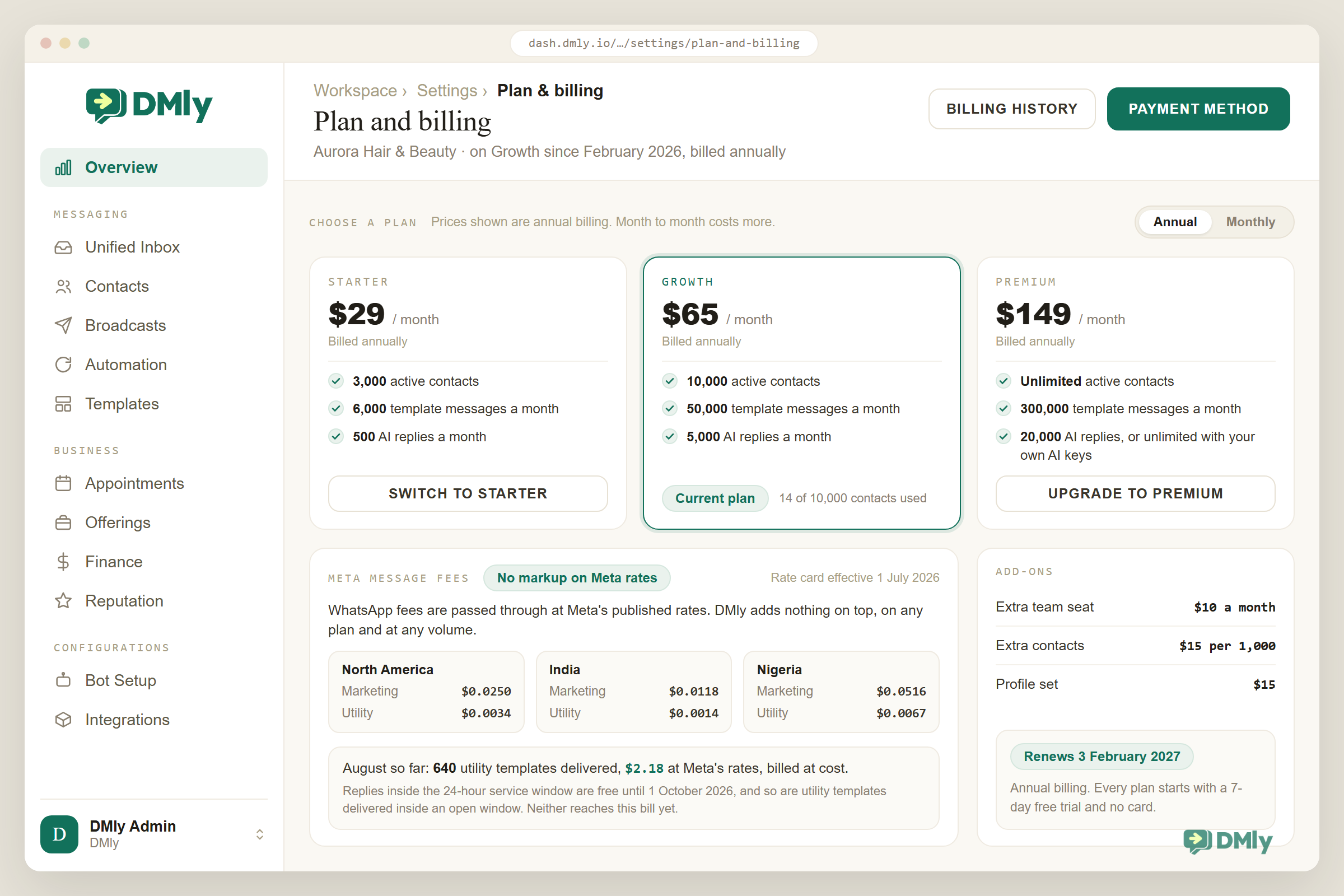
| DMly plan | Price (billed annually) | Active contacts | Broadcast / template messages | AI replies per month |
| Starter | $29 / month | 3,000 | 6,000 | 500 |
| Growth | $65 / month | 10,000 | 50,000 | 5,000 |
| Premium | $149 / month | Unlimited | 300,000 | 20,000, or unlimited with your own AI keys |
Those are annual-billing rates; paying month to month costs more, extra team seats are $10, and every plan starts with a 7-day free trial, no card. Two structural points matter more than our specific numbers when you compare any platforms. First, check what the subscription includes versus meters: contacts, messages, AI replies, seats and channels are the five dials vendors tune. Second, and this is the line item that ambushes people at volume: check whether the platform adds a markup on Meta’s message rates. DMly does not (you pay Meta’s standard rates, nothing added), and any comparison that ignores markup is comparing half a price.
Line 2: What Does Meta Charge for a WhatsApp Chatbot?
Meta charges nothing for the WhatsApp Business API itself, and it charges for messages rather than for access. Per-message pricing arrived in July 2025. Up to 30 September 2026, the conversations your chatbot exists for (customers messaging you, the bot answering inside the 24-hour service window) were free at Meta’s layer; from 1 October 2026 those replies are charged, at the same rate as that market’s utility messages. What Meta has always billed is business-initiated template messages, per delivered message, priced by category and country: marketing templates dearest, utility templates cheap, and authentication templates for login codes. Utility templates delivered inside an open service window were free too, and from 1 October they are charged as well.
The spread by country is the part that surprises budgeters, so here is a taste of Meta’s official USD rate card, effective 1 July 2026:
| Market | Marketing (per delivered msg) | Utility (per delivered msg) |
| India | $0.0118 | $0.0014 |
| Nigeria | $0.0516 | $0.0067 |
| North America | $0.0250 | $0.0034 |
| Brazil | $0.0625 | $0.0068 |
| United Kingdom | $0.0635 | $0.0220 |
The third category, authentication templates for login and verification codes, mostly concerns product businesses rather than local ones, but it hides the rate card’s sharpest corner: several countries price authentication differently when the message is sent by a business based abroad. India charges $0.0014 for domestic authentication but $0.0304 for the international variant, Indonesia $0.1360 and Nigeria $0.0750 for theirs, which is a line worth checking before building any cross-border verification flow on WhatsApp.
One free ride is still worth knowing about: a conversation that starts from a click-to-WhatsApp ad opens a 72-hour window that is free to message, templates included. That one matters more from October than it used to, because the ordinary in-window free ride has ended. The full country-by-country table, with the worked examples and the tier discounts for volume senders, lives in our WhatsApp Business API pricing rate card; for this page’s purpose, the rule of thumb is that a small business sending hundreds of templates a month spends single-digit to low-double-digit dollars at Meta’s layer, and campaign-led senders should multiply their list size by their market’s marketing rate before promising themselves anything.
Line 3: How Much Does It Cost to Build a WhatsApp Chatbot?
Zero is a real number here, and for most small businesses the right one. On a no-code platform, the welcome-and-answers chatbot (greet, answer the usual questions, offer booking, hand anything odd to a human) is a weekend project for the owner: pick triggers, write answers in your own voice, connect the calendar, test on your own phone. Our beginner’s guide to no-code WhatsApp automation walks that exact build. The cost is your evenings, and the build usually beats agency versions on one axis that matters most, which is that it sounds like you.
Hiring is legitimate when the flows are genuinely complex or nobody has the evenings. Ballparks, plainly labelled as ballparks because scope moves them: freelancer builds of a standard flow set tend to land in the low hundreds of dollars; agency builds with strategy, copywriting and integrations run to four figures; and custom-coded bots straight against the API (a developer, hosting, webhook plumbing) are the expensive path that mainly suits products with engineering teams, priced in developer time rather than package fees. Two rules protect the budget: never pay four figures before a no-code trial has proven the use case, and make sure whatever is built lives in an account you own, so the asset survives the relationship.
Line 4: The Hidden Costs (and the Fake Ones)
The genuinely hidden costs are small but real. Maintenance is the big one: an hour or two a month updating answers, pruning flows that stopped earning their place, and reading the numbers, because a chatbot answering with last season’s prices is worse than no chatbot. Opt-in list building costs effort (and sometimes an incentive) before broadcasts can pay. And the costliest line never appears on an invoice: a bot with no human handover quietly taxes you in abandoned conversations, which is why every flow we ship carries a marked exit to a person.
The fake costs deserve equal time, because they pad quotes. There is no Meta fee for API access, no WhatsApp Business Account licence, no per-number rental at Meta’s layer, and no charge for template approval; anyone itemizing those is decorating the bill. Quality rating problems are real but cost you throughput, not fees: sloppy broadcasts get numbers throttled, which is a marketing loss masquerading as a technical one. The honest hidden-cost summary: dollars are the smallest risk, attention is the real subscription.
Three Real Monthly Bills, Worked Out
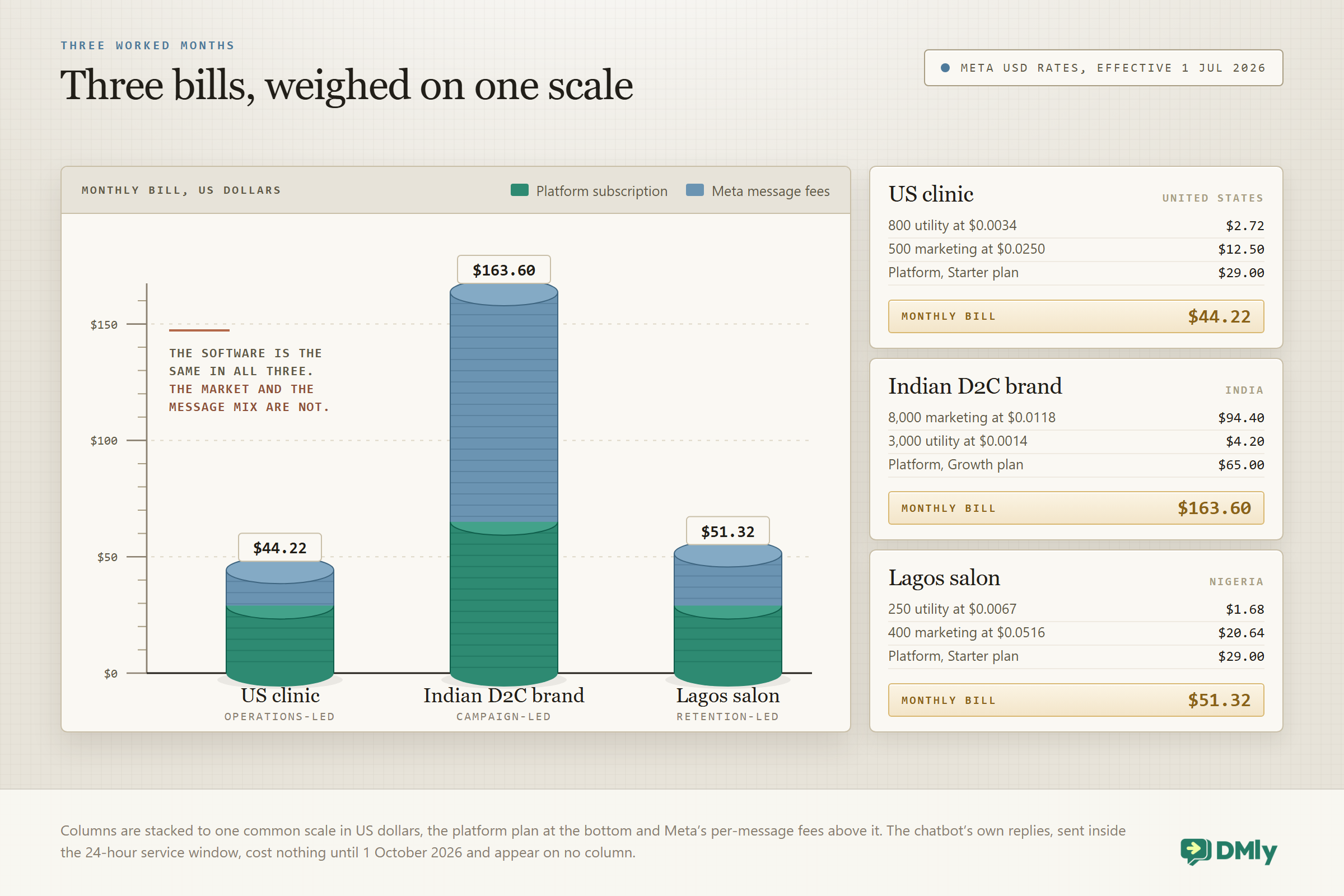
Numbers beat ranges, so here are three composite businesses priced end to end at Meta’s 2026 USD rates, each on the DMly plan its volume actually needs. One note on how to read all three: they are priced on the rules up to 30 September 2026, when service conversations (customers messaging in, the chatbot answering) appeared on no line at all, however many thousands there were. From 1 October those replies carry that market’s utility rate, so add your own reply volume at the utility figure in the table above to bring each bill up to date. On the volumes below that is a few dollars, not a new bracket.
A US clinic, operations-led
800 appointment reminders and recall notices as utility templates (800 × $0.0034 = $2.72) and 500 marketing messages for seasonal campaigns (500 × $0.0250 = $12.50). Meta total $15.22, platform on Starter $29, monthly bill about $44. Note the shape: for operations-led businesses the platform is the bigger line by a distance, and until October the chatbot’s actual conversations cost nothing at all. From October they cost $0.0034 each in this market, which on a few hundred replies is under two dollars.
An Indian D2C brand, campaign-led
8,000 marketing messages a month to an opted-in list (8,000 × $0.0118 = $94.40) plus 3,000 order and delivery utility updates (3,000 × $0.0014 = $4.20). Meta total $98.60, platform on Growth for the volume and contacts $65, monthly bill about $164. India’s cheap rates are why campaign models thrive there; the same 8,000 marketing sends would cost $500 in Brazil, which is the rate card lesson in one sentence.
A Lagos salon, retention-led
Roughly 600 customer conversations handled by the bot, which cost nothing before October and are billed at Nigeria’s $0.0067 utility rate after it; 250 appointment reminders sent as utility templates outside the window (250 × $0.0067 = $1.68); 400 marketing messages for rebooking nudges and offers (400 × $0.0516 = $20.64). Meta total $22.32, platform on Starter $29, monthly bill about $51. The 650 templates sit comfortably inside Starter’s 6,000 allowance.
What Moves the Bill: The Six Dials
Two businesses running the same chatbot can pay wildly different bills, and the WhatsApp chatbot cost always comes down to the same six dials. Knowing them turns budgeting from guesswork into arithmetic. One reading note on Figure 3 above: the usage strip in it states that replies inside the 24-hour window are free, and that utility templates delivered inside an open window are free too. Both were true up to 30 September 2026 and are charged at your market’s utility rate from 1 October.
- Where your customers are. The country rate is the biggest multiplier in the system: the same marketing message costs $0.0118 in India and $0.0625 in Brazil, a spread of more than five times. Businesses with international lists should price by audience mix, not headquarters.
- Your template category mix. Marketing rates run several times utility rates in most markets, so a bill dominated by reminders and receipts is structurally cheaper than one dominated by campaigns. Shifting a message from marketing to genuinely utility framing (where it honestly belongs there) changes its price class.
- List size times frequency. The marketing line is simply recipients × sends × rate. Halving frequency to the unengaged half of a list routinely halves the Meta line with no revenue loss, which no other dial can do.
- Window discipline. Answering inside 24 hours is still the cheapest route: an in-window reply is charged at your market’s utility rate from October, where a message sent after the window has closed as a marketing template costs several times that. Slow operations quietly convert your cheapest messages into your dearest ones.
- AI reply volume. Platform-side, AI answers are metered by plan (500 a month on DMly’s Starter, 5,000 on Growth, 20,000 on Premium, or unlimited with your own AI keys), so a bot that leans heavily on AI conversation belongs on the plan whose meter fits.
- Team size. Seats are the quiet platform dial ($10 each on DMly); a chatbot that hands over to six humans carries a payroll of seats behind it.
Budgeting the First Year, Month by Month
The first year has a predictable shape, so budget it deliberately rather than reacting to it. Month zero is free: a 7-day trial with no card is enough to build the welcome flow, connect the calendar and test on your own phone before a dollar moves. Months one to three, most local businesses fit Starter at $29: 3,000 contacts, 6,000 template messages and 500 AI replies cover a single-location operation finding its rhythm, with Meta fees in the single digits while the audience is small.
Then watch for the three tripwires that mean you have outgrown the plan: contact number 3,001, template message 6,001 in a month, or AI reply 501. Any one of them is the signal to move to Growth at $65, and the healthy version of that upgrade is the one where the chatbot’s bookings already dwarf the difference. Two decisions round out the year: switch to annual billing once you trust the channel (it is meaningfully cheaper than month to month; switch after the first proven quarter, not before), and heavy senders should know that Meta’s own volume tiers discount marketing rates as monthly volume climbs, which is covered properly in the rate card pillar. A realistic first-year total for a single-location service business: around $350 to $450 all in, most of it platform, almost none of it Meta.
The Arithmetic That Actually Matters: Cost per Outcome
The bill only makes sense next to what a message earns, so run the outcome arithmetic before judging any monthly total. Take the Lagos salon’s marketing line: 400 rebooking nudges at $20.64. If just one nudge in two hundred books a $75-class service, that month’s nudges produced two bookings and roughly $150 of revenue against about $21 of spend, and the whole month’s bill is settled by the first one. The clinic’s version is starker: 800 reminders at $2.72 against the cost of even a single no-show hour, which is why reminder automation is the fastest-payback line in this entire industry.
The honest way to run this for your own business: take your average transaction value, count the no-shows and unanswered enquiries of a normal month, and price the bill against recovering ten percent of them. When the chatbot cost fails that test, the problem is almost never the pricing; it is a bot built to deflect conversations instead of converting them, and the fix costs a rebuild, not a bigger budget.
It also helps to name what the bill replaces, because a chatbot is rarely a new cost so much as a cheaper form of an old one. The evening and weekend enquiries it answers were previously answered by nobody, which is to say they were answered by your competitors. A human covering those hours costs wages that dwarf the entire yearly chatbot bill; the chatbot covers them for the price of a plan and answers in seconds. And against SMS blasting, the older small-business reflex, WhatsApp gives you two-way conversation inside the window at your market’s cheapest per-message rate, plus rich media, buttons and delivery-based billing, where SMS charges for every fragment in both directions and can only talk in plain text. The bill on this page is not an addition to your marketing costs; for most local businesses it is a consolidation of them.
Seven Questions to Ask Any Vendor Before You Sign
- Do you add a markup on Meta’s message rates? The compounding line. Pass-through pricing (DMly’s policy) keeps usage at cost forever; markup grows with your success.
- What exactly is metered? Contacts, messages, AI replies, seats, channels: get the five dials in writing and price your realistic month against them.
- Who owns the WhatsApp Business Account? It must be yours, so your number, templates and standing survive any future migration.
- Can I export my contacts and history? If leaving is hard, notice that before joining.
- Are template submissions charged? Meta approves templates free; a platform fee here is a vendor choice worth knowing about.
- What happens at the plan limits? Hard stop, overage billing or forced upgrade: each is fine, surprise is not.
- Is there a trial with my real use case? A week with your actual number and flows outperforms every demo and every comparison page, including this one.
How to Shrink the Bill
- Answer inside the window. Replies your chatbot or team send inside the 24-hour service window were free until 1 October 2026 and are charged at your market’s utility rate after it, which is still the cheapest message you can send. Responsiveness is literally a pricing strategy.
- Send while the conversation is warm. Utility templates delivered inside an open window cost nothing up to 30 September 2026, and the utility rate after it. Sending the receipt and the reminder while the customer is still talking to you used to take them off the bill entirely, and still keeps them in the cheapest class.
- Prune the marketing list. Marketing rates are the expensive line, and messages to people who never engage are the first cost to cut: segment by behaviour and send fewer, sharper campaigns. The bonus is a healthier quality rating.
- Refuse markup. Platform markup on Meta’s rates compounds with every message; pass-through pricing keeps line 2 at cost forever.
- Use click-to-WhatsApp windows. Ad-born conversations are free to message for 72 hours, templates included; build the welcome sequence to use the window the ad spend already bought.
Is a Free WhatsApp Chatbot Really Free?
Sometimes, for a while, and never entirely, so here is the sober map. The free WhatsApp Business App gives every small business auto-greetings and away messages at zero cost, and for a sole trader answering ten chats a day it is genuinely enough; it is not a chatbot, though, because it cannot hold a conversation, book anything or run flows. Free platform tiers on the API side do exist across the market, and they are honest marketing with limits where you would expect them: message caps, contact caps, branding, and the meter starting exactly when the bot begins earning. Meta’s fees, meanwhile, exempt nobody: template messages cost the same from a free tier as from an enterprise contract.
| WhatsApp Business App | API + platform (this article’s bill) | |
| Cost | Free entirely | Platform plan + Meta template fees |
| Chatbot capability | Greeting and away messages only | Full flows, AI replies, booking, payments, broadcasts, team inbox |
| Right for | Sole traders answering everything personally | Any business that wants conversations handled and outcomes automated |
The framing that serves you better than free-hunting: a chatbot that books three extra appointments a month has paid for a $29 plan in most trades, so the real question is not how to get the bill to zero, it is whether the bot is built well enough to bury the bill. That is a build question, not a budget one, and the build is the part you control.
WhatsApp Chatbot Cost FAQs
How much does a WhatsApp chatbot cost per month?
Roughly $30 to $200 for most small businesses in 2026: a platform plan ($29 to $149 on DMly, verified August 2026) plus Meta’s per-message fees, which run from a few dollars for operations-led businesses to about $100 for campaign-led senders. Your chatbot’s replies to customers cost nothing at Meta’s layer up to 30 September 2026, and your market’s utility rate after that, which on a few hundred replies a month is a couple of dollars. The usage line stays small unless you broadcast heavily.
Is the WhatsApp Business API free?
Access, yes: Meta charges no API fee, no account licence and nothing for template approval. What costs money is sending business-initiated template messages (per delivered message, priced by category and country) and whatever platform you run the API through. Replies to customers inside the 24-hour service window were free until 1 October 2026; from that date Meta charges for them at your market’s utility rate.
How much does WhatsApp charge per message?
It depends on the template category and the recipient’s country: from $0.0014 per delivered utility message in India to $0.0625 per marketing message in Brazil, with most markets in between. Replies you write inside the service window were not charged at all until 1 October 2026, and are charged at the utility rate after it. Our WhatsApp Business API pricing rate card carries the full 2026 country table.
Can I build a WhatsApp chatbot for free?
The build itself, yes: on a no-code platform the standard welcome-answers-booking chatbot is a DIY weekend, no developer required, and DMly’s 7-day trial means the first week costs nothing at all. Running it involves the platform plan and Meta’s fees for any templates you send, so “free to build, cheap to run” is the honest phrasing.
Does the free WhatsApp Business App charge for messages?
No: the WhatsApp Business App is free to download and free to message from, with no per-message fees at any volume. The trade is capability, not cost: it offers greeting and away messages but no real chatbot, no flows, no team inbox and no API, which is why growing businesses move to the API path and pick up the bill this article itemizes.
How much does a WhatsApp chatbot cost in India?
India is the cheapest major market to run one: utility messages at $0.0014 and marketing at $0.0118 per delivered message mean even an 8,000-send campaign month costs under $100 at Meta’s layer, plus your platform plan. That arithmetic is why campaign-led WhatsApp selling took off in India first.
Price your own month, free
Seven days, no card: build the chatbot, send your real reminders, and read your own bill instead of anyone’s estimates. Plans from $29 a month with Meta’s rates passed through untouched.
See DMly pricing and start the trial
The Bill, Settled
Four lines, no mystery: a platform plan you choose, Meta fees your message mix decides, a build cost that is optional, and maintenance paid in attention. For most local businesses the whole WhatsApp chatbot cost lands between $30 and $200 a month, with the bot’s core job, answering your customers, sitting in the cheapest class of message there is.
Price it against one recovered no-show or one retained regular and the question flips from “how much does a WhatsApp chatbot cost” to how much the empty slot was costing all along. That number never appears on an invoice, which is exactly why this page exists.
If you take one action from the breakdown, make it the free week: build the bot on the trial, run your real reminders through it, and read the bill your own business generates. Seven days of your own data will out-argue every estimate on this page, ours included.
Writing about WhatsApp automation, bookings and growth for local business.
Turn WhatsApp into your busiest channel.
Start free and run message, bookings, payments and reviews in one place.
