
WhatsApp Lead Generation: The One Job Where the Rules Are On Your Side
Almost everything written about marketing on WhatsApp is really about a restriction. You cannot message whoever you like. You cannot say what you like. You need an approved template, in the right category, at the right price, to a person who has not switched you off. It is a channel that spends most of its rulebook telling you what you cannot do.
WhatsApp lead generation is the one job where all of that runs the other way. A lead taps your link, scans your code or clicks your ad, and the first thing that happens is that they message you. That single fact turns every restriction into a permission. The window is open because they opened it. You do not need a template, because you are replying, not starting. You are not paying a marketing rate, and you are not competing for a slot in their capped inbox, because none of that applies to a conversation the customer began.
So the interesting question is not how to get around the rules. It is how to build the front of your business so that more people start conversations, and how to make the twenty-four hours after they do actually count. That is what this page is about.
Two neighbours, so you land in the right place. If you want the mechanics of the link itself, the parameters and what it can and cannot measure, that is our guide to click-to-chat links and what they cannot measure. If you are running paid traffic into WhatsApp, the ad side is click-to-WhatsApp advertising, budgets and attribution. This page is the WhatsApp lead generation funnel between them: what happens from the moment somebody arrives to the moment you know whether they are worth a phone call.
Why the 24 hour window makes WhatsApp lead generation easier, not harder
The rule that makes WhatsApp difficult is the same rule that makes lead generation on it easy. It is worth understanding once, properly, because every decision further down this page follows from it.
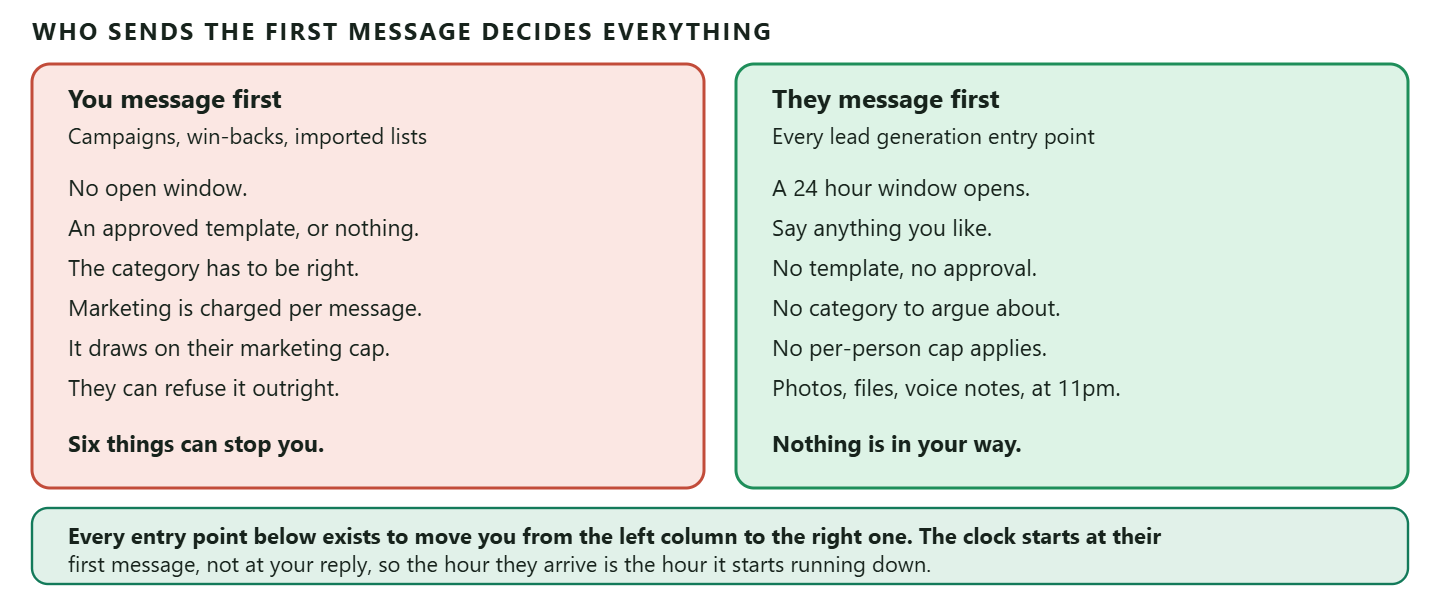
You can send a free-form WhatsApp message to somebody only within 24 hours of their last message to you. Outside that window, Meta delivers approved templates and nothing else. DMly’s documentation is blunt about the consequence: a contact who has never messaged you has no open window at all, so a lead you imported from a spreadsheet cannot be sent a friendly hello, only an approved template.
Now read that from the lead generation side. Every entry point in this article works by getting the other person to send the first message. A click-to-chat link opens their WhatsApp with your text already typed. A QR code does the same from a poster. A click-to-WhatsApp ad does it from Instagram. In each case the conversation begins with an inbound message, and DMly’s own documentation names the moment plainly: the flow starts when the contact sends that first message, which is also the moment your 24 hour window opens.
For the next day, you can say anything. Ask questions. Send a price list, a photo, a voice note, a PDF. Answer at 11pm. None of it needs approval and none of it is charged at a marketing rate. This is the most valuable 24 hours in the whole channel and most businesses waste it, because they treat the arrival as a name captured rather than a clock started.
The practical version of that rule: The practical version of that rule Templates start conversations, free-form continues them. Lead generation is the one part of your marketing where you never have to start one, so it is the one part where templates are optional. Everything you build should be aimed at getting the first message sent, not at collecting a number you will later have to pay to reach.
Where a WhatsApp conversation actually starts
WhatsApp lead generation starts with putting a door in every place somebody might already be interested. There are four kinds of door, and most businesses build one and stop.
A link belongs anywhere text can be tapped: the website, the Instagram bio, an email signature, a booking confirmation, an ad. A QR code belongs anywhere a phone camera can point: the shop window, the packaging, the table, the receipt, the flyer, the van. An ad belongs where you are already buying attention, and it is the only one of the four you pay for. A widget belongs on the pages where people hesitate: pricing, delivery, returns.
You do not need to write the link by hand. Our free WhatsApp link generator builds one with the prefilled message included, and the WhatsApp QR code generator turns the same thing into something printable. Both are free and neither needs an account.
What separates a door that works from one that does not is the sentence next to it. “Message us” asks the reader to invent a reason. Give them one instead, and make it specific enough to be worth the tap:
- “Chat with us for a quote in about two minutes.”
- “Scan for today’s availability.”
- “Ask us anything before you book. A real person replies.”
- “Send us a photo of the room and we will price it.”
That last one is the pattern worth stealing. The best opening line asks for something only that person can give, because it starts the qualification in the first message rather than three messages later, and because somebody willing to photograph their room is a different prospect from somebody who taps out of curiosity.
The prefilled message is doing two jobs: The prefilled message is doing two jobs A link built through DMly’s growth tools opens the contact’s WhatsApp with your keyword already typed, so they only press send. That keyword is what identifies which poster they came from, and it is also plain text your keyword automations can match on. So the same prefilled sentence tells you where they came from and decides which flow greets them.
What you can and cannot know about where a lead came from
Trackable entry points are worth the small extra effort, but they answer a narrower question than most people assume. Here is exactly what gets counted.
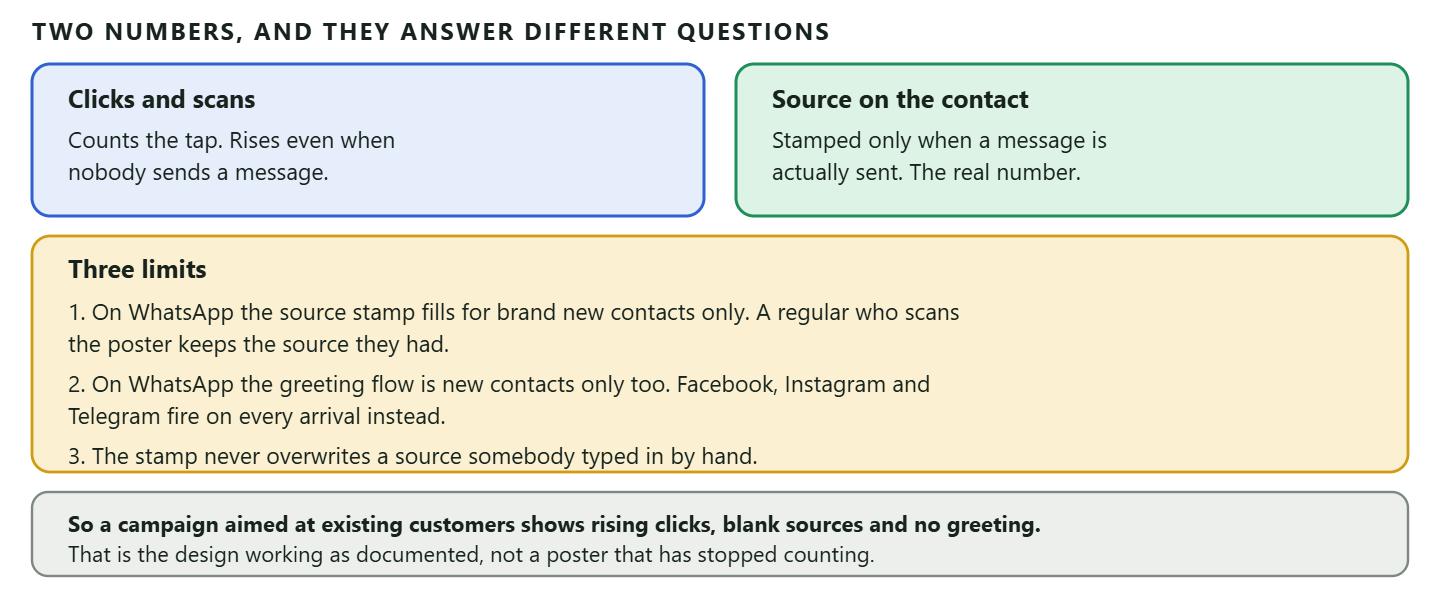
A growth tool counts two different things, and confusing them is the usual mistake. Clicks and scans count the tap: somebody opened the link and may have done nothing else. Source is the useful one: when the person actually sends the message, DMly stamps that tool’s name onto the new contact, so you can tell the poster that produced a conversation from the poster that produced curiosity. Two numbers instead of one, and the ratio between them is the real measure of whether the wording on the poster is any good.
Now the limits, because they change what you can conclude.
Three limits to know before you print anything: Three limits to know before you print anything On WhatsApp the source stamp applies to brand new contacts only. Somebody already in your list who scans the poster at the till keeps whatever source they had, so the scan count rises and the attribution does not. On WhatsApp the greeting flow is also new contacts only. An existing contact who taps a poster simply opens a chat: no flow, no stamp. Facebook, Instagram and Telegram behave differently and fire on every arrival. The stamp never overwrites what a human typed. It only fills a source that is still empty or still just the channel’s own name.
The practical consequence is worth stating plainly, because it catches people out in a specific way. If you run a campaign aimed at people who already buy from you, the numbers will tell you almost nothing: the clicks will climb, the sources will stay blank, and no automated greeting will fire. That is not a broken poster, it is the design. Trackable entry points measure new demand, and a campaign to your existing list needs to be measured some other way, which usually means a different keyword and a manual look at the inbox.
A growth tool also belongs permanently to the channel it was made on. A WhatsApp poster and an Instagram bio link are two separate tools even when they say the same thing, which is what you want, because then the numbers tell you which one people actually use.
Qualifying a WhatsApp lead when there is no lead score
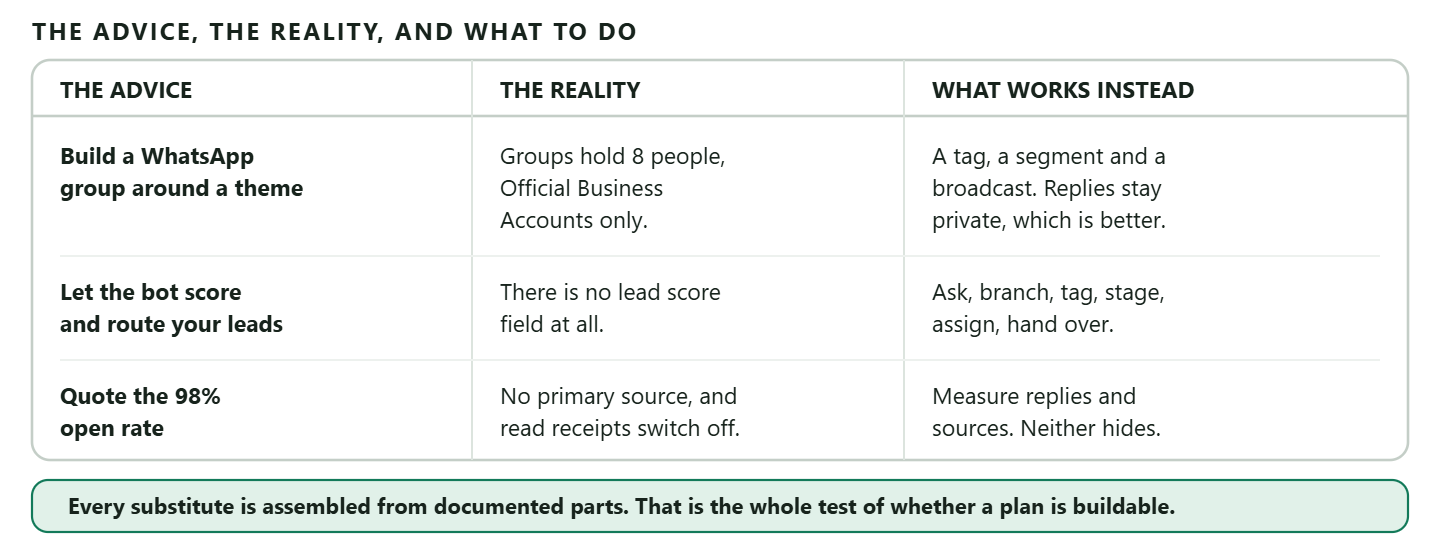
Here is a correction to the previous version of this page, because it matters more than anything else on it. That version said a chatbot could “score leads and route high-quality prospects directly to your sales team”. There is no lead score. DMly has no numeric rating on a contact that goes up as somebody looks more promising, and searching the documentation for the concept turns up only customer satisfaction scores, which measure something else entirely.
That sounds like bad news and mostly is not, because the thing people actually want from a lead score is for the right conversations to reach a person quickly. That is built from parts which do exist, and naming them is more useful than a number would have been:
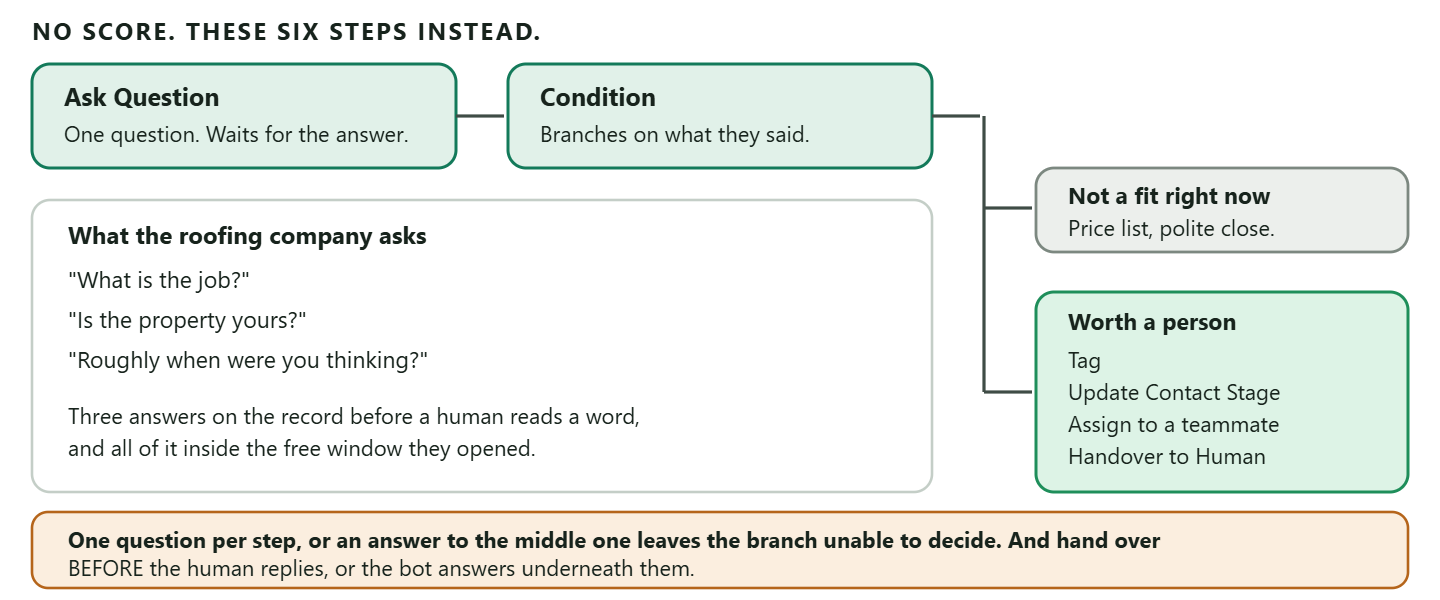
- Ask Question puts a question to the contact and waits for the reply, so the answer is captured rather than skimmed.
- Condition branches on what they said, which is where qualification actually happens.
- Tag marks the contact so you can find and segment them later.
- Update Contact Stage moves them along your own sales pipeline.
- Assign hands the conversation to a named teammate.
- Handover to Human pauses the bot so the person taking over is not talking over it.
Strung together, that is a qualification flow. A roofing company asks what the job is, then whether the property is theirs, then roughly when. A budget answer at the bottom of the range gets a price list and a polite close. Anything above it gets tagged, staged, assigned to whoever covers that area, and handed to a human with the answers already on the record. Nobody scored anything, and the outcome is the one the score was supposed to produce.
Two design notes that decide whether this works in practice. Ask one question per step rather than three in one message, because a contact who answers only the middle one leaves you with a branch that cannot decide. And put Handover to Human before the human, not after, or your teammate types a careful reply while the bot cheerfully answers the next message underneath it.
Five switches on a contact that look like the same setting
This is the part of the CRM that trips people up more than any other, and a lead generation programme walks straight into it. A contact carries several independent switches and none of them feed each other.
| The switch | Where you set it | What it actually does |
| Lifecycle stage | Convert to client, or Mark as lead, on the contact | Whether the finance side of the profile exists, and which tab they appear under |
| Pipeline stage | Pipeline View, the contact page, a flow, or your AI agent | Your own sales process and segment targeting. Flows can branch on it. It never touches lifecycle stage or billing |
| Blocked | The inbox, not Contacts | Blocked contacts get no automated messages |
| Opted out | They reply STOP, or a flow runs Unsubscribe Contact | Stops all automated messages. A person can still reply by hand. Reversible from Suppressions, or by the contact replying RESUBSCRIBE |
| Pause bot reply | The contact page | Stops your bot answering this one person so a human can take over |
The collision worth memorising is the first two. DMly ships three default pipeline columns named Lead, Engaged and Customer. Dragging somebody into the Customer column does not make them a client, and converting somebody to a client does not move them out of the Lead column. The words are the same and the fields never speak to each other.
For a lead generation programme that matters in one very practical way. If your team works out of Pipeline View and your reporting reads the lifecycle stage, the two will disagree permanently and both will be right. Pick one as the one that counts, write it down for whoever joins next, and let the other be a convenience.
Hour 25, and what following up actually costs
The window closes 24 hours after their last message, and most leads do not buy inside a day. This is where WhatsApp lead generation rejoins the ordinary rules, and it is worth planning for before it happens rather than discovering it on a Tuesday.
Once the window is shut, a follow-up is an approved template. Which category it lands in depends on what it says, and the honest reading is that most follow-ups are marketing: an offer, a nudge, a reason to come back. Marketing templates are billed at the highest rate, they draw against that person’s own cap, and they can be refused outright by somebody who has switched off marketing from your business. The rules and the arithmetic are set out in our guide to which messages count as marketing and what that costs.
So the design goal is to need fewer of them. Three habits do most of the work:
- Ask the question that needs an answer while the window is open. Budget, timing, address, photo. Every answer you collect on day one is a template you do not have to buy on day three.
- End your first reply with a question rather than a full stop. A reply resets the 24 hours. A statement ends the conversation and starts the clock running out.
- Agree the next step inside the conversation. “Shall I call you Thursday morning?” moves the follow-up to a channel with no window at all, which is usually the cheapest answer available.
One dated item to build into any plan. From 1 October 2026, Meta begins charging for two things that used to be free: service messages, meaning your free-form replies inside the window, and utility templates sent inside an open window. For a lead generation programme that lives inside the window on purpose, that is a real change to the cost model rather than a footnote, and it is worth pricing before the invoice does it for you.
The tactic that cannot be built, and the one that replaces it
Almost every article on this subject, including the previous version of this one, recommends building a WhatsApp group. A “New Property Alerts” group for buyers. A “Weekly Growth Hacks” insider group. A thirty day challenge group for a fitness coach. The logic is sound and the feature is not there.
Meta’s Groups API documentation gives the numbers and they end the idea. Groups are invite-only. They are available only to businesses with an Official Business Account. They are “not available for WhatsApp Business app phone numbers and phone numbers onboarded to Multi-solution Conversations”, which between them covers most small businesses. And a group holds a maximum of 8 participants.
Eight. Not eighty. Whatever you were picturing, it is not that, and DMly’s documentation does not cover groups at all, so it is not available that way either.
What replaces it is duller and works better for this job anyway. Tag the people who came in on a theme, save them as a segment, and send them the thing you would have posted in the group. They do not see each other, which for a list of competing house-hunters is a feature rather than a loss, and every reply lands in a private thread where the actual selling happens. The mechanics of sending to a saved list are in our guide to WhatsApp newsletters and broadcasts.
What to measure in a WhatsApp lead generation programme, and one number to stop quoting
An open rate on WhatsApp is a floor, not a measurement, and it is worth knowing why before you report one to anybody.
You will read everywhere that WhatsApp messages see open rates close to 98 per cent. No primary source publishes that figure, it is not in Meta’s documentation, and the previous version of this page repeated it without one. More to the point, it could not be verified even in principle, because any contact can turn read receipts off. WhatsApp’s own Help Centre describes the setting, under Settings, Account, Privacy, and notes that read receipts are always sent in group chats regardless. Every contact who has switched them off reads your message and never registers as having opened it.
So the number is not wrong so much as unknowable, and it flatters you in one direction only. What you can rely on instead:
- Delivered is real, and it is the one that tells you the number was good and the message left.
- Opened exists on WhatsApp only. SMS reports delivered but never opened, and Facebook, Instagram and Telegram report neither, so a flat open figure on those channels is a channel fact rather than a campaign result.
- Replies cannot be hidden by a privacy setting, which makes them the honest engagement number for a channel whose whole point is conversation.
- Sources tell you which door people came through, which is the only attribution you get and is worth more than any open rate.
For a lead generation programme the number that actually matters is none of those. It is the share of arrivals that reach a real conversation, and then the share of those that reach a booking, a quote or an order. Everything above is diagnostic. What a messaging tool can and cannot report is set out honestly in our guide to the metrics worth tracking after you automate messaging, including the ones nothing in this category reports.
Consent, in the terms the product actually uses
Somebody messaging you first is the cleanest consent there is for that conversation. It is not consent for everything afterwards. The distinction is the whole of good practice in WhatsApp lead generation, and most of the compliance question too.
Replying to somebody who has just asked you a question needs nothing extra. Adding them to a list you will broadcast to later is a separate decision that they should get to make in words, in the chat, before it happens. “Shall I send you new listings as they come up, about twice a week?” is a complete opt-in: it says what, it says how often, and it leaves a record of the answer in the thread.
Two mechanics worth knowing because they run whether you plan for them or not. A contact who replies STOP is opted out, which halts every automated message to them, though a person on your team can still reply by hand. It reverses from the Suppressions list, or by the contact replying RESUBSCRIBE. And a contact you block in the inbox receives no automated messages either, which is a different switch in a different place, as the table above sets out.
None of this is legal advice and the rules that apply to you depend on where your customers live. The habit that survives every version of them is the same: ask in the conversation, say what they are getting, and make leaving easy.
A WhatsApp lead generation setup you could build this week
Small, concrete and built so the window does the work. Five steps, in this order.
- Make one trackable link and one QR code, both pointing at the same greeting, both with a prefilled message that names where they came from. The link goes in the Instagram bio and the website header. The code goes in the window and on the receipt.
- Write the sentence next to them properly. Name what they get and how fast. “Send us a photo and we will price it today” beats “Message us on WhatsApp” every time it has been tried.
- Build one greeting flow with two questions in it, not six. The first qualifies, the second captures the thing you would otherwise have to ask for later.
- Branch once. Below the line gets a helpful answer and a polite close. Above it gets tagged, staged, assigned and handed to a human, with the bot paused.
- Reply with a question. Every reply resets the 24 hours, so a conversation that keeps asking keeps itself alive and free.
Then watch two numbers for a month: sources against clicks, which tells you whether the poster’s wording works, and conversations against sources, which tells you whether the greeting does. Almost every problem in a WhatsApp lead generation programme is one of those two, and they need different fixes.
For the wider picture of turning a first conversation into a customer who stays, see using messaging to improve customer retention. And if your leads are coming from outbound research rather than inbound taps, that is the other discipline entirely, covered in WhatsApp prospecting and finding leads before they find you.
Frequently asked questions
What is WhatsApp lead generation?
Using WhatsApp to turn interest into a conversation and that conversation into a qualified opportunity. Instead of sending somebody to a contact form, you give them a link, a code or an ad that opens a chat with your business, and you qualify them by talking rather than by collecting fields.
Do I need the WhatsApp Business API for lead generation?
Not to start. The free WhatsApp Business app handles a small volume perfectly well, and a link and a good opening sentence work on either. What the platform adds is automation: a greeting that fires at 11pm, a flow that qualifies while you sleep, source tracking that tells you which poster worked, and assignment so the right person picks it up. The honest trigger for moving is not volume in the abstract, it is the first week you lose a lead because nobody was at a desk.
How do I qualify leads on WhatsApp?
Ask one question at a time and branch on the answer. There is no lead score to rely on, so qualification is a flow: Ask Question captures the answer, Condition branches on it, and the promising branch tags the contact, sets a pipeline stage, assigns a teammate and hands over to a human. The unpromising branch should still be useful to the person, because a good no costs nothing and gets remembered.
Can I message a lead after 24 hours?
Only with an approved template, and for most follow-ups that means a marketing template, which is charged at the marketing rate and can be refused by anyone who has switched marketing off. The cheaper habit is to collect what you need while the window is open and to agree the next step inside the conversation.
Is the 98 per cent WhatsApp open rate real?
There is no primary source for it and it is not in Meta’s documentation. It also cannot be measured properly, because any contact can turn read receipts off in their privacy settings, so an open figure is a floor rather than a rate. Reply rate and source attribution are the numbers to run a programme on.
Can I build a WhatsApp group for leads?
Not usefully. Meta’s Groups API is invite-only, needs an Official Business Account, is unavailable to WhatsApp Business app numbers, and caps a group at eight participants. Use a tag, a saved segment and a broadcast instead, which reaches everybody and keeps each reply private.
Why did my poster get scans but no leads in the report?
Check whether the people scanning it are already your contacts. On WhatsApp the source stamp and the greeting flow both apply to brand new contacts only, so an existing customer who scans a poster opens a chat with no flow and no source recorded. Clicks rise, attribution does not, and nothing is broken.
Is WhatsApp lead generation suitable for a small business?
It suits small businesses better than large ones, because the advantage is that a real person answers quickly and that is easier to do with four staff than four hundred. A link, a clear sentence and somebody who replies within the hour will out-convert a large competitor’s automation most of the time.
The setup that works is unglamorous: a trackable door in every place people already look, a sentence next to it worth tapping, one flow that asks two good questions, and a person who arrives before the window closes. DMly runs that shape natively, with growth links and QR codes that tell you which one worked, a flow builder whose steps are the ones named above, and a single inbox where the qualified conversations land already tagged and assigned.
Writing about WhatsApp automation, bookings and growth for local business.
Turn WhatsApp into your busiest channel.
Start free and run message, bookings, payments and reviews in one place.
