
Instagram vs TikTok Comment Automation: Which Converts Better?
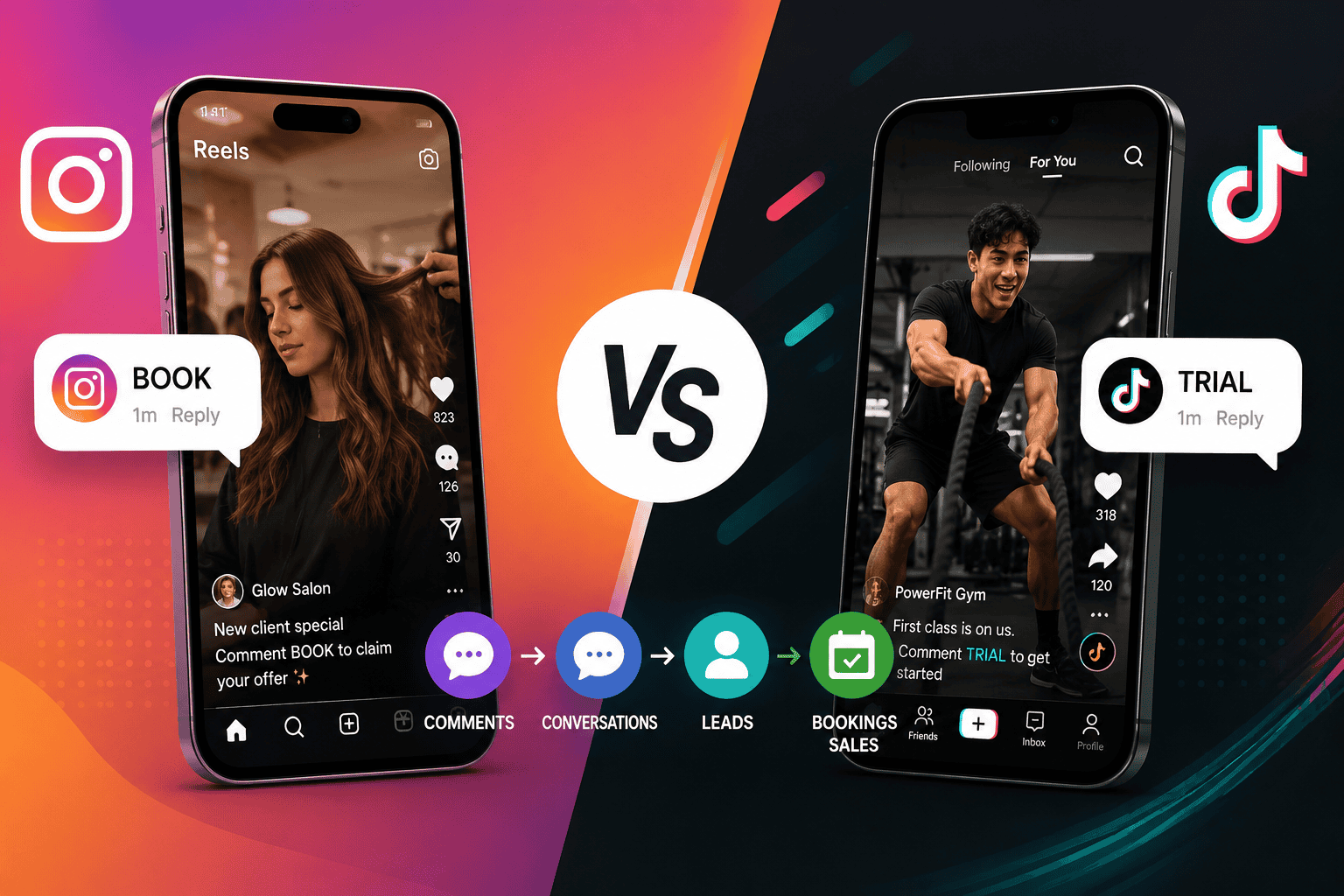
You post the same short video on Instagram and TikTok. Both end with the same CTA: “Comment BOOK and we’ll send you the details.“
TikTok brings in 300 comments. Instagram gets 90. At first glance, TikTok looks like the obvious winner. But then Instagram produces 25 bookings while TikTok produces 15. Suddenly, comment volume doesn’t tell the whole story.
That’s what makes Instagram vs TikTok comment automation an interesting comparison. TikTok is built for discovery and can put content in front of huge new audiences, while Instagram has a well-established culture of moving between posts, profiles, and DMs.
So which one converts better? This comparison of Instagram vs TikTok comment automation runs through reach, comment intent, what each platform will actually let a flow do with a comment, and what happens to those people afterwards. The short version is that the two are not doing the same job, and the section after next explains why that matters more than any engagement figure.
Instagram vs TikTok Comment Automation at a Glance
Instagram and TikTok can both turn comments into customer conversations, but they tend to shine at different stages. TikTok is particularly strong at getting content discovered, while Instagram has an advantage when the campaign depends on continuing the conversation through DMs.
Here’s the quick comparison:
| Factor | TikTok | |
| Content discovery | Strong, especially with Reels | Excellent, driven heavily by the For You feed |
| Viral reach potential | High | Very high |
| Comment-to-DM campaigns | Excellent fit | Useful, but subject to TikTok’s messaging capabilities and limits |
| Private lead nurturing | Excellent | Good |
| Appointment campaigns | Excellent | Good |
| Existing customer relationships | Strong | More discovery-focused |
| Younger audience reach | Strong | Particularly strong |
| Local business campaigns | Excellent | Strong, especially for discovery |
How Comment Automation Differs on Instagram and TikTok
The basic idea is the same on both: someone comments, a flow notices the keyword, and it responds. The parts are the same too. You give the flow a trigger, you tell it which words to watch for, and you tell it what to do when it sees one.
The keyword matching is more flexible than most campaigns use. A trigger can fire on any message at all, on an exact phrase, on a prefix, or on the text appearing anywhere in the comment. That last one matters more than it sounds. Real people type “price?”, “PRICE PLEASE” and “how much, price?”, and a trigger set to exact phrase catches one of those three. Set it to contains, and pick a word nobody would use by accident.
On TikTok you get three triggers: an inbound DM, a comment on one of your videos, and an outgoing message. On Instagram a flow can fire on a comment under a post, a comment during an Instagram Live, a story reply or a story mention. So far, so symmetrical. The bigger difference is what tends to happen around that interaction.
On TikTok, comments often come from discovery. Someone may have never seen your business before, but your video appears on their For You feed and catches their attention. This makes TikTok comment automation particularly useful for turning a sudden burst of reach into something you can act on.
On Instagram, the path can be more conversation-focused. A person might discover a Reel, visit your profile, browse other posts, and then interact with your business through DMs. Comment-to-DM campaigns fit naturally into that behavior, particularly when someone needs more information before booking or buying.
That is the marketing difference, and it is real. But underneath it sits a mechanical one that matters more, and almost nothing written on this subject says it plainly.
Only one of them can turn a comment into a private message
On Instagram, comment automation means comment-to-DM. When a flow fires on a comment, its first message step opens a DM with that commenter as a private reply, and it does not need the 24-hour messaging window to be open to do it. That is the mechanism behind every “comment PRICE and I’ll send it over” campaign you have seen. A separate step posts a public reply under the comment, and the two are usually paired so the thread does not look ignored.
On TikTok, there is no such bridge. Comments and DMs are separate threads, and the person who commented and the person who DMs you are separate contact records even when they are obviously the same human being. TikTok gives no way to link one to the other, and you cannot open a DM thread with someone yourself.
What trips people up is that the flow builder does show a Send a DM action on the TikTok comment trigger. It looks like the Instagram mechanic and it is not one. It is a general-purpose action: it delivers only to a contact who already has an open DM conversation with you, inside the 48-hour window, and a person who has only left a comment is a different contact record with no thread at all. On them, the step fails. Which makes a public reply saying “check your DMs” worse than no reply, because the customer reads it and then waits for a message that was never sent.
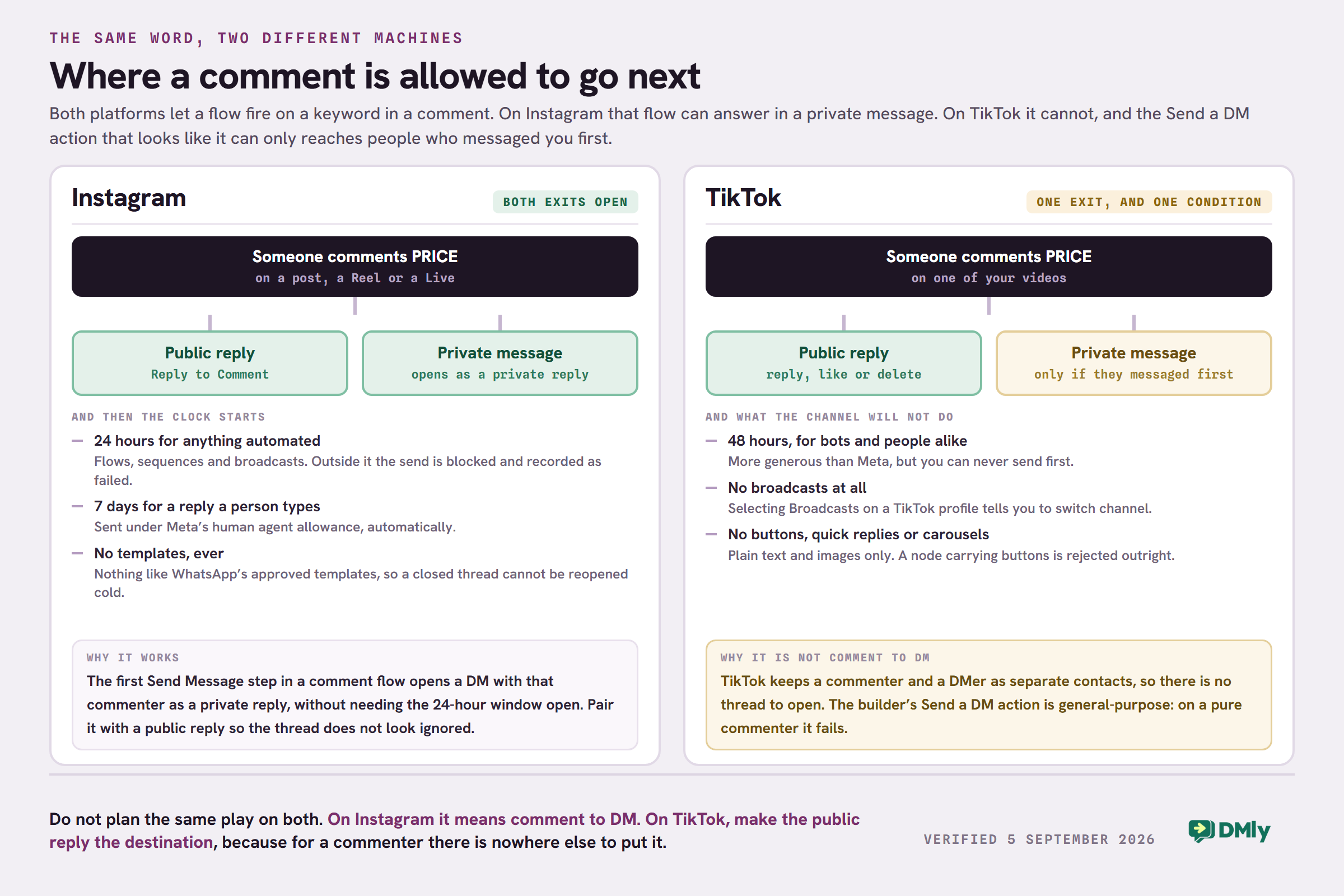
None of that is a limitation of any particular tool, and no tool can work around it. It is how the two platforms are built, and it changes what the word “automation” is even describing on each one. On Instagram it describes a private conversation. On TikTok it describes a public answer under a video that strangers are still being shown.
The rest of the rules follow from there. Instagram gives you 24 hours from the contact’s last message for anything automated and seven days for a reply a person types by hand in the inbox, and it has no message templates at all, so a thread that closes cannot be reopened. TikTok gives everyone the same 48 hours, bots and people alike, which is more generous, but you can never send first, there are no broadcasts, and message steps carry plain text and images only. A node with buttons or quick replies on it is rejected outright.
A simple way to think about the difference is:
TikTok: Discovery → Comment → Automation → Conversation
Instagram: Content → Comment → DM → Nurture → Conversion
The Real Question: What Does “Converts Better” Mean?
Before declaring Instagram or TikTok the winner, you need to decide what counts as a conversion for your business.
A comment itself isn’t necessarily one. Neither is a DM. They’re steps towards the outcome you’re trying to generate.
For a local business, a conversion could be:
- A booked appointment for a salon, dentist or spa
- A trial registration for a gym
- A table reservation for a restaurant
- A qualified enquiry for a service business
- A completed purchase for a retailer
- An email or lead captured from a content campaign
This distinction matters when comparing the platforms.
Imagine the same “Comment TRIAL” campaign runs on both. TikTok generates 500 keyword comments and 20 trial bookings. Instagram gets just 150 comments but produces 30 bookings.
TikTok clearly won the attention battle. Instagram produced more of the outcome the business cared about.
That’s why Instagram vs TikTok comment automation shouldn’t be judged by views or comment counts alone. Follow the entire journey:
Views → Keyword comments → Conversations → Qualified leads → Bookings or sales
The platform that converts better is the one that moves a greater share of the right people towards your actual campaign goal.
Where TikTok Comment Automation Has the Edge
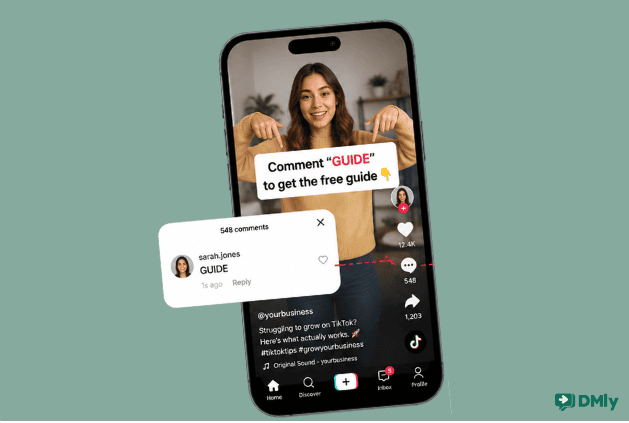
TikTok’s biggest advantage happens before the automation even starts. Its recommendation-heavy For You feed can put a business in front of people who have never followed, searched for, or interacted with it before.
That makes TikTok comment automation particularly interesting when your goal is discovery and volume.
More Opportunities to Reach New People
A small business doesn’t necessarily need a large following for a TikTok video to travel. If the content performs well, it can reach a much wider audience and introduce plenty of new people to the business.
Add a CTA such as “Comment MENU for the full list“, and some of that passing attention becomes an interaction your automation can pick up.
Strong Potential for High-Volume Campaigns
TikTok suits campaigns where lots of people can take the same simple action.
Think:
“Comment GUIDE.”
“Comment LINK.”
“Comment INFO.”
“Comment TRIAL.”
If a video takes off, automation becomes particularly valuable because the business doesn’t have to manually work through a sudden rush of comments.
A Strong Top-of-Funnel Platform
TikTok can be excellent for getting people through the door. Giveaways, launches, free resources, introductory offers, and trial campaigns can all benefit from its discovery model.
The catch is intent. Someone discovering your business between entertaining TikToks may be curious without being ready to buy. Lots of comments can therefore produce plenty of conversations without producing the same number of customers.
TikTok’s edge is reach, discovery and a large pool of people who had never heard of you this morning. What happens next is where it gets narrow, and it is worth being blunt about the shape of it: your automated answer goes up in public, under a video that strangers are still being recommended, in plain text with no buttons to tap. That is fine for “the link is in our bio” and useless for “your appointment is at 4.15 with Priya”. Our full guide to TikTok comment automation covers the triggers, the keyword matching and the public-reply craft in detail.
Where Instagram Comment Automation Has the Edge
Instagram becomes particularly interesting when a customer needs more than one interaction before converting.
Someone can discover your Reel, look through your profile, check previous work, read comments, and continue the conversation through DMs. For many businesses, that creates a useful environment for moving someone from curiosity towards a decision.
Comment-to-DM Feels Natural
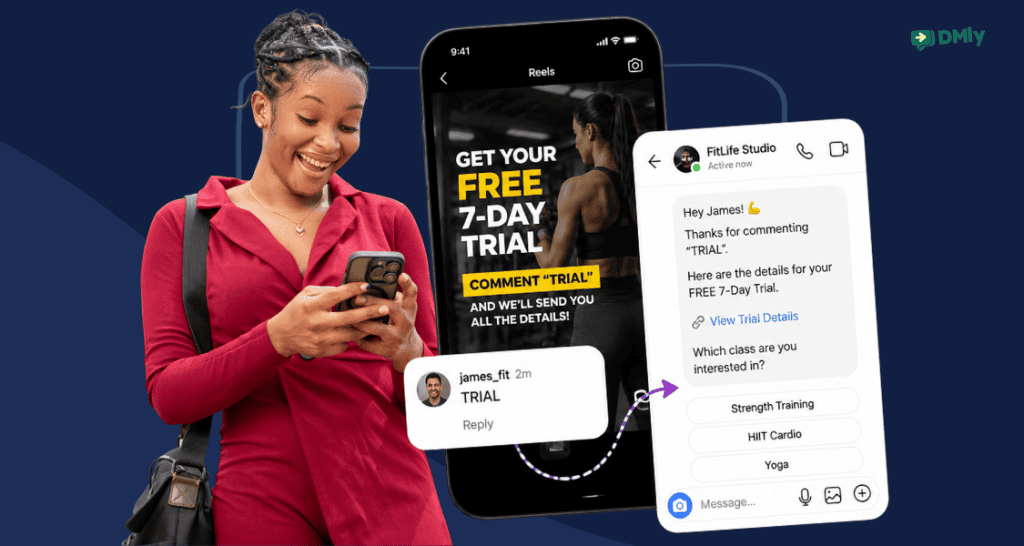
Instagram users are used to dealing with businesses in DMs, and the platform supports the move mechanically rather than by convention. A comment flow can fire on a comment under a post, a Reel or an Instagram Live, and also on a story reply or a story mention, and its first message step opens the DM as a private reply. Our guide to building comment-to-DM campaigns walks through the keyword, the reply and the handover, and the wider Instagram DM automation guide covers the flows around them. A campaign can move someone from “Comment PRICE” into a private conversation where they receive pricing, ask questions, and potentially book.
That makes Instagram especially useful when the sale requires a little discussion.
Better Suited to Longer Customer Journeys
Consider a salon treatment.
A customer may want to know the price, how long it takes, which option suits them, and what appointments are available. Instagram comment-to-DM automation can start that journey, while automation, AI or a team member handles what follows.
Strong Fit for Visual Local Businesses
Salons, spas, restaurants, gyms, beauty businesses and local retailers already have plenty to work with on Instagram. Their profiles can act almost like visual storefronts, giving someone more context before or after they enter the DM conversation.
Useful for Nurturing Existing Interest
Instagram doesn’t depend entirely on reaching strangers. Campaigns can also reach followers and previous customers who already know something about the business.
That can make a keyword such as BOOK, MENU or PRICE more meaningful because some commenters are further along in their decision.
Instagram vs TikTok for Different Campaign Goals
Neither platform has the advantage for every campaign. The better choice depends on what you want people to do after seeing your content.
| Campaign Goal | Better Fit | Why |
| Generate awareness | TikTok | Strong discovery can introduce your business to people outside your existing audience |
| Lead magnet downloads | Both | TikTok can drive discovery, while Instagram works well for delivering resources through DMs |
| Appointment bookings | Comment-to-DM journeys suit services where customers may have questions before booking | |
| Free trials | Both | TikTok can attract new prospects, while Instagram can help nurture them towards registration |
| Quote requests | DMs give businesses room to ask qualifying questions before handing the lead to a person | |
| Product launches | Both | TikTok can create attention around a launch, while Instagram can handle product enquiries privately |
| Giveaways | TikTok | Its discovery potential suits campaigns designed to attract lots of participation |
| Restaurant promotions | Customers can move naturally from food content into menu, availability or reservation conversations | |
| Events and classes | Both | The better platform will usually depend on where the target audience is most active |
| Repeat-customer campaigns | Businesses can market to an audience that already follows and interacts with their profile |
There is also no reason every campaign needs a single-platform winner.
The question that decides the year, not the campaign
Ask whether you will need to message these people again next week, because on this one neither platform is any use. Instagram has nothing resembling WhatsApp’s approved message templates, so once the window closes on a conversation there is no way to reopen it. TikTok has no broadcasts and no way to start a conversation at all. Both doors lock behind you.
So a comment is a conversation you were given, not a contact you own. The campaigns that keep paying are the ones that ask for something durable while the window is still open: a phone number, an email address, or a marketing opt-in. On Instagram there is a specific node for that last one, and accepting it buys you exactly one more message after the window closes, which is enough to move somebody somewhere better. Somewhere better usually means WhatsApp, where an approved template can start a conversation months later, or SMS, which has no window at all.
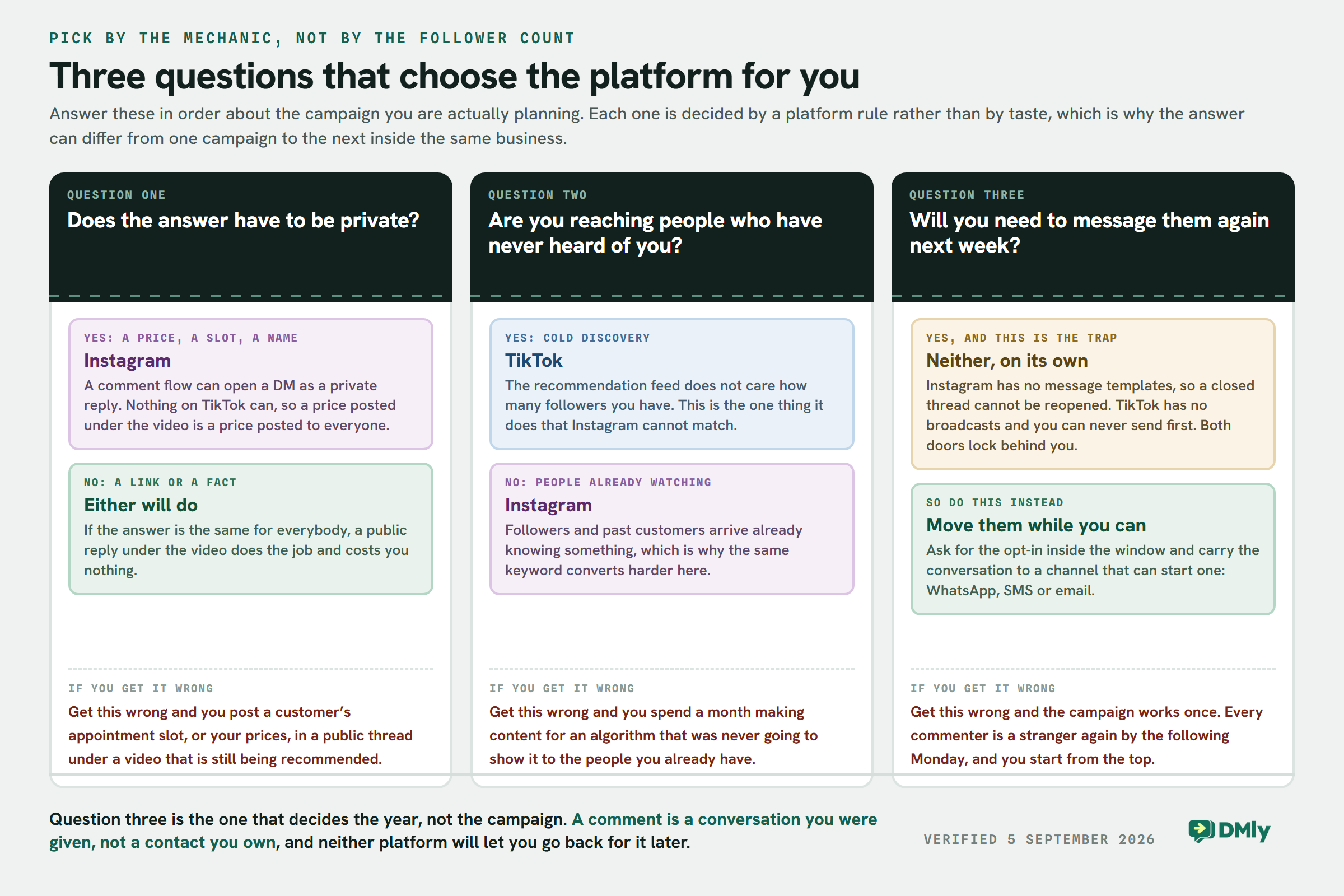
Run the questions in that order and the answer often turns out to be different for two campaigns in the same business, which is a more useful result than a verdict.
A gym, for example, could use TikTok to get its “Comment TRIAL” campaign in front of new people while running the same offer on Instagram for followers who already know the business. The automation can then guide both groups towards the same goal.
The important part is to compare what happens at the bottom of each journey. TikTok may bring you more commenters while Instagram brings fewer but more qualified conversations, or the opposite could happen for your audience. Your booking, lead, and sales numbers will tell you which platform deserves more attention.
Which Platform Is Better for Local Businesses?
For local businesses, Instagram probably has the slight overall advantage for comment automation, particularly when the goal is an appointment, reservation, or qualified enquiry. But the answer changes depending on what you sell and how customers discover you.
A few examples make the difference clearer:
- Salons and spas: Instagram is a strong fit. Before-and-after posts and Reels can lead directly into PRICE or BOOK campaigns, followed by a DM conversation and appointment.
- Restaurants: Instagram works well for menus, reservations and offers. TikTok can be particularly useful for discovery when a food video takes off and reaches people who haven’t encountered the restaurant before.
- Gyms and fitness studios: Both have a good case. TikTok can introduce the gym to new prospects, while Instagram can turn TRIAL or CLASS comments into booking conversations.
- Dentists and clinics: Instagram generally makes more sense for structured enquiries where people want information before arranging an appointment.
- Local retailers: This one depends heavily on the customer base. TikTok can help new products get discovered, while Instagram can work better for questions about price, stock, sizes and availability.
Read that list again and one pattern runs through it. Instagram wins wherever the answer is specific to the person asking, because that answer has to go somewhere private, and only Instagram has a route there from a comment. A price that depends on hair length, a slot that is free on Thursday, whether a treatment suits a particular skin type: none of those belong under a public video. TikTok wins wherever the answer is the same for everybody, which is exactly what a menu, an opening time, a link or a downloadable guide is.
That rule is more useful than a platform preference, because it survives your business changing. And the deciding factor is still where your customers already spend their time and what they do there. A restaurant getting 50,000 TikTok views every week shouldn’t abandon that attention because Instagram looks better on paper.
Running Instagram vs TikTok Comment Automation on Both
You don’t have to pick a side. If your customers use both Instagram and TikTok, running comment automation on both gives you two chances to turn social content into customer conversations.
Take a gym promoting a free trial. It could publish the same campaign idea on both platforms:
TikTok video → Comment “TRIAL” → Automated conversation → Trial booking
Instagram Reel → Comment “TRIAL” → DM conversation → Trial booking
The creative may be adapted for each platform, but the business goal stays the same. TikTok might introduce the offer to people who have never heard of the gym, while Instagram could pick up followers who have been watching its content for weeks.
Using both also gives you useful comparison data. Instead of guessing which platform is better, you can compare keyword comments, conversations started, qualified leads and completed bookings.
DMly makes this easier by bringing Instagram and TikTok conversations into the same system. Your team can manage enquiries in one place rather than jumping between apps, while automations, AI and customer records help keep each conversation moving.
Over time, the numbers may show that one platform deserves more attention. Until then, running both gives you a much better test than choosing Instagram or TikTok based on reach alone.
Instagram vs TikTok Comment Automation With DMly
Running comment automation on both platforms can become messy if Instagram lives in one tool, TikTok in another and your team still has to check each inbox separately. DMly brings both sides together.
You can connect your Instagram and TikTok accounts, then build automations around the behavior you want on each platform. That means you don’t have to force Instagram and TikTok audiences through identical workflows.
For example:
Instagram: Comment “BOOK” → DM → Choose service → Answer questions → Book appointment
TikTok: Comment “BOOK” → Automated response → Continue conversation → Capture interest → Booking
AI agents, customer profiles, tags, team handover and appointment booking all attach to those journeys, and both platforms feed the same inbox, so nobody has to keep two apps open to answer one customer.
What no tool changes is the platform rules themselves. DMly will not give TikTok a comment-to-DM bridge, because TikTok does not have one, and it will not give Instagram a message template, because Meta does not offer them there. Anything that promises otherwise is describing something that will fail quietly at send time. What a single system does buy you is the comparison: the same contact record, the same tags and the same booking data behind both columns, so the numbers you end up comparing were counted the same way.
So, instead of asking which platform produced more views or comments, you can look further down the journey and see which one produced the conversations, leads, and bookings that mattered.
How to Test Which Platform Converts Better for Your Business
The most reliable way to settle the Instagram vs TikTok debate is to test them with your own audience.
Run a similar campaign on both platforms. Keep the offer, keyword, and final goal as consistent as possible, while adapting the actual content to suit each platform.
For example, a gym could run:
“Comment TRIAL to claim a free first class.”
Then track the journey on both platforms:
| Metric | TikTok | |
| Views | ||
| Keyword comments | ||
| Conversations started | ||
| Qualified leads | ||
| Bookings | ||
| Comment-to-lead rate | ||
| Comment-to-booking rate |
Run it long enough to beat one lucky Reel or one video that happened to travel. Then add two rows the table above does not have, because they are the ones that decide: comment-to-booking rate, which is bookings divided by keyword comments and is the only number that compares the platforms fairly, and opt-ins captured, which is how many of those people you will still be able to reach in a month.
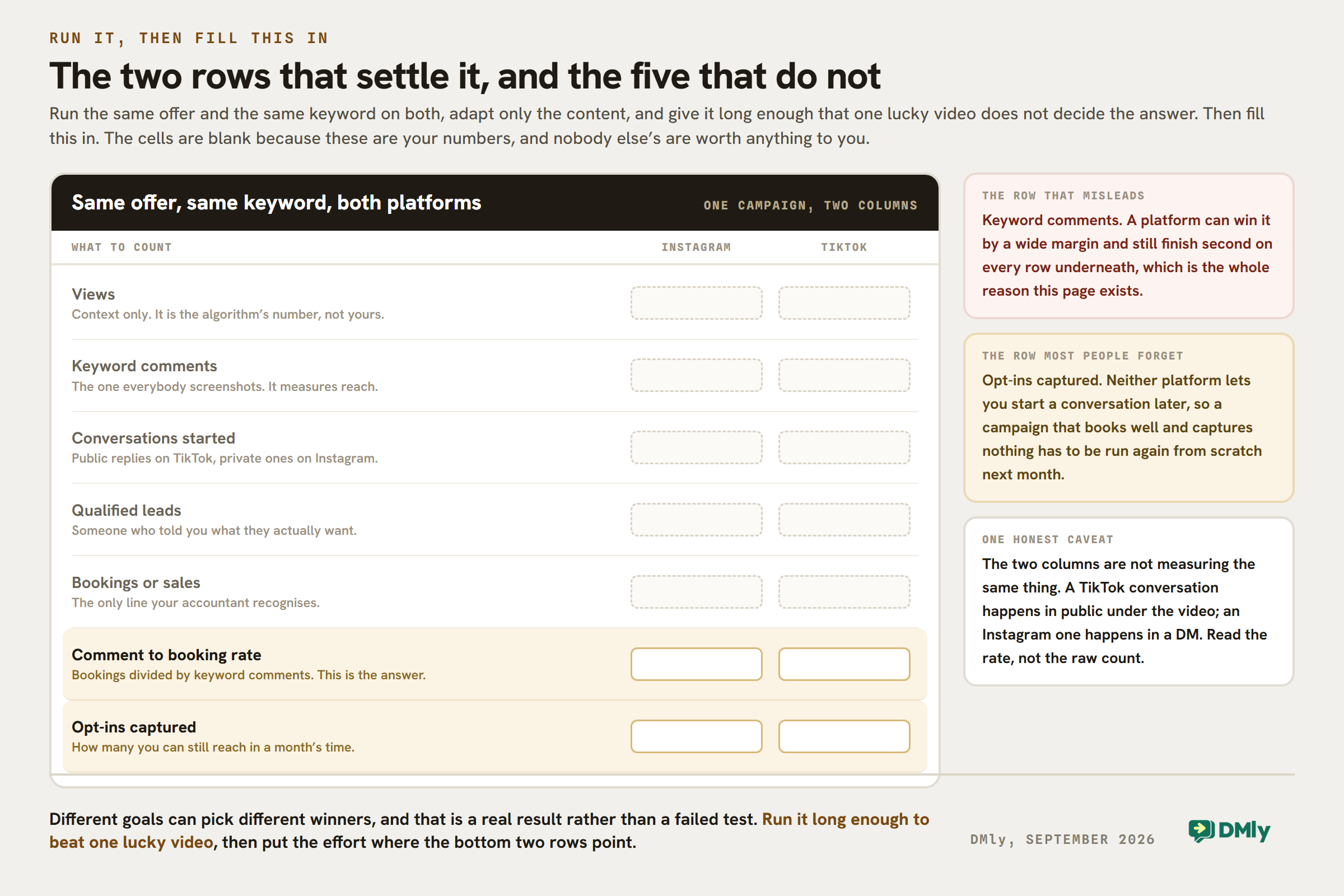
Both of those rows can contradict the comment count, and when they do, the comment count is the one that is wrong.
Then look beyond the biggest numbers. If TikTok generates 1,000 comments but Instagram produces twice as many bookings, Instagram is doing more for that particular campaign. If TikTok delivers more qualified customers despite starting with a colder audience, that’s useful information too.
You may even find that different platforms win for different goals. TikTok might perform better for lead generation while Instagram wins for appointment bookings.
That’s a much more useful answer than declaring one platform the universal winner. Test both, follow the customer all the way to the outcome you care about, and put more effort into the channel producing the better business results.
Frequently Asked Questions
Is Instagram or TikTok comment automation better?
It depends on what you want the automation to achieve. TikTok has a strong discovery engine, which can make it useful for reaching new audiences and generating comment volume. Instagram is particularly well suited to campaigns where comments need to become longer DM conversations, leads or bookings.
Does Instagram Comment Automation Convert Better Than TikTok?
Not automatically. Conversion depends on your audience, content, offer, and what happens after someone comments. Instagram may perform better for a salon using a “Comment BOOK” campaign, while TikTok could win for a brand giving away a free resource to generate leads.
Can You Automatically DM People Who Comment on Instagram and TikTok?
On Instagram, yes: a comment flow opens a DM with the commenter as a private reply, and it works even outside the 24-hour window. On TikTok, no. TikTok has no comment-to-DM mechanism, and it keeps commenters and DMers as separate contacts, so there is no thread to open. The builder does show a Send a DM action on the comment trigger, but it is general-purpose and reaches only somebody who already has an open DM conversation with you; on a pure commenter it fails. A TikTok comment automation can reply in public, like the comment or delete it, and that is the list.
Which Is Better for Generating Leads, Instagram or TikTok?
TikTok can have an advantage when you want to reach large numbers of new people. Its discovery model means your content can reach viewers who have never interacted with your business.
Instagram can be stronger when lead generation requires a longer private conversation. Someone can move from a Reel into DMs, ask questions, and continue towards an enquiry or booking.
Can I Use the Same Comment Automation Campaign on Instagram and TikTok?
Yes, although copying everything exactly isn’t always the best approach. You can keep the same offer, keyword, and conversion goal, then adapt the content and customer journey to suit each platform.
What Is the Best Instagram and TikTok Comment Automation Tool?
Look for a tool that officially supports the platforms you want to automate and gives you enough control over triggers, actions, messaging, and human handover.
DMly is a strong option for businesses using both Instagram and TikTok because it brings their conversations into one omnichannel inbox. You can also connect automation with AI agents, CRM, appointment booking, and your wider customer journey.
Should Local Businesses Automate Comments on Both Instagram and TikTok?
If both platforms already generate useful engagement for your business, it can make sense.
You don’t need to invest equally in each one. Run comparable campaigns, track conversations, qualified leads, and completed bookings, then use those results to decide where to spend more of your time.
Writing about WhatsApp automation, bookings and growth for local business.
Turn WhatsApp into your busiest channel.
Start free and run message, bookings, payments and reviews in one place.
