
Gym Member Retention Strategies: 15 Ways to Reduce Churn (With a Retention Rate Calculator)
Every gym has a lost-property box, and if you care about gym member retention, it’s the most honest report you own. A water bottle with a name written on the lid. A padlock still locked. A towel, a skipping rope, one lifting glove. Each thing in there belonged to someone who meant to come back for it.
Some of them did. A few of them never came back at all. They didn’t cancel on a particular day or send you an angry email. They just came a bit less, then a lot less, and then a direct debit failed or a renewal date passed and they were gone. Nobody at the desk noticed, because nothing happened to notice.
That’s the shape of most churn in a gym: quiet, gradual and visible weeks before it’s final, if you’re looking at the right numbers. In this guide, we’ll work out your retention rate and churn rate by hand with a calculator you can copy into a spreadsheet, look at why members leave, and then go through fifteen gym member retention strategies in the order a member meets them, from their first week to the conversation when they want to stop.
What Gym Member Retention Means, and How It Differs From Churn
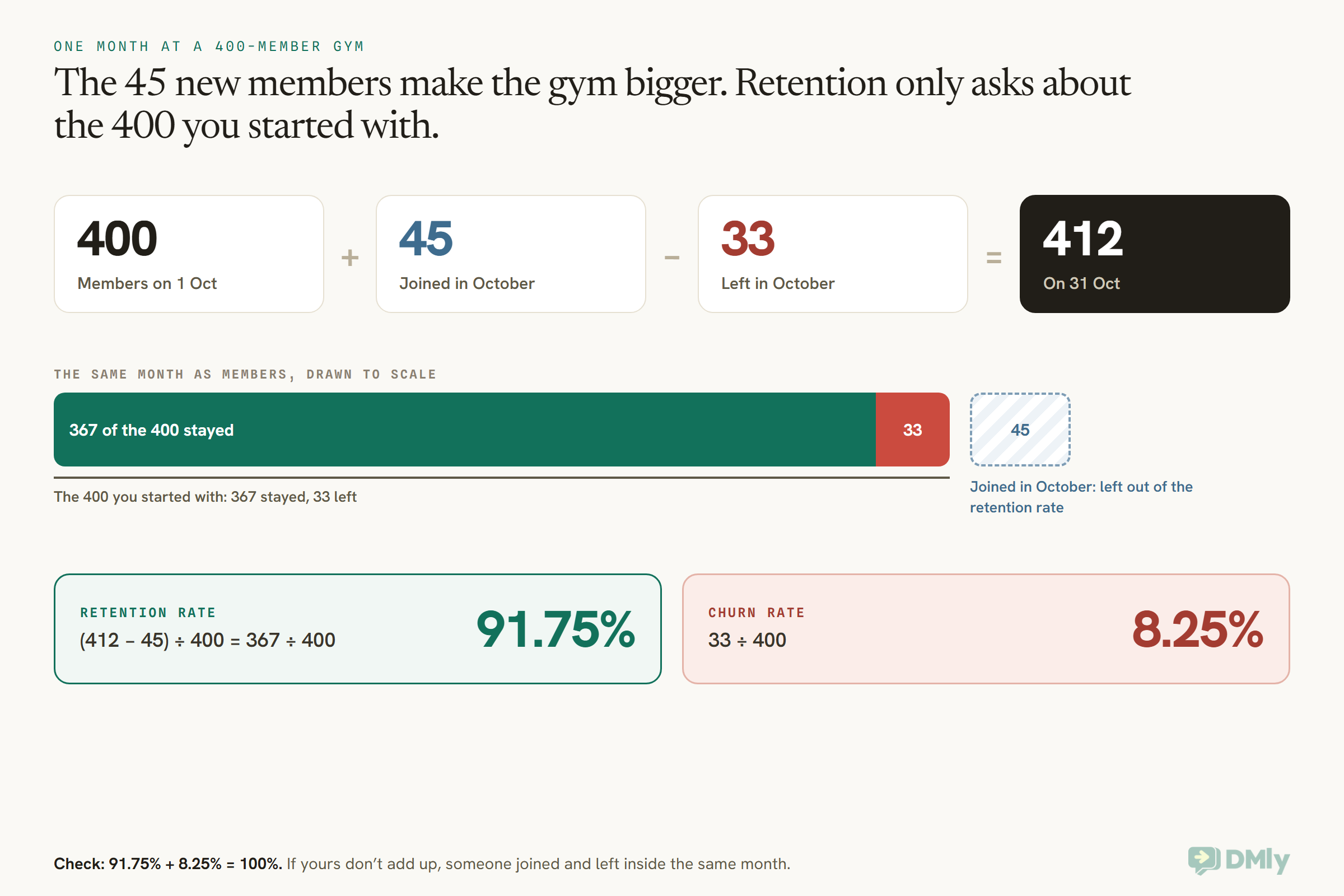
Gym member retention is the share of the members you had at the start of a period who are still members at the end of it. Churn is the other side of the same coin: the share who left. If you start a month with 400 members and 33 of them cancel, your churn for the month is 8.25 per cent and your retention is 91.75 per cent.
That sounds simple, and it is, as long as you’re careful about two things.
- New members don’t count towards retention. A gym can grow every month and still have a retention problem. If you sign 45 people and lose 33, your member count goes up, which feels good, but a third of your marketing effort is spent refilling a leak.
- “Member” has to mean the same thing every month. Is someone on a freeze a member? Is someone on a ten-class pack? Is a junior whose parent pays? Pick an answer, write it down, and use it every time, or your numbers will drift for reasons that have nothing to do with your members.
Retention and churn are worth measuring separately from total members because they answer different questions. Your member count tells you how big you are. Your retention rate tells you how good you are at keeping the people you already won, which is cheaper than winning new ones and is mostly in your control.
Gym Retention Rate Calculator: How to Calculate Gym Member Retention by Hand
To calculate your gym’s retention rate, take the members you have at the end of the month, subtract the new members who joined during it, divide by the members you had at the start, and multiply by 100. You need three numbers and a calculator. Here’s the whole thing.
The two formulas
- Retention rate = (members at the end − new members who joined) ÷ members at the start × 100
- Churn rate = members who left ÷ members at the start × 100
Counted carefully, the two add up to 100 per cent. That’s a useful check: if they don’t, someone joined and left in the same month, or a number was miscounted. We’ll come back to that.
A worked month you can check by hand
Here’s the same example as a table, so you can see where each number comes from. Swap in your own.
| Line | What it is | Example |
| A | Members at the start of the month | 400 |
| B | New members who joined during the month | 45 |
| C | Members who left during the month | 33 |
| D | Members at the end (A + B − C) | 412 |
| Retention | (D − B) ÷ A × 100 | 367 ÷ 400 = 91.75% |
| Churn | C ÷ A × 100 | 33 ÷ 400 = 8.25% |
The same calculator in a spreadsheet
If you’d rather not do it by hand each month, put one month on each row. Column A is the month, B the members at the start, C who joined, D who left. Then add these formulas in row 2 and drag them down:
- E2, members at the end:
=B2+C2-D2 - F2, retention rate:
=(E2-C2)/B2, formatted as a percentage - G2, churn rate:
=D2/B2, formatted as a percentage - B3, next month’s start:
=E2, so each month starts where the last one ended
Three months of a fictional gym look like this:
| Month | Start (B) | Joined (C) | Left (D) | End (E) | Retention (F) | Churn (G) |
| October | 400 | 45 | 33 | 412 | 91.75% | 8.25% |
| November | 412 | 30 | 41 | 401 | 90.05% | 9.95% |
| December | 401 | 22 | 28 | 395 | 93.02% | 6.98% |
Two things jump out of a table like this that you’d never feel from the front desk. November lost more people than it signed. And December’s churn was lower even though the gym was quieter, which is worth asking about: was it the season, or something you did?
Four counting rules to settle before your first month
Most retention numbers go wrong in the counting, not the arithmetic. Decide these once.
- Freezes. Count a frozen member as a member, not a leaver, and keep a separate “frozen” count beside the main table. If a freeze ends in a cancellation, count the churn in the month they actually cancel.
- Class packs and drop-ins. Keep them out of the membership calculation. A ten-class pack has no “start of month” in the same sense. Track packs separately: of the people who finished a pack this month, how many bought another within, say, 60 days?
- Joined and left in the same month. These people count in B and in C, which is why retention and churn stop adding to 100. Don’t hide them. Write them down as their own line, because someone who leaves inside their first month is telling you something about your onboarding, not about your gym.
- Transfers and family plans. A member moving from a single plan to a couples plan hasn’t left. A member who moves to your other branch hasn’t left the business, though that branch has lost them. Decide whether you’re measuring the site or the business.
From a monthly rate to a yearly one
Monthly churn looks small, which is exactly why it’s dangerous. If your monthly retention stays at 91.75 per cent, then after twelve months only about 36 per cent of the members you started the year with are still with you. The sum is 0.9175 multiplied by itself twelve times, or =0.9175^12 in a spreadsheet.
Bring monthly churn down two points, to 6.25 per cent, and the same sum (=0.9375^12) keeps about 46 per cent. Ten more people in every hundred, a year later, from a change you’d barely notice on any single month.
This shortcut assumes every month is the same, and they aren’t. For a true yearly figure, take the list of members you had on 1 January and count how many are still members on 31 December. The shortcut is for planning; the list is for the record.
What one member is worth, and what a point of churn costs
A rough average membership length is 1 divided by your monthly churn. At 8.25 per cent churn, that’s 1 ÷ 0.0825, or about 12 months. Multiply by your monthly fee and you have a rough value for a typical member:
- At $50 a month, about 12.1 months is roughly $606 per member.
- At ₹2,000 a month, roughly ₹24,200.
- At ₦30,000 a month, roughly ₦364,000.
- At £40 a month, roughly £485.
Cut churn to 6.25 per cent and the average stretches to 16 months, so the $50 member is worth about $800 instead of $606. That gap, around $194 a member, is roughly what each improvement in this guide is competing for. It’s also a sensible ceiling for what you’d spend to win someone back.
These are averages from a simple model, not a promise. They’re good enough to compare one decision with another, which is all you need them for.
Cohorts: the view that shows where people drop off
A monthly churn rate mixes everyone together: the person in their second week and the person in their fifth year. A cohort table splits members by the month they joined and follows each group forward. It’s the single most useful view for spotting where your gym loses people.
Write down who joined each month, then count how many of that group are still members one, three and six months later. Divide each count by the number who joined.
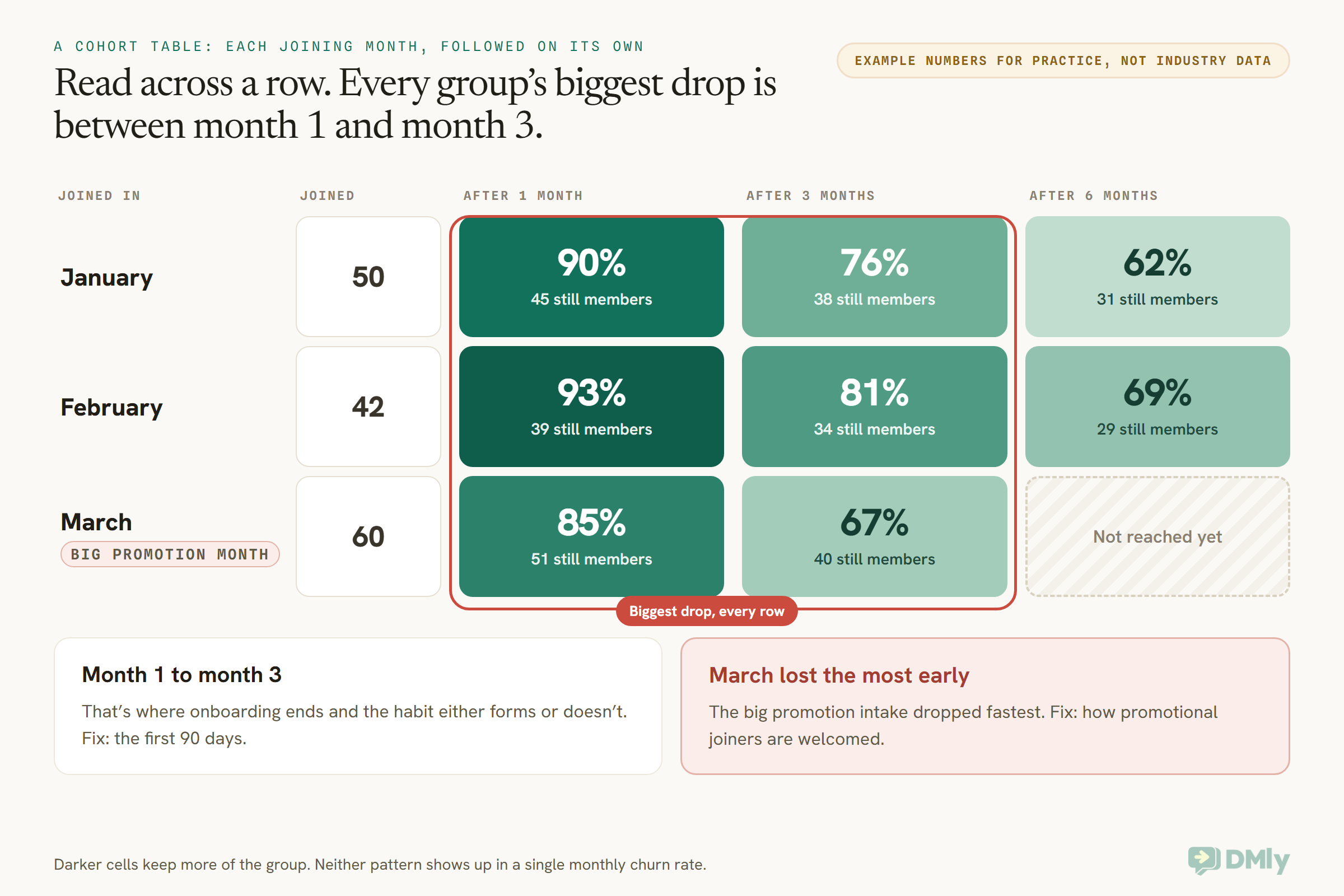
In the example, every group loses most heavily between month one and month three, and the big March intake (a promotion month) loses fastest. Neither of those shows up in a single monthly churn rate. Both point to a specific fix: the first 90 days, and how promotional joiners are welcomed.
What Is a Good Gym Retention Rate?
A good gym member retention rate is one that’s higher than yours was last year, measured the same way. That’s not a dodge. It’s the only comparison that’s fair.
You’ll find industry averages quoted around the web, and we’ve deliberately not printed one here. Published figures count different things: some are yearly, some monthly; some count cancellations, others count anyone who didn’t renew; some include class packs and some don’t. A budget gym with a no-contract monthly plan and a boutique studio selling twelve-month memberships will never land in the same place, and a single average across both tells neither of them much. We couldn’t read a figure at its original source that we’d be comfortable putting beside your own numbers, so we’ve left it out.
What you can do with confidence:
- Compare this month’s churn with the same month last year, so seasons cancel out.
- Compare cohorts with each other. If the people who joined in a promotion month leave faster than the rest, that’s a real finding.
- Compare plans. If your annual members stay much longer than monthly ones, ask what would move more people onto annual.
Why Gym Members Leave, and the Two Kinds of Churn
Gym members leave for two different kinds of reason: they decide to stop (voluntary churn), or their payment stops without them deciding anything (involuntary churn). The fixes are completely different, so it’s worth sorting your leavers into the two piles before you change anything.
Voluntary churn usually starts long before the cancellation. The reasons you’ll hear most if you ask leavers properly tend to fall into a few groups, though only your own exit conversations can tell you the mix at your gym:
- The habit never formed. They joined with good intentions, came a few times, and it never became part of their week.
- Life changed. A move, a new job, an injury, a baby, a tighter budget. Some of these you can’t fix. Some of them you can bridge with a freeze or a cheaper plan.
- The experience let them down. Classes always full, equipment broken, the place too crowded at the only time they can come, or simply feeling that nobody knew their name.
- They found something else. A cheaper gym, a home workout, a running club with their friends.
Involuntary churn is different. The member didn’t decide to leave. A card expired, a bank declined a payment, or an invoice sat unpaid. It’s the most recoverable churn you have, because the person may not even know they’ve lapsed.
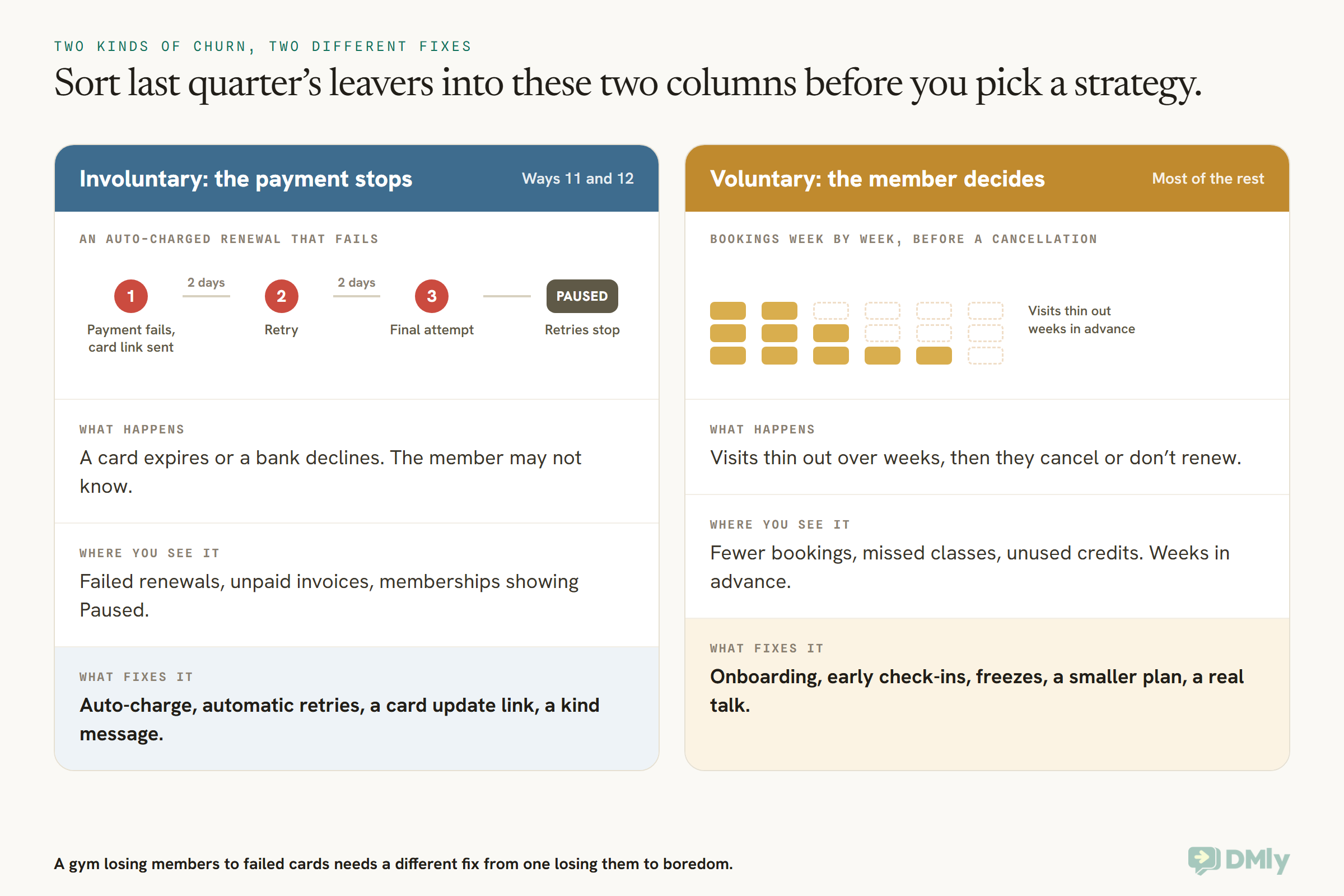
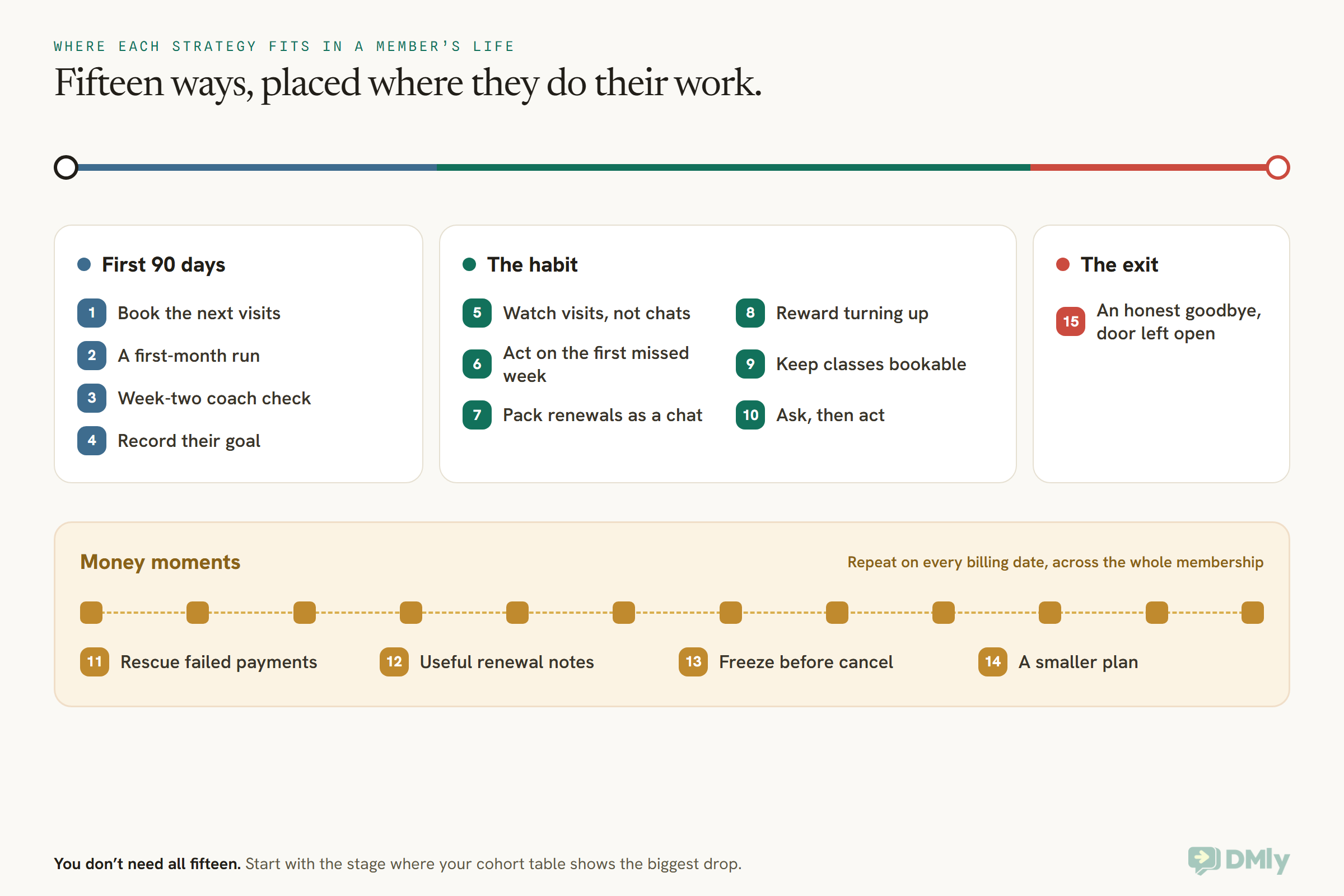
With the two kinds of churn in mind, here are fifteen gym member retention strategies, grouped by when in a member’s life they matter. You don’t need all fifteen. Look at your cohort table, find the stage where you lose the most people, and start there.
Gym Member Retention Strategies for the First 90 Days
The first 90 days decide most gym member retention, because that’s when a new member either builds a routine or quietly drifts. In the cohort example, the drop between month one and month three was bigger than anything that came after. These four strategies are about getting someone from “I joined” to “this is what I do on Tuesdays”.
1. Book the next three visits before they leave the desk
The most useful thing a new member can walk out with isn’t a towel or a T-shirt. It’s their next three sessions already in the diary. A plan in the calendar beats a good intention every time.
At sign-up, sit with them for two minutes and book them into specific classes, or set a time for their first sessions on the floor. If they’d rather do it later, send your booking link on WhatsApp while they’re still standing there, so it’s at the top of their chats tonight.
In DMly, a class seat is booked from your booking page or from a link you send in the chat, and each booking fires a Class booked trigger you can build a confirmation on. One thing to know: each contact holds one place per session, so a couple joining together books two seats from two contacts. Our guide to automating fitness class bookings on WhatsApp walks through the booking routes.
2. A first-month welcome run that follows their bookings
New members have a lot of small questions they won’t ask: where to park, what to bring, whether “all levels” really means beginners. A short welcome run across the first few weeks answers them before they become a reason to stay home.
Keep it to four or five messages, and tie them to what the member is actually doing. “Your first spin class is tomorrow at 6.30. Bring water and come ten minutes early so we can set your bike up” helps. “Welcome to the family! Here are our ten core values” doesn’t.
In DMly, a welcome run is a sequence (a series of messages sent a set number of days apart). The only way in is a flow’s Sequence step, so you’d start a flow on Subscription created, which fires when a member’s subscription starts, and add the Sequence step to it. Two things to check. Template steps can send at any time, but free-form steps only arrive inside WhatsApp’s 24-hour window. And the sequence’s Stop when the contact replies switch is off by default, which you’ll often want on, so a member who starts chatting with you doesn’t get the next scripted message on top. Our WhatsApp drip campaign examples show how these runs are paced.
One thing that catches gyms moving from another system: a CSV import of your existing members doesn’t fire any automations. Members you import won’t get the welcome run, and nobody starts a subscription for them, so plan that first month by hand.
3. A coach check-in in week two, from a real person
Somewhere around the second week, the excitement wears off and the soreness sets in. That’s the moment a short message from a named coach does more than any automation: “Hi Priya, it’s Sam from Thursday’s class. How are the legs? Want me to show you the stretches we didn’t get to?”
This one should be human. What software can do is make sure it happens. Assign the new member’s conversation to their coach in the shared inbox so it lands in that coach’s list, and leave an internal note on what you talked about at sign-up. If the coach can see “joined for a 10K in March, bad knee” before they type, the message writes itself.
4. Write down why they joined, and use it
Everybody joins a gym for a reason: a wedding, a race, a doctor’s warning, a new city with no friends in it. The reason is the best retention tool you have, because it’s what you remind them of on the day they don’t feel like coming.
Store it as a custom field on the member’s contact record, something like “Goal”, with a short value: “10K in March”, “strength after baby”, “meet people”. Then your coaches and your messages can use it. “Eight weeks to your 10K. Want to book the Saturday run club?” lands very differently from a generic nudge.
Keep what you record short and relevant. A goal is useful. Detailed health information usually isn’t something to keep in a messaging tool, and you shouldn’t collect more than you need.
How to Reduce Gym Churn While the Habit Forms and Holds
To reduce gym churn after the first few months, watch attendance closely and act on the first sign of a member drifting, not the last. Most voluntary churn is visible in visits weeks before it reaches a cancellation. These six strategies are about seeing it early and making turning up easy and worth it.
5. Watch visits, not chat silence
The earliest warning sign is a member coming less often than they used to. Someone who booked three classes a week in September and one in October is telling you something, even if they’ve said nothing at all.
Here’s the honest picture of what DMly can and can’t see:
- It sees bookings. The Appointments report (Configurations, Reports, Appointments) exports a CSV with one row per booking, including the date, service, client and status. Open it in a spreadsheet, make a pivot table of bookings per client per month, and you have an attendance trend for every member who books.
- It doesn’t have an attendance segment. There’s no saved-list rule for “booked fewer than four times this month” or for subscription status.
- “Days since last activity” isn’t attendance. That segment rule counts quiet days in the chat. A member who trains five times a week but never messages you looks inactive to it, and anyone who replies to you drops out of it. Don’t use it to find drifting members.
- Check-in doesn’t start anything. Marking a class seat Attended or No-show on the roster fires no automation at all, so you can’t build a “missed class” message on it.
- Open gym floors are invisible. If members use your weights room without booking, DMly has no record of their visits. Your door or check-in system is the source for those members.
A workable setup for a gym that runs on bookings: tag every member “Member” (a flow on Subscription created can add the tag, and a flow on Subscription cancelled can remove it), and have a flow on Class booked add a “Booked this month” tag. At the start of each month, remove “Booked this month” from everyone in bulk. Then a saved list (a segment) with the “Member” tag that excludes “Booked this month” is, at any point in the month, the members who haven’t booked anything yet. Bulk tag changes from the contacts list don’t fire automations, which is exactly what you want here.
6. Act on the first missed week, not the third missed month
When a member drops off, the useful window is short. In week one they’ve just been busy. By month three they’ve told their friends they “used to go”. The message that works is early, personal and asks for nothing more than a reply.
“Hi Tunde, haven’t seen you at the 6am since the start of the month. All good? Your spot on Wednesday’s class is open if you want it.” No guilt, no discount, no exclamation marks.
Send it from a person, from your drifting-members list, and send it early in the month while there’s still time to book. If the member messaged you in the last 24 hours, you can write anything you like. Outside that window, WhatsApp only delivers pre-approved templates, and a “we haven’t seen you” check-in is a Marketing template under Meta’s rules, because it’s prompting a conversation and asking them to come back. That means it only goes to members who agreed to hear from you that way.
If your gym is in the United States, there’s a bigger catch: Meta doesn’t currently deliver marketing templates to US phone numbers at all. For US members, this check-in has to be a reply inside an open conversation, a call, or an SMS to members who’ve agreed to texts. Our guide to WhatsApp message templates explained covers the categories in more detail.
7. Make class-pack renewals a conversation, not a surprise
Class packs churn differently from memberships. Nobody cancels a pack. It just runs out, or expires, and the member never buys the next one. The moment to talk is before the last class, not after.
DMly has a Credits low trigger that fires when a member’s credit balance drops to 3 or fewer. Two things make it narrower than it sounds. The threshold is fixed at 3 and can’t be changed, and it fires once, on the way down, so a member gets one warning per pack. And credits that expire never fire anything, so a pack that lapses overnight with five classes left does so in silence.
So use the one warning well: “You’ve got {{credit.balance}} classes left on your pack. Want me to hold you a seat at Thursday’s class?” That kind of balance update, with no offer in it, fits Meta’s Utility category, which covers account alerts like “you have N minutes remaining in your plan”. Add “and 10% off your next pack” and it becomes Marketing. For expiring packs, a saved list with a Credit balance rule (for example, at least 1) is the place to look a week before your packs’ expiry dates, since no trigger will tell you.
8. Reward turning up, not just paying
A loyalty programme that rewards spending tells members you care about their money. One that rewards attendance tells them you care whether they come. For retention, the second one is the one that matters.
In DMly, loyalty points can come from attended classes. The catch is that “attended” means someone marked them Attended on the class roster, so check-in has to be a habit for your front desk or instructors. If nobody ticks the roster, nobody earns. Loyalty is also off until you switch it on, and it needs three settings before it can turn points into a reward: the points needed to redeem, the discount value and a coupon code prefix. Our page on how a WhatsApp loyalty program actually works covers the rules on what you can send about points.
Rewards don’t have to be money. A free guest pass, first pick of a new class, a named shout-out on the studio’s board: plenty of members value being noticed more than being discounted.
9. Keep the classes people want bookable
Few things wear down a member faster than trying to book the same full class three weeks running. If your popular slots are always full, some of your churn is people who couldn’t get in.
Look at the Appointments report’s Avg class fill card and the per-service breakdown. Classes that are full every week are a signal to add a session, not a success to celebrate. A waitlist helps too: when a seat opens, the next person can be moved up, and the Class seat opened trigger can tell people a place is free.
Think carefully about no-show fees. DMly can charge a No-show fee when a seat is marked no-show, set per service, and a fee of 0 exempts a service. Fees protect a full class from people who book and don’t come. But a fee on the first missed class of a member who’s already drifting gives them a reason to leave. Many gyms charge fees on the busiest classes and not elsewhere, and waive the first one.
10. Ask how it’s going, then act on the answer
Members rarely complain before they leave. They just leave. A short question at the right moment surfaces the broken treadmill or the class time that no longer works while there’s still a member to keep.
DMly’s CSAT Survey step sends a one-tap rating question on WhatsApp (it’s WhatsApp only), and the score is recorded the moment the member taps, even if you haven’t wired up a follow-up for that score. A natural place is after a support conversation closes, with the Conversation closed trigger, while the 24-hour window is still open. Send every low score to a person straight away. One tap of “unhappy” from a three-year member is worth a phone call that day.
Two limits worth knowing. A generic “how are we doing?” survey sent cold isn’t Utility under Meta’s rules; feedback requests only count as Utility when they’re about a specific visit or interaction. And replies to DMly’s out-of-window survey template aren’t scored, so surveys work best inside an open conversation. Some of the best feedback still comes from coaches who ask at the end of class and write down what they hear.
Retention Strategies at the Money Moments: Payments, Renewals and Freezes
Every billing date is a moment you can lose a member, either because the payment fails or because the renewal reminds them to reconsider. These four strategies handle the involuntary churn from failed payments and give members a softer option than cancelling.
11. Rescue failed payments before they become cancellations
A member whose card was declined hasn’t decided anything. If you let the membership lapse quietly, you’ve lost someone who wanted to stay. This is the easiest churn to recover, and it’s worth getting right first.
Here’s what DMly does when an auto-charged renewal fails. The member is told the payment failed, with a link to save a new card. DMly retries two days later, then waits another two days for a final attempt. After three failures, the membership is Paused and DMly stops retrying. When the member saves a new card, it resumes and the owed renewal is charged straight away.
Three things to set up around that:
- Use auto-charge. Without it, DMly still raises each renewal invoice and sends a pay link, but it can’t collect on its own. After three unpaid invoices, the membership pauses and the member gets no message about it. Auto-charge needs a payment gateway that supports saved cards; Mercado Pago doesn’t.
- Send the card link yourself outside the 24-hour window. DMly’s own “payment failed” WhatsApp template has no room for the card link. A flow on Subscription payment failed that sends
{{subscription.update_card_link}}in a template with a variable for it reaches members who haven’t messaged you lately. A plain “your payment didn’t go through, here’s the link to update your card” is an account alert, which suits Utility. - Read the reason before you call. Open the membership with View and a red banner shows why the last attempt failed, in the payment gateway’s own words. “Insufficient funds” and “card expired” are different conversations.
Keep the tone light. “Looks like your card didn’t go through, it happens. Tap here to update it, or reply and we’ll sort it at the desk” keeps a member. “FINAL NOTICE: your membership will be suspended” loses one.
12. Send renewal reminders that help, not ones that prompt a rethink
A renewal reminder is a fork in the road. Done well, it’s a courtesy that prevents a surprise charge and an angry message. Done badly, it’s a monthly prompt to ask “do I actually use this?”
DMly sends a renewal reminder three days before each billing date by default, plus a receipt after a successful charge and a notice when one fails. You can switch each off for an individual member with Edit notifications. For annual members, the reminder matters most: a year’s fee arriving unannounced is a common reason for a chargeback and a lost member.
Keep reminders plain. “Your monthly membership renews on 3 November for $50 on your saved card” is Utility under Meta’s rules. Add “renew today and save 10%” and Meta treats it as Marketing, because account messages aren’t allowed to include offers or try to secure renewals. If you want to say something warm, say it in person or in a separate message to members who’ve opted in.
Price rises need extra care. In DMly, editing a plan’s price never changes memberships that are already running, so a rise has to be applied member by member. That’s a chance to tell each person yourself, with notice, rather than letting a bigger charge speak for you.
13. Offer a freeze before a cancel
Lots of cancellations are really “I can’t come for a while”: an injury, a work trip, exams, a new baby. If the only option you offer is cancelling, that’s what they’ll do, and getting a cancelled member back is far harder than unfreezing one.
Make a freeze easy to ask for and say yes quickly. In DMly, your team uses Pause subscription, which stops billing straight away. When you resume a membership you paused yourself, the next billing date moves forward by the number of whole days it was paused, so the member isn’t charged for time they didn’t get. The docs don’t describe a way for members to pause themselves, so a freeze is a message to your team, which is no bad thing: it’s a conversation, and the member feels looked after.
Two practical points. First, DMly’s Paused status also covers memberships paused by failed payments, so add a “Frozen” tag when you pause one on purpose. Otherwise your frozen count and your payment problems end up in the same pile. Second, a manual pause doesn’t resume on its own. Put the return date in a custom date field and use the Birthday / key date trigger to message the member, and your team, a few days before. DMly’s docs don’t say whether that trigger matches the year, so test it on one member first and clear the date once they’re back.
14. Offer a smaller plan as well as the door
When a member says “it’s too expensive” or “I’m only coming once a week now”, a cheaper plan keeps them inside the building. A member on a smaller plan still trains, still knows your coaches and still has a reason to upgrade again when life settles.
This only works if the smaller plan exists before the conversation. An off-peak membership, a four-classes-a-month plan or a weekend-only option gives your front desk something to offer that isn’t a discount.
In DMly, Change plan moves a member to a different plan, either at the next renewal or straight away. A downgrade never takes back credits they already have; only future renewals grant the smaller amount. If you’ve built automations on the Subscription plan changed trigger, note that a change scheduled for the next renewal fires it twice, once when you schedule it and again when it takes effect, so don’t message the member from that trigger.
Retention Strategies for When a Member Wants to Leave
When a member asks to cancel, the goal is an honest conversation that leaves the door open, not a fight to keep them. Some people genuinely need to go, and how you treat them decides whether they come back, recommend you or warn their friends off.
15. Hold an honest leaving conversation, and leave the door open
Ask one question, and listen to the answer: “Before you go, what would have made you stay?” Write it down. Over a few months, these answers become the most valuable research you have, and they’ll tell you which of the fourteen strategies above you actually need.
If there’s a real fix (a freeze, a smaller plan, a better class time), offer it once. If not, say thank you, make cancelling easy, and confirm it clearly. A member who had to fight to leave doesn’t come back.
In DMly, a flow on Subscription cancelled can tag the member “Former member” and hand the conversation to a person with the Handover to Human step, so someone always sees a cancellation. Cancelling refunds nothing and can’t be undone from the list, so if they return, you start a new subscription. Any credits they had stay on their balance, which is a gentle reason to come back and use them.
Keep the confirmation plain: “Your membership has been cancelled from 30 November. Thanks for training with us.” That’s Utility. A “come back for half price” line turns it into Marketing. Save the win-back for later, a few weeks or months on, to former members who agreed to hear from you. Our guide to building a WhatsApp win-back campaign for inactive customers covers the timing and the rules.
Retention by Type of Gym
Retention strategies work differently depending on how your gym makes money and how members use it. The calculator is the same everywhere; where you put your effort isn’t.
- Budget and big-box gyms (a 24-hour gym in Houston, a chain in Bengaluru, a high-street gym in Leeds). Most members use the open floor without booking, so attendance data lives in your door system, not your booking tool. Involuntary churn from failed payments is often the biggest leak you can fix quickly, and a freeze option catches a lot of “I’ll be away” cancellations.
- Boutique studios (spin, HIIT or reformer Pilates in Austin, Mumbai or Dubai). Every visit is a booking, so you can see drift clearly. Full classes and waitlists matter more here, and class packs need their own retention number alongside memberships.
- Personal training studios. Retention lives in the trainer relationship. Watch for clients who stop rebooking after a block of sessions ends. If you book PT as a repeating series, note that an automation on Appointment booked fires once for the whole series, while DMly’s service reminders cover every date.
- Martial arts and junior programmes (a karate dojo in Lagos, a gymnastics club in Manchester). The member is a child; the person you’re keeping is the parent who pays and drives. Gradings, term breaks and school holidays are the natural churn points, so plan messages around them.
- Yoga and Pilates studios. Packs, drop-ins and memberships often run side by side. Credit expiry is a quiet churn point, so keep an eye on balances before packs lapse.
- Community-style gyms (CrossFit-style boxes, run clubs, women-only gyms in Riyadh or Kuala Lumpur). Members stay for the people as much as the training. Events, buddy sessions and being greeted by name do a lot of the retention work for you.
Which Gym Retention Messages WhatsApp Lets You Send
Most retention messages fall into one of two WhatsApp categories, and the category decides who you can send them to, what they cost and whether they arrive. Inside the 24-hour window after a member messages you, you can reply with anything. Outside it, you need a pre-approved template, and Meta decides the category from what the message says, not what you call it.
| Message | Usual category | Watch for |
| Class booking confirmation or reminder | Utility | Keep it to the booking details |
| “You have 3 classes left on your pack” | Utility | An offer in it makes it Marketing |
| Renewal reminder or receipt | Utility | “Renew now and save” makes it Marketing |
| Failed payment with a card update link | Utility | No upsell in the same message |
| Freeze or cancellation confirmation | Utility | A “come back” offer makes it Marketing |
| “We haven’t seen you in a while” | Marketing | Needs marketing opt-in; not delivered to US numbers |
| Win-back offer to a former member | Marketing | Opt-in, timing and the US rule again |
| “How was Saturday’s class?” | Utility if it’s about that specific class | A generic survey isn’t Utility |
On cost: Meta charges per delivered template at the rate for the member’s country, and since 1 October 2026 ordinary replies inside the window are charged too, after the first 1,000 a month on each number. The page on the WhatsApp pricing change on 1 October has the detail. For a gym, the cost of a retention message is tiny next to the value of a member, but sending fewer, better messages still matters, because members who feel spammed opt out.
Running Gym Retention in DMly: What It Does and Doesn’t Do
DMly gives you the moving parts for most of these gym member retention strategies: memberships with auto-charge and retries, class bookings and rosters, credits, tags, saved lists, sequences and the shared inbox. It doesn’t give you a retention dashboard, and it’s worth being clear about the gaps so you don’t go looking for something that isn’t there.
What it does well for retention:
- Recurring memberships with auto-charge, a three-attempt retry ladder and a card update link (ways 11 and 12).
- Pausing, changing and cancelling memberships, each with its own trigger (ways 13 to 15).
- Class booking, waitlists, rosters and attendance-based loyalty points (ways 1, 8 and 9).
- Credits with a low-balance trigger and a live balance you can put in a message (way 7).
- Tags, saved lists, sequences and one inbox where coaches and the front desk see the same conversation (ways 2 to 6).
What it doesn’t do:
- There’s no retention or churn report. You count members yourself, which is what the calculator above is for.
- Subscriptions don’t export, so the monthly count comes from the Subscriptions tab (Active, Paused and Cancelled) or from your “Member” tag.
- No saved-list rule reads subscription status or attendance, and check-in fires no automation.
- Visits to an open gym floor without a booking aren’t recorded.
- Nothing emails you a report on a schedule. Every export is a download you ask for.
If you’re new to running the gym side of DMly, the WhatsApp automation for gyms guide is the overview of memberships, class booking and renewals, and the WhatsApp AI assistant for a gym guide covers answering members’ everyday questions, with freezes and cancellations handed to a person.
A 15-minute weekly retention routine
- Monday, 5 minutes: look at your drifting-members list (tagged “Member”, no “Booked this month”) and send three or four personal messages.
- Wednesday, 5 minutes: open Finance, Subscriptions and check anything Paused that isn’t tagged “Frozen”. Those are payment problems. Read the failure reason and follow up.
- Friday, 5 minutes: read the week’s low survey scores and leaving reasons, and pick one thing to fix.
- First of the month: count members, fill in one row of the calculator, update the cohort table, and clear “Booked this month”.
What It Costs to Run Gym Retention on WhatsApp
Running these strategies in DMly costs your plan fee plus Meta’s per-message charges. DMly’s plans, read on its pricing page in October 2026, are $29, $65 and $149 a month billed yearly ($39, $79 and $199 billed monthly), with 3, 6 and 15 team seats. Memberships, bookings and payments are included on every plan, there’s a 7-day free trial with no card needed, and DMly adds no markup to Meta’s message rates. If you’re in Nigeria, naira prices are on DMly Nigeria.
On top of that you pay Meta for templates delivered to members outside the 24-hour window, at your members’ country rates, and your payment gateway’s fees on membership payments. Put those next to the calculator: at the example’s $606 per member, keeping one extra member a month pays for a lot of messages.
Frequently Asked Questions
How do you calculate gym member retention?
Take the members you have at the end of the month, subtract the new members who joined during it, and divide by the members you had at the start. Multiply by 100 for a percentage. With 400 at the start, 45 joining and 412 at the end, retention is (412 − 45) ÷ 400, or 91.75 per cent.
What’s the difference between retention rate and churn rate?
Retention is the share of starting members who stayed; churn is the share who left. Counted the same way, they add up to 100 per cent. If yours don’t, someone joined and left in the same month, which is worth tracking on its own.
What is a good churn rate for a gym?
The fairest benchmark is your own: the same month last year, measured the same way. Published averages count different things and mix very different kinds of gym, so we don’t quote one. Watch your trend and your cohorts instead.
How do I turn a monthly retention rate into a yearly one?
Multiply the monthly rate by itself twelve times. In a spreadsheet, =0.9175^12 gives about 36 per cent. It assumes every month is the same, so for the real figure, count how many of the members you had on 1 January are still members on 31 December.
Should frozen members count as churn?
No. Count them as members and keep a separate frozen count. If a freeze ends in a cancellation, count the churn in the month they cancel. In DMly, tag frozen memberships so they aren’t confused with ones paused by failed payments.
What’s the most effective of these gym member retention strategies?
It depends where you lose people. If failed payments are a big share of your leavers, fix those first, because they’re the easiest to recover. If your cohort table shows a big drop between month one and month three, focus on the first 90 days.
Can DMly show me my gym’s churn rate automatically?
No. DMly has no retention or churn report, and subscriptions don’t export. You count members from the Subscriptions tab or a “Member” tag and use the calculator in this guide. What DMly does automate is the work that moves the number: payment retries, reminders, bookings and messages.
Can I message members who stopped coming on WhatsApp?
Yes, with care. Inside 24 hours of their last message you can reply freely. Outside it, a “we haven’t seen you” check-in is a Marketing template, so it needs their opt-in, and Meta doesn’t currently deliver marketing templates to US phone numbers.
The Lost-Property Box, Emptied
Every few months, someone at your gym empties the lost-property box. The bottles go in the recycling, the towels go to charity, and nobody asks whose they were. That’s the habit gym member retention asks you to break: noticing the people behind the things they left.
You don’t need all fifteen strategies at once. Start with the calculator, because you can’t improve a number you’ve never written down. Then:
- Fill in last month’s row: start, joined, left, end.
- Sort last quarter’s leavers into “payment stopped” and “decided to go”.
- Build a cohort table, even a rough one, and find your biggest drop.
- Pick the two or three strategies that fit that stage, and run them for a quarter.
- Count again, the same way, and see what moved.
If you’d like memberships, class bookings, payment retries and member messages in one place, you can start a free DMly trial and set up your first membership plan today. And for the bigger picture of how messaging helps any business keep customers, our guide to using messaging to improve customer retention is a good next read.
Writing about WhatsApp automation, bookings and growth for local business.
Turn WhatsApp into your busiest channel.
Start free and run message, bookings, payments and reviews in one place.
