
Zipchat Alternative 2026: What Happens on the 501st Reply
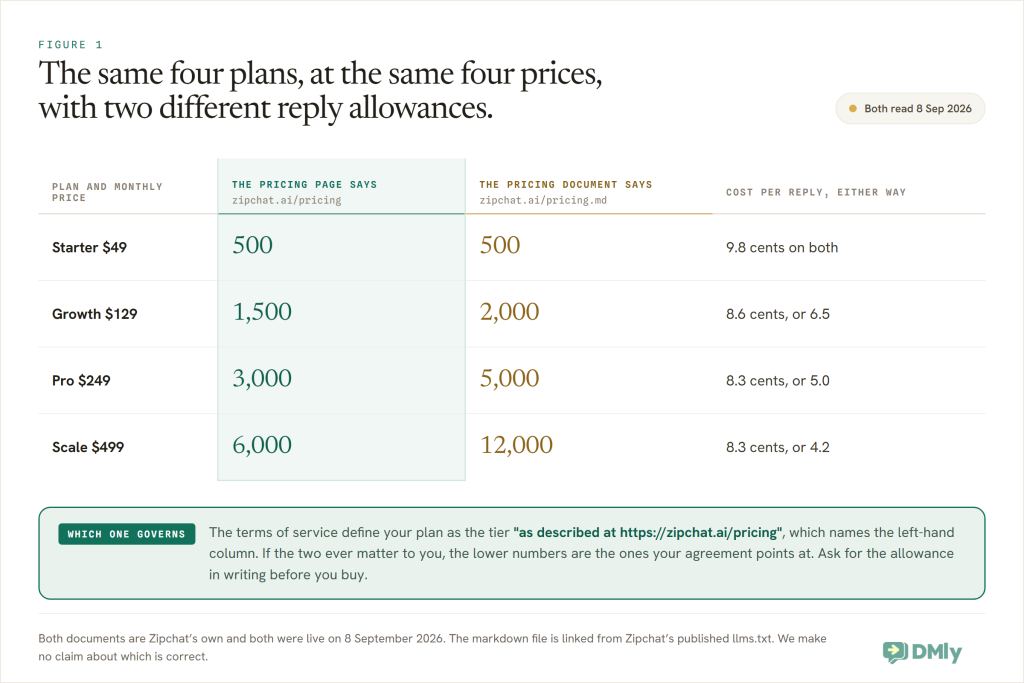
Zipchat publishes its Growth plan in two places. On the pricing page the plan buys 1,500 AI replies a month. In the pricing document Zipchat links from its own llms.txt, the same plan buys 2,000. The Pro plan is 3,000 replies on one and 5,000 on the other, and the Scale plan is 6,000 on one and 12,000 on the other, which is a difference of exactly double.
Both documents are current, both are Zipchat’s own, and we re-fetched both on 8 September 2026 to be sure. That is the shape of the whole problem with pricing a chat tool by the reply: the number that decides your bill is the one nobody quotes twice the same way. If you are shopping for a Zipchat alternative, the useful comparison is not a feature grid. It is working out what each platform is actually counting, and what happens on the day you go past it.
This page does that. It reads Zipchat’s pricing page with both billing toggles set, reads the pricing document behind its llms.txt, reads the terms of service that governs the contract you sign, and then sets the result beside DMly, including the places where DMly is the weaker choice. Every figure below has its source and its billing period named, and the arithmetic is on the page so you can check it.
What Zipchat Actually Sells in 2026
Zipchat is no longer only a shopping assistant for online stores, and any comparison written before this year now describes half the product. Zipchat Inc. runs an AI agent that reads your catalogue and your content, then answers customers across a website chat widget, WhatsApp, Instagram direct messages, Facebook Messenger and email. All five of those channels are on every paid plan, including the cheapest one.
Three things have been added since most reviews of it were written, and they matter if you are drawing up a shortlist:
- Zipchat Code. A second mode that connects to a live Git repository on GitHub, GitLab or Bitbucket and answers product and technical questions from the code rather than from documentation. That is a software company’s tool, not a shop’s, and it means Zipchat is now competing in two different markets at once.
- An AI social media manager. It replies to and moderates comments on your Facebook and Instagram posts, and opens a direct message from a comment. If you were choosing a platform on comment automation alone, that gap has closed.
- AI product questions. Generated questions that sit on a product page, so a shopper taps one and gets an answer without opening a chat at all.
It plugs into Shopify, WooCommerce, BigCommerce, Wix, Magento and PrestaShop, and it now carries a Zendesk integration. Any shortlist of a Zipchat alternative drawn up last year was drawn against a narrower product than the one on sale today. The company is registered in Delaware at 407 E Ayre St, Wilmington, and its terms of service are governed by Delaware law. None of that is a criticism. It is the sort of detail a comparison page should tell you and usually does not.
How Zipchat Charges: the Reply, Not the Conversation
Everything about Zipchat’s cost comes down to one unit, and Zipchat defines it plainly enough that you can plan around it. From their own pricing FAQ: “A reply is any response the AI sends to a visitor or customer, whether in the chat widget, email, or a connected messaging channel like WhatsApp or Instagram. Each outbound AI message counts as one reply.” A second answer adds the part people miss: “Replies across all channels count toward your plan’s monthly reply limit.”
So there is one meter, it is shared across every channel, and only the AI’s outbound messages move it. A customer writing to you costs nothing. A colleague typing an answer by hand costs nothing. The AI answering costs one, every time it opens its mouth.
The conversion Zipchat publishes, and why it is worth writing down
Zipchat prints an approximate conversation figure next to every reply allowance, and that is more helpful than it looks. Starter’s 500 replies are described as “around 200 conversations per month”. Growth’s 1,500 are “around 600”. Pro’s 3,000 are “around 1,250” and Scale’s 6,000 are “around 2,500”.
Divide one by the other and Zipchat is telling you it expects about 2.4 to 2.5 AI replies per conversation. That is the number to hold against your own inbox. If your customers ask two questions and leave, the allowance stretches further than Zipchat assumes. If they are the sort who ask about sizing, then delivery, then returns, then a discount code, a conversation is five or six replies and the allowance runs at roughly half the conversations printed on the card.
What one reply costs on each plan
These are the monthly-billing prices read from Zipchat’s pricing page on 8 September 2026, with the cost per included reply worked out beside them.
| Plan | Monthly | Annual, per month | Replies included | Cost per reply |
|---|---|---|---|---|
| Starter | $49 | $39 | 500 | $0.098 |
| Growth | $129 | $103 | 1,500 | $0.086 |
| Pro | $249 | $199 | 3,000 | $0.083 |
| Scale | $499 | $389 | 6,000 | $0.083 |
| Unlimited | From $999 | Not offered | Unlimited | By quote |
The cost per reply barely moves, and above Pro it stops moving altogether. It falls from 9.8 cents on Starter to 8.6 on Growth and 8.3 on Pro, and then Scale works out at 8.3 as well. Zipchat’s own FAQ says “the cost per individual reply drops with each tier”, which holds all the way to Pro and then flattens on the published pricing page. On the markdown pricing document it does keep falling, to 5.0 cents and then 4.2, so if you want a reason to think that document is the intended one, this is it. Either way, choose between Pro and Scale on the training-page allowance or the number of stores rather than on the reply price.
The Unlimited tier is different in kind. It is quoted by demo from $999 a month, billed monthly with the rate locked for twelve months, and it includes unlimited replies. Zipchat’s terms of service names the tier Enterprise rather than Unlimited and refers to an Order Form, which is not published. That is normal for a negotiated tier and it is stated here only so you know the published card stops at $499.
Two controls on the pricing page, and only one changes the price
The Monthly and Annual toggle is real money. Annual billing takes Starter to $39 a month, Growth to $103, Pro to $199 and Scale to $389, which is a saving of about 20 per cent on the first three and about 22 per cent on Scale. The plan card then shows the annual total: $468, $1,236, $2,388 and $4,668. Read the section on the terms of service before you take it, because the discount has a condition that the pricing page does not mention.
The monthly visitor count selector at the top of the page is not a price control. Picking “under 25k” or “over 150k” only moves a Recommended badge from one plan to another. It is a helpful shortcut, but it is a proxy and not a promise: your plan is metered on AI replies, and replies come from the share of visitors who actually open a chat. A shop with 20,000 visitors and a prominent widget can burn 500 replies faster than a shop with 100,000 visitors and a widget nobody notices. Count your own conversations, not your traffic.
The Two Price Lists That Do Not Agree
This is the finding that sent us looking at a Zipchat alternative in the first place, and it is worth setting out carefully because it is not an accusation. Zipchat publishes an llms.txt file, which is a standard way of offering a clean copy of a site to language models. Among the documents it links is a pricing page in markdown at zipchat.ai/pricing.md. Its numbers are not the numbers on the HTML pricing page.
They disagree on features as well as volumes. The markdown file puts proactive chat triggers, WhatsApp cart recovery and Zipchat Code on the Growth plan and Agentic Skills on Pro. The HTML comparison grid ticks Proactive AI, WhatsApp Marketing, Agentic Capabilities and Agentic Search on every plan including Starter. The markdown file also gives Starter “1 AI agent” where the HTML page gives every plan unlimited team members and says nothing about a count of agents.
We are not going to tell you which one is wrong, because we cannot know. The likeliest explanation is the ordinary one: two documents maintained by different hands, and one of them updated later than the other. What we can tell you is which one governs, and that answer comes from the contract. Zipchat’s terms of service define a Subscription Plan as the tier “as described at https://zipchat.ai/pricing”, naming the HTML page and not the markdown one. If the two disagree, the lower set of numbers is the set your agreement points at.
The action for a buyer is one email. Ask Zipchat to confirm, in writing, the reply allowance on the plan you are about to buy, and keep the reply. It costs nothing, and on the Scale plan the answer is worth $499 a month either way you read it.
What the Terms of Service Adds That the Pricing Page Does Not
We read Zipchat’s terms of service in full, dated 28 October 2025, and three clauses change the shape of the offer. None of them is hidden. All three are in a document linked from the footer of every page, and none of them appears on the pricing page where the decision is actually made.
Overage is charged automatically, and only one payment route has a ceiling
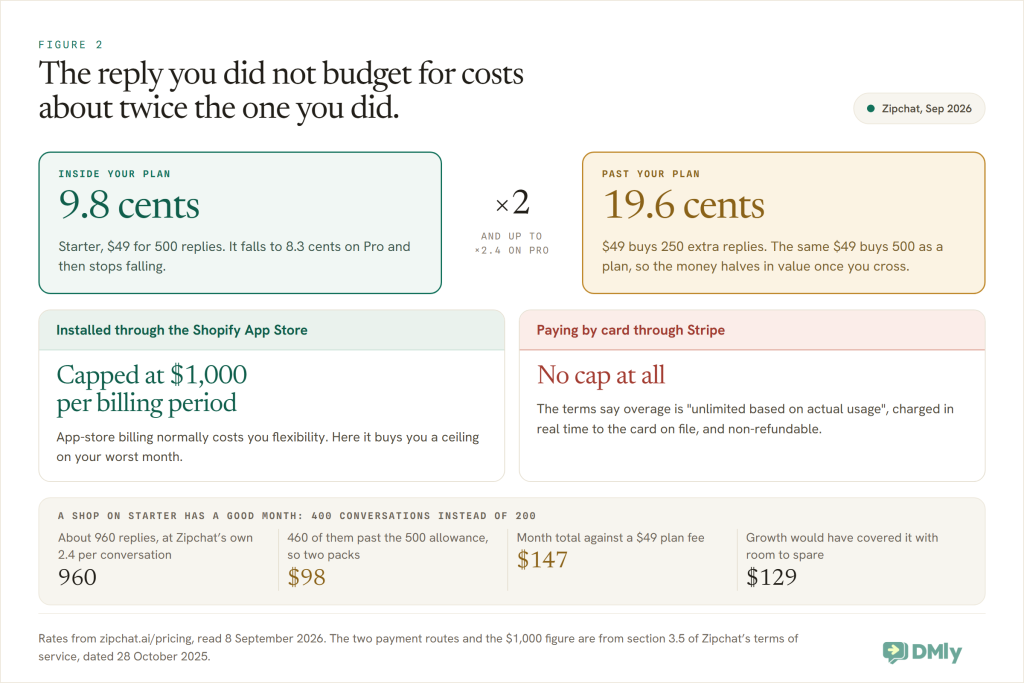
The pricing page presents the extra reply pack as something you buy: “Extra reply packages are available at $49 for 250 additional replies.” Section 3.5 of the terms describes it as something that happens to you. In Zipchat’s own words, overage charges “will be calculated in real-time and automatically charged to Customer’s payment method on file as overage occurs”, and by subscribing you authorise that in advance. They are also, in the same clause, non-refundable.
Then comes the line that should decide how you sign up. The clause continues: “Stripe Customers: Overage charges are unlimited based on actual usage. Shopify Payments Customers: Overage charges are capped at $1,000 per billing period.”
Read that twice, because it inverts the usual advice. App-store billing normally costs you flexibility. Here it buys you a ceiling. If you run a Shopify store and you install Zipchat through the Shopify App Store, your worst month is capped at your plan fee plus $1,000. If you pay by card through Stripe, the terms say there is no cap at all.
Put a number on it. The overage rate of $49 for 250 replies is 19.6 cents a reply, against 9.8 cents included on Starter and 8.3 cents on Pro. Overage is therefore roughly twice the in-plan rate, and about 2.4 times it on the larger plans. There is a smaller absurdity underneath: on Starter, $49 buys you 500 replies as a plan and 250 replies as a top-up, so the same money buys half as much once you are over the line. Zipchat says as much themselves, and fairly: “upgrading to the next plan is almost always more cost-effective.”
A worked example, at Zipchat’s published rates and its own 2.4 replies per conversation. A shop on Starter at $49 has a good month and takes 400 conversations instead of 200. That is about 960 replies against an allowance of 500. The 460 extra replies are two full packs at $49 each, so the month costs $147 instead of $49. Growth at $129 would have covered it with room to spare. The overage is not a trap, but it is a rate you want to notice before your card does.
The annual discount costs you the money-back guarantee
Every plan card on Zipchat’s pricing page carries the line “with 30-day money back guarantee”, and the FAQ says “Every paid plan includes a 30-day money-back guarantee.” Section 3.3 of the terms is narrower. Monthly customers get it, and combined with the seven-day trial that is a stated 37 days of risk-free use. Then: “Annual subscription customers are not eligible for the money-back guarantee.” The same clause adds that refunds “will be provided as store credits unless otherwise determined by Zipchat in its sole discretion”.
So the annual toggle is a real trade and not a free saving. On Starter you save $120 across the year and give up the ability to walk away in month one. On Scale you save $1,320 and commit $4,668. Neither is the wrong choice, but the pricing page shows you one half of the trade and the terms hold the other half. Take the monthly plan for the first two months, then switch to annual once you know your reply volume. That costs $20 on Starter and buys you the guarantee and a real usage number.
Three smaller clauses worth a minute
- Subscriptions renew automatically, in capitals, for another term of the same length at the then-current rate, unless you cancel before the current term ends. On an annual plan that is a twelve-month decision made by not acting.
- Total liability is capped at one month of fees. On Starter that is $49. This is a very common cap in software contracts and Zipchat is not unusual in setting it, but if the AI quotes a wrong price to a customer or promises a delivery date you cannot meet, one month of fees is the ceiling on what you can recover.
- The free trial ends by charging you. Section 3.2 says the payment method “will be automatically charged the applicable Subscription Fees unless Customer cancels before the trial expires”. Put a reminder in your calendar for day six.
The Meta Fee Note on Zipchat’s Pricing Page
If you plan to use WhatsApp, there is a second bill, and Zipchat’s description of it has not kept up with Meta. Zipchat’s pricing FAQ carries this note, quoted in full so you can check it yourself:
Note: Meta does charge a fixed fee, depending on the country, for sending the first message to a number. This applies only for marketing campaigns. In US it would be $0.02 per chat initiated, meaning the cost of the campaign would be $20 for 1.000 people reached
Set that against what Meta publishes. Meta’s own rate card for North America prices a marketing message at $0.0250, so a thousand of them is $25.00 rather than $20. More importantly, Meta stopped charging per conversation on 1 July 2025 and now charges per delivered message. There is no “per chat initiated” any more. A three-message marketing sequence to one contact is three charges, not one.
The likely explanation is the innocent one: the note was written under Meta’s old conversation-based model and has not been revisited. We are not suggesting anyone is being misled, and Zipchat is far from the only platform whose pricing page still describes the model that expired. But the sentence “This applies only for marketing campaigns” is about to stop being true for a second reason.
From 1 October 2026, Meta charges for two more things. Utility templates sent inside an open 24-hour window become billable, with no free allowance at all, and that is the change most businesses will feel. Service messages also become billable, but every business phone number gets 1,000 free service messages a month, charged only from the 1,001st, resetting monthly with no rollover. For a shop answering a few hundred questions a month, the service side still costs nothing and the confirmations and reminders are the bill. We have set the whole change out, with worked examples, in our guide to what service messages now cost from 1 October, and you can look your own market up on the WhatsApp Business API rate card by country.
The practical point for anyone comparing platforms: ask every vendor on your shortlist when their published Meta figures were last checked. It is a fair question, it takes them a minute to answer, and the answer tells you something about how the rest of the page was maintained.
What Zipchat Genuinely Does Well
A comparison that only lists a competitor’s faults is not worth reading, and four of the criticisms on the previous version of this page were wrong. Here is what Zipchat is good at, stated without hedging.
- It is a selling agent, not a support bot. It reads your live catalogue at the moment of the question, recommends products, handles objections, explains ingredients and sizing from documents you upload, and creates single-use Shopify discount codes inside the conversation. That is a genuinely different product from a chatbot answering an FAQ, and if on-site conversion is your problem it is the right shape of tool.
- Every channel is on every plan. The website widget, WhatsApp, Instagram, Messenger and email are all ticked on the $49 Starter plan. So are Agentic Search, Agentic Skills, proactive triggers, human escalation, WhatsApp marketing, the analytics dashboard and API access. Very few platforms in this category give you the whole feature set at the entry price, and Zipchat does.
- Team members are unlimited on every plan. The earlier version of this page said Starter includes one team member. That was wrong, and it is corrected here. Zipchat charges nothing per seat at any tier, which is unusual and worth real money: most platforms in this comparison charge $10 or more per extra person.
- It does run outbound campaigns. The previous version said outbound was minimal. Zipchat publishes compliant WhatsApp broadcast campaigns, AI follow-up sequences, cart recovery messages and QR codes for collecting WhatsApp subscribers in a shop or at an event. Withdrawn as a criticism.
- Setup is genuinely quick. A Shopify install or one snippet in your site header, and Zipchat says most merchants go live the same day with a free onboarding call included on every new plan.
Where Zipchat Stops, and When to Look for a Zipchat Alternative
The real limits are about what Zipchat is not built to hold, and they are easier to plan around than a vague complaint about depth. Each of the five below is a boundary around what the product is for, rather than a fault inside it.
- The channel list is shorter, not shallower. Zipchat’s five channels all run on the same AI and the same knowledge base, which is a good design. But there is no SMS, no Telegram, no TikTok and no Google Business Profile. If your customers text you, or your bookings arrive through your Google listing, those conversations have nowhere to land.
- There is no customer record. Across Zipchat’s published capabilities there is no contact profile, no segment builder and no pipeline. The platform is organised around the conversation and your store’s own data, and it says so. If you want to tag a customer as a wholesale enquiry in March and message that group in June, the list has to live somewhere else.
- Campaigns are WhatsApp campaigns. The outbound tooling is real, and it is on one channel. There is no published broadcast on Instagram, Messenger, SMS or Telegram.
- No bookings, invoices or review requests. If your business sells appointments rather than products, Zipchat has no calendar, no deposit, no invoice and no way to ask for a Google review afterwards. This is not a gap in the product so much as a statement of who it is for.
- The bill moves with your best months. This is the one criticism from the earlier version that survives, and it survives strengthened. A busy December is a bigger invoice, automatically, at roughly twice the in-plan rate per reply, with no ceiling unless you happen to pay through Shopify.
How DMly Compares on the Same Axes
We make DMly, so read this section with that in mind, and check the two lines where we say Zipchat is the better buy. DMly’s plan prices below are billed yearly and were read from our own pricing page on 8 September 2026.
| What you are comparing | Zipchat | DMly |
|---|---|---|
| Entry price | $49 a month, or $39 billed annually | $29 a month billed yearly |
| AI replies on the entry plan | 500 | 500 |
| Cost per included AI reply, entry plan | $0.098 | $0.058 |
| AI replies at the top published tier | 6,000 for $499 | 20,000 for $149 |
| Going past the AI allowance | Charged automatically at $0.196 a reply | The AI step is skipped, and nothing is charged |
| Bring your own AI provider key | Not offered | Premium only, and then replies are unmetered |
| Team seats | Unlimited on every plan | 3, 6 or 15, then $10 a month each |
| Messaging channels | Website widget, WhatsApp, Instagram, Messenger, email | WhatsApp, Messenger, Instagram, Telegram, SMS, TikTok, live chat widget |
| Google Business Profile and reviews | No | Yes, as a connected profile |
| Contact records, tags and pipelines | No published contact record | Included on every plan |
| Bookings, invoices and payments | No | Included on every plan |
| Live product catalogue as the AI’s source | Yes, and it is the core of the product | No equivalent catalogue-trained agent |
| Codebase mode for software teams | Yes, Zipchat Code | No |
| Markup on Meta’s WhatsApp fees | None published | None. You pay Meta directly |
The two rows that decide most of it are the AI reply rows, and they are closer than either side would like to admit. Both entry plans include exactly 500 AI replies a month. DMly’s costs $29 and Zipchat’s costs $49. Above that the curves separate sharply: DMly’s Premium plan at $149 includes 20,000 AI replies, which is more than three times Zipchat’s Scale allowance for less than a third of the money, and on Premium you can connect your own OpenAI, Claude, Gemini or DeepSeek key and stop being metered at all.
Two places where Zipchat is the better buy, said plainly. First, seats: Zipchat charges nothing for team members at any tier, and DMly charges $10 a month for each person past your plan’s allowance. A ten-person support team costs $70 a month more on DMly’s Starter plan than it does on Zipchat’s. Second, the catalogue: Zipchat’s agent is trained on your live product data and is built to sell from it, and DMly has nothing that does the same job. If your single problem is turning product-page browsers into buyers on a Shopify store, Zipchat is the more direct answer and a Zipchat alternative may not be what you actually need.
What DMly Will Not Do, and What Happens at the Limit
DMly meters usage too, and any page telling you otherwise is selling. The earlier version of this article said DMly prices on capacity rather than usage. That was too neat. A DMly plan carries five separate meters: active contacts, broadcast and template messages, profiles per channel, team seats, and AI replies. The AI reply meter counts chatbot replies generated on DMly’s shared AI in a calendar month, exactly the way Zipchat’s counts replies, and on the Starter plan the number is the same 500.
What differs is the day you cross it, and this is the honest comparison rather than the flattering one.
- On Zipchat, you are charged. Overage is calculated in real time and taken from the card on file, unlimited unless you pay through Shopify Payments. You find out because money moves, which is unwelcome but at least it is loud.
- On DMly, the AI stops answering. Once the shared AI has answered as many times this month as your plan allows, the next AI reply turn is skipped rather than failing. The flow carries on to its next step. A system note appears inside the conversation reading that the AI reply limit has been reached for the month and that it resets at the start of the next one. Nothing is charged and nothing breaks. But a customer asked a question and the AI did not answer it.
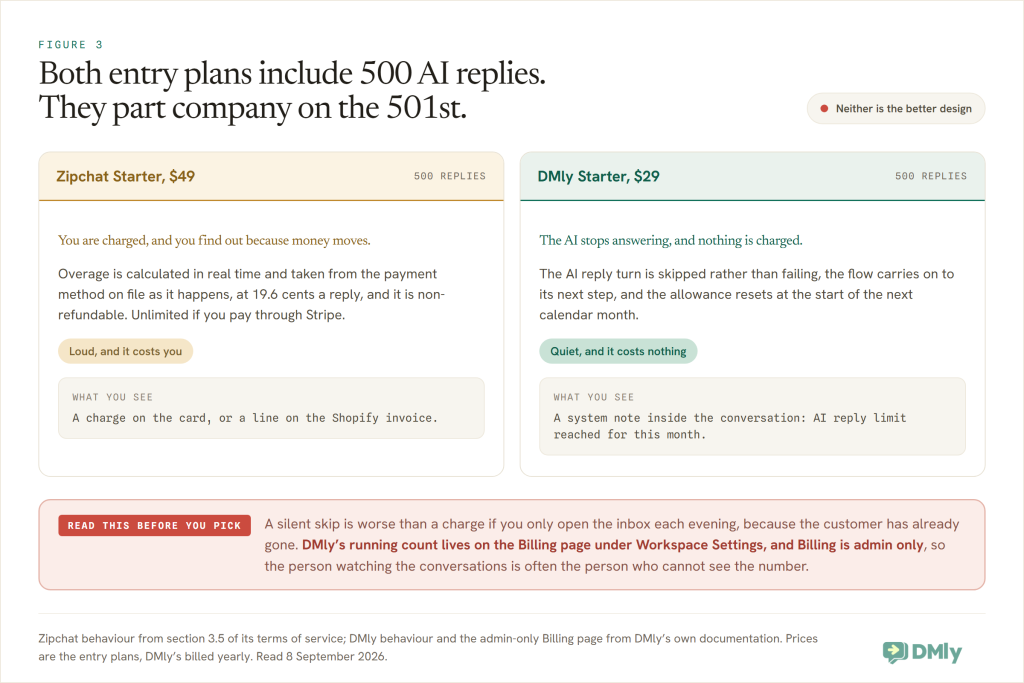
Neither of those is obviously the better design, and which one suits you depends on how you run the day. If you check the inbox once each evening, a silent skip is worse than a charge, because the customer has already gone. If you are watching cash and would rather the tool stop than surprise you, the skip is exactly right.
There is a second half to this that we would rather state than have you discover. The running count of AI replies used this month lives on the Billing page under Workspace Settings, and Billing is admin only. If your base role is Member or Viewer you cannot open it at all. The bar there turns amber at 90 per cent of your allowance and red at 100, and there is no equivalent counter on the automation or inbox screens where the work actually happens. So the person most likely to notice the AI going quiet is the person least likely to be able to see the number. If you are on DMly’s Starter plan and running an AI-heavy flow, put a monthly reminder in the calendar to look.
One more limit that a feature grid will not show you. DMly’s Starter plan allows 10 active bots per profile. Bot flows themselves are unlimited on every plan, so you can build as many as you like, but only ten can be switched on at once per profile on Starter. Growth and Premium lift that to unlimited. If your plan is a dozen small automations rather than three big ones, that cap arrives sooner than you would expect, and the fix is either consolidating flows or moving to Growth at $65.
Two further limits worth knowing before you commit: broadcasts are not available on the live chat widget or on TikTok, so a campaign that needs to reach widget visitors has to reach them on a channel they also use, and on Messenger and Instagram an automated send only reaches people who messaged you in the last 24 hours, even though a reply typed by hand in the inbox gets seven days. Our guide to the 24-hour messaging window sets out how that shapes what you can send and when.
Which One to Pick, and When a Zipchat Alternative Wins
Buy Zipchat if the sentence “I need my product pages to sell better” describes your whole problem. It is built for that, its agent reads your catalogue, every feature is on the entry plan, and seats are free. Take the monthly plan first so you keep the money-back guarantee, install through the Shopify App Store if you can so your overage has a $1,000 ceiling, and write down your reply count after the first full month before you take the annual discount.
Look for a Zipchat alternative if the conversation is only one part of the job. If you also need to keep a customer list you can segment, send a campaign somewhere other than WhatsApp, take a booking, raise an invoice, ask for a Google review, or answer someone who reached you by text message, then you are buying two tools instead of one, and the second one will need to hold the customer record anyway.
Buy on the unit, not on the monthly price. Every platform in this market meters something different, and the price on the card is meaningless until you know what it counts. Zipchat counts AI replies across all channels. DMly counts AI replies, broadcast and template messages, and active contacts separately. QuickReply.ai counts a calendar-day chat, everything both ways to one contact between midnight and midnight. CM.com will sell you monthly active users, 24-hour conversations or messages counting both directions. AiSensy publishes two separate per-message price lists. Work out your own monthly volume in each of those units before you compare a single price, or you are comparing nothing.
If you want the wider field rather than a head-to-head, our roundup of WhatsApp platforms for marketing teams covers ten of them with prices checked at source, and our guide to selling on WhatsApp covers the catalogue side that Zipchat handles on your website.
Frequently Asked Questions
How much does Zipchat cost?
Zipchat publishes four plans: Starter at $49 a month, Growth at $129, Pro at $249 and Scale at $499, all billed monthly. Annual billing takes them to $39, $103, $199 and $389 a month, charged as a yearly total. A fifth tier, quoted by demo from $999 a month, includes unlimited replies. Extra replies beyond your plan cost $49 for 250, charged automatically as you use them.
What counts as a reply on Zipchat?
Any outbound message the AI sends to a customer, on any connected channel. Zipchat’s own definition covers the chat widget, email, WhatsApp and Instagram, and all of them draw on the same monthly allowance. Inbound messages from customers are free, and so are replies a person on your team types by hand. Zipchat’s plan cards suggest a conversation runs to about 2.4 or 2.5 replies, so 500 replies is roughly 200 conversations.
Why do Zipchat’s two pricing pages show different reply limits?
We do not know, and we are not going to guess at a reason. The HTML pricing page gives Growth 1,500 replies, Pro 3,000 and Scale 6,000. The markdown pricing document linked from Zipchat’s own llms.txt gives the same plans 2,000, 5,000 and 12,000 at the same prices. Both were read on 8 September 2026. Zipchat’s terms of service define your plan by reference to the HTML pricing page, so that is the list your contract points at. Ask them to confirm the allowance in writing before you buy.
What happens if I go over my Zipchat reply limit?
You are charged automatically. Zipchat’s terms say overage is calculated in real time and taken from the payment method on file as it occurs, and that it is non-refundable. The rate is $49 per 250 replies, about 19.6 cents each, roughly twice the in-plan rate. If you pay through Shopify Payments the terms cap overage at $1,000 per billing period. If you pay through Stripe, the same clause says overage is unlimited.
Does Zipchat’s money-back guarantee apply to annual plans?
No. Zipchat’s pricing page shows the 30-day money-back guarantee on every plan card, but section 3.3 of its terms of service says annual subscription customers are not eligible for it, and that refunds are issued as store credits unless Zipchat decides otherwise. Monthly customers keep the guarantee, which with the seven-day trial gives a stated 37 days. Starting monthly and switching to annual later costs very little and keeps the protection.
Is DMly a good Zipchat alternative for an online store?
It depends on which half of the job matters more. DMly gives you seven messaging channels, a contact record with tags and pipelines, broadcasts, bookings, invoices and Google review requests, and it includes 500 AI replies on a $29 plan against Zipchat’s 500 on a $49 plan. What DMly does not have is an agent trained on your live product catalogue that sells from a product page, and that is the thing Zipchat is built to do. For pure on-site conversion, Zipchat is the more direct tool.
Do I still pay Meta separately for WhatsApp?
Yes, on both platforms. Meta charges per delivered business-to-user message, and neither Zipchat nor DMly publishes a markup on top of it. From 1 October 2026 two more categories become billable: utility templates sent inside an open 24-hour window, with no free allowance, and service messages, though every business phone number gets 1,000 of those free each month before charging starts. Marketing messages in North America are $0.0250 each on Meta’s published card.
What happens when DMly runs out of AI replies?
Nothing is charged. The AI reply step is skipped for the rest of the month and the flow moves on to its next step, with a system note inside the conversation saying the limit has been reached and that it resets at the start of the next calendar month. On the Premium plan you can connect your own AI provider key, and replies on your own key are never metered. The running count sits on the Billing page under Workspace Settings, which only admins can open.
Writing about WhatsApp automation, bookings and growth for local business.
Turn WhatsApp into your busiest channel.
Start free and run message, bookings, payments and reviews in one place.
