
CM.com Review 2026: What Is Priced, and What Is Not
Scroll to the bottom of any page on cm.com and you will find a list of what the company sells. Among the things on it are payment terminals, QR payments, transaction processing, a cash register, SIP trunking, seated ticketing, ticketing for museums and parks, an event and festival app, and e-signatures. Somewhere in that list, between the cash register and the customer data platform, sits the WhatsApp and SMS messaging you probably came looking for.
That is the single most useful thing to know before you read another word. CM.com is not a WhatsApp tool that also does a few other things. It is a listed European communications and payments company whose messaging business is one department of several, and whose customers include the sort of organisation that needs to sell forty thousand festival tickets and take the money at the gate.
This CM.com review is written for a smaller reader than that: a business owner deciding where to run customer messaging. So it does three things. It sets out what CM.com actually charges, which turns out to be a more interesting question than it looks, because the published prices and the unpublished ones fall in a very particular pattern. It says plainly what CM.com is better at than we are. And it names the one thing on their own pricing page that a buyer should check before signing anything.
Who CM.com Actually Is
Step zero first, because a review of a vendor that has moved or gone is worse than no review. Checked on 6 September 2026: cm.com returns 200 on the root, the robots file, a sitemap of well over a megabyte, and every pricing page linked from it, with a real, current product behind all of them. The company is very much trading.
From CM.com’s own about page, read the same day: founded in 1999, headquartered in Breda in the Netherlands, 600 or more full-time equivalents, a local presence in 15 countries, listed on Euronext Amsterdam as CMCOM, and revenue of 274 million euros in 2024. Their 2025 annual report describes record EBITDA, a record gross margin and the refinancing of 100 million euros of convertible bonds.
Those numbers matter to a small buyer for one practical reason. A company of that size with a public share price is not going to disappear, and it is also not going to design its onboarding around a salon with three staff. Both halves of that are true at once, and the rest of this page is mostly about the consequences.
The product has been restructured since this page was last written. CM.com now organises everything into four groups: Connect (the channels and the APIs), Activate (campaigns, marketing automation and AI personalisation), Convert (payments, live experiences and e-signatures) and Support (an agent inbox and their HALO AI agents), all sitting on what they call the Customer Context Platform. HALO is described in their own annual report as “the first Agentic AI platform in the EU”.
The channel list has grown too, and this page had it wrong. It used to say SMS, WhatsApp, Apple Messages for Business and RCS. CM.com’s own menu today lists RCS, WhatsApp, Voice, SMS, Email, Instagram, Facebook Messenger, Viber, Telegram, Apple Messages for Business and Line, each available through the API or the platform.
CM.com Pricing in 2026: The Pattern of What Is Published
The old version of this page quoted “from 49 euros a month, Go plan”, and that figure is still exactly right. It is worth saying so, because a competitor page that is wrong about a price is worthless, and this one was not. What it never explained is what 49 euros actually buys, and what it does not.
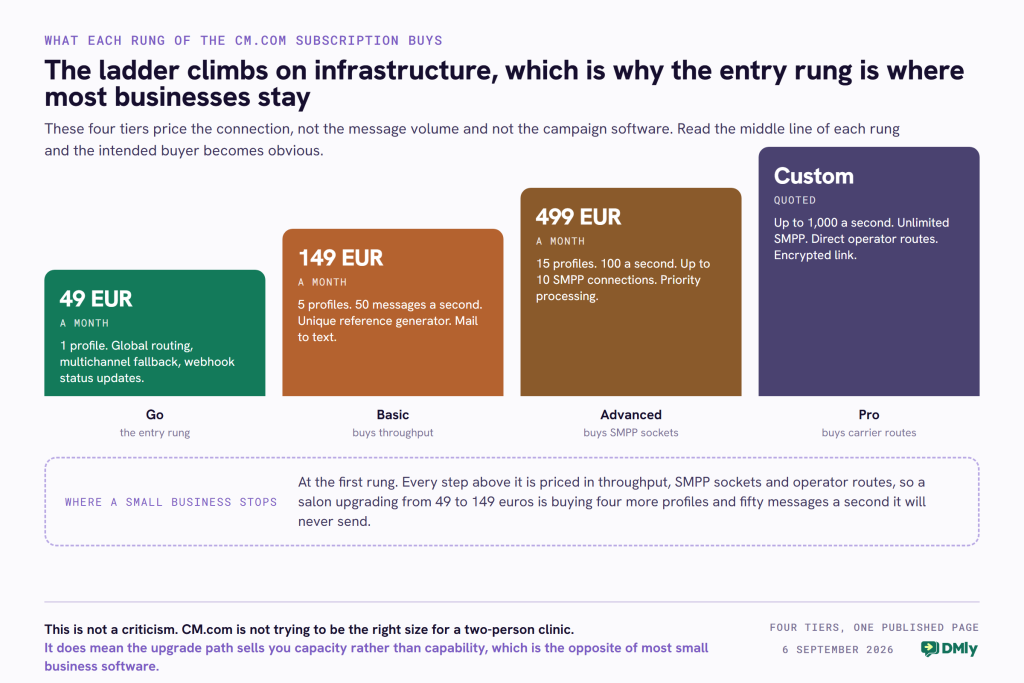
The 49 euros buys a connection. Here is the whole published ladder, read from CM.com’s Conversational Channels pricing page on 6 September 2026, with the billing period beside every figure.
| Conversational Channels subscription | Price | Profiles | What the tier adds |
|---|---|---|---|
| Go | 49 euros a month | 1 | HTTP endpoint, expert managed global routing, multichannel fallback, global regulation filter, webhook status updates, email support |
| Basic | 149 euros a month | 5 | 50 messages a second throughput, unique reference generator, mail to text, phone support |
| Advanced | 499 euros a month | 15 | 100 messages a second, up to 10 SMPP connections, high priority processing, phone number sanitisation, custom media retention, live chat support |
| Pro | Custom | Not stated | Up to 1,000 messages a second, unlimited SMPP, direct operator routes, customised routes, two way encrypted connection, a named account manager |
Read the “what the tier adds” column and it becomes obvious what kind of product this is. The things you pay more for are throughput, SMPP sockets, direct operator routes and encryption of the link. Those are the concerns of somebody plumbing a messaging pipe into a large system. They are not the concerns of somebody who wants a shared inbox and a booking reminder.
Now look at what is not published
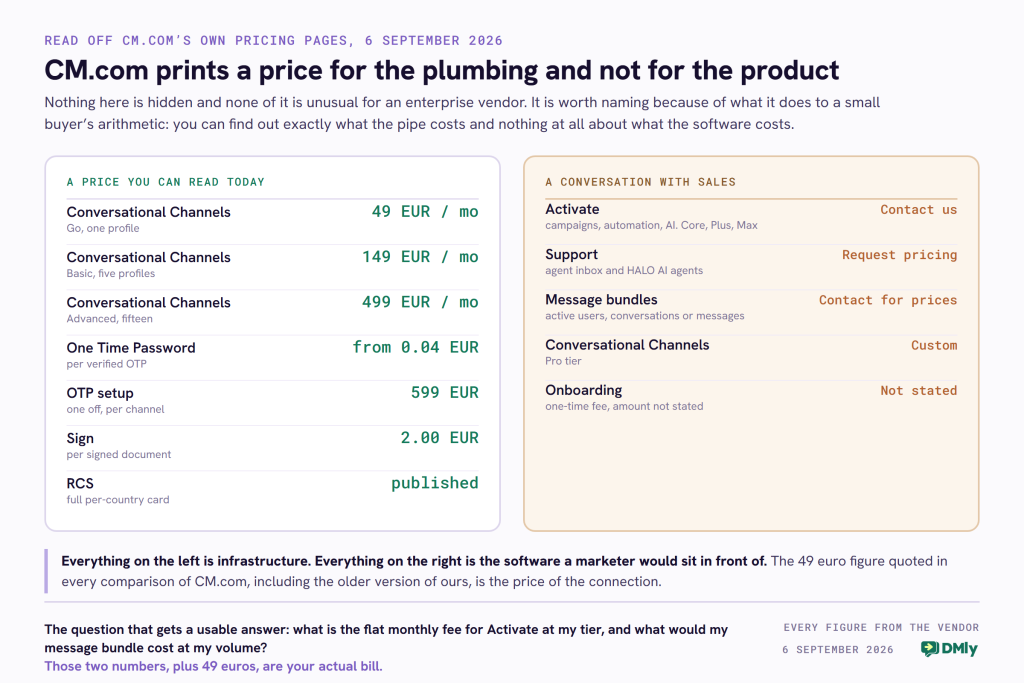
This is the finding, and it is a pattern rather than a single number. CM.com publishes a price for almost every piece of infrastructure and no price at all for the software a marketer would actually sit in front of.
Activate, which is the campaigns, marketing automation and AI personalisation product, has a published pricing page with three named tiers, Core, Plus and Max. That page tells you the included email volume on each: 25,000, 250,000 and 2,500,000 emails a month. It tells you what each tier adds. It says “one flat monthly fee per tier”. It does not print the fee. The button says “Contact us for more info”.
Support, which is the agent inbox and the HALO AI agents, has the same three tier names on the main pricing page and a button reading “Request pricing”. No figure anywhere.
And the message volume itself, which for most buyers will be the largest line on the bill, is sold through one of three bundle models with the page ending on “Contact for bundle prices”.
None of that is hidden, and none of it is unusual for an enterprise vendor. It is worth naming because of what it does to a buyer’s arithmetic: you can find out exactly what the pipe costs and nothing at all about what the product costs. The 49 euro figure that circulates in every comparison of CM.com, including the older version of this one, is the price of the least interesting part.
The question that gets a usable answer, and it is the only question worth asking first: what is the flat monthly fee for Activate at the tier you would put me on, and what would my message bundle cost at my volume? Those two numbers, plus 49 euros, are your actual bill. Anyone quoting you 49 euros a month for CM.com has quoted you the connection.
Three Bundle Models, and Why the Unit Decides What You Can Check
CM.com sells message volume in one of three units, and it publishes the definitions clearly. In their own words:
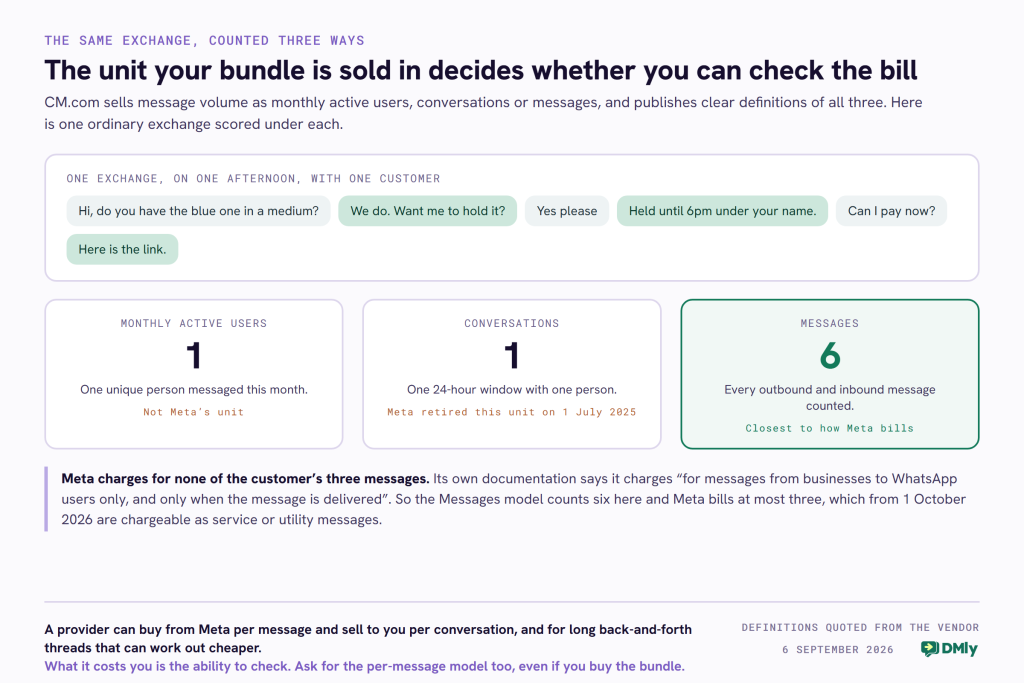
- Monthly Active Users. “Perfect for continuous engagement within a month with your customers. This model counts unique users with whom messages were exchanged within a calendar month.”
- Conversations. “Ideal for one-time chats with different customers with a clear start and end. This model counts all 24-hour windows messaging sessions to a unique user.”
- Messages. “Optimal for your needs to send out single messages with limited responses. This model counts all outbound (MT) and inbound (MO) messages.” This is the unit a broadcast is actually measured in.
Offering all three is genuinely thoughtful, and the descriptions are honest about which shape of business each suits. But there is a consequence buried in the middle one that is worth pulling out, because it applies to every provider that offers it.
Meta stopped charging per conversation on 1 July 2025. Its own documentation now describes per-message pricing, with a rate for each template category by country, and from 1 October 2026 a per-message charge for service messages as well. A conversation, meaning a 24-hour window, is no longer a unit Meta bills in. It is a unit some providers still bill in.
There is nothing wrong with that. A provider can perfectly reasonably buy from Meta per message and sell to you per conversation, and for a business whose customers send long back-and-forth threads it can work out cheaper. What it costs you is the ability to check. If your bill is denominated in conversations and Meta’s rate card is denominated in messages, no arithmetic you can do from the outside will tell you whether the pass-through is at cost, at a margin, or at a discount. You are buying a bundle, and a bundle is a judgment call rather than a calculation.
There is a second detail inside the Messages model worth knowing, because it is the one that looks most like Meta’s own unit and is not quite. It “counts all outbound (MT) and inbound (MO) messages”, while Meta charges “for messages from businesses to WhatsApp users only, and only when the message is delivered”. A six-message exchange in which the customer sent three is six on that meter and at most three on Meta’s.
So ask for the Messages model as well as the one they recommend, even if you end up buying the bundle. Priced per message, you can compare it line for line against Meta’s published rate for your country and see exactly what the platform is charging you for. That comparison is worth having in front of you at a renewal, whichever unit you sign in.
The Priced Extras Most Reviews Never Mention
CM.com publishes several other rate cards, and two of them carry numbers a buyer should see before being surprised by them.
One-time passwords. Their OTP-as-a-Service page quotes “starting at 0.04 euros” per verified OTP, and beneath it, in the same block, a one-time setup cost of 599 euros per channel. Their own footnotes add that the per-OTP price excludes the channel cost of actually sending it, and that “an extra authentication template update fee may apply for conversational channels”. If two-factor codes on WhatsApp and SMS are why you are here, that is 1,198 euros before the first code goes out, plus the message.
E-signatures. Sign is priced two ways and both are printed: 2.00 euros per document with no monthly fee on the Go subscription, or a Bundle subscription from 29.95 euros a month for 20 documents, with out-of-bundle documents charged at the baseline price. The Bundle adds API access at no extra cost, two-factor document protection, qualified electronic signatures and a connection to their payments platform. Several things listed under it are marked as add-ons, including the customer success manager and the 24 hour support, so read that column before assuming it is included.
RCS. This one is a genuine credit and almost nobody gives it to them. CM.com publishes a full per-country RCS rate card in euros, with three separate columns because RCS has three billable shapes: a basic 160-character business-initiated message, a single message that becomes a conversation if the user replies within 24 hours, and a conversation. The Netherlands is 0.0832, 0.0890 and 0.1070 euros across the three; the United Kingdom is 0.0396, 0.0710 and 0.1310; Germany is 0.0710, 0.0790 and 0.1130. Publishing three columns rather than one average is the more honest presentation, and it is more detail than most providers give for any channel.
What CM.com Is Genuinely Better At
No CM.com review that gives the competitor nothing is worth reading, and here there is a great deal to give. Four of these are things DMly does not do at all.
They are the carrier relationship, not a layer on top of one. Direct operator routes, SMPP connections, expert managed global routing, route testing and multichannel failover are their own infrastructure. When a message to a mobile network in a difficult market fails, CM.com is the party that can do something about it. That is a different kind of company from a platform that resells someone else’s gateway, and it is why they can offer throughput guarantees at all.
They publish throughput as a specification. 50 messages a second on Basic, 100 on Advanced, up to 1,000 on Pro. Most platforms in this category describe their sending speed with an adjective. A number you can hold them to is worth more.
European data residency is a stated position rather than a checkbox. Their own wording: “CM.com is headquartered in the Netherlands and processes data within the EU. Full GDPR compliance, by default, not as an add-on.” For a European public body, a hospital group or a bank, that sentence is not marketing; it is the reason the procurement conversation can happen at all. It is one of the clearest genuine differentiators any vendor in this category has.
The breadth is real, not a feature list. Payment terminals, transaction processing, recurring payments, ticketing for venues and festivals, e-signatures, SIP trunking and voice all exist as products with their own pricing pages. If your business needs several of those and messaging is one line in a larger integration, buying them from one listed vendor with one contract is a legitimate strategy, and it is one DMly cannot offer at any price.
Four Criticisms This Page Made, and What Survives
An earlier version of this CM.com review listed four shortcomings. Two hold up, one needs correcting, and one was never a criticism so much as a description.
Holds up, and the numbers now support it: “pricing can become difficult to predict.” The section above puts figures on why. The connection is published, the campaign product’s fee is not, the AI product’s fee is not, and the message volume is a quoted bundle in one of three units. That is not an accusation of anything; it is simply four unknowns where a small buyer expects one.
Holds up, sharpened: “can be complex for smaller teams.” The sharper version is not that the interface is hard. It is that the ladder is priced by SMPP sockets, throughput and operator routes, which means every rung above the first is selling you something a small business has no use for. You would move from 49 to 149 euros to get from one profile to five, and collect 50 messages a second you will never send.
Withdrawn: “limited out-of-the-box automation.” That is no longer true and probably was not fair when it was written. Activate publishes a campaigns builder, automated workflows, campaign insights, AI-driven automated workflows with dynamic response on the Plus tier, and AI agentic commerce with inventory checks on Max. Support publishes HALO AI agents and an agent inbox they hand off to. Whatever else is true about the price, the automation is there.
Reframed rather than withdrawn: “may be more than some businesses need.” That was written as a criticism and it is really the whole answer. CM.com is not trying to be the right size for a two-person clinic, and treating that as a flaw is like criticising a wholesaler for not selling one of something.
The 1 October Meta Change, and One Link Worth Following Yourself
Whichever platform you use, Meta changes what it charges for on 1 October 2026, and two of the three changes affect the messages small businesses send most. All of this was read at source on 6 September 2026.
From 1 October, Meta charges per message for service messages, the ordinary replies a person or a bot types inside an open conversation, which have been free since November 2024. It also starts charging for utility messages sent in reply to a customer inside the open 24-hour window, free since July 2025. Service messages are priced at the same rate as utility and authentication messages in the customer’s country, and Meta’s page states plainly that service messages get no volume tiers, though utility and authentication keep theirs.
The part that makes it survivable for most small businesses is new, and Meta marks it that way on its own page: “Effective October 1, 2026, Meta will introduce a free monthly tier of service messages. Each month, every business phone number will receive 1,000 free service messages; Meta will only charge as of the 1,001st service message delivered. These free service messages do not roll over if not used in a specific month and reset monthly, for each business phone number.” Note the units: per phone number, per month, counting messages.
And the deadline to act on this week. Meta’s own page states that for any solution provider or directly integrated business “that does not have a payment method on file by September 30, 2026”, Meta “will stop delivering service messages” from the day they become chargeable. Ask your provider today whether a payment method is on file for your WhatsApp Business Account, and get the answer in writing. Our guide to the 1 October pricing change has the arithmetic.
The link on CM.com’s own pricing page, and why it matters
At the foot of CM.com’s Conversational Channels pricing page is a footnote reading “Sending WhatsApp messages may incur extra costs (see here)”, and “here” links to Meta’s documentation. That is exactly the right thing to do, and more than many providers bother with.
The trap is not CM.com’s doing. Meta reorganised its pricing documentation and now serves two path families that say different things. The one that link points at still carries text saying Meta will announce the October rates “no later than September 1, 2026”, as though nothing had been published yet. The current family, at developers.facebook.com/documentation/business-messaging/whatsapp/pricing, says the opposite: “Rate cards effective October 1, 2026, including service rates, are now published below.” Both pages return 200. Only one is current.
We flag it because it caught us too. The older path is the one a plain fetch reaches most easily, and it is the one that will quietly persuade you the October rates have not been announced. If any provider tells you the numbers are not out yet, check the other family before you believe it. This is worth doing on our pages as much as anyone’s.
Where DMly Is Different, and Where It Simply Cannot Compete
Start with the part where CM.com wins outright, because on this comparison it is a long list.
DMly is a layer on somebody else’s carrier relationship, and CM.com is the carrier relationship. Our own documentation says so: DMly sends SMS through Twilio, Plivo or a custom HTTP gateway, and you pay that provider for the messages. We have no direct operator routes, no SMPP, no route testing and no failover between carriers, because we are not in that business. If your requirement is a million SMS a month through direct routes with a throughput guarantee, we are the wrong tool and CM.com is a right one.
The same goes for four whole products. DMly has no e-signature product, no payment terminals, no ticketing and no SIP trunking. If you need those, the question is not which is better, it is whether you want them from one supplier.
What DMly is built for is the opposite end of the same market: one local business running its whole customer relationship through chat. Seven channels and SMS, in our own site’s counting, all landing in one shared inbox: WhatsApp through the official Business API, Instagram, Facebook Messenger, TikTok, Telegram, a Live Chat widget and Google Business Profile for reviews, plus SMS through one of those three gateways. Beside the messaging sit bookings with services, staff, availability and classes; invoices, orders, payments, coupons and expenses; recurring plans, subscriptions and gift cards; a contact record with pipeline stages; and a Reputation section that requests and manages Google reviews.
And the price of all of it is printed. Read off our own pricing page on 6 September 2026, billed yearly: Starter 29 dollars a month with 3 seats, 3,000 active contacts and 10,000 broadcast or template messages; Growth 65 dollars with 6 seats, 10,000 contacts and 50,000 messages; Premium 149 dollars with 15 seats, unlimited contacts and 300,000 messages. AI agents, bookings, invoices, CRM, reputation and the automation builder are on every plan. Extra seats are 10 dollars a month. DMly adds no markup to Meta’s per-message rates, which you pay Meta directly.
Two more limitations, stated here rather than left for you to find
Our SMS is text only and it is somebody else’s account. No images, no files, no tappable buttons; if a flow step tries to send media on SMS, only the caption and the link go out as plain text. There are no read receipts, and no growth tools, because a QR code or a chat link has no equivalent on SMS. You also open and pay for the Twilio or Plivo account yourself. For a business whose primary channel is SMS at volume, that arrangement is worse than buying from a carrier, and we would rather say so than let you discover it in month two.
We publish one price list, in dollars, and it meters contacts. There is no euro card, which for a European buyer comparing against CM.com’s euro pricing is a real friction. And Starter’s 3,000 active contacts and 10,000 broadcast messages are ceilings that CM.com’s model does not have: they sell you a connection and a volume bundle, so holding a large list costs you nothing with them. If you have eighty thousand contacts you message twice a year, our per-contact tiers are the wrong shape.
CM.com and DMly Side by Side
Every cell in this CM.com review was read off one of the two companies’ own published pages on 6 September 2026. Where a price is not published, the cell says so rather than guessing at one.
| What you are comparing | CM.com | DMly |
|---|---|---|
| Entry subscription | Go, 49 euros a month, one profile | Starter, 29 dollars a month billed yearly, 3 seats |
| What the entry price buys | A messaging connection with global routing and fallback | The whole platform: inbox, automation, bookings, invoices, CRM, reviews |
| Price of the campaign and automation product | Core, Plus or Max, volumes published, fee not published | Included on every plan |
| Price of the AI agent product | Request pricing | Included on every plan, 500 to 20,000 replies by tier |
| Message volume | A quoted bundle in one of three units: active users, conversations or messages | An allowance per plan, with Meta’s per-message rate paid to Meta |
| Channels | RCS, WhatsApp, Voice, SMS, Email, Instagram, Messenger, Viber, Telegram, Apple Messages, Line | WhatsApp, Instagram, Messenger, TikTok, Telegram, Live Chat, Google Business Profile, plus SMS |
| SMS | Direct carrier routes, SMPP, published per-country rate card | Through your own Twilio, Plivo or custom gateway; text only |
| Published throughput | 50, 100 or up to 1,000 messages a second by tier | Not published as a specification |
| Bookings, invoices, Google reviews | Not part of the product | Services, staff and classes; invoices, orders and payments; review requests |
| Payments, ticketing, e-signatures | Full products with their own rate cards | Invoices and payment links only, no terminals or ticketing |
| Data residency | Netherlands headquarters, processing within the EU, stated as a default | Not published as a commitment |
| Company | Listed on Euronext Amsterdam, founded 1999, 274 million euros revenue in 2024 | Private |
CM.com Review Verdict: Who Each One Is Actually For
These two products barely overlap, and the honest advice is mostly about recognising which side of the line you are on.
Choose CM.com if messaging is infrastructure in your business
If you have a development team, if messages are triggered by your own systems rather than typed by a person, if you send in volume across many countries, if you need a throughput number in a contract, or if EU data residency is a procurement requirement rather than a preference, CM.com is built for exactly that and there is no argument for a small business tool. Add payments, ticketing or e-signatures to that list and the case gets stronger, not weaker.
Go in with the two unpublished numbers in hand. Ask for the Activate monthly fee at your tier and the bundle price at your volume before anything else, because 49 euros is the connection and not the bill.
Choose DMly if the messages are the front of a business rather than a pipe into one
If your enquiries arrive as WhatsApp messages and Instagram DMs from people who want an appointment, a price or a table; if the useful next step is a booking with a staff member, a reminder the day before, an invoice and a review request; if nobody on the team writes code, and if you want the whole price printed before you talk to anyone, then the wide enterprise platform is the wrong shape and the size of the vendor is not the point.
If you are somewhere in between
A mid-sized business that both runs a shop floor and sends a lot of transactional SMS may genuinely need both, and there is no shame in that. The split that usually works is to put the customer-facing conversation where the bookings and invoices are, and the machine-generated volume where the carrier routes are. Whichever way you split it, the 30 September payment method deadline attaches to your WhatsApp Business Account, not to your software, so it survives any change of platform.
Frequently Asked Questions
How much does CM.com cost?
The published part is the Conversational Channels subscription: Go at 49 euros a month for one profile, Basic at 149 for five, Advanced at 499 for fifteen, and Pro on request. That is the connection only. The campaign and automation product, Activate, publishes three tiers and their included email volumes but not the fee. The AI agent product says “Request pricing”. Message volume is a quoted bundle. So the honest answer is that CM.com’s entry price is 49 euros a month and its actual price cannot be worked out from published information.
Is CM.com good for small businesses?
It is not aimed at them, and that is a design decision rather than a defect. The tiers above the entry level are priced by SMPP sockets, throughput and operator routes, which are things a small business will never use. If you are a clinic, a salon, a studio or a shop, you would be paying for infrastructure and still needing a separate booking system, invoicing, customer record and review tool on top.
Does CM.com charge a markup on WhatsApp messages?
We cannot tell you, because their bundle prices are not published and one of the three bundle models is denominated in conversations rather than messages, which is not the unit Meta bills in. That is not a criticism, it is a structural fact about bundles. If you want to be able to check, ask for the Messages bundle model priced per message, then compare it against Meta’s published rate card for your country. That question works on any provider, ours included.
What are the best CM.com alternatives?
It depends entirely on which half of CM.com you were buying. If you wanted the carrier-grade messaging pipe, compare it with other communications platform providers on direct routes, throughput and what the whole thing will actually cost you, not on features. If you wanted a customer conversation that ends in a booking, a payment or a review, that is a different category, and our list of WhatsApp platform alternatives compares ten of them on the smallest cheque each will take.
Does CM.com support WhatsApp, Instagram and Telegram?
Yes. Their own channel menu lists RCS, WhatsApp, Voice, SMS, Email, Instagram, Facebook Messenger, Viber, Telegram, Apple Messages for Business and Line, each available through the API or through the platform. An earlier version of this page listed only four of those and was out of date.
Is CM.com a real company or a reseller?
A real one, and a large one. CM.com is listed on Euronext Amsterdam under CMCOM, was founded in 1999, is headquartered in Breda in the Netherlands, employs more than 600 full-time equivalents across 15 countries and reported 274 million euros of revenue in 2024, all from its own about page and investor relations pages. It operates its own carrier routes rather than reselling somebody else’s.
When was this CM.com review last checked against the source?
6 September 2026. Every CM.com figure here was read that day from cm.com’s own pricing, product and about pages. Every Meta figure was read the same day from Meta’s own developer documentation. Every DMly figure came from our own pricing page and documentation. Prices in this category move, and CM.com restructured its whole product line since this page was first written, so check the source before you decide.
Writing about WhatsApp automation, bookings and growth for local business.
Turn WhatsApp into your busiest channel.
Start free and run message, bookings, payments and reviews in one place.
