
Best Fresha Alternatives for Salons and Spas in 2026
Let us start on the wrong foot for an article about Fresha alternatives, and make the case for staying. Fresha runs one of the largest consumer booking marketplaces in beauty and wellness, and that marketplace sends real customers to real salons who would never otherwise have found them. Its calendar is genuinely good. Its point of sale is genuinely good. Its mobile app is the one most stylists find easiest to pick up. If you have been on it for three years and it works, “everyone says you should switch” is not a reason.
And there is a much better reason to hesitate, which almost nobody has caught up with. The thing salons used to leave Fresha over has gone.
So this guide does two jobs. First, what actually changed, because if you read a Fresha comparison written before this year you are reading about a product that no longer exists in that form. Then the Fresha alternatives worth looking at, with every price read from the vendor’s own page on the same day, the billing period and the unit written beside each one, and an honest note wherever we could not verify something.
What Actually Changed at Fresha, and Why the Comparisons Are Out of Date
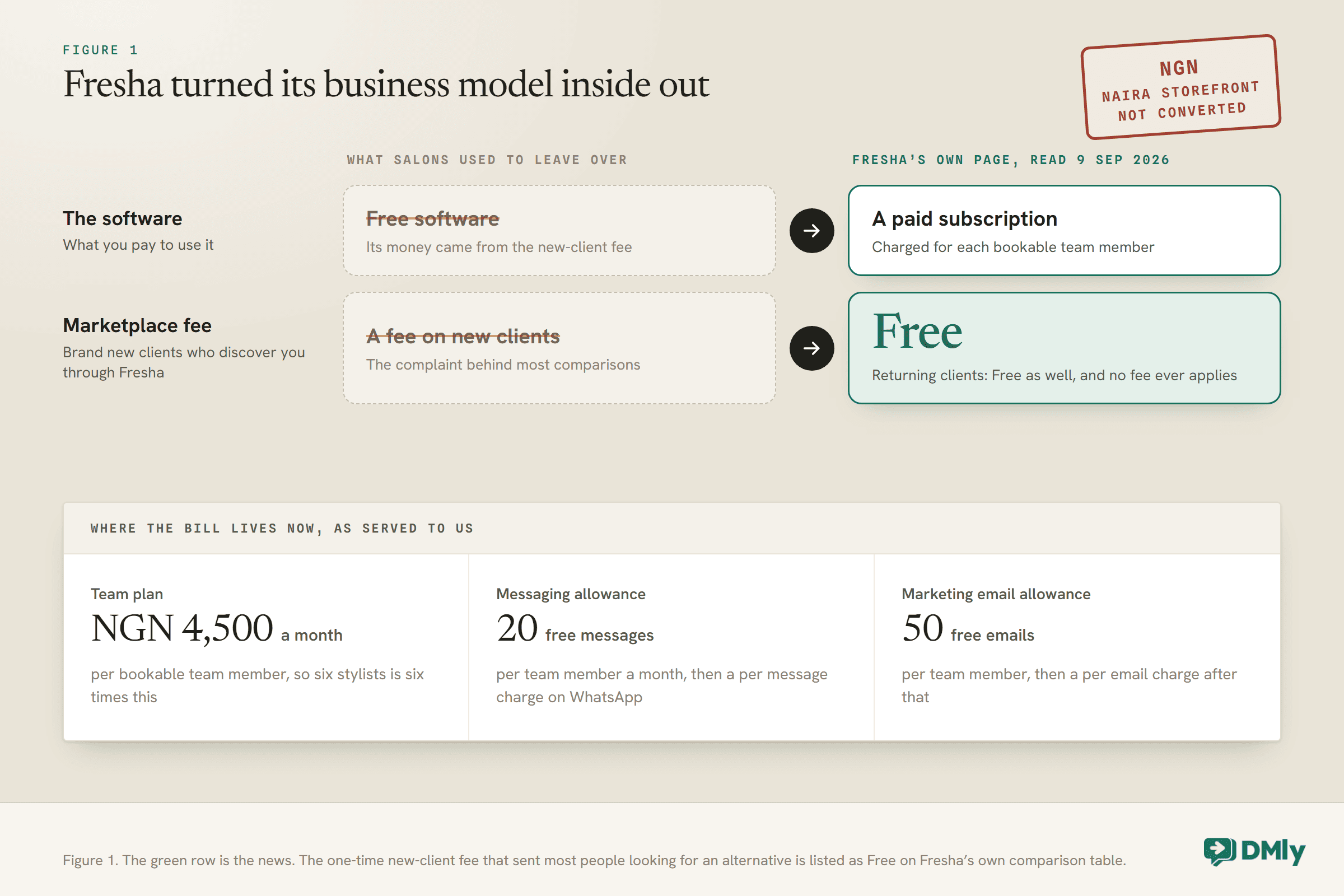
Fresha has turned its business model inside out. It used to be free software that made its money from a fee on new clients. It is now paid software that charges no fee on new clients.
Read from Fresha’s own pricing page on 9 September 2026, its comparison table lists Fresha marketplace, new clients, describes it as a one-time fee applied to brand new clients who discover your business through the marketplace, and gives the price as Free. Returning clients are Free as well, and the table says no fee ever applies to them. Its own FAQ puts it beyond doubt: asked whether it charges booking fees for each appointment, Fresha answers that it does not, and that with its business plan you get unlimited bookings at no extra cost.
In exchange, the software is now a subscription, and the subscription is charged per bookable team member. The page says so in its own headline: as you expand, we charge for each bookable team member.
That is a complete inversion. The old complaint, which drove most of the search traffic that brought you here, was a percentage taken off new clients you felt you had earned. That complaint no longer applies. The new one is different in kind: your software bill now grows every time you hire.
Read this before you use any Fresha figure, including ours: Fresha’s pricing page changes currency depending on where the visitor is. The page we were served on 9 September 2026 was priced in Nigerian naira, and we could not find a currency switcher; a United States path returns a 404. So every Fresha number below is labelled NGN and dated, and none of them has been converted into anything else, because a naira figure printed with a dollar sign in front of it is a specific and well-documented way to mislead people. Open the page yourself and read your own currency before you make a decision. The structure of the pricing, which is what this article is really about, is the same whatever currency you are shown.
The Three Reasons Salons Still Look for Fresha Alternatives
The old reason has gone. Three new ones have taken its place, and all three are about shape rather than headline price.
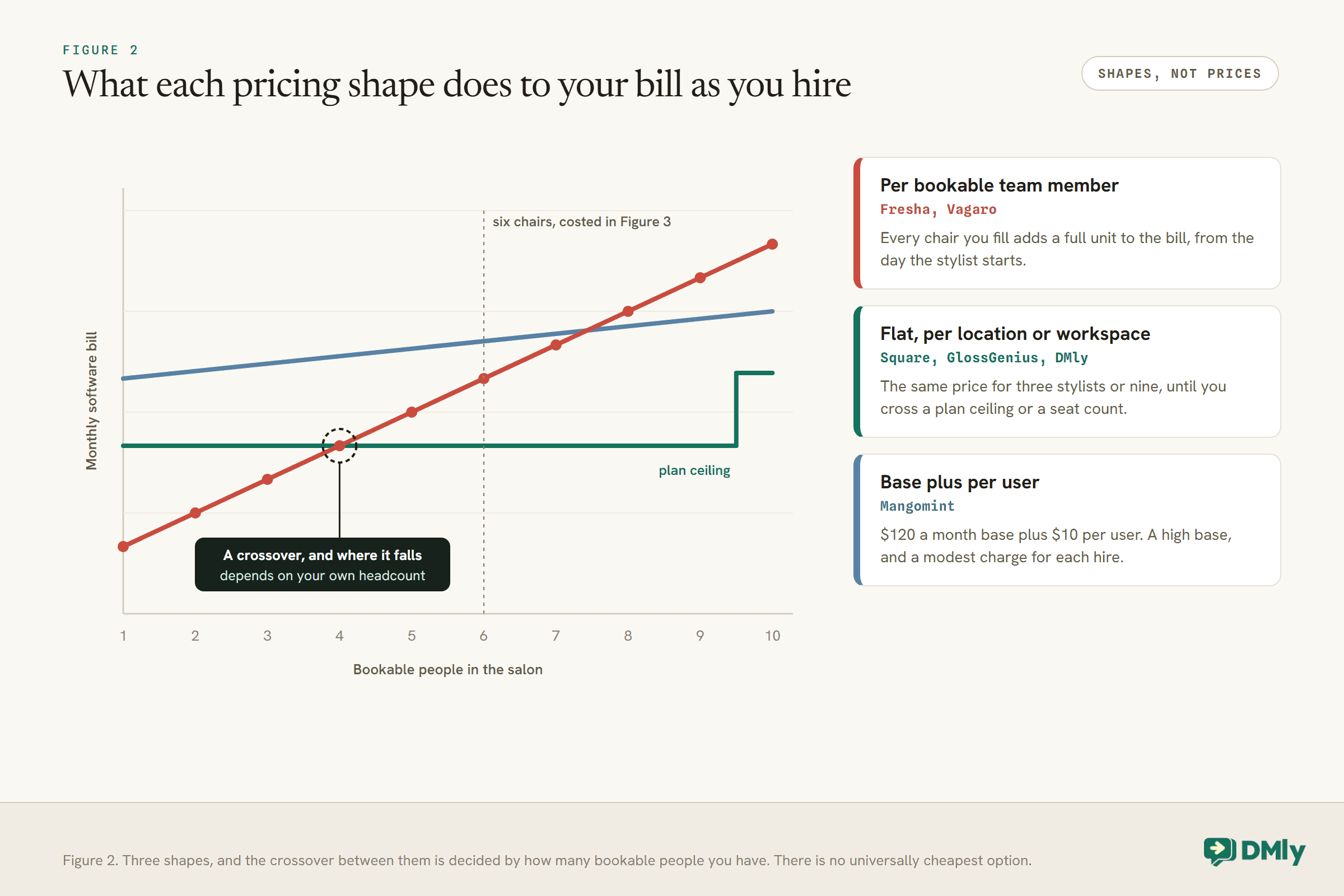
1. The bill grows every time you hire. Per-bookable-team-member pricing means that a salon going from four chairs to six adds fifty per cent to its software bill on the day the two new stylists start, before either has taken a booking. If your growth plan is more people rather than more revenue per person, this is the structural objection, and it is a real one.
2. Communications are metered, per member. Twenty free messages a month per team member and fifty free marketing emails per team member, and then a per-message charge on WhatsApp and a per-email charge after that. For a salon that reminds every client twice, twenty is not a month’s worth, it is a few days. Marketing texts carry their own per-text price. None of this is hidden and none of it is unusual, but a business whose whole customer relationship runs through messaging will find the meter is where the money actually goes.
3. The add-ons multiply by the same factors. Loyalty is priced per location, per month. Team Connect is priced per team member, per month. Insights is priced per bookable team member, per month. Accounting and data connectors are per location. Every one of those multiplies against the same two numbers that are already growing.
Notice that none of the three is a complaint about the product. They are complaints about a pricing shape, which is exactly the right reason to look at something else and exactly the wrong reason to expect the new thing to be better at cutting hair.
How to Compare Honestly: Four States of a Price
Before any list, a method, because the reason software comparisons are so bad is that they treat “no number on the page” and “a number we did not find” as the same thing.
Every one of the Fresha alternatives below sits in one of four states a price can be in, and it is worth knowing which you are looking at:
- Published. The numbers are on the page and anybody can read them. Most of this list.
- Not published. There is no pricing page at all.
- Gated. There is a pricing page, it lists plans and features in detail, and every plan says talk to sales. Phorest is the clean example in this category and it is covered below.
- Published, but not verifiable by us. The vendor publishes a price, everybody can see it, and we could not read it honestly. That is a limitation on us and not a criticism of them, and the right thing to do is say so rather than reach for a number from a directory.
Two further rules make a comparison usable. Write the billing period and the unit beside every figure, because a monthly-billed price and an annual-billed one differ by up to a quarter, and per location, per user and per bookable team member are three different products. And never take a price from a software directory; those sites are frequently a year behind and they are not the vendor.
The Fresha Alternatives Worth a Look
Every price below was read from the vendor’s own page on 9 September 2026, with the billing period and the unit recorded. Nothing here comes from a software directory.
DMly, if the problem is the conversation rather than the calendar
DMly is a messaging platform with bookings and payments attached, rather than a salon system with messaging bolted on, which makes it the right or the wrong answer depending on where your day actually goes. If most of your work is people asking questions on WhatsApp and Instagram before they book, it fits. If most of your work is a busy front desk and a till, one of the salon-first tools below fits better.
Price, read at source: Starter $39, Growth $79 and Premium $199 a month billed monthly, or $29, $65 and $149 a month billed yearly. Flat per workspace, not per stylist: team seats are included at three, six and fifteen respectively, and an extra seat is $10 a month. An extra profile set is $15 a month and extra contacts are $15 per thousand. A seven-day trial with no card.
What it does for a salon: staff are bookable people with their own hours and their own timezone, so the public booking page computes slots per stylist. Services carry three payment modes, no payment, pay after the appointment, or pay before booking with a fifteen-minute hold on the slot. A pay-before service can take a deposit of 1 to 99 percent of the price instead of the full amount, and any service can carry a no-show fee. Packages and memberships exist as Plans, one-time for a ten-session package and recurring for a monthly membership, with credits. Loyalty points are awarded on appointment completion. Review requests go out on WhatsApp automatically after a visit.
What it does not do, and this is the important one: there is no consumer marketplace. Nobody browsing for a nail salon in their area will discover you through DMly. That is covered properly in its own section below, because for some salons it is decisive.
On WhatsApp charges: DMly adds no markup on Meta’s per-message rates, which you pay Meta directly. That is a different arrangement from a bundled per-message price and it is worth comparing carefully rather than assuming either is cheaper.
Mangomint, if you want the salon-first product and will pay for it
Price, read at source: $120 a month base plus $10 per user, so a six-user salon is $180 a month, with each additional location a further $120 a month. Add-ons: a phone line at $70 a month, marketing from $30 a month, payroll at $50 a month plus $8 per worker. Card processing is 2.45% plus 15 cents in person and 2.90% plus 30 cents for virtual payments. Free onboarding and data transfer, no contracts.
The most expensive on this list at the small end and the one salon owners speak about most warmly. If your objection to Fresha was the pricing shape rather than the price, note that Mangomint is a hybrid: a substantial flat base with a modest per-user charge on top, so it punishes hiring far less than a pure per-member model does.
GlossGenius, if you are small and want the processing bundled
Price, read at source: Standard $28 a month billed monthly or $24 billed annually. Gold $56 monthly or $48 annually, described as for businesses up to nine staff. Platinum $168 monthly or $148 annually, for teams of ten and above. A flat 2.6% card processing rate on every plan, with no extra fees for tap to pay, card on file or manual entry, and instant payouts available for an additional 1.8%. Payroll is $40 a month plus $6 a seat. Free data transfer.
The striking thing on the software line is that Gold covers up to nine staff for $56 a month, which is flat where Fresha’s equivalent is multiplied. The trade is that GlossGenius makes its money on the processing rate, so the honest comparison is your monthly card volume at 2.6% against whatever you pay now, not the subscription line on its own.
Square Appointments, if you already take card payments on Square
Price, read at source, United States storefront: Free at $0 a month per location for solo professionals, Plus at $49 a month per location, Premium at $149 a month per location, and a Pro tier at custom pricing for businesses processing over $250,000 a year. Plus and Premium carry a thirty-day free trial. Square Payroll starts at $35 a month plus $6 per person paid, and hardware starts at $59.
Priced per location rather than per person, which makes it the flattest curve here for a growing team, and the free tier is a genuine free tier rather than a trial. The obvious caveat is that this is a payments company’s scheduling product: it makes most sense if your card processing is already there, and much less if you are happy with your current processor.
Vagaro, if you want the marketplace as well as the software
Price, read at source: priced per bookable person for a single location, starting at a list price of $30 a month for one person, currently promoted at $23.99 a month for the first six months. The page carries a selector running from one person up to seven or more, so the price scales with your team. We read only the single-person figure and are not going to quote a six-person number we did not see on the page.
Worth naming because it is the closest structural match to Fresha: a marketplace plus software, priced per bookable person. If your objection was specifically the marketplace fee rather than per-person pricing, Vagaro solves nothing. If your objection is that you want a marketplace at all, it is the obvious comparison.
Phorest, and what a gated price actually tells you
Phorest publishes a pricing page with named plans, a Salon and Spa set and a Med Spa set, and a long and genuinely detailed feature list per tier. What it does not publish anywhere on that page is a single number in any currency. Every plan carries a Request a quote button.
That is the gated state, and it is not a criticism. It usually means pricing varies by market and by size, and it reliably means one thing for you: you cannot compare Phorest against anything on this page without a sales call. Budget the call, or rule it out on that basis, but do not go looking for a number in a directory, because whatever you find will be somebody’s quote from an unknown year.
One we did not verify, said plainly: Booksy is a serious contender for barbers and salons and it is missing from the priced list above for one reason: the path we tried returned a 404 and we did not pursue it far enough to stand behind a figure. That is a limitation on this article, not a judgement on the vendor. If Booksy is on your shortlist, open their own pricing page and read it yourself. We would rather leave a gap than print a number we did not read.
Costing Six Chairs Against the Fresha Alternatives
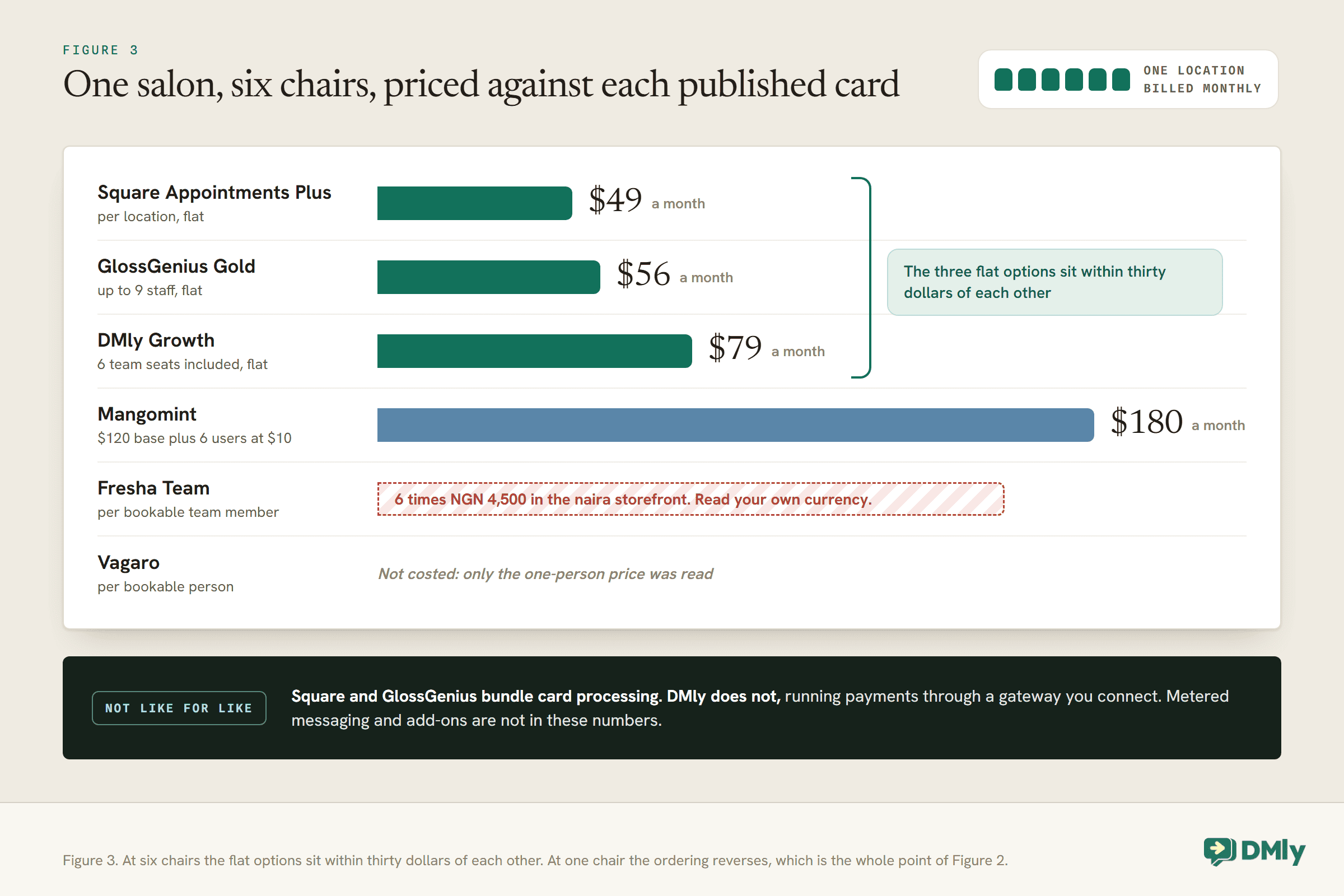
Headline prices from the Fresha alternatives above are useless until you put your own shape into them, so here is the same salon costed against the published figures: one location, six bookable stylists, monthly billing.
- Square Appointments Plus: $49 a month, per location. Unchanged whether you have three stylists or nine.
- GlossGenius Gold: $56 a month billed monthly, $48 billed annually. Covers up to nine staff, so unchanged as well.
- DMly Growth: $79 a month billed monthly, $65 billed annually. Six team seats included, so no per-stylist charge at this size.
- Mangomint: $120 base plus six users at $10, so $180 a month.
- Fresha Team: six bookable team members at the per-member rate. In the naira storefront we were served, that is six times NGN 4,500. Read your own currency before comparing this row to the others.
- Vagaro: per bookable person, and we did not read the six-person figure, so it is not costed here.
Three things that table is not. It is not like for like: Square and GlossGenius bundle card processing into the relationship and DMly does not, running payments through a gateway you connect. It is not the whole bill: metered messaging, payroll add-ons and per-location extras are where several of these get more expensive in practice. And it is not a recommendation, because a salon that lives on walk-ins and a salon that lives on Instagram enquiries should not choose the same product.
What it does show clearly is the shape argument. At six chairs the flat options cluster between roughly $49 and $79 a month, and the per-member options rise with every hire. At one chair the ordering would be completely different.
The One Thing None of These Replaces
If a meaningful share of your new clients arrive through Fresha’s marketplace, and that has just become free, then leaving costs you a customer acquisition channel and saves you nothing on it. That is the honest headline of this entire article and it deserves to be said before any recommendation.
Go and look at where your last fifty new clients came from. If a real slice of them found you by browsing rather than by searching for you by name, you are getting genuine demand generation from a marketplace, and no messaging platform, scheduling tool or CRM on this page reproduces that. DMly does not have a marketplace. Mangomint does not. GlossGenius does not. Square does not. Vagaro does, which is precisely why it is on the list.
The reverse is also worth checking, because the answer is often surprising. Plenty of salons discover that almost every new client came from Instagram, a word-of-mouth recommendation or a Google search for their own name, and that the marketplace was delivering a handful of price-shopping first-timers who never rebooked. In that case you are paying a per-member subscription for a channel you are not using.
Either way, it is a question with a real answer sitting in your own booking records, and it is a much better basis for a decision than a comparison table.
What to Check Before You Move Anything
Six checks before you commit to any of these Fresha alternatives, and the first two have sunk more migrations than any feature gap.
Get your data out first, and look at it. Client list with contact details, appointment history, and any gift card or package balances people have paid for and not yet used. Outstanding balances are the ones that cause arguments: a client with four massages left on a package will not accept “the system changed” as an answer.
Check who owns your online booking link. If your Instagram bio, your Google Business Profile and your website all point at a booking page hosted by your current system, every one of those has to be repointed on the same day, and the ones you forget quietly send customers to a dead end for months.
Count your bookable people honestly, including the part-timers. On per-member pricing, the Saturday-only junior is a full unit.
Price the messaging separately. Metered allowances are where the difference between a quoted price and a real bill usually lives. Work out how many reminders and confirmations you actually send in a month, and price that line on both systems.
Move in your quietest month, and run both for two weeks. Not glamorous, and it is the difference between a migration and an incident.
Do not rebuild everything on day one. Get the calendar, the reminders and the payments working, then add automations. If you want a sense of what the rest looks like once the basics are running, our guide to WhatsApp automation for salons covers the sequence, and the appointment booking guide covers the calendar side.
Frequently Asked Questions
Is Fresha still free?
No. Read at source on 9 September 2026, Fresha is a paid subscription charged per bookable team member, with three tiers and a seven-day trial. What is now free, on Fresha’s own comparison table, is the marketplace fee for brand new clients, which used to be the main reason people looked for alternatives.
Does Fresha still charge a fee for new clients from its marketplace?
Its published pricing table lists the one-time new-client marketplace fee as Free, and says no fee ever applies to returning clients. Its FAQ adds that it does not charge booking fees for each appointment and that its business plan includes unlimited bookings at no extra cost.
Why is the Fresha price in this article in naira?
Because Fresha’s pricing page changes currency depending on where the visitor is, and that is the storefront we were served. We have not converted it, because a figure in one currency printed as another is a well-known way to mislead. Open the page yourself for your own market.
Which of these Fresha alternatives is cheapest?
It depends entirely on how many bookable people you have. At six chairs the flat options sit roughly between $49 and $79 a month on the software line. At one chair, per-person pricing is usually cheaper than a flat plan. There is no universally cheapest answer, which is why the shape matters more than the headline.
Will I lose my reviews if I switch?
Reviews left on a booking marketplace belong to that marketplace and generally do not travel. Reviews on your Google Business Profile are yours and are unaffected by any of this, which is a good argument for building your review programme on Google rather than inside a platform you might leave. Our guide to Google review automation covers that.
Can I take deposits without Fresha?
Yes. In DMly, a service can be set to pay before booking, which holds the slot for fifteen minutes while the client pays and releases it if they do not, and that is the mechanism that protects against no-shows. A pay-before service can also take a deposit, a percentage from 1 to 99 of the price, with the balance collected at the appointment, and any service can carry a no-show fee charged when a booking is marked as a no-show.
Why is Phorest not priced in this article?
Because Phorest does not publish prices. Its pricing page lists plans and features in full and carries no currency figure anywhere, with a Request a quote button on every tier. That is a gated price, which is a legitimate choice by the vendor and means you cannot compare it without a sales call.
Is DMly a like-for-like replacement for Fresha?
No, and it would be dishonest to say so. DMly is a messaging platform with bookings, payments, packages, memberships, loyalty and reviews attached, and it has no consumer marketplace. If your customers find you and then talk to you, it is a strong fit. If your customers discover you by browsing a marketplace, you are giving something up that DMly does not replace.
What does it cost to send WhatsApp reminders on each of these?
That is the line to compare most carefully, because the models differ. Fresha meters messages with a small monthly allowance per team member and a per-message price after it. DMly adds no markup and you pay Meta’s per-message rates directly. Neither is automatically cheaper, and the answer depends on how many reminders you actually send.
Do I need to move my card payments as well?
Not necessarily, and it is worth separating the two decisions. GlossGenius and Square bundle processing into the relationship at a published rate, while DMly runs payments through a gateway you connect, so your processing arrangement is yours. Our guide to setting up WhatsApp payments covers the mechanics.
How often do these prices change?
Often enough that this page carries a date on every figure. Everything here was read from each vendor’s own page on 9 September 2026. Before you sign anything, open the vendor’s pricing page yourself, and check the billing period and the unit rather than just the number.
Writing about WhatsApp automation, bookings and growth for local business.
Turn WhatsApp into your busiest channel.
Start free and run message, bookings, payments and reviews in one place.
