
10 Glassix Alternatives in 2026, With Every Price Re-Checked

This page has recommended ten Glassix alternatives since April, and one of them was a tool called Flowcart. We are retracting that recommendation, and it is worth explaining why before anything else here asks for your trust.
Correction, 8 September 2026: Flowcart is still trading. An earlier version of this paragraph said it had stopped. That was our error: we checked flowcart.io and flowcart.com, and neither of them is the vendor’s. Flowcart’s own site is flowcart.ai, and its pricing page is up. What actually changed is narrower. Flowcart no longer publishes its plan prices, and the tiers that once carried figures now read “Get a Quote”. A comparison built on prices a reader can check without asking has nowhere to put a product that quotes on request, so Flowcart stays off the list below.
So we went back and read every price on this page at its source on 6 September 2026, in a browser where the page needed one, and in the vendor’s own public pricing API where the page publishes nothing in its HTML. Of the eleven products named here, nine were carrying a wrong price, a wrong billing period or a wrong plan name. Some of those errors were ours. Some of them are what happens when a market reprices itself twice in eighteen months.
What follows is the corrected version: what Glassix actually costs, what its own comparison table gates, where our criticism of it was unfair, and ten Glassix alternatives with a real figure, a real billing period and the one limit that decides each of them.
What Glassix Costs in 2026
Glassix does not sell plans, it sells seats. That single fact reorganises everything else, and this page had been printing the plan totals as if they were the price of the software.
| Plan | Per user, per month | Users allowed | Card minimum, billed monthly | Billed annually |
|---|---|---|---|---|
| Starter | $49 | 1 to 5 | $49 for 1 user | $499.80 for the year, $41.65 per user a month |
| Growth | $65 | 2 to 9 | $130 for 2 users | $1,248 for the year, $52 per user a month |
| Enterprise | Not published | Unlimited | Talk to a partner | Not published |
Three things in that table were not on this page before, and each one changes a buying decision.
Growth costs more per seat than Starter, not less. $65 against $49, a 33 per cent increase per person for moving up a tier. That is the opposite of how almost every platform in this market prices, and it is printed on their own cards: “$49 per user/month” and “$65 per user/month”.
The annual option is a year paid up front, not a monthly discount. Starter annual is $499.80 and Growth annual is $1,248, and those are the amounts the card asks for. If you were budgeting $49 a month, the annual button wants five hundred dollars today.
The advertised saving is accurate for one plan and not the other. The banner says “Save up to 20% with annual!”, and “up to” is doing the work. Growth genuinely saves 20 per cent, $65 down to $52. Starter saves 15 per cent, $49 down to $41.65. The smaller customer gets the smaller discount, which is worth knowing before you compare it against a competitor advertising a flat rate.
The Sixth User Costs $145 a Month
Because the price is per seat and each plan has a seat range, there is a step in the pricing that nobody advertises. Starter runs from one to five users. Growth starts at two and runs to nine. So the sixth person you hire does not cost $49. It costs $145.
Five people on Starter is 5 times $49, which is $245 a month. Six people cannot stay on Starter, so the whole team moves to Growth at $65 each, which is $390. The bill goes up by $145 to add one person, because the sixth seat also reprices the five you already had.
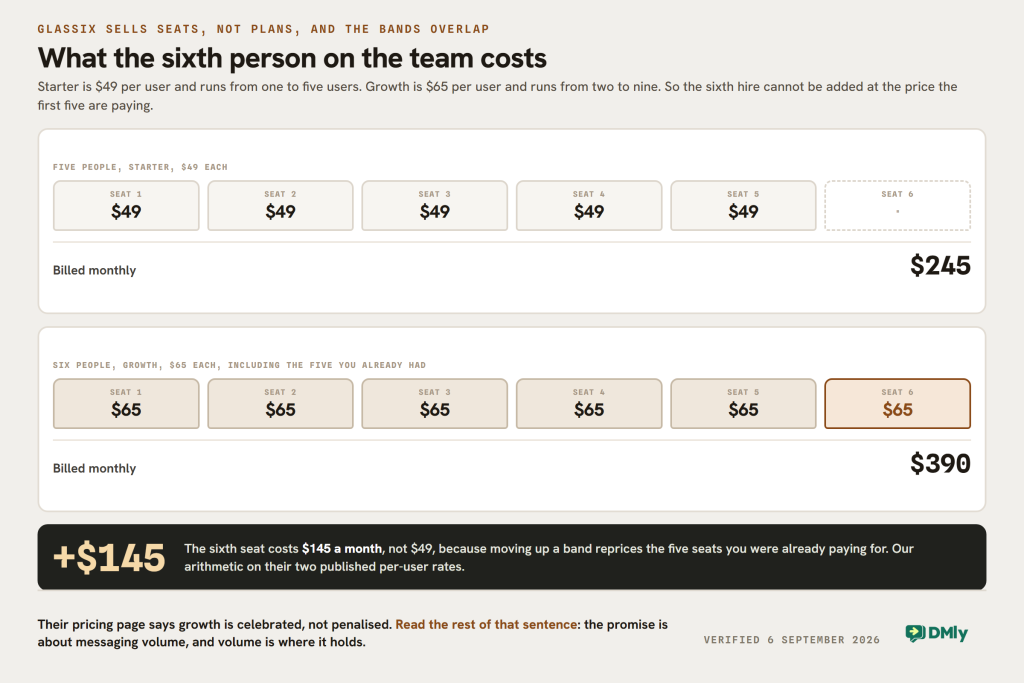
Sitting directly underneath the comparison table on the same page is this, in their words: “With Glassix growth is celebrated, not penalized! Unlike other vendors we don’t punish you for growth. Scaling up shouldn’t come with a price tag!”
Read the rest of that sentence before deciding it is a contradiction, because the claim is narrower than it looks: “you have the freedom to grow your messaging volume without worrying about increased costs.” It is a promise about volume, not about people, and on volume it mostly holds. Their conversation allowance is listed as unlimited under a fair usage model on all three plans, which is genuinely generous next to the per-conversation meters further down this page.
But their own pricing FAQ answers “What is your pricing model?” with “Our pricing is based on the number of users and the features you require.” Growing the team is exactly the kind of growth that costs money here, and the step from five to six is the sharpest point on the curve. If you are a support desk that expects to hire, price the team you will have in a year rather than the one you have today.
There is one more cap worth putting beside the volume claim: bot conversations are capped at 50,000 on Starter, 100,000 on Growth and 500,000 on Enterprise. Human conversations are unlimited. Automated ones are not, which is the reverse of what most buyers assume when they read “unlimited”.
What the Glassix Comparison Table Actually Gates
Glassix publishes a full feature grid, which is more than most of its competitors do, and it repays reading. These are the rows that decide whether the cheaper plan is usable.
| What you are buying | Starter | Growth | Enterprise |
|---|---|---|---|
| Total channels | 4 | 8 | Unlimited |
| How many of each channel | Max 1 | Max 3 | Unlimited |
| Email inboxes | 1 | 3 | 10 |
| Text messages | Inbound conversations | Inbound and outbound | Inbound and outbound |
| Charged separately | Charged separately | Charged separately | |
| Departments and brands | 1 and 1 | 1 and 1 | 50 and 25 |
| Languages | 1 | 2 | Unlimited |
| Tags | 25 | 100 | Unlimited |
| Canned replies | 10 | 50 | Unlimited |
| Surveys | Not included | Unlimited | Unlimited |
| Bot conversations | 50,000 | 100,000 | 500,000 |
| How far back reports go | Last 14 days | Up to 3 months | Up to 6 months |
| API | Not included | Limited | Full |
| Support SLA | 24 hours | 12 hours | Varies by plan |
The reporting row is the one that catches people. On Starter, reports go back fourteen days. You cannot look at last month, you cannot compare quarters, and you cannot show anyone a trend. For a platform whose pitch is measurement and AI-driven optimisation, a two-week memory on the entry plan is a real constraint rather than a detail.
The channel row is the second one. Starter is four channels with a maximum of one of each. One web chat, one Instagram, one Facebook page, one WhatsApp number. If you run two brands, or two shops with their own Instagram accounts, Starter cannot hold them, and the departments and brands rows say the same thing in a different way: one of each until Enterprise.
Text messages are receive-only on Starter. Their grid reads “Inbound conversations” on Starter and “In/Outbound conversations” on Growth and Enterprise. That row is about SMS rather than WhatsApp, so read it narrowly, but if SMS is part of why you are buying, the entry plan will take messages and not send them.
One row contradicts itself between the plan card and the grid, and it is worth asking about rather than guessing. The Growth card lists “Digital surveys (limited)”. The comparison grid two screens below lists Surveys as “Unlimited” on Growth. Both are on the same page on the same day. If surveys matter to you, get the answer in writing before you buy, because “limited” and “unlimited” are not a rounding error.
Finally, WhatsApp carries a “$” symbol on all three plans rather than a tick. WhatsApp is billed on top of the subscription wherever you buy it, and Meta’s own rates are the larger part of that bill in most markets. That is not a criticism of Glassix, it is the model everyone on this page operates under, and it is the reason the subscription figures below are only half of what you will pay.
Where This Page Was Unfair to Glassix
Two of the arguments this page made against Glassix no longer stand up, and one of them was never checked properly in the first place.
We said the platform runs on GPT-4. Glassix does not say that anywhere on its site any more. There is no mention of GPT, of any model name, or of any AI vendor across their product pages. Attributing a specific model to a platform is a claim with a short shelf life, and ours expired. What they describe now is an “AI-native autonomous contact center”, with AI human co-handling, a Copilot layer over operational reporting, quality assurance, A and B testing, and a voice product. Voice is not in this review at all, and it is on their main navigation.
We said Glassix is built for support and not for growth. They publish a marketing solutions page and a sales solutions page, and those pages describe lead scoring, automatic lead routing, and outbound campaigns using approved WhatsApp templates. A tool that runs template broadcasts and scores the replies is not a support-only tool, and saying so was lazy.
What survives from the original criticism is narrower and more useful. Glassix does not sell bookings, invoices, payments or review collection, so if the job is to run a service business rather than to answer it, the subscription covers one half of the work. And the analytics are built around conversations and agents rather than revenue: there is a BI row on Enterprise, but no published attribution or campaign-revenue reporting on Starter or Growth, where the reports window is fourteen days and three months respectively.
How Every Price Below Was Checked
Every figure on the rest of this page was read on 6 September 2026 from the vendor’s own pricing page. Where a page renders its prices after loading, it was opened in a real browser and the rendered figure was read from the card a customer would see. No directory, no aggregator and no other review was used as a price source, because those are where stale numbers go to be copied.
Three things that turned up while doing it are worth stating once, because they apply to more than one vendor:
- Several of these pages contain no price at all until JavaScript runs. DoubleTick and Wati both serve a pricing page whose plan cards are empty in the HTML and filled in afterwards. DoubleTick’s page even ships the fallback message “Could not load prices, please refresh the page”. If your ad blocker or a slow connection stops that request, you are looking at a plan card with no number on it.
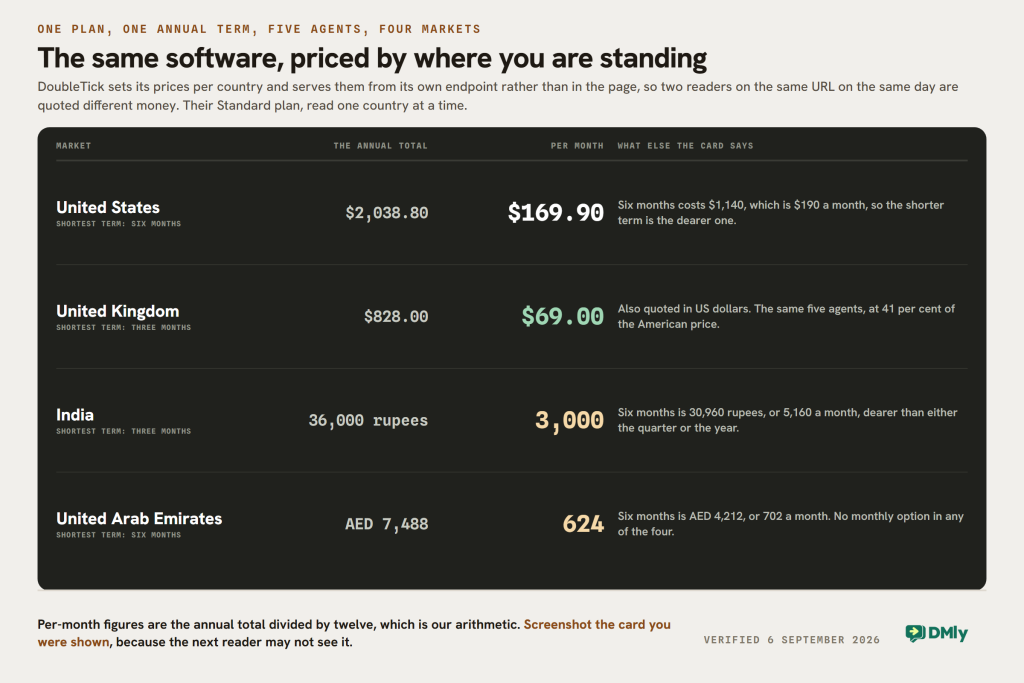
- Some prices depend on where you are. DoubleTick’s are set per country and served from its own API. The same plan, for the same five users, is $169.90 a month in the United States and $69 a month in the United Kingdom, both quoted in US dollars.
- A monthly price is not always available. Two of the ten tools below will not sell you a single month at any price: one starts at a quarter, the other at six months. If you are testing rather than committing, that matters more than the headline figure does.
Ten Glassix Alternatives, With the Price Written Down
Each of these Glassix alternatives gets the same treatment: what the tool is for, what it costs in the smallest configuration the vendor will sell, and the one limit that decides whether it fits. Where a plan is only sold by the quarter, six months or year, that is said rather than divided into a friendlier monthly number and left there.
1. DMly
We make DMly, so weigh this accordingly and check it against the others rather than taking our word for it. It is an omnichannel messaging platform for local and service businesses, and the difference from Glassix is what the subscription covers: conversations, but also bookings, invoices, payments, a CRM with pipelines, comment automation on Instagram and Facebook, and Google review requests, against the same contact record.
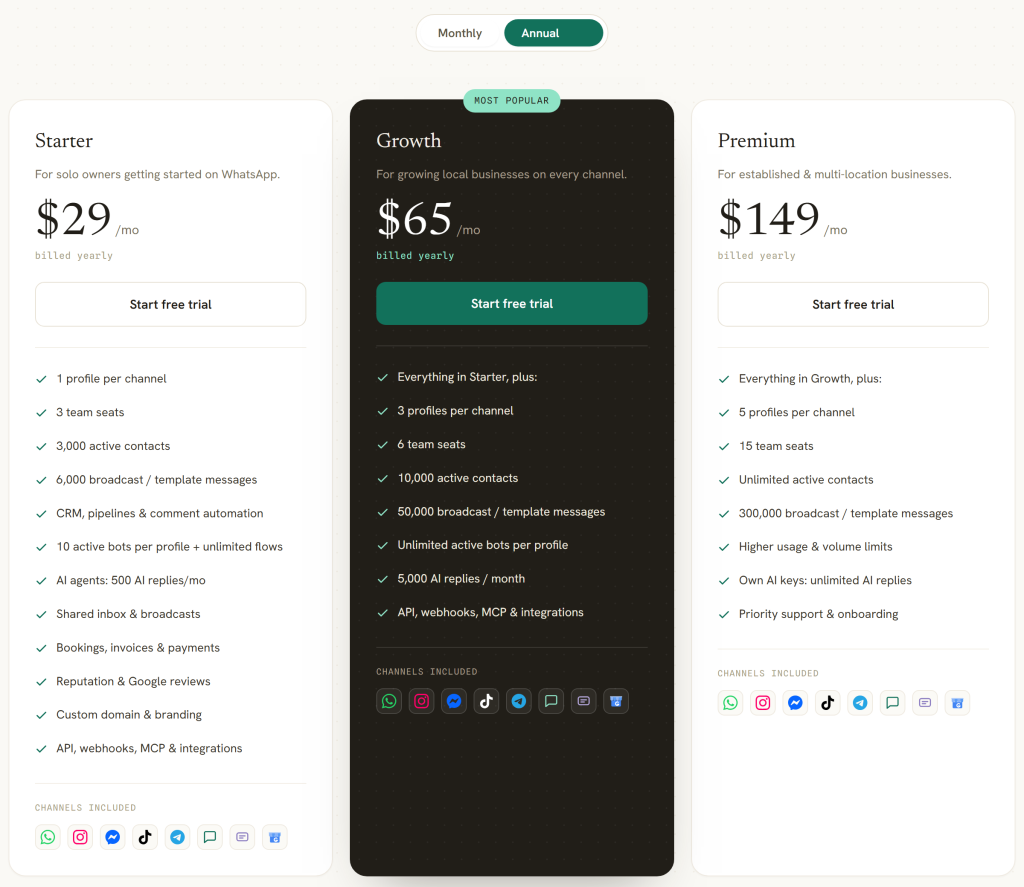
From our pricing page, read the same morning as everything else here: Starter $29 a month billed yearly, or $39 monthly, with 3 team seats, 1 profile per channel, 3,000 active contacts, 10,000 broadcast or template messages, 10 active bots per profile with unlimited flows, and 500 AI replies a month. Growth $65 or $79, with 6 seats, 3 profiles per channel, 10,000 contacts, 50,000 messages, unlimited active bots and 5,000 AI replies. Premium $149 or $199, with 15 seats, 5 profiles per channel, unlimited contacts, 300,000 messages, 20,000 AI replies, and the option of your own AI keys for unlimited replies.
Add-ons are published rather than quoted: an extra team seat is $10 a month, an extra profile set (one more number or profile on every channel at once) is $15, and extra contacts are $15 per thousand. The trial is 7 days with no card. WhatsApp is billed by Meta directly with no markup added.
The honest comparison with Glassix is the seat count, not the headline. Glassix Starter is $49 for one user. DMly Starter is $39 monthly for three. Where Glassix is the better buy is depth of contact-centre machinery: SLA management, queue ordering, departments, blacklists and a published support SLA are all things a busy desk uses and DMly does not sell.
2. Whaticket
Whaticket replaces Flowcart on this list, and it is the closest thing here to Glassix in shape: a multi-agent inbox across WhatsApp, web chat, Instagram, Facebook and TikTok, sold to teams rather than individuals. It is a Spanish-language product with a large Latin American customer base, and it integrates with Mercado Libre, which nothing else on this page does.
Whaticket has abolished fixed plans. Their page says so directly: you set the number of users and the number of WhatsApp connections and the price follows. The minimum is 3 users and 1 connection, at US$49.00 a month, with every additional WhatsApp line from $20 a month, 20 per cent off for annual billing and a 14-day trial. Mass messaging is bought separately as credits, from $25 per thousand down to $105 per seven and a half thousand, and their own footnote says those credits are only consumed on QR-code connections, so campaigns sent through the official API are exempt.
The three-user minimum is the limit that decides it. A sole trader cannot buy Whaticket at any price, and $49 is a three-seat price rather than a seat price, which makes it about $16.33 a seat and genuinely competitive for a small team. Our full Whaticket review covers the builder and the two footnotes under their credit table in more detail.
3. DoubleTick
DoubleTick is a WhatsApp-first campaign and catalogue platform aimed at e-commerce teams. Broadcasts, product sharing, a shared inbox and an automated ordering bot are the core, and the plans are counted in agents rather than contacts.
The old figure on this page, $141.58 a month, is wrong and so is the plan name. Read from the rendered card on their US pricing page: Starter is $170 a month, billed yearly at $2,039, for 5 agents and one WhatsApp Business account. Pro is $308 a month, billed yearly at $3,694, for 10 agents. Enterprise is custom. There is no monthly option: their own pricing API offers six-month and annual terms in the United States and nothing shorter, and they state plainly that they do not offer a free trial.
Two things about that page are worth a buyer’s attention. The headline above the plans reads “Choose the plan that fits your business, with AI agents built into every plan”. The first card underneath it is headed “STARTER, DOES NOT INCLUDE AI AGENTS”, and its AI row says “Not available on starter plan”. Both are on the same screen. AI agents start on Pro, at $308 a month.
And the price depends on which country you are in. DoubleTick sets its prices per market and serves them from its own API rather than in the page. The same Standard plan, the same five agents, on an annual term, is $169.90 a month in the United States and $69 a month in the United Kingdom, both quoted in US dollars. In India it is 36,000 rupees a year, and there the six-month bundle at 30,960 rupees costs more per month than either the three-month or the annual option, which is a pricing shape worth checking before you pick a term.
4. WhatChimp
WhatChimp is the cheapest serious tool on this list and the one that asks the least of you to set up. Bulk WhatsApp broadcasting, a no-code chatbot builder, a shared inbox, a chat widget, SMS through your own Twilio account, and integrations with Zapier, Make, n8n, Pabbly, Shopify and WooCommerce.
The prices this page carried were right but incomplete, because they are the annual rates. Basic is $24 a month billed annually and $40 billed monthly, with 2 team members, 5,000 subscribers and 100,000 AI tokens a month. Pro is $60 annually and $100 monthly, with 5 team members, 15,000 subscribers, unlimited AI tokens, AI intent detection, appointment booking, and the omnichannel inbox that adds Instagram and Facebook. Enterprise is quoted. Their advertised claim of “40% off with annual” is exactly right, in both directions.
Two team members on the entry plan is the limit that decides it, and the second one is that Instagram and Facebook are a Pro feature, so the $24 plan is WhatsApp and SMS only. They also publish a claim worth holding them to: “0% Markup Fees. Pay only Meta’s official conversation charges. Unlike others who add 20 to 25% markup, we don’t add a single extra cost.”
5. DelightChat
DelightChat is built for Shopify and direct-to-consumer brands, and it is the only tool here that puts email in the same inbox as WhatsApp, Instagram and Facebook by default. Order management, abandoned cart recovery, order confirmation and cash-on-delivery templates all come from the Shopify integration rather than being built by hand.
“Around $29 a month” was true and useless, because DelightChat meters two things at once and publishes the overage for both. Startup is $29 a month for 500 support tickets and 2,500 marketing contacts, with extras at $10 per 100 tickets and $10 per 1,000 contacts. Scale is $99 for 2,000 tickets and 10,000 contacts, at $8 and $5. Growth is $299 for 6,000 tickets and 30,000 contacts, at $5 and $3. A marketing contact is one unique phone number per month however many messages you send it.
The add-ons are published too, which is more than most: an extra WhatsApp API number is $25 a month, the AI Assistant gives 10,000 free tokens a month and then costs $1 per 100,000, and the back-in-stock widget adds $10, $20 or $30 by plan, charged per WhatsApp number or Shopify store rather than per account. The trial is 14 days with no card. The annual discount is 30 per cent and you cannot self-serve it: their page says to contact the sales team to activate the offer.
6. Gallabox
Gallabox is a lead-qualification platform for service businesses with heavy inbound demand: click-to-chat widgets, AI qualification bots on WhatsApp and Instagram, drip campaigns, ads attribution and a lead pipeline on the higher tiers.
The “$89 a month” on this page was wrong by a wide margin, and the billing period was missing, which matters more. Basic is $150 a month, billed quarterly, which means the smallest cheque Gallabox will take is $450. Essential is $331 a month billed quarterly and Advanced is $632, with an annual option saving 25, 25 and 20 per cent. Enterprise is quoted, with multi-year contracts offered.
The limit that decides Basic is printed in brackets on their own card: “3 users (hard cap)”. Not three included with more available, three and no more, at any price. Extra users appear on Essential at $18 each and Advanced at $24. Basic also carries one channel each of WhatsApp, Instagram and a web widget, 500 AI credits a month and a 48-hour support SLA. If your reason for buying is that four people answer the phone, the entry plan is not a starting point, it is a dead end.
7. Wati
Wati is the most widely used WhatsApp Business API platform for small and mid-sized businesses, and its appeal is that it does the obvious things without ceremony: a shared team inbox, broadcasts, a chatbot builder, CTWA ads, catalogue and Shopify templates.
“Around $49 a month” happened to land near one of the real numbers by accident. Read from the rendered pricing page: Growth is $39 a month billed annually and $49 billed monthly. Pro is $79 and $99. Business is $199 and $249. A $4.99 a month Shopify add-on is charged separately.
The limit that decides Wati is the seat rule on the entry plan, and it is unusual enough to quote exactly: “3 Users Included. No additional users.” You cannot buy a fourth seat on Growth for any money. The fourth person means Pro at $79, where seats are 5 included and $24 each after that, and Business adds seats at $69 each. Growth also connects one channel only, allows 15,000 broadcasts a month, 1,000 free automation triggers, 10,000 API calls with no webhooks, and 250 AI co-pilot credits. Our head-to-head with Wati goes through that seat rule in detail.
8. Trengo
Trengo is the closest competitor to Glassix on this list in both design and price: an omnichannel inbox with ticketing, flowbots, a small CRM and a support-desk structure built for teams of ten and up. If you are comparing Glassix against something rather than choosing between categories, this is the comparison.
The “$408 a month” figure this page carried was close, and incomplete in the way that matters. Their page switches between euros, dollars and pounds, and the figures are set per currency rather than converted. In dollars, Boost is $405 a month billed monthly and $347 billed annually, with 10 users and 500 conversations a month, or 6,000 a year on the annual plan. Pro is $695 monthly and $579 annually, with 20 users and 1,500 conversations a month. In euros the same plans are 349 and 299, and 599 and 499. Enterprise is quoted. So the old figure was three dollars off the monthly rate, and never said it was the monthly rate, which hid a cheaper annual one.
The unit is the thing to understand before the price. Trengo defines a conversation as any reply to an inbound or outbound message inside a 7-day window, and anything outside that window starts a new one. Extra conversations are 15 euros per hundred on the annual plan and 18 monthly. Anything handled with an AI surcharge costs 25 to 30 cents on top, per conversation. Extra users are 25 or 30 euros on Boost and 40 or 50 on Pro.
One row on their rate card has a shelf life. Trengo lists all WhatsApp service conversations as free, which is correct today and stops being correct on 1 October 2026, when Meta begins charging for service messages and for utility messages sent inside an open window. That is not Trengo’s doing, but it is their page, and it is the second rate card we have read this month whose service row expires on that date. Our explanation of what changes on 1 October has the detail.
9. Respond.io
Respond.io is the most capable workflow engine here. Multi-channel inbox, lead routing and assignment, a proper automation builder with branching, contact management and open API access. If Glassix feels strong on AI and thin on structured automation, this is the swap.
The figures on this page were the annual rates presented as if they were the monthly ones. Both sets, read from their cards: Starter is $99 a month, or $948 for the year, which works out at $79 a month. Growth is $199 monthly, or $1,908 a year at $159 a month. Advanced is $349 monthly, or $3,348 a year at $279 a month. Enterprise is quoted.
Seats are the second meter and they are cheaper than most: Starter includes 5 users with extras at $15 a month, or $12 on the annual plan. Growth includes 10 with extras at $25 or $20. Advanced includes 10 with extras at $30 or $24. The limit that decides it is the entry price rather than a feature: $99 a month is roughly double Glassix Starter and roughly triple Wati Growth, and you are paying for automation depth that a two-person shop will not use.
10. Interakt
Interakt is a WhatsApp-first sales tool with a CRM attached: pipelines, deal stages, broadcast segmentation on CRM data, and a workflow builder. It is aimed at teams that already think in stages rather than in conversations.
“Starts at $12 a month” was true and misleading, which is the worst kind of price. Starter is $12 a month, $69 a quarter or $239 a year, and it carries one channel, not both. Growth, the cheapest plan with WhatsApp and Instagram together, is $55 a month, $149 a quarter or $499 a year. Advanced is $69, $189 or $649. All are quoted before tax, with 8 per cent off quarterly and 20 per cent off yearly.
Two add-ons sit outside the plans and both are large. The Sales CRM roles are sold separately at $49 a month, $135 a quarter or $471 a year, plus $10 a month per Sales CRM agent, and every plan card says explicitly that those roles are not included. WhatsApp AI Agents are an add-on at $74.99 for Growth and Advanced, which is more than either plan costs. If you are buying Interakt for the CRM and the AI, the honest entry price is not $12 and it is not $55.
Glassix Alternatives Compared
All ten Glassix alternatives in one place, with the price the vendor publishes and the billing period attached, because a monthly-equivalent number with an annual commitment behind it is not the same product as a monthly price.
| Tool | Best for | Entry price, as published | Seats at entry | The limit that decides it |
|---|---|---|---|---|
| Glassix | AI-led contact centres | $49 per user a month | Priced per seat, 1 to 5 | Reports go back 14 days; the sixth user adds $145 |
| DMly | Service businesses that also book and invoice | $39 a month, or $29 billed yearly | 3 | No ticketing, SLA management or queue ordering |
| Whaticket | Latin American teams and Mercado Libre sellers | $49 a month | 3 minimum, no fewer | A sole trader cannot buy it |
| DoubleTick | WhatsApp catalogue and campaign teams | $170 a month, billed yearly at $2,039 | 5 | No monthly term, no trial, no AI on the entry plan |
| WhatChimp | Cheap, fast WhatsApp broadcasting | $40 a month, or $24 billed yearly | 2 | Instagram and Facebook start on Pro |
| DelightChat | Shopify and D2C brands | $29 a month | Not seat-limited at entry | Two meters at once: 500 tickets and 2,500 contacts |
| Gallabox | Inbound lead qualification | $150 a month, billed quarterly | 3, hard cap | You cannot buy a fourth seat on Basic |
| Wati | Straightforward WhatsApp automation | $49 a month, or $39 billed yearly | 3 | “No additional users” on the entry plan |
| Trengo | Structured support desks of 10 and up | 349 euros a month, or 299 billed yearly | 10 | 6,000 conversations a year, then 15 euros per 100 |
| Respond.io | Complex multi-channel workflows | $99 a month, or $79 billed yearly | 5 | Entry price is double Glassix Starter |
| Interakt | WhatsApp-first sales pipelines | $12 a month for one channel; $55 for two | Unlimited agents | Sales CRM roles cost $49 more; AI agents $74.99 |
The Smallest Cheque Each One Will Take
Monthly-equivalent pricing hides the number that actually leaves your account, and on this list the gap between the two is enormous. The cheapest way into DelightChat is $29. The cheapest way into DoubleTick is $1,140, because there is no monthly term in the United States and the shortest one they sell is six months.
| Tool | Shortest term sold | Smallest first payment |
|---|---|---|
| Interakt | One month | $12, for one channel |
| DelightChat | One month | $29 |
| DMly | One month | $39 |
| WhatChimp | One month | $40 |
| Glassix | One month | $49, for one seat |
| Wati | One month | $49 |
| Whaticket | One month | $49, for three seats |
| Respond.io | One month | $99 |
| Trengo | One month | 349 euros |
| Gallabox | One quarter | $450 |
| DoubleTick | Six months | $1,140 |
That table is the one to look at if you are still deciding. Nine of these eleven products can be tried for the price of a dinner. Two of them ask for a commitment before you have sent a single message, and both of those two are otherwise good products that would not have been ruled out on features.
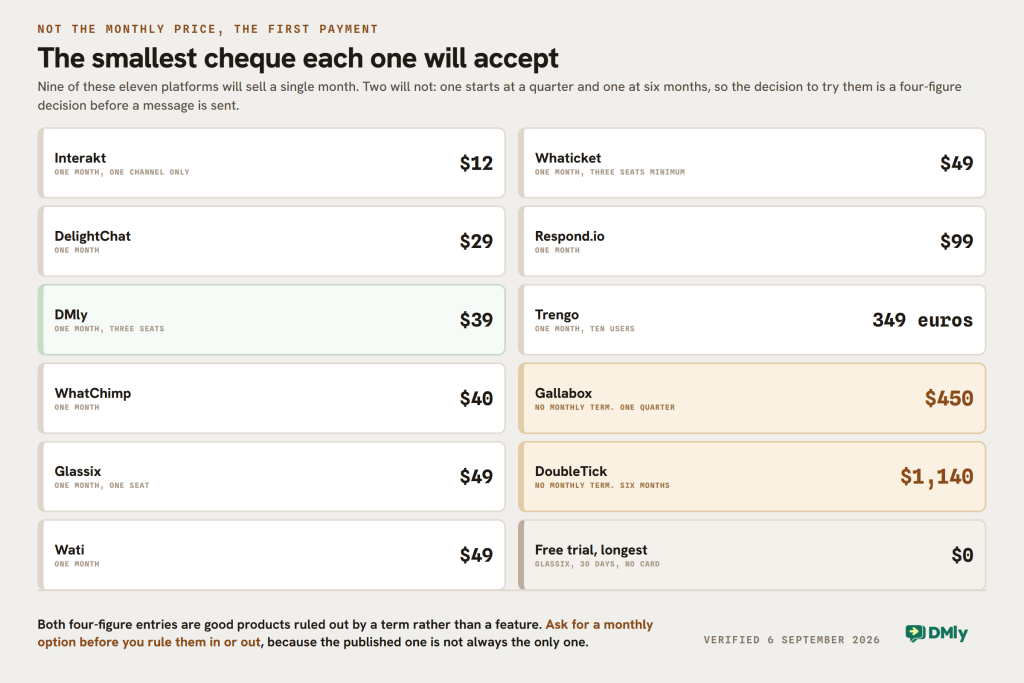
It also reframes the Glassix annual option. $499.80 up front for one seat is a bigger first payment than the monthly price of anything else on this list except Trengo, and the reward for it is 15 per cent. Take the monthly option and move to annual once you know the tool suits you.
Which One to Buy, by Situation
You are one person, or two
Glassix works at this size and most of this list does not. One seat is $49 and the platform does not force a minimum team on you, which rules it in where Whaticket and Gallabox are ruled out on their own minimums. The trade is the fourteen-day reporting window and one of each channel. If bookings or invoices are part of the job, DMly at $39 covers a different half of it. If you only need broadcasts, WhatChimp at $40 monthly is the cheapest serious option here.
You are a support desk of five to nine people
This is where Glassix is genuinely strong and where the price step bites. Five people is $245 a month on Starter with a fourteen-day report window, six people is $390 on Growth with three months of history, unlimited surveys, three of each channel and a twelve-hour SLA. Do that arithmetic before you compare anything, because Growth against Trengo Boost at 299 euros for ten users is a much closer contest than Starter against anything.
You run campaigns more than you answer questions
None of the contact-centre tools are built for this and Glassix is one of them. Wati Growth at $39 billed yearly gives 15,000 broadcasts a month, WhatChimp Basic gives unlimited message credits inside Meta’s window, and DMly includes 10,000 to 300,000 broadcast and template messages by plan. Whichever you pick, the larger bill is Meta’s, so check the per-message rate for your own market before you compare subscriptions at all.
You sell on Shopify
DelightChat, and it is not close. Abandoned cart, order confirmation, order tracking and cash-on-delivery templates come with the integration rather than being built by hand, and email sits in the same inbox. Watch the two meters: 500 tickets and 2,500 marketing contacts on Startup, with overage at $10 per hundred and $10 per thousand, which is where the real bill forms.
You are testing rather than committing
Rule out Gallabox and DoubleTick on the term, not the product. A quarter and six months respectively is a lot to spend on a tool you have not used, and DoubleTick does not offer a trial at all. Glassix gives 30 days free with no card, which is the longest trial on this page. DelightChat gives 14 days, Whaticket 14, DMly 7.
You expect to hire
Price the seat rule before the plan. Three of these tools will not sell you an extra seat on the entry plan at any price: Wati says “no additional users” outright, Gallabox prints “3 users (hard cap)”, and Glassix caps Starter at five before the whole team reprices. Seats are the meter that surprises people in this category, more often than messages are.
The Verdict
Glassix is a better product than this page used to say, and a more expensive one than it looks. The AI positioning has moved on from a model name to an autonomous contact centre with voice, co-handling and quality assurance attached, and the marketing and sales pages describe lead scoring and outbound template campaigns that our old criticism said were missing. The feature grid they publish is more detailed than almost anyone else’s on this page, and publishing it is to their credit.
The reason to look elsewhere is arithmetic rather than capability. Per-seat pricing that rises with the tier, a five-seat ceiling on the entry plan, a fourteen-day reporting window, one of each channel, and a year paid up front for a 15 per cent discount add up to a platform that is cheap to start and expensive to grow into. If you are a contact centre with a stable headcount, that is fine. If you are a business that expects to add people, do the sixth-seat sum first.
The wider lesson from re-reading eleven rate cards in one morning is worth more than any single recommendation. One vendor we used to recommend has taken the figures off its pricing page and now quotes on request. Two publish no price in their page at all. One serves a different price to a British reader than to an American one on the same URL. One contradicts its own headline on its own pricing card. Take the figure from the vendor’s page on the day you buy, screenshot the card you were shown, and treat every roundup, including this one, as a starting point with a date on it.
Of the Glassix alternatives here, three are like-for-like replacements rather than different products: if the job is answering messages and nothing else, Trengo and Respond.io are the serious options beside Glassix itself, and the choice between them is about team size. If the job also includes taking bookings and getting paid, DMly starts at $29 a month billed yearly and the trial does not ask for a card.
Glassix Alternatives FAQs
How much does Glassix cost in 2026?
Glassix is priced per user. Starter is $49 per user a month and allows one to five users, so a single seat is $49. Growth is $65 per user a month and allows two to nine, so its two-seat minimum is $130. Enterprise is quoted. Paying annually means paying for the year up front: $499.80 for one Starter seat, or $1,248 for two Growth seats. The trial is 30 days and does not ask for a card. All figures read from their pricing page on 6 September 2026.
What are the best Glassix alternatives?
It depends on the job. For a like-for-like omnichannel support desk, Trengo and Respond.io are the closest matches. For WhatsApp campaigns on a small budget, Wati and WhatChimp. For Shopify stores, DelightChat. For inbound lead qualification, Gallabox, if you can commit to a quarter. For a business that also takes bookings and payments, DMly. Flowcart, which earlier versions of this page recommended, is still trading but no longer publishes its plan prices, so it has been removed from a list built on published figures.
Does Glassix include AI on every plan?
Not the full suite. Their plan cards list AI capabilities as an add-on on Growth, and the complete conversational AI suite appears only on Enterprise, with enhanced AI capabilities also marked as an add-on there. Standard bots and automation are included on Starter. Glassix does not publish a price for the AI add-on, so the only way to know what it costs is to ask them.
Is Glassix better than Trengo?
They are aimed at different team sizes, which settles it more often than features do. Glassix sells single seats from $49 and caps its entry plan at five users. Trengo’s cheapest plan includes ten users at 299 euros a month on an annual contract, or 349 monthly, and meters conversations at 6,000 a year with extras at 15 euros per hundred. Below about six people Glassix is cheaper. Above ten, Trengo usually is, and it has the more conventional ticketing structure.
Which Glassix alternative is cheapest?
Interakt at $12 a month, but that plan carries one channel rather than both, so the honest cheapest for WhatsApp and Instagram together is Interakt Growth at $55, or WhatChimp Basic at $24 billed yearly and $40 monthly for WhatsApp with Instagram and Facebook starting on Pro. DelightChat at $29 is the cheapest that includes email in the same inbox. All of these are before Meta’s per-message charges, which are usually the larger number.
Which of these tools will not let me add a team member?
Three of them, on their entry plans, and each says so on its own page. Wati Growth reads “3 Users Included. No additional users.” Gallabox Basic reads “3 users (hard cap)”. Glassix Starter allows one to five users, and the sixth forces the whole team onto Growth at $65 each, which raises a five-person bill from $245 to $390. Whaticket runs the other way and will not sell fewer than three seats.
Are these prices going to change on 1 October 2026?
The subscriptions on this page will not, but the WhatsApp bill underneath them will. From 1 October, Meta charges for service messages, meaning the free-form replies your team types inside the 24-hour window, and for utility messages sent in reply inside an open window. The first 1,000 service messages a month on each business phone number are free, and service messages have no volume tiers. Any vendor page that still lists WhatsApp service conversations as free, and at least one on this list does, is describing a rate card with three weeks left on it.
Writing about WhatsApp automation, bookings and growth for local business.
Turn WhatsApp into your busiest channel.
Start free and run message, bookings, payments and reviews in one place.
