
Charles Review 2026: No Published Price, and 7 Charles Alternatives
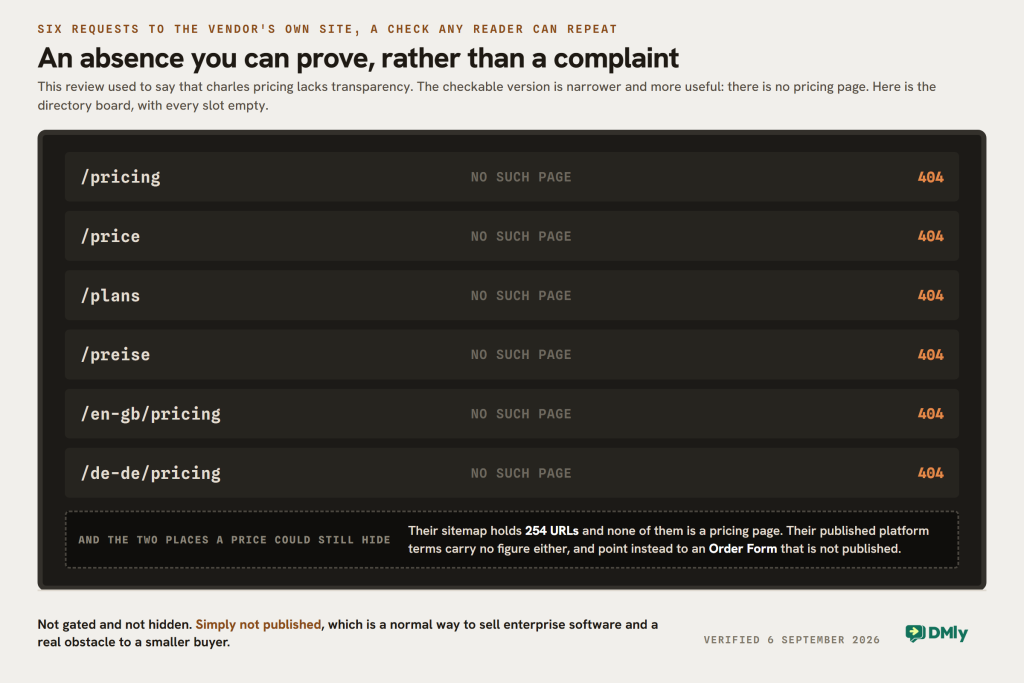
Six addresses, and none of them exists.
/pricing, /price, /plans, /preise, /en-gb/pricing and /de-de/pricing all return 404 on charles’s own website. Their sitemap holds 254 URLs and not one of them is a pricing page. charles does not publish a price at all, and that single fact is worth more to you than every adjective the earlier version of this page used about their pricing being hard to predict.
So this charles review has been rebuilt around what can be checked. What charles is now, who owns it, what its published terms commit you to, and seven charles alternatives with a real figure, a real billing period and the smallest cheque each will actually accept.
Everything below was read at source on 6 September 2026. Where a vendor renders its prices in JavaScript, we read them in a browser and say so. We have not run any of these products on a paid plan this month, so you will not find grades here for how they feel to use. You will find what they cost and what the price is attached to.
What charles Is Now, and What It Used to Be
The first correction is the name. This page called the company Hello Charles. Their own site calls the product charlesAI, lower case, and describes it as a conversational AI and CRM platform. The company behind it is Charles GmbH of Gartenstrasse 86, Berlin, registered at the Charlottenburg district court under HRB 203739 B, with Andreas Tussing as managing director.
The rest of the corporate picture, all from their own about page and newsroom: around 50 employees, a $20 million Series A in August 2022 led by Salesforce Ventures with Accel and HV Capital, and, on their own account, more than 30 million euros raised in total. It began as a sustainable fashion brand founded by Artjem Weissbeck, a co-founder of Kapten & Son, and Andreas Tussing, formerly of McKinsey, who wanted WhatsApp as their main marketing channel and could not find software that did it. So they built the software instead.
Two things changed since this page was written, and both matter for a shortlist.
- charles acquired Spectrm, a Berlin company that built conversational AI for Facebook Messenger and Instagram, and folded its technology in. What came with it is worth naming: Spectrm’s hybrid SafeMatch approach, which their announcement describes as keeping conversational AI agents “within enterprise brand guidelines and out of hallucinations or politically and morally sensitive topics”, and a customer list including Volkswagen, BMW and The Premier League. If you were treating charles as a WhatsApp-only vendor, that is no longer accurate.
- They now sell RCS, the successor to SMS, and describe themselves as a verified Google RCS partner in Europe. Their RCS page makes a claim worth knowing if you sell in Germany: a total addressable market of over 65 million smartphones, which they put at 86 per cent of the market, sourced to Google. RCS needs no pre-approved templates, which is its real advantage over WhatsApp for campaign work.
Their published customer list is the strongest signal about who charles is built for: Volkswagen, BMW, Jack Wolfskin, Takko Fashion, Dermalogica, fashionette, SNOCKS, Kapten & Son, HelloFresh and ABOUT YOU. That is an enterprise and upper-mid-market list, and it explains the pricing model rather than excusing it. Companies of that size buy on an order form, not from a pricing page.
charles Pricing: What Is Published, and What Is Not
There are four honest things a review can say about a price. It is published, meaning a currency and a period you can read without an account. It is not published, meaning no pricing page exists and every number comes from a sales conversation. It is gated, meaning a pricing page exists with the numbers taken out of it. Or it is published and we could not reach it, which is a limitation on us rather than a criticism of the vendor.
charles is squarely in the second category, and we checked properly before saying so. Six plausible pricing paths return 404. The sitemap has 254 URLs and no pricing page among them. The footer has no pricing link. And the one place a price might reasonably hide, the legal small print, does not carry one either.
That last check is the one most reviews skip, and it is the one that has paid off elsewhere in this series. Their Platform User Terms of Use, published in their help centre, refers repeatedly to a separate commercial agreement it calls an Order Form, Client Terms and a Subscription Agreement. None of those is published. In their words, your access “is provided on the basis of a subscription of the Platform as agreed in an Order Form and applicable Terms and Conditions”. The price exists. It lives in a document you only see once you are in a sales process.
The terms that are published are worth reading before you start that process, because two of them are unusual:
- A ten-year confidentiality obligation on the individual user. The terms say you will not pass platform account data or credentials to “a competitor of the Platform Operator, i.e. all companies worldwide that are active in the field of conversational commerce or WhatsApp or similar messaging channel marketing”, and that the obligation “shall continue to apply for a period of 10 years after the end of the Client’s Platform Subscription”. Ten years is a long time, and the definition of a competitor is a whole market rather than a list.
- No refund where an account is terminated for cause. Their words: “In cases of termination for cause, Authorized Users will not be entitled to any remedy or refund.” They also reserve the right to suspend an account without prior notice on “an evidence-founded reasonable suspicion” of a breach, with the user required to provide evidence at their own or the client’s expense to regain access.
Neither is scandalous. Enterprise software contracts often read like this, and charles publishes theirs where anyone can find them, which is more than several vendors further down this page do. But if you are a twenty-person brand comparing tools on a Tuesday afternoon, the practical fact is that you cannot budget for charles without booking a call. That is the real difference between charles and every alternative below, and it is a bigger difference than any feature. If a published figure is what you need, our roundup of WhatsApp automation tools with prices on the page is the faster way to shortlist.
Five Criticisms This charles Review Made, and Why Four Are Gone
The earlier version of this review listed five reasons businesses look for charles alternatives: unpredictable pricing, unreliable Klaviyo integration, support that does not scale, technical stability problems, and a product built more for enterprise than for growing brands.
Three of those were built on phrases like “often reported” and “some businesses report”, with nothing behind them that a reader could check. We have not run charles on a paid account, so we are in no position to grade their support desk or their uptime, and an integration we have not tested is not an integration we can call unreliable. Those three are withdrawn.
The fourth, “built more for enterprise than growing brands”, was true but stated as a complaint. It is better read as a description. Their customer list is Volkswagen and BMW; their commercial model is an order form; their platform terms assume a procurement department. That is not a flaw, it is a target market, and knowing which side of it you are on is the whole decision.
The fifth stands, sharpened: the price is not unpredictable, it is unpublished, which is a different and more checkable claim.
One more thing this page never said, and should have. charles has the clearest public documentation of Meta’s WhatsApp pricing of any vendor on this page. Their help centre article sets out both of the changes coming on 1 October 2026, quotes Meta’s own worked example of a single hour costing one charge, then three, then five, and states the volume-tier detail almost nobody covers. The next section is the test that turned that up.
A Test Nobody Runs: Whose Page Describes the Meta Pricing That Actually Applies
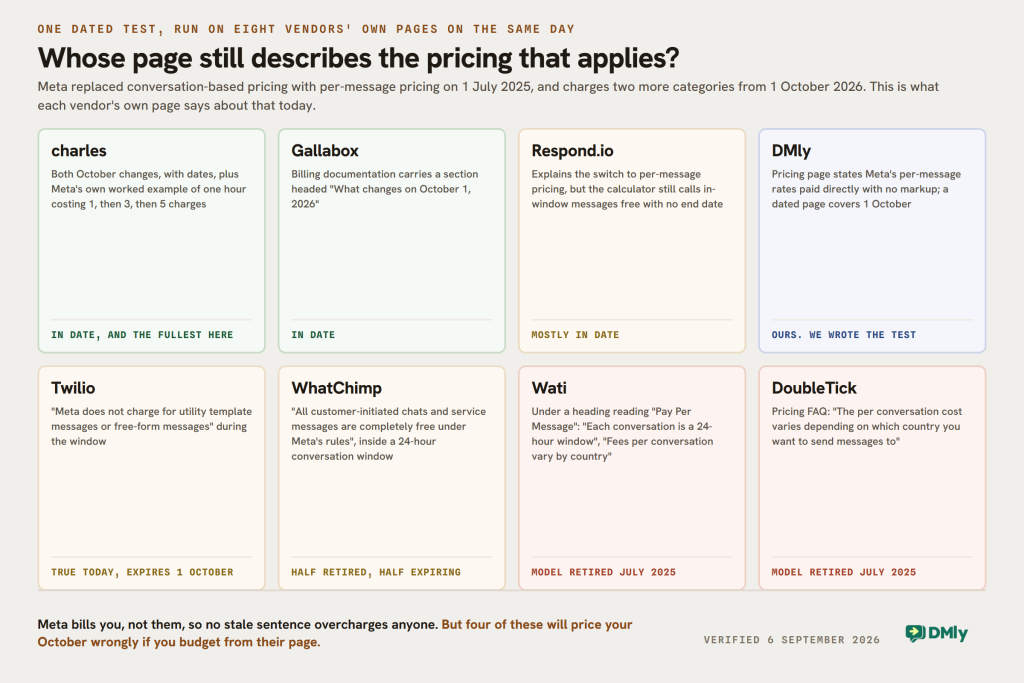
Every platform on this page sits on top of Meta’s charges, and Meta has changed how those charges work twice. On 1 July 2025 it replaced conversation-based pricing with per-message pricing. Meta’s own documentation is blunt about it: “Conversation-based pricing is deprecated. It was replaced with per-message pricing on July 1, 2025.” And on 1 October 2026, twenty-five days after this was written, two categories that are free today start being charged: service messages, which are the ordinary free-form replies you send inside the 24-hour window, and utility messages sent inside that same window. We have written up exactly what becomes billable on 1 October, and the per-country rate card shows what a message costs where your customers are.
So there is a test available that costs nothing and separates these vendors more usefully than any feature grid: open each vendor’s own page and see which pricing model it describes. A page still explaining a model Meta retired fourteen months ago is telling you something about how closely that vendor watches the platform it resells.
| Vendor | What their own page says about Meta’s charges | Current? |
|---|---|---|
| charles | Sets out both 1 October changes with dates, quotes Meta’s worked example of one hour costing 1, then 3, then 5 charges, and states that service messages get no volume tiers while utility and authentication keep theirs | Yes, and the fullest here |
| Gallabox | Their billing documentation carries a section headed “What changes on October 1, 2026” | Yes |
| Respond.io | Explains the switch from conversation-based to per-message pricing and publishes per-market rates. Their calculator still says free-form and in-window utility messages are free, with no note that this ends | Mostly |
| Twilio | “No Meta fee during customer service window for utility and free-from messages”, and again in the body: “Meta does not charge for utility template messages or free-form messages” | True today, false from 1 October |
| WhatChimp | “Exchange as many messages as you want within Meta’s 24-hour conversation window” and “All customer-initiated chats and service messages are completely free under Meta’s rules” | The first was retired in July 2025; the second ends on 1 October |
| Wati | Under a heading reading “Pay Per Message, Get More Control”: “Each conversation is a 24-hour window where you can send unlimited messages” and “Fees per conversation vary by country” | The heading is current, the explanation under it is not |
| DoubleTick | Pricing FAQ: “What are the conversation charges? The per conversation cost varies depending on which country you want to send messages to” | Prices by a unit Meta stopped billing in July 2025 |
| DMly | Our pricing page says you pay Meta’s standard per-message rates directly with no markup, and we publish a dated page on what changes on 1 October | Yes, and we wrote this test, so read our row accordingly |
This is not a gotcha, and none of these vendors is overcharging anyone because of a stale sentence. Meta bills you, not them, and your invoice will follow Meta’s rules whatever a marketing page says. But if you are budgeting from a vendor’s own explainer, four of these seven will give you a number for a world that ends on 1 October. Ask each shortlisted vendor one question: what happens to my bill on 1 October, and have you modelled it for my volumes. The quality of the answer will tell you more than the demo.
Seven charles Alternatives, Every Price Re-Read
This page has carried the same seven names since April, with figures that were stale in three cases and missing a billing period in most of the rest. Here is the whole set, re-read at source on the same day.
| Vendor | What this page said | What their own page says on 6 September 2026 |
|---|---|---|
| DMly | $29 / $65 / $149 billed yearly | Unchanged and correct: $29, $65 and $149 a month billed yearly, or $39, $79 and $199 monthly |
| Respond.io | “starting at around $79/month” | $79 a month billed yearly ($948 a year). Billed monthly it is $99. Broadcasts and automation are not on that plan |
| Wati | “typically starts at around $49/month” | $39 a month billed annually, $49 billed monthly. That plan is one channel and three users with no additional users allowed |
| Twilio | “pay-as-you-go”, no figure | $0.005 per message, inbound or outbound, plus Meta’s fees passed through. No subscription at all |
| WhatChimp | “$40/month for the Basic plan”, Pro “~$100” | Those are the monthly rates. Billed annually it is $24 and $60 a month |
| Gallabox | “starts at $25/month” | $150 a month billed quarterly. Six times what this page said, and the entry plan is capped at three users |
| DoubleTick | “around $141.58/month for the Starter plan” | $170 a month, $2,039 billed yearly, and that plan has no AI agents at all |
1. DMly
We make DMly, so treat this entry as an interested party writing about itself and check the figures against the pricing page.
Three plans, all published: Starter $29, Growth $65 and Premium $149 a month billed yearly, or $39, $79 and $199 billed monthly. Starter is one profile per channel, three team seats, 3,000 active contacts, 10,000 broadcast or template messages and 500 AI replies a month. Growth triples the profiles, doubles the seats to six, and raises the allowances to 10,000 contacts, 50,000 broadcast messages and 5,000 AI replies. Premium is five profiles, fifteen seats, unlimited contacts, 300,000 broadcast messages and unlimited AI replies on your own provider keys. Extra seats are $10 a month, an extra profile set is $15, extra contacts are $15 per thousand, and the trial is seven days with no card.
Seven messaging channels in one inbox rather than one: WhatsApp, Facebook Messenger, Instagram, Telegram, SMS, TikTok and a live chat widget, plus a Google Business Profile connection that handles reviews rather than chat. Bookings, invoices, payments and review collection sit alongside the messaging, which is the real difference from a pure campaign tool.
Where charles is the better buy, and we would rather say it than have you find out later. If your list is a national brand’s list, your campaigns run in several European languages, and your procurement department expects a signed order form with an SLA attached, charles is built for that and we are not. Their customer list is Volkswagen and BMW for a reason. DMly is built for the business that wants messaging, bookings and invoices in one place without a procurement cycle.
2. Respond.io
The closest thing here to a full omnichannel operations platform, and priced accordingly. Starter $79, Growth $159 and Advanced $279 a month billed yearly, which their page shows as $948, $1,908 and $3,348 for the year. Billed monthly the same tiers are $99, $199 and $349. Enterprise is quoted.
Two things their card does not put in the headline. First, the price is attached to a Monthly Active Contacts tier that you choose on the page, running 1,000, 2,500, 5,000, 10,000 and above, so the figures above are the smallest tier. Second, and more consequential: broadcasts, workflow automation and AI agents are not on Starter. They begin at Growth. If the job you are hiring for is sending WhatsApp broadcasts, the real entry price is $159 a month billed yearly, not $79.
Extra users are $12, $20 and $24 a month depending on tier, on top of the five, ten and ten included. Their FAQ is refreshingly plain about Meta: “WhatsApp fees are not included in any respond.io subscription. Meta charges these fees based on your usage.”
3. Wati
$39, $79 and $199 a month billed annually; $49, $99 and $249 billed monthly. Read on their pricing page in a browser, because the figures arrive in JavaScript.
The entry plan has a hard ceiling this page never mentioned. Wati’s own card reads “Connect any 1 Channel” and “3 Users Included. No additional users.” Not three included with more available: no additional users at all. A fourth person means the $79 plan, which includes five and sells extras at $24 a month each. On the top tier extra users are $59 each.
The add-ons are published and worth adding up before you commit: automation triggers at $25 per thousand a month, AI co-pilot credits at $20 per thousand, the Shopify integration at $4.99 a month, and additional WhatsApp numbers at $29 a month each. Their Astra AI agents are a separate product, described on the plan card itself as “priced separately”.
4. Twilio
The only entry here with no subscription, and the only one this page previously described without a number. Twilio’s own summary: “Twilio’s per-message fee for WhatsApp is $0.005, inbound or outbound”, plus Meta’s per-template fees, which Twilio passes through.
Half a cent a message is a remarkable figure next to a $79 or $150 subscription, and the comparison is unfair in both directions. Twilio charges for inbound messages, which nobody else on this page does, and it gives you no inbox, no campaign builder, no contact list and no automation canvas. You are buying a pipe and building everything that hangs off it. For a business sending seven thousand messages a month, Twilio’s own fee is $35; the developer weeks are the actual price.
Their page also states that utility and authentication messages “start at $0.0034/message”, which is Meta’s rate rather than theirs.
5. WhatChimp
Basic $24 and Pro $60 a month billed annually, or $40 and $100 billed monthly on their pricing page, with an unpriced Enterprise tier above. The previous version of this page quoted the monthly figures without saying they were monthly, which made WhatChimp look more expensive than its annual rate and cheaper than its real commitment.
Basic is two team members and 5,000 subscribers. Pro is five members and 15,000 subscribers, and it is the tier that adds an omnichannel inbox across WhatsApp, Instagram and Facebook, an appointment booking system, and the removal of the “Powered by WhatChimp” mark. Their own headline claim on the pricing page is worth quoting because it names a practice the rest of this market rarely discusses: that other providers “charge 20 to 35 per cent commission on every WhatsApp conversation”, while they connect you to Meta with zero markup.
6. Gallabox
This is the biggest correction on the page. Gallabox does not start at $25 a month. It starts at $150 a month, billed quarterly. The three tiers they publish are Basic at $150, Essential at $331 and Advanced at $632, every one of them quarterly, with an Enterprise tier that is quoted and offers multi-year contracts.
Because the shortest term they sell is three months, the smallest cheque Gallabox will take is $450. Basic is capped at three users, described on their own grid as a hard cap, with 500 AI credits a month and one channel each of WhatsApp, Instagram and a web widget. Essential includes six users with extras at $18, Advanced ten with extras at $24, and the AI credit allowance runs 500, 2,000 and 8,000 a month with top-ups sold in blocks of 5,000.
7. DoubleTick
Starter is $170 a month, $2,039 billed yearly, and it does not include AI agents. Pro plus AI is $308 a month, $3,694 billed yearly, with up to ten AI agents, a 50MB knowledge base, 3,500 AI credits and 350 AI voice minutes a month. Enterprise is quoted and lifts those to fifty agents, 100MB and 20,000 credits. Starter includes five agent seats, Pro ten.
Their own page says three different things about AI agents, and it is worth asking which one applies to you. The line above the plans reads “Choose the plan that fits your business, with AI agents built into every plan.” The Starter card is headed “Starter, does not include AI agents”. And the comparison table below labels the same row “Add-on from Pro, $90 a month”. We are not saying any of those is wrong; we are saying they cannot all describe the same offer, and the answer changes the entry price by $90 a month.
One of These charles Alternatives Now Prices by Quote
One of the tools this page recommended has taken the figures off its own pricing page, and we would rather explain that in the open than quietly delete the sentence.
The e-commerce answer in the FAQ below used to name Flowcart alongside DMly and QuickReply.ai. Flowcart no longer publishes its plan prices. Read at source on 8 September 2026: the pricing page at flowcart.ai is live and complete, with a free trial and a demo booking on it, but where the tiers once carried figures they now read “Get a Quote”. That is the gated state described at the top of this review: a pricing page exists with the numbers taken out of it. Every other name here earns its place by printing a figure you can read without a sales call, so Flowcart now sits outside a comparison built that way.
Correction, 8 September 2026. An earlier version of this section carried a false claim about Flowcart’s standing as a business. We had checked flowcart.io and flowcart.com, neither of which is the company. Flowcart is trading, its own site is flowcart.ai, the claim has been removed, and we apologise for it.
The slot it occupied is filled below with a vendor whose price we read at source on 6 September.
The Smallest Cheque Each One Will Take
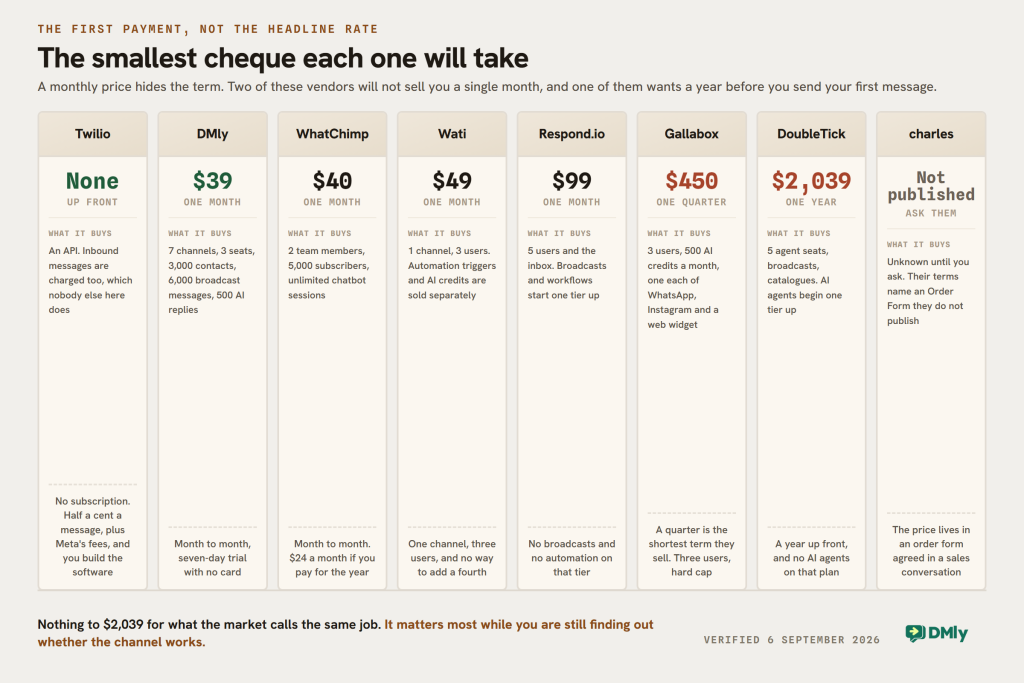
Monthly headline prices flatter whoever prints them, because they hide the term. Here is the number that actually leaves your account before you send a single message.
| Platform | Smallest first payment | What it commits you to |
|---|---|---|
| Twilio | Nothing up front | No subscription. You pay half a cent a message plus Meta’s fees, and build the software yourself |
| DMly | $39 | One month |
| WhatChimp | $40 | One month |
| Wati | $49 | One month, one channel, three users and no way to add a fourth |
| Respond.io | $99 | One month, and no broadcasts or automation on that tier |
| Gallabox | $450 | A quarter, because a quarter is the shortest term they sell |
| DoubleTick | $2,039 | A year, and no AI agents on that plan |
| charles | Not published | An order form, agreed in a sales conversation |
That is a range of nothing to $2,039 for what the market describes as the same job. It matters most while you are testing. Finding out whether WhatsApp campaigns work for your business costs $39 with one vendor on this list and $2,039 with another, and the expensive one is not obviously the better product. Once you know the channel works, the ranking changes and the term stops mattering.
Which of These charles Alternatives to Actually Buy
Stay with charles, or buy it, if you are the customer it is built for. A recognisable consumer brand, campaigns in several European languages, a procurement process that expects an order form and an SLA, and enough volume that a fixed monthly subscription would be the wrong shape anyway. Their documentation is the most current on this page, their AI has a published safety story that came with the Spectrm acquisition, and their customer list is the strongest evidence any vendor here offers. You will have to book a call to find out what it costs, and if that is a dealbreaker, it is a dealbreaker rather than a scandal.
Buy Respond.io if the inbox is the point and several channels land in it, but budget from $159 a month billed yearly rather than $79, because that is where broadcasts and automation begin.
Buy Wati or WhatChimp if you want the cheapest route to a working WhatsApp campaign and you can live inside the entry plan’s limits. Read Wati’s user rule twice: three users, no additions, is a real ceiling on a real business.
Buy Twilio only if you have developers and the interface is something you would rather own than rent. The half-cent-a-message fee is genuine and so is the absence of everything else.
Buy Gallabox or DoubleTick when the specific feature makes the case, because both ask for a bigger commitment than the rest of this list. Gallabox’s lead qualification is genuinely good and its quarterly term is the price of admission. DoubleTick’s catalogue and campaign tooling is built for stores, and its entry plan is a year, without AI agents.
Buy DMly if messaging is one part of a wider business: bookings and invoices alongside campaigns, seven channels rather than one, and a month-to-month option while you find out whether any of it works.
And whichever of these charles alternatives you pick, ask the same question before you sign: what happens to my bill on 1 October, and have you modelled it at my volumes. Four of the vendors on this page currently describe a version of Meta’s pricing that will not survive that date. The vendor who answers that question well is telling you something no feature list can.
Frequently Asked Questions
How much does charles cost?
charles does not publish a price. There is no pricing page on their site, no pricing URL among the 254 in their sitemap, and no figure in their published platform terms, which instead refer to a separate Order Form agreed with each client. Any number you find elsewhere is somebody’s recollection of their own contract, not a published rate, so the only way to get a figure is to ask them.
Which charles alternative is best for e-commerce?
For a store that wants campaigns, abandoned-cart recovery and order updates in one place, DMly and QuickReply.ai are both worth a look; QuickReply.ai publishes tiers starting from $39 a month, sold annually or quarterly rather than by the month, with taxes and messaging charges extra. An earlier version of this answer also named Flowcart, which no longer publishes plan prices and so falls outside a comparison built on published figures. If you are a larger consumer brand, charles itself remains a serious answer to that question.
What is the best charles alternative for agencies?
Agencies need separate client workspaces, and that narrows the field quickly. Respond.io puts multiple workspaces on its Advanced tier at $279 a month billed yearly. DMly sells a white-label and agency offer with its own client workspaces and branding. Most of the cheaper tools on this page are built for one business rather than many, so check the workspace question before the feature list.
What does switching from charles to DMly cost?
DMly is $29 a month for Starter, $65 for Growth and $149 for Premium, all billed yearly, or $39, $79 and $199 billed monthly, with a seven-day trial that needs no card. Meta’s per-message charges are billed separately and paid directly, with no markup added. What you cannot compare is the other half of the sum, because charles does not publish a figure to compare it against.
Does DMly offer a free plan?
No. There is no permanent free tier. Entry pricing is $29 a month billed yearly or $39 billed monthly, and every plan comes with a seven-day free trial that does not ask for a card.
Is charles only for WhatsApp?
Not any more. WhatsApp is still the centre of the product, but the Spectrm acquisition brought Facebook Messenger and Instagram conversational AI with it, and they now sell RCS as a separate channel and describe themselves as a verified Google RCS partner in Europe. If you shortlisted them as a WhatsApp-only tool, that is out of date.
Which of these platforms adds a markup to Meta’s message charges?
Twilio states its own fee openly at half a cent a message on top of Meta’s, which is a markup declared rather than hidden. WhatChimp and DMly both state that they add nothing. Respond.io says Meta’s fees are not included in the subscription without saying whether anything is added. charles does not address it on any published page. The honest answer for the rest is that you have to ask, and it is a fair question to put in writing before you sign.
Writing about WhatsApp automation, bookings and growth for local business.
Turn WhatsApp into your busiest channel.
Start free and run message, bookings, payments and reviews in one place.
