
Growby Review 2026: One Pricing Page, Five Price Lists

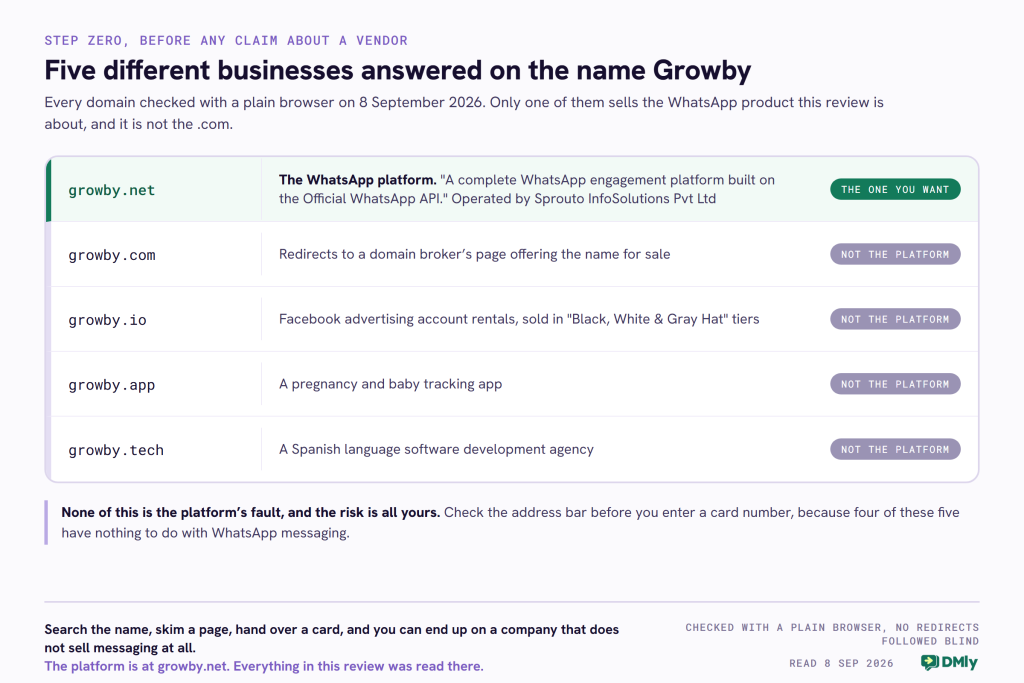
Type “Growby” into a browser and five different businesses answer.
One of them rents Facebook advertising accounts in tiers openly labelled white hat, gray hat and black hat. One is a pregnancy and baby tracker. One is a software agency in Latin America whose site is in Spanish. One is a domain broker offering the name itself for sale. Only the fifth, growby.net, is the WhatsApp marketing platform you were looking for.
None of that is the platform’s fault, and this Growby review is not about the other four. None of it says anything about the software either. But it does tell you something useful about buying this particular product: check the address bar before you enter a card number. That habit turns out to be the right one for the rest of the purchase too, because the single most confusing thing about Growby is not the software. It is the price list, and there are five of those as well, all on one page.
This Growby review reads the platform the way an owner would: what it costs, what the plan names actually mean, what the WhatsApp charges on top will be after Meta’s rules change on 1 October, and where Growby genuinely beats the alternatives. Every figure below was read at source on 8 September 2026 from Growby’s own pricing page, its reseller page, its published pricing data and its FAQ, and every WhatsApp rate was checked against Meta’s own October rate card rather than any vendor’s summary of it.
Who Growby Actually Is
Growby is an Indian software company selling WhatsApp marketing to small businesses, and knowing that explains most of what follows.
The footer of every page names the company: “Copyright 2022-2026 by growby.net. All Rights Reserved by Sprouto InfoSolutions Pvt Ltd.” The support numbers are Indian mobile numbers, the published hours are “Mon-Fri 10:00 to 18:00 hrs IST”, and the first question in the pricing FAQ is about GST invoices. Growby describes itself as a Meta Business Partner and states plainly that it “is not directly a part of WhatsApp, Facebook Inc., or Meta”, which is the correct and honest disclaimer to make.
A banner across the top of the site announces that they have “launched a new WhatsApp Marketing Platform, Growby V2.0”, and the sign-up buttons now point at a separate application at agents.growby.net. So the product you buy today is a second-generation platform, recently shipped.
Why any of this matters to you: the company is real, contactable and open about who it is, which is more than can be said for parts of this market. It also means the pricing is built around a home market that pays in rupees, and the version of the price list you see depends on where you are sitting. More on that below, because it is not a small difference.
What Growby Actually Does
Growby is a WhatsApp broadcast and chatbot tool, and it is more focused than the “multi-channel marketing automation platform” description it used to carry.
Their own summary of what every plan includes is short and specific: “WhatsApp Broadcast, Dashboard, Inbox, Create Templates, Contact and Group Management, Campaign Sent to Selected Groups.” That is the product. If you are picturing an email and SMS suite with WhatsApp bolted on, adjust the picture: this is a WhatsApp tool.
A second correction to what this page used to say. An earlier version credited Growby with campaigns across “WhatsApp, email, SMS, and social messaging”. Nothing Growby publishes today describes an email or an SMS channel. Their site title, their product menu and every row of their feature grid are WhatsApp. We have withdrawn the multi-channel claim rather than repeat it.
Broadcasts and contact groups
You import contacts, put them into groups, and send an approved WhatsApp template to a group on a schedule. Their comparison grid lists “Unlimited WhatsApp broadcast” and “Schedule WhatsApp campaign” on every tier including the free one. For a salon sending a Tuesday offer to 400 past clients, that is the whole job, and Growby does it. If you are new to this, our guide to WhatsApp broadcasts covers the opt-in and template rules that apply whichever tool you pick.
Chatbot flows, and the number that limits them
This is where the tiers actually separate, and Growby publishes the numbers honestly in its comparison grid. Total Chatbot Flow runs 1, 2, 5, 10, then 1000 across the six columns, and Total Automation runs the same. So on the entry paid tier you get a handful of flows, not an unlimited builder, and if you want more than ten you are into the top of the ladder.
That matters more than it sounds. A “flow” is one conversation path: a welcome, a booking question set, an out-of-hours reply. Two of them is enough to test the idea. It is not enough to run a business on.
The AI chatbot, and where it starts
An “AI powered chatbot” is listed as a Pro feature on the plan cards, not a Starter one, alongside “AI Chatbot automated training”, an “AI Chatbot flow Builder” and an “AI Template Builder” in the grid. If the AI reply is the reason you are shopping, the entry plan is not the one you want. That is a normal way to build a ladder and worth knowing before you buy rather than after. For what these bots cost across the market, see how much a WhatsApp chatbot costs in 2026.
Integrations: two, published
A correction to what this page used to say. An earlier version of this review credited Growby with OpenAI, and with “access to 1,000+ integrations via n8n” on its top plan. Read today, Growby’s own integration list names exactly two: Google Sheet and Zapier. n8n, OpenAI, Shopify and WooCommerce appear nowhere on their site that we could find.
Absence from a marketing site is not proof a connection has been switched off, so the fair statement is the narrow one: those integrations are no longer described anywhere Growby publishes, and we have withdrawn the claim rather than repeat it. If n8n is load-bearing for you, ask them directly before you buy. Their comparison grid does put “Direct Meta Cloud API access” and a “Postman API Collection” on the higher tiers, so a developer route exists.
Growby Review: Pricing in 2026 and the Real Ladder
Growby’s plans are Starter, Pro and Enterprise, and they start at $40 a month. An earlier version of this Growby review quoted a Starter, Pro and Business ladder at $50, $110 and $210. All six of those figures are out of date, and the third plan is no longer called Business. Here is what Growby’s own pricing page publishes today.
| Plan | Monthly | Yearly | What you get |
|---|---|---|---|
| Free | $0 | $0 | Published in their pricing data, but the page’s own script hides it from the cards |
| Starter | $40 | $320 | 5,000 template messages, unlimited session messages, 1 WhatsApp number, 5 users, chatbot flow builder, Google Sheet, email support |
| Pro | $90 | $540 | 75,000 messages, 3 WhatsApp numbers, 10 users, AI powered chatbot, Meta Cloud API credentials, priority support |
| Enterprise | $300 | $3,000 | 250,000 messages, unlimited numbers, unlimited users, dedicated account manager, custom integrations, SLA |
Growby pricing also includes a message credit top-up list, priced consistently at one hundredth of a cent per credit: $20 for 200,000 credits, $50 for 500,000, $100 for 1 million, $200 for 2 million and $500 for 5 million, all one-time purchases. That part is clean and easy to reason about.
The genuine headline, and it is a good one: Growby states, twice, that “We do not charge any additional message cost unlike our competitors. Pay direct message cost to Meta.” Taken at face value that means no platform markup on WhatsApp traffic, which is the single biggest hidden cost in this category and the thing several competitors are least clear about. Growby is clear about it, and deserves the credit.
One Pricing Page, Five Different Price Lists
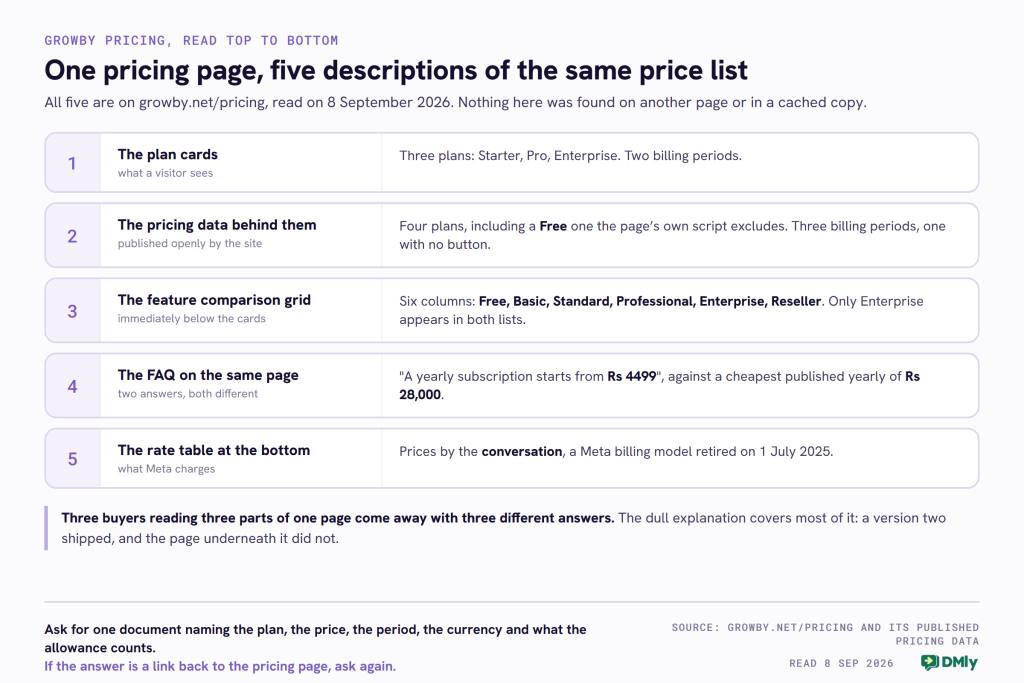
This is the thing to understand before you buy, and it is not a criticism of the software. Growby’s single pricing page describes its prices in five different ways, and they do not agree with each other. Any one of them read on its own will give you a confident and wrong idea of what you are about to pay.
The five, in the order you meet them scrolling down the page:
- The plan cards, selling Starter, Pro and Enterprise in two billing periods.
- The pricing data behind them, which holds four plans including a free one the page’s own script filters out, and three billing periods, one of which has no button.
- The feature comparison grid, whose six columns are named Free, Basic, Standard, Professional, Enterprise and Reseller.
- The FAQ, which quotes a starting price of 4,499 rupees and a set of ranges that match nothing above it.
- The WhatsApp rate table at the foot, priced in conversations, a unit Meta retired on 1 July 2025.
Each is examined below, and the last two have consequences big enough for their own sections.
The comparison grid names plans you cannot buy
Directly under the three plan cards sits a feature comparison table introduced with “Can’t decide which plan is right for you? Check out feature comparison below.” Its six columns are headed Free, Basic, Standard, Professional, Enterprise and Reseller.
Compare that to the cards immediately above it, which sell Starter, Pro and Enterprise. Only Enterprise appears in both. There is no Basic, Standard or Professional plan on sale anywhere on the page. So the table built to help you choose a plan is describing a different set of plans from the ones you can actually pay for, and the flow-count numbers you most need, 1, 2, 5, 10, 1000, are attached to those names rather than to the ones with prices on them.
The FAQ quotes a price that is not on the page
Further down the same page, the FAQ answer to “What is the cost of WhatsApp bulk marketing software?” reads: “An yearly subscription of our WhatsApp marketing software starts from Rs 4499. Other plans like quarterly and whitelabel plans have prices in the range of Rs 1333 to 5000 to Rs 15999 to Rs 69999 respectively.”
The cheapest yearly price Growby actually publishes is 28,000 rupees, for Starter. The figure 4,499 appears nowhere in their pricing data. A second FAQ answer on the same page says “Growby offers three plans, including a reseller program”, which matches neither the four business plans in the data, nor the three partner plans, nor the six columns in the grid. A third refers to features being “restricted in the standard plan”, using one of the names that has no price.
The most likely explanation is simply that the FAQ predates the V2.0 relaunch and was not rewritten with the rest of the page. That is an ordinary thing to happen to a website. It is worth knowing about because an owner comparing quotes will read a number in an FAQ as readily as a number on a card.
The Billing Period That Costs Less Than One Month
Growby publishes quarterly prices that no button on the page will show you, and some of them are strange enough to be worth asking about before you commit.
The pricing page offers a Monthly and a Yearly toggle. The pricing data behind it carries a third billing period, Quarterly, with a full set of prices in all four currencies, and the page’s own code has a label ready for it. There is simply no button, so a shopper never sees these numbers.
| Starter | Published price | Cost per month |
|---|---|---|
| Monthly | $40 | $40.00 |
| Quarterly | $60 | $20.00 |
| Yearly | $320 | $26.67 |
Read that column twice. Three months of Starter is published at $60, while one month is $40. Buying a quarter costs one and a half months. And the quarterly rate works out cheaper per month than the annual one, which reverses the usual logic that the longer commitment is the better deal.
In rupees it is starker still: Starter is 3,500 a month, 3,000 a quarter. Three months costs less than one.
The partner ladder runs the other way. The Growth partner plan is published at $127 a month, $2,400 a quarter and $999 a year. Three months at the monthly rate is $381, so the quarterly figure is more than six times that, and more than twice the price of a full year. The same pattern holds in euros, pounds and rupees, so it is systematic rather than a single typing slip.
We are not going to tell you what those numbers mean, because we cannot know. The likely explanation is that the quarterly column is left over from an older price list and has not been maintained, which would fit neatly with it having no button. What we can tell you is the question to ask: “Your pricing data lists quarterly prices. Are they current, and can I buy on them?” If the answer is yes, quarterly Starter is the cheapest way to run this software. If the answer is no, you have lost nothing by asking.
The Price You See Depends On Where You Are
Growby shows rupee prices to visitors in India and dollar prices to everyone else, and the two lists are not conversions of each other.
The page detects your country from your IP address and selects the currency for you: India gets rupees, every other country gets dollars. You can switch manually between dollars, rupees, euros and pounds, and offering four currencies is genuinely more than most vendors in this market bother with. It is a real credit.
The interesting part is what the two lists imply about each other. Divide each rupee price by its dollar equivalent and you do not get one exchange rate, you get several.
| Plan and period | US dollars | Rupees | Implied rupees per dollar |
|---|---|---|---|
| Starter, monthly | $40 | 3,500 | 87.5 |
| Starter, quarterly | $60 | 3,000 | 50.0 |
| Pro, yearly | $540 | 48,000 | 88.9 |
| Enterprise, monthly | $300 | 20,000 | 66.7 |
| Accelerator partner, monthly | $90 | 5,000 | 55.6 |
A single currency conversion cannot produce rates from 50 to 88.9 on the same day. What this tells you is that the two lists were priced separately for two markets rather than converted, which is a perfectly normal commercial decision and one plenty of software companies make.
The practical consequence for you is worth stating plainly: on some plans the rupee price is materially cheaper than the dollar price, and on others it is not. The partner Accelerator plan is the widest gap on the list. If you are buying from outside India, that is not a lever you can pull, but it is context for any quote you are given. The euro and pound lists have a related quirk: Starter and Enterprise are priced identically in the two currencies, at 35 and 250 respectively, while Pro is not.
The WhatsApp Charges On Top, And What Changes on 1 October
Your Growby bill is the plan price plus whatever Meta charges for the messages, and Growby’s own rate table needs reading carefully before you budget from it.
At the foot of the pricing page Growby publishes a per-country table of WhatsApp charges under the heading “Pay based on the conversations, not per individual WhatsApp message sent”, explaining that “Each WhatsApp Conversation is a 24 hour window where you can send unlimited messages.”
That was exactly how WhatsApp worked until 1 July 2025, when Meta replaced conversation-based pricing with per-message pricing. Meta’s own documentation is unambiguous: “Effective July 1, 2025, Meta charges on a per-message basis.” The individual cells in Growby’s table are caught between the two models, reading “$ 0.0604/message/user /24hrs” under a column headed “Per Conversation”.
Where their numbers match Meta exactly, and where they do not
Here is the part that deserves credit. We checked all seven of Growby’s marketing rates against Meta’s published rate card effective 1 October 2026, and five of them match to the fourth decimal place. Growby is passing Meta’s card through accurately, which is more than one or two competitors in this category manage.
| Market | Growby’s marketing rate | Meta’s rate from 1 Oct 2026 | |
|---|---|---|---|
| Pakistan | $0.0473 | $0.0473 | Matches |
| Indonesia | $0.0411 | $0.0411 | Matches |
| Malaysia | $0.0860 | $0.0860 | Matches |
| Brazil | $0.0625 | $0.0625 | Matches |
| Nigeria | $0.0516 | $0.0516 | Matches |
| USA | $0.0604 | $0.0250 | 2.4 times higher |
| India | Rs 0.73 | Rs 0.8631 | 15% lower |
Two rows are out. The USA figure sits well above Meta’s North America marketing rate, and the India figure sits below what Meta will charge, which would quietly under-budget an Indian business. Because five rows are exact, the pattern looks far more like two stale entries than like a markup. We are not going to call it anything more than that, and Growby’s own note beneath the table is the opposite of a markup claim: “We do not charge anything extra per message. Directly pay WhatsApp charges.”
The question to put to any vendor showing you a rate card, Growby included: “Is this card current with Meta’s October rates, and which rows did you last update?”
The column that is about to become free, and the one that is not on the table
This is the bit that will actually change your bill, and no vendor rate card we have seen has caught up with it yet.
Growby’s table has a second column, “User-Initiated Rates”, telling you to budget $0.0088 per conversation in the USA or 0.29 rupees in India. User-initiated is what Meta now calls a service message: a reply inside the 24-hour window that opens when a customer messages you first.
From 1 October 2026, Meta introduces a free monthly tier of 1,000 service messages for every business phone number, charging only from the 1,001st. It does not roll over and it resets every month. For a salon, a clinic or a small shop answering a few dozen customers a day, that free tier covers the entire service side. The column Growby tells you to budget for is the one that is about to cost most small businesses nothing.
And the charge that genuinely starts on the same date is missing from the table altogether. From 1 October, Meta begins charging for utility templates sent inside an open 24-hour window, which have been free since July 2025. There is no free tier on those. Order confirmations, delivery updates and appointment reminders are the templates most small businesses send, so for a busy business this is the line item that grows, not the service one.
The honest headline for an owner: the service side costs you nothing until you pass a thousand a month, and the utility templates are the bill. We have written the change up properly in the WhatsApp pricing change on 1 October, and the current per-market numbers are in our WhatsApp Business API pricing by country rate card. Neither of those is a Growby problem specifically. Every vendor’s card is stale on this right now, including cards we have checked at AiSensy, Interakt and Spoki.
The Reseller Programme, And What Each Vendor Publishes
Growby sells a white-label version of itself, and it is a real part of the business rather than a footnote. If you run an agency and want to sell WhatsApp messaging under your own name, this is one of the more developed offers in the category.
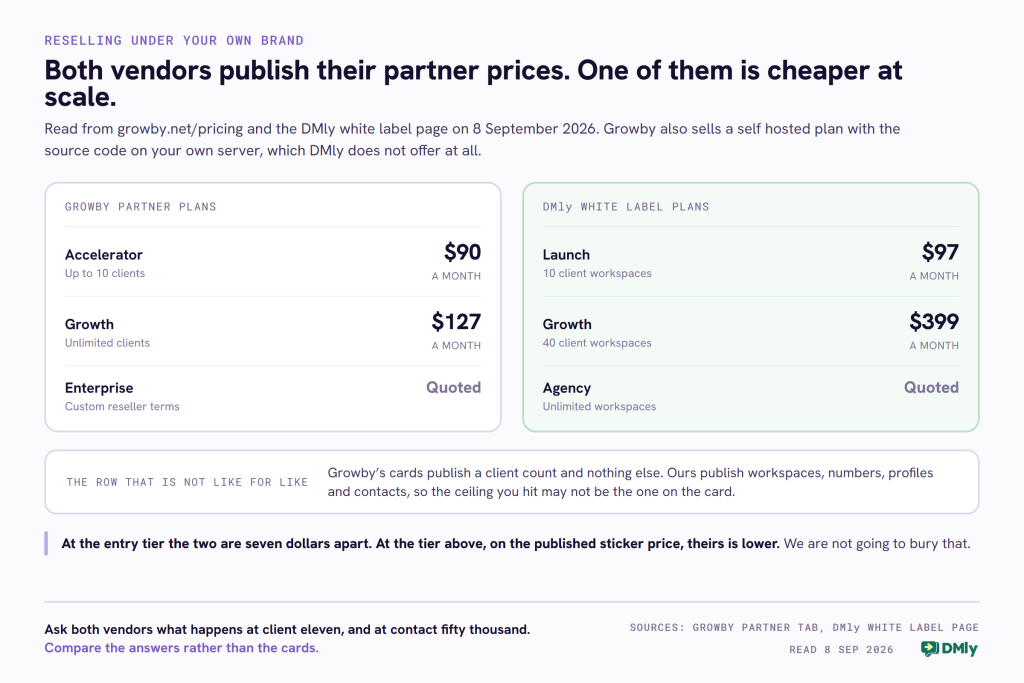
The partner ladder is Accelerator at $90 a month for up to ten clients, Growth at $127 a month for unlimited clients, and an Enterprise tier quoted on request. You get your logo, your brand name, your own domain, the right to set your own prices, and on the top of the range, self-hosting.
Two things about that comparison are only fair to say out loud.
First, Growby’s partner plan is much cheaper than ours at the second tier and it is not close. Their Growth partner plan is $127 a month for unlimited clients. Ours is $399 a month for forty client workspaces. If your whole requirement is “let me put my brand on a WhatsApp broadcast tool and resell it”, Growby is the cheaper way to do that, and we would rather say so than hope you do not check. The same honesty applies to the rest of the field: see our Chatfuel review for a vendor whose pricing moved even further.
Second, the two cards are not measuring the same thing. Growby’s partner cards publish a client count and little else. DMly’s publish client workspaces, WhatsApp numbers, connected profiles and total contacts, because those are the ceilings a reseller actually hits. “Unlimited clients” on a card does not tell you how many WhatsApp numbers or contacts sit behind it. Ask, before the answer matters.
Where the price is, and is not, published
Growby’s own reseller page does not print the prices. It says: “Login or sign up to the Growby portal to view pricing.” The numbers above come from the Partners tab on the main pricing page, which does publish them. So the same figures are gated on one page and open on another, and which you meet depends on which link you follow.
We have a version of the same problem, and it is worth admitting. DMly publishes its partner prices on its white-label page, but our own documentation says that inside the app, “Reseller plans are ordinary paid plans that DMly has flagged as reseller plans. Nothing on your billing page marks them as such, so ask DMly which plan to pick.” A price you can read and then cannot find in your own billing screen is only half published. Both vendors should fix this, ours included.
One more term worth reading before you sign. Growby’s FAQ covers a plan called “RESELLER WHITE LABEL, SELF-HOSTED WITH SOURCE CODE, LIFETIME”, and its refund policy is short: “Once the source code has been provided to you, refunds will no longer be applicable.” That is entirely reasonable for a source-code sale, and it is the kind of clause you want to have read first. Their standard cancellation terms are similar in spirit: you can cancel at any time, but “there are no refunds if you cancel your plan in the middle of your subscription duration”, which is worth weighing against the annual and quarterly options.
Where Growby Is Genuinely The Better Buy
Several of these beat us, and a review that pretended otherwise would not be worth reading.
- No markup on messages, said plainly. “We do not charge any additional message cost unlike our competitors. Pay direct message cost to Meta.” That is the right policy and it is stated where you can find it.
- Five logins on the entry plan. Growby’s $40 Starter includes 5 users. DMly’s $39 Starter includes 3 seats. If you have a front desk of four people, Growby’s entry plan fits and ours does not.
- A free plan. There is a Free tier in their published pricing data, and unlimited WhatsApp broadcast appears on every column of their comparison grid including it.
- Four currencies for the subscription itself. Dollars, rupees, euros and pounds. DMly bills its own plans in dollars only. If being invoiced in your own currency matters to your accountant, that is a real difference.
- Self-hosting with source code. DMly has nothing comparable at any price. We checked every page of our own documentation, and self-hosting DMly is not offered. If you need the software on your own infrastructure, Growby sells that and we do not.
- A cheaper reseller tier at volume, as set out above.
DMly as a Growby Alternative
The honest summary: Growby is a WhatsApp broadcast tool, and DMly is the software a local business runs its front desk on. If you only need the first thing, the rest of this section is not an argument you need to have.
Eight channels, not one
DMly connects WhatsApp, Facebook Messenger, Instagram, Telegram, SMS, TikTok, the LiveChat widget on your own site, and your Google Business Profile, and they all land in one inbox. Growby is a WhatsApp product. If your customers message you on Instagram as often as WhatsApp, that is the difference that matters most and no feature list changes it.
Two of those channels have limits worth knowing before you count on them: broadcasts are not available on Live Chat or TikTok, and Messenger and Instagram broadcasts only reach people who messaged you in the last 24 hours, not seven days. We would rather you knew that here than found it in the product.
Unlimited bot flows on every plan
This is the sharpest single contrast. Growby’s grid caps chatbot flows at 1, 2, 5 and 10 across its tiers. DMly’s plan comparison lists bot flows as Unlimited on Starter, Growth and Premium alike, so the number of conversation paths you build is never the thing that makes you upgrade. What does scale with the plan is AI replies, at 500, 5,000 and 20,000 a month, and on Premium you can connect your own OpenAI, Claude, Gemini or DeepSeek key and stop counting altogether.
The front desk, not just the campaign
Appointments, invoices and payments, Google review requests and a built-in CRM with pipelines are included on every DMly plan, including the $29 one. That is the part Growby does not do at all, and it is why the comparison is less like two competitors and more like two categories. A clinic that wants the booking, the reminder, the invoice and the review request to be one system rather than four is the shape of customer this suits. If that is you, our guide to WhatsApp CRM for small businesses is the better starting point than any review.
| Feature | DMly (from $29/month) | Growby (from $40/month) |
|---|---|---|
| Channels | WhatsApp, Instagram, Messenger, Telegram, TikTok, SMS, Live Chat, Google Business | |
| Chatbot flows | Unlimited on every plan | 1, 2, 5, 10 by tier |
| Team seats on entry plan | 3 | 5 |
| AI chatbot | Included on every plan | From the Pro plan |
| Built-in CRM | Included, with pipelines | Contact and group management |
| Bookings and appointments | Included | Not offered |
| Invoices and payments | Included | Not offered |
| Google reviews and reputation | Included | Not offered |
| White label | From $97/month | From $90/month |
| Self-hosting | Not offered | Offered, with source code |
| Subscription currencies | US dollars | Dollars, rupees, euros, pounds |
| Markup on Meta’s message fees | None | None |
What DMly costs
Starter is $29 a month billed yearly or $39 billed monthly, with 3 seats, 3,000 active contacts and 10,000 broadcast messages. Growth is $65 or $79, with 6 seats, 10,000 contacts and 50,000 messages. Premium is $149 or $199, with 15 seats, unlimited contacts and 300,000 messages. Every plan includes the AI agent, the CRM, bookings, invoices, reputation and the API. There is no markup on Meta’s fees.
The one place to compare carefully is contacts. DMly meters active contacts and Growby does not. If you hold a list of 40,000 and message it rarely, Growby’s model suits you better and ours will push you up a tier. Set that against the flow caps running the other way, and the answer depends entirely on which limit you hit first.
Growby Review Verdict: Which One Fits Your Business
Choose Growby if WhatsApp is the only channel you care about, you want to broadcast to a large list without paying per contact, you need five logins for under $50, you want to be billed in rupees, euros or pounds, or you want to resell a white-label WhatsApp tool cheaply. The self-hosted source-code plan has no equivalent anywhere in this comparison.
Choose DMly if your customers reach you on more than one app, you want more than ten chatbot flows without moving to a top tier, or you want the booking, the invoice, the reminder and the review request handled by the same system that holds the conversation.
Either way, before you pay anyone, ask the two questions this review turned up: is the quarterly price list current, and is the WhatsApp rate card updated for Meta’s October rates. If you are still drawing up a shortlist, how to choose a WhatsApp marketing tool sets out the checks worth running on any vendor, and our roundup of WATI alternatives covers the wider field. For agencies specifically, white-label WhatsApp software for agencies goes deeper on the reseller economics than this page can.
Growby Review FAQs
Growby pricing 2026: how much does Growby cost?
Growby pricing starts at $40 a month for Starter, with Pro at $90 and Enterprise at $300, all billed monthly. Billed yearly the same plans are $320, $540 and $3,000. There is also a Free tier in their published pricing data. Prices are available in US dollars, rupees, euros and pounds, and the currency you are shown is chosen from your IP address. Meta’s per-message WhatsApp charges are extra and paid directly to Meta, with no Growby markup.
Is Growby a legitimate company?
Yes. growby.net is operated by Sprouto InfoSolutions Pvt Ltd, an Indian company, and Growby is listed as a Meta Business Partner. It publishes a business address, two support phone numbers, working hours in Indian Standard Time and a GST invoicing policy. Be aware that four other unrelated businesses use the name Growby on other domains, so check that you are on growby.net before entering payment details.
Why do Growby’s plan names not match its comparison table?
The plans on sale are Starter, Pro and Enterprise. The feature comparison table below them is headed Free, Basic, Standard, Professional, Enterprise and Reseller. Only Enterprise appears in both. The most likely explanation is that the comparison table was not updated when Growby launched its V2.0 platform and renamed its plans. Take the flow and automation limits from it as indicative, and confirm the numbers for the plan you are actually buying.
Does Growby charge extra for WhatsApp messages?
No. Growby states twice on its pricing page that it adds no per-message cost and that you pay Meta directly. Their published marketing rates match Meta’s own October 2026 card exactly in five of the seven markets they list. The USA row is higher than Meta’s published North America rate and the India row is lower, which looks like two entries that have not been refreshed rather than a markup. Ask them to confirm the card is current before you budget from it.
Does Growby offer a white label or reseller plan?
Yes, and it is one of the stronger parts of the offer. The Partners tab on the pricing page lists Accelerator at $90 a month for up to ten clients and Growth at $127 a month for unlimited clients, with an Enterprise tier on request. There is also a lifetime self-hosted plan that includes source code, which is not refundable once the code has been delivered. Growby’s dedicated reseller page asks you to log in to see prices, so use the Partners tab on the pricing page instead.
Growby review 2026: is Growby worth it?
For WhatsApp broadcasting on a budget, yes. This Growby review found a focused, honestly priced tool from a real company, with no markup on Meta’s message fees, five logins on a $40 plan and a genuinely competitive reseller programme. The reservations are about the pricing page rather than the product: plan names that do not match between two tables on the same screen, an FAQ quoting a price that no longer exists, and a WhatsApp rate card still denominated in conversations. Ask about those before you pay and you will know exactly what you are buying.
What is the best Growby alternative?
It depends which limit you are hitting. The right Growby alternative is decided by the cap you hit first, not by a feature list. If you have outgrown the chatbot flow caps or your customers message you on Instagram and Messenger as well as WhatsApp, DMly covers eight channels with unlimited bot flows on every plan from $29 a month, plus bookings, invoices and Google reviews in the same system. If you simply want cheaper broadcasting to a very large contact list, Growby’s own model may still suit you better than ours, because we meter active contacts and they do not.
Writing about WhatsApp automation, bookings and growth for local business.
Turn WhatsApp into your busiest channel.
Start free and run message, bookings, payments and reviews in one place.
