
Siteti Review 2026: Naira Pricing, Features and the Best Alternative for Nigerian Businesses
This Siteti review starts with an exchange rate that nobody printed. Open Siteti’s pricing page, look at the Starter plan in naira, ₦46,400 a month, then tap the USD button and it reads $29. Divide one by the other and you get ₦1,600 to the dollar. Do the same for Growth and Pro and you get ₦1,600 again, exactly, every time.
That isn’t a trick, and it isn’t a scandal. It’s a choice. Siteti has fixed its naira prices at a rate of its own, so your bill doesn’t move when the naira does. On 13 October the Central Bank’s own rate was about ₦1,332, so the fixed price carries roughly a fifth on top of the official dollar price, and in return you never have to find a dollar card or watch the rate.
Whether that’s a good trade depends on your business, and so does nearly everything else on the page. In this guide, we’ll look at what Siteti is, what every plan costs in naira and in dollars, what each tier really unlocks, who pays Meta for your WhatsApp messages (Siteti’s own pages give three different answers), what calling works from a +234 number, Siteti’s genuine strengths, what it doesn’t list, and how DMly compares as a Siteti alternative, including the cases where you should pick Siteti instead.
Siteti Review in Brief: Who It Suits, and Who Should Keep Looking
The short Siteti review: it’s a Lagos-built WhatsApp CRM with honest naira billing, more users on its entry plan than most, a free developer sandbox and WhatsApp calling with recording from the Growth plan, but it’s WhatsApp only, its chatbot builder starts at ₦94,400, and the price jumps from ₦94,400 to ₦638,400 the moment your team reaches eleven people.
Siteti is a good fit if:
- You only need WhatsApp, and a team of up to ten people answering it.
- You want to pay a fixed naira price by Nigerian card, or by bank transfer on a yearly plan.
- You need WhatsApp calls answered and recorded for quality control (Growth and Pro).
- You’re a developer who wants to build and test against a WhatsApp API for free, with no time limit.
Keep looking if:
- Your customers also message you on Instagram, Facebook, TikTok or your website. Siteti’s site doesn’t list those channels.
- You want AI to answer messages, bookings with deposits, or invoices with pay links in the same tool. None of those is listed.
- Your team is eleven people or more and doesn’t need call recording. The next tier is nearly seven times the price.
- You can’t get a clear written answer on who pays Meta, in what currency. Siteti’s own pages disagree, and that bill can be bigger than the subscription.
Everything in this review was read on Siteti’s own website, its pricing toggles and its API documentation in a browser on 14 October 2026, with no account and no login. We make DMly, which competes with Siteti, so we’ve tried to be fair and we show our working. Check every number against the pages we cite before you pay anyone, including us.
What Siteti Is: A Lagos WhatsApp CRM on the WhatsApp Business API in Nigeria
Siteti is a WhatsApp CRM and WhatsApp Business API provider built for Nigerian businesses: one shared inbox on your official WhatsApp number, broadcasts, segments, a chatbot builder, calling and an API. Its terms of service give an address in Ajah, Lagos, say the agreement is governed by Nigerian law, and were last updated on 9 October 2026. The site’s footer describes the company as “Siteti Inc.” and an official Meta Business Tech Provider partner. We didn’t check that against a Meta directory, so treat it as Siteti’s own description.
If the word “API” puts you off, here’s the plain version. The free WhatsApp Business app on your phone works for one person and a handful of chats. The WhatsApp Business API is the official version for businesses that need several staff on one number, automation and bulk messages. You don’t use it directly; you use it through a provider like Siteti or DMly. Our guide to the WhatsApp Business app vs the API explains the difference properly, and our page on the WhatsApp Business API in Nigeria covers what it takes to get one here.
What Siteti offers, from its own feature pages:
- Broadcasts. Bulk and scheduled WhatsApp campaigns to contacts, segments or lists, with delivery and read tracking.
- A shared team inbox. Several agents on one number, chat assignment, shared labels and notes.
- Contacts and segments. Import from CSV, Excel or Google Sheets, then group people by tags.
- A chatbot builder and interactive flows. Drag-and-drop journeys for lead capture, forms and orders.
- WhatsApp calls in the browser, with recording on the higher plans.
- Coexistence mode, so you can keep the WhatsApp Business app on your phone alongside the API and bring past chats across (Siteti says up to six months, where available).
- Help with Meta verification and the green tick, and a written checklist of the CAC documents Meta usually asks Nigerian businesses for.
Siteti also runs industry pages for real estate, e-commerce and travel agencies, and a “virtual call center” page. Most of the coverage we found about Siteti elsewhere was either sponsored or a price round-up, and we found no independent user reviews, so every fact in this Siteti review comes from Siteti’s own pages.
Siteti Pricing in Naira, Read on 14 October 2026
Siteti pricing has four tiers: a free developer Sandbox, Starter at ₦46,400 a month, Growth at ₦94,400 and Pro at ₦638,400, or $29, $59 and $399 if you switch the page to dollars. Paying yearly takes 6% off. Here is the whole price list as the page showed it, with both toggles clicked.
| Plan | Monthly | Yearly, per month | Billed yearly | In US dollars | Users |
| Sandbox | ₦0 | ₦0 | Free, no expiry | $0 | For testing; 10 active test contacts |
| Starter | ₦46,400 | ₦43,616 | ₦523,392 | $29 a month, or $327 a year | 5 |
| Growth | ₦94,400 | ₦88,736 | ₦1,064,832 | $59 a month, or $666 a year | 10 |
| Pro | ₦638,400 | ₦600,096 | ₦7,201,152 | $399 a month, or $4,501 a year | Unlimited |
Three things on that list are worth slowing down for.
The yearly discount is 6%, not 15%. Siteti’s home page FAQ says yearly billing gives 15% off. The pricing page, and the arithmetic on its own cards, says 6%. Go by the pricing page, and confirm before you pay a year upfront.
Naira or dollars is a real decision. Every naira price is the dollar price multiplied by 1,600. At the CBN’s central rate on 13 October (₦1,332.47), the $29 Starter plan works out to about ₦38,642, against ₦46,400 on the naira card. Paying in dollars only saves you money if your bank actually gives you something near that rate and lets you spend dollars online without hitting a limit, which many Nigerian cards don’t. If you’d rather never think about exchange rates, the naira price is the price of that peace of mind.
How you can pay. Siteti takes Paystack and Flutterwave, Nigerian debit cards, and bank transfer on yearly plans. Its Nigeria page says no dollar card or international card is needed. Its pricing page doesn’t say whether VAT is included, so ask.
What Each Siteti Plan Unlocks, and the Cliff at the Eleventh User
On Siteti, Starter gets you broadcasts, quick replies, segments, interactive flows and up to five users; the chatbot builder, webhooks, API broadcasts, analytics and call recording all start on Growth; and only Pro removes the user cap. That’s the comparison table at the bottom of the pricing page, which is the most detailed thing Siteti publishes about its plans.
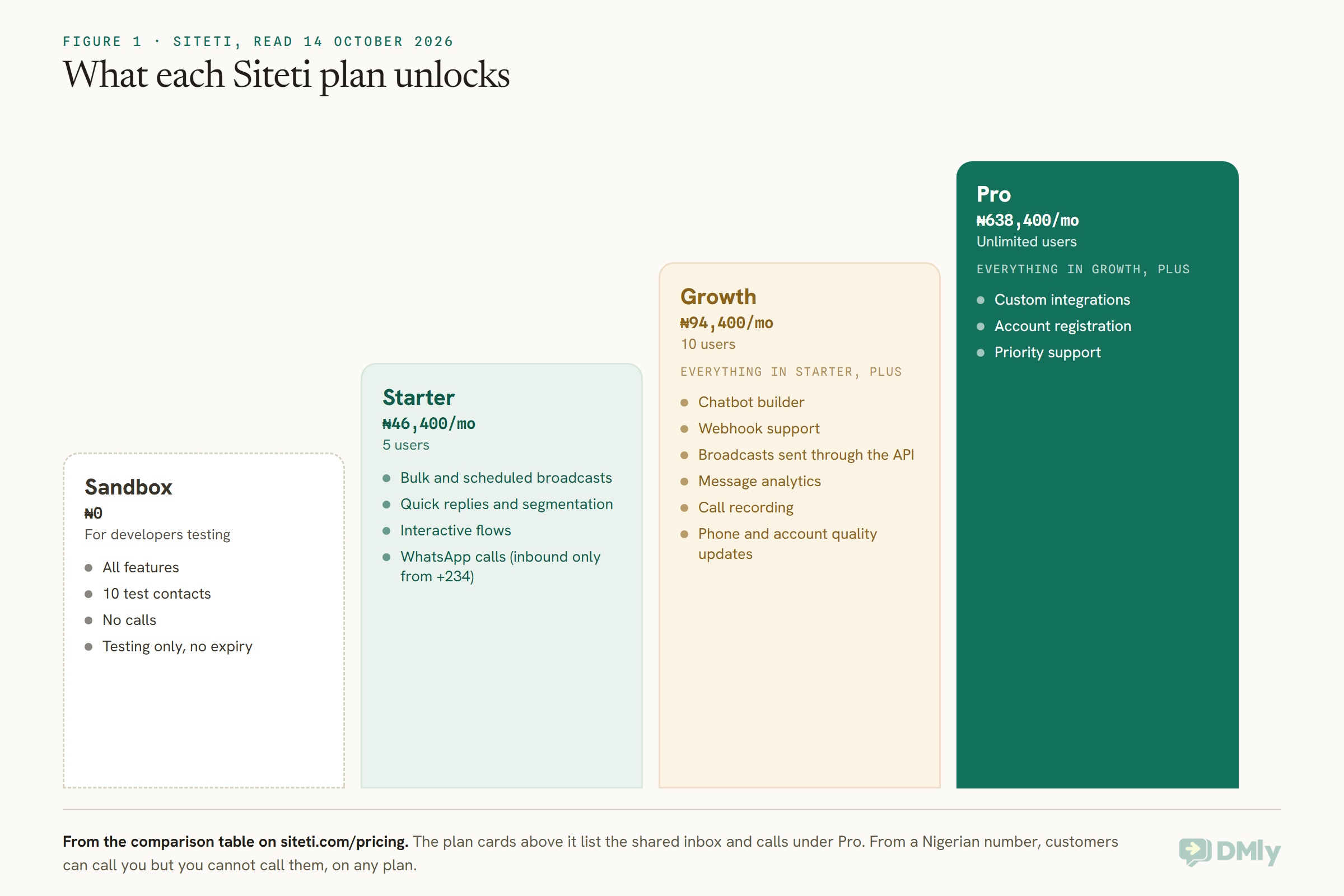
Read the table with your own team in mind and two things stand out in this Siteti review.
Automation isn’t on the entry plan. Starter gives you broadcasts and quick replies, plus “interactive flows”. But the chatbot builder, which is what most people mean by automation (the thing that answers “how much?” at midnight), starts on Growth at ₦94,400. So does webhook support, which is how Siteti hands a customer’s answer to your other systems.
There’s a cliff at the eleventh person. Growth seats ten. The eleventh user needs Pro, and Pro is ₦638,400 a month. There’s no add-on seat price on the page, so a team of eleven pays nearly seven times what a team of ten pays. For a large contact centre with thirty or sixty agents, unlimited users at that price can make sense. For a growing shop that has just hired its eleventh person, it’s a hard jump.
One more thing the page leaves unclear. The plan cards at the top list “Shared Team Inbox” and “Inbound and Outbound Calls” under Pro, as if they were Pro features. The detailed table underneath gives the shared inbox to every plan, with five, ten or unlimited users, and ticks calls on every plan too. We’ve drawn the table, because it’s the more specific of the two, but ask Siteti to confirm which is right for the plan you’re buying.
Who Pays Meta on Siteti? Three Pages Give Three Answers
On top of any WhatsApp platform’s subscription, Meta charges for the messages you send, and Siteti’s pricing page, its Nigeria pricing page and its API documentation each describe that charge differently. This matters more than anything else in this Siteti review, because for a business that broadcasts, Meta’s bill is often bigger than the platform’s.
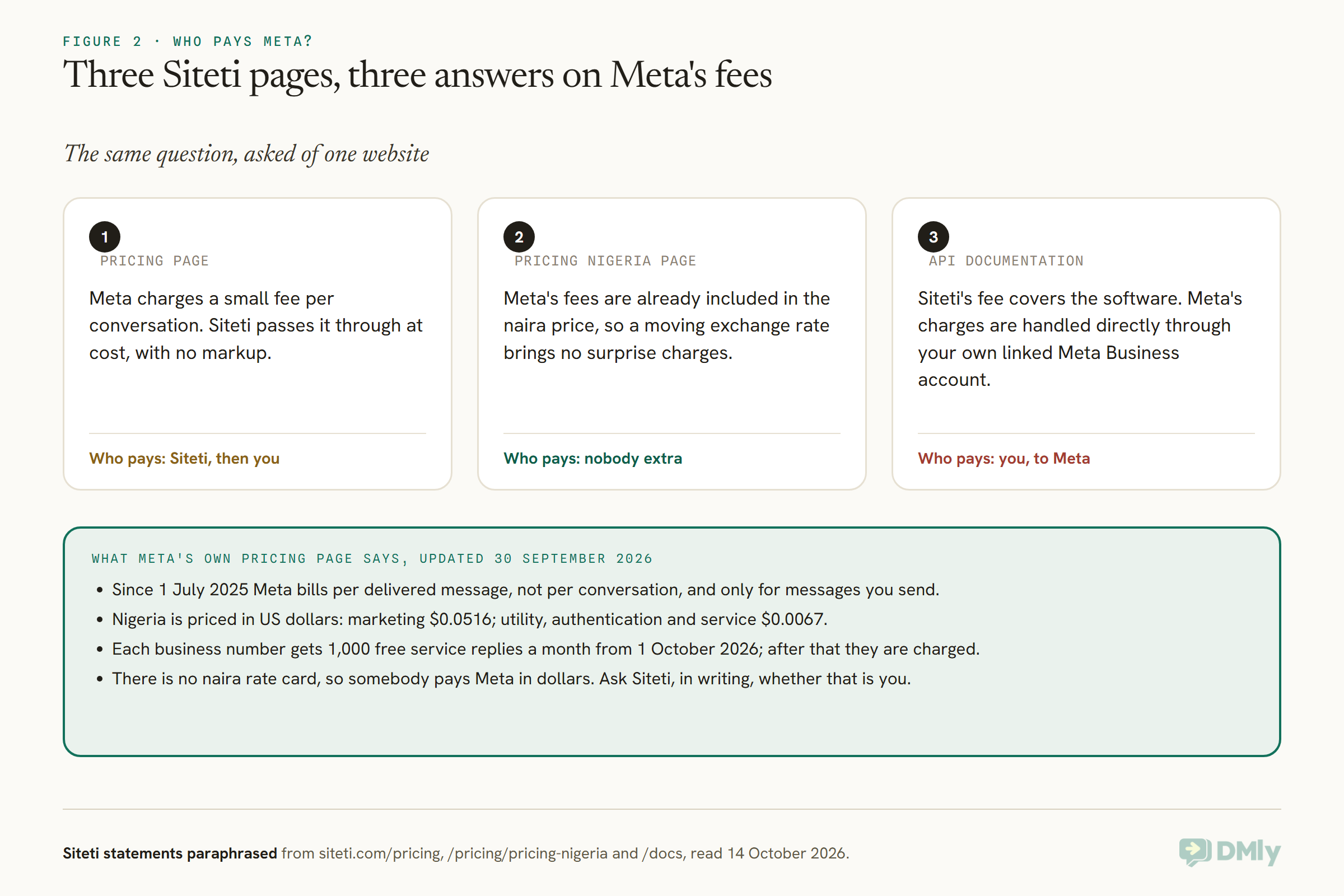
Here’s why each version changes your bill.
- If Meta’s fees are passed through at cost, Siteti pays Meta and charges you the same amount on top of your subscription. You’d want to know in which currency, and at which exchange rate.
- If they’re already included, as the Nigeria page says, your ₦46,400 covers the messages too. That would be remarkable value for anyone who broadcasts, and it would need a limit somewhere, which the page doesn’t give.
- If they’re billed to your own Meta account, as the API docs say, you add a payment method in Meta’s Billing Hub and Meta charges you in dollars, on your card, separately from Siteti.
We aren’t saying any of these is dishonest. Pages get written at different times by different people. But it’s the single question to settle before you sign up, and to get in writing.
There’s also a small correction to make, gently. Siteti’s pricing page says Meta charges “per conversation”. Meta stopped doing that on 1 July 2025: it now charges per delivered message, by category and by the customer’s country. Siteti’s own blog post of 12 October 2026 explains the per-message model well, so this looks like an old line on the pricing page rather than a misunderstanding.
What Meta actually charges for Nigerian numbers, from its US dollar rate card effective 1 October 2026, converted at the CBN central rate of ₦1,332.47 on 13 October:
| Message type | What it’s for | Meta’s rate | About, in naira |
| Marketing | Promotions, offers, broadcasts | $0.0516 | ₦68.76 |
| Utility | Order updates, reminders, receipts (now charged inside the 24-hour window too) | $0.0067 | ₦8.93 |
| Authentication | One-time passcodes | $0.0067 | ₦8.93 |
| Authentication, international | Passcodes where Meta’s international rate applies | $0.075 | ₦99.94 |
| Service | Free-form replies inside the 24-hour window | First 1,000 a month free per number, then $0.0067 | ₦8.93 after the first 1,000 |
Siteti’s blog quotes about $0.0101 (roughly ₦14) for a Nigerian service or utility message and about $0.062 for marketing. Those are higher than Meta’s current card, so plan with Meta’s figures, not either of ours. Our guide to the WhatsApp pricing change on 1 October explains the service-message change in full, and our WhatsApp Business API pricing by country page lists every market’s rates.
WhatsApp Calls on Siteti From a Nigerian Number
Siteti lets your team take WhatsApp voice calls in the browser on every paid plan and record them on Growth and Pro, but from a Nigerian (+234) business number Meta only allows customers to call you, not the other way round. The pricing table ticks “Inbound and Outbound Calls” on every plan, which is true in some countries. Siteti’s own virtual call center page says the honest part plainly: in Nigeria, only inbound calls are supported.
That isn’t a Siteti limit; it’s Meta’s. Meta’s calling documentation lists five countries whose business numbers can’t place calls to customers: the United States, Canada, Egypt, Vietnam and Nigeria. Calls customers make to you are free, and work everywhere. So the realistic setup for a Nigerian business is “customers tap call, your team answers in the browser”, which is genuinely useful if your customers like to talk.
Where Siteti stands out is call recording. It’s ticked on Growth and Pro, and the home page pitches it for quality control. If you run a support desk where someone needs to listen back to calls, that’s a real reason to choose Siteti today. One thing to understand first: Meta doesn’t let a business place WhatsApp calls to Nigerian numbers, so on a +234 line, recording means recording the calls your customers make to you. DMly takes WhatsApp calls too, as we’ll see below, and its call recording is coming soon, but it hasn’t been released yet, so we don’t count it here.
The free Sandbox doesn’t include calls at all, so you’ll need a paid plan to test calling properly.
The Free Developer Sandbox and the Siteti API
Siteti’s Sandbox is free forever and gives developers the full API (version 2.6), webhooks, flows, chatbots and catalogues to build against, limited to ten active test contacts and testing only. Once ten contacts are used, new messages pause and API requests for new contacts stop. It’s a thoughtful offer, and it’s rarer than it should be: most WhatsApp platforms, ours included, give you a time-limited trial rather than a free place to build.
The API itself is small and readable. You send templates in bulk, send free-form replies inside the 24-hour window, list your templates and segments, and receive events such as a first message from a new number, a window opening, a failed delivery, or a billing problem. There’s also a neat Nigerian touch: an inbound endpoint built for data from other systems, with a worked example where a Moniepoint POS payment saves the customer and sends a payment confirmation template in one call.
Two lines in the docs don’t match the rest of the site, though:
- The API introduction says it only works within “your 30-day free trial” or on an active Pro subscription. The pricing table puts API broadcasts and webhooks on Growth, and the solution pages advertise a 7-day trial. Ask which applies before you build an integration on Growth.
- The same docs say Meta’s charges are handled through your own Meta Business account, which is the third of the three answers above.
What This Siteti Review Found in Siteti’s Favour
Siteti’s real strengths are naira billing done properly, five users on a ₦46,400 plan, WhatsApp call recording, a free developer sandbox, and a Lagos-based team that understands how Nigerian businesses get verified. Here’s the fair list.
- Fixed naira prices. No dollar card, no exchange-rate surprises on the subscription, Nigerian debit cards through Paystack and Flutterwave, and bank transfer for yearly plans.
- Five users on the entry plan. Many platforms start at two or three seats. Siteti’s Starter seats five.
- Call recording on Growth and Pro, which few small-business WhatsApp tools offer.
- A free, permanent sandbox for developers.
- Local know-how on verification. Its setup guide covers the details Nigerian businesses trip over: matching your business name to your CAC documents character for character, using a utility bill that shows the same address, and choosing phone-call verification when SMS codes don’t arrive. If you’re doing it yourself, our step-by-step guide to completing Facebook business verification covers the same ground.
- Local support. A WhatsApp support line and a Lagos address. Its Wati comparison page claims 24/7 Lagos-based WhatsApp and phone support; the pricing table lists priority support on Pro only.
- Coexistence. Keeping the WhatsApp Business app on your phone while the API runs, with past chats brought across, is promised on the home page. (Its Cloud API setup FAQ says the opposite, so confirm it for your number.)
What Siteti’s Site Does Not List
As of 14 October 2026, Siteti’s site lists WhatsApp as its only messaging channel and doesn’t list AI replies, appointment booking, invoicing, a white-label or partner programme, contact limits or VAT treatment. “Not listed” isn’t the same as “doesn’t exist”, so if any of these matters to you, ask Siteti directly. But you can’t plan around a feature that isn’t on the page.
| What you might need | What Siteti’s site shows |
| Instagram, Facebook Messenger, TikTok, Telegram or a website chat widget | Not listed on Siteti’s site as of 14 October 2026. A CRM page mentions email and SMS in general terms, but no other channel appears as a product. |
| AI that writes replies | Not listed on Siteti’s site as of 14 October 2026. Siteti’s own blog describes its chatbot builder as a set of states and rules you design. |
| Bookings, deposits or no-show fees | Not listed as a feature. Industry pages mention chatbots that schedule inspections or appointments, but no booking calendar is described. |
| Invoices | Not listed. Pages mention Paystack, Flutterwave and Moniepoint payment links and payment-triggered messages. |
| White-label, reseller or agency partner programme | Not listed on Siteti’s site as of 14 October 2026. Pro is described as “for agencies”, which is a plan, not a partner programme. |
| Contact or broadcast limits per plan | Not published. The broadcast FAQ says reach depends on your plan. |
| VAT | Not stated on the pricing pages. |
| Where customer data is stored | Not stated. The privacy policy says data of users outside Nigeria may be stored in other jurisdictions. |
One gentle correction on compliance. Several Siteti pages describe the platform as built for the NDPR, the Nigeria Data Protection Regulation. Nigeria’s data law is now the Nigeria Data Protection Act 2023, with the GAID 2025 implementation directive that took effect on 19 September 2025; the Commission simply stopped applying the NDPR. One Siteti page already names the NDPA, so this is wording catching up. It matters for broadcasts: GAID Article 18(1) makes consent mandatory for direct marketing, with no soft opt-in for existing customers. Whichever platform you choose, only broadcast promotions to people who agreed to receive them.
DMly as a Siteti Alternative, Honestly
DMly is the Siteti alternative for a Nigerian business that wants WhatsApp plus its other channels, AI replies, bookings and naira payments in one tool, from ₦29,000 a month. We make DMly, so read this section as an interested party talking, and check every figure on our Nigeria pricing page.
Read on that page on 14 October 2026:
| Starter | Growth | Premium | |
| Monthly | ₦29,000 | ₦59,000 | ₦99,000 |
| Yearly | ₦290,000 | ₦590,000 | ₦990,000 |
| Team seats | 3 | 6 | 15 |
| Profiles per channel | 1 | 3 | 5 |
| Active contacts | 3,000 | 10,000 | Unlimited |
| Broadcast or template messages a month | 10,000 | 50,000 | 300,000 |
| AI replies a month | 500 | 5,000 | 20,000, or your own AI key for unlimited |
Add-ons: an extra seat is ₦6,500 a month, an extra profile set ₦9,500, and extra contacts ₦9,500 per 1,000. The trial is seven days on any plan, with no card. You pay by card, transfer or USSD through Paystack and Flutterwave. Prices already include 7.5% VAT.
What’s different from Siteti, in plain terms:
- All your channels in one inbox. WhatsApp, Instagram, Facebook Messenger, TikTok, Telegram and a live chat widget for your website, plus SMS through your own Twilio, Plivo or custom gateway, all in one inbox. Instagram connects with Instagram Login, so you don’t need a Facebook Page. Google Business Profile connects too, for your reviews.
- Automation and AI on every plan. The flow builder and the AI reply step are on Starter, with 500 AI replies a month included. You don’t have to move up a tier to answer “how much?” at midnight.
- Bookings that take deposits. A booking page with services, staff and classes. A service can take a deposit of 1 to 99% to book, and you can set a no-show fee.
- Invoices and pay links in naira. Send an invoice or a pay link in the chat and it’s marked paid when the money lands. Paystack, Flutterwave and Monnify are all available, and with Paystack a link can open straight onto a one-time bank account so your customer pays by transfer from their banking app. Our guide to WhatsApp payment links shows how it works.
- CRM and reviews. Tags, saved segments that update themselves, a pipeline, and automatic Google review requests.
- WhatsApp calls, with recording on the way. DMly takes WhatsApp voice calls in the inbox on every plan. From a Nigerian number it’s inbound only, exactly as with Siteti, because that’s Meta’s rule. Call recording is coming soon; until it ships, Siteti is ahead on this one.
- For developers and agencies. A REST API, webhooks for 83 kinds of event, and an MCP server so tools like Claude can work in your workspace. Agencies can let their own clients connect WhatsApp, Instagram and TikTok from inside the agency’s app, and can resell DMly under their own brand; our guide to white-label WhatsApp software for agencies covers the partner plans, which start at $97 a month for ten client workspaces.
- Meta billed directly, with no markup. You pay Meta yourself at its published rates. That’s simple and transparent, but it means a payment method in Meta’s Billing Hub and dollar charges on your card, because Meta has no naira rate card.
And one thing that’s the same: DMly supports coexistence too, so you can keep the WhatsApp Business app on your phone and bring up to 180 days of chats across when you connect.
When DMly Is the Wrong Choice
Choose Siteti over DMly if you need calls recorded, if you have a huge list and a tiny team, if your team is close to a hundred people, or if Siteti confirms in writing that Meta’s fees are included in its naira price. Each of those is a real case, so here they are with the numbers.
- You need call recording today. If listening back to customer calls is part of how you run quality or resolve disputes, Siteti Growth and Pro list it now. DMly’s call recording is coming soon but isn’t released yet, so if you need it this month, that settles it.
- You message a very large list with a very small team. DMly’s Starter covers 3,000 active contacts (people you’ve messaged, or who’ve messaged you, in the last 30 days); more cost ₦9,500 per 1,000, and unlimited means Premium at ₦99,000. Siteti doesn’t publish a contact limit. If Siteti confirms that Starter has no cap that would bite you, a three-person team messaging 20,000 people a month could pay less on Siteti’s ₦46,400 plan.
- Your team is around a hundred people. DMly Premium seats 15, and each extra seat is ₦6,500. Siteti Pro is ₦638,400 with no user limit. The two cross at about 97 people; beyond that, Siteti Pro costs less.
- You want one naira bill that includes Meta. DMly bills the platform in naira and Meta bills you in dollars, directly. If Siteti confirms its Nigeria page’s promise that Meta’s fees are included, that’s a genuine simplification for a business without easy access to dollar payments. Get the limits in writing.
- You’re a developer who wants a free, permanent sandbox. DMly offers a seven-day trial, not a forever-free build environment.
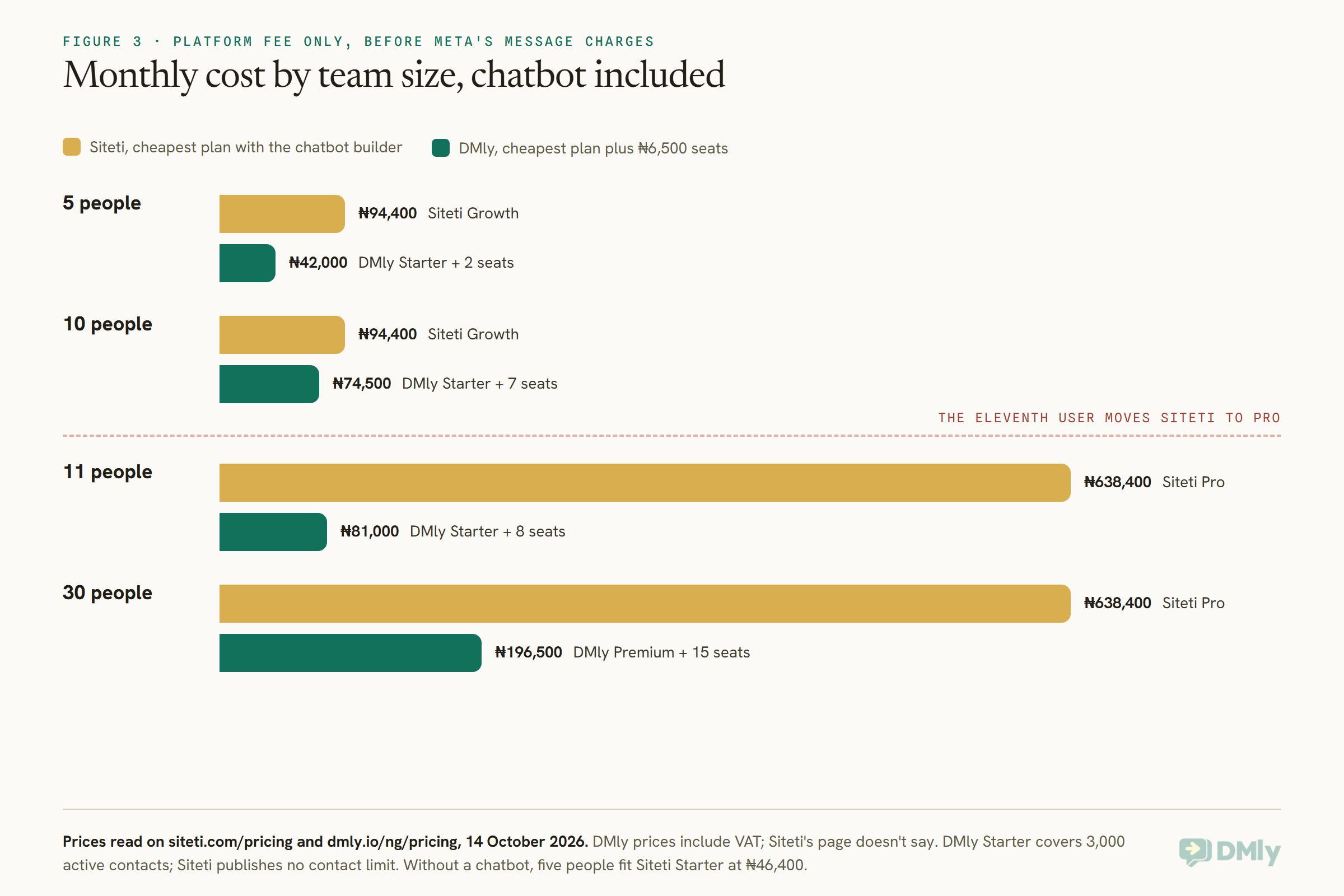
On seat price alone, DMly is cheaper at most team sizes: five people cost ₦42,000 on DMly’s Starter with two extra seats, against ₦46,400 on Siteti’s Starter. So “fewest naira per user” isn’t, on its own, a reason to choose Siteti below about 97 people. The reasons above are.
DMly vs Siteti, Side by Side
DMly vs Siteti comes down to breadth against focus: Siteti does WhatsApp with calls and recording, DMly does WhatsApp alongside six other channels, AI, bookings and payments. Here’s the comparison on what each company publishes.
| What you’re comparing | Siteti (read 14 Oct 2026) | DMly (read 14 Oct 2026) |
| Entry price | ₦46,400 a month, 5 users | ₦29,000 a month, 3 seats |
| Price for 6 to 10 users | ₦94,400 (Growth) | ₦48,500 to ₦74,500 (Starter plus seats) or ₦59,000 (Growth, 6 seats) |
| Price at 11 users | ₦638,400 (Pro) | ₦81,000 (Starter plus 8 seats) |
| Chatbot or flow builder | From Growth | Every plan |
| AI replies | Not listed | Every plan (500 a month on Starter) |
| Channels | WhatsApp, Instagram, Messenger, TikTok, Telegram, live chat, SMS, plus Google Business Profile | |
| WhatsApp calls from a +234 number | Inbound, every paid plan | Inbound, every plan |
| Call recording | Growth and Pro (calls customers make to you, on a +234 line) | Coming soon, not yet released |
| Bookings with deposits and no-show fees | Not listed | Every plan |
| Invoices and naira pay links | Payment links mentioned; invoices not listed | Every plan; Paystack, Flutterwave, Monnify |
| API and webhooks | Webhooks from Growth; docs say the API needs Pro or the trial | Every plan, plus an MCP server |
| Free option | Developer sandbox, 10 test contacts, no expiry | Seven-day trial, no card |
| Meta’s fees | Three different statements | Billed to you by Meta directly, no markup |
| Contact limits | Not published | 3,000 / 10,000 / unlimited active contacts |
| VAT | Not stated | Included in the price |
| White-label or reseller programme | Not listed | Yes, partner plans from $97 a month |
Three Nigerian Businesses, Priced Both Ways
For most small Nigerian teams that need automation, DMly costs less each month than Siteti, but a call-heavy support desk that must record calls today is better served by Siteti, at least until DMly’s call recording ships. Here are three worked examples for this Siteti review, with platform prices from 14 October 2026 and Meta’s charges at its Nigeria rates, converted at ₦1,332.47 to the dollar.
A fashion boutique in Ajah: four people, WhatsApp and Instagram
Four staff answer customers on WhatsApp and Instagram DMs. The owner sends two broadcasts a month to 2,500 opted-in customers and wants an automatic reply for price and delivery questions.
- Siteti: Starter at ₦46,400 covers the four people and the broadcasts, but not the chatbot builder, which needs Growth at ₦94,400. Instagram isn’t listed, so those DMs stay on the phone.
- DMly: Starter plus one seat is ₦35,500, with Instagram in the same inbox, flows and 500 AI replies. The 2,500 customers fit inside 3,000 active contacts, and 5,000 broadcast messages fit inside 10,000.
- Meta, either way: 5,000 marketing messages at $0.0516 is $258 a month, about ₦343,778. That’s the biggest number on this page, and it’s the same on both platforms if Siteti passes Meta’s fees through at cost. It’s why the “who pays Meta” question matters so much.
A dental clinic in Abuja: eight people, bookings and deposits
Eight people, one location. Patients book online, pay a 25% deposit by Paystack, and get a reminder the day before, about 600 a month.
- Siteti: eight users and reminders fit Growth at ₦94,400 (Starter stops at five users). Bookings and deposits aren’t listed, so you’d add a separate booking tool and pay for it too.
- DMly: Starter plus five seats is ₦61,500, with the booking page, 25% deposits, no-show fees and reminders included.
- Meta, either way: 600 utility reminders at $0.0067 is $4.02, about ₦5,357 a month. Replies to patients’ questions stay inside the 1,000 free service messages for most clinics this size.
A delivery company’s support desk in Lagos: thirty agents, calls recorded
Thirty agents. Customers call on WhatsApp about late parcels, and every call must be recorded for disputes. The team sends about 60,000 replies a month on one number.
- Siteti: thirty users means Pro at ₦638,400, which includes unlimited users and call recording.
- DMly: Premium plus fifteen seats is ₦196,500, with inbound WhatsApp calls in the inbox. But call recording hasn’t shipped yet (it’s coming soon), so if you need it now, choose Siteti.
- Meta, either way: after the first 1,000 free, 59,000 service replies at $0.0067 is $395.30, about ₦526,727 a month. Incoming calls are free.
Seven Questions to Put to Siteti Before You Pay
Before you choose Siteti, get written answers to seven questions: who pays Meta, VAT, contact limits, which plan includes the shared inbox and the API, trial length, who owns your WhatsApp account, and where your data lives. They’re the gaps and contradictions this Siteti review found, and any good provider will answer them in an email.
- Who pays Meta for my messages, in what currency, and is it inside my naira price? Ask for the answer that applies to your plan, and any limit if it’s “included”.
- Is VAT included in the price on the page?
- What contact and broadcast limits apply to my plan? The broadcast FAQ says reach depends on the plan, but no numbers are published.
- Does my plan include the shared inbox and the API? The plan cards, the comparison table and the API docs point in different directions.
- How long is the free trial: 7 days or 30?
- If you create my Meta business portfolio and WhatsApp Business Account, will they be in my name, with me as admin? This decides how easily you can leave later.
- Where is my customers’ data stored, and will you sign a data processing agreement under the NDPA 2023? Ask the same of any provider, us included: DMly’s documentation says customer data is hosted in Europe and the United States, and a signed agreement is available on request.
And one thing no provider can promise: “zero ban risk”. Meta decides whether a number is restricted, based on how people respond to your messages. Sending only to people who opted in is what keeps you safe, on any platform.
Moving Your Number Between Siteti and Another Provider
Your WhatsApp number can only sit with one provider at a time, but it belongs to you, so you can move it between Siteti, DMly or anyone else through Meta. What decides how painful that is comes down to a few things you can check today.
- Who owns the WhatsApp Business Account. If it’s in your own Meta business portfolio, your approved templates move with the number. If the provider owns it, the templates usually stay behind and you resubmit them.
- Two-step verification. Turn it off on the number before you start; migrations fail with it on.
- Chat history. Past conversations generally don’t move between providers. Export what you need before you switch, while you can still log in.
- Opt-outs. Export your list of people who asked not to be messaged, and load it into the new tool before your first broadcast. Ignoring an opt-out is the fastest way to a bad quality rating.
- Chatbots and flows. They don’t transfer between platforms. Plan a day to rebuild them.
If you’re starting from scratch rather than moving, our WhatsApp API setup guide for Nigeria walks through the whole process, from CAC documents to your first approved template.
Siteti Review: The ₦1,600 Dollar, Revisited
We started this Siteti review with an exchange rate hidden in a price list, and it turns out to be a fair summary of the whole product. Siteti has thought carefully about what it’s like to buy software in Nigeria: fixed naira prices, local cards, local verification help, a free place for developers to build, and calls your team can record. The ₦1,600 dollar is what that certainty costs, and plenty of businesses will happily pay it.
What the price list doesn’t tell you is just as important. The chatbot builder starts at ₦94,400. The eleventh user costs ₦544,000 a month more than the tenth. WhatsApp is the only channel. And three Siteti pages give three answers to the question that decides your real monthly bill: who pays Meta. Get that one in writing before anything else.
If your business is WhatsApp-only, ten people or fewer, and needs recorded calls, Siteti is a sensible choice and this review won’t talk you out of it. If you also sell on Instagram, take bookings, collect deposits or want AI answering the midnight questions, a broader Siteti alternative will cost you less and do more. You can see every DMly plan in naira on our Nigeria pricing page and try any of them free for seven days.
Frequently Asked Questions
Is this Siteti review independent?
No, and we say so up front. DMly competes with Siteti. Everything about Siteti here was read on Siteti’s own pages on 14 October 2026, and we’ve listed where Siteti is the better choice. Check the figures yourself before you decide.
How much does Siteti cost in Nigeria?
On 14 October 2026, Siteti pricing was ₦46,400 a month for Starter (5 users), ₦94,400 for Growth (10 users) and ₦638,400 for Pro (unlimited users), or 6% less on yearly billing. In dollars, the same plans are $29, $59 and $399. A free developer Sandbox is limited to 10 test contacts. Meta’s message charges and any VAT aren’t clearly stated, so ask.
Does Siteti include Meta’s WhatsApp fees in its price?
Siteti’s own pages disagree. Its pricing page says Meta’s fees are passed through at cost, its Nigeria pricing page says they’re already included, and its API documentation says they’re billed through your own Meta Business account. Ask Siteti which applies to your plan, in writing.
Can Siteti make outbound WhatsApp calls in Nigeria?
Not from a Nigerian number. Meta doesn’t allow business-initiated calls from business numbers registered in Nigeria, and Siteti’s own call center page says Nigeria is inbound only. Your customers can call you for free, and Siteti can record those calls on Growth and Pro.
Does Siteti have an AI chatbot?
Siteti has a chatbot builder from the Growth plan, which works on rules and steps you design. AI-written replies are not listed on Siteti’s site as of 14 October 2026.
What is the best Siteti alternative for Nigerian businesses?
It depends on what you need beyond WhatsApp. If you want Instagram, Messenger, TikTok and your website chat in one inbox, with AI replies, bookings with deposits and naira pay links, DMly does all of that from ₦29,000 a month. If you need recorded WhatsApp calls, Siteti remains the better fit.
Can I move my WhatsApp number from Siteti to DMly?
Yes. Your number belongs to you and can move between providers through Meta. Turn off two-step verification first, check who owns your WhatsApp Business Account so your templates come with you, and export your chats and opt-out list before you switch.
Writing about WhatsApp automation, bookings and growth for local business.
Turn WhatsApp into your busiest channel.
Start free and run message, bookings, payments and reviews in one place.
