
TextYess Review 2026: The Price Is a Formula, Not a Number
The number at the top of the TextYess pricing page looks like a price. It is not one. It is a floor, and that is where this TextYess review has to start.
Underneath it sit three dials, and every one of them adds money. Turn the first from 1,000 outbound messages to 7,000, and the second from 1,000 AI replies to 3,000, and the same plan reads 1,135 euros a month. That is the single most useful thing to know before you shortlist this platform, and it is the thing this page previously left out.
So this page has been rewritten around the money. What the entry plan includes, what each extra message costs, where the published price stops existing altogether, and why the same plan carries three different price tags depending on which of their pages you open.
Everything below was read on 6 September 2026 from TextYess’s own pricing page, their Italian pricing page, and their Shopify App Store listing. We have not run the platform on a paid account, so you will not find a verdict here on how it feels to use day to day. What you will find is the arithmetic, done properly, and an honest account of where DMly is a sensible alternative and where it is not.
Who TextYess Is, and Where It Sells
TextYess is a Sicilian software company selling an AI shopping assistant to online stores. The footer of their own site names the entity, TextYess S.R.L., with the Italian VAT number 03748980830, and their Shopify App Store listing gives the registered address as Via Cesare Battisti 303, Messina. The same listing dates the launch of their Shopify app to 14 September 2023 and shows a 5.0 rating from 48 reviews.
That matters more than it sounds. The site is published in exactly two languages, English and Italian, and the Italian half is not a translation afterthought: it is where the prices are quoted in the currency the company actually bills in. Their case studies are Italian and Spanish brands. If you are shopping from outside Europe, you are buying from a European vendor whose price list is written in euros, and the section below on the three price tags is about exactly that.
One correction to make straight away. The earlier version of this review said TextYess runs on WhatsApp and on-site chat. There are now three surfaces, not two. Their pricing page lets you tick WhatsApp, On-site Chat and Voice Agent, and their own footer marks the voice product “Voice (Beta)”. The voice agent answers phone calls rather than messages, and it is priced by the minute, which we will come to. An assistant that answers a phone call is a different animal from one that answers a message, and it is worth reading our note on what separates an AI agent from a chatbot before you judge either.
Their Shopify listing also names the tools they connect to: Checkout, Gorgias, Instagram, Klaviyo, WhatsApp and Zendesk. That confirms the Klaviyo, Gorgias and Zendesk connections this review has always claimed, and adds Instagram, which their own pricing page does not offer as a tickable channel. If Instagram matters to you, that gap between the two pages is worth a question to their sales team before you sign.
TextYess Pricing in 2026: One Plan, Three Meters
There is one paid plan, called Pro, and an unpriced Enterprise tier above it. Pro starts at 249 euros a month, which is what the earlier version of this review said and is still correct. What was missing is everything the base price does not cover.
The base buys you one channel and a very small amount of usage. Here is what 249 euros actually includes, read from the pricing page with every dial at its lowest setting.
| What the base includes | Amount | What it costs to go past it |
|---|---|---|
| Messaging channels | One, your choice of the three | 100 euros a month for each extra channel |
| Outbound messages | 1,000 a month | 12 cents each, on the WhatsApp channel |
| AI replies | 1,000 a month | 8.3 cents each on monthly billing |
| AI voice minutes | 100 a month, only if you take the voice channel | 39 cents a minute on monthly billing |
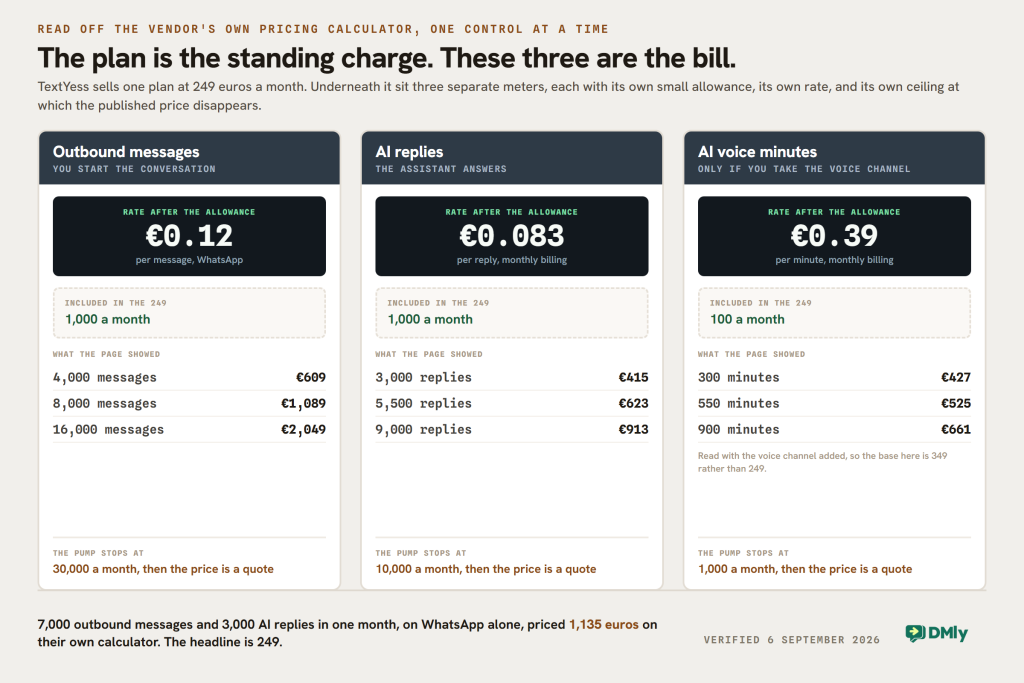
Those unit rates are not printed anywhere on their site. We derived them the honest way, by setting each dial to several positions and writing down the price the page returned each time. Six readings of the outbound dial gave 249 euros at 1,000 messages, 609 at 4,000, 1,089 at 8,000, 2,049 at 16,000, 2,889 at 23,000 and 3,369 at 27,000. Every one of those is the base plus twelve cents for each message above the first thousand.
The AI reply meter is separate from the message meter, and both run at once. This is the part that catches people out. An AI reply is the platform answering a customer. An outbound message is you starting a conversation. A busy month generates both, and they are billed on different rates against different allowances.
Here is the configuration we built on their own calculator, which is not an extreme one for a store running WhatsApp campaigns: WhatsApp only, 7,000 outbound messages and 3,000 AI replies in the month. The page returned 1,135 euros. The headline is 249. The realistic bill for a store that actually uses the thing is four and a half times that, and none of it is hidden: it is simply behind a control that most people never touch before they book a demo.
Where the Published Price Stops Existing
Each dial has a ceiling, and the ceiling does something worth knowing about. Push any one of the three to its maximum and the price disappears. The Pro card stops showing a figure at all and reads “Custom Pricing, Billed Annually”.
- Outbound messages stop at 30,000 a month. The dial labels the top position “30.000+” and the price vanishes.
- AI replies stop at 10,000 a month. Same behaviour.
- AI voice minutes stop at 1,000 a month. Same behaviour again.
This is not a criticism. Plenty of vendors stop publishing above a certain size, and saying so on the card is better than pretending. But it does define the shape of the product: TextYess publishes a price for stores sending fewer than 30,000 WhatsApp messages a month, and quotes for everyone above that. If your December sends 40,000, the number you plan around is a number you have to ask for.
Annual billing takes 20 per cent off the whole calculation, so the same base of 249 euros becomes 199.20 a month, paid a year at a time. Their English card renders this as 171 pounds, which is a separate problem and the subject of the next section.
The Same Plan Carries Three Different Price Tags
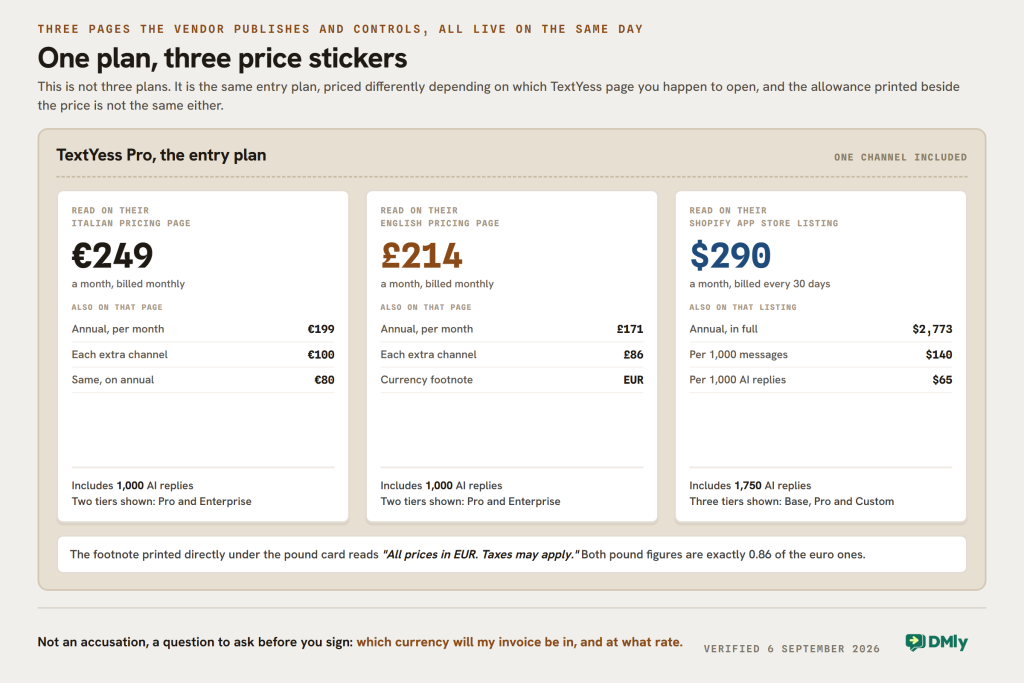
This is the finding that took the longest to pin down, and it is the one to raise with their sales team before you sign anything. One plan, three published prices, all live on 6 September 2026.
| Where you look | Entry price | AI replies included | Tiers shown |
|---|---|---|---|
| Their Italian pricing page | 249 euros a month | 1,000 | Pro, Enterprise |
| Their English pricing page | 214 pounds a month | 1,000 | Pro, Enterprise |
| Their Shopify App Store listing | 290 US dollars a month | 1,750 | Base, Pro, Custom |
Start with the pound. The English card shows 214 pounds a month and 86 pounds for each extra channel. The footnote directly beneath the same card reads, in their words, “All prices in EUR. Taxes may apply.” The Italian card shows 249 euros and 100 euros. Divide one by the other and both pairs give the same ratio, 0.86.
The likely explanation is straightforward and not sinister: the English page appears to be converting the euro price at a fixed rate rather than pricing separately in sterling, which is why the footnote still says the prices are in euros. We are not asserting that as a finding of fact, because only TextYess can confirm it. What we can tell you is the question to ask: which currency will my invoice be denominated in, and at what rate. A fixed conversion is fine when it is disclosed. It is only a problem when a buyer budgets in pounds and gets billed in euros.
The Shopify listing is a different product description altogether, and it is worth reading even if you never install from there. It publishes three named tiers rather than two, includes 1,750 AI replies a month rather than 1,000, and prints two unit rates their own website never mentions:
| Shopify tier | A month | A year | Outbound messages | Saving on annual |
|---|---|---|---|---|
| Base | $290 | $2,773 | 1,000 | 20 per cent |
| Pro | $436 | $4,166 | 2,000 | 20 per cent |
| Custom | $533 | $5,560 | 3,000 | 13 per cent |
The Custom card carries the sentence that makes all this worth the effort: “$140 per 1,000 outbound WhatsApp messages. $65 per 1.000 AI Replies.” That is 14 cents a message and 6.5 cents an AI reply, against the 12 cents and 8.3 cents their own calculator charges in euros. Messages are dearer through Shopify, AI replies are cheaper, and neither page mentions the other.
One more line on that listing deserves a note: “All charges are billed in USD. Recurring and usage-based charges are billed every 30 days.” Billing every 30 days is not the same as billing monthly. It produces just over twelve bills in a calendar year, which is standard for Shopify apps and entirely disclosed, but it is not what most people picture when they read “a month”.
A detail that runs the other way, in the buyer’s favour. The line above the channel tick boxes says extra channels are 100 euros a month each, and it says that on the annual view too. It is out of date in your favour: switch to annual with two channels and the page charges 279 euros against 199 for one, so the second channel actually costs 80 euros a month, not 100. The discount applies to the add-on as well as the base, and their own label has not caught up.
The Bill That Is Not on Either Page
Everything above is what TextYess charges. Meta charges separately for WhatsApp messages, and neither the TextYess pricing page nor the Shopify listing mentions it.
We are not going to tell you they are hiding it. Plenty of platforms leave Meta’s charges off the pricing page because the amount depends on which country your customers are in. But when a platform meters you at twelve cents an outbound message, you need to know whether that twelve cents includes Meta’s charge or sits on top of it, and the pages do not say. Ask them directly: is Meta’s per-message charge inside your per-message rate, or billed to me separately. The answer changes the total by a meaningful amount, and it is a fair question that any vendor should be able to answer in one sentence.
This matters more from October than it used to. Meta’s own upcoming-pricing documentation now carries two dated changes, both effective on 1 October 2026, in Meta’s words: it “will charge on a per-message basis for all service messages, consistent with how Meta charges for template messages”, and it “will charge on a per-message basis for utility messages sent in response to users (within an open 24-hour customer service window)”. Service messages had been free since November 2024, and in-window utility messages since July 2025. Read the first of those alongside the allowance on Meta’s main pricing page: from the same date every business phone number will get 1,000 free service messages a month, with no rollover and a reset every month, so the meter only starts at the 1,001st. In-window utility messages get no such allowance, so they are charged from the first one, which for many stores is the larger of the two new bills.
The detail almost nobody covers is on that upcoming-pricing page: “Volume tiers: None. Meta will not offer volume tiers for service messages. Meta continues to offer volume tiers for utility and authentication messages.” Past that free thousand, service message cost therefore scales in a straight line with how much your assistant talks. For a platform whose selling point is an AI that answers customers all day, a thousand free service messages a month is not much headroom on the WhatsApp channel. Model both new charges before you commit to a year. We have written up what actually becomes billable on 1 October, and the per-country rate card shows what a message costs where your customers are.
What TextYess Does Well, and Two Things This TextYess Review Withdrew
Now the part that justifies the price, because there is one.
The AI is wired to your product catalogue, and that is a real difference rather than marketing. Their Shopify listing describes it plainly: an AI assistant “seamlessly connected to your product catalog”, running alongside broadcast campaigns, abandoned-cart recovery and post-purchase follow-ups. When a customer asks whether the navy version comes in a 42, an assistant with catalogue access answers from stock. An assistant without it either guesses or fetches a human.
Most of the platforms in this category sell flows and templates, and their AI answers from a document you uploaded. TextYess sells the shop assistant. If that is the job you are hiring for, this is a product built for it rather than a product that can be bent towards it.
Three other things they publish that are worth knowing:
- They will supply the phone number. Their setup steps say “Use a new number or let us provide one. We’ll take care of the rest.” If you would rather not put your shop’s main number on the WhatsApp Business Platform, that removes the most common blocker to getting started.
- Seven days free, on every card. Every button on the pricing page carries “7-day free trial”, including the one under Enterprise, which is unusual for a tier that is sold by a salesperson.
- They publish results, and you should read them as their figures rather than as findings. Their WhatsApp page counts up to a 15 times return on ad spend, a 10 per cent conversion rate and 85 per cent of conversations handled with no human. No methodology, sample or period is published alongside them, so treat them as the vendor’s claim about the vendor’s best accounts. That is not an accusation. It is how every number on every vendor’s home page should be read, ours included.
Two criticisms have been removed from this TextYess review because we could not support them. The old version said TextYess had “limited flexibility beyond sales use cases” and shallow CRM depth. We have not run the product on a paid account, so those were adjectives rather than findings, and adjectives about software you have not used do not belong in a review. What stays is what their own pages support: this is a sales and support assistant for online stores. Nothing on their website or their Shopify listing offers appointment booking, invoicing or review collection, and that is the real dividing line between a shop assistant and a general business platform.
DMly as a TextYess Alternative: the Honest Version
We make DMly, so start with the thing that goes against us.
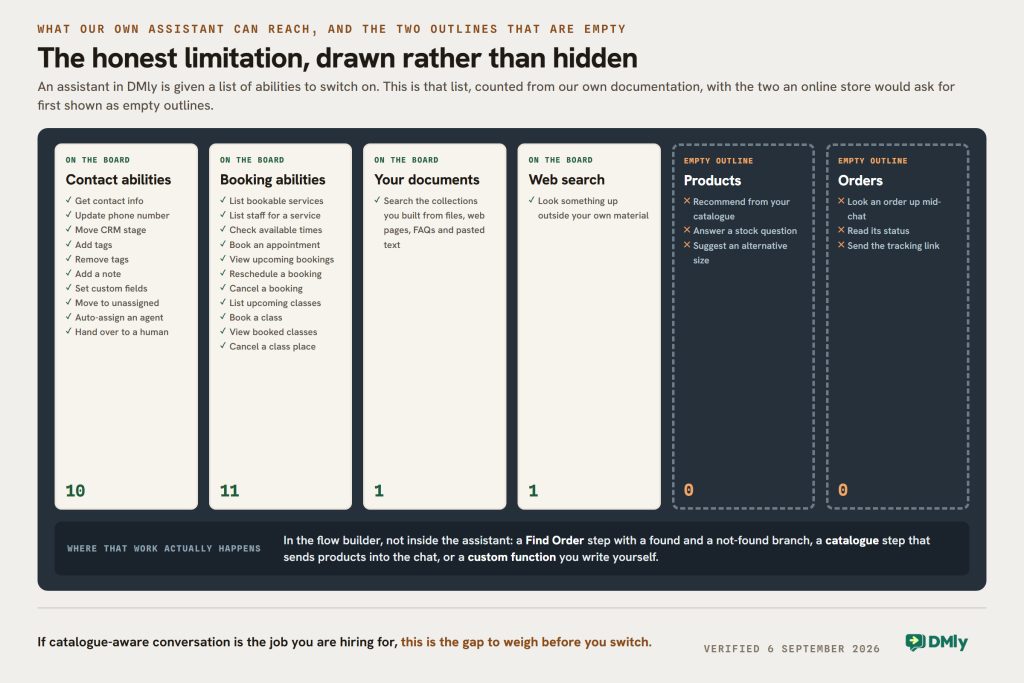
DMly’s AI cannot look up an order or recommend a product on its own. The AI reply step in DMly is given a list of abilities to switch on, and our documentation lists them: ten CRM abilities that read and write the contact in front of it, eleven booking abilities that check availability and book, reschedule or cancel appointments and classes, a search across your own uploaded documents, a web search, and custom functions you define yourself. There is no product ability and no order ability on that list. Ask a DMly assistant “has the navy one come back in” and it will answer from a document if you gave it one, and otherwise it will not know.
That is precisely the job TextYess sells, so if catalogue-aware conversation is what you are buying, they do it natively and we do not.
The workaround is real, and it is worth knowing before you decide. Store knowledge in DMly lives in the flow builder rather than inside the AI, and the flow builder reaches everything the AI cannot:
- Order lookups happen in a Find Order step. It looks the order up against the person you are talking to, or by order number, and splits the flow into a found branch and a not-found branch that both have to be connected before you can publish. The found branch hands you the order number, status, total and tracking link to use in the reply. Our template library ships this as a ready-made “where is my order” automation, and the not-found branch passes the chat to a person rather than looping.
- Products go into the chat through a catalogue step. You can send the whole catalogue, one product by its SKU, or a named list of products. The catalogue itself is Meta’s, connected to your WhatsApp Business Account in Commerce Manager rather than built in DMly, and the whole pipeline from browsing to payment is set out in our guide to selling products inside a WhatsApp chat.
- Anything else goes into a custom function. You define an HTTP call with a name, a description and a parameter schema, and the AI decides when to call it. That is a developer job, not an afternoon.
So the honest summary is this: DMly automates a store very well and converses about a store less well. If your customers mostly ask “where is my order” and you mostly want to chase abandoned carts and confirm cash-on-delivery orders, the flow builder does that without an AI at all. If your customers ask open-ended questions about products all day, TextYess is built closer to that shape.
What DMly Does That TextYess Does Not
DMly connects to Shopify and WooCommerce directly, with ten store triggers behind the connection. The connection uses a custom app token from your own Shopify admin, and the first sync brings in your products, your customers and ninety days of orders. After that the store’s own webhooks keep it current. Two honest details published in the same place: the initial sync never fires automations, so connecting a store with ten thousand historical orders will not message anybody, and there is no store-order browser in DMly, because the synced data exists to power automations rather than to be browsed.
What that connection buys you is the ordinary work of running a shop on WhatsApp, and there is a longer walkthrough in our guide to Shopify store sync and abandoned carts on WhatsApp:
- Abandoned checkouts, which fire when a started checkout goes quiet for about an hour, once per checkout, and skip anyone who went on to buy. On WooCommerce there is no checkout object, so an unpaid pending order is what counts instead. What the message itself should say is a separate craft, covered in our piece on follow-ups that actually recover a cart.
- Cash-on-delivery confirmation, filtered so card orders never see it, sending a form with a confirm button and writing a note back onto the store order where your fulfilment staff will see it. Dispatch on confirmation rather than on silence.
- Back in stock and low inventory, which have no single recipient, so the flow runs for everyone holding a tag you nominate, capped at 500 contacts per event.
- Customer milestones, which fire once per customer when total spend or order count crosses a threshold you set.
One gap in our own documentation, stated because you would find it eventually: the payment-failed store trigger never fires from Shopify, because Shopify does not report a failed checkout payment as an event. It works on WooCommerce.
Beyond the store, the difference is scope. TextYess sells three surfaces. DMly connects seven messaging channels, plus a Google Business Profile connection that handles reviews and posts rather than chat, and adds bookings, invoices and payments, loyalty and review collection on top of the messaging.
| TextYess | DMly | |
|---|---|---|
| Entry price | 249 euros a month, one channel | $29 a month billed yearly, $39 monthly |
| What the entry price meters | 1,000 outbound messages, 1,000 AI replies | 6,000 broadcast or template messages, 500 AI replies, 3,000 active contacts |
| Cost above the allowance | 12 cents a message, 8.3 cents an AI reply | Move up a plan; extra contacts $15 per 1,000 |
| Messaging channels | WhatsApp, on-site chat, voice agent (their footer marks voice as beta) | WhatsApp, Messenger, Instagram, Telegram, SMS, TikTok, live chat widget |
| AI that answers from your product catalogue | Yes, it is the product | No, only through a flow step or a custom function |
| Shopify and WooCommerce store events | Shopify, via their app | Both, ten triggers including abandoned checkout and cash on delivery |
| Bookings and appointments | Not offered on their site | Services, staff and classes, with AI booking abilities |
| Invoices and payments | Not offered on their site | Invoices, payment links, subscriptions, loyalty |
| Google reviews | Not offered on their site | Review requests and a reputation inbox |
| Markup on Meta’s WhatsApp charges | Not stated either way | None. Our pricing page says you pay Meta’s standard per-message rates directly |
The Smallest Cheque Each One Will Take
Comparison tables flatter whoever writes them, so here is the least flattering number instead: the smallest amount of money that gets you a working account.
| Route | Smallest first payment | What it commits you to |
|---|---|---|
| TextYess, monthly, one channel | 249 euros | One month |
| TextYess, annual, one channel | About 2,390 euros | A year, at 199.20 a month |
| TextYess through Shopify, Base | $290 | Thirty days |
| DMly, monthly | $39 | One month |
| DMly, annual | $348 | A year, at $29 a month |
That gap is not an argument on its own. A store turning over enough to justify a dedicated AI shopping assistant will not be deterred by 249 euros, and a platform that recovers three carts a month has already paid for itself. The gap matters when you are testing. Finding out whether conversational commerce works for your shop costs 249 euros a month with one vendor and $39 with the other, and most shops discover the answer in the first six weeks.
Where This TextYess Review Lands
Buy TextYess if the assistant is the point. You run a Shopify or direct-to-consumer store with steady traffic, your customers ask real questions about products, and you want an AI that answers from live catalogue and order data without a human in the loop. Budget for the meters, not the headline: work out your monthly outbound volume and your expected AI replies, put them into their calculator before the demo, and take that number to the sales call.
Buy DMly if the shop is one part of a wider business. Bookings as well as orders, invoices as well as carts, more than one messaging channel, and a budget that has to survive a quiet quarter. You get store automation that is genuinely good and conversational product search that is genuinely not there, and you should decide which of those two you actually need before you pay anybody.
Buy neither yet if you have not modelled 1 October. Both platforms sit on top of Meta’s charges, and from that date two categories of message that used to be free start carrying a charge: utility messages sent inside an open 24-hour window, from the first one, and service messages only once you pass the 1,000 a month that every business phone number will get free. Whichever way you go, do the sums on the new basis rather than on last quarter’s bill.
Frequently Asked Questions
How much does TextYess cost?
The Pro plan starts at 249 euros a month for one channel, 1,000 outbound messages and 1,000 AI replies. Above those allowances their calculator adds 12 cents per outbound message and 8.3 cents per AI reply, and each extra channel is 100 euros a month. Annual billing takes 20 per cent off. The same plan is shown as 214 pounds on their English page and $290 on their Shopify App Store listing.
Is TextYess good for Shopify?
It is built for it. Their Shopify app launched in September 2023, holds a 5.0 rating from 48 reviews, and the listing describes an AI assistant connected to your product catalogue alongside broadcast campaigns, abandoned-cart recovery and post-purchase automation. Note that installing through Shopify puts you on a different price list from the one on their website, with three tiers instead of two and different usage rates.
Does TextYess support multiple channels?
Three, and you pay for each one. WhatsApp, an on-site chat widget and an AI voice agent that their own footer marks as beta. The first is included in the 249 euros and each additional one adds 100 euros a month on monthly billing, or 80 on annual. Their Shopify listing also names Instagram among the tools the app works with, which their pricing page does not offer, so ask about it if it matters.
Does the TextYess price include what Meta charges for WhatsApp?
Their published pages do not say, in either direction. Meta already bills separately for template messages, which are the marketing, utility and authentication categories, whenever a template reaches out to a customer. Two further charges start on 1 October 2026. Service messages become chargeable beyond the first 1,000 a month, which every business phone number will get free, with no rollover. And utility templates sent inside an open 24-hour customer service window, free today, become chargeable from the very first one with no allowance at all. Rates vary by the country your customer is in. Ask TextYess whether their per-message rate includes Meta’s charge or sits on top of it before you sign, because the answer moves the total.
What is the best TextYess alternative?
It depends on which half of TextYess you are replacing. For catalogue-aware AI conversation, look for a platform that says plainly that its assistant reads your product and order data, because most of the WhatsApp automation tools on the market do not. For store automation, multiple channels and a lower entry price, DMly starts at $29 a month billed yearly, connects Shopify and WooCommerce with ten store triggers, and adds bookings, invoices and review collection that TextYess does not offer. What DMly does not have is an AI that browses your catalogue unprompted, and that is worth knowing before you switch.
Is this TextYess review based on hands-on testing?
No. Everything here comes from pages TextYess publishes and controls, read on 6 September 2026: their English and Italian pricing pages, their product pages, and their Shopify App Store listing. We moved the controls on their own pricing calculator and recorded the prices it returned, which is how the per-unit rates in this article were worked out. We have not bought a paid account, so this TextYess review makes no claim about how the product performs in daily use, and every adjective that implied otherwise has been removed.
Writing about WhatsApp automation, bookings and growth for local business.
Turn WhatsApp into your busiest channel.
Start free and run message, bookings, payments and reviews in one place.
