
Best GoHighLevel Alternatives for Agencies and Local Businesses in 2026
If you’re reading about GoHighLevel alternatives, there’s a fair chance the cancellation email is already written. It’s sitting in your drafts: a polite line to HighLevel’s billing team, something about “exploring other options”, and an empty To field.
Don’t send it yet. Not because the reasons you wrote it are wrong. A bill that arrives in three layers, clients who log in for two features out of twenty, and a WhatsApp channel that costs extra per client are all real reasons people leave. But HighLevel is very good at a few things, and the wrong replacement can leave you rebuilding thirty funnels, a phone system and an email programme in a tool that was never built for them.
So this guide does the homework first. We’ll look at what HighLevel actually costs in 2026, read from its own pricing page and help centre; where it is still stronger than anything on this list; ten alternatives for agencies and for single local businesses, each priced at source; what moving really involves; and where our own product, DMly, is the wrong choice. By the end you’ll know whether to send that email, rewrite it, or delete it.
The Short Answer: GoHighLevel Alternatives by Who You Are
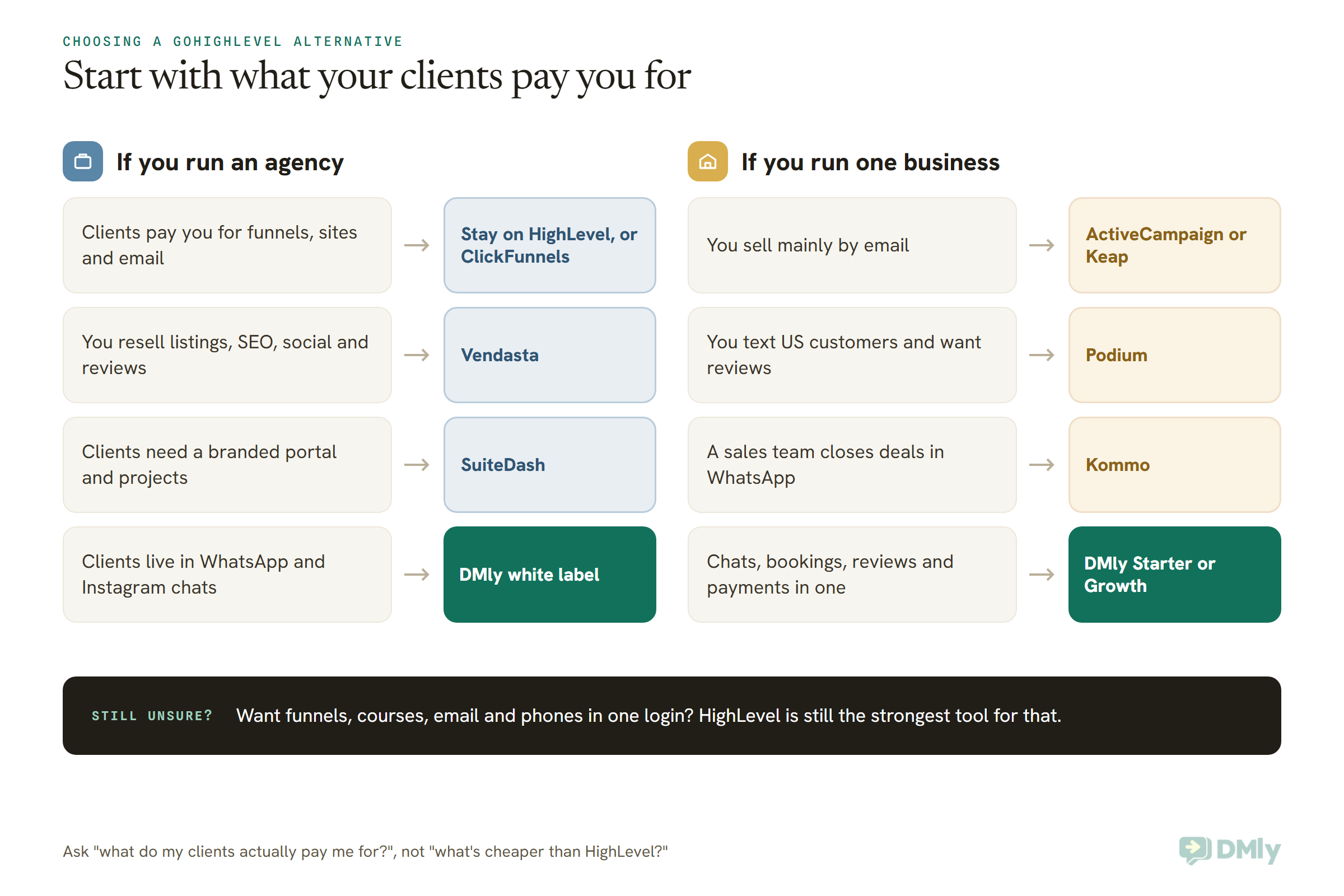
There is no single best GoHighLevel alternative, because HighLevel does a dozen jobs and most people only want to replace two or three of them. Start with the row that sounds like you.
| If you are… | Look at | Why | Watch out for |
| An agency selling funnels, websites and email | Stay on HighLevel, or ClickFunnels | Nothing else here builds funnels, sites and email in one place as well | ClickFunnels has workspaces, not white labelling |
| An agency reselling listings, SEO, social and reputation | Vendasta | A wholesale catalogue of products you resell at your own price | A monthly minimum spend, and a one-year contract above Starter |
| An agency or consultant whose clients need a branded portal | SuiteDash | Flat price, unlimited users, proposals, projects and invoices | No SMS, WhatsApp or funnels on its pricing page |
| An agency whose clients live in WhatsApp and Instagram chats | DMly white label | Every chat channel included, bookings, reviews, your own Stripe | No funnels, email campaigns or phone system |
| A coach or creator selling courses on a budget | Systeme.io | Funnels, email and courses, with a free plan | Not white label |
| A local business that sells by email | ActiveCampaign or Keap | Deep email automation and a CRM | Keap requires paid implementation; texting is US only |
| A US business that wants texting and reviews with a sales rep | Podium | Reviews, texting, phones and webchat, with onboarding | Starts at $399 a month |
| A sales team closing deals in WhatsApp | Kommo | A pipeline built around chat, priced per seat | Six-month minimum, no monthly billing |
| A local business wanting chats, bookings, reviews and payments together | DMly Starter or Growth | All channels and bookings on every plan, from $29 a month billed yearly | No funnels, email campaigns or phone system |
| A growing company that wants a large CRM ecosystem | HubSpot | A huge app marketplace and mature CRM | WhatsApp sits on Professional tiers and above |
The rest of this guide explains each of those verdicts, with the prices behind them.
What GoHighLevel Costs in 2026, Read at Source
GoHighLevel pricing starts at $97 a month for three client accounts, rises to $297 for unlimited accounts and $497 for SaaS mode, and then adds per-client add-ons and pay-as-you-go usage on top. We read all of this on HighLevel’s own pricing page and help centre on 13 October 2026.
The three plans
Starter is $97 a month or $970 a year. You get three sub-accounts (a sub-account is one client business inside your agency), unlimited contacts, unlimited users and what HighLevel calls all core features. Unlimited is $297 a month or $2,970 a year: unlimited sub-accounts, the ability to pass phone and email costs to clients at cost (HighLevel calls this rebilling), and basic API access. Agency Pro is $497 a month or $4,970 a year and adds SaaS mode, which lets you sell subscriptions from your own website and create client accounts automatically, plus rebilling with your own markup and advanced API access. An Enterprise plan is priced by quote and includes HighLevel’s white label mobile app and HIPAA compliance.
Every plan starts with a 14-day free trial, and HighLevel says it runs month to month with no long-term contract.
The per-client add-ons
This is where a quote to a client starts to wobble. Several features are charged per sub-account, every month:
- WhatsApp: $10 a month per WhatsApp-enabled sub-account, plus message usage.
- AI Employee: $50 a month (Growth) or $97 a month (Unlimited) per sub-account.
- Branded Client Portal App: $49 a month per sub-account.
- Online listings: $30 a month per sub-account. SEO (powered by Search Atlas): $79 a month per sub-account.
Some extras are charged once for the whole agency: a white label mobile app at $497 a month, HIPAA compliance at $297 a month, and premium support at $500 a month.
The wallet
Usage is paid from an agency wallet that tops itself up from your card. HighLevel’s pricing guide says its phone system is priced “precisely the same amount as Twilio”, email costs $0.675 per 1,000 sent, and AI usage is billed as it happens. A separate help article explains that a fixed 5% markup applies to some phone pass-through charges: A2P registration fees, SMS, MMS and RCS carrier fees, and verified caller ID. For WhatsApp, HighLevel’s guide says a 5% Stripe fee is added to Meta’s message rates.
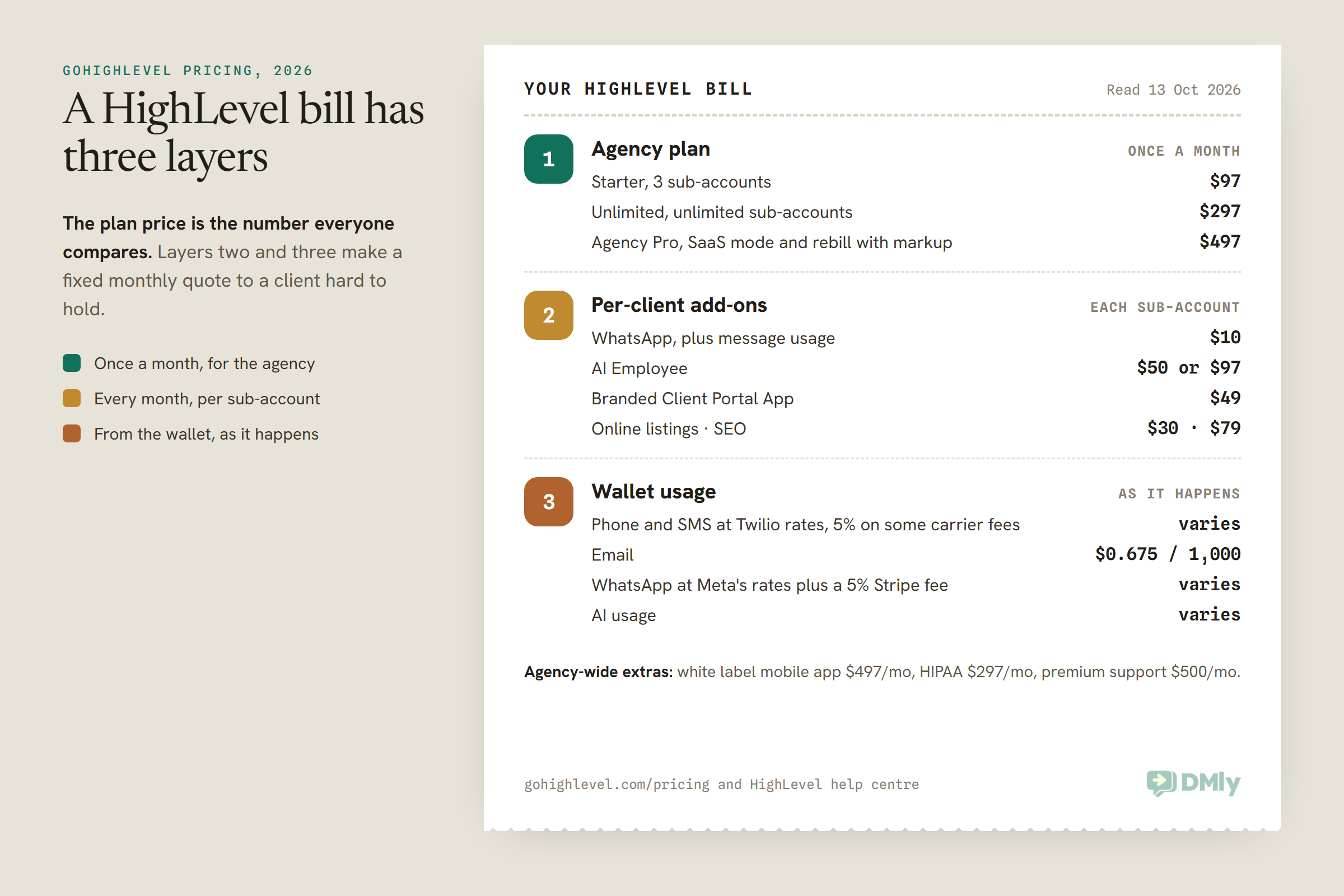
None of this is hidden. HighLevel’s own FAQ is plain that usage costs for phone numbers, texts, emails and premium AI sit outside the subscription, and that on Unlimited and Agency Pro you can pass them on to clients. The point is that “$297 a month” is the start of the sum, not the answer to it.
Where GoHighLevel Is Still Stronger Than Its Alternatives
HighLevel is still the strongest single tool on this list for funnels, websites, email marketing, phone calling and breadth. If that’s what your clients pay you for, most alternatives are a step down, and it’s better to know that now.
- Funnels and websites. A website and funnel builder with domain management is part of every plan. Of the alternatives below, only ClickFunnels and Systeme.io come close, and neither is white label.
- Email marketing. Built in, sending out of the box for every sub-account, at $0.675 per 1,000 emails.
- Phone and voice. HighLevel lets agencies buy numbers, text and call inside the product, and lists Voice AI among its core features. Most alternatives here either leave calling out or ask you to bring your own provider.
- Breadth in one login. Its feature list runs from booking calendars and reputation management to courses, communities, social media management, an ad manager and a prospecting tool.
- No caps on contacts or users. Every plan says unlimited contacts and unlimited users. Several alternatives, ours included, price by contacts or pool them across clients.
- Snapshots. HighLevel’s FAQ describes a library of pre-built accounts for industries like real estate, dentists and gyms, which shortens setup for a new client.
- SaaS mode. On Agency Pro, client sign-up, account creation and usage rebilling with your markup are automated end to end.
- Payment providers. Stripe, PayPal, NMI, Authorize.net, Square, Adyen and Razorpay are all listed.
If your agency’s offer is “we build your funnel, run your email and answer your phones”, the honest advice is to stay, fix your pricing, and maybe add a specialist tool for the one channel HighLevel handles least well for your clients.
Why People Look for a HighLevel Alternative Anyway
Most people leave HighLevel for one of five reasons: a bill that is hard to predict, clients who use a fraction of it, messaging-first customers, the price of SaaS mode, or simply not being an agency.
1. The bill is hard to quote. When a client asks “what will this cost me a month?”, the honest answer depends on their texts, calls, emails, AI use and add-ons. Agencies on retainers end up either absorbing the variable part or explaining it every month.
2. Clients use two features out of twenty. A salon that only wants bookings, reminders and review requests is still sitting inside a funnel builder, a course platform and an ad manager. The breadth that sells HighLevel to the agency can be noise to the client.
3. The client’s customers live in WhatsApp. In India, Nigeria, Brazil, the Gulf and much of Southeast Asia, the conversation starts in WhatsApp, not SMS or email. On HighLevel, WhatsApp is a $10 per client add-on with usage on top. That is reasonable for one client and adds up across forty.
4. Selling the software as your own costs $497. Automated sign-up and rebilling with markup sit on Agency Pro. An agency with eight clients may not want to start there.
5. You’re one business, not an agency. HighLevel’s plans are built around sub-accounts. A single dental practice or gym can use Starter, but it is paying for an agency structure it will never use.
Notice that only the first and fourth reasons are really about HighLevel’s price. The others are about fit, and fit is what should decide which alternative you look at.
How We Picked and Checked These Alternatives
We started from the tools HighLevel itself compares against, kept the ones an agency or local business would realistically weigh, and read every price on the vendor’s own website on 13 October 2026.
HighLevel’s own site has comparison pages against ActiveCampaign, HubSpot, ClickFunnels, Keap, Kartra, Vendasta, SharpSpring, Klaviyo, Zoho and Salesforce. That’s a useful signal of who its buyers shortlist. We kept those that fit agencies and local businesses, added SuiteDash and Systeme.io (common picks for white-label portals and cheap funnels), Podium and Kommo (common picks for messaging-led local selling), and DMly, which we make. We left out Salesforce and Klaviyo as built for different buyers, and Kartra and SharpSpring because we didn’t read their pages for this guide.
Where a page would not load or hid its prices, we say so and don’t fill the gap with someone else’s figure. Prices are in US dollars as shown to us; several vendors show other currencies by region, so check yours.
And to be upfront: DMly is our product. We’ve profiled it the same way as the others, including a section on where it’s the wrong choice.
GoHighLevel Alternatives for Agencies
For agencies, the real GoHighLevel alternatives are Vendasta, SuiteDash and DMly’s white label, with ClickFunnels and Systeme.io as funnel-first options that don’t put your brand on the software. Each one replaces a different slice of HighLevel.
1. Vendasta: for agencies that resell a catalogue of products
Vendasta is built for agencies that sell many digital products to local businesses: listings, reputation, social, email and text campaigns, website hosting and AI tools, bought at wholesale and resold at your price. Its pricing works differently from everyone else’s. You commit to a monthly minimum spend on its products, and if you hit it, the platform subscription itself can be $0.
Price (read 13 October 2026): Starter has a $99 monthly minimum spend, no contract, one team seat and co-branding with Vendasta. Professional has a $499 monthly minimum, a one-year contract, five seats and a white-label client portal. Premium has a $999 minimum, ten seats and a multi-location client portal. Extra seats cost $30, $35 and $65 a month on those plans. Client accounts and client users are unlimited.
Better than HighLevel for: agencies whose business is reselling many separate products, each with its own margin. Weaker for: anyone who wants full white labelling on a small budget, since that starts at the $499 minimum with a year’s commitment. WhatsApp isn’t mentioned on its pricing page.
2. SuiteDash: for a branded client portal on a flat price
SuiteDash is a white-label client portal and business operations suite: CRM, proposals, contracts, projects, invoicing, file sharing, a learning area and support tickets, all behind your logo and domain. Its pitch is one price, not per user.
Price (read 13 October 2026, monthly): Start $19, Thrive $49 and Pinnacle $99 a month, with unlimited contacts, staff and portals on every plan. White labelling and a custom branded mobile app are listed from Start. A SuiteDreams package costs $1,499 once plus $49 a month. The 14-day trial runs on Pinnacle with no card.
Better than HighLevel for: consultants and service agencies whose clients need a place to sign proposals, see projects and pay invoices. Weaker for: customer messaging. Its pricing page doesn’t mention SMS, WhatsApp, calling or funnels, so it replaces HighLevel’s client-management side, not its marketing side.
3. DMly white label: for agencies whose clients sell in the chat
DMly is a messaging and booking platform for local businesses: WhatsApp, Instagram, Messenger, TikTok, Telegram, live chat and SMS in one inbox, with flows, AI replies, bookings, invoices, payments and Google reviews. The white-label layer lets you sell all of it under your own name. If you want the full setup walkthrough, our guide to white-label WhatsApp software for agencies covers branding, domains and client workspaces step by step.
Price (read on dmly.io/whitelabel, 13 October 2026): Launch is $97 a month for 10 client workspaces, 10 WhatsApp numbers, 80 connected profiles and 50,000 contacts. Scale is $249 for 25 workspaces, 25 numbers, 200 profiles and 200,000 contacts. Growth is $399 for 50 workspaces, 50 numbers, 400 profiles and 500,000 contacts. Agency is custom, with unlimited workspaces and a dedicated partner manager. The page shows the first three struck down from $149, $349 and $499 without saying for how long, so check before you commit. Add-ons cost $19 for 10 more profiles, $49 for 5 more WhatsApp numbers, $29 for 25,000 more contacts and $79 for 10 more workspaces. Branded Android and iOS apps cost $59 a month plus $99 to set up. There’s no revenue share.
What you get on every tier, according to DMly’s docs: your own domain with SSL issued automatically, your app name, logo and colour, your own email server for notifications, plans you build and price yourself, and billing through your own Stripe account. Your clients pay you; DMly never sees that money. You can open any client workspace to set it up or help, suspend one that stops paying, and grant extra contacts, profiles or teammates on the spot. There is also an Agency API that creates a client’s login and workspace in one call, and a Channel Connect feature that lets your clients connect WhatsApp, Instagram, Messenger, TikTok or Telegram from inside your own app without ever signing in to DMly. We explain that flow in let customers connect WhatsApp, Instagram and TikTok without leaving your app.
Better than HighLevel for: agencies serving businesses that sell and book through chat, especially outside the US, because every channel is included rather than added per client, and DMly adds no markup to Meta’s WhatsApp rates. Weaker for: funnels, websites, email campaigns, phone systems, voice AI, courses and communities, none of which DMly offers. More on that below.
A few details worth knowing before you pick a tier, all from DMly’s docs:
- Your own workspace counts. It sits under your agency and takes one of your workspace slots, so Launch gives you nine client workspaces, not ten.
- Some limits are pooled. Contacts, connected profiles and WhatsApp numbers are shared across every workspace in your agency. A busy client can use up room another client was counting on.
- “Powered by” stays, but it’s yours. Booking pages, HTML invoices, notification emails and the live chat widget always carry a Powered by line. On a branded agency it shows your app name and links to you; there is no switch to remove it.
- DMly’s name appears in two places. Meta’s and TikTok’s own consent screens, when a client connects an account, show the name of DMly’s app, not yours. The standard DMly mobile app keeps DMly’s icon unless you pay for the branded apps.
- Your clients depend on your subscription. If your reseller plan lapses, every client workspace locks at once, including clients who have paid you.
- Opening a client’s workspace is logged. It writes an entry in that client’s own audit log, with your name and IP address. Tell clients you have this access.
4. ClickFunnels: for agencies that live in funnels
ClickFunnels is the funnel builder HighLevel is most often compared with. It now includes email, courses, workspaces and AI writing tools.
Price (read 13 October 2026): Launch is $97 a month, or $81 a month billed annually, with one workspace, two team members, 10,000 contacts and 50,000 emails a month. Scale is $197, or $164 annually, with five workspaces and 75,000 contacts. Optimize is $297, or $248 annually, with ten workspaces and 150,000 contacts. Dominate is $5,997 a year. The page flags unlimited funnels as “Limited Time”.
Better than HighLevel for: teams whose whole craft is funnels and who want a tool built around them. Weaker for: agencies, because the pricing page lists workspaces (it calls them sub-accounts) but no white labelling, and no texting, calling or WhatsApp.
5. Systeme.io: for funnels, email and courses on a small budget
Systeme.io bundles funnels, email marketing, courses, a blog, affiliate programmes and webinars, and is popular with coaches and creators.
Price (read 13 October 2026, from its pricing FAQ): Free covers 2,000 contacts, three funnels and one course. Startup is $17 a month for 5,000 contacts, Webinar $47 for 10,000, and Unlimited $97 for unlimited contacts. Every plan includes unlimited email sending, 0% transaction fees and unlimited sub-accounts, each with the same limits as your own plan.
Better than HighLevel for: a solo marketer or small agency that mainly needs funnels and email and wants to spend very little. Weaker for: anyone who needs their own brand on the software, a booking system for appointments with staff, or chat channels. Its features list shows SMS through Twilio but not WhatsApp.
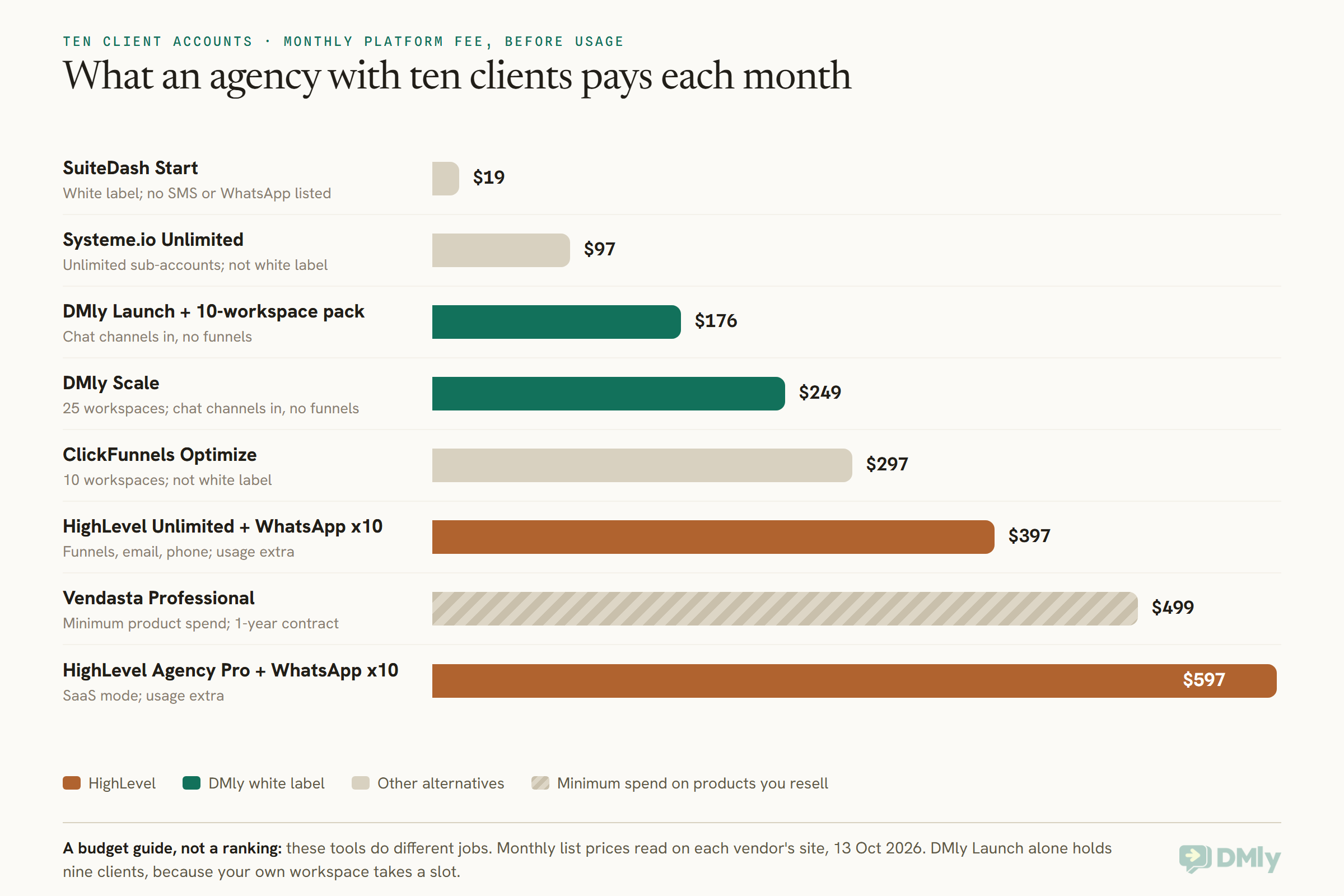
Two notes on that chart. DMly’s Launch tier alone would hold only nine clients, because your own workspace takes a slot, so the chart adds the $79 pack of ten more. And Vendasta’s $499 is a minimum spend on products you resell, not a fee for nothing; if you would sell that much anyway, its platform subscription can come to $0.
GoHighLevel Alternatives for Local Businesses
If you run one business rather than an agency, the best GoHighLevel alternatives are the tools built for a single location: HubSpot, Keap, ActiveCampaign, Podium, Kommo and DMly’s standard plans. None of them makes you pay for an agency layer you won’t use.
6. HubSpot: for a growing company that wants a big CRM
HubSpot is the CRM many businesses grow into: marketing, sales and service tools on one contact database, with a very large marketplace of integrations.
Price: HubSpot’s pricing pages would not load for us on 13 October 2026 (they stayed on a loading screen in two attempts), so we can’t give you today’s figures. When we read them on 25 September 2026, the WhatsApp channel needed Marketing Hub or Service Hub on a Professional or Enterprise tier, and Service Hub Professional was $90 to $100 a seat a month depending on billing, plus a required $1,500 onboarding fee. Check hubspot.com before you rely on those.
Better than HighLevel for: a company with a sales team and a long sales cycle that wants a mature CRM. Weaker for: a small local business on a tight budget that wants WhatsApp, since that sits on the paid upper tiers.
7. Keap: for owners who want done-with-you email automation
Keap (formerly Infusionsoft) is a CRM with email marketing, landing pages, funnels, invoicing, an appointment scheduler and automation, aimed at small service businesses.
Price (read in a browser, 13 October 2026): “Starting at $299/mo” billed monthly, with the full platform on one plan and contacts priced on a slider. Two users are included and extra users cost $39 a month. Implementation services are required. Text marketing is US only, and one-to-one texts work in the US and Canada. Keap’s FAQ mentions a $299 early termination fee if you cancel an annual contract inside the year.
Better than HighLevel for: an owner who wants an expert to set up the automation with them. Weaker for: anyone outside North America who needs texting, and anyone who wants WhatsApp, which its pricing page doesn’t mention.
8. ActiveCampaign: for email-led businesses on a small budget
ActiveCampaign is an email marketing and automation platform with a CRM add-on, landing pages and, now, separate WhatsApp plans.
Price (read in a browser, 13 October 2026, at 1,000 contacts, billed annually): Starter $15, Plus $49, Pro $79 and Enterprise $145 a month for email. WhatsApp plans are separate, starting at $99 a month billed annually, with outbound template messages paid from pre-paid monthly credits. SMS is an add-on, with broadcasts in the US, UK and Australia.
Better than HighLevel for: businesses whose main channel is email and who want a cheaper start. Weaker for: bookings, reviews and payments in the same tool.
9. Podium: for US businesses that want texting, reviews and a sales rep
Podium combines review requests, texting, webchat, phones, payments and an AI assistant for local businesses, with onboarding and a customer success manager.
Price (read in a browser, 13 October 2026): Core $399 a month, Pro $599 a month, and Signature on custom pricing, all through “Talk to Sales”. HVAC businesses are asked to contact sales for their own pricing. The FAQ says the monthly cost varies with your industry, volume and carrier fees.
Better than HighLevel for: a US business that wants a vendor to set everything up and a single number to call. Weaker for: price, and for businesses whose customers message on WhatsApp, which its pricing page doesn’t mention.
10. Kommo: for sales teams closing deals in chat
Kommo is a sales CRM built around messaging, with a pipeline that fills from WhatsApp, Instagram and other chats, and AI agents on the upper plans.
Price (read 13 October 2026): Base $25, Advanced $35 and Pro $45 per user per month. Monthly billing isn’t available; the minimum term is six months, so Base is billed at $150 per user. AI credits are 750, 1,250 and 2,250 per seat each month and don’t roll over. Our full Kommo review goes through the plans in detail.
Better than HighLevel for: a sales team that lives in WhatsApp and wants a pipeline view first. Weaker for: bookings with staff calendars, and for teams that grow, since the price is per seat.
And DMly’s standard plans: for chats, bookings, reviews and payments in one
If you run one business, you don’t need DMly’s white label. The standard plans cover the same product for a single business.
Price (read in a browser on dmly.io/pricing, 13 October 2026): Starter $29 a month billed yearly or $39 monthly, with 3 team seats, 1 profile per channel, 3,000 active contacts, 10,000 broadcast and template messages and 500 AI replies a month. Growth is $65 yearly or $79 monthly, with 6 seats, 3 profiles per channel, 10,000 active contacts, 50,000 messages and 5,000 AI replies. Premium is $149 yearly or $199 monthly, with 15 seats, 5 profiles per channel, unlimited active contacts, 300,000 messages, and unlimited AI replies with your own AI keys. Every plan includes bookings, invoices and payments, Google reviews, and the API and integrations. There’s a 7-day free trial with no card, and DMly adds no markup to Meta’s WhatsApp rates.
For a wider comparison of messaging tools for a single business, see our list of the best WhatsApp business software for small businesses.
GoHighLevel vs DMly: What Each Does Natively
HighLevel wins on funnels, websites, email, phone and courses; DMly wins on chat channels, WhatsApp cost and the price of putting your brand on it. Because we make DMly, here is the comparison laid out flat, using HighLevel’s pricing page and DMly’s docs, so you can check both.
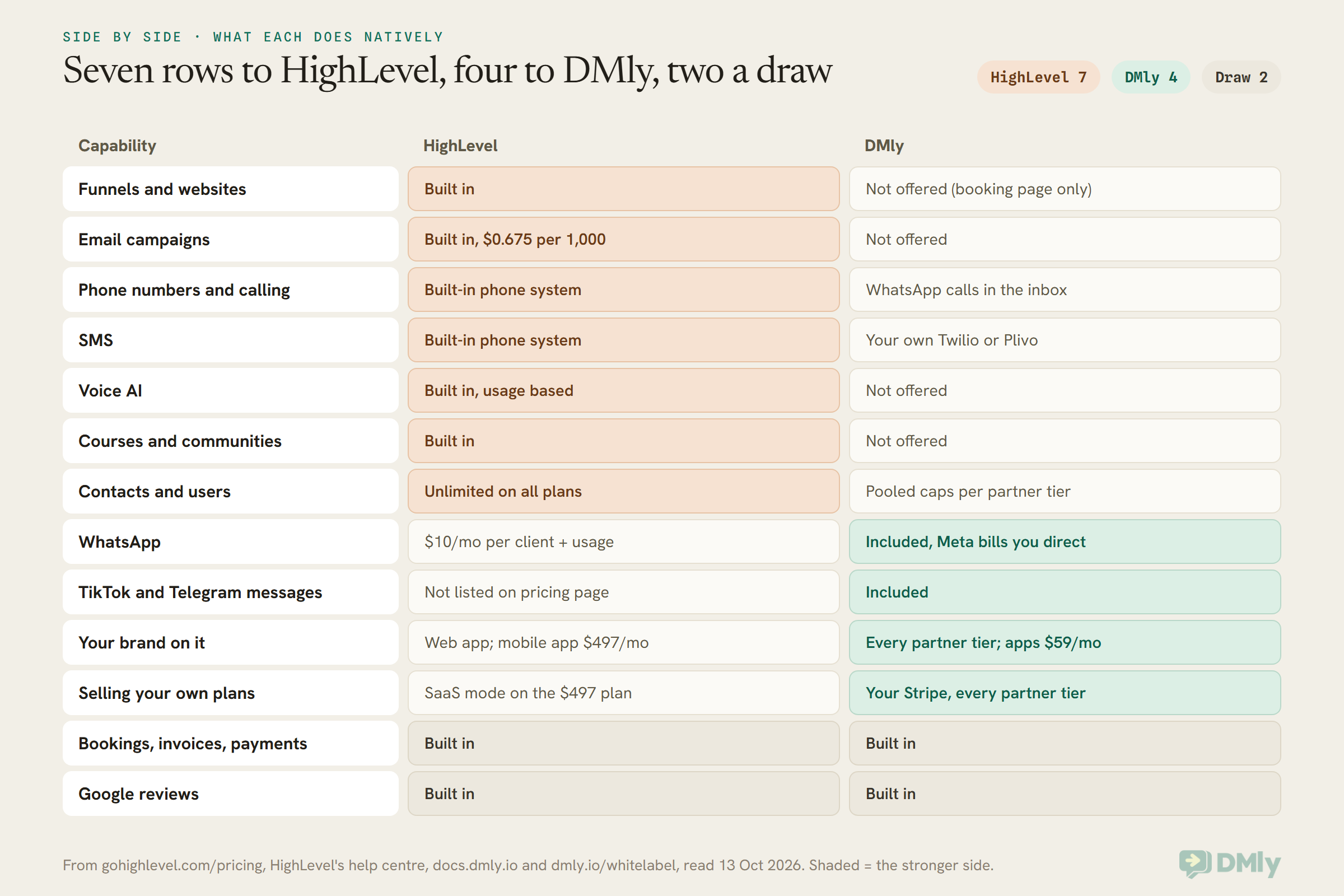
Read that grid by your clients, not by the count. If they need a funnel, a newsletter and a phone line, HighLevel’s seven rows are the ones that matter. If they need to answer Instagram DMs, take bookings in WhatsApp, chase payments and collect Google reviews, DMly’s rows are, and you’d be paying HighLevel for the other seven.
Two lines in that grid need a word more. DMly’s WhatsApp calling takes calls from customers for free, in the same inbox as their messages. Calling out needs the customer’s permission first, and WhatsApp doesn’t allow businesses to call out from numbers registered in the US, Canada, Egypt, Vietnam or Nigeria, so for many readers it’s an inbound line only. And DMly’s SMS is bring-your-own: you connect Twilio or Plivo and pay them, which is fine for a business that already has a provider and an extra job for one that doesn’t.
Every Option Side by Side
Here are all ten alternatives and HighLevel on one table, with entry prices read on 13 October 2026.
| Tool | Entry price read | Your brand on it? | WhatsApp? | Best for |
| HighLevel | $97/mo, 3 sub-accounts | Yes (web app) | $10/mo per sub-account + usage | Funnels, email, phones, breadth |
| Vendasta | $99/mo minimum spend | From Professional ($499 minimum) | Not on pricing page | Reselling a product catalogue |
| SuiteDash | $19/mo | Yes, from Start | Not on pricing page | Branded client portals |
| DMly white label | $97/mo, 10 workspaces | Yes, every tier | Included, no markup on Meta’s rates | Chat-led clients, bookings, reviews |
| ClickFunnels | $97/mo ($81 annual) | Not listed | Not on pricing page | Funnel-first teams |
| Systeme.io | Free; $17/mo | No | Not on pricing page | Funnels and courses on a budget |
| HubSpot | Could not be read 13 Oct | No | Professional tiers and up (25 Sep) | A growing company’s CRM |
| Keap | From $299/mo | No | Not on pricing page | Done-with-you email automation |
| ActiveCampaign | $15/mo annual | No | Separate plans from $99/mo annual | Email-led businesses |
| Podium | $399/mo | No | Not on pricing page | US texting and reviews |
| Kommo | $25/user/mo, 6-month minimum | No | Yes | Sales teams in chat |
| DMly standard | $29/mo billed yearly | No (that’s the white label) | Included, no markup on Meta’s rates | One business: chats, bookings, reviews |
“Not on pricing page” means exactly that: we didn’t find WhatsApp on the page we read. Some of these tools may offer it through an integration or a marketplace app, so ask before you rule one out.
The WhatsApp Line on Your Clients’ Bill
From 1 October 2026, Meta charges for service messages after the first 1,000 a month per number and for utility messages sent inside an open chat, so WhatsApp costs now matter whichever tool you choose. What differs between tools is what sits on top of Meta’s rate.
On HighLevel, its WhatsApp guide says the agency pays $10 a month for each WhatsApp-enabled sub-account, Meta’s message rates have a 5% Stripe fee added, and you can rebill clients with a multiplier from 1x to 10x. The default is 1.05x, which simply covers that fee. That’s a neat way to turn usage into margin, and it’s genuinely useful if you want WhatsApp profit to scale with volume.
On DMly, Meta bills the business directly for its WhatsApp messages and DMly adds nothing to them. There’s no per-client WhatsApp fee and no multiplier. The flip side is that you can’t mark up Meta’s charges through DMly the way HighLevel lets you, so your margin has to live in the plan price you set for each client. That’s simpler to explain to a client and harder to grow with volume. We walk through building those prices in how to price WhatsApp automation services for clients.
Whichever you pick, the October change is worth a conversation with every client who answers a lot of WhatsApp questions. A clinic replying to thousands of patient questions a month will now see a bill for messages that used to be free. Our guide to service messages vs templates explains which messages count.
One more thing for agencies with US clients: Meta currently doesn’t deliver marketing templates to US phone numbers at all. If your clients are US businesses selling to US customers, WhatsApp is a support and booking channel for them, not a promotions channel, and that alone may keep HighLevel’s SMS and email at the centre of your offer.
Moving From GoHighLevel: What Comes With You
Your contacts and your WhatsApp number can move; your automations, chat history and funnels don’t, and have to be rebuilt or rehomed. Plan the move per client, not all at once.
- List what each client actually uses. If a client relies on a HighLevel funnel or website, it needs a new home before you leave, because tools like DMly and SuiteDash don’t host them.
- Check who owns the WhatsApp Business Account. A WhatsApp number can be connected to only one provider at a time, and moving it is done at Meta. If the account sits in the client’s own Meta Business Manager, its approved templates come with it. If it doesn’t, the templates stay behind and need re-approval. DMly’s migration guide also asks you to turn off two-step verification on the number before you start.
- Export before you switch. Chat history, opt-out lists and campaign reports won’t import into a new tool. Download them while you can still log in.
- Bring contacts across by CSV. Most tools import contacts, tags and custom fields. In DMly, contacts, tags, custom fields, services and products all have importers.
- Rebuild the automations. No tool on this list imports HighLevel workflows. Use the move to drop the ones nobody missed.
- Ask HighLevel about phone numbers. If clients use numbers from HighLevel’s phone system, ask HighLevel how to port them out before you cancel. We couldn’t find that documented on the pages we read.
- Run one client first. Move your simplest client, run both systems side by side for a couple of weeks, then move the rest.
If a client still uses the WhatsApp Business app on a phone, DMly can connect that number in co-existence mode, which keeps the app working on the same number and brings across up to 180 days of one-to-one chats. Our WhatsApp appointment booking guide is a good next read once the number is live, because bookings are usually the first thing local clients want rebuilt.
Where DMly Is the Wrong GoHighLevel Alternative
DMly is the wrong choice if your clients pay you for funnels, websites, email marketing, a phone system or courses. It doesn’t do any of those, and we’d rather you knew before a trial than after.
- You build funnels and websites. DMly has a booking page, not a site or funnel builder.
- Email newsletters are a big part of your retainer. DMly sends email for notifications and review requests, but it has no email campaign builder. Broadcasts go out on chat channels and SMS.
- Your clients run on phone calls. There’s no phone system or dialler, and no voice AI. WhatsApp calls work in the inbox, with the country limits above.
- Your clients are mostly US businesses marketing to US customers. With marketing templates not delivered to US numbers, the most valuable part of DMly for promotions doesn’t apply, and HighLevel’s SMS and email are a better fit.
- You need unlimited contacts across every client. DMly’s partner tiers pool contacts, profiles and numbers across your agency.
- You want to mark up usage. HighLevel’s rebilling multiplier has no equivalent in DMly; your margin lives in your plan price.
- You need to set each client’s AI allowance. DMly’s docs say the plans you build can’t set a client’s AI reply allowance; every client gets the system default.
- You can’t bill clients through Stripe. Client billing runs through your own Stripe account. If Stripe doesn’t support your business’s country, you can still assign plans by hand and invoice clients your own way, but you lose the automatic sign-up and checkout.
Where DMly does fit is the agency whose clients live in their messages: salons, clinics, gyms, tutors, restaurants and shops whose customers ask, book and pay in WhatsApp and Instagram, and who want reminders and Google review automation running without a funnel in sight.
Six Businesses, Six Answers
The right alternative changes with the market and the client list. Here are six realistic cases.
A dental marketing agency in Texas. Its clients pay for a website, Google Ads landing pages, email recall campaigns and call tracking. Every one of those is a HighLevel strength, and US marketing templates aren’t delivered on WhatsApp anyway. The answer is to stay, and maybe move to Agency Pro if selling the software as its own product is part of the plan.
An agency in Pune serving coaching institutes. Parents and students message on WhatsApp about batches, fees and timetables, and almost nobody reads email. Funnels matter less than fast replies, reminders and fee links. DMly’s white label fits, priced in the institute’s terms, with HighLevel’s per-client WhatsApp fee no longer stacking up across thirty clients.
A Lagos agency serving salons and spas. Bookings arrive on Instagram and WhatsApp, deposits are the pain point, and clients want reviews. DMly covers the chat, booking and review side. One check first: client billing in DMly runs through Stripe, so the agency should confirm its Stripe setup or plan to assign plans by hand and invoice clients locally.
A consultant in Manchester looking after four gyms. The gyms want a branded place for documents, onboarding forms, invoices and a support ticket queue, and they already have a booking system. SuiteDash’s flat price and client portal are a better match than either HighLevel or DMly.
A Dubai property agency running click-to-WhatsApp ads. Leads land in WhatsApp in English and Arabic, and the team works them like a sales pipeline. Kommo suits a seat-based sales team; DMly suits a team that also wants bookings for viewings and an ads report showing which ads produced conversations. HighLevel would be overkill unless they also run email and funnels.
A franchise network across Australia and Canada. Head office wants listings, reputation, social posting and SEO across eighty locations, sold and billed centrally. That’s Vendasta’s home ground, with its multi-location portal on Premium.
What to Test Before You Switch
Use the free trial to test the three jobs your clients care about most, with a real client’s data, before you move anyone. A short checklist:
- Run one real enquiry end to end. Message the test business on the channel its customers use, and follow it through to a booking or a payment.
- Price one real client. Work out their monthly cost on the new tool, including message fees, add-ons and seats, and compare it with what they pay you now.
- Check your brand everywhere. Sign up as a client on your own domain in a private browser window, then look at the emails, the booking page and the invoice they receive.
- Check what happens when you stop paying. Read what the vendor does to your clients if your own plan lapses. On DMly, every client workspace locks.
- Time the setup. Note how long it takes to make one client ready, because that’s the hour you’ll repeat for every new client.
Frequently Asked Questions
What are the best GoHighLevel alternatives?
The best GoHighLevel alternatives depend on what you replace. For agencies: Vendasta for reselling a product catalogue, SuiteDash for branded client portals, and DMly’s white label for clients who sell through WhatsApp and Instagram. For single businesses: ActiveCampaign or Keap for email, Podium for US texting and reviews, Kommo for chat-led sales teams, and DMly’s standard plans for chats, bookings and reviews together. ClickFunnels and Systeme.io suit funnel-first teams.
Is there a cheaper alternative to GoHighLevel?
Yes, but only if you need less of it. SuiteDash starts at $19 a month and Systeme.io has a free plan, and DMly’s white label starts at $97 for ten workspaces. None of them replaces all of HighLevel’s funnels, email, phone and courses, so compare against the parts your clients actually use.
How much does GoHighLevel cost in 2026?
On 13 October 2026 HighLevel’s pricing page showed Starter at $97 a month with three sub-accounts, Unlimited at $297 and Agency Pro at $497, with annual prices of $970, $2,970 and $4,970. Usage for phone, SMS, email and AI is extra, and add-ons like WhatsApp ($10 a month per sub-account) are charged per client.
Does GoHighLevel include WhatsApp?
WhatsApp is an add-on on HighLevel: $10 a month for each sub-account that uses it, plus Meta’s message rates with a 5% Stripe fee added, according to HighLevel’s WhatsApp pricing guide. Agencies can rebill it to clients with a multiplier.
Which GoHighLevel alternatives offer white label?
Of the tools in this guide, SuiteDash (from its $19 plan), Vendasta (white-label portal from its Professional plan) and DMly (every partner tier) offer white labelling. ClickFunnels and Systeme.io offer workspaces or sub-accounts but not your brand on the software.
Can I move a WhatsApp number from GoHighLevel to another tool?
Usually, yes. A WhatsApp number can be connected to one provider at a time, and the move happens at Meta. If the WhatsApp Business Account is in your client’s own Meta Business Manager, the approved templates come with it. Turn off two-step verification on the number first, and export chat history before you switch, because it won’t import.
Does DMly have funnels, email marketing or a phone system?
No. DMly has a booking page but no website or funnel builder, no email campaign builder and no phone system or voice AI. It covers chat channels, automation, AI replies, bookings, invoices, payments and Google reviews. If funnels and email are your agency’s core offer, HighLevel is the better fit.
Is GoHighLevel worth it for a single local business?
It can be, if you want funnels, email and a phone system in one place. But HighLevel’s plans are built around agencies and sub-accounts, so a single salon, clinic or gym is often better served by a tool priced for one business, such as ActiveCampaign, Podium, Kommo or DMly’s standard plans.
The Draft, Sent or Deleted
Back to that email in your drafts. If your clients pay you for funnels, newsletters and phone lines, delete it: HighLevel is still the best single tool for that job, and the fix is your pricing, not your platform. If they pay you to answer their customers, book their chairs and chase their reviews, mostly in WhatsApp and Instagram, then one of these GoHighLevel alternatives will probably do that job for less and with less to explain.
Either way, don’t send it on a hunch. Price one real client on the new tool, run them through a trial for two weeks, and let that bill decide. If you want to test the white-label route, DMly’s partner plans start with a free trial, and your first client can be your own business.
Writing about WhatsApp automation, bookings and growth for local business.
Turn WhatsApp into your busiest channel.
Start free and run message, bookings, payments and reviews in one place.
