
Wati vs Respond.io vs Interakt vs AiSensy vs DMly: WhatsApp Automation Platforms Compared (2026)
Here is the conclusion this comparison reaches, stated before the evidence so you can hold us to it. If your business runs on conversations alone, the specialists remain excellent: Respond.io for multi-agent teams that live in an omnichannel inbox, Wati as the familiar default for WhatsApp-only small businesses. If your market is India and your model is broadcast-led selling, AiSensy and Interakt are tuned for precisely that game. And if the point of your conversations is bookings, invoices, payments and repeat customers, DMly is the only platform of the five where that machinery is native rather than bolted on.
Now the part most comparison pages bury: we build DMly. Every “X vs Y” article in this category is written by somebody’s marketing team, usually without saying so, and the way we have chosen to earn your trust is not fake neutrality but visible method. So this page quotes no competitor prices (they change; check each vendor’s site), describes every rival by its own public positioning as of August 2026, gives each one a genuine “choose it if” verdict, and puts DMly last in the lineup so the others get judged first. Where we have published deeper teardowns, they are linked: the Wati comparison and alternatives guide and the full AiSensy review both go further than this page can.
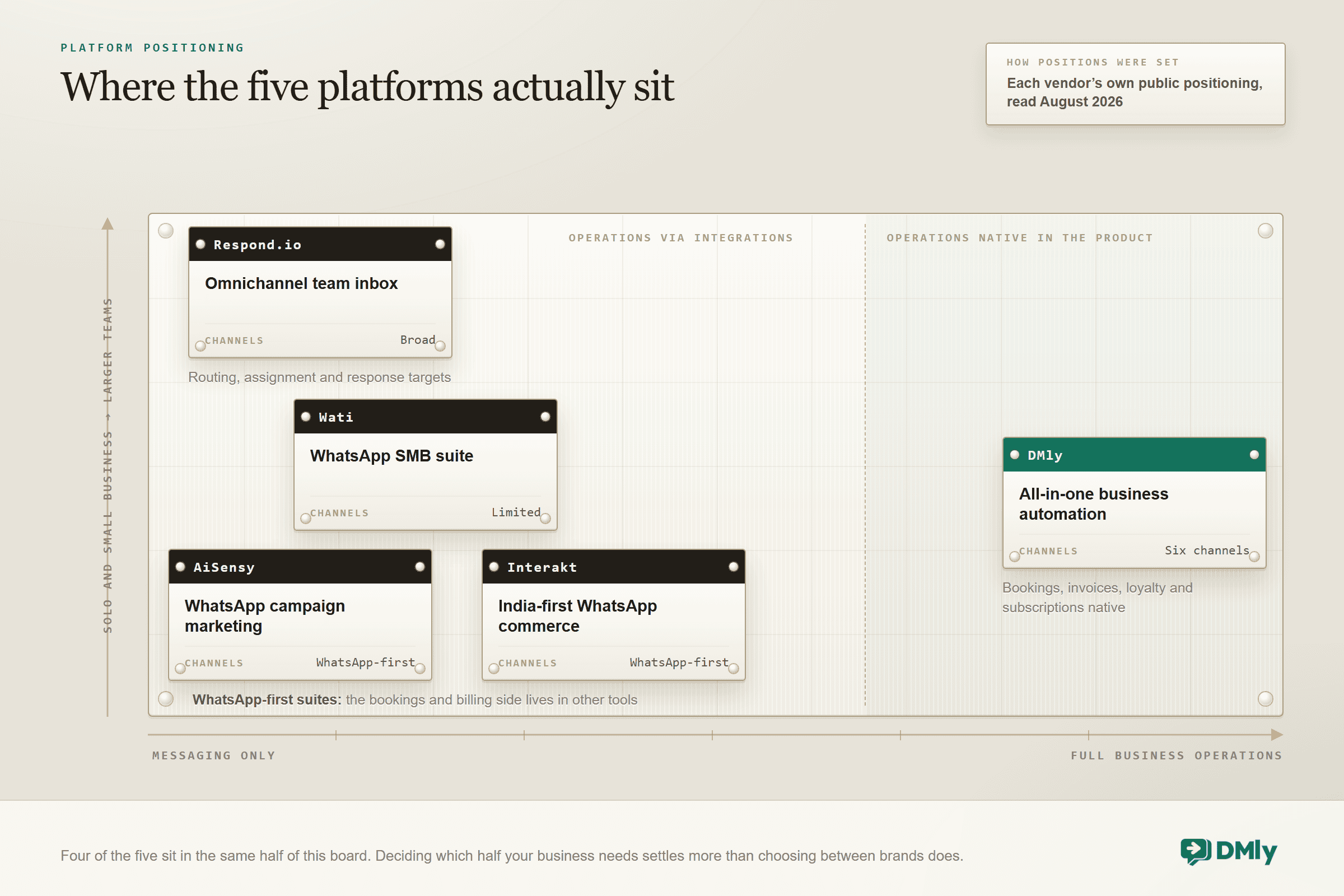
One idea makes the whole comparison click, and it explains why the five feel so different the moment you see a demo: they are not five versions of one thing. They are three different kinds of product wearing the same “WhatsApp automation platforms” label. There are WhatsApp-focused suites for small businesses (Wati, Interakt, and AiSensy in its marketing-first way), an omnichannel conversation inbox (Respond.io), and an all-in-one business platform where messaging is the front door to the operation (DMly). Most bad purchases here are not bad brands; they are the wrong kind of product.
How We Compared Them (So You Can Check Our Work)
Seven things decide almost every purchase in this category, and they are the spine of everything below. They are: species (what the product fundamentally is), channel breadth (WhatsApp only, or the places your customers actually are), automation depth (what the builder’s steps are made of), the beyond-chat surface (bookings, invoicing, payments, loyalty: native, integrated or absent), pricing shape (who the model is cheap for, separate from any single price), team fit (solo operator to multi-agent floor), and ecosystem (integrations, agencies, templates, the gravity of an installed base).
Method matters as much as dimensions, so here is ours. Every competitor claim on this page comes from that vendor’s own public product and pricing pages as read in August 2026, stated qualitatively; where a claim is a judgement rather than a fact, it is phrased as one. We quote no competitor prices, because they change without notice and a stale number in a comparison is worse than none; shapes are stable, so shapes are what we compare. And where the honest answer favours a rival, we say so in plain sentences, because a comparison that never concedes anything is an advert, and you have read enough of those on the other four blogs.
The one-line buying rule: decide the kind of product before the brand. A perfect omnichannel inbox is the wrong purchase for a salon that needs bookings, and a perfect all-in-one is the wrong purchase for a support floor that needs routing depth. Most regret in this category is the wrong kind of product, discovered in month three.
The Five WhatsApp Automation Platforms on One Screen
| Wati | Respond.io | Interakt | AiSensy | DMly | |
| Species | WhatsApp SMB suite | Omnichannel team inbox | India-first WhatsApp commerce | WhatsApp campaign marketing | All-in-one business automation |
| Channels beyond WhatsApp | Limited | Broad | WhatsApp-first | WhatsApp-first | Broad (WhatsApp, Instagram, Messenger, Telegram, SMS, live chat) |
| Automation builder | No-code chatbot and keyword rules | Workflow engine for conversation ops | Basic journeys | Campaign flows and CTWA workflows | Visual flows, quick automations, AI steps |
| Bookings, invoicing, loyalty | Via integrations | Via integrations | Payments tuned to India, rest via integrations | Thin | Native |
| Pricing shape (verify with vendor) | Per user plus message markups | Scales with seats and contacts | Entry plans plus conversation charges | Campaign plans plus message charges | Plan plus credits, no markup on Meta rates |
| Strongest fit | WhatsApp-only SMBs | Support and sales teams at scale | India-first sellers starting on the API | Broadcast-led marketers with opted-in lists | Local and service businesses running the whole operation in chat |
The Five WhatsApp Automation Platforms, Honestly
Wati: the familiar default for WhatsApp-only small businesses
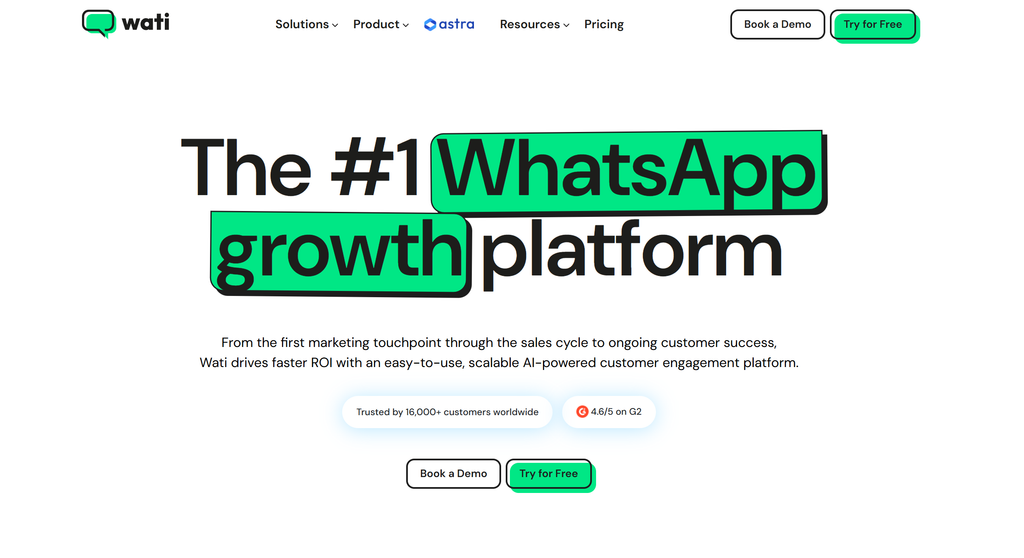
Wati is the name most small businesses meet first, and there are honest reasons for that: a WhatsApp-focused suite with broad coverage (shared inbox, broadcasts, a no-code chatbot builder, catalogue and Shopify integrations), a large template and integration ecosystem, and enough market presence that most agencies and freelancers already know their way around it. If you want the well-trodden path for a WhatsApp-only operation, this is it.
The trade-offs are the ones our Wati alternatives guide exists to unpack. The pricing shape is per user with message markup economics that deserve a careful look at volume (model your real month on their current sheet, not the headline). The channel story is WhatsApp-centric, so an Instagram-heavy or multi-channel business is working against the grain. And the business machinery (bookings, invoicing, loyalty) lives in third-party integrations rather than the product, which means more subscriptions and more seams. Choose Wati if WhatsApp is your only serious channel, your operations already live happily elsewhere, and familiarity across your team and agency matters more than consolidation.
Respond.io: the omnichannel inbox for teams at scale
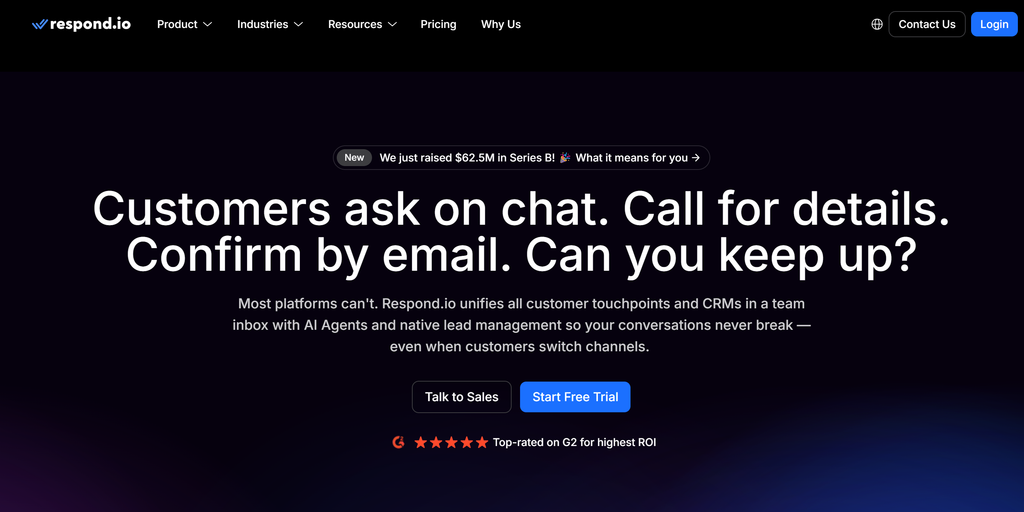
Respond.io is inbox-first and proud of it. The product is built around conversation operations for multi-agent teams: strong multi-channel coverage, routing and assignment, service-level discipline and a workflow engine aimed squarely at the mechanics of handling thousands of conversations well. Among the five, it is the platform that takes “the chat itself is the product” most seriously, and mid-market support and sales teams are its natural home.
The flip side is the same fact seen from a smaller desk. Its cost structure scales with seats and contacts, its depth is heavier than a two-person salon will ever use, and the beyond-chat business surface is not the point: bookings, invoices and loyalty are assumed to live in other systems that your team stitches around the inbox. Choose Respond.io if you run a genuine team on conversations across several channels, you measure response and resolution times, and your operational stack is already settled elsewhere.
Interakt: the India-first commerce entry point
Interakt, from the Jio ecosystem, is a high-volume favourite among Indian small businesses for a coherent reason: WhatsApp marketing, catalogue and payment integrations tuned specifically to the Indian market, packaged at entry pricing that suits first-time API users (verify current plans on their site). For an India-first seller taking a storefront onto WhatsApp for the first time, it is a sensible, low-friction on-ramp.
Its strengths mark its edges. The platform is WhatsApp-only by design, the automation depth is basic next to the workflow engines in this lineup, and the global story is thinner outside its home market. Businesses tend to outgrow it in one of two directions: toward heavier marketing tooling, or toward operational platforms when the bookings and billing side of the business wants to live where the conversations are. Choose Interakt if you sell India-first, want catalogue commerce on WhatsApp quickly, and are optimising for the lowest-friction start rather than the longest runway.
AiSensy: the broadcast cannon for campaign-led sellers
AiSensy positions hard on one job and does it with conviction: WhatsApp marketing at campaign scale. Broadcasts, campaign tooling and click-to-WhatsApp ad workflows are the centre of the product, and its natural users are Indian D2C brands and course sellers whose model is campaign-led selling to a large opted-in list. If your revenue arrives in launches and offers rather than appointments and invoices, that focus is a feature.
The trade-offs mirror Interakt’s, plus one of its own: single-channel focus, and marketing depth prioritised over operational machinery, so the inbox, CRM and beyond-chat features are supporting cast rather than leads. Our full AiSensy review walks the details and the pricing structure to check. Choose AiSensy if broadcast-led marketing to an opted-in list is your engine, India is your market, and you are comfortable running the rest of the business in other tools.
DMly: the all-in-one, reviewed by the people who build it
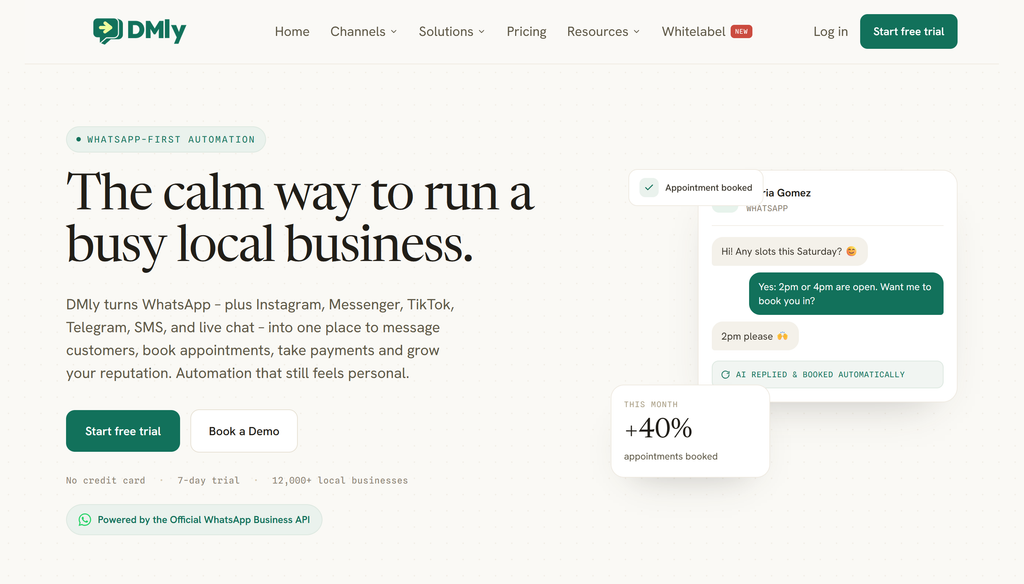
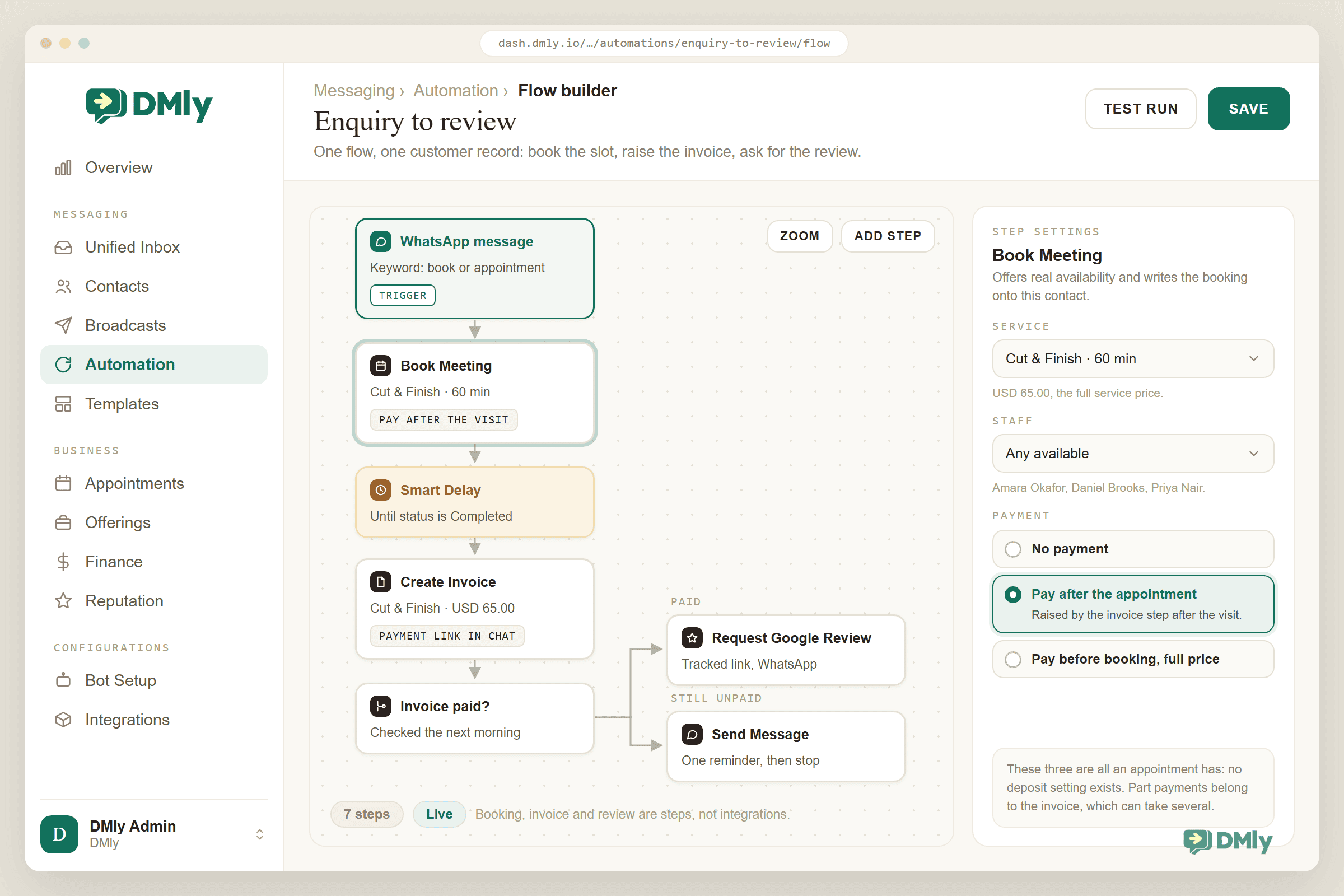
Flag raised again: this is ours, so read it as a claim sheet to verify rather than a neutral verdict. DMly’s bet is different from the other four. The conversations are the front door, and behind the door is the actual business: appointment and class booking with reminders, invoicing and payment collection, subscriptions, loyalty points and coupons, review requests, a CRM with segments, broadcasts, and a visual flow builder plus AI that can use all of it as steps, across WhatsApp, Instagram, Messenger, Telegram, SMS and live chat, with a REST API and webhooks underneath. The pricing shape is a plan plus prepaid message credits, with no markup on Meta’s rates (current plans at dmly.io/pricing).
Where do we lose, honestly? DMly is younger than Wati and Respond.io, and the third-party marketplace around those veterans is larger. If you need nothing but an enterprise-scale inbox, Respond.io specialises harder in that one layer, and if you want an India-tuned broadcast cannon and nothing else, AiSensy’s focus is real. Choose DMly if your conversations exist to produce bookings, payments and repeat customers, and you would rather run that whole loop on one customer record than subscribe to four tools and integrate the seams. That argument, stage by stage, is our guide to automating the entire customer journey.
Which Platform Has the Best Automation Builder?
There is no single best builder, because these WhatsApp automation platforms are automating different things. Respond.io has the strongest engine for conversation operations, AiSensy for campaign journeys, and DMly for business processes; Wati is the competent middle and Interakt the basic entry. The test that cuts through any demo is simple: name the most valuable thing you would automate, then look at what the builder’s steps are actually made of.
If the answer is routing (assign this conversation, escalate that one, enforce response targets across a team), Respond.io’s workflow engine is built for exactly that grammar. If the answer is campaigns (segment the list, fire the broadcast, branch on the reply, retarget the silent), AiSensy’s flows speak it natively. If the answer is operations (answer the enquiry, book the slot, send the reminder, take the payment, request the review, mint the loyalty reward), DMly is the only builder in the lineup where those are first-class steps rather than webhook calls to other products. Wati’s no-code chatbot and keyword rules cover FAQ-and-capture automation well; Interakt’s journeys handle storefront basics. Match the builder to the sentence you most need it to say.
A word on the AI badges, because all five vendors now wear one and the label has stopped meaning anything by itself. The question that separates the offerings is not “does it have AI” but “what can the AI act on”: an assistant that can only converse is a nicer FAQ page, while an assistant wired into the same system as your calendar, invoices and customer record can move a conversation to an outcome. Interrogate the demo with your hardest real conversation, ask what happens when the AI is unsure, and check that a human handover is one tap for the customer, not a buried escape hatch. The vendors differ more here than their landing pages admit, and the differences track the species line from the top of this page.
Which Platform Goes Beyond Messaging?
One of the five, natively. DMly ships bookings, invoicing, payments, subscriptions and loyalty as product features; Wati, Respond.io, Interakt and AiSensy treat all of that as integration territory, with Interakt’s India-tuned payment links a partial exception. Whether that difference matters to you depends entirely on where your operations live today, and the honest answer for a lot of businesses is “nowhere in particular yet”.
If your booking calendar, invoicing and loyalty already run in dedicated systems you like, a specialist inbox plus integrations is a legitimate architecture, and the four rivals are built on that assumption. The all-in-one case bites when those operations are still manual, scattered or duct-taped, because every integration seam is a place the customer record splits: the chat tool knows the conversation, the calendar knows the booking, the accounting app knows the invoice, and no system knows the customer. One record that carries all four is what makes whole-journey automation (the enquiry that becomes a booking that becomes a payment that becomes a review that becomes a return visit) something you switch on rather than something you engineer.
Which Platform Is Best for WhatsApp Broadcasts?
For pure campaign volume, AiSensy has built its whole product around the answer. If broadcasts are one instrument in a larger operation rather than the whole band, the sums come out differently. AiSensy’s campaign tooling, retargeting mechanics and click-to-WhatsApp ad workflows are the most broadcast-centric in this lineup, which is exactly what a launch-driven D2C brand is buying. Wati’s broadcasts are a solid, familiar core feature, and Interakt covers the storefront basics.
The interesting comparisons are the other two. Respond.io can absolutely send campaigns, but its centre of gravity is inbound conversation operations, so broadcast-led marketers are borrowing a support tool for a marketing job. DMly’s broadcasts ride on the CRM: audiences are segments built from real behaviour (last visit, spend, tags, loyalty balance, opt-in status), which pushes toward fewer, sharper sends, and the credits shape means Meta’s per-message rates arrive without markup. If your broadcast strategy is “everyone, every week”, AiSensy is honed for the volume game; if it is “the right hundred people, at the right moment, tied to bookings and payments”, the CRM-led shape earns its keep. Either way, the sending economics come from Meta’s marketing template rates, which is a budget line to price before you commit to any platform.
How Do the Pricing Models Compare?
Compare shapes, not screenshots of price tables. The numbers change, and the shape is what decides which of these WhatsApp automation platforms is cheap for a business like yours. The four shapes in this lineup: per-seat pricing with per-message markups (Wati’s familiar shape), costs that scale with seats and contact volumes (Respond.io’s), entry plans plus per-conversation charges (Interakt and AiSensy’s home turf), and a flat plan plus prepaid credits with no markup on Meta’s rates (DMly’s). None of these is universally cheapest; each is cheapest for a specific shape of business.
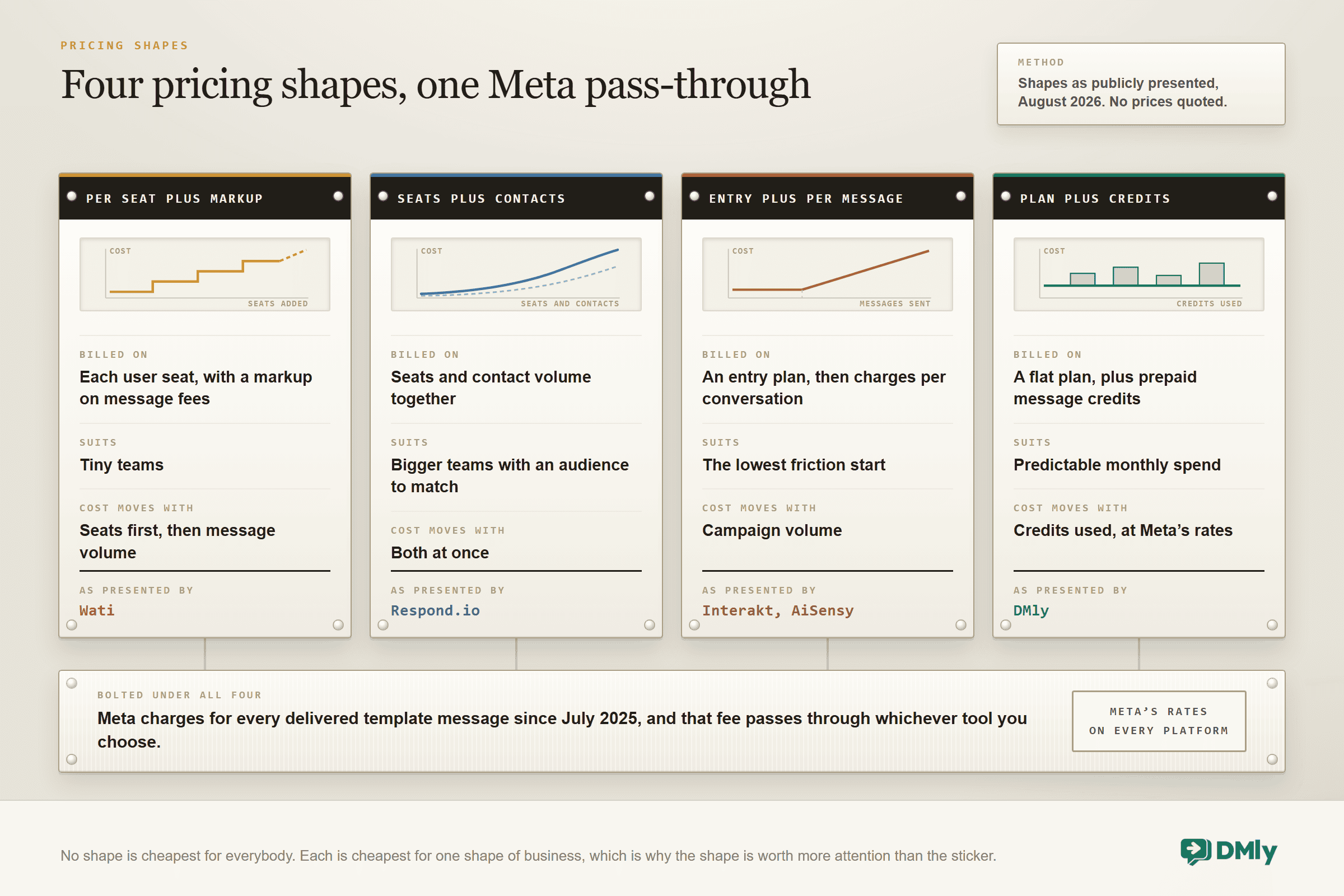
Two rules make the comparison fair. First, separate the platform fee from the message fee: since July 2025, Meta charges per delivered template message on every platform equally, so the real comparison is platform fees plus any markup on top of Meta’s rates (our country-by-country rate card covers Meta’s side of the bill). Second, price a realistic month rather than a plan page: estimate your conversation mix (service replies your customers started, utility templates such as reminders, and marketing volume), then run that month through each shortlisted vendor’s current calculator. One dated change belongs in that estimate. Until 30 September 2026, service replies inside the 24-hour window were free on every platform, and so were utility templates delivered inside an open window; from 1 October 2026 Meta charges for both, at that market’s utility rate, so a month modelled on the old rules will read low. A platform that looks expensive at the plan level is sometimes cheapest at your actual volume, and vice versa.
What Does Switching Platforms Actually Involve?
Less than the fear suggests, and the fear is doing a lot of work in this market. So here is the honest inventory. Your WhatsApp number is not hostage to any of these five: a number and its WhatsApp Business Account can be migrated between providers, and the assets that live at Meta’s layer travel with it, including your approved message templates, display name and the account’s standing. That is worth knowing before a renewal conversation, because it changes the negotiation.
What does not move automatically is everything that lives at the platform’s layer rather than Meta’s. Conversation history stays in the old tool, so export what you are entitled to before you cancel. Contacts and their opt-ins are yours: export them, with tags and consent status, and import them into the new home. Automations do not port between builders; they get rebuilt, which in practice is a healthy forced audit, because every business we have watched migrate discovered flows nobody remembered and messages nobody would approve today. Integrations re-wire, team members re-onboard, and for a typical small business the whole move is a focused week, not a quarter.
The practical sequence: export contacts and history from the old platform first, stand up the new workspace and rebuild your top three automations, migrate the number, then re-point ads, QR codes and website links. Plan the migration for your quietest days, warn the team, and expect the messy part to be organisational memory, not technology. If the platform you are leaving makes exporting your own contacts hard, treat that as the final confirmation you chose correctly.
Which Should You Choose? Five Situations
- A WhatsApp-only small business that wants the familiar path: Wati, with eyes open on message economics at volume, and our alternatives guide read first.
- A support or sales team where chat itself is the product: Respond.io, and budget properly for how its costs scale with seats and contacts.
- An India-first seller putting a catalogue on WhatsApp for the first time: Interakt for the lowest-friction start, AiSensy if the model is broadcast campaigns more than storefront.
- A D2C brand or course seller living on launches to an opted-in list: AiSensy, with the full review as your due diligence.
- A local or service business where conversations exist to produce bookings, payments and regulars: DMly, because that machinery is native, and the free trial is the honest way to test our bias.
Still torn between more than these five WhatsApp automation platforms? The wider field, twelve tools deep, is in our Best WhatsApp Business Software roundup, and the live 20 best WhatsApp automation tools list covers the long tail.
Wati vs Respond.io vs Interakt vs AiSensy vs DMly: FAQs
Is Wati better than Respond.io?
They are different species, so “better” depends on the buyer: Wati is a WhatsApp-focused suite for small businesses, Respond.io an omnichannel inbox for multi-agent teams. A five-person WhatsApp-only shop will find Respond.io heavy; a twenty-agent support operation will find Wati narrow. Pick by team size and channel breadth, not by feature-count screenshots.
What is the best Wati alternative?
Name the reason you are leaving first. If message markup economics at volume pushed you out, shortlist platforms that pass Meta’s rates through without markup. If the missing bookings-invoices-loyalty layer did, an all-in-one like DMly replaces the integration stack rather than one tool in it. If you outgrew the inbox, Respond.io is the team-scale specialist. Our Wati alternatives guide maps each exit route in detail.
Is AiSensy good for small businesses?
For one kind of small business, genuinely: broadcast-led marketers in India selling to an opted-in list, for whom its campaign and click-to-WhatsApp tooling is the whole point. Service businesses whose revenue is appointments and invoices will find the operational side thin and should compare an all-in-one instead. The full AiSensy review covers where it earns its place.
What is the difference between Interakt and Wati?
Both are WhatsApp-first SMB tools, and the difference is centre of gravity: Interakt is tuned to Indian commerce (catalogue, India-friendly payment integrations, entry pricing for first-time API users), while Wati carries the broader ecosystem, deeper chatbot tooling and wider global familiarity. Both leave bookings, invoicing and loyalty to integrations, so neither answers the operational question.
Can I run two WhatsApp automation platforms at the same time?
Not on one number: a WhatsApp Business number connects to one provider at a time, which is why switching means migrating rather than overlapping. The practical workaround for a cautious evaluation is a second number: trial the candidate platform on a fresh number with real flows for a fortnight, then migrate the main number once it has earned the move. It is slower than a side-by-side demo and enormously more informative.
Why choose DMly over Wati, Respond.io, Interakt or AiSensy?
One reason, stated plainly by the people who build it: when your conversations exist to produce bookings, payments, reviews and repeat visits, DMly runs that whole loop natively on one customer record, across six channels, with plan-plus-credits pricing and no markup on Meta’s rates. If chat is your entire product, or India-first broadcasting is your entire model, the specialists above may fit tighter. The trial exists so you can test the claim instead of trusting it.
Test the bias, free
The honest way to read a vendor’s comparison is to make it prove itself. Connect your number, build one booking or payment flow, and judge DMly against this page.
The Verdict, Restated
Kind of product first, brand second. Respond.io for teams that live in the inbox, Wati for WhatsApp-only familiarity, Interakt and AiSensy for India-first commerce and campaigns, and DMly when your conversations are the front door to bookings, money and regulars. Four of those five clauses are about our competitors, and every one of them is true; that is what we meant by earning the fifth.
Writing about WhatsApp automation, bookings and growth for local business.
Turn WhatsApp into your busiest channel.
Start free and run message, bookings, payments and reviews in one place.
