
DMly vs Authkey: Which Messaging Platform Fits Your Business?
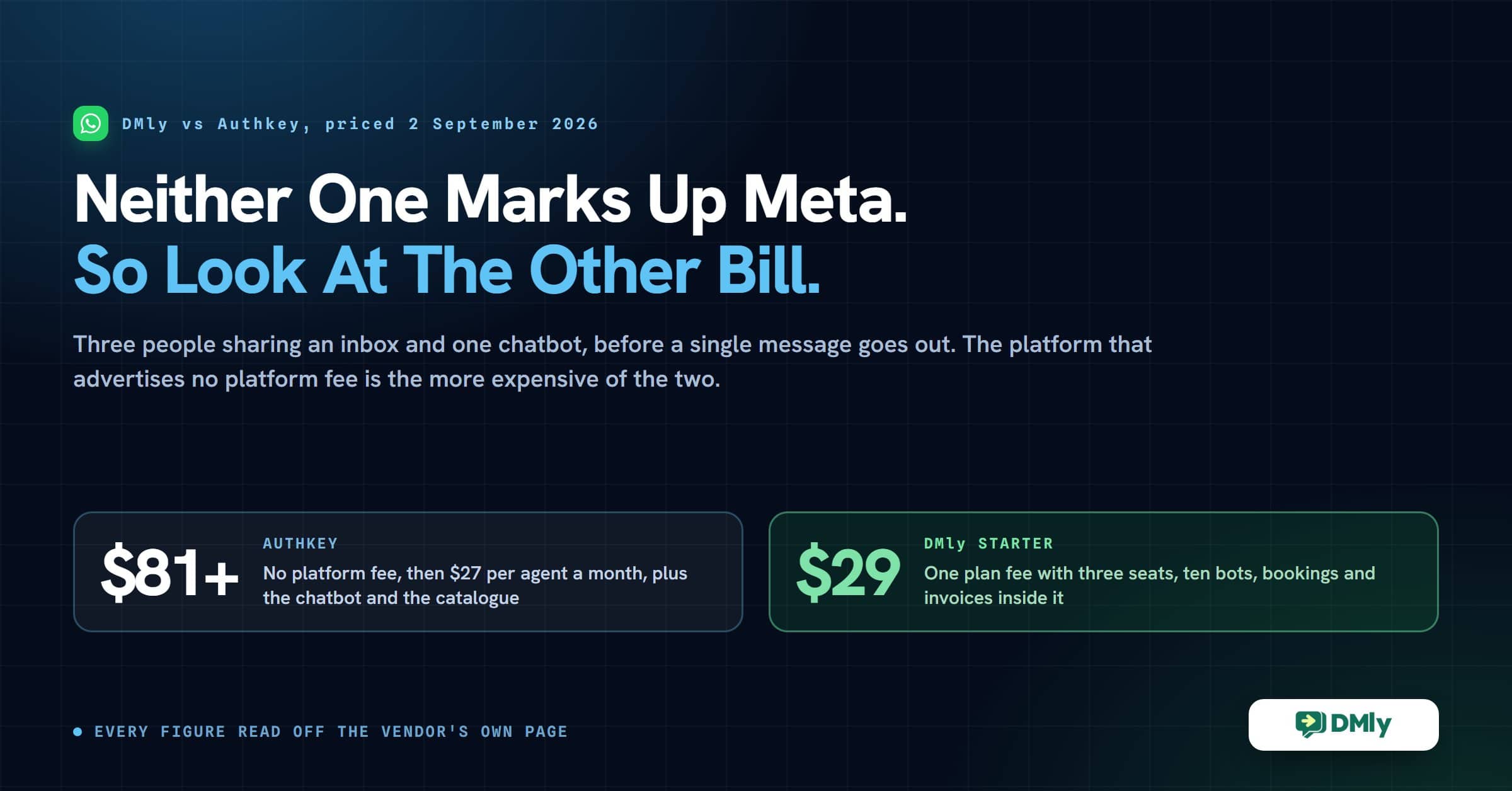
Authkey and DMly both tell you, on their own pricing pages, that they add nothing to what Meta charges for a WhatsApp message. Both are telling the truth.
That makes a straight price comparison between these two harder than it looks. If the message bill is the same either way, the number that decides your monthly cost is not the message rate. It is what each platform charges you before you send anything, and what each one lets you do once the customer replies.
Those two answers pull in opposite directions. Authkey charges no platform fee and then prices the shared inbox, the chatbot and the catalogue separately, one at a time. DMly charges a platform fee and then includes the seats, the bots and the tools inside it.
This DMly vs Authkey comparison prices both sides from each vendor’s own published figures, read on 2 September 2026. The comparison also covers a change landing on 1 October 2026 that moves the message bill on both platforms, because two of the lines Authkey currently shows as free stop being free on that date.
The short answer, if you only have a minute
Choose Authkey if your problem is delivery
Authkey is a communications carrier with a WhatsApp product attached. It makes the most sense when the thing keeping you awake is whether the message arrives:
- you send one-time passcodes, delivery alerts or verification messages in volume
- you need SMS as a first-class channel, not a fallback, in several countries
- you want failover routing, so a message that cannot go one way goes another
- you want RCS, voice or email from the same account as WhatsApp
- you have a developer who will work from an API reference and a Postman collection
Choose DMly if your problem starts after the message arrives
DMly is a business platform with messaging at the front of it. It fits when getting the message delivered was never the hard part:
- the reply needs to become a booking, an invoice or a review request
- three or four people share the same inbox and you do not want to pay per head for it
- your customers are spread across WhatsApp, Instagram, Messenger and your website
- you want the customer record, the payment history and the conversation in one place
- nobody on your team writes code, and nobody is going to start
In one sentence: Authkey sells you the wire, DMly sells you the shop floor. If you need the wire, DMly does not sell one, and that is the honest limit this comparison keeps coming back to.
What you pay before you send a single message
This is where the two platforms genuinely differ, and it is not the part either of them advertises. Authkey’s pricing page leads with “no setup fees, no extra charges” and “no platform markup”. All of that is accurate, and all of it is about the message price. The tools sit outside it.
On Authkey’s own add-on table, the shared team inbox is billed per agent, per month. The chatbot is billed per bot, per month. The catalogue is billed per catalogue, per month. Flows, the tool that builds a form inside a WhatsApp chat, is free, as are the chat widget and the QR code generator.
The agent price is worth a moment, because Authkey’s pricing page carries two different figures for it. The Agent Pricing tab shows a list price of $30 per agent, discounted by volume: $27 each for one to four agents, $24 each for five to nine, and $21 each for ten or more. The add-on table further down the same page shows a flat 1,500 rupees per agent per month, while the Agent Pricing tab’s rupee card starts at 2,000. Ask which one applies to you before you sign anything.
DMly does the opposite. There is one plan fee, and the seats, the bots, the flows and the tools are inside it. Starter is $29 a month billed yearly, or $39 billed monthly, and it carries three team seats, ten active bots per profile with unlimited flows, 3,000 active contacts and 10,000 broadcast or template messages. An extra seat beyond the three is $10 a month.
The same three people, priced two ways
Take a small business with three people answering messages and one chatbot handling the first question. Nothing exotic, and no messages sent yet.
| What you are buying | Authkey | DMly Starter |
|---|---|---|
| Platform fee | None | $29 a month billed yearly, $39 monthly |
| Shared inbox for three people | $27 per agent a month, so $81 | Included, three seats |
| One chatbot | 1,500 rupees per bot a month | Included, ten active bots per profile plus unlimited flows |
| Product catalogue | 1,500 rupees per catalogue a month | Included |
| Setup and onboarding | Free | Free, on a 7-day trial with no card |
| Chat widget and QR generator | Free | Included |
| Markup on Meta’s message fees | None | None |
| Before the first message | $81 for the seats, plus the bot and catalogue add-ons | $29 |
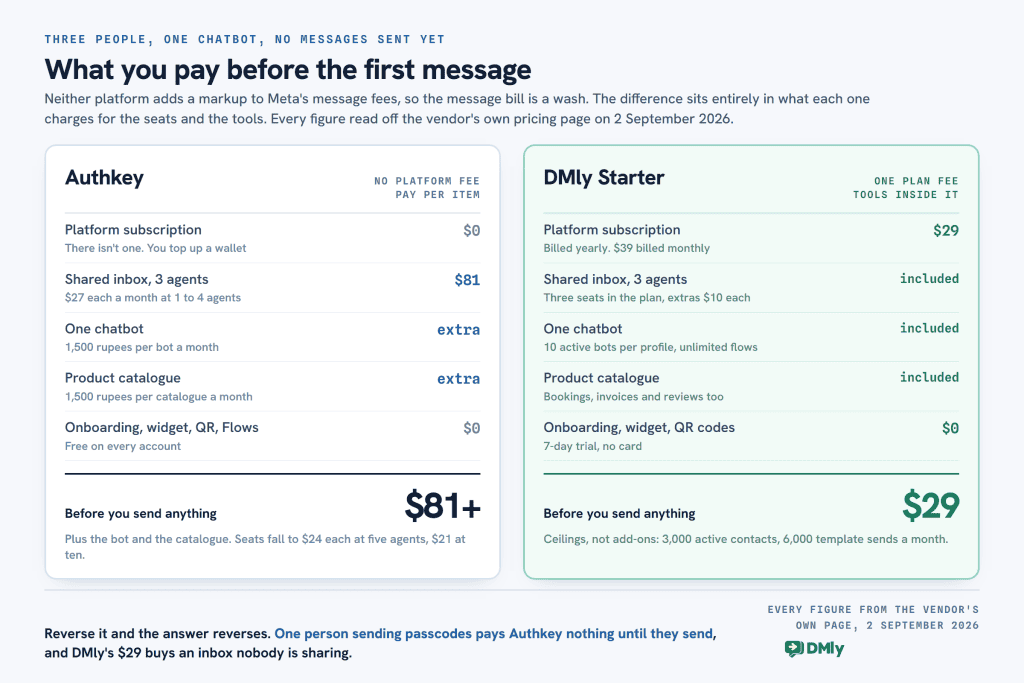
That gap closes as you grow, because Authkey’s agent discount deepens and DMly’s plans step up. It also reverses in Authkey’s favour the moment you need something DMly does not sell, which is most of the next section. But at the size most local businesses actually start at, three people and one bot, the platform that says it has no platform fee is the more expensive of the two.
The reverse case matters just as much. If you are one person sending a lot of one-time passcodes, Authkey costs you nothing at all until you send, and DMly’s $29 buys you a shared inbox you do not need. Neither model is a trick. They are aimed at different problems, and the wrong one is expensive in both directions. Our breakdown of what a WhatsApp chatbot actually costs works through the same arithmetic across the wider market.
What each message costs, and what changes on 1 October 2026
Authkey’s rate card
Authkey has no subscription plans for messaging at all. Its own answer to “how do I upgrade or downgrade?” is that there is nothing to upgrade: you top up a wallet and every cost comes out of it. The rate you pay is Authkey’s service fee and Meta’s template charge combined, published as one number, country by country.
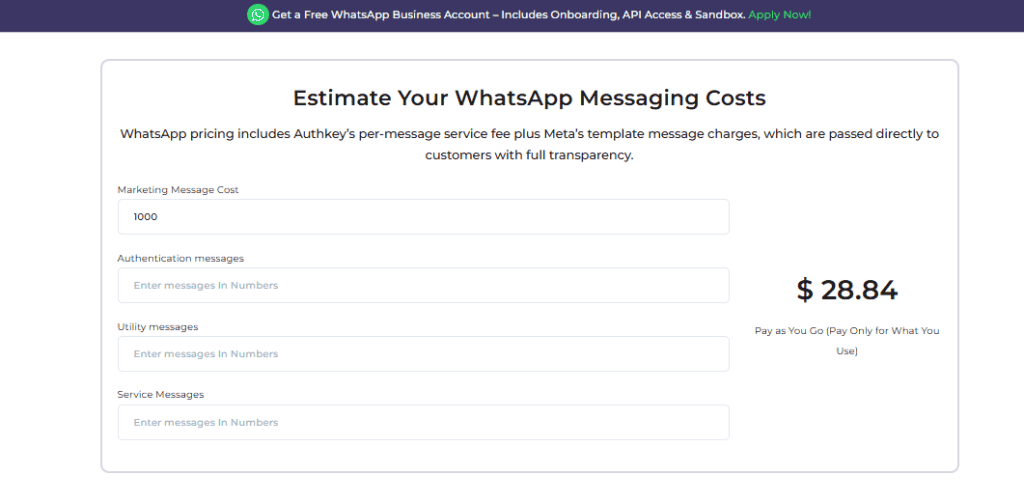
Read off their live table on 2 September 2026, in US dollars for United States numbers:
| Template category | Authkey, United States | Authkey, India |
|---|---|---|
| Marketing | $0.028845 per message | 0.95 rupees per message |
| Utility | $0.004614 per message | 0.15 rupees per message |
| Authentication | $0.004614 per message | 0.15 rupees per message |
| Service replies inside the 24-hour window | Free today, billable from 1 October 2026 | Free today, billable from 1 October 2026 |
An earlier version of this page said authentication and utility messages cost $0.00 through Authkey. That was wrong and it has been corrected. Authentication is charged, and utility is only free while a customer service window is open. The old $0.03 figure for marketing was close for the United States, but it was printed as though it were a flat worldwide rate, and it is not: the same message is 0.0259 dollars to Kenya, 0.0721 to Brazil, 0.0845 to Australia and 0.1652 to France on Authkey’s card today. If you send to more than one country, see our country by country WhatsApp rate card.
DMly’s rate card is Meta’s rate card
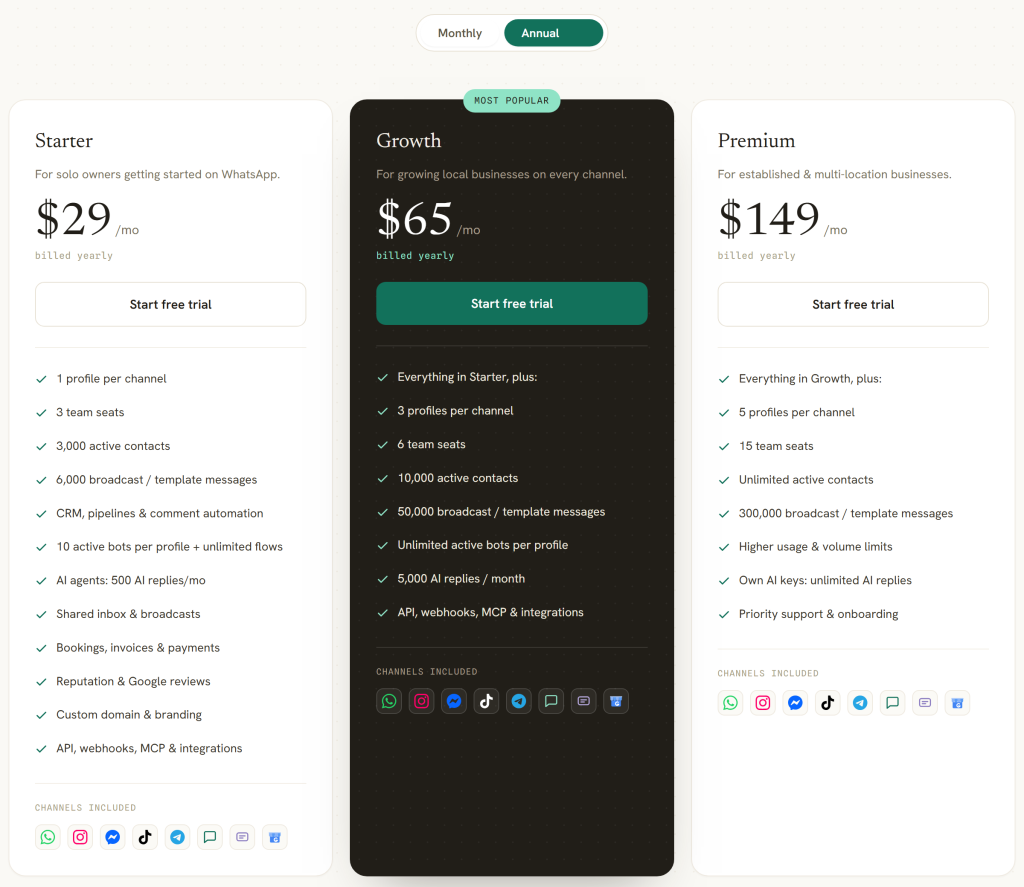
DMly does not resell Meta’s messages. You connect your own WhatsApp Business account, Meta bills you directly at its published rate for your country, and DMly adds nothing to it. Your subscription pays for the platform and nothing else, which is why the three plans are the whole of DMly’s rate card:
| Plan | Billed yearly | Billed monthly | Seats | Active contacts | Broadcast or template messages | AI replies a month |
|---|---|---|---|---|---|---|
| Starter | $29 | $39 | 3 | 3,000 | 10,000 | 500 |
| Growth | $65 | $79 | 6 | 10,000 | 50,000 | 5,000 |
| Premium | $149 | $199 | 15 | Unlimited | 300,000 | 20,000, or unlimited on your own AI keys |
Add-ons are priced the same way on every plan: $10 a month for an extra seat, $15 a month for an extra profile set, $15 per additional thousand contacts. There is a 7-day trial on any plan with no card. The full list is on the DMly pricing page.
The 1 October 2026 change, and why it hits this comparison twice
Two categories of message that are free today become billable on 1 October 2026, and Meta’s upcoming-pricing documentation is explicit about both. Budget for both, not one.
- Service messages. These are the free-form replies a person or a bot types back inside the 24-hour window after a customer messages you. They have been free since 1 November 2024. From 1 October they are charged per message, but only above a free monthly tier: Meta gives every business phone number 1,000 free service messages a month and charges from the 1,001st, with no rollover.
- Utility templates sent in response to a customer inside an open window. Order confirmations, shipping updates, appointment changes. Free since 1 July 2025, charged from 1 October.
One detail almost nobody carries, and it changes how a busy support queue is priced: Meta does not offer volume tiers for service messages. Utility and authentication keep theirs, and the free 1,000 a month is not a volume tier either, because it is a fixed allowance off the top rather than a rate that improves. So above it a long conversation costs in a straight line rather than getting cheaper as it runs on. The 72-hour free entry point window, the one that opens when someone taps a click-to-WhatsApp ad, is unchanged.
There is also a deadline before the deadline, and it is the one to act on. Meta’s own wording is that any solution provider or directly integrated business without a payment method on file by 30 September 2026 will have service message delivery stopped when charging begins on 1 October. If you have been running on free replies and never added a card, adding one is now a job with a date on it. We have written the change up in full in what service messages now cost from 1 October.
The reason this lands twice on this page is that both of the lines currently showing as free on Authkey’s card are the two that change. Their rate table shows service messages at zero and utility as free within the window. Both of those become chargeable, on Authkey and on every other provider, because the charge is Meta’s and not the provider’s.
One thing to read carefully on any provider’s site, Authkey’s included: their pricing FAQ still explains WhatsApp billing as a conversation model, where a 24-hour window is the billed unit and everything inside it is free. Meta retired that model on 1 July 2025 and now charges per delivered template by category. The old explanation is not a small wording problem in October, because the whole thing it describes as free is what starts being charged.
Two platforms built for two different jobs
What Authkey is
Authkey is a communications platform in the older sense of the phrase: an API you send messages through. It began with SMS and it still shows. The product list runs SMS, voice, email, WhatsApp Business API and RCS, with one-time passcodes, two-factor authentication, flash call verification, cash on delivery confirmation and RCS-to-SMS fallback built on top of them.
The infrastructure claim is the point of the whole thing: Authkey connects to more than 220 carriers across more than 200 countries, and sells failover routing and parallel sending as features rather than as engineering details. If one route degrades, the platform can move a message to another route or another channel.
The question Authkey is built to answer is “how do we make sure this message gets delivered?” Everything else on the platform, including the WhatsApp inbox and the chatbot, is sold as an add-on around that.
What DMly is
DMly is a customer engagement platform that happens to start with a message. It carries eight channels, not five, and it is worth naming them properly because the difference matters when you are deciding where your conversations live: WhatsApp, Facebook Messenger, Instagram, Telegram, SMS, TikTok, the LiveChat widget on your own website, and your Google Business Profile.
Two of those come with limits worth knowing before you plan around them. The LiveChat widget and TikTok cannot send broadcasts at all, so a campaign that needs to reach website visitors has to reach them somewhere else. Messenger and Instagram have no message templates; they have a reply window instead, and for anything automated that window is 24 hours, not the seven days a person gets for a reply they type by hand.
Past the inbox, DMly carries the parts of a business that a messaging tool usually hands off: a contact record with pipelines and segments, a booking calendar with services, staff and group classes, invoices and payments, Google review requests and a reputation inbox, loyalty points, gift cards and prepaid credit packs. The question it is built to answer is “what happens after the customer replies?”
Where Authkey is genuinely stronger
This section is longer than a comparison on our own blog usually makes it, because three of these are things DMly does not do at all, and pretending otherwise would waste your time.
Carrier reach and failover
DMly is not a carrier and does not pretend to be one. SMS in DMly runs through an account you open yourself with Twilio or Plivo, or through a custom HTTP gateway, and you pay that provider for the messages. Three providers are supported and only three. There is no carrier network behind DMly and no failover routing, because there are no routes to fail over between: there is your gateway.
The detail that catches people out is the custom gateway. A custom HTTP gateway in DMly is outbound only. It sends your messages, but replies never reach your inbox and delivery reports never update a message’s status. If you need two-way SMS you have to be on Twilio or Plivo. DMly’s SMS is also text only: no images, no files, no tappable buttons, and no read receipts, because SMS does not report them. Our guide to SMS automation and gateways covers how to set that up properly.
If your business depends on a message arriving in a country you have never sent to before, that difference is not a nuance. It is the whole decision.
RCS, voice and email
DMly has no RCS channel, no voice channel and no email channel. Not a limited version of them: they are not in the product. Authkey has all three, plus voice one-time passcodes and flash call verification, and it will fall back from RCS to SMS automatically when a handset cannot receive the richer format.
RCS in particular is worth watching if most of your customers are on Android in a market where carriers have enabled it. Nothing in DMly reaches those inboxes, and the word RCS does not appear anywhere in DMly’s documentation.
One wallet, and no plan to outgrow
Authkey’s refusal to sell plans is a real advantage in one specific case: a business whose volume swings hard from month to month. There is no tier to sit under, no allowance to blow through, and no upgrade conversation in a busy month. You spend what you send.
DMly’s plans work the other way. Starter’s 10,000 broadcast or template messages is a real ceiling, and going past it means Growth at $65. If your December is five times your March, that is a genuine downside of the plan model and worth pricing before you commit.
A white-label panel of its own
An earlier version of this page said Authkey had no white-label offering. It does. Authkey publishes a white-label and reseller panel with your own logo, domain and pricing, managed hosting, and its own billing, user management and analytics. No price is published for it, so it is a conversation rather than a checkout.
DMly’s equivalent is its agency tier: your own branding, client workspaces you provision and suspend, a custom domain, and a Stripe connection so you bill your clients directly. Both exist, both are quoted rather than listed, and the choice between them comes down to which underlying product your clients need.
Where DMly is genuinely stronger
Everything that happens after the reply
This is the gap, and it is a wide one. A customer messages “can I come in Thursday?” On Authkey, an agent reads it in the inbox and then opens whatever else the business uses to take a booking. On DMly, the booking is in the same product: services, staff, availability, group classes, a public booking page, calendar sync and automatic reminders.
The same is true of the sale that follows. DMly issues branded invoices, records payments, tracks expenses and reports revenue, and it will chase an overdue invoice on WhatsApp without anyone remembering to. It asks for the Google review afterwards and collects the replies in a reputation inbox. It keeps loyalty points that turn into a discount coupon on their own, sells gift cards and prepaid credit packs, and runs memberships as recurring plans.
None of that is on Authkey’s product menu. It is not a criticism of Authkey, which has never claimed to be a booking system. It is simply the line between the two, and it is the line most small businesses are actually shopping on. If bookings are your case, our WhatsApp appointment booking guide and the invoicing walkthrough show what that looks like in practice.
One honest limit inside that strength. DMly appointments have exactly three payment modes: no payment, pay after the appointment, or pay before booking with the slot held for 15 minutes while the client checks out. There is no deposit or part-payment option on a booking. Invoices are different and do support partial payment, so if you need a deposit the workaround is to invoice for it rather than to take it on the booking. Get that the wrong way round and you will look for a setting that is not there.
The cost of the people, not the messages
Authkey’s shared inbox is a real product with real features: tagging, notes, chat assignment and history, sticky agent, smart routing, custom labels, downloadable chats, a Kanban view and live chat reports. It is also charged per agent, every month, forever.
DMly puts three seats inside the $29 plan, six inside Growth and fifteen inside Premium, with extras at $10 each. For a four-person team the difference is $108 a month against $39. For a fifteen-person team on Authkey’s deepest published discount it is $315 a month against $149. Neither figure includes a message.
If your inbox is one person, this argument disappears entirely and Authkey wins on cost. It only bites when the inbox is shared, which is the moment most businesses reach a few months in. The shared team inbox is where that plays out.
Eight channels, one thread per customer
Authkey’s inbox is a WhatsApp inbox. DMly’s carries WhatsApp, Messenger, Instagram, Telegram, SMS, TikTok, the website widget and Google Business Profile, and the same customer keeps one contact record across all of them. Someone who found you on Instagram, booked on WhatsApp and left a review on Google is one person in DMly, with one history.
Whether that is worth anything depends entirely on where your customers already are. If they are all on WhatsApp, it is worth nothing. Our omnichannel inbox guide is a fair place to work out which case you are in before you pay for either.
DMly vs Authkey: five rounds, decided on the evidence
Not on feature counts, and not on marketing claims. On the situations a business actually hits.
Round 1: getting the message delivered
Authkey, comfortably, and it is not close. Carrier-level routing, failover, parallel sending, 220 carriers and 200 countries, plus RCS, voice and email in the same account. DMly’s SMS is a gateway you bring yourself, with no failover and no read receipts, and its custom gateway option cannot receive replies at all.
Winner: Authkey.
Round 2: turning the reply into a booking or an invoice
DMly, because Authkey does not compete here. Bookings, invoices, payments, expenses, reviews, loyalty and memberships are in DMly and are not on Authkey’s product list. Authkey integrates with Zapier, Pabbly Connect, Integrately, Kylas, Shopify and Magento, so you can bolt something on, but that is another subscription and another system to keep in step.
Winner: DMly.
Round 3: who can actually run it
Authkey is API-first and its front door is a set of API references and a Postman collection. That is a strength if you have a developer and a cost if you do not. DMly is built for the person who owns the business to configure themselves, which is a limitation in the other direction: there is less to customise at the wire level.
Winner: DMly, for a team without developers. Authkey if you have one.
Round 4: reporting, and this one is a draw
An earlier version of this page gave this round to DMly. Checked properly, it does not deserve it. Authkey reports delivery, and delivery reporting is what a carrier is good at. DMly reports the team: assigned, closed, replies, average first response and average resolution, per agent as well as team-wide, filtered by date and exportable. That is a genuinely useful report and most WhatsApp tools in this bracket do not have it.
But DMly’s broadcast reporting has real holes, and you should know about them before you plan a campaign around the numbers:
- Replies is always 0. Nothing in DMly counts replies to a broadcast, on any channel. It appears as a stat card and as the last step of the funnel and it will read zero forever. Replies do arrive, in the contact’s conversation thread, they are just never counted.
- Engagement over time is placeholder data. It shows the same fixed shape for every broadcast and is not derived from your send.
- Delivered and Opened only work on WhatsApp, and Delivered alone on SMS. On Messenger, Instagram and Telegram they stay at zero no matter how well the campaign did.
So the honest version is: use WhatsApp’s Delivered and Opened, use the team report, and do not build a dashboard on the rest. Winner: neither, and they measure different things. Our broadcast guide covers what to track instead.
Round 5: running a team on it
Both platforms have a shared inbox with assignment and history, and both have a drag-and-drop board: Authkey calls its Kanban view, DMly calls its Pipeline view. The difference that costs money is that DMly’s inbox is inside the plan and Authkey’s is priced per agent per month, across eight channels rather than one.
One documented DMly limit belongs here, because Authkey’s sticky agent covers it and DMly’s round-robin does not. DMly’s round-robin fires once, on a contact’s first ever inbound message, and never on a returning contact. It picks whoever currently holds the fewest open conversations. So a regular who messages you every month is not sent back to the person who knows them unless you pair it with the “whoever replied last” setting or assign by hand.
Winner: DMly, on cost and on channel coverage.
Scorecard
| Round | Winner | Why |
|---|---|---|
| Getting the message delivered | Authkey | 220 carriers, failover routing, RCS, voice and email. DMly has none of it |
| Turning the reply into revenue | DMly | Bookings, invoices, reviews and loyalty are in the product, not integrated in |
| Who can run it | DMly, unless you have a developer | Authkey’s front door is an API reference |
| Reporting | Draw | Authkey measures delivery, DMly measures the team, and DMly’s broadcast stats have real gaps |
| Running a team on it | DMly | Seats included rather than $27 each a month, across eight channels rather than one |
The pattern is the same one the pricing pointed at. Authkey wins where communication is infrastructure. DMly wins where communication is the front of a business.
DMly vs Authkey, feature by feature
Every row checked against each vendor’s own published material on 2 September 2026. Where a platform charges extra for something, the row says so, because “included” and “available” are not the same sentence.
| Capability | Authkey | DMly |
|---|---|---|
| WhatsApp Business API | Yes, Meta Tech Partner | Yes, Meta Business Partner |
| Markup on Meta’s message fees | None | None |
| Platform subscription | None. Wallet top-up, pay per message | $29, $65 or $149 a month billed yearly |
| Shared team inbox | Paid add-on, $27 to $21 per agent a month by volume | Included: 3, 6 or 15 seats, extras $10 a month |
| Chatbot builder | Paid add-on, 1,500 rupees per bot a month | Included: 10 active bots per profile on Starter, unlimited above it, unlimited flows on all plans |
| Product catalogue | Paid add-on, 1,500 rupees per catalogue a month | Included |
| Channels in the inbox | Eight: WhatsApp, Messenger, Instagram, Telegram, SMS, TikTok, website widget, Google Business Profile | |
| SMS | Own carrier network, 220 carriers in 200 countries, failover routing | Bring your own Twilio, Plivo or HTTP gateway. No failover, text only, no read receipts |
| RCS messaging | Yes, with automatic SMS fallback | Not available |
| Voice and email | Yes, both, with voice OTP and flash call verification | Not available |
| CRM | The shared team inbox, which Authkey calls its CRM: tagging, notes, assignment, history, Kanban, sticky agent. Priced per agent. Plus CRM integrations | Contacts, client profiles, pipelines and 15 segment fields across contact, engagement and commerce data |
| Audience segmentation | Contact management and lead assignment logic in the agent product | Saved segments on lifecycle, source, tags, custom fields, birthday month, channel reach, opt-in, total spend, last purchase, order count, loyalty points and credit balance |
| Bookings and appointments | Not on the product list | Services, staff, availability, group classes, booking page, calendar sync, client portal. Three payment modes and no deposit option |
| Invoices and payments | Not on the product list | Branded invoices, partial payment, coupons, gift cards, refunds, expenses and a revenue report |
| Reviews and reputation | Not on the product list | Google Business Profile connection, automatic review requests, a reputation inbox and post performance |
| Loyalty and memberships | Not on the product list | Loyalty points that convert to a coupon, gift cards, prepaid credit packs and recurring plans |
| Broadcast campaigns | Unlimited broadcast campaigns, campaign scheduler | Yes on six channels. Not on the website widget or TikTok |
| Broadcast reporting | Real-time and downloadable delivery reports | Delivered and Opened on WhatsApp only, Delivered on SMS. Replies always reads 0 |
| Team reporting | Live chat reports in the agent product | Assigned, closed, replies, average first response and average resolution, per agent, exportable |
| AI | AI-driven communication and chatbot flow logic | AI agents on every plan: 500, 5,000 or 20,000 replies a month, own AI keys on Premium |
| API and webhooks | Yes, with Postman collections and IP whitelisting | Yes on every plan, plus an MCP server for AI clients |
| Integrations | Zapier, Pabbly Connect, Integrately, Kylas, Shopify, Magento | Shopify, WooCommerce, Zapier, n8n, HubSpot and the API. No native Salesforce connector |
| White label | Reseller panel with own logo, domain and pricing. Price on application | Agency branding, client workspaces, custom domain, Stripe connection. Price on application |
| Free trial | Free onboarding and a sandbox, no setup fee | 7 days on any plan, no card |
The verdict
Authkey is the better platform if the message itself is the hard part. High-volume passcodes, transactional alerts, several countries, RCS or voice alongside WhatsApp, a developer to wire it up, and volume that swings too much to sit comfortably on a plan. Nothing in DMly competes with a carrier network, and this page is not going to pretend otherwise.
DMly is the better platform if the message is the easy part. When the work is booking the appointment, taking the payment, chasing the invoice, asking for the review and keeping three or four people in one inbox without paying per head, DMly does those in one subscription and Authkey does not do them at all.
The honest test is one question: after a customer replies to you, what has to happen next, and where does it happen today? If the answer is “it goes into another system”, the platform that includes that system is worth more than the one with the better routing. If the answer is “nothing, the message was the job”, pay per message and keep your money.
Comparing infrastructure platforms more widely, the same question runs through our reviews of Kaleyra, Bird, formerly MessageBird and CM.com, all three of which sit on Authkey’s side of the line.
Frequently asked questions
Is Authkey good for WhatsApp marketing?
Yes, for sending. Authkey is on the official WhatsApp Business API, supports unlimited broadcast campaigns and a campaign scheduler, and charges no markup on Meta’s rates. What it does not carry is the layer after the send: no bookings, no invoicing, no review collection, and a shared inbox that is a paid add-on rather than part of the product. If your marketing ends when the message is delivered, it is a good fit.
How much does Authkey cost?
There is no subscription. You top up a wallet and pay per template message at a rate that combines Authkey’s fee and Meta’s charge, varying by country: on 2 September 2026 that was $0.028845 for a marketing message to a United States number and $0.004614 for utility or authentication, or 0.95 and 0.15 rupees respectively in India. The tools are separate: the shared inbox is $27 to $21 per agent a month depending on how many agents you have, and the chatbot and catalogue are 1,500 rupees each a month on their add-on card.
Are authentication and utility messages free on Authkey?
No, and an earlier version of this page said they were. Authentication messages are charged. Utility messages are only free while a 24-hour customer service window is open, and from 1 October 2026 they are charged in that case too, from the very first one. Service replies are charged as well, though only above 1,000 free a month per business phone number, and they have no volume tiers either, so above that allowance they do not get cheaper as a conversation runs on.
Is DMly cheaper than Authkey?
It depends entirely on how many people use it. For one person sending messages through an API, Authkey is cheaper, because there is no platform fee to pay. For three people sharing an inbox, DMly Starter at $29 a month billed yearly is cheaper than $81 a month of Authkey agent seats before either has sent anything. The message rate itself is a wash: neither adds a markup to Meta’s fee.
Does DMly support SMS and RCS?
SMS yes, RCS no. DMly’s SMS runs on your own Twilio, Plivo or custom HTTP gateway account and you pay that provider directly. It is text only, with no read receipts, and a custom HTTP gateway is outbound only, so replies and delivery reports do not come back. There is no RCS channel in DMly at all. Authkey has both, with automatic RCS-to-SMS fallback.
Does DMly charge a markup on Meta’s WhatsApp fees?
No. You connect your own WhatsApp Business account, Meta bills you directly at its published rate for the country you are messaging, and DMly adds nothing to it. Your subscription pays for the platform. Authkey works the same way, except that it bills the Meta charge through its own wallet as a single combined rate rather than leaving Meta to invoice you.
DMly vs Authkey: which is better for a growing business?
Growth usually means more people in the inbox and more things to do after a message, and both of those favour DMly, because seats are inside the plan and bookings, invoices, reviews and loyalty are inside the product. Growth that means more messages to more countries favours Authkey. Work out which kind of growth you are having before you pick.
What do I need to do before 1 October 2026?
Make sure your WhatsApp Business account has a payment method on file by 30 September 2026. Meta’s own documentation says that any business or provider without one will have service message delivery stopped when charging begins on 1 October. After that, budget for two things that used to be free: the free-form replies your team sends inside the 24-hour window, which come with 1,000 free a month before any charge starts, and utility templates you send back to a customer inside that window, which have no allowance at all.
Writing about WhatsApp automation, bookings and growth for local business.
Turn WhatsApp into your busiest channel.
Start free and run message, bookings, payments and reviews in one place.
