
WhatsEra Review (2026): The Site Is Down, the Product Is Not
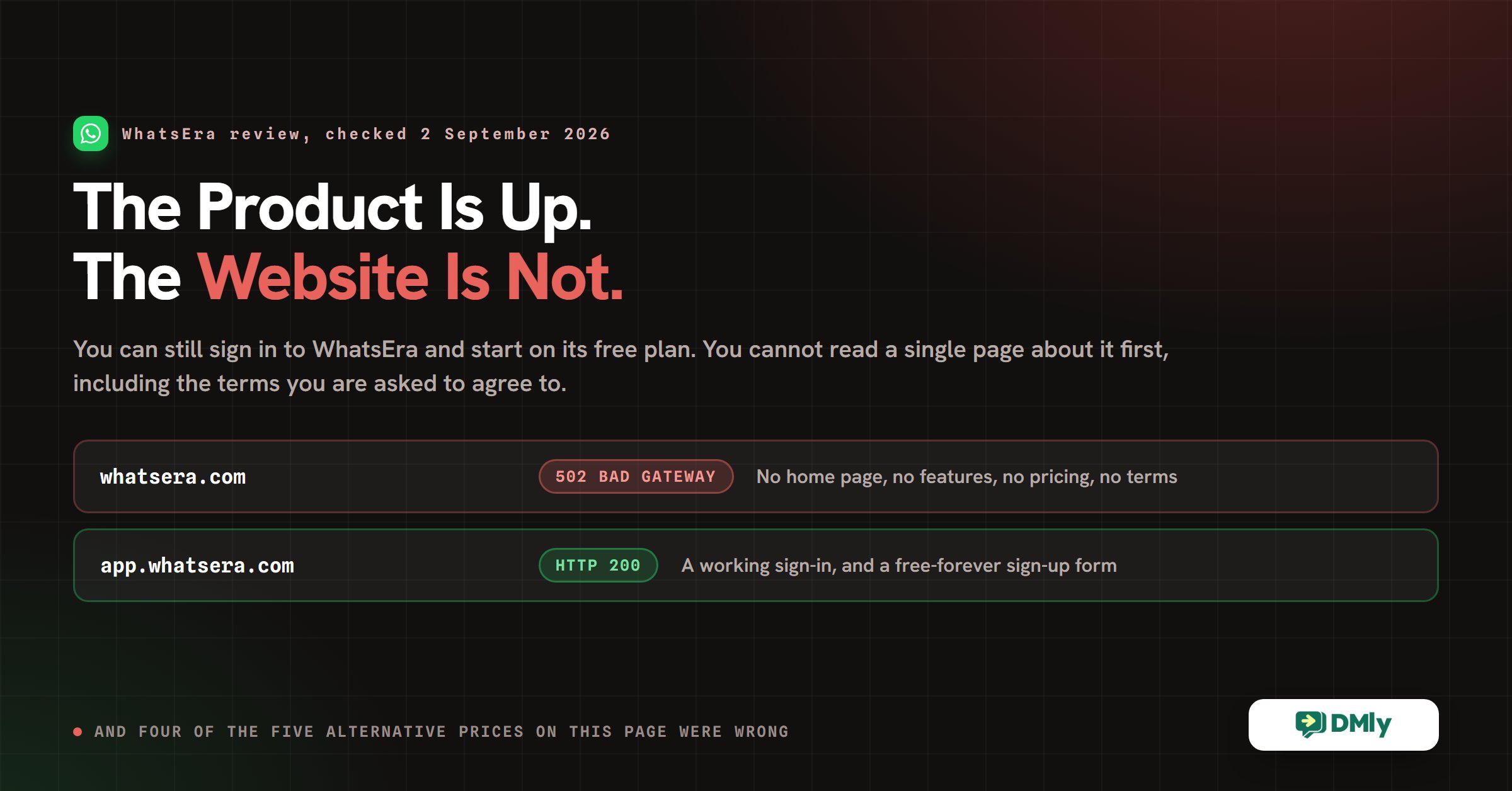
The first thing this WhatsEra review did was open WhatsEra’s website. On 2 September 2026, three times in a row, whatsera.com returned a bare 502 Bad Gateway: no home page, no feature pages, no pricing, just an nginx error screen.
That is not the finding you expect from a software review, and it is not the end of the story either. The product itself is still running. app.whatsera.com answers normally, serves a working sign-in screen, and its registration page says “Get started absolutely free. Free forever. No credit card needed.” So WhatsEra has not vanished. What has gone is everything a prospective customer would read before signing up.
This WhatsEra review covers what can be verified today, says plainly what cannot, and then does the job the page is really here for: the alternatives. That part needed more work than expected. Four of the five alternative prices on the previous version of this page were wrong, one of them by roughly ten times, and every figure below has now been read off the vendor’s own pricing page on 2 September 2026.
WhatsEra Review: What Happens When You Try to Reach the Site Today
Check it yourself before you do anything else, because this is the single most important thing on the page and it may have changed by the time you read it. Here is exactly what was checked and what came back.
| What was checked | What came back |
|---|---|
whatsera.com, the marketing site | 502 Bad Gateway from nginx, on three attempts in a row. No content of any kind. |
app.whatsera.com, the product | HTTP 200. A working WhatsEra sign-in screen with email, password and a Forgot password link. |
| The registration page | Live, and headed “Get started absolutely free. Free forever. No credit card needed.” Name, country, mobile, email, password. |
| The Terms of Service and Privacy Policy links on that registration form | Both point at the same URL, and it returns “Sorry, page not found!” |
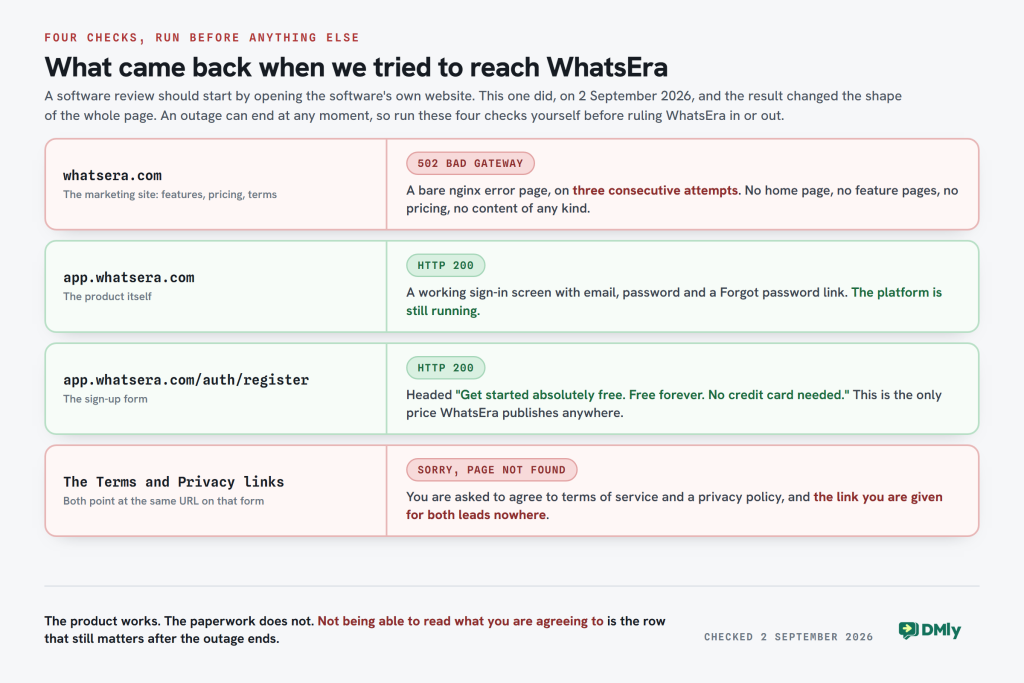
Take the last row seriously whatever happens to the outage. The registration form asks you to agree to terms of service and a privacy policy, and the link it gives you for both leads to a page that does not exist. For a platform that will hold your customer list and send messages on your behalf, being unable to read what you are agreeing to is a real problem, not a cosmetic one.
What WhatsEra Is, and What This WhatsEra Review Cannot Confirm
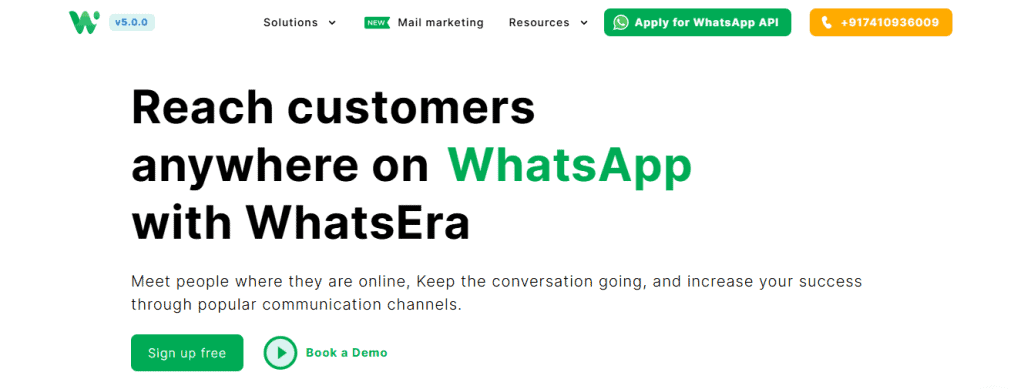
WhatsEra is a WhatsApp marketing and customer communication platform, built and sold from India, and this WhatsEra review found its product still running behind a broken front door. Its home page carries an Indian support number and an “Apply for WhatsApp API” button, and its newest navigation item was Mail marketing, so it had been widening beyond WhatsApp into email.
The product does what this category does: bulk WhatsApp campaigns from an approved template, campaign scheduling, interactive buttons and list messages, a shared inbox several people can work from at once, auto-replies and chatbot flows, and an API for connecting your CRM or website.
Here is the honest limit of this review. Every feature description above comes from material published before the site went down. With whatsera.com unreachable, none of it can be re-verified today, and neither can anything that may have changed in the meantime. This page will not restate old marketing copy as current fact. If you are seriously evaluating WhatsEra, the only reliable route right now is to register on the app host and look at the product itself.
WhatsEra Pricing: A Free Tier, Then a Quote
The old version of this page said WhatsEra publishes no pricing at all. That was half right, and the missing half is the useful half.
There is no pricing page and there never was a Pricing item in the navigation, so anything beyond the entry level is a conversation with their sales team, priced on your user count, message volume, automation needs and integrations. That much stands.
But the registration page publishes one price and it is zero: “Get started absolutely free. Free forever. No credit card needed.” What the free tier includes is not stated anywhere public, which is a real gap, but a free-forever plan you can start without talking to anyone is a materially different proposition from “contact us for a quote”, and every review including our own previous one missed it.
Two things follow for you as a buyer. First, you can evaluate WhatsEra without a sales call, which is more than several of the alternatives below allow. Second, you cannot budget for it or compare it on price, because the moment you outgrow free you are back to a quote with no anchor to negotiate against. If you go that route, the questions to ask are the same ones we set out in our review of Anantya.ai, which is the other platform in this market that quotes rather than publishes.
WhatsEra Review: Strengths and Limitations
What It Does Well
- A free tier you can start on your own. No card, no call, no quote. In a market where the going rate for an entry plan runs from $29 to $170 a month, that is a genuine advantage for a small business that wants to try WhatsApp automation before committing.
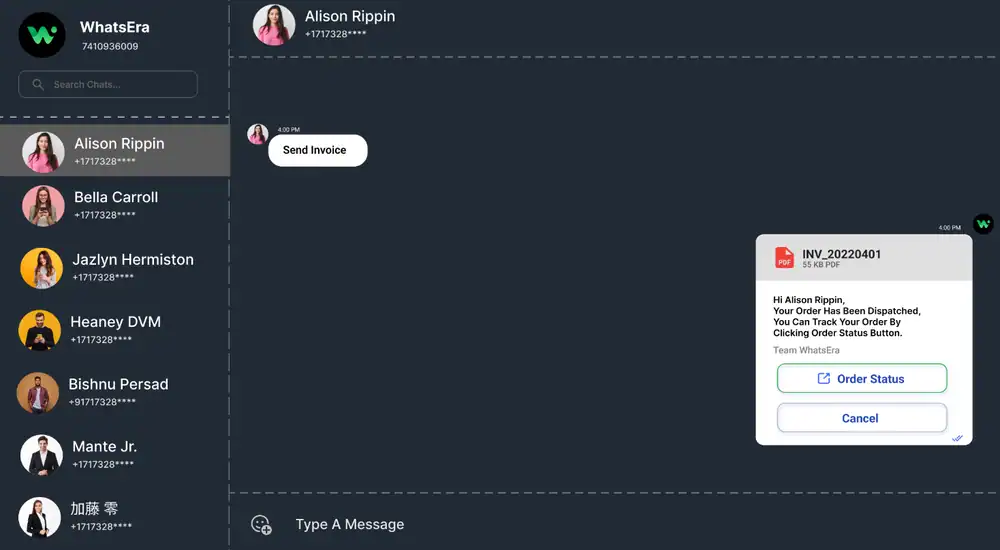
- Straightforward to use. The consistent theme in user feedback is that it is easy to navigate without technical help, and the inbox capture above supports that.
- Multi-user access to one WhatsApp number, which is the whole reason most businesses leave the free WhatsApp Business app in the first place.
- Invoicing inside the chat, which their own screenshot shows and their marketing barely mentions.
- Responsive support, reported consistently by users, with a phone number on the home page rather than a contact form.
Where It Falls Short
- The website is down. Everything else on this list is secondary to that. You cannot read the feature pages, the terms, the privacy policy or any pricing.
- No published pricing above the free tier. You cannot compare, budget or shortlist without a sales conversation.
- Essentially a single-channel platform. It is built around WhatsApp, with email added later. If your customers also reach you on Instagram, Messenger, Telegram or a widget on your site, you will be running a second tool.
- Automation depth is unclear. Auto-replies and chatbot flows are documented; multi-step journeys with branching, waits and conditions are not, and with the site down there is no way to check.
- No public record you can point at. No changelog, no status page, no documentation site that resolves. When something breaks, you are relying on support.
WhatsEra Review: The Five Alternatives, and Why Four Prices Had to Be Corrected
This is the part of the page that had aged worst, and it matters more than the WhatsEra section, because a wrong price sends you to the wrong shortlist. Every figure was re-read on the vendor’s own pricing page on 2 September 2026. Four of the five had moved, and two were not close.
| Platform | What this page used to say | What the vendor’s own page says today |
|---|---|---|
| Gallabox | “starts around $24/month” | $150 a month, billed quarterly (about $112 billed yearly). Three users, hard cap, and no extra seats purchasable on that plan. No monthly billing option at all. |
| Trengo | “starts around €113/month” | €299 a month billed annually, €349 monthly, for 10 users and 6,000 conversations a year. The cheaper tier no longer exists. |
| DoubleTick | “around $14 to $20/month” | $170 a month, or $2,039 billed yearly, and AI agents are not available on that plan at any price. No free trial. |
| BotSailor | “paid plans from $10.99, agency white-label from about $70.99” | $10.99 is right for the smallest tier. Agency, the white-label plan, starts at $130.99 a month; $70.99 is a regular Premium tier. |
| DMly | “typically starts around $29/month” | Correct, and now stated in full: $29, $65 and $149 a month billed yearly, or $39, $79 and $199 billed monthly. |
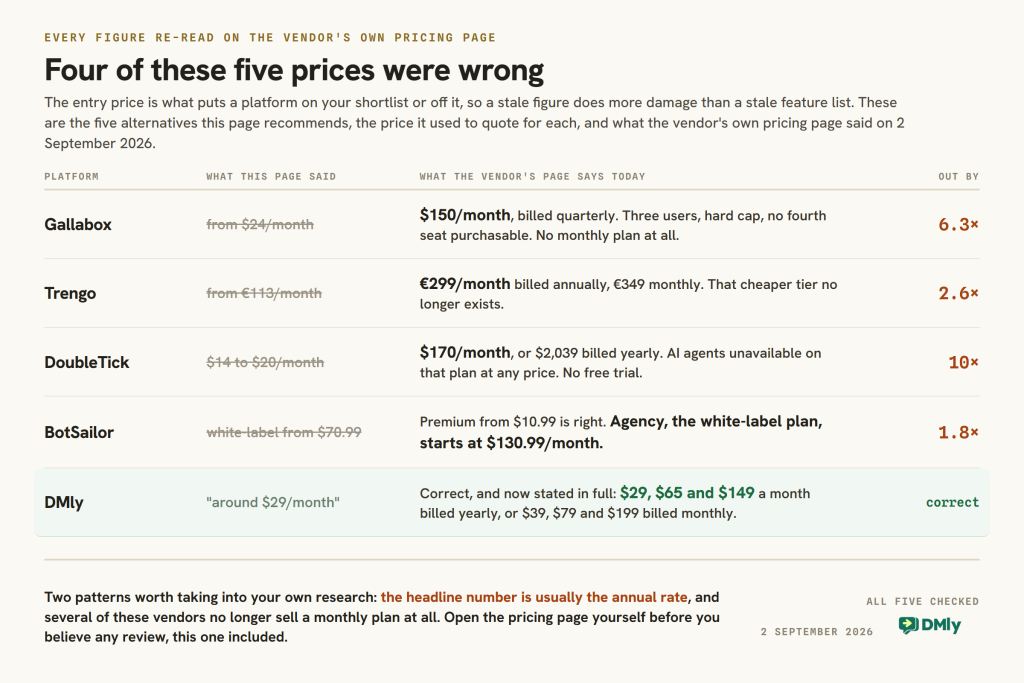
Two patterns are worth carrying into your own research, because they are not specific to these five vendors. The headline number is often the annual rate, and several of these platforms no longer sell a monthly plan at all. Gallabox bills quarterly or yearly and nothing else. And the cheap tier that a review quotes is frequently the tier the vendor has since deleted, which is what happened to Trengo’s.
1. DMly, the Broadest Alternative
Fair warning: this WhatsEra review is published by DMly, so read this section as an argument rather than a verdict, and check it against the section further down where we set out what DMly does not do.
Where WhatsEra is a WhatsApp platform with email attached, DMly is built around the whole customer relationship: eight channels in one inbox, a CRM with pipelines and lifecycle stages, a booking calendar, invoicing and payments, Google review requests, and loyalty and gift cards, with automation and AI running across all of it.
DMly Pricing in Full
| Plan | Billed yearly | Billed monthly | Team seats | Active contacts | Broadcast and template messages | AI replies |
|---|---|---|---|---|---|---|
| Starter | $29/mo | $39/mo | 3 | 3,000 | 10,000/mo | 500/mo |
| Growth | $65/mo | $79/mo | 6 | 10,000 | 50,000/mo | 5,000/mo |
| Premium | $149/mo | $199/mo | 15 | Unlimited | 300,000/mo | 20,000/mo, or unlimited on your own AI key |
What DMly Actually Includes
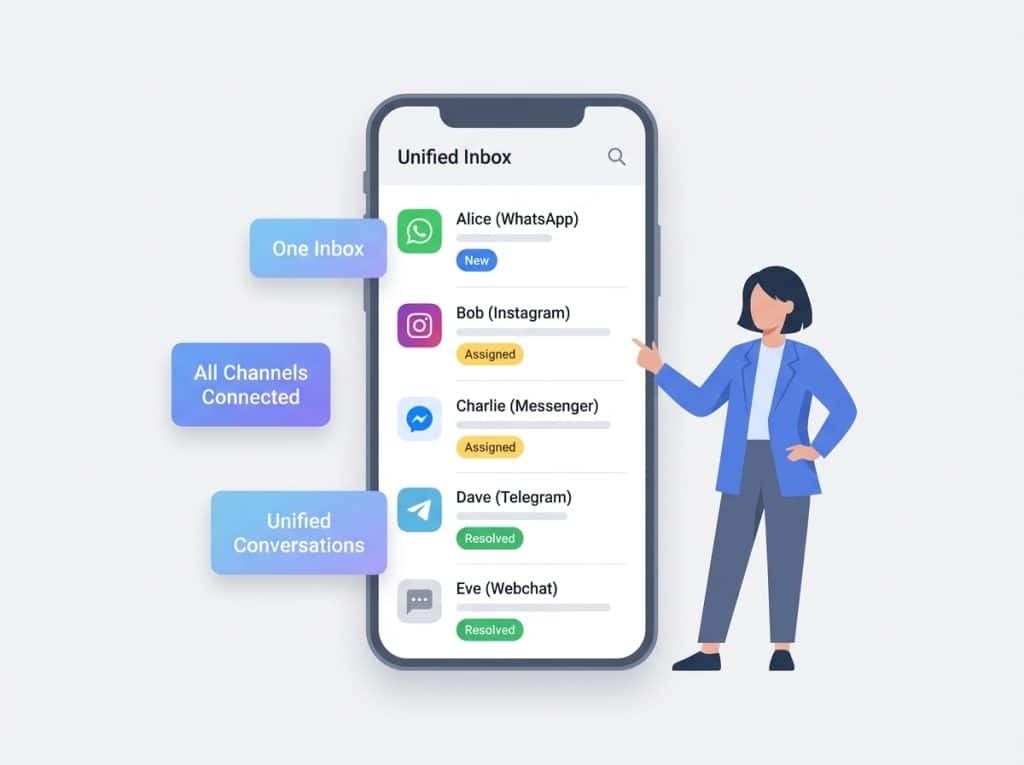
- Eight channels, not five. WhatsApp, Instagram, Facebook Messenger, Telegram, SMS, TikTok, a Live Chat widget for your website, and Google Business Profile, all landing in one shared inbox.
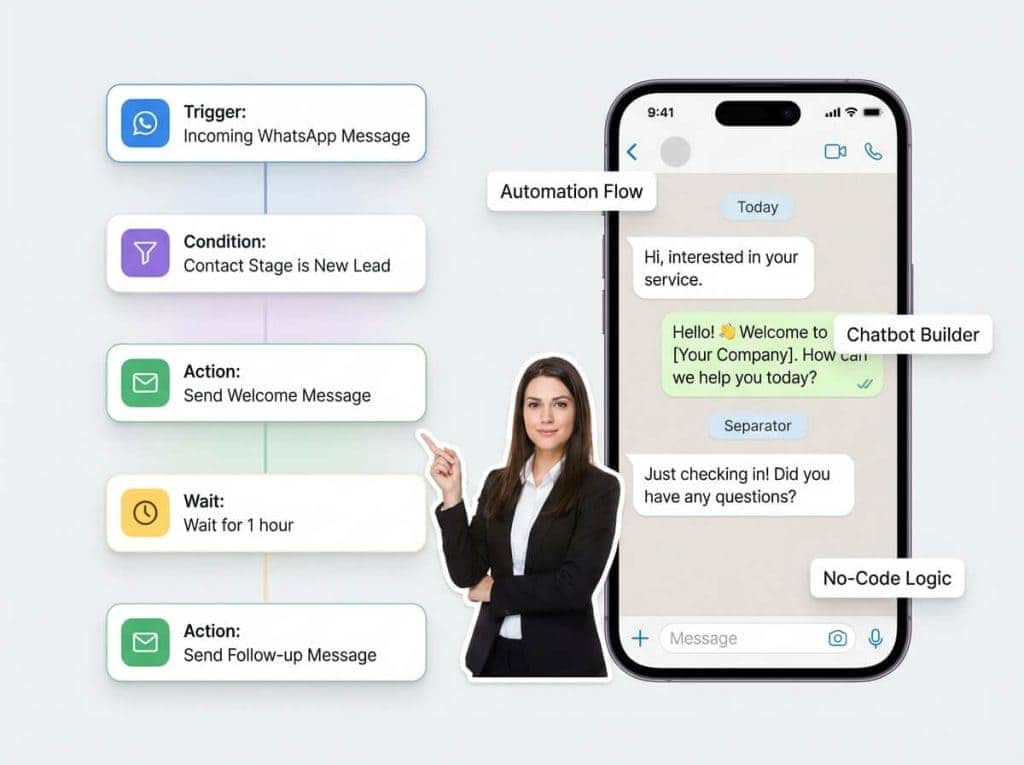
- Automation with real branching. Triggers, conditions, a randomiser, a Smart Delay with three waiting modes including waiting until a dated event such as an appointment, and sequences.
- AI agents that act, not just answer. Switched on per step, they can read the contact, tag them, move them along your pipeline, search your uploaded documents, book an appointment or hand the chat to a person.
- A CRM with lifecycle stages and your own pipeline stages, which are two separate axes, plus custom fields, tags, notes and documents on the contact.
- Segments that rebuild themselves. Four basic filters (stage, tags, excluded tags, days since last activity) and twelve condition fields, including total spend, order count, last purchase, loyalty points and credit balance.
- Bookings, invoices, reviews and loyalty in the same product: a calendar with bookable staff and classes, invoices sent through WhatsApp, tracked Google review requests, and a loyalty programme with points and gift cards.
- White-label and reselling through a reseller dashboard, your own domain and your own branding. See white-label.
Where DMly Loses
- Broadcast reporting has three holes. Replies is always 0 on every channel, Engagement over time is placeholder data that shows the same shape for every broadcast, and Delivered and Opened only work on WhatsApp, with Delivered alone on SMS. Use the per-template performance view instead; our broadcast guide explains the workaround.
- Two of the eight channels cannot broadcast at all. The Live Chat widget and TikTok are inbox-only, and Messenger and Instagram have no message templates, so anything automated has to land inside a 24-hour window.
- Message volume is capped by plan: 10,000, 50,000 or 300,000 a month, with no message top-up add-on. Several platforms here cap users rather than messages.
- Appointments have three payment modes and none of them is a deposit. No payment, pay after, or pay before with a 15-minute slot hold. A part-payment has to go through an invoice, which does support partial payment.
- No native Salesforce or Zoho connector. There is a HubSpot connector: a flow step pushes a contact to HubSpot, and HubSpot and Mailchimp are listed under Sales and CRM in the integrations. The rest of the list is Shopify, WooCommerce, Zapier, n8n, OpenAI, Claude, Gemini, DeepSeek, Google Drive, Zoom, Slack, Google Sheets and Mercado Pago. Anything beyond that goes through Zapier, n8n or the API.
- Unlimited AI needs your own provider key, and that is Premium only. Below that you are on a monthly allowance, and two of the four supported providers cannot search your uploaded documents.
2. Gallabox, and the Price That Was Out by Six Times
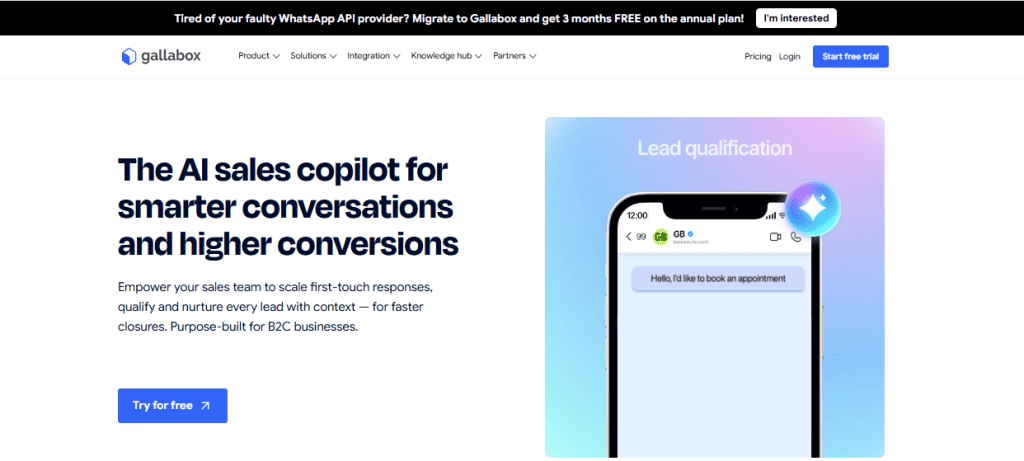
Gallabox is a capable WhatsApp platform with a beginner-friendly automation builder, and it costs about six times what this page previously said. The corrected card, read on 2 September 2026:
- Basic: $150 a month, billed quarterly (₹2,999 or AED 549). Three user accounts, described on their own page as a hard cap, with extra users listed as “upgrade required” rather than purchasable. 500 AI credits a month. One WhatsApp number, one Instagram handle, one website widget.
- Essential: $331 a month, billed quarterly. Six users, $18 a month for each extra, 2,000 AI credits, drip campaigns, ads attribution, full API.
- Advanced: $632 a month, billed quarterly. Ten users, $24 for each extra, 8,000 AI credits, AI voice, pipeline management and appointment booking.
- Enterprise: talk to sales.
Two structural points the old figure hid. Gallabox does not sell a monthly plan: the toggle offers quarterly or yearly, and yearly saves 25 per cent, which puts Basic at about $112 a month on a year’s commitment. And the three-user cap on Basic is genuinely hard, so a fourth person means moving to Essential at $331, not buying a seat. If you are comparing entry prices, that is the number that matters.
Gallabox is worth shortlisting for its lead-qualification AI and its Click-to-WhatsApp ads attribution, both of which are stronger than most of this bracket. Just shortlist it at its real price. There is a fuller write-up in our BotSailor comparison, which covers the same market from the automation side.
3. Trengo, Where the Cheap Plan No Longer Exists
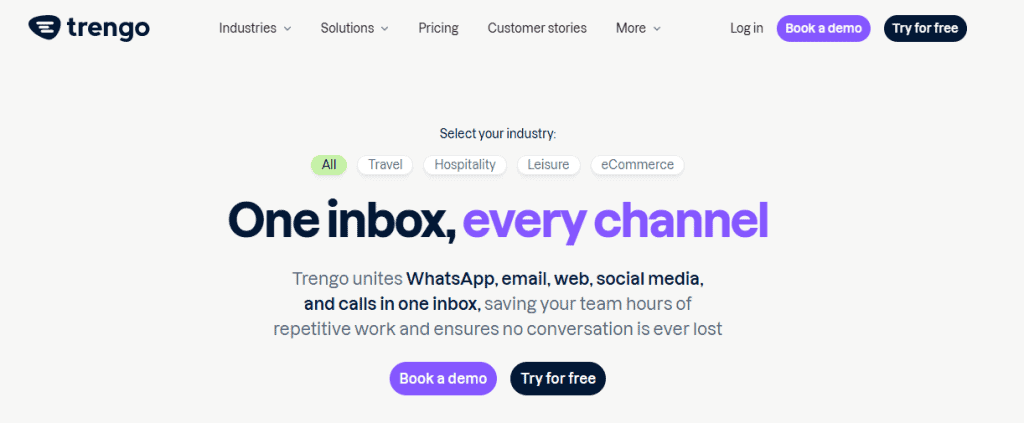
Trengo is the omnichannel help desk of this list, and it is now priced like one. The €113 a month this page used to quote was a tier Trengo has since removed. Read on their own pricing page on 2 September 2026:
- Boost: €299 a month billed annually, or €349 monthly. Ten users included and 6,000 conversations a year.
- Pro: €499 a month billed annually, or €599 monthly. Twenty users and 18,000 conversations a year.
- Enterprise: custom.
The detail that catches people is the second meter. Trengo charges for users and for conversations, so a small team handling a lot of chats can exhaust an allowance that looks generous. Six thousand conversations a year is about five hundred a month across ten people. Both self-serve buttons on the plan cards read Book a demo, though there is a free trial available from the main navigation.
Trengo is the right answer if your problem is genuinely a support desk: many channels, many agents, tickets, internal collaboration, and email and voice alongside messaging. It is an expensive answer to “I want to send WhatsApp campaigns”. Our Trengo review goes into the trade-off in more detail.
4. DoubleTick, Where the Old Figure Was Out by Ten Times

This page said DoubleTick starts around $14 to $20 a month. It starts at $170. From their own pricing page on 2 September 2026:
- Starter: $170 a month, or $2,039 billed yearly. Five agents included, one WhatsApp Business Account, broadcasts, segments, catalogues and analytics. AI agents are not available on this plan at any price, and neither is Bot Studio, chat assignment, conversation search, Shopify or Google Sheets.
- Pro: $308 a month. Billed yearly that is $2,614 without AI agents or $3,694 with them. Ten agents, up to ten AI agents, a 50 MB knowledge base and 3,500 AI credits a month.
- Enterprise: custom.
Two things to have in writing before you buy. DoubleTick offers no free trial, in their own words: “We don’t offer a free trial, but you can book a demo.” And their AI toggle changes the yearly Pro price by more than a thousand dollars while leaving the monthly figure identical at $308, so confirm exactly what a monthly Pro subscription includes rather than assuming it matches the yearly one.
A long list of things most platforms include are add-ons here, priced separately: WhatsApp Flows, Conversion API optimisation for click-to-WhatsApp ads, WhatsApp calling, Salesforce, HubSpot, WooCommerce, Zapier, Zoho CRM and enterprise analytics. Budget for the add-ons, not the plan. There is more in our DoubleTick review.
5. BotSailor, and What the White-Label Plan Really Costs
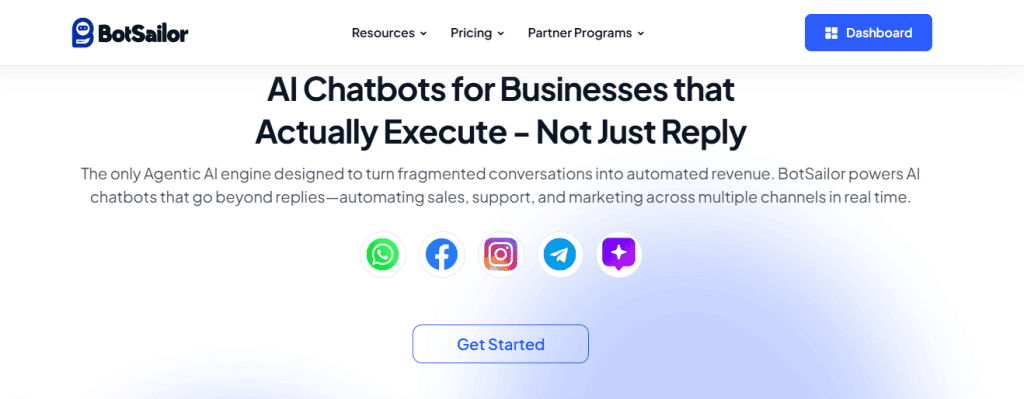
BotSailor is the cheapest way onto this list and the one whose pricing model is least like the others. You are not buying seats. You are buying a subscriber ceiling, and the price climbs with it:
- Basic: free forever. One user account, 1,000 subscribers, 10,000 message credits a month, 200,000 AI tokens a month, no team members. No card required.
- Premium, by subscriber tier, monthly: $10.99 for 1,000 subscribers, $14.99 for 2,000, $19 for 3,000, $30 for 5,000, $54 for 10,000, $70.99 for 20,000, $78 for 30,000, $94.99 for 50,000, $159.99 for 100,000 and $289.99 for 200,000. Quarterly billing takes 10 per cent off and yearly takes 20 per cent.
- Agency, the white-label reseller plan, from $130.99 a month for 500,000 subscribers and 50 user accounts, then $166.99, $286.99, $558 and $718.99 as the ceiling rises.
That agency figure is the correction that matters. This page previously said white-label started at about $70.99 a month. It does not: $70.99 is the Premium tier for 20,000 subscribers, and the cheapest plan that lets you resell BotSailor under your own brand is $130.99, nearly double. If you were budgeting an agency offering off the old figure, redo the sum.
BotSailor also runs on five channels rather than the four this page used to list: WhatsApp, Facebook Messenger, Instagram, Telegram and a website chat widget. It is the strongest choice here for flexible chatbot building and the weakest for anything resembling a CRM.
Which WhatsEra Alternative Fits Which Business
| If this is your situation | Start with | Entry cost |
|---|---|---|
| You want the free tier WhatsEra offers, on a platform whose website you can actually read | BotSailor | Free forever, 1,000 subscribers |
| WhatsApp and Instagram are your channels and you want strong lead qualification | Gallabox | $150/mo billed quarterly |
| You are a support desk: many channels, many agents, tickets and email | Trengo | €299/mo billed annually |
| WhatsApp is a sales channel and you have the budget for a per-agent platform | DoubleTick | $170/mo |
| You want an agency offering under your own brand | BotSailor Agency or DMly white-label | $130.99/mo, or DMly’s reseller plan |
| Bookings, invoices, reviews or loyalty are part of the job, not just messaging | DMly | $29/mo billed yearly |
What Changes for All Six of These on 1 October 2026
This applies to WhatsEra, to every alternative above and to DMly equally, because it is Meta’s change rather than any vendor’s. Two categories of message start attracting charges at the start of October, and only one of them comes with a free allowance.
- Service messages become chargeable above a free allowance. These are the free-form replies you type inside the 24-hour window after a customer messages you. They have been free since November 2024. From 1 October every business phone number gets 1,000 free service messages a month and Meta only charges from the 1,001st. The allowance resets monthly and does not roll over. Above it they cost the same as that market’s utility messages, and unlike utility and authentication messages they get no volume discounts at all. Most small businesses will stay under 1,000 and pay nothing on this one.
- Utility messages sent inside an open window become chargeable too. Order updates, delivery notifications and appointment reminders that land while the customer’s window is still open have been free since 1 July 2025. There is no free allowance on these, so for a business that sends confirmations and reminders this is usually the larger of the two.
There is a hard deadline before that. Every account on the WhatsApp Business Platform needs a payment method on file by 30 September 2026, and from 1 October Meta stops delivering service messages for accounts that do not have one. That catches exactly the businesses whose replies have always been free and who therefore never added billing details, including the ones that will stay inside the free allowance and never actually be billed. None of it affects the free WhatsApp Business app. The full picture is in our guide to the October WhatsApp pricing change.
Add the payment method this week regardless of which platform you choose. If WhatsEra is your platform and its website is still down, that is a task you will have to do inside Meta’s WhatsApp Manager rather than through your provider.
The Verdict of This WhatsEra Review
This WhatsEra review ends where it began. WhatsEra looks like a reasonable small-business WhatsApp platform with a free tier, and right now nobody can read its website. Those two facts sit together awkwardly and only you can decide how much the second one weighs. Our view: a free plan you can start without a card makes it cheap to find out for yourself, and a broken marketing site plus a dead link to the terms you are agreeing to makes it a poor place to put a customer list you cannot afford to lose.
If you want the free entry point without the uncertainty, BotSailor’s free-forever plan is the closest equivalent on a platform that is fully documented and publicly priced. If you want depth on WhatsApp with real lead qualification, Gallabox is the shortlist, at $150 a month rather than the $24 this page used to claim. If your business runs on appointments, invoices, reviews and repeat customers rather than campaigns alone, that is the argument for DMly, and it is the one we would make.
Whatever you pick, take one habit from this WhatsEra review with you: open the vendor’s own pricing page before you believe any review of it, this one included. Four of the five prices on the previous version of this page were wrong, and every one of them was checkable in under a minute.
Frequently Asked Questions
Is WhatsEra still working?
The product appears to be. On 2 September 2026 the app host, app.whatsera.com, returned HTTP 200 and served a working sign-in screen and a registration page. The marketing site at whatsera.com returned a 502 Bad Gateway on three consecutive attempts, so the home page, feature pages, terms and privacy policy were all unreachable. Check both yourself before deciding, because an outage can end at any time.
How much does WhatsEra cost?
WhatsEra publishes no price list. Its registration page offers a free-forever plan with no credit card required, and everything beyond that is a custom quote based on your users, message volume, automation and integrations. Meta’s per-message charges are separate and are billed on top whatever platform you use.
What is the best WhatsEra alternative?
It depends on what you need. BotSailor is the closest match if the free tier is what attracted you, with a genuinely free forever plan for 1,000 subscribers. Gallabox is the strongest WhatsApp-focused option at $150 a month billed quarterly. Trengo suits a multi-channel support desk at €299 a month. DoubleTick suits WhatsApp sales teams at $170 a month. DMly is the broadest, from $29 a month billed yearly, and adds bookings, invoicing, reviews and loyalty to the messaging.
Does WhatsEra support automation?
It has documented auto-replies and chatbot flows, and multi-user access to a single WhatsApp number. How deep the automation goes beyond that cannot be confirmed while the website is unreachable, and this review will not repeat old marketing copy as though it were current.
Why did the prices in this WhatsEra review change?
Because they were wrong, and a WhatsEra review that leaves them wrong is worse than useless. This page was written when several of these vendors published different figures, and reviews across this market copy each other rather than re-checking. Gallabox now bills quarterly at $150 a month rather than $24, Trengo has deleted the tier that cost €113, DoubleTick starts at $170 rather than $14, and BotSailor’s white-label plan is $130.99 rather than $70.99. Everything here was re-read on the vendors’ own pages on 2 September 2026 and is dated for that reason.
Can multiple users share one WhatsApp number on these platforms?
Yes, on all of them. That is the main reason businesses move from the free WhatsApp Business app to a platform in the first place. What differs is how many people are included and what an extra one costs: WhatsEra does not publish a number, Gallabox caps Basic at three with no way to add a fourth, DoubleTick includes five agents on Starter, Trengo includes ten on Boost, and DMly includes three on Starter with extra seats at $10 a month.
Writing about WhatsApp automation, bookings and growth for local business.
Turn WhatsApp into your busiest channel.
Start free and run message, bookings, payments and reviews in one place.
