
Botpress Review (2026): Two Numbers, Corrected in Public
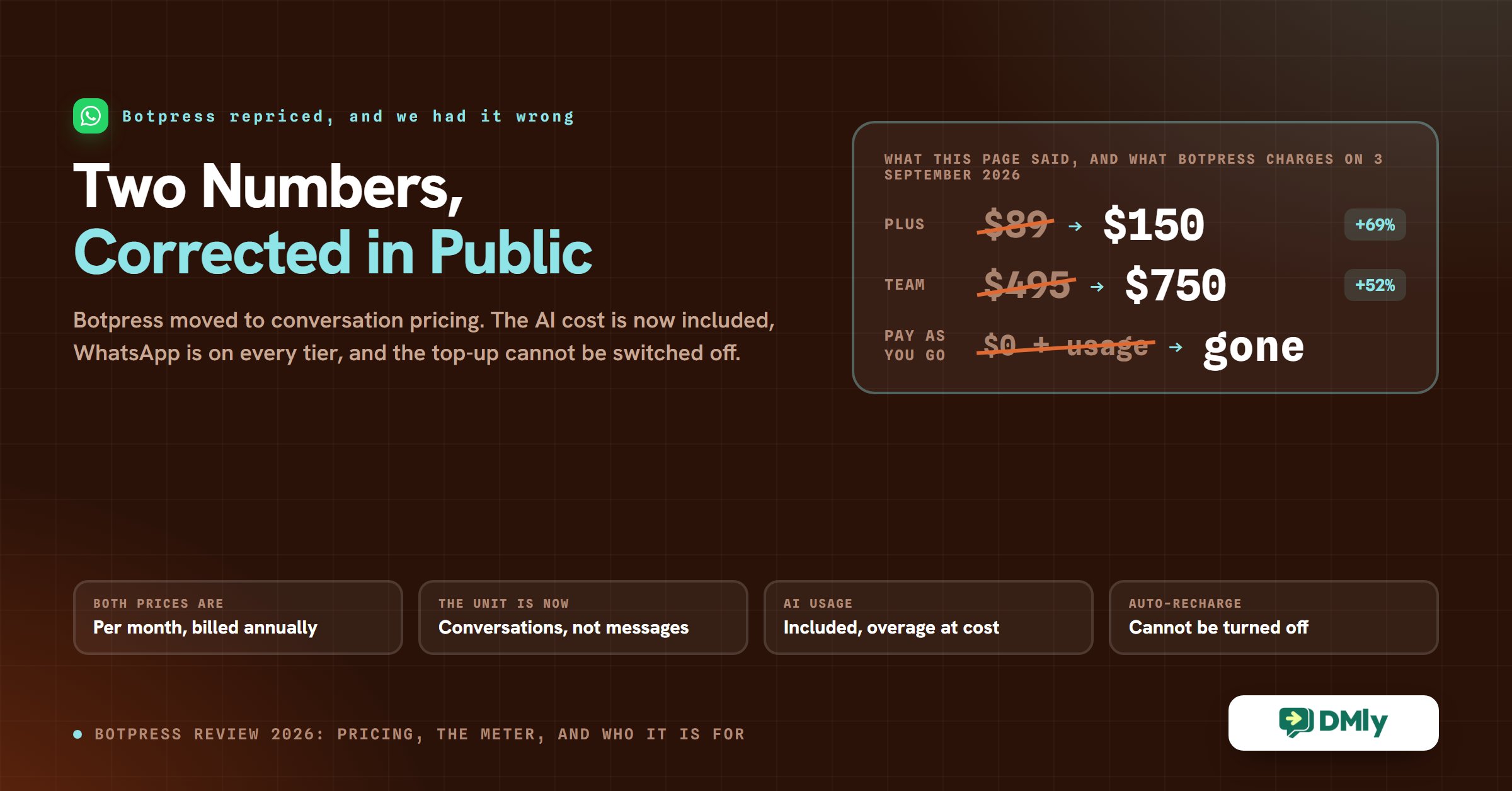
Until today this page told you the Botpress Plus plan cost $89 a month and the Team plan cost $495. Both figures are wrong, and not by a little. Read from botpress.com on 3 September 2026, Plus is $150 a month billed annually and Team is $750. That is 69 per cent and 52 per cent above what we were telling you, and the pay-as-you-go tier the page described as the entry point no longer exists at all.
We would rather correct that in public than quietly edit two numbers, because the reason they moved is worth more to you than the numbers themselves. It is the same convention we applied to a vendor that had been absorbed into a much larger company: say what changed, say when we checked, and let the reader see the working. Botpress has changed what it sells you. The old model was a platform fee with usage stacked underneath it. The new one is a conversation quota, with the AI cost folded in, and an automatic top-up that you are not allowed to switch off.
Whether that is better or worse depends entirely on how many conversations you have, which is why most of this Botpress review is about the meter rather than the feature list. There is also a category correction to make: Botpress is a platform for building AI agents, not a WhatsApp marketing tool, and the earlier version of this page compared it to one. That was our error, not theirs.
Everything in this Botpress review was read from their own site on 3 September 2026. We make DMly, which appears later as an alternative. Said here rather than at the bottom, and there is a section that names the readers for whom Botpress is plainly the better answer.
What Botpress Actually Is
Botpress is a place to build an AI agent, and increasingly a place to run a support desk with one. It is not a broadcast tool, not a CRM and not a marketing platform, and reading it as one is the fastest way to reach the wrong conclusion about the price.
Their own product navigation, on 3 September 2026, breaks into four things:
- Botpress Studio, the visual agent builder. This is the node-and-flow canvas most people picture when they hear the name.
- Botpress Viber, which is a natural-language builder: you describe the agent you want in a prompt and it builds, tests and publishes one. It has nothing to do with the Viber messaging app, which is worth saying plainly because a lot of people are going to search for it and find the wrong thing. Their own page describes it as prompting your agent into existence with no nodes, flows or code.
- Botpress Desk, an AI helpdesk, which is where the company is clearly putting its weight. The whole solutions menu is customer support: ticket deflection, ticket enrichment, escalation and handoff, ticket management.
- Botpress Engine and the ADK, the underlying AI infrastructure and developer kit.
The integrations catalogue, which they call the Hub, is genuinely large and is filtered by Integration, Channel and LLM. Browsing the first page alone turns up Airtable, Asana, Attio, AWS Lambda, AWS S3, BambooHR, BigCommerce, ActiveCampaign, Apollo.io and an Anthropic LLM connector, and the listing runs to eleven pages. They do not publish a total, so this page no longer quotes one, which is a change from the previous version.
Botpress Pricing in 2026: What This Botpress Review Had Wrong
The whole model is now priced on conversations, with the AI cost included rather than stacked on top. That is a genuine simplification and Botpress deserves credit for it. It also means the number you have to estimate before you buy is a number most businesses have never counted.
| Plan | Price | Conversations included | Extra conversations | AI usage included | Seats |
|---|---|---|---|---|---|
| Free | $0 | 100, and their card does not say per month | None. No top-ups or overages | Included, metered | 3 on the card, 1 in their own structured data |
| Plus | $150/mo billed annually | 250 a month | Packs of 100 at $65, or $0.65 each | $25 | 3 |
| Team | $750/mo billed annually | 1,500 a month | Packs of 100 at $50, or $0.50 each | $150 | Unlimited |
| Enterprise | Custom | Custom | Custom | Custom | Unlimited |
Two small inconsistencies on their own page, flagged rather than resolved because we cannot resolve them from outside. The Free card says 3 seats and the structured data behind the same page says 1. And the Free tier’s conversation allowance is printed as “100 conversations” where the paid tiers all say “/mo”, so it is not clear from the page whether that 100 is monthly or a one-off. Ask before you plan around either.
Three things that are clear and are better than the old version of this page implied. WhatsApp and webchat are included on every tier, including Free. AI usage is bundled rather than billed separately, with $0.10 of it covered on every conversation. And Botpress publishes storage limits per tier in three separate units, which almost nobody does: table rows, vector storage and file storage, at 1,000 rows and 100MB each on Free, rising to 500,000 rows, 5GB of vectors and 50GB of files on Team, with a $40 a month add-on if you outgrow it.
What counts as a conversation, in their own words
If you read one thing on their pricing page before you sign anything, read the conversation definition, because it is doing all the work. Botpress publishes it in their FAQ and it is more specific than most. Here is what it says, and what each clause means for the bill.
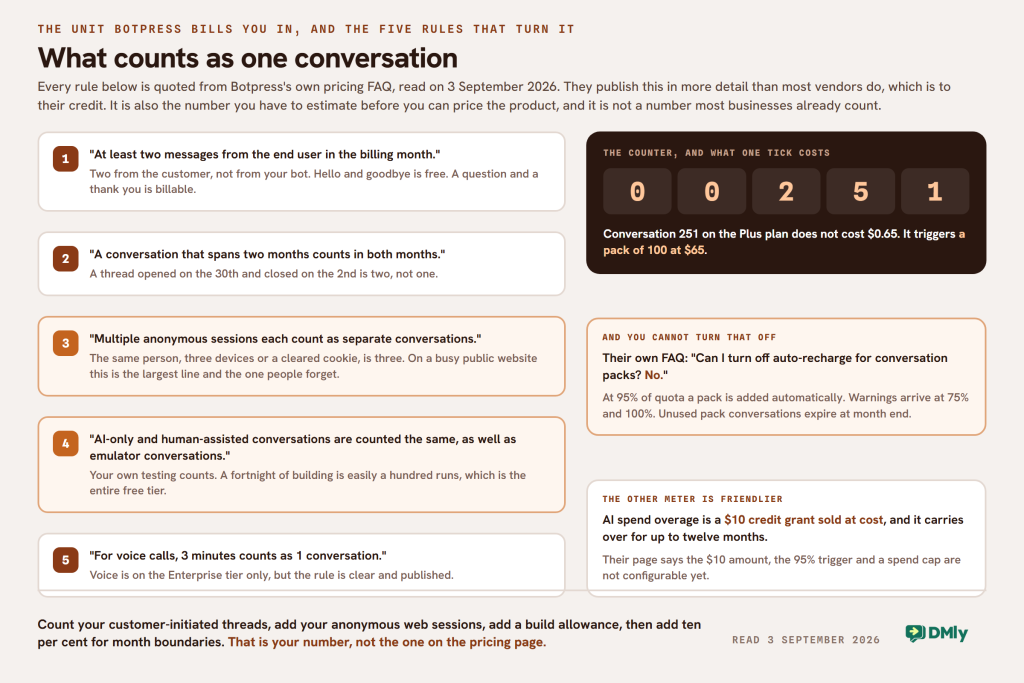
- “Any exchange with at least two messages from the end user in the billing month counts as a conversation.” Two messages from the customer, not from your bot. A visitor who says hello and leaves is free. A visitor who asks one question and then says thanks is billable.
- “A conversation that spans two months counts in both months.” A support thread that opens on the 30th and closes on the 2nd is two conversations, not one.
- “Multiple anonymous sessions each count as separate conversations.” The same human on your website, on three devices or after clearing cookies, is three conversations. If your traffic is anonymous web visitors rather than logged-in customers, this is the clause that moves your number most.
- “AI-only and human-assisted conversations are counted the same, as well as emulator conversations.” That last word matters: your own testing counts against your quota. Building and debugging an agent involves talking to it a great deal, and every one of those runs is billable at the same rate as a customer.
- “For voice calls, 3 minutes counts as 1 conversation.” Voice is Enterprise-only, so this affects a small number of readers, but it is a clear rule and worth having.
None of that is hidden or unusual. Every metered platform has to draw the line somewhere and Botpress draws it in public and in detail, which is more than several competitors manage. The point is that “conversation” is not a word you can estimate from your own intuition, and the emulator clause in particular will surprise a team that plans a month of building before launch.
The top-up you are not allowed to turn off
This is the single most important thing on their pricing page, and it is stated as an answer to a question a buyer clearly keeps asking. We are quoting it in full because paraphrasing would soften it:
“Can I turn off auto-recharge for conversation packs? No. Pausing conversations means pausing the product entirely, whether an AI agent or a human is handling it. Instead, you’ll get early warnings at 75% and 100% so you can right-size your plan before overages kick in.”
The mechanic underneath it: at 95 per cent of your quota, a pack of 100 conversations is added to your account automatically. You are notified at 75 and 100 per cent and on every pack purchase. Packs persist month to month until you remove them in billing settings, and unused conversations inside a pack expire at the end of the month rather than rolling over.
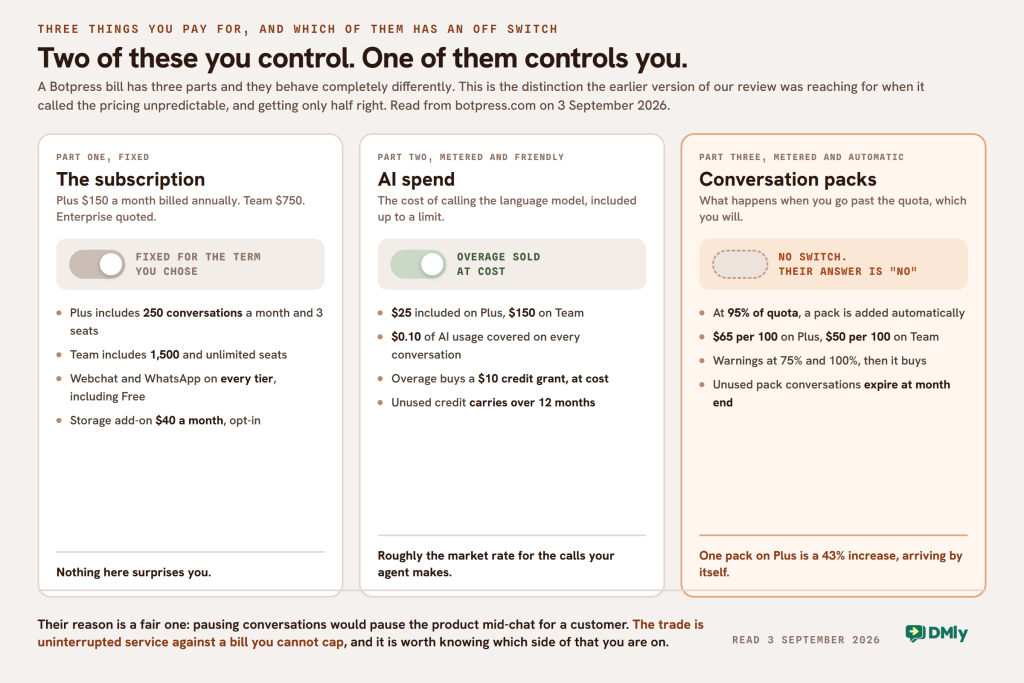
The reasoning they give is honest and it is the right reasoning for a support product. An AI helpdesk that stops answering at midnight on the 28th because a counter hit a limit is worse than an unexpected invoice, and most businesses would agree. The trade is real: you get uninterrupted service and you give up the ability to cap the bill.
So this is not an accusation, it is an arithmetic warning. On Plus, packs cost $65 per 100 conversations. A month that runs 40 per cent over a 250-conversation quota is 100 extra conversations, which is one pack, which is a $65 line on a $150 subscription: a 43 per cent increase, arriving automatically. The action for a reader is to set your own alert at 75 per cent inside your own tools rather than relying on the email, and to right-size the plan on the second month rather than the sixth.
The AI meter, which behaves completely differently
Botpress runs a second meter for the cost of calling the language model, and it is worth understanding because it is the fairer of the two. Plus includes $25 of AI usage a month, Team includes $150, and every conversation carries $0.10 of AI usage covered by them.
When your workspace hits 95 per cent of its AI spend, Botpress buys a $10 credit grant on your behalf, sold at cost. Unlike conversation packs, those credits do not expire at month end: any unused balance carries over for up to twelve months. Their page also says plainly that the $10 amount and the 95 per cent trigger are not configurable yet, and that a spend cap is coming.
“Sold at cost” is a real commitment and it is unusual. It also means the AI half of your bill is the half you can reason about: it is roughly the market rate for the model calls your agent makes. The conversation half is where the margin lives, and that is the half with no off switch.
Why they price on conversations rather than resolutions, in their words
Worth quoting because it is a genuinely good argument and a reader comparing AI support tools will meet the other model constantly: “Conversations are predictable, you know your monthly cost before the month starts. Resolution pricing creates disputes over what ‘resolved’ means and, perversely, raises your bill when your bot gets smarter.”
That is right, and it is the strongest thing on their pricing page. Set it beside the auto-recharge answer, though, and the two claims sit at an angle to each other: you know your cost before the month starts as long as the month goes the way you expected, and if it does not, the correction is applied for you. Both things are true. Read them together rather than separately.
Seven Things This Botpress Review Got Wrong
Five of the seven were unfair to Botpress. A Botpress review written against a pricing model that has since been replaced ages badly, and this one did. The page was written in May 2026 against a pricing model that has since been replaced, and several of its criticisms were aimed at things Botpress has now fixed.
| What this page said | What is true, checked 3 September 2026 |
|---|---|
| “Plus Plan ($89/month)” | $150 a month billed annually. A 69 per cent difference |
| “Team Plan ($495/month)” | $750 a month billed annually. A 52 per cent difference |
| “Pay-As-You-Go Plan ($0 + Usage Costs)” | Gone. The entry tier is now Free, hard-capped, with the words “no top-ups or overages” printed on the card |
| “You still pay separately for AI token usage” | Wrong now. AI usage is included, at $25 on Plus and $150 on Team, with $0.10 covered on every conversation and overage credits sold at cost |
| “You still pay separately for external channels like WhatsApp” | Wrong. WhatsApp and webchat are on every tier, including Free |
| “the plan includes 5,000 monthly messages” | The unit is not messages. It is conversations: 250 a month on Plus, 1,500 on Team, with a published definition |
| “Open-source foundation” listed as a pro, and “over 200 integrations” | Both removed. Neither is claimed anywhere we could find on their current site, and we do not publish figures we cannot source |
One criticism survives in a sharper form. The old page said Botpress pricing “can become unpredictable” because costs scale with AI usage, messages, storage and channels. That specific version is now out of date, because AI usage and channels are included. The true version is narrower and more useful: one meter is predictable and one is not. The AI meter has a published rate, at-cost overage and credits that carry over for twelve months. The conversation meter tops itself up automatically at $65 a pack and cannot be paused. That is the sentence the old page was reaching for.
Where Botpress Is Plainly the Right Tool, and This Botpress Review Says So
Four situations where you should stop comparing and go and build something. These are not consolation prizes, and two of them are jobs we do not do at all.
- You are building a custom AI agent with real logic in it. Node-and-flow control, autonomous behaviour, knowledge bases with retrieval, tables for structured data, guardrails, and an ADK for the parts you want in code. Nothing in the WhatsApp platform category comes close, including us. If you want to see what the messaging side of that looks like in code, our WhatsApp automation API guide covers the constraints that apply whichever platform you build on.
- Your agent needs to reach into systems that are not messaging tools. The Hub connects to Salesforce, Hubspot, Zendesk, Intercom, Airtable, AWS Lambda, S3, BambooHR and hundreds of others across eleven pages of listings. If the answer your bot gives depends on a lookup in a warehouse system, this is the right shape of product.
- Support deflection is the actual goal. Botpress Desk exists to answer tickets and escalate the ones it cannot, with enrichment and routing around it. If your metric is ticket volume rather than campaign revenue, they are building directly at you.
- You want to prototype without a card. The free tier is hard-capped, which is exactly right for a prototype: it cannot surprise you, because it cannot top itself up.
Where It Is the Wrong Tool
These are limits of category rather than quality. Botpress is not trying to do most of this, and holding it to account for jobs it does not claim would be the same mistake the old version of this page made in the other direction.
- There is no broadcast tool. If your plan is to message a list of customers on WhatsApp with an approved template, that is not what this product does. Template approval, opt-in handling, audience segmentation and send scheduling all belong to a different category of tool. Our guide to WhatsApp broadcasts describes the job.
- There is no CRM in the business sense. There are Tables, which are structured data your agent can read and write. That is not a pipeline, a lifecycle stage, a contact history or a customer record your sales person can work from. Our guide to what a WhatsApp CRM is describes the difference.
- Nothing after the conversation. No bookings, no invoices, no payments, no review collection, no loyalty. Again: not a criticism, just a boundary.
- The entry price is high for a small business. $150 a month billed annually is $1,800 committed before you send a message, at 250 conversations a month. If you are a salon with sixty enquiries a week, the maths does not work and no feature list will make it work.
- Team is a step, not a slope. The gap between Plus and Team is $150 to $750. There is nothing in between, so a business that outgrows 250 conversations a month and does not need unlimited seats is buying packs at $65 until 1,500 conversations makes the fivefold jump worthwhile. The crossover is around 1,000 conversations a month; do that sum with your own numbers before you commit to an annual term.
Botpress vs DMly: Different Products, Not Different Prices
The honest framing is that these two would sit next to each other in a stack rather than compete for the same budget line. Botpress builds the agent. A WhatsApp platform runs the channel, the campaigns and the commerce around it. Some businesses genuinely need both, and quite a lot need only one.
| Botpress | DMly | |
|---|---|---|
| What it is | A platform for building and running AI agents | A customer operations platform built around messaging |
| Entry price | Free, hard-capped at 100 conversations | $29/mo billed yearly, after a 7-day trial with no card |
| First paid tier | $150/mo billed annually | $29/mo billed yearly |
| Metered on | Conversations, plus a separate AI spend meter | Contacts, broadcast messages and AI replies |
| Can you cap the bill? | No. Conversation auto-recharge cannot be turned off | Allowances are fixed to the plan; add-ons are opt-in |
| Agent building depth | Far deeper. Flows, autonomous nodes, RAG, guardrails, tables, an ADK | Flow builder and AI agents, aimed at non-developers |
| Non-messaging integrations | Hundreds, across eleven pages of the Hub | Shopify, WooCommerce, Zapier, n8n, Google Drive, Zoom, OpenAI, Claude, Mercado Pago |
| Messaging channels | Webchat and WhatsApp on every tier, Slack, more via the Hub; voice on Enterprise | WhatsApp, Instagram, Messenger, Telegram, SMS, TikTok, LiveChat widget, Google Business Profile |
| Broadcasts and campaigns | Not part of the product | Audiences, scheduling, approved templates, the 24-hour window enforced before you send |
| Bookings, invoices, reviews, loyalty | Not part of the product | Bookings, invoices and payments, Google reviews, loyalty and gift cards |
| Who is meant to operate it | A builder or a developer | The person answering the messages |

What an AI Agent Has to Do for a Small Business, and Where This Botpress Review Lands
Most people arriving at a Botpress review are not trying to buy an agent-building platform. They are trying to stop answering the same eleven questions. It is worth separating those two things, because the gap between them is where a lot of money and a lot of weeks get spent.
For a shop, a clinic or a studio, an agent that earns its keep does roughly five things: answers opening hours and price questions from your own material, takes a booking or hands off to someone who can, recognises a returning customer, knows when to stop and fetch a human, and does all of it on the channel the customer already used. That is a modest specification and almost every WhatsApp platform now ships it, including ours, on every plan rather than as an upgrade.
Where a platform like Botpress starts to matter is the sixth thing. When the answer depends on a lookup in a system nobody else integrates with, when the agent has to follow a procedure with branches and conditions and a retry, when you need guardrails you can specify and test, or when you want the whole thing in code so it can be reviewed and versioned. Those are real requirements and they are why the product exists. They are also requirements most small businesses discover they do not have, six weeks in.
One cost that is easy to forget on either path. Whichever platform runs your agent, WhatsApp messages themselves are billed by Meta, per message, at a rate that depends on the recipient’s country and the category of the message. That sits outside any platform subscription. We publish a country by country rate card so you can put a number on it before you commit to anything.
And a dated one. On 1 October 2026, Meta begins charging for two categories that are free today: service messages, and utility messages sent inside an open 24-hour window. Support agents live almost entirely in the service category, so this change lands squarely on anyone putting an AI agent on WhatsApp for support. Meta published the rates on 1 September, so the size of it is now knowable: service messages cost the same as utility and authentication messages in your market, and the first 1,000 service messages a month on each business phone number are free. Our explanation of the October change walks through what changes and how to price it. Price that properly before you sign an annual commitment this month.
The practical test, and it is a fair one to apply to us as much as to Botpress: write down the five questions your customers actually ask, then ask whichever vendor you are talking to how their product answers them and how long that takes to set up. If the answer involves a build, you are buying a platform. If it involves connecting a channel and pointing the thing at your existing FAQ page, you are buying a tool. Both are legitimate purchases. They are not the same purchase, and the price difference between them on this page is roughly fivefold.
How to Estimate Your Botpress Bill Before You Sign Up
Do this before you look at the feature list, because the feature list will not tell you whether you can afford the thing. It takes about ten minutes with numbers you already have.
- Count the customer-initiated threads you had last month, on every channel the agent will cover. Not messages: threads where the customer said something and then said something else. That is the closest thing you already have to their unit.
- Add your anonymous web traffic. If the agent goes on your website, every distinct session that gets two messages in counts separately, even from the same person on a different device. For a busy site this can be the largest single line, and it is the one people forget.
- Add a build allowance. Emulator conversations count. A fortnight of building and testing an agent is easily a hundred runs, and on the free tier that is your entire quota.
- Add ten per cent for month boundaries. Threads that straddle the end of the month are counted in both.
- Now compare against the tiers, using packs for the gap. Under 250 a month, Plus at $150. Between 250 and roughly 1,000, Plus plus packs at $65 per hundred. Above about 1,000, Team at $750 is cheaper than Plus with packs, and it also buys unlimited seats. Do the crossover with your own number rather than trusting that one.
- Then add the AI meter. $25 is included on Plus. Beyond that you buy $10 credit grants at cost, and they carry over for twelve months, so this line is far less alarming than the conversation line.
If that exercise produces a number you are happy with, then the verdict of this Botpress review is simple: Botpress is a serious piece of engineering and you should go and use it. If it produces a number that makes you wince, the honest answer is that you are probably not the customer this product is priced for, and there is no configuration that changes that.
Which One to Choose
You are a developer or a technical team building a custom agent
Botpress, without much hesitation. Start on Free to prototype, because the hard cap means it cannot surprise you, and budget the emulator conversations into the hundred. Read the conversation definition before you move to Plus.
You run a support desk with real ticket volume
Also Botpress, and specifically Desk. The whole product line is pointed at deflection and escalation, the Zendesk and Intercom integrations are first-class, and Team’s unlimited seats stop the per-agent maths that hurts elsewhere. At 1,500 conversations a month, $750 is a defensible number for a support operation and an impossible one for a shop.
You run a business where the conversation ends in a booking or a payment
Neither product category is wrong here, but the WhatsApp platforms are the right shape and Botpress is not. You want the calendar, the invoice, the review request and the repeat visit in the same place as the chat, and you want to buy it for tens of dollars a month rather than hundreds. That is DMly and it is also several of the other platforms reviewed on this blog.
You want an AI agent on WhatsApp and you are not a developer
This is the case the old version of this page handled worst. You do not need an agent-building platform to get an AI agent answering WhatsApp: most WhatsApp platforms now include one, ours included on every plan rather than as an upgrade. What you give up is depth of logic. What you gain is that the thing is running on Tuesday instead of in six weeks. Start with our guide to getting official WhatsApp Business API access, because that step is identical whichever platform you pick and it is where most of the delay actually lives.
Frequently Asked Questions
How much does Botpress cost?
There is a free tier with 100 conversations and no top-ups. Plus is $150 a month billed annually with 250 conversations a month, and Team is $750 a month billed annually with 1,500. Enterprise is quoted. Extra conversations come in packs of 100 at $65 on Plus and $50 on Team. Monthly billing costs more than the annual figures above, at a stated saving of 20 per cent for annual. Read from botpress.com on 3 September 2026, and note that this page previously quoted $89 and $495, which were the old prices.
Is Botpress free?
There is a genuinely free tier, and unusually it is hard-capped: their own card says “no top-ups or overages”, so it cannot generate a bill. It covers 100 conversations, three AI agents, webchat and WhatsApp, a Help Center and community support through their Discord. It is a prototyping tier rather than a production one, and remember that your own testing conversations count against the hundred.
What counts as a conversation in Botpress?
Their published definition: any exchange with at least two messages from the end user in the billing month. A conversation spanning two months counts in both. Multiple anonymous sessions each count separately. AI-only, human-assisted and emulator conversations all count the same, so your own testing is billable. Three minutes of a voice call counts as one conversation.
Can I cap what Botpress charges me?
Not on conversations. Their FAQ answers this directly with a “No”: at 95 per cent of quota a pack of 100 conversations is bought automatically, and the reason they give is that pausing conversations would pause the product for customers mid-chat. You get warnings at 75 and 100 per cent. The AI spend meter works differently and is friendlier: overage credits are $10 grants sold at cost, they carry over for up to twelve months, and their page says a configurable spend cap is coming.
Does Botpress work with WhatsApp?
Yes, and on every tier including Free, which is a change from what this page used to say. What it does not include is the marketing side of WhatsApp: no broadcast tool, no template management, no audience segmentation, no opt-in handling. It puts an AI agent on the channel, which is a different job from running campaigns on it.
What is Botpress Viber?
It is Botpress’s natural-language agent builder: you write a prompt describing what the agent should do and it builds, tests and publishes one, with channels connected and reusable playbooks in place. Despite the name it has nothing to do with the Viber messaging app.
What are the best Botpress alternatives?
It depends which half of this Botpress review you were reading for. For building custom AI agents with deep logic, the honest answer is that the alternatives are other developer platforms rather than WhatsApp tools. For putting an AI agent on WhatsApp and running the business around it, the WhatsApp-first platforms are cheaper and faster, and this blog reviews several of them, including SendWo and Wati and its alternatives. DMly is ours, costs $29 to $149 a month billed yearly, and includes AI agents on every plan.
Is this Botpress review independent?
No, and it opens by saying so. We make DMly. What we can offer is a page that corrects its own errors in public rather than quietly: seven corrections are listed above, five of them in Botpress’s favour, including two prices we had badly wrong. Every Botpress claim here comes from botpress.com on 3 September 2026, and the section above tells you how to check the only number that really matters, which is your own.
Writing about WhatsApp automation, bookings and growth for local business.
Turn WhatsApp into your busiest channel.
Start free and run message, bookings, payments and reviews in one place.
