
RapBooster Review (2026): The Price Is Behind a Login
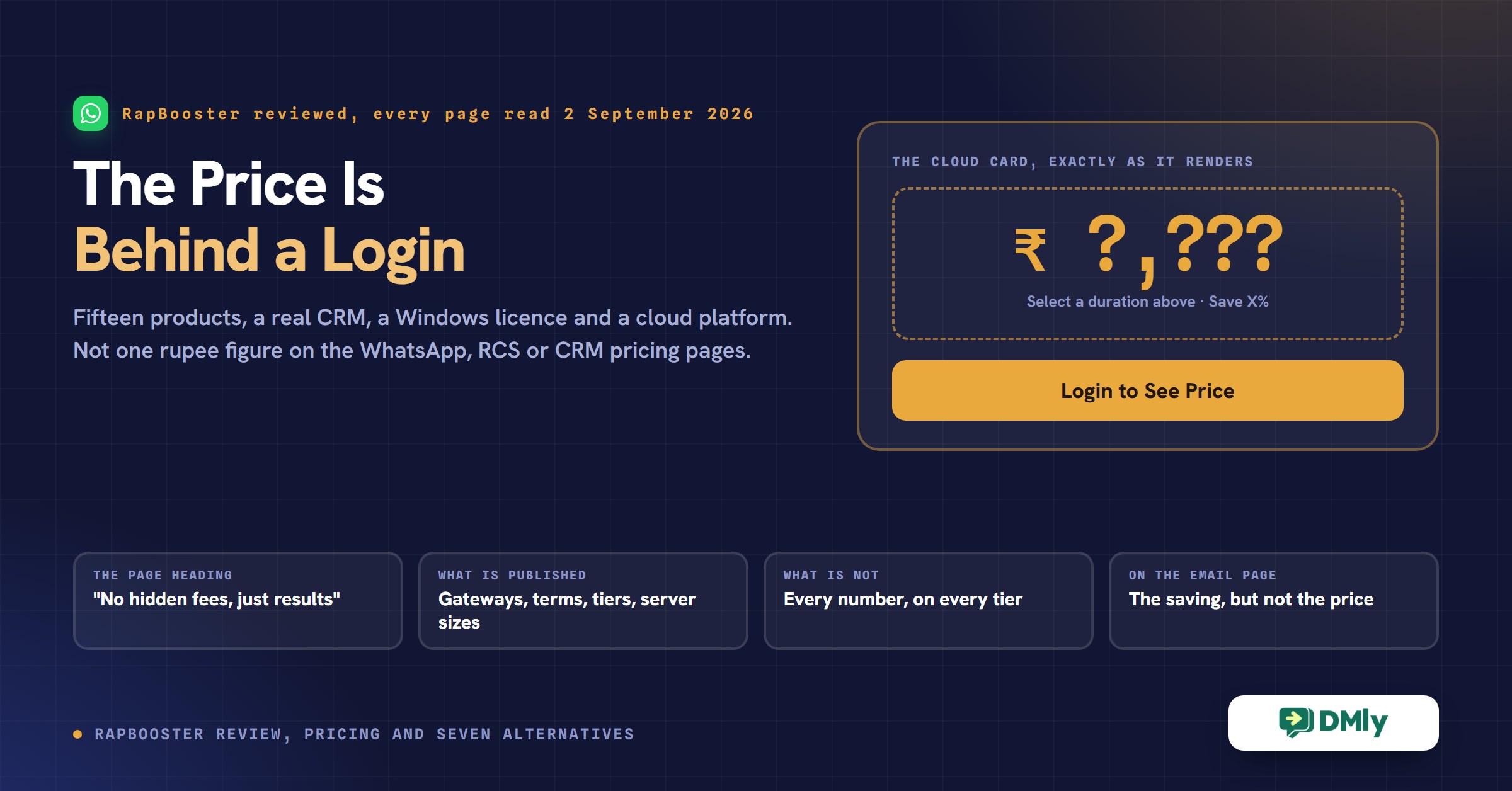
RapBooster’s WhatsApp pricing page is a properly built thing. It has a plan configurator, a slider for how many WhatsApp numbers you need, five billing terms, a separate desktop tab, and six sizes of dedicated server. Across the top it says: “Cloud or desktop. Monthly or yearly. No hidden fees, just results.”
Every price on it reads Login to See Price.
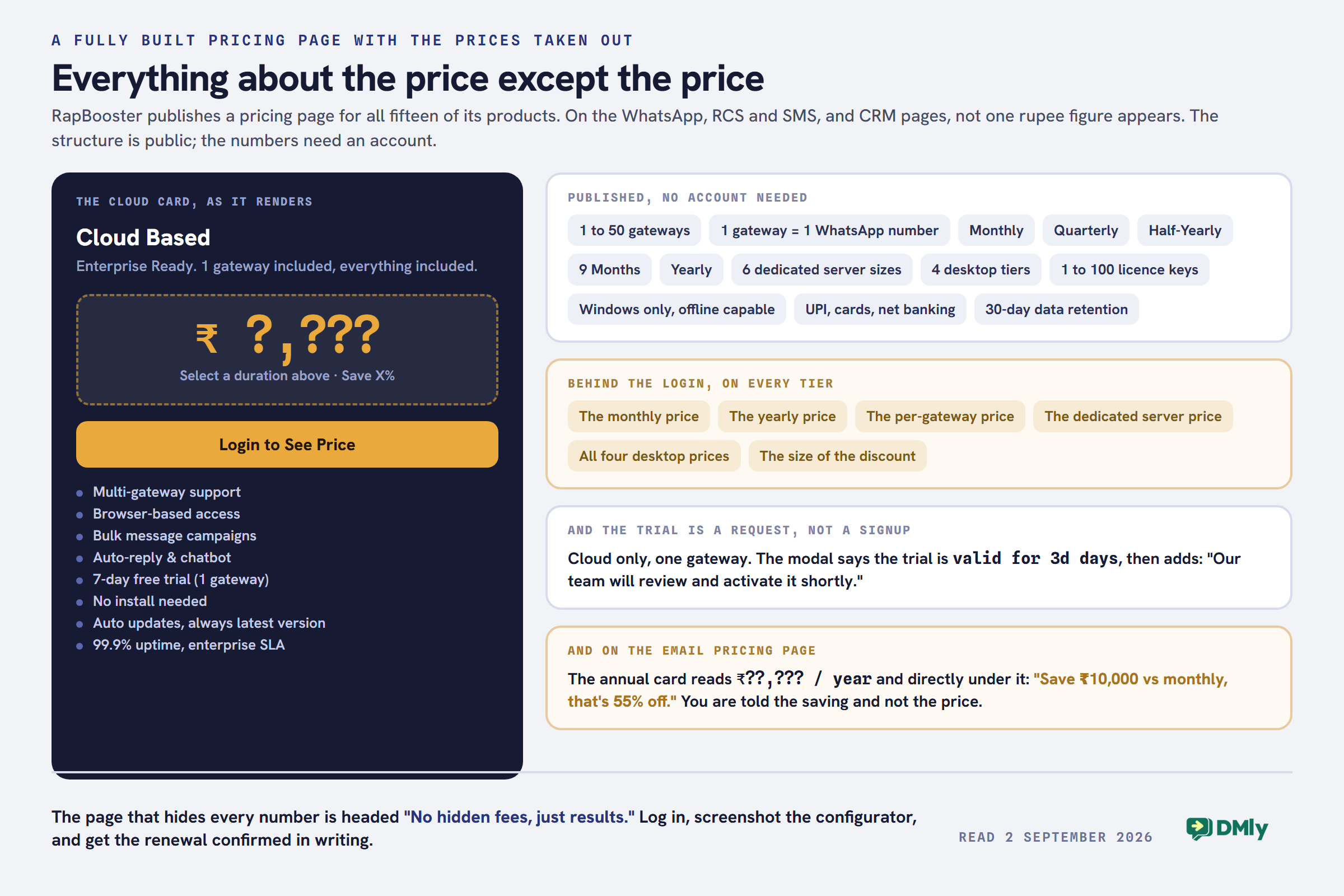
Not one rupee figure appears anywhere on that page. The cloud card shows a rupee sign with a dash after it where the number should be. The dedicated servers show “₹?,???”. The saving shows “Save X%”. Checked on 2 September 2026, and checked again on their RCS, SMS and CRM pricing pages, where it is the same.
That is the single most useful thing to know before you evaluate this platform, and it is not what this RapBooster review used to say. The old version of this page told you RapBooster “does not publicly display its pricing” and left it there. What is actually happening is stranger and more worth your time, so this page has been rebuilt from the vendor’s own site as it stands today.
What RapBooster is now, and what it used to be
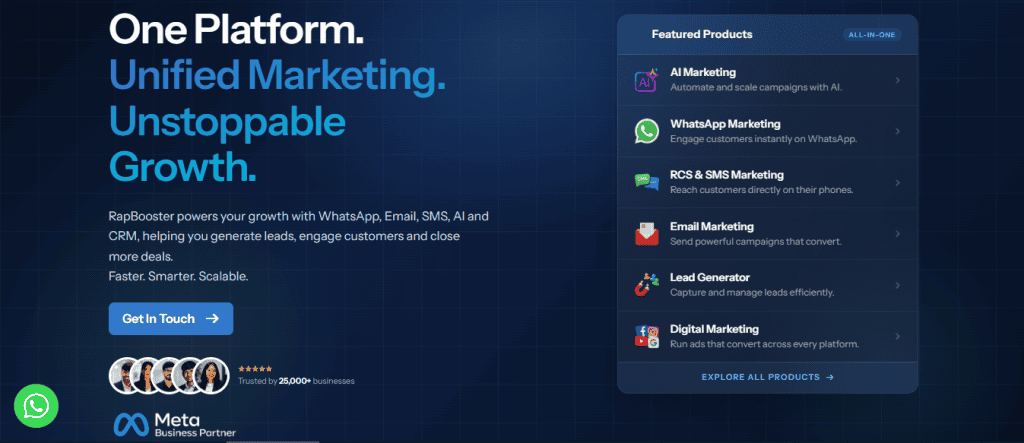
If you last looked at RapBooster as a WhatsApp bulk sender, you are looking at the wrong product. The company has rebuilt around an all-in-one positioning, and the WhatsApp tool is now one of about fifteen things it sells. That is why this RapBooster review has been rebuilt from scratch rather than edited.
Their own About page dates the business to 2012, “founded under the Dunes Factory umbrella” as a digital marketing agency, with bulk SMS and WhatsApp broadcast tools following in 2014. Today the product menu runs: AI Marketing, WhatsApp Marketing, RCS and SMS Marketing, Email Marketing, Lead Generator, Digital vCard, Website Builder, and Voice Marketing marked coming soon. Alongside those sit CRM Software, Billing and Inventory, and HRMS. Alongside those sit agency services: website design, e-commerce, app development, graphics and video, and digital marketing.
On the WhatsApp product specifically, the feature menu lists an AI Chatbot, Payments, Forms, Bluetick (the verified badge), Broadcasting, Catalogue, Webviews, Flows, a Team Inbox, Analytics and Reports, and a QR Generator. The pricing page carries the line “Official Meta WhatsApp Business Solution Provider”, and the About page shows a “Meta Verified Partner” badge. Those are their claims and we are repeating them as claims; we have not independently confirmed the partner status.
The desktop software has not gone away, it has become a tab. The pricing page splits into Cloud Based and Desktop License, and the desktop side is still described as “Yearly license · Windows only · Offline capable”, sold in blocks of 1 to 100 licence keys across four tiers named Plus, Pro, Advance and Ultra. So RapBooster is now selling both the old thing and the new thing on the same screen, which is a genuinely useful signal about who they serve.
The pricing page that will not show you a price
What is published is the shape of the pricing. What is withheld is every number in it. That distinction matters enough that we now name it on every comparison we write. A vendor price is either published, with a currency and a period you can read; not published, meaning there is no pricing page at all and you must ask; or gated, meaning there is a full pricing page and the numbers behind a login or a quote request. RapBooster is the third kind, and it is a different problem for a buyer than the second.
Here is what the page does tell you, all of it verifiable without an account:
- Cloud is metered in gateways. Their note: “1 gateway = 1 WhatsApp number”. The selector offers 1, 2, 3, 5, 10, 15, 20, 25 and 50 gateways.
- Five billing terms. Monthly, Quarterly, Half-Yearly, 9 Months and Yearly.
- A dedicated-infrastructure tier for unlimited gateways, in six server sizes from 2 vCPU with 4 GB RAM up to 32 vCPU with 128 GB RAM and 1.9 TB of storage, billed monthly.
- Four desktop tiers. Plus is basic messaging, templates and contact management; Pro adds bulk campaigns and auto-reply; Advance adds an advanced chatbot, CRM integration and API access; Ultra adds unlimited campaigns, a white-label option and dedicated support.
- The trial. Cloud only, one gateway, and the modal says it is “valid for 3d days” before adding that “Our team will review and activate it shortly”. So it is a request, not a self-serve signup.
- Payment and retention terms. UPI, cards and net banking; “Instant Activation, Live in under 5 minutes”; and “30-Day Retention, Data safe after expiry”, which their FAQ expands to mean you can renew within 30 days without losing configurations.
And here is the part that is hard to read as anything but an oversight. On the Email Marketing pricing page, the annual card renders the price as “₹??,??? / year” and immediately underneath it says “Save ₹10,000 vs monthly, that’s 55% off“. You are told exactly how much you save and left with question marks where the price goes. If the saving is ₹10,000 and it represents 55 per cent, the arithmetic is available to anyone who wants it, which rather defeats the purpose of hiding the number.
We are not going to tell you why the numbers are behind a login. There are ordinary reasons a vendor does this: regional pricing, partner rates, a rebuild in progress. What we can tell you is what it costs you. You cannot compare RapBooster against anything else on this page without first handing over a mobile number and completing an OTP flow, and the page that asks you to do that is headed “No hidden fees”.
The action, if you are seriously evaluating them: log in, screenshot the configurator at the gateway count and billing term you actually want, and ask them in writing to confirm that figure holds at renewal. A price you had to authenticate to see is a price you cannot check later against what you were quoted.
What this RapBooster review got wrong
Four things this page told you were true when it was written and are not true now. They are listed here rather than quietly deleted, because if you read this page earlier you may have decided something on the strength of them.
| What this page said | What is on the vendor’s site on 2 September 2026 |
|---|---|
| “Lack of built-in CRM functionality” | CRM Software is one of their products, with its own overview, features, pricing and process pages. Desktop Advance and above also list CRM integration. |
| “Limited AI and conversational features” | AI Marketing is a product line, and AI Chatbot is the first item in the WhatsApp feature menu. |
| “Need for multi-channel engagement” | They sell WhatsApp, RCS, SMS and Email and claim “9+ Integrated Channels”. The real distinction is narrower and it is below. |
| “RapBooster does not publicly display its pricing” | There is a published pricing page for every product. The structure is public; only the numbers are gated. |
The multi-channel point is worth getting right rather than dropping, because there is a real difference underneath the wrong version of it. RapBooster’s channels are outbound marketing channels: WhatsApp, RCS, SMS and email, the places you send campaigns from. They are not conversational channels in the sense of Instagram DMs, Facebook Messenger, Telegram, TikTok or a chat widget on your own site. If your enquiries arrive on Instagram, RapBooster’s breadth does not help you, and if your job is to blast a promotion across four outbound channels at once, it is exactly the right shape. That is a useful thing for a buyer to know. “They do not do multi-channel” was not.
What you actually get on the WhatsApp product
Read the feature menu rather than the marketing copy and RapBooster’s WhatsApp product is a recognisable modern platform, not a bulk sender with a web page bolted on. The tabs on their own product navigation are: AI Chatbot, Payments, Forms, Bluetick, Broadcasting, Catalogue, Webviews, Flows, Team Inbox, Analytics and Reports, and QR Generator.
Three of those are worth translating, because they are the ones that separate a real Business Platform product from a desktop tool.
- Bluetick is the green verified badge on your WhatsApp profile. Only a business on Meta’s official platform can apply for it, so its presence in the menu is a reasonable indicator that the cloud side really is the sanctioned route rather than automation of a personal account. We cover what the badge does and does not get you in our guide to the WhatsApp Business API for small businesses.
- Team Inbox means more than one person can answer. This page previously treated a shared inbox as something only the alternatives offered, which was not accurate.
- Flows and Webviews are Meta’s own in-chat form and mini-web-page formats. Supporting them is a meaningful signal, because they are only available through the official platform.
What the menu does not contain is anything for Instagram DMs, Facebook Messenger, Telegram, TikTok or a website chat widget. RapBooster’s breadth runs sideways into other products, email and SMS and CRM and billing, rather than into other conversational channels. If your customers reach you in more than one inbox, that is the gap to test before you buy, and it is a different gap from the one this page used to describe.
Who you are contracting with
More is published here than on most tools in this category, and it still stops short of a legal entity. We check this on every vendor now, because a licence is a contract and you should know whose.
Published and checkable: a telephone number (+91 9680440022), an email address, stated support hours of Monday to Saturday, 10:00 to 18:00, a founding date of 2012, the parent name “Dunes Factory”, and full Terms and Conditions, Privacy Policy and Disclaimer pages that are real documents rather than templates. Not published anywhere we could find: a registered company name, a corporate identity number, a GST number, or a postal address.
For a monthly cloud subscription that is a normal amount of disclosure. For the fifty-PC desktop licence or a dedicated server on an annual term, it is worth asking who the invoice will come from before you commit, and getting the answer in writing.
Seven RapBooster alternatives, priced on 2 September 2026
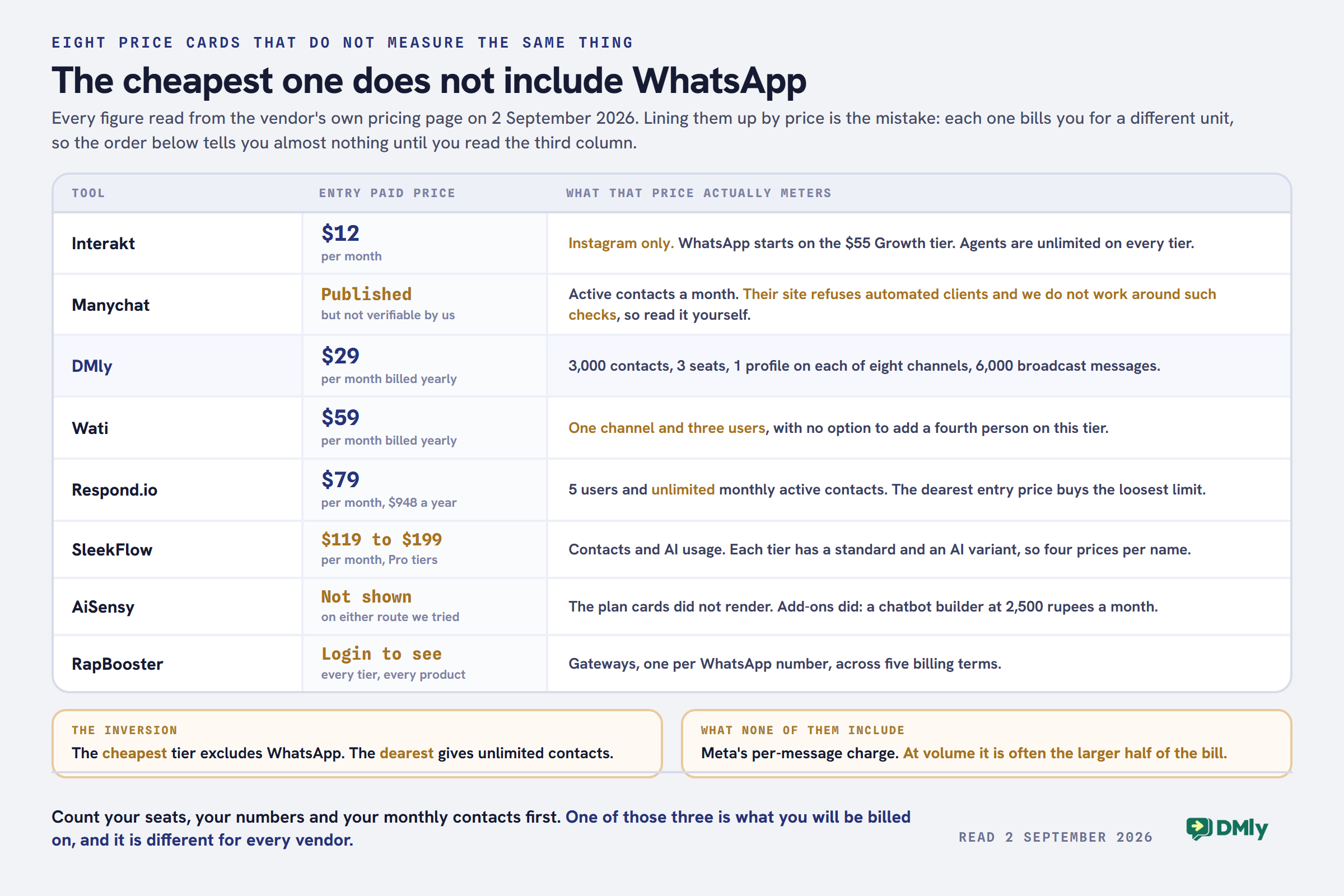
Every figure below was read off the vendor’s own pricing page on the same day, and where one could not be read we say so instead of filling the gap. That is a rule we now apply to every comparison on this site, and it cost us two rows here. The gaps are worth more than filled-in guesses.
| Tool | Entry paid price | What that tier meters | Best when |
|---|---|---|---|
| DMly | $29/mo billed yearly ($39 monthly) | 3,000 contacts, 3 seats, 1 profile per channel, 10,000 broadcast messages | Enquiries arrive on several channels and the job is answering, booking and invoicing them. |
| Wati | $59/mo billed yearly ($69 monthly) | 1 channel, 3 users, no additional users on this tier | WhatsApp-first teams that want a mature, well-supported platform and will pay for it. |
| Interakt | $12/mo Starter (Instagram only); $55/mo Growth for both channels | Unlimited agents, then per-message charges | Indian D2C sellers who want unlimited seats without per-user maths. |
| Manychat | Published, but not verifiable by us. See the note below. | Active contacts a month | Creators running Instagram and Messenger comment-to-DM automation. |
| Respond.io | $79/mo ($948/yr billed yearly) | 5 users, unlimited monthly active contacts on Starter | Bigger support teams that need routing, workflows and reporting. |
| AiSensy | Not verifiable on the day. See the note below. | Add-ons are published: chatbot builder ₹2,500/mo, AI Agent Builder ₹3,500/mo | Indian businesses wanting a WhatsApp-only stack with pay-as-you-go credits. |
| SleekFlow | Pro tiers from US$119 to US$199/mo depending on term and AI variant | Contacts and AI usage, with a standard and an AI version of each tier | Multi-market teams that want an enterprise-shaped omnichannel inbox. |
The AiSensy row, and why it is empty
AiSensy’s pricing page loads and its plan section is headed “WhatsApp Business API Pricing Plans, Monthly / Quarterly / Yearly Subscription, Unlimited Users Plan”. The plan cards themselves did not render on either of the two routes we tried on 2 September 2026, so we have no base price we can stand behind and we are not going to take one from a directory or from another review.
What did render, and is quoted here because it is genuinely useful: billing is pre-paid, monthly or quarterly (5 per cent off) or yearly (10 per cent off); the drag-and-drop chatbot builder is ₹2,500 a month, or ₹2,250 billed annually, for five chatbots; the AI Agent Builder is ₹3,500 a month, or ₹3,150 billed annually, including 3,500 AI messages; and an Indian virtual number is ₹2,000 plus GST a year or ₹299 a quarter. Message credits are separate and paid to Meta.
The Manychat row, and why it has no number in it
Manychat publishes its prices openly. Anyone with a browser can read them, there is no login and no quote request, and none of what follows is a criticism of Manychat. It is a limitation on us.
Their site sits behind a Cloudflare check that refuses automated clients: every path we request, including robots.txt, returns 403 with a challenge header. That check exists to confirm a human is asking, and we do not work around checks like that. Which means we cannot verify Manychat’s pricing the way we verify every other figure here: read directly from the vendor, on the day, and quotable back to source.
So there is no Manychat price on this page, and we are not taking one from a directory either. On the Whatso review we found two major software directories still publishing a price for a vendor whose domain no longer resolves at all, which is what a second-hand number is worth. Open their pricing page and read it yourself. It will take ten seconds and it will be current, which is more than we could promise for a figure we had copied.
What we can tell you without a figure, because it is structural rather than numeric: Manychat meters active contacts a month rather than seats or channels, it has a genuinely free tier, and it is built around Instagram and Messenger comment-to-DM automation rather than WhatsApp-first support. That is usually enough to know whether it belongs on your shortlist at all.

The rest, in one line each
- Wati. Growth $59/mo billed annually or $69 monthly, one channel and three users with no option to add more on that tier. Pro is $119 or $149 with extra users at $39 each; Business is $279 or $349 with extra users at $89. Add-ons are priced separately: automation triggers $40/mo, AI co-pilot credits $30/mo, extra WhatsApp numbers $29/mo each, Shopify $4.99/mo, a custom subdomain $50 once. In India there is also a ₹999 one-time single-user plan that returns ₹999 as message credits and lasts three months.
- Interakt. Starter is $12/mo but covers Instagram only, which is easy to misread as a WhatsApp entry price. Both channels start at Growth, $55/mo plus taxes, with Advanced at $69. Agents are unlimited on all tiers. WhatsApp AI Agents are a $74.99 add-on, and the Sales CRM is a separate ₹2,499/mo product.
- Respond.io. Starter $79/mo, or $948 a year billed yearly against a $1,188 list. Growth $159 ($1,908/yr) adds broadcasts, workflow automation, AI agents and the developer API. Advanced $279 ($3,348/yr). Seven-day trial, no card. Their pricing page states no markup on WhatsApp messages.
- SleekFlow. Each tier comes in a standard and an AI variant, and the four numbers on the Pro row run US$119 to US$199 a month depending on billing term and variant, with Premium US$299 to US$399 and Enterprise on request. Yearly saves up to 25 per cent. We have deliberately given the range rather than mapping each figure to a named plan, because the page does not label them unambiguously to a reader outside a browser session.
One note that applies to all of them, RapBooster included: none of these prices includes what Meta charges to deliver the message. That is billed per message, varies by country and message type, and it is frequently the larger half of the bill at volume. Sending to people who never opted in is also the fastest way to lose the number entirely, which we cover in quality rating, messaging limits and bans. Our WhatsApp Business API pricing by country rate card is where to work out your own number. There is also a change to how WhatsApp charges landing on 1 October 2026, which competitors are already flagging on their own pricing pages; we are tracking it in the WhatsApp pricing change on 1 October and will update the rate card the day Meta publishes the figures.
How to choose between them
The entry price is the least useful number on this page, because no two of these tools meter the same thing. Wati’s cheapest tier limits you to one channel and three people. Respond.io’s gives you unlimited contacts but starts at $79. Interakt’s cheapest does not include WhatsApp at all. Comparing $12 to $79 tells you nothing until you know what is being counted.
- Work out your metered unit first. Count the humans who need a login, the WhatsApp numbers you actually run, and the number of distinct people you will message in a month. One of those three is what you will be billed on, and it is different for each vendor.
- Decide whether you are sending or answering. Broadcast tools and inbox tools look alike on a feature list and feel nothing alike in use. If your problem is that messages arrive faster than your team can reply, a cheaper broadcast tool will not touch it, and a WhatsApp CRM is the category you actually want.
- Add the Meta bill before you compare. A platform that is $20 cheaper and marks up messages is not cheaper.
- If a price is behind a login, get it in writing. That applies to RapBooster’s whole catalogue and to any vendor whose quote arrives by email rather than appearing on a page.
- Check the renewal, not the first invoice. Annual discounts, introductory credits and one-time plans all price year one differently from year two.
Where DMly fits, and where it does not
DMly is an answering tool that can also broadcast, which is the opposite emphasis to RapBooster. That is the honest one-line difference, and it decides whether the rest of this section is relevant to you.
One inbox across eight channels: WhatsApp, Facebook Messenger, Instagram, Telegram, SMS, TikTok, a live chat widget on your own site, and Google Business Profile, which brings reviews rather than chat. Behind it sit a CRM with tags, custom fields, lifecycle and pipeline stages; a flow builder; AI agents that can read your services, check real availability and book an appointment; bookings, invoices and payments; and automatic Google review requests.

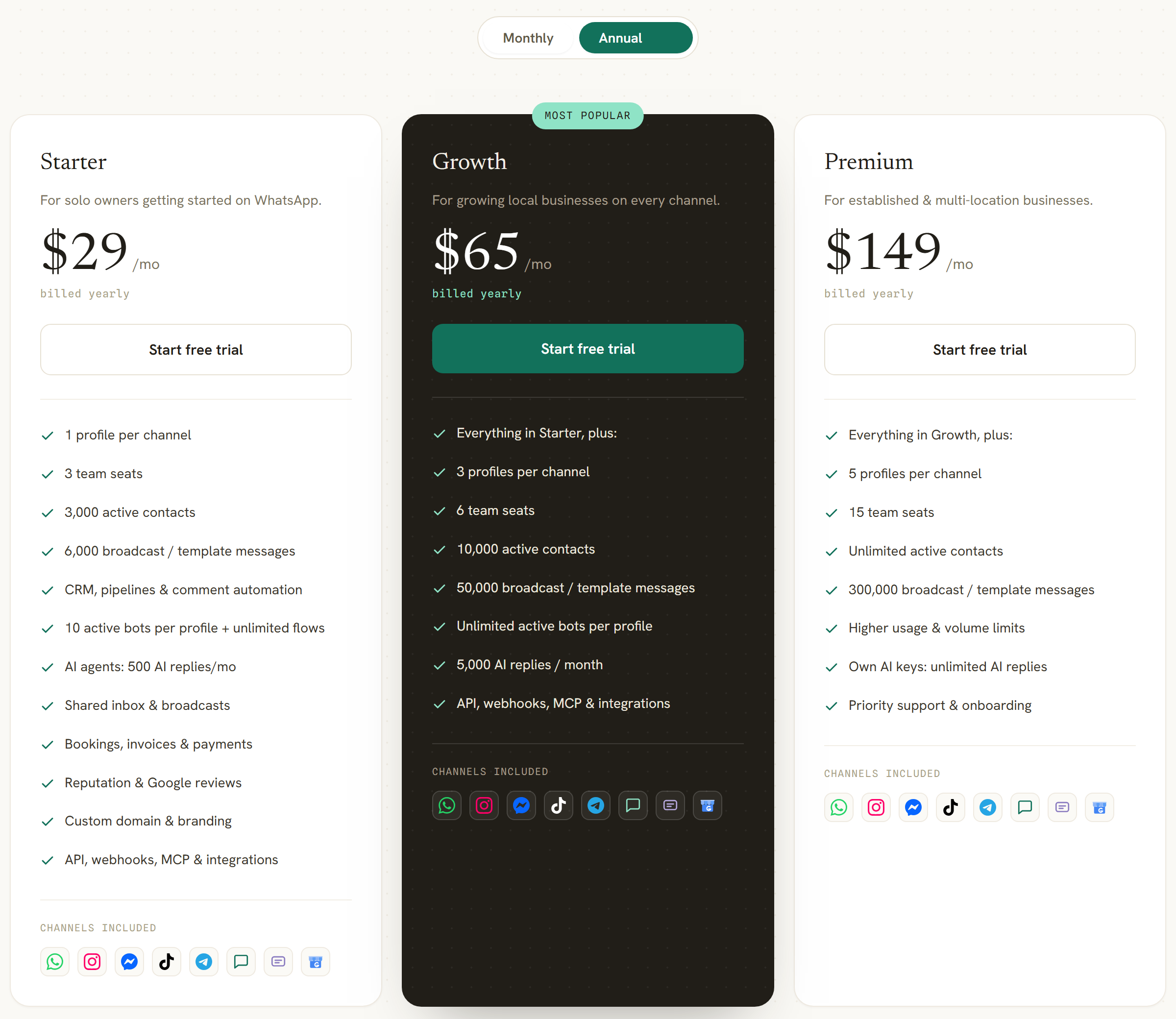
Pricing, verified on the same day as everything else on this page: Starter $29 a month billed yearly (3,000 contacts, 3 seats, 10,000 broadcast or template messages, 500 AI replies), Growth $65 (10,000 contacts, 6 seats, 50,000 messages, 5,000 AI replies), Premium $149 (unlimited contacts, 15 seats, 300,000 messages, 20,000 AI replies plus unlimited on your own AI keys). Billed monthly those are $39, $79 and $199. Extra seats are $10 a month, extra profile sets $15, extra contacts $15 per thousand. Seven-day trial, no card, and no markup on Meta’s per-message rates.
Four things DMly does not do
- It will not message people who have not messaged you. Outside the 24 hours after a contact writes to you, WhatsApp delivers only templates Meta approved in advance, and a stranger has no open window at all. That rule, and how to work inside it, is the whole subject of our guide to WhatsApp broadcasts, opt-in and timing. If your plan is bulk outreach to a bought list, DMly is the wrong tool, and the honest version of that trade is set out in our reviews of Whatso and WhatSender.
- There is no RCS or postal-style email marketing. If you want one vendor for WhatsApp, RCS, SMS and email campaigns, that is RapBooster’s shape, not ours.
- There is no free plan and no perpetual licence. Seven days, then a subscription.
- Segments cannot target campaign behaviour. This page used to claim you could segment on “people who clicked a campaign”, and that is wrong. Segments are built from pipeline stage, tags, days since last activity, and twelve condition fields covering lifecycle, source, custom fields, birthday month, channel reachability, marketing opt-in, total spend, last purchase, order count, loyalty points and credit balance. What you can do is retarget a previous broadcast filtered by who read it, replied to it, or was sent it and did not reply. That is a broadcast audience, not a saved segment, and the distinction matters when you are planning.
RapBooster review FAQs
How much does RapBooster cost?
We cannot tell you, and neither can their website without an account. On 2 September 2026 every tier on the WhatsApp, RCS and SMS, and CRM pricing pages rendered “Login to See Price”, with no rupee figure anywhere. What is published is the structure: cloud priced by number of gateways across five billing terms, a dedicated-server tier in six sizes, and four Windows desktop licence tiers sold in blocks of 1 to 100 keys. Log in to see the numbers, and get them confirmed in writing.
Is RapBooster a WhatsApp Business API provider?
Their WhatsApp pricing page carries the line “Official Meta WhatsApp Business Solution Provider” and their About page shows a “Meta Verified Partner” badge. We are reporting those as the vendor’s own claims rather than confirming them. Note that they also still sell a Windows desktop licence described as “offline capable”, which is a different technical route with different rules attached, so ask which one your quote is for.
Does RapBooster have a CRM?
Yes. CRM Software is a product in its own right with overview, features, pricing and process pages, and the Desktop Advance and Ultra tiers list CRM integration. An earlier version of this review said RapBooster lacked built-in CRM functionality. That was wrong and has been corrected.
Is there a free RapBooster trial?
Yes, on cloud plans with one gateway. It is a request rather than an instant signup: the modal says the trial is valid for three days and that “Our team will review and activate it shortly”. There is no free tier.
What is the best RapBooster alternative?
It depends what you are metered on. For multi-channel campaign sending, Wati and Interakt are the closest like-for-like, and our roundup of WhatsApp messaging automation tools covers the wider field. For creators automating Instagram and Messenger, Manychat, whose prices you will need to read on its own site rather than here. For large support teams, Respond.io. For answering enquiries across eight channels and turning them into bookings and invoices, DMly. Five of the seven are priced above, read from each vendor’s own page on the same day, and the two gaps are explained rather than filled.
How current is this RapBooster review?
Every price, feature and quotation on this page was read on 2 September 2026 from the vendors’ own websites, not from directories or other reviews. Where a figure would not render, we say so rather than substituting one. We also check that each vendor’s own domain is live before trusting anything on it, because a review can quietly end up describing a product that is no longer for sale.
RapBooster review: the short version
RapBooster is a bigger, more serious business than this page used to describe: fifteen products, a 2012 founding date, a real CRM, real AI features, and both a cloud platform and a Windows licence sold side by side. If you want one Indian vendor for WhatsApp, RCS, SMS and email campaigns plus the business software around them, they are a reasonable shortlist entry and our earlier dismissal of them was not fair.
The one thing standing between you and a decision is that you cannot see a price without an account, on a page headed “No hidden fees”. Log in, screenshot the configurator, and get the renewal confirmed in writing. Then compare it against the six alternatives above on the unit you are actually metered on, not on the entry price.
And if the real problem is that messages are arriving faster than anyone can answer them, no broadcast tool is the answer. See what DMly costs, or start the seven-day trial and connect one channel before you decide anything.
Writing about WhatsApp automation, bookings and growth for local business.
Turn WhatsApp into your busiest channel.
Start free and run message, bookings, payments and reviews in one place.
