
SMS Marketing Automation: Gateways, Flows, and Compliance (2026)
Every other messaging channel a business can use asks the customer to have something. An app. An account. A data connection. A habit. SMS asks for a phone.
That is the whole case for it, and it hasn’t changed since the first text in 1992. A text message reaches the cheapest handset on the market and the most expensive one, with the same certainty, whether or not the person has ever installed anything, whether or not they have data that day, whether or not they’ve ever heard of your business. In the United States, Pew puts cellphone ownership at 98% of adults; smartphones, the thing every other channel needs, at 91%. That gap is small, but it’s real, and it’s made entirely of people only a text can reach. No channel has lower reach requirements. Very few have higher delivery rates.
It’s also the channel with the least room in it. One hundred and sixty characters. No images worth sending. No buttons, no lists, no catalogue, no typing indicator. A cost on every single message, including the ones that say “thanks!”. And, because it reaches everyone, a thick layer of law in every country about who you may text and when, with fines that have closed businesses.
So the question is never “should we do SMS marketing?” in the way the phrase suggests, with blasts and offers and a monthly send. The question is which of your messages are worth the constraints. This guide walks through where SMS marketing automation genuinely beats WhatsApp, what consent means in the countries you actually sell in, the arithmetic of segments and cost, the five texts that earn their place, how to write inside the limit, and how to set it all up in DMly so texting does its best job for you: the reliable second channel that makes sure the message arrives.
Where SMS Marketing Automation Beats WhatsApp, and Where It Loses
These two are not competing for the same job, and you will get more out of both once you stop asking which is better. Most small businesses come to SMS marketing automation after WhatsApp, so it is worth settling the comparison properly rather than treating it as a rivalry.
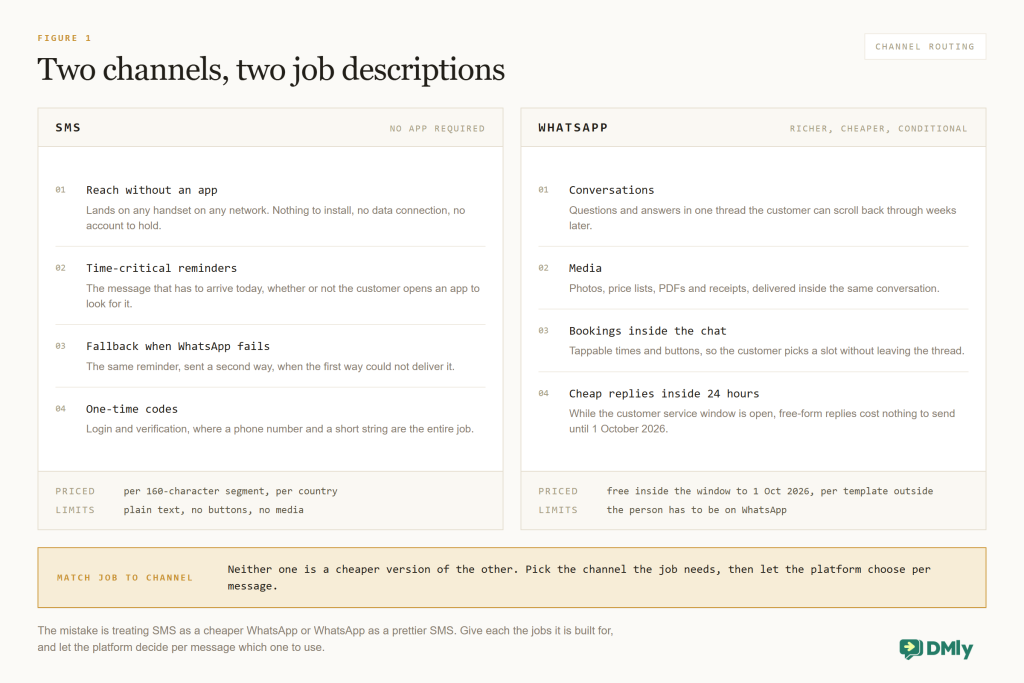
SMS wins on reach and certainty. It doesn’t care which app the customer has, whether their WhatsApp is on an old number, or whether they’re on Wi-Fi. For a message that must arrive, an appointment reminder, a delivery window, a “your table is ready”, nothing is more dependable, and nothing is read faster: in SimpleTexting’s 2026 consumer survey (vendor data, so treat the precision lightly), 74% of people said they check a text within five minutes. It also works for the customers who aren’t on WhatsApp at all, which in some markets is a meaningful slice and in every market is somebody.
WhatsApp wins on everything inside the conversation. Images and voice notes. Buttons your customer can tap instead of typing. A booking picked from real availability and paid for without leaving the chat. Replies you can write in your own words rather than from a pre-approved script, which until 1 October 2026 also cost nothing inside the 24-hour window; from that date Meta charges for those service replies, at the same rate as that market’s utility messages, and for utility templates sent inside the window too. And an AI agent that reads what your customer wrote, answers from your knowledge and hands over when it should. Our FAQ and auto-response guide is built on that richness; almost none of it exists on SMS.
The cost comparison is subtler than it looks. WhatsApp charges per delivered template, and from 1 October 2026 it charges for service replies and for utility templates inside the 24-hour window as well; SMS charges you per segment, every time, in both directions on some plans. For a single reminder, the two sit in the same range. For a back-and-forth conversation, WhatsApp is still dramatically cheaper. For reaching someone who doesn’t have WhatsApp at all, SMS is the only price on the menu. The conclusion that matters for your business is the simple one: the cheapest channel is the one that gets the job done in a single message.
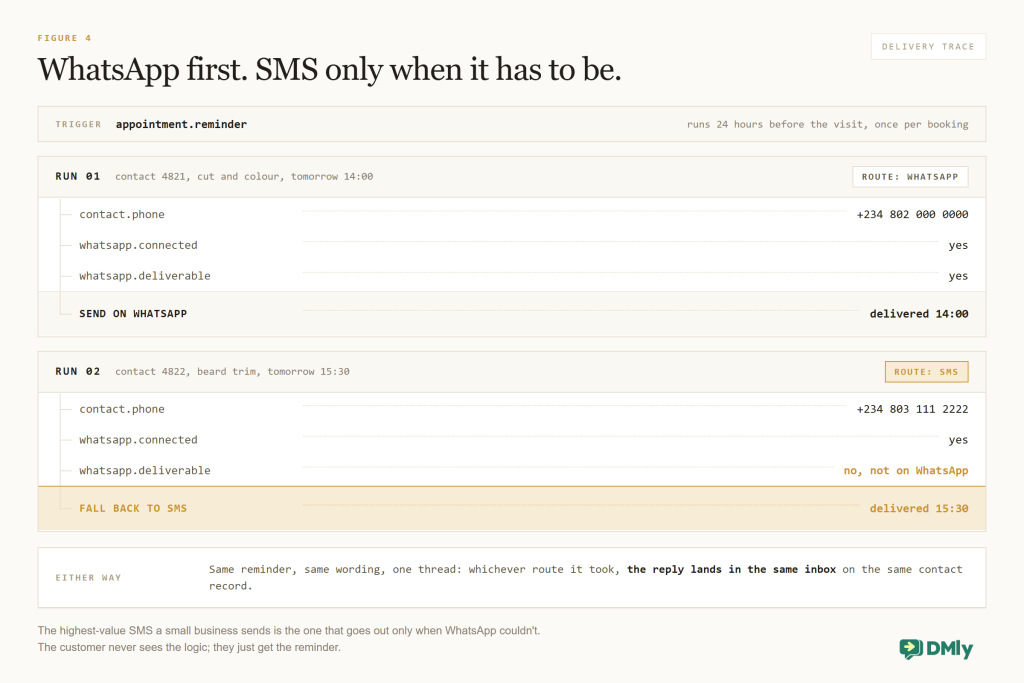
Which leaves the division of labour this guide is built on: WhatsApp for the conversation, SMS for the message that must arrive. The practical expression of that rule is a platform that can send a reminder on WhatsApp when it can and on SMS when it must, from the same booking, without anyone choosing. We’ll build exactly that below.
Consent Is the Whole Game
Get this one thing right and nothing else in this guide can hurt you. SMS is regulated more tightly than any other channel you can use, and for a sound reason: a text interrupts. It lights up a phone in a pocket, often with a sound, from a sender the person may not recognise. Every country that regulates it starts from the same idea, and it’s worth internalising before any tool: you may text people who asked you to, about what they asked for, until they tell you to stop.
This section is not legal advice; it’s a map of the rules that matter most for the markets DMly customers are in, with the dates they were checked, so you know what to look up. If you sell across borders, the strictest rule you’re subject to is the one to build around.
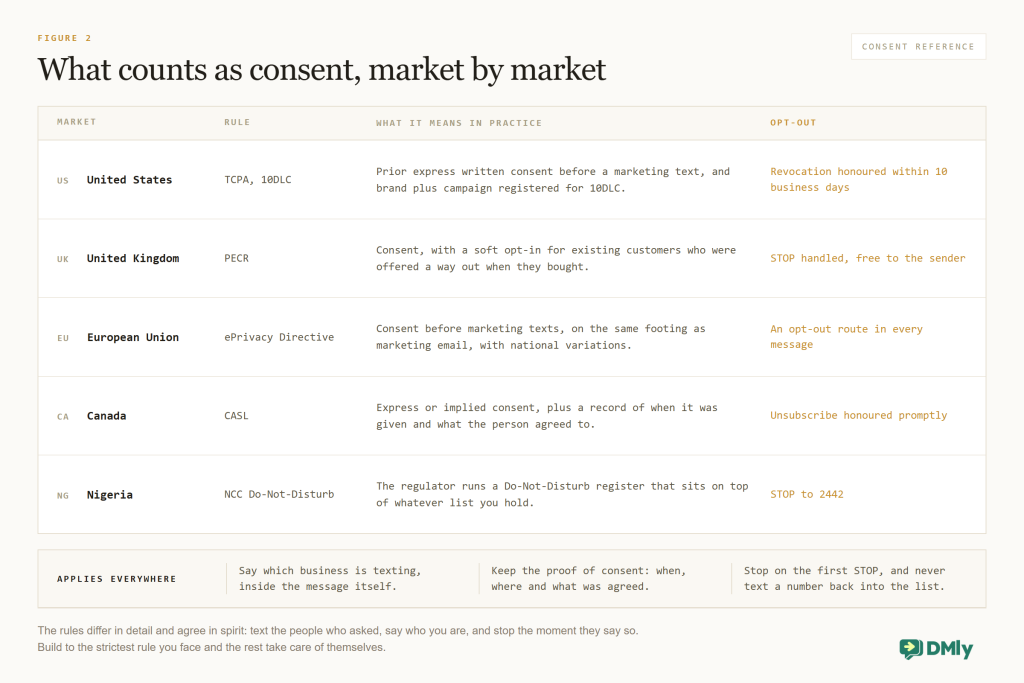
United States. The Telephone Consumer Protection Act (TCPA) requires prior express written consent before you send marketing texts, and the penalties are per message, which is how class actions reach seven figures. Separately, anyone sending application-to-person texts from an ordinary ten-digit number has to register their brand and campaign in the 10DLC system before sending; unregistered traffic attracts extra carrier fees and puts your deliverability at the carriers’ mercy. And an FCC order in force since 11 April 2025 says a customer can revoke consent by any reasonable means, not just the word STOP, and you must honour it within a reasonable time and never more than ten business days. If a customer texts “please stop texting me”, that counts. The industry’s own CTIA principles add the manners: standard STOP wording, plain-language opt-outs like cancel or quit honoured too, one final confirmation text and then silence.
United Kingdom and the EU. Marketing texts need consent under the UK’s PECR (and the equivalent ePrivacy rules across the EU), with a narrow exception for existing customers being told about similar products, provided every message offers an easy opt-out. GDPR then governs how you store the number and the consent record. The regulator that matters in the UK is the ICO, and it fines.
Canada. CASL requires consent, express or implied, before any commercial electronic message, text included, with identification of the sender and an unsubscribe mechanism in every message. Implied consent exists only in limited cases, such as an existing business relationship, and it doesn’t last forever; express opt-in is the safe default.
Nigeria. The NCC runs a Do-Not-Disturb service on the common short code 2442: subscribers text STOP for full DND or a category number for partial, ALLOW to switch it off again, and every operator must block promotional traffic to those lines. A business whose texts keep landing on DND numbers is a business about to be blocked at the carrier. Here, as everywhere, consent you collected yourself is the only safe list.
What that means in practice, everywhere. Collect consent yourself, explicitly for texts, and record when and how (a custom field on the contact: sms_opt_in = 2026-08-14, booking form). Identify your business in every message. Put an opt-out in every marketing message and honour it instantly. Keep marketing texts to waking hours in the recipient’s time zone. Never buy a list. And treat transactional texts the person triggered themselves (their own booking reminder, their own receipt) as a separate, permitted category, which is why those are the texts to automate first.
The Economics of 160 Characters
You are billed per segment, not per message, and the gap between those two words is where small businesses quietly overspend.
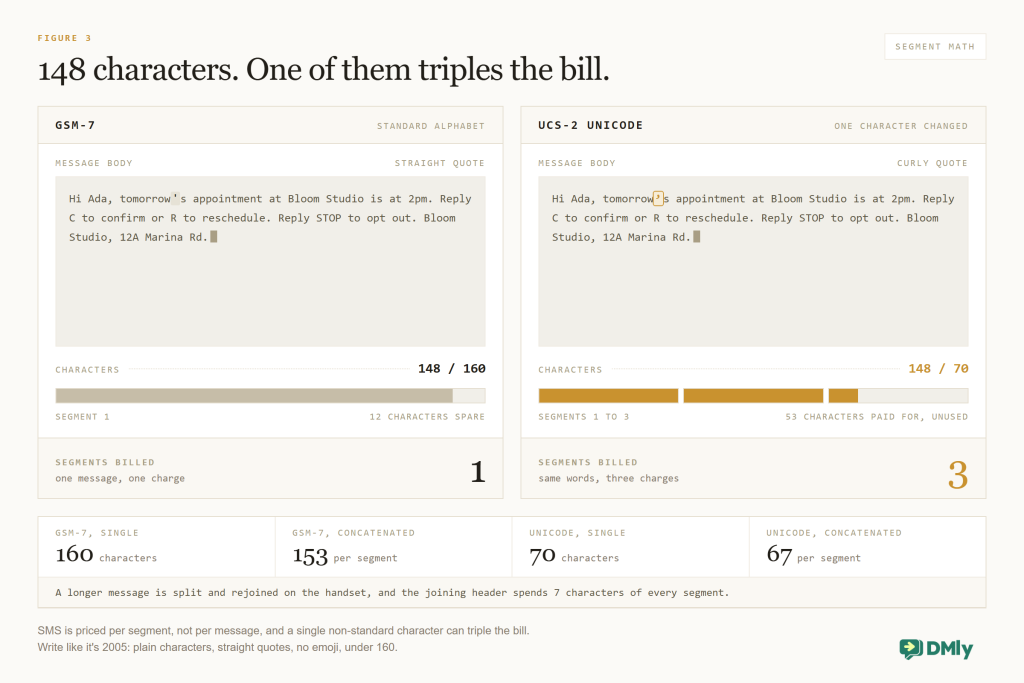
A text written in the standard alphabet (GSM-7: plain letters, digits, basic punctuation) holds 160 characters in one segment; longer messages are split into 153-character segments and stitched back together on the phone. Add a single character outside that alphabet, an emoji, an accented letter, a smart “curly” quote pasted from a document, and the whole message switches to Unicode, where a segment holds 70 characters (67 when concatenated). The same 150-character reminder is one segment plain and three segments with an emoji in it. Same words, three times the bill, and a chance it arrives as fragments on older handsets.
What a segment costs you depends on the country and the route it takes. Through a provider like Twilio or Plivo, which is how DMly sends SMS (a custom HTTP gateway is a third, send-only option), you pay the provider’s per-segment rate for the destination directly; in most markets it’s a few cents or less, and in some it’s surprisingly more, so check the rate card for the countries your customers are in before you plan a campaign. DMly adds no per-message markup; the subscription covers the software and your provider bills you for the traffic. Two honest footnotes. DMly doesn’t count segments or cap length: a long message is handed to the gateway whole and the provider bills whatever it splits into, so watch spend in the Twilio or Plivo dashboard, not in DMly. And broadcast recipients on SMS count against your plan’s monthly broadcast allowance (6,000 on Starter, 50,000 on Growth, 300,000 on Premium), the same as on WhatsApp; reminders and flow texts don’t.
Three habits keep the bill honest. Write plain: straight quotes, no emoji, no accents, and a hard stop at 160. Shorten links, ideally with your own domain rather than a public shortener, which some carriers treat as spam. And remember that on two-way plans a reply costs you too, so “Reply C to confirm” is a feature with a price, worth paying for a reminder and not worth paying for a newsletter.
Then there’s who the text appears to come from. Depending on the country, your provider can give you a local long number (two-way, the default), a short code (expensive, high volume, mostly North America), a toll-free number, or an alphanumeric sender ID that shows your business name instead of a number (one-way, common outside North America, increasingly requiring pre-registration). For a small business, a local long number you own, registered properly where registration is required, is the sensible answer: customers can reply to it, and it survives a change of platform. In DMly the sender is simply the number (or Twilio Messaging Service) you pick when you connect, and it appears on every text from the inbox, broadcasts and flows alike; change it later and the customer sees a new thread, so pick it once.
SMS Marketing Automation: The Five Texts Worth Automating
Five texts do almost all of the useful work, and everything else you were thinking of sending probably belongs on WhatsApp. Given the constraints, the ones that earn their place are the messages where certainty matters more than richness.
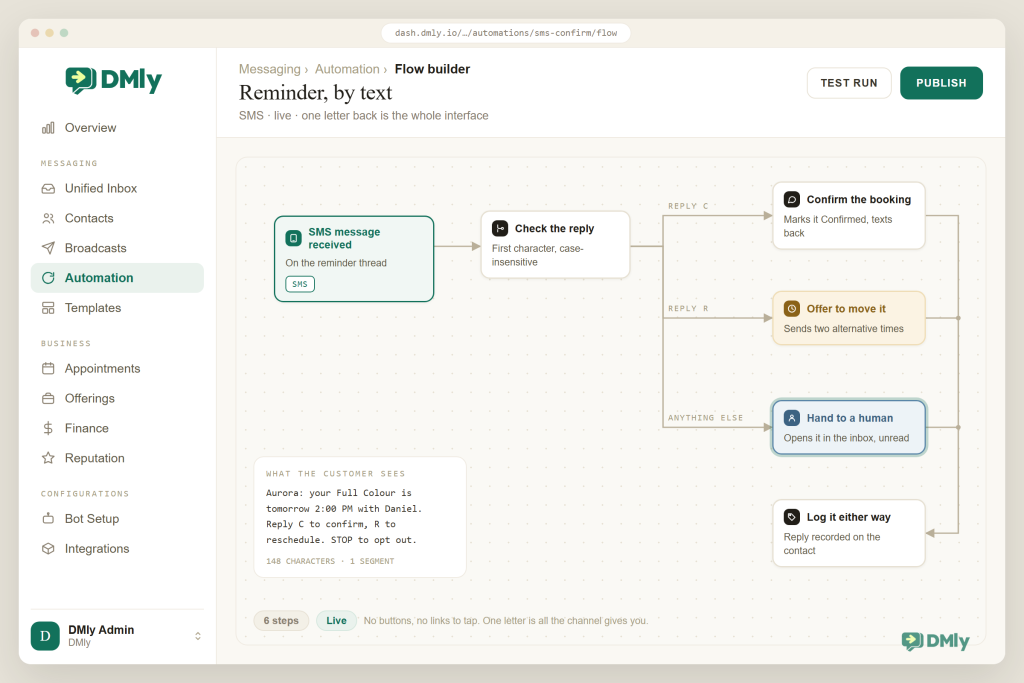
1. The appointment reminder. The single highest-value SMS in small business. A reminder 24 hours before with a one-letter confirm (“Reply C to confirm or R to reschedule”) cuts no-shows measurably. The healthcare evidence is the best we have: a Cochrane review of text-message reminders found attendance rose from 67.8% without a reminder to 78.6% with one, at roughly 55% to 65% less cost per attendance than phoning, and a separate systematic review put the average cut in non-attendance at about a third of the baseline rate. A salon, clinic, tutor or mechanic runs the same arithmetic. Your customer asked for the appointment, so the reminder is expected rather than promotional, and it is time-critical, which makes SMS the right channel whenever WhatsApp can’t be guaranteed. Appointment reminders get a guide of their own.
2. The confirmation and the change. “Booked: Tue 3pm, gel manicure, 45 min. Reply R to move it.” Sent the moment a booking is made, and again if it changes. Short, factual, and the thing customers screenshot.
3. The fallback. The text that goes out only because the WhatsApp message didn’t: your customer isn’t on WhatsApp, or the template failed to deliver. Nobody designs their messaging around this one, and it quietly saves more appointments than any campaign. We build it in DMly further down, and it turns out to be one tick box rather than a flow.
4. The “it’s ready” and the “it’s here”. Your order is ready for collection. Your table is ready. The part arrived. Your results are in, call us. Moments where the customer is waiting on exactly one fact and wants it on whatever reaches them fastest. (When a flow on SMS reaches a booking step, DMly sends a booking link rather than tappable times, which is the right shape for a channel with no buttons.)
5. The occasional, consented promotion. Yes, SMS marketing in the classic sense works: a quiet-Tuesday offer to people who opted in to offers, with a link and a STOP line, sent at 10am, at most a couple of times a month. The response rates are real: Klaviyo’s 2025 benchmark across its ecommerce customers (vendor data) shows SMS campaigns clicking at 5.76% against 1.29% for email. The discipline is that the consented list is small, the segment is smaller, and the message is one sentence. For anything richer than that (a photo of the new menu, a choose-your-slot button, a two-way conversation about a sale), use WhatsApp and keep your SMS budget for the four texts above. A text can also sit inside a longer win-back or follow-up sequence: DMly’s sequences run on SMS as plain-text steps on the days you set, with no window to worry about.
Writing a Text That Earns Its Segment
Writing for SMS is a craft of subtraction, and the payoff is a message people act on rather than report. A few rules do most of the work.
- Say who you are in the first three words. “Lane Salon: your 3pm…” The number may be unfamiliar; the name shouldn’t be. In some countries identifying the sender is the law; everywhere it’s the difference between a reply and a block.
- One message, one job. A reminder reminds. It doesn’t also mention the loyalty scheme. If a second thing needs saying, that’s a second text, sent another day, or a WhatsApp message with room in it.
- Make the reply a single character, and never a stop word. C to confirm, R to reschedule, Y for yes. Every extra letter the customer has to type is a reason not to, and there’s a trap in the obvious words: in DMly, a bare
cancelorendis an opt-out keyword, so “reply CANCEL to cancel your booking” would unsubscribe the customer and kill the flow. Single letters sidestep it. - Put the link last and the STOP line on marketing. The link is the action; it goes at the end where a thumb finds it. The opt-out line goes on every promotional text, and not on the transactional ones the customer asked for, where it only adds characters and confusion.
- Count the characters, then count the bytes. Write the text, then check: is it under 160, and is every character plain? A word processor’s smart quote will silently triple your cost.
- Send when people are awake. Reminders the evening before or the morning of. Promotions mid-morning or early evening, never before 9 or after 8 in the customer’s time zone, and never on a day they’d find odd.
A worked example, 139 characters, one segment: Lane Salon: your colour appt is tomorrow (Tue) at 3pm with Ada. Reply C to confirm or R to reschedule. Questions? Just reply. Identity, fact, action, door left open, no emoji, no STOP line because it’s transactional.
Setting Up SMS Marketing Automation in DMly
You keep your own provider account, your own number and your own carrier rates; DMly just does the sending and the answering. It connects to your account with an SMS provider and runs the channel inside the same inbox, flows and broadcasts as everything else, so nothing here becomes a second system to look after.
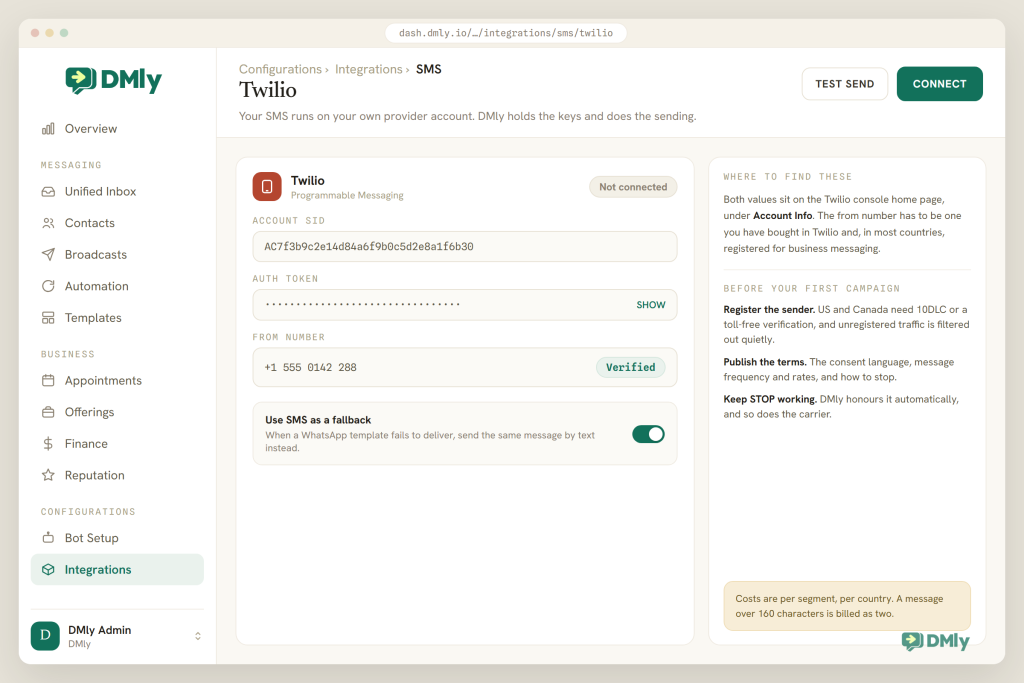
- Get a number from a provider. Open an account with Twilio or Plivo, buy a local number in the country you serve (two-way, so customers can reply), and complete whatever registration that country requires before marketing traffic flows. In the US that means 10DLC brand and campaign registration; elsewhere it may mean registering your sender name in advance. Each provider has its own setup guide, and both are short.
- Connect it to DMly. Integrations → the SMS section → Twilio or Plivo. Twilio asks for the Account SID, Auth token and your From number (or a Messaging Service SID); Plivo for the Auth ID, Auth token and sender number. DMly checks the credentials with the provider, then shows you two webhook addresses, which are simply the places your provider should deliver things to: paste them into the provider’s dashboard for that number as the incoming-message and delivery-status addresses, or replies and delivery reports will never reach you. From then on inbound texts land in the Unified Inbox beside WhatsApp and Instagram, and outbound goes through your account at your provider’s rates. (Someone who WhatsApps you and later texts the SMS number arrives as two contacts; merge them once.)
- Record consent on the contact. Add a custom field for SMS consent with the date and source, and tag people as they opt in (booking form, keyword, at the desk). Your promotional segment is then “SMS consent is set, exclude Unsubscribe”, and nothing else ever gets a marketing text.
- Switch on the reminders. Appointment confirmations and reminders are built into DMly’s bookings: set the reminder times on each service (a day before, an hour before) and choose the channels under Notification settings, where each event has a master toggle and Email, SMS and WhatsApp boxes. DMly sends these WhatsApp-first whenever it has a phone number and a connected WhatsApp channel; when WhatsApp can’t carry the message (the person isn’t on it, or the window is closed with no approved template), the other channels you ticked take over. Tick SMS, and that single setting is the fallback pattern with no flow to build. A reminder is skipped, never retried, if the booking is no longer confirmed or the contact has opted out.
- Build the one-letter reply flow. An automation on the SMS channel with the SMS message trigger (on SMS it opens as “Choose a trigger”, so pick the event before publishing or the flow never fires). The trigger takes keywords (exact match on C or R is the clean choice), or a Condition on the reply text: C confirms the booking, R sends the reschedule link, anything else hands over to a person. SMS flows send one plain text body per step, no buttons or media, so design each step as a sentence. For the fallback inside a WhatsApp flow, the Send SMS step works from any channel’s flow, defaults to the contact’s phone number, and quietly logs rather than breaking if there’s no number to send to.
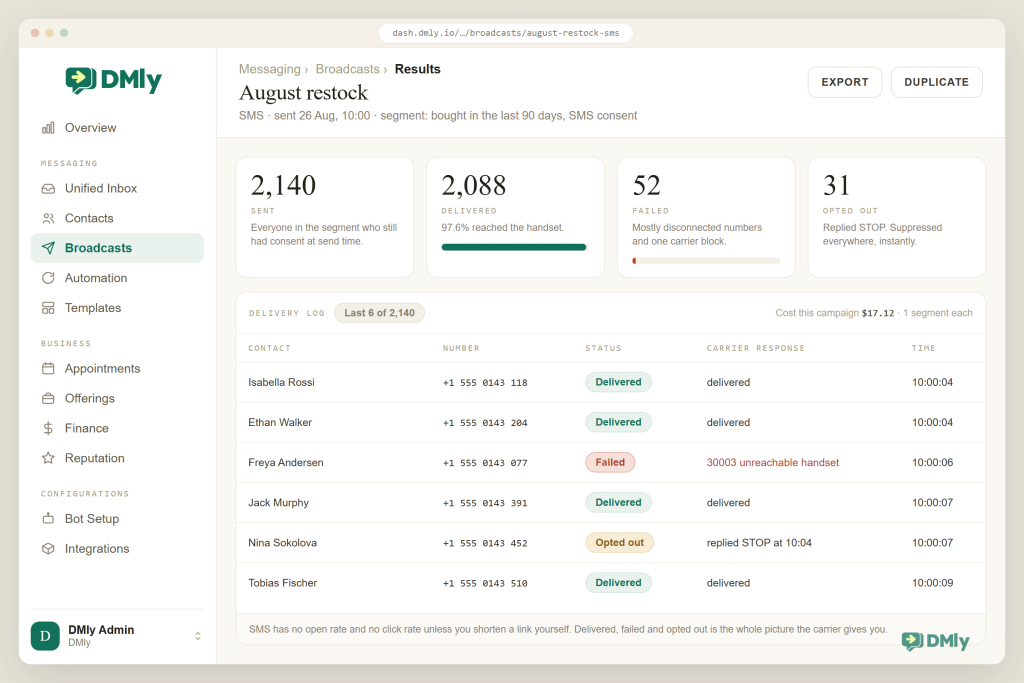
- Broadcast sparingly. SMS broadcasts in DMly are free-form (no templates, no approval queue); the message step even reminds you that long texts split into segments. Delivery reports fill in, which WhatsApp does too but Telegram doesn’t. Audience: the consented segment only, with Reachable contacts only ticked. Message: one sentence, a link, STOP. DMly paces sends at up to 600 a minute per SMS channel, and your provider’s own limits apply on top.
- Let STOP do its job. A contact who texts
stop,stop all,unsubscribe,cancel,quit,endoropt outas their whole message is opted out across your channels on the spot: tagged Unsubscribe, dropped from every broadcast, sequence and reminder, with a note on the conversation. Your team can still reply by hand, andstartorsubscribebrings them back. DMly doesn’t add a STOP footer to outbound marketing for you, so write it in.
Measuring SMS Marketing Automation Without Fooling Yourself
SMS gives you one honest number and several tempting ones, and it is worth knowing which is which before you report to yourself. The honest one is delivered: your provider confirms the carrier accepted the message, and DMly shows it. Below the high nineties, your list has dead numbers or your registration is incomplete and carriers are filtering you; both are fixable, and both are invisible if you don’t look.
There is no read receipt on SMS and never will be, so any “open rate” you’re quoted for texts is a guess. Measure what the text was for instead. For reminders: the confirm rate (replies of C) and, the number that matters, the no-show rate before and after. For order and “it’s ready” texts: nothing, they’re a service. For promotions: link taps (through your own short links, since DMly’s trackable chat links don’t run on SMS) and the bookings or orders that followed, against the segment cost of the send. And across all of them: opt-outs per send. A promotional text that produces more STOPs than bookings was a text that shouldn’t have gone, and the list is telling you so politely before a carrier or a regulator tells you otherwise.
Why DMly for SMS
The case for running SMS marketing automation in DMly rather than in a standalone texting tool is that it stops being a second system for you to check. That is the same case as for any other channel you add.
Your provider, your number, your carrier rates: DMly connects to Twilio or Plivo rather than reselling traffic with a markup, so a channel that’s priced per segment stays as cheap as it can be. The texts land in the same Unified Inbox as WhatsApp, Instagram and the rest, so a customer who confirms by text and asks a question by WhatsApp is one conversation to one person. Reminders and confirmations come from the bookings you already take, and the WhatsApp-first routing with SMS fallback means the message that must arrive, does, without a flow for every case. Opt-outs are honoured across channels automatically. And the same AI agent and knowledge base you use elsewhere can read an SMS reply and act on it, within the limits of a channel that only carries text.
Commercially, SMS is included as a channel on every plan ($29, $65 and $149 a month billed yearly), there’s no DMly per-message fee, and the 7-day trial needs no card. You’ll pay your provider for segments, which is exactly what you should be paying for SMS, and SMS broadcast recipients draw on the same monthly broadcast allowance as WhatsApp.
Questions Small Businesses Ask About SMS Marketing Automation
Do I really need consent to text my own customers?
For marketing, yes, in every market that matters, and the record of that consent protects you. For transactional texts the customer triggered (their own booking reminder, their receipt), the rules are looser, which is why those are the texts to automate first. This is not legal advice; the rules and the regulators are named in the consent section above.
Why did my text cost three times what I expected?
Almost certainly a non-standard character: an emoji, an accented letter or a curly quote pasted from a document. That switches the message from 160-character to 70-character segments. Write plain, and check the character count before sending.
Should I use SMS or WhatsApp for appointment reminders?
Both, in that order of preference: WhatsApp when the customer is on it and the message delivers (it’s richer and usually cheaper), SMS when it isn’t or doesn’t. DMly makes that choice per message automatically.
Can I send a picture or a button by SMS?
Not in a standard SMS. Pictures need MMS, which is patchy and expensive outside North America; buttons don’t exist. Put the picture and the button on WhatsApp, and put a link in the text.
What happens when someone replies STOP?
In DMly they’re opted out across channels on the spot: tagged Unsubscribe and excluded from every automated message, though your team can still reply by hand. Honouring that instantly is both the law in most markets and the thing that keeps your number off carrier block lists.
Does DMly charge extra for SMS marketing automation?
No per-message fee. SMS is included as a channel on every plan; you connect your own Twilio or Plivo account and pay the provider’s per-segment rate for the traffic.
The Message That Has to Arrive
SMS won’t be the channel you build your customer relationships in. It’s too small, too costly per word and too regulated for that, and WhatsApp does the relationship job better. What SMS does, better than anything else you own, is make sure the one message that matters lands on whatever phone your customer happens to be holding. Build your SMS marketing automation around that single job, keep the consent record clean, write like every character costs money (it does), and the channel will quietly save you more appointments than any campaign ever wins.
Add SMS as a channel. Connect your Twilio or Plivo number to DMly, switch on reminders with WhatsApp-first routing and SMS fallback, and let the message that has to arrive, arrive. Start the 7-day trial, no card, no per-message fee from DMly.
Writing about WhatsApp automation, bookings and growth for local business.
Turn WhatsApp into your busiest channel.
Start free and run message, bookings, payments and reviews in one place.
