
AiSensy Review 2026: Two Price Lists, and One Number to Check
When a platform tells you it charges you nothing extra and simply passes Meta’s messaging fee straight through, that is a good sign. It is also a claim you can check in about two minutes, because Meta publishes its rate card openly, in sixteen currencies, as a downloadable file.
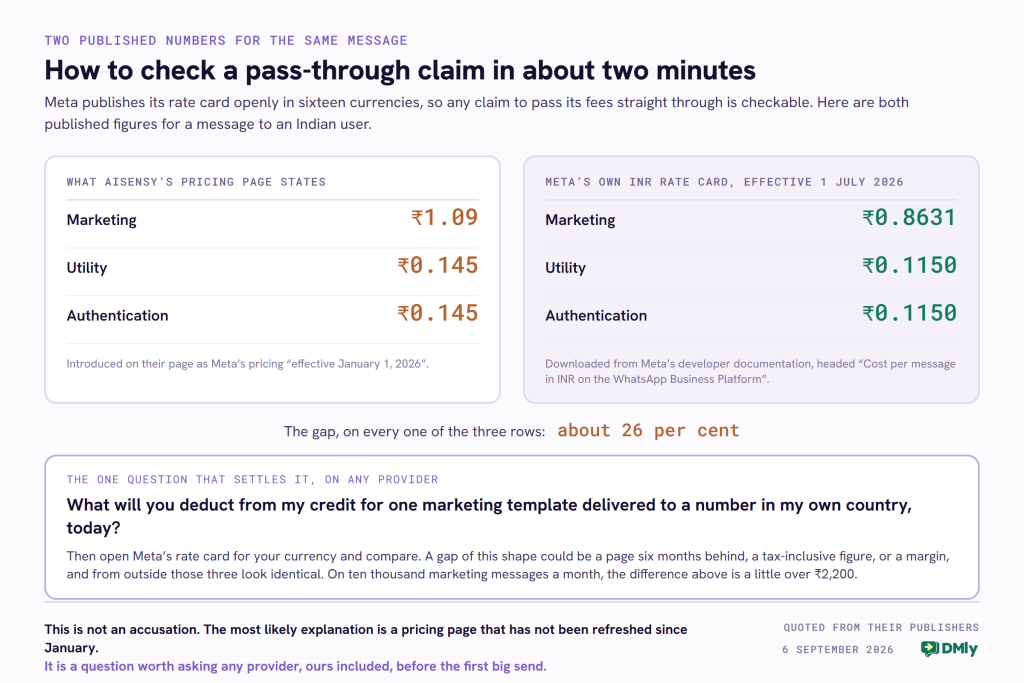
So we checked. AiSensy’s pricing page states, in its own words, that a marketing message to an Indian user costs “₹1.09 per message” and that utility and authentication messages cost “₹0.145 per message”. Meta’s own rupee rate card, downloaded from its developer documentation on 6 September 2026 and headed “Cost per message in INR on the WhatsApp Business Platform, effective July 1, 2026”, gives India as 0.8631 marketing, 0.1150 utility, 0.1150 authentication.
Those are two published numbers for the same thing, about twenty six per cent apart, and there is a likely and perfectly ordinary explanation for the gap. This AiSensy review sets both figures out, says what the explanation probably is, and gives you the one question to ask before you budget. It also covers the two things this page got wrong for a year: there are two separate AiSensy price lists, and the automation you probably came for is not in any plan.
What AiSensy Is, and Where It Comes From
AiSensy is a WhatsApp Business API platform, and it is the most India-centred one in this category. That is not a criticism. It is the single most useful thing to know about it, because almost everything that follows, including which price you are quoted, depends on it.
Step zero first, because an AiSensy review is worthless if the vendor has moved or gone. Checked on 6 September 2026: aisensy.com returns 200 on the root, the robots file, the sitemap and the pricing page, with a real product behind it. The pricing page renders its plan cards in the browser, which is a change worth recording, because an earlier pass on this page could not get those cards to resolve into figures at all and had to leave a blank where the plan prices should be. They resolve now, so this review has the whole ladder.
What the platform does is broadcast messaging, a shared team inbox with multiple agents, campaign scheduling and click tracking, contact tagging, Click-to-WhatsApp ad management, WhatsApp catalogues, payments and native forms, plus chatbot flows and an AI agent sold separately. The company’s own pricing page claims it is “Trusted by 210,000+ Businesses across 68+ Countries”.
The India orientation shows up in concrete, checkable ways: the default pricing page is in rupees and titled “WhatsApp Business API Pricing in India”, per-message rates are quoted in rupees, one of the published add-ons is an Indian Virtual Number at ₹2,000 plus GST a year requiring GST or MSME registration for the identity check, and the highest published tier is described in lakhs. There is a separate dollar page for everyone else. If you are outside India, that second page is the one that applies to you, and it is not the one most reviews quote.
AiSensy Pricing in 2026: There Are Two Lists, and They Are Not Conversions
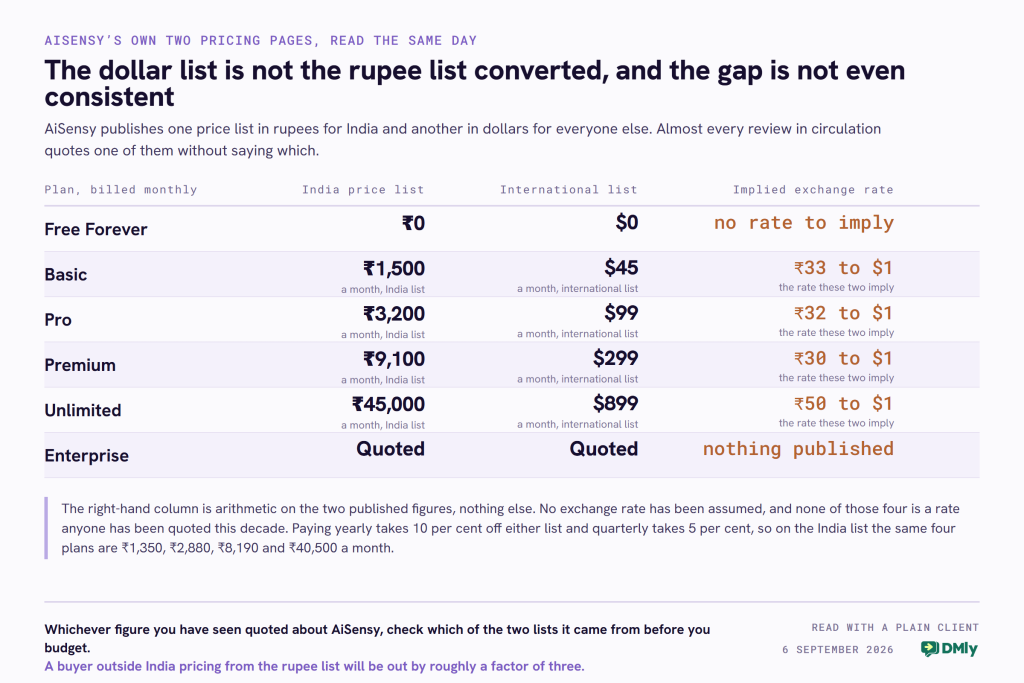
This is the part earlier versions of this page got half right. The dollar figures it quoted, $0, $45 and $99, are correct today for the Free, Basic and Pro plans billed monthly. What it never said is that there are two more paid tiers above Pro, and that a completely different set of numbers applies if you buy in India.
Both lists were read from AiSensy’s own pricing pages on 6 September 2026, with the billing period recorded beside every figure.
| Plan | India list, billed monthly | India list, billed yearly | International list, billed monthly | International list, billed yearly |
|---|---|---|---|---|
| Free Forever | ₹0 | ₹0 | $0 | $0 |
| Basic | ₹1,500 | ₹1,350 a month, ₹16,200 a year | $45 | $40.50 a month, $486 a year |
| Pro | ₹3,200 | ₹2,880 a month, ₹34,560 a year | $99 | $89.10 a month, $1,069.20 a year |
| Premium | ₹9,100 | ₹8,190 a month, ₹98,280 a year | $299 | $269.10 a month, $3,229.20 a year |
| Unlimited | ₹45,000 | ₹40,500 a month, ₹4,86,000 a year | $899 | $809.10 a month, $9,709.20 a year |
| Enterprise | Quoted | Quoted | Quoted | Quoted |
Put the two columns next to each other and something obvious falls out: the dollar list is not the rupee list converted. You do not need an exchange rate to see it, because the two published figures imply one. Basic at ₹1,500 and $45 implies about 33 rupees to the dollar. Pro at ₹3,200 and $99 implies about 32. Premium at ₹9,100 and $299 implies about 30. Unlimited at ₹45,000 and $899 implies about 50. Those are not rates anyone has been quoted this decade, and they are not even consistent with each other.
The plain reading is that AiSensy runs two separate commercial price lists rather than one list in two currencies, which is an entirely normal thing for a company selling into very different markets to do, and nobody should treat it as a scandal. What matters to you is practical. Almost every review of AiSensy in circulation quotes one list or the other without saying which, so a buyer outside India reading a rupee figure will be out by a factor of roughly three. Open the page that applies to where your business is registered, and price from that.
The Automation Is Not in Any Plan, Including the ₹45,000 One
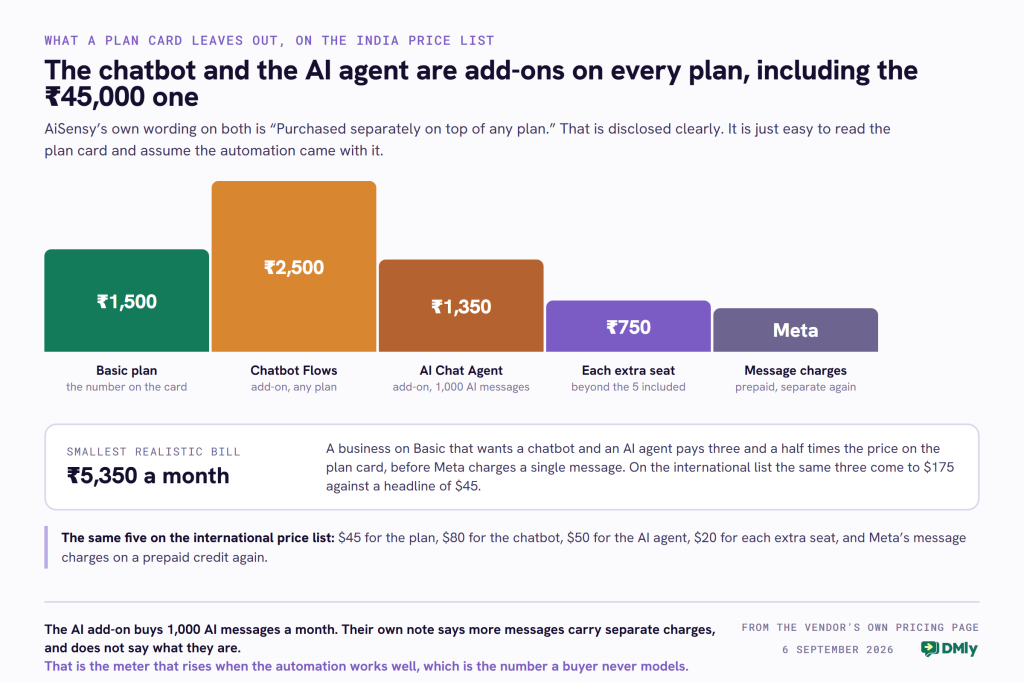
This is the structural finding of the review, and it is the one that changes what a buyer should budget. Chatbot flows and the AI agent, which are the two things most people arrive at a platform like this wanting, are sold as add-ons on top of every single plan. Not on the free tier only. On every tier, including the top published one.
| Add-on, charged separately on any plan | India list | International list | What it includes |
|---|---|---|---|
| Chatbot Flows | ₹2,500 a month | $80 a month | The drag and drop builder, five chatbots, cart management and catalogue sharing |
| AI Chat Agent | ₹1,350 a month | $50 a month | 1,000 AI messages a month, knowledge base, long term memory, tool calling |
| Extra team member | ₹750 a seat a month | $20 a seat a month | One more agent login beyond the seats your plan includes |
Work through what that means for a real budget. A small business on Basic that wants a chatbot and an AI agent is paying ₹1,500 plus ₹2,500 plus ₹1,350, which is ₹5,350 a month, or three and a half times the number on the plan card. On the international list the same three come to $175 a month against a headline of $45. Neither figure includes what Meta charges for the messages, which is a separate prepaid balance again.
The AI agent’s allowance is worth reading twice as well. ₹1,350 buys 1,000 AI messages a month, and their own note says “For more AI messages, separate charges apply”, without publishing what those charges are. That is the meter that rises when the automation works well, which is exactly the number a buyer does not model.
Seats are the third line. Basic includes one owner plus five agents and Premium includes one owner plus nine; beyond that every login is ₹750, or $20, a month. That is a fair price for a seat, but it belongs in the arithmetic: a ten person team on Basic is paying for four extra seats before anything is automated.
The Pass-Through Number, and the Question That Settles It
Here are the two published figures side by side. Nothing below is an inference: both are quoted from the source that publishes them, and you can open both yourself.
| Message to an Indian user | What AiSensy’s pricing page states | Meta’s own INR rate card, effective 1 July 2026 | Difference |
|---|---|---|---|
| Marketing | ₹1.09 | ₹0.8631 | About 26 per cent higher |
| Utility | ₹0.145 | ₹0.1150 | About 26 per cent higher |
| Authentication | ₹0.145 | ₹0.1150 | About 26 per cent higher |
The likely explanation is the dull one, and AiSensy’s own page all but says it out loud. Their pricing FAQ introduces those figures like this: “Meta has announced revised per-message pricing for WhatsApp Business API, effective January 1, 2026. The updated pricing for India is: Marketing messages ₹1.09 per message; Utility messages ₹0.145 per message; Authentication messages ₹0.145 per message.” Their page is quoting a January card. Meta’s current card is dated 1 July 2026, and Meta may revise rates quarterly. The most probable reading is simply that the page has not been refreshed since January.
We are not saying AiSensy adds a markup, and nothing here should be read that way. A gap of this shape could be a page that is six months behind, a figure quoted with Indian GST included, or a genuine platform margin, and from the outside those three look identical.
What settles it is one question, and it is worth asking any provider, us included. Ask: what will you deduct from my conversation credit for one marketing template message delivered to a number in my own country, today? Then open Meta’s rate card for your currency and compare. If the two match, you have a genuine pass-through. If they do not, you now know the size of the gap and can decide whether it is worth it. On ten thousand marketing messages a month, twenty six per cent on India’s marketing rate is a little over ₹2,200.
Two things to their credit while we are here. AiSensy publishes per-message rates on the pricing page at all, which a surprising number of platforms in this category do not, and it links out to a full country-by-country sheet. And its billing model is stated plainly: “All billing is pre-paid”, with the WhatsApp conversation credit recharged and managed separately from the subscription. Knowing that up front is worth more than a lower headline number.
One line in their published grid does deserve a flag, in the same spirit. On the five priced plans the per-message rates are printed as figures. On Enterprise, the same three rows read “Custom”. A custom per-message rate is, by definition, a rate that can differ from the published one, in either direction. If you are being quoted Enterprise, that is the row to ask about first.
“Service Messages Are Always Free” Has Twenty Four Days Left
This applies to every WhatsApp platform including ours, but AiSensy’s page states it more often and more absolutely than most, so this is the place to set it against the source.
AiSensy’s pricing page says it four times. Its plan cards carry a line reading “Unlimited Free Service Conversations: Replying to any user message within the 24-hour service window is always free, on every plan.” Its terminology section says “Service conversations are FREE for all businesses using AiSensy.” Its FAQ says “Service messages will continue to remain free within the 24-hour customer service window.” And the per-message row on every plan card reads simply “Service: Free”.
Meta’s own developer documentation, read on 6 September 2026, says this: “Effective October 1, 2026, Meta will charge on a per-message basis for all service messages, consistent with how Meta charges for template messages. These messages have not been charged since November 1, 2024.” Service messages will be priced at the same rate as utility and authentication messages in your customer’s country, and Meta’s page states plainly that there are no volume tiers on service messages, though utility and authentication keep theirs.
The same date brings a second change that the phrase “always free” also covers: utility messages sent in reply to a customer inside the open 24-hour window start being charged too. They have been free since July 2025.
Once again the likely explanation is the calendar rather than anything else. AiSensy’s page is calibrated to Meta’s January announcement, and Meta’s October announcement came later. Every platform in this category has pages that will need rewriting in the next three weeks, and ours are no exception. The reason it matters here is that this specific claim is the one a buyer builds a support budget on.
The part that makes this survivable, which almost nobody has written up yet
Meta marked this as new on its own pricing page, and it changes the answer for most small businesses: “Effective October 1, 2026, Meta will introduce a free monthly tier of service messages. Each month, every business phone number will receive 1,000 free service messages; Meta will only charge as of the 1,001st service message delivered. These free service messages do not roll over if not used in a specific month and reset monthly, for each business phone number.”
Read the units carefully, because a retired 2024 rule looked almost identical and was not: this one is per business phone number, per month, and it counts messages rather than conversations. A shop answering forty enquiries a week at four or five replies each is under a thousand and pays nothing. A clinic running a busy front desk on WhatsApp will go past it. The exercise takes five minutes: count the replies your side sent last month, subtract a thousand, and multiply the rest by your country’s utility rate. Our rate card by country has that number.
The deadline that can switch your replies off, whichever platform you are on
Act on this one this week. Meta’s own page states that for any solution provider or directly integrated business “that does not have a payment method on file by September 30, 2026”, Meta “will stop delivering service messages” from the date they become chargeable on 1 October. Not slow them down. Stop delivering them.
If you reach WhatsApp through AiSensy, through us, or through anyone else, ask that provider today whether a payment method is on file for your WhatsApp Business Account and get the answer in writing. If you use the free WhatsApp Business app rather than the Business Platform, none of this touches you. There is more in our guide to the 1 October pricing change.
What “Unlimited” Means on the AiSensy Price List
Two different things on this page are called unlimited, and neither means what the word usually means. Both are disclosed, and both are easy to walk past.
The first is the plan called Unlimited, at ₹45,000 or $899 a month. AiSensy’s own footnote says: “‘Unlimited’ limits follow AiSensy’s fair-use policy (Agents up to 200, Tags up to 500, Attributes up to 100, Segments up to 50).” Those are generous ceilings and there is nothing wrong with having them. They are still ceilings, printed under the word unlimited, and the plan that carries them also still buys its chatbot and AI agent as add-ons.
The second is the phrase “Unlimited Users Plan” printed across the top of the pricing page. It does not mean unlimited team members: team members are ₹750 a seat beyond your plan’s allowance. AiSensy’s own FAQ defines it: “Unlimited User means that there is no limit on the number of Monthly Active Users (MAUs) you can connect with in a month.” It is about your customers, not your staff, and that distinction is worth several hundred rupees a month to a growing team.
The genuinely unlimited thing is the one that matters most for a big list, and it is a real advantage. AiSensy charges nothing for holding contacts. Its own line is “Upload & manage unlimited contacts: import as many as you like; you pay only for the conversations you actually send.” If you have a hundred thousand contacts and message them twice a year, that model is cheaper than any per-contact plan on the market, and it is fair to say so plainly on a page that is arguing for the alternative.
Seven Criticisms This Page Used to Make, and What Survives
An earlier version of this AiSensy review listed seven shortcomings, most of them adjectives with nothing behind them. Each was checked against what AiSensy actually publishes. Five are withdrawn and two survive in a sharper form. Withdrawing a criticism is not politeness; a page that criticises a named company on nothing is worth less than no page at all.
Withdrawn: “restricted integrations, especially with tools like Zapier or Make.” AiSensy’s integrations page lists Zapier, Integrately and Pabbly by name, alongside Shopify, WooCommerce, Razorpay, Shopify Checkouts, WebEngage, LeadSquared and inbound webhook APIs. Naming Zapier as the missing one was simply wrong.
Withdrawn: “limited automation depth, doesn’t support complex, multi-step customer journeys.” They sell a drag and drop flow builder with keyword, template, QR code and Meta ad triggers, cart management, catalogue sharing, timeouts and time delays inside flows, plus an AI agent with a knowledge base, long-term memory and tool calling. That is not shallow. The narrow true version is the one in the section above: none of it is included in a plan. That is a pricing structure, not a capability gap, and saying so accurately is more useful to a buyer than calling the product basic.
Withdrawn: “basic personalization capabilities” and “manual effort for ecommerce workflows.” Both were unsupported. They publish carousel template click tracking, per-recipient campaign click tracking, retargeting based on how people responded to an earlier campaign, WhatsApp catalogues, cart management inside the flow builder, and Shopify and WooCommerce syncing for order, shipping and abandoned cart notifications.
Survives, sharpened: “minimal CRM functionality.” Contact management really is tags and custom attributes rather than a customer record, and the ceilings are published per plan: 10 tags and 5 attributes on Basic, 100 and 20 on Pro, 250 and 50 on Premium, 500 and 100 on Unlimited, with audience segments capped at 2, 10, 50 and 50. There is no pipeline, no lifecycle stage and no appointment or invoice history attached to a contact, which is what people usually mean by a CRM built around messaging. If that is what you need, this is a real gap and the numbers say so better than the adjective did.
Survives, sharpened: “region-focused approach.” The evidence is the two price lists, the rupee-denominated per-message rates, the Indian Virtual Number add-on requiring GST or MSME registration, and tiers described in lakhs. Set against that, they publish a dollar list, a Portuguese site and a claim of 68 countries. The true version is not that AiSensy cannot serve you outside India. It is that the numbers you will find quoted about it usually will not apply to you.
Withdrawn as written, and folded into the two below: “scaling limitations.” Half of it was right and half was wrong. The tag, attribute and segment caps are real, and this page now gives them as numbers instead of as a warning. The automation half was wrong: automation is not a ceiling you hit on AiSensy, it is a purchase you make, and those are different problems with different solutions.
Two credits the old page never gave. AiSensy publishes a support response promise and hard performance numbers: broadcast sending speed rises from 40 messages a second on Basic to 250 on Premium and 1,000 on Unlimited, which is a real specification most competitors leave vague. And number masking on Premium, where agents see only the last four digits of a customer’s number across chats, lists and exports while the owner still sees the full number, is a genuinely thoughtful control that very few platforms in this bracket offer at all.
Where DMly Is Built Differently, Including Where It Loses
The two products are aimed at different halves of the same problem. AiSensy is a WhatsApp campaign machine: get the API, get the blue tick, broadcast fast, track clicks, run ads into chats. DMly is built for the business the chat turns into: the booking, the reminder, the invoice, the review.
DMly runs seven channels and SMS, in its own site’s counting: WhatsApp through the official Business API, Instagram, Facebook Messenger, TikTok, Telegram, a Live Chat widget on your own site and Google Business Profile for reviews, plus SMS through Twilio, Plivo or a custom gateway, all landing in one shared inbox. Beside the messaging sit bookings with services, staff, availability and classes; invoices, orders, payments, coupons and expenses; recurring plans, subscriptions and gift cards; a contact record with pipeline stages; and a Reputation section that requests and manages Google reviews.
The structural difference in pricing is that nothing is an add-on. Read off our own pricing page on 6 September 2026, billed yearly: Starter $29 a month, Growth $65, Premium $149. AI agents, bookings, invoices, CRM, reputation and the automation builder are on every plan; the tier decides your capacity, not your feature list. Extra seats are $10 a month, an extra profile set is $15, extra contacts are $15 per thousand. DMly adds no markup to Meta’s per-message rates.
The honest limitation, and on this comparison it is a big one
DMly meters two things AiSensy does not: how many contacts you hold, and how many broadcast messages you send. Starter includes 3,000 active contacts and 10,000 broadcast or template messages a billing period. Growth includes 10,000 contacts and 50,000 messages. Premium is unlimited contacts and 300,000 messages. AiSensy charges nothing for either: you hold as many contacts as you like and pay Meta per message through a prepaid credit.
For a local business with a few thousand customers, DMly’s model is simpler and usually cheaper, because the contact allowance is never the binding constraint and one subscription covers the bookings and invoices too. For a business with a very large list that it messages rarely, AiSensy’s model is straightforwardly better, and no amount of feature comparison changes that arithmetic. If you hold eighty thousand contacts and broadcast to them twice a year, you would be paying DMly for contact capacity you use twice.
The allowance also behaves in a way worth knowing before you plan a campaign. DMly checks your remaining broadcast allowance while you are composing, not part way through the send, and refuses to schedule, send or approve a broadcast that will not fit, telling you by how much and offering to reduce the audience, wait for the renewal or upgrade. That is the right failure mode, because it happens before anything leaves. It is still a wall, and on Starter, six thousand messages is two sends to a three thousand person list.
The second thing DMly does not do is the one an India-first buyer will feel immediately: we publish one price list, in dollars. There is no rupee card. Starter at $29 against Basic at ₹1,500 is not a comparison you can make from the headline numbers, and we are not going to pretend otherwise on our own page.
AiSensy and DMly Side by Side
Every cell in this AiSensy review is read off one of the two companies’ own published pages on 6 September 2026. Where a figure depends on which price list you are on, both are given.
| What you are comparing | AiSensy | DMly |
|---|---|---|
| Entry paid plan | Basic, ₹1,500 or $45 a month billed monthly | Starter, $29 a month billed yearly |
| Top published plan | Unlimited, ₹45,000 or $899 a month | Premium, $149 a month billed yearly |
| Chatbot builder | Add-on, ₹2,500 or $80 a month on any plan | Included on every plan |
| AI agent | Add-on, ₹1,350 or $50 a month for 1,000 AI messages | Included on every plan, 500 to 20,000 replies by tier |
| Extra team seat | ₹750 or $20 a month | $10 a month |
| Contacts | Unlimited on every plan, no charge for holding them | 3,000, 10,000 or unlimited by tier |
| Broadcast messages | No platform cap; you buy conversation credit | 10,000, 50,000 or 300,000 a period by tier |
| Channels | WhatsApp, Instagram, Messenger, TikTok, Telegram, Live Chat and Google Business Profile, plus SMS | |
| Customer record | Tags and attributes, capped 10 to 500 and 5 to 100 by tier | Contact record with pipeline stages, tags and custom fields |
| Bookings, invoices, reviews | Not part of the product | Services, staff and classes; invoices, orders and payments; Google review requests |
| Per-message rates | Published on the pricing page, and printed as “Custom” on Enterprise | Meta’s own rates, paid to Meta, no DMly markup |
| Currencies published | Rupees and dollars, on two separate lists | Dollars only |
| Billing | Prepaid, with conversation credit recharged separately | Subscription, with Meta billed separately by Meta |
AiSensy Review Verdict: Which One Actually Fits
The decision is not about which product is better. It is about which of two costs is bigger in your business: the messages, or the work that happens after them.
Stay with AiSensy if the campaign is the product
If you are an Indian D2C brand, an edtech, or anyone whose WhatsApp activity is mostly large scheduled broadcasts with click tracking and Click-to-WhatsApp ads feeding them, AiSensy is built for exactly that and priced for it on the rupee list. The sending speed tiers are a real specification, holding a large list costs nothing, and the free tier will genuinely get you an API number and a blue tick application without a card. Budget the add-ons from the start rather than after, and ask the per-message question above before your first big send.
Look at DMly if the message is the start of something
The moment a WhatsApp conversation has to turn into an appointment with a staff member and a room, a reminder the day before, a payment, and a review request afterwards, a broadcast tool is the wrong shape. You can bolt those on with three more subscriptions, and plenty of businesses do; the cost is not the subscriptions, it is the four places a customer’s details can fall out of step. DMly’s case is that those jobs share one contact record and one bill. That case is worth nothing at all if you do not have those jobs.
Look at DMly if WhatsApp is not the only place people write to you
AiSensy is a WhatsApp platform and does not pretend otherwise. If half your enquiries are Instagram DMs or comments under a Reel, that half is invisible to it. If WhatsApp genuinely is where your customers are, that limitation costs you nothing.
One thing is true whichever you choose: the 30 September payment method deadline attaches to your WhatsApp Business Account, not to your software. Changing platforms does not reset it.
Frequently Asked Questions
How much does AiSensy cost in 2026?
There are two published lists. In India, billed monthly: Free ₹0, Basic ₹1,500, Pro ₹3,200, Premium ₹9,100, Unlimited ₹45,000, Enterprise quoted. Internationally: Free $0, Basic $45, Pro $99, Premium $299, Unlimited $899. Paying yearly takes 10 per cent off either list and quarterly takes 5 per cent. On top of whichever plan you pick, chatbot flows are ₹2,500 or $80 a month, the AI agent is ₹1,350 or $50 a month for 1,000 AI messages, and extra seats are ₹750 or $20 each. Meta’s message charges are separate again, on a prepaid credit.
Does AiSensy include a chatbot?
Not in any plan. The drag and drop chatbot builder and the AI agent are both sold as add-ons, and AiSensy’s own wording on each is “Purchased separately on top of any plan.” That applies at every tier including Unlimited at ₹45,000 a month. It is disclosed clearly on the pricing page; it is just easy to read the plan card and assume the automation came with it.
Does AiSensy charge a markup on WhatsApp messages?
We cannot tell you that, and we are not going to guess. What we can tell you is that AiSensy’s pricing page states ₹1.09 for a marketing message to an Indian user while Meta’s own rupee rate card, effective 1 July 2026, gives ₹0.8631, a difference of about 26 per cent, and that AiSensy introduces its figures as Meta’s pricing “effective January 1, 2026”. The most likely explanation is a page that has not been updated. Ask them what they will actually deduct per marketing template today and compare it with Meta’s card for your currency. That question works on any provider.
Is AiSensy only for businesses in India?
No. It publishes a separate dollar price list, a Portuguese site, and claims customers in 68 countries. India is plainly the home market: the default pricing page is in rupees, per-message rates are quoted in rupees and one add-on is an Indian virtual number requiring GST or MSME registration. The practical consequence for a buyer outside India is that most published figures about AiSensy are from the rupee list and will not be what you are charged.
What does “Unlimited” mean on AiSensy’s plans?
Two different things, both disclosed. The plan named Unlimited carries a published fair-use ceiling of 200 agents, 500 tags, 100 attributes and 50 segments. The phrase “Unlimited Users Plan” across the top of the pricing page refers to monthly active users, meaning your customers, not your team: extra team logins are ₹750 or $20 a seat a month on every plan. The thing that genuinely is uncapped is contact storage, and that is a real advantage if you hold a very large list.
What is the best AiSensy alternative?
It depends on what you want the messages to do. If you want the same job done, look at platforms built around WhatsApp broadcasting and compare them on sending speed, seat pricing and whether the chatbot is included. If you want the conversation to end in a booking, a payment or a review inside the same system, that is the case for DMly against AiSensy, and the honest counterweight is that DMly meters contacts and broadcast volume where AiSensy does not. Our list of WhatsApp platform alternatives compares ten of them on the smallest cheque each will take.
When was this AiSensy review last checked against the source?
6 September 2026. Every AiSensy figure on this page was read that day from aisensy.com, from both the rupee and the dollar pricing pages and from the integrations page. Every Meta figure was read the same day from Meta’s own developer documentation and from its published rupee rate card file. Every DMly figure was read from our own pricing page and documentation. Prices in this category move quarterly, so if you are reading this months later, check the two pricing pages yourself before you decide.
Will my WhatsApp costs go up on 1 October 2026?
Your subscription does not change, on either platform. Meta’s charges do. From 1 October, ordinary replies inside an open conversation are charged at your country’s utility rate, with the first 1,000 a month per business phone number free and no roll-over, and utility messages sent in reply inside the 24-hour window become chargeable too. The date to act on before that is 30 September, when a payment method has to be on file or Meta stops delivering those replies.
Writing about WhatsApp automation, bookings and growth for local business.
Turn WhatsApp into your busiest channel.
Start free and run message, bookings, payments and reviews in one place.
