
The WhatsApp Pricing Change on 1 October: What Service Messages Now Cost
On 1 October 2026, Meta starts charging for replies you send to your own customers. Not marketing. Not broadcasts. The ordinary back-and-forth of answering someone who messaged you first.
That has been free since November 2024, long enough that most businesses have forgotten it was ever billed. This WhatsApp pricing change puts it back on the meter, and it brings a second change along with it that far fewer people have noticed.
Before anything else, two pieces of good news, because both of them are being buried under the headlines.
If you use the free WhatsApp Business app, none of this affects you: The green app you downloaded from the app store, the one you run from your phone, is not changing. No new charges, nothing to do, no bill. This whole change applies only to the WhatsApp Business Platform, the API version that businesses connect to through a provider like DMly. If you are not sure which you have: if you never set up a payment method with Meta, you are on the free app and you can stop worrying now.
And on the platform, your first 1,000 replies each month are free: Every business phone number gets 1,000 free service messages every month, and the meter only starts at the 1,001st. Spread over a month that is about 33 typed replies a day, so if your inbox is quieter than that, the reply half of this change costs you nothing at all. Meta marks the allowance as new on its own pricing page, and a great deal of the coverage of the WhatsApp pricing change was written before it appeared, which is why you may not have read about it. The catch is in the next section.
What the WhatsApp Pricing Change Actually Does on 1 October
The WhatsApp pricing change stops two categories of message being free, and only one of them is being widely reported. If you read a single sentence about this change somewhere else, you probably read about the first and not the second.
Change one: service messages become billable, after the first 1,000 each month. Meta’s wording is that from 1 October it will charge on a per-message basis for service messages, in the same way it charges for template messages. A service message is any free-form reply you send to a customer inside the 24-hour window their message opened. You typing “Yes, we have that in stock” is a service message. What Meta has since put underneath it is a floor: every business phone number receives 1,000 free service messages a month, and the charge begins at the 1,001st. For a great many local businesses that is the whole of change one, and it comes to nothing.
Change two: utility templates inside the window become billable too, from the very first one. Meta will charge for utility messages sent in response to users within an open 24-hour customer service window. These have been free in-window since July 2025. This is the one people are missing, and now that service replies come with a free monthly allowance and utility templates come with none, it is the bigger number for most small businesses, because it covers your booking confirmations, your reminders, your “your order is ready” messages.
Put together, and this is the sentence worth carrying away: both halves get a price on 1 October, but only one of them comes with an allowance. If you run a business where customers message you and you reply, the replying is very probably free, and the confirmations and reminders are the part that lands on the bill.
Why you keep reading that only service messages are changing: Meta keeps two separate pages. One lists what things cost today, and it still shows in-window utility templates as free, because right now they are. The other lists upcoming changes, and that is where both changes are written down. Plenty of coverage read the first page and stopped. If you go looking to check any of this yourself, make sure you are on the upcoming-changes page and not the current-prices one.
What Counts as a Service Message
The simplest way to think about it: if you typed it yourself and it was not a pre-approved template, it is a service message. That covers almost everything a human sends from an inbox.
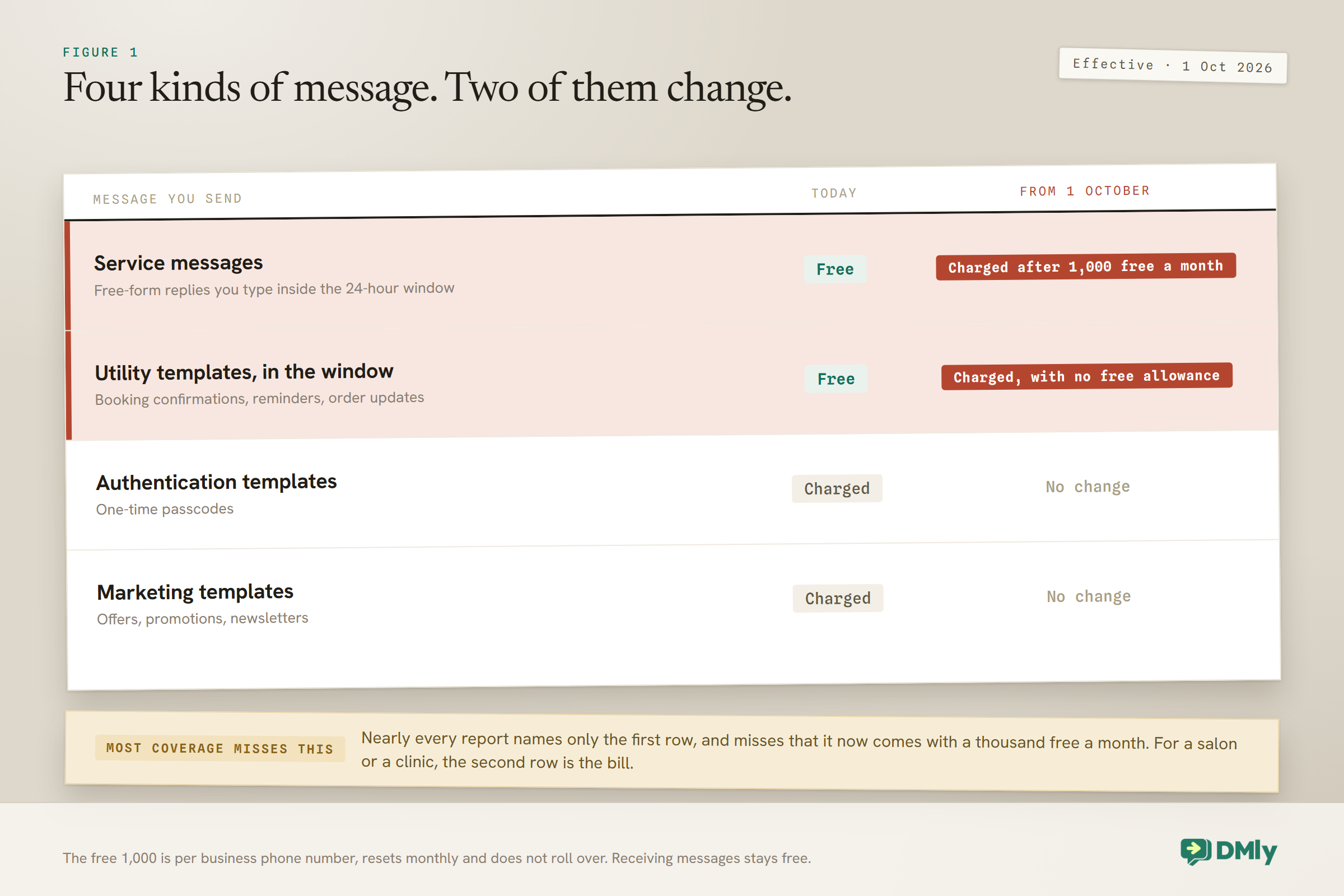
WhatsApp sorts your outgoing messages into a small number of buckets, and after 1 October the bucket decides the price:
- Service messages. Free-form replies inside the 24-hour window. Typed by a person, or sent by an automation as plain text. Free until 1 October. After that, 1,000 free a month per business phone number, then charged.
- Utility templates. Pre-approved messages tied to something that happened: an order, a booking, a payment. Free inside the window until 1 October, charged after, with no free allowance at all. Already charged outside the window.
- Authentication templates. One-time codes. Charged already, no change.
- Marketing templates. Offers, promotions, newsletters. Charged already, no change.
So two of the four buckets change, and they happen to be the two that a customer-facing small business uses most. If the difference between these categories is fuzzy for you, our guide to WhatsApp Business message templates walks through what belongs in each one and why Meta cares.
What Stays Free, and It Is More Than You Think
Meta did not put a price on everything, and the largest exception is also the newest, which is why it is missing from most of what has been written about this WhatsApp pricing change.
Your first 1,000 service messages a month are free, on every business phone number you run. Meta will only charge from the 1,001st service message it delivers for you in a calendar month. The allowance resets on the first of each month and it does not roll over, so 400 unused in September are simply gone on 1 October. Spread across a month, a thousand messages is about 33 replies a day. Count what you actually send for a week and most owners find they are nowhere near it.
Two limits on that, both worth knowing before you relax completely. It counts service messages only, so your confirmations and reminders do not draw on it and are charged from the first one. And it is counted per business phone number, so two shops sharing one number share one allowance, while two numbers get one each.
Receiving is free. Customers messaging you costs nothing, no matter how much they write. You are only ever billed for what you send.
The window still opens for free. When a customer messages you, a 24-hour window opens. Opening it costs nothing. What changes is that your replies inside it have a price once you are past the first 1,000.
The 72-hour free entry point window is untouched. This is the other exception worth designing around, and it is the reason the change has a silver lining. If somebody arrives from a Click-to-WhatsApp ad or a Facebook Page call-to-action button, and you reply within 24 hours, you get a 72-hour window in which you can send any type of message at no charge. Not a discount. Free.
Sit with that for a second, because it inverts something. After 1 October, a conversation that started from an ad is cheaper to run than one that started organically. If you already run Click-to-WhatsApp campaigns, the messaging side of them just got more valuable relative to everything else.
And the free app remains entirely free. Worth repeating, because a lot of people are going to read scary headlines about WhatsApp charging businesses and assume it means them.
What the WhatsApp Pricing Change Will Cost You
For a typical local business the honest headline is that the service side costs nothing and the utility templates are the bill. That is close to the opposite of how most of the coverage reads, and it is worth walking through slowly, because it stops being true the moment you get busy.
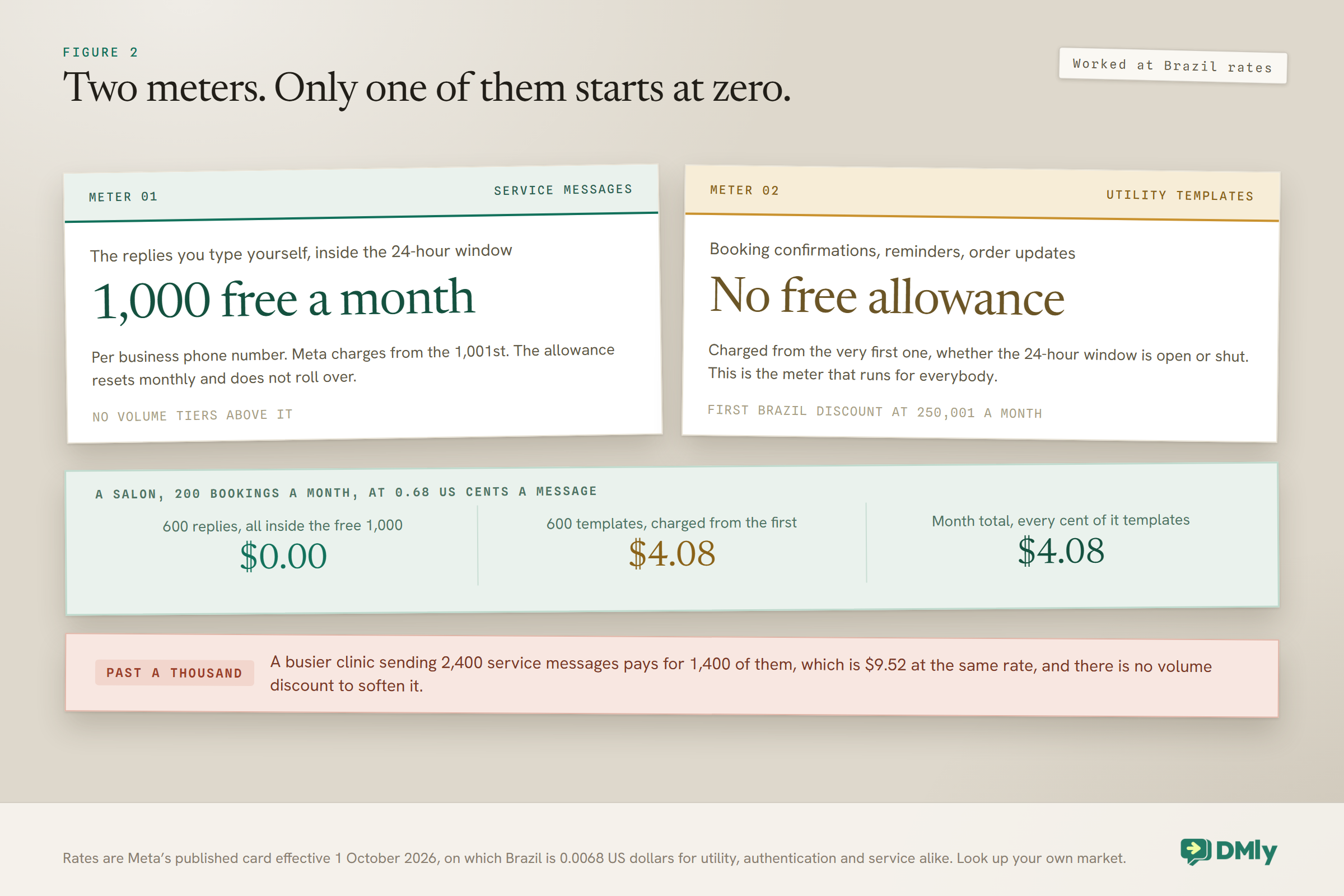
You now have two meters running, not one, and they behave differently. Your typed replies run against the allowance and cost nothing until you pass it. Your utility templates start charging at the first one. So the arithmetic has two lines, and for most small businesses the first line is zero.
The rates are published, which they were not when most of the early coverage was written. Meta put up the rate cards effective 1 October on 1 September, one file per currency, and they now carry a Service column beside marketing, utility and authentication. On the card, service, utility and authentication are the same figure in every market, so if you already know what a utility message costs you, you know what a reply costs you above the allowance.
Here is the arithmetic, worked in Brazil, where the published rate effective 1 October is 0.0068 US dollars, or 0.68 US cents, for utility, authentication and service alike. Take a month with 300 conversations that each take four replies from you:
- Four replies across 300 conversations is 1,200 service messages. The first 1,000 are free, so you pay for 200 of them.
- 200 at 0.68 cents is $1.36 for a whole month of replying.
- Send one utility template per conversation on top and all 300 are charged, because that meter has no free tier. 300 at 0.68 cents is $2.04.
- Monthly total $3.40, and the templates are the larger half of it.
That is the honest headline for most small businesses: this is not going to bankrupt you, and the half you were most worried about is the half you probably will not pay for. The panic in some of the coverage is out of proportion, largely because it was written before the free tier existed.
Where it becomes real money is volume, and it is the second meter that gets you there first. Meta publishes its own Brazil comparison, and it is worth reading for a reason that has nothing to do with this change: for 1,000 AI-powered replies it puts message delivery at 0.68 cents each and the AI behind them at roughly 2 to 9 cents each, depending on how capable a model you point at the problem. Once you are paying for replies at all, in other words, the delivery charge is the small number on the invoice.
Your rate is not Brazil’s. Rates vary a lot by country and the pattern is less tidy than people assume: on the published October card, North America is 0.34 US cents, cheaper than Brazil, while the United Kingdom is 2.2 cents and Germany 5.5 cents. Our WhatsApp Business API pricing by country guide has the rate card, and the number you want is your market’s utility rate, because your service rate is the same figure.
A five minute exercise worth doing this week: Open your inbox, pick ten conversations from last week, and count two things separately: how many messages you typed, and how many templates went out around them. Multiply the typed number by the conversations you have in a month. Under 1,000 and the reply side is free. Whatever is left above it, plus every single template, times your country’s rate, is your new bill. Most owners who do this are relieved. A few are not, and those few learn something important about how many messages their flows are sending.
What This Looks Like for Three Real Businesses
Averages are useless here, because what the WhatsApp pricing change costs you depends almost entirely on how your particular business talks to people. Three sketches, all worked at Brazil’s published 0.68 cent rate so the numbers are comparable, and all assuming one business phone number, because the allowance is counted per number. Substitute your own rate and the shape stays the same.
A salon doing 200 appointments a month. Most bookings arrive as a short conversation: they ask about a time, you confirm, they say thanks. Call it three replies from you, which is 600 service messages a month. All 600 sit inside the free 1,000, so the replying costs nothing at all. Then each booking triggers a confirmation and two reminders. Those are utility templates with no free allowance, so 3 times 200 is 600 templates, and 600 at 0.68 cents is $4.08. That is the entire bill, and every cent of it is templates. Push the schedule to four reminders and it becomes 1,000 templates, or $6.80. Trimming that back is a ten minute job, and it is the only lever that does anything here.
A clinic doing 400 appointments a month with more back-and-forth. Medical bookings involve questions: insurance, what to bring, whether to eat beforehand. Say six replies per conversation, which is 2,400 service messages. The first 1,000 are free, so 1,400 are charged, and 1,400 at 0.68 cents is $9.52. Add four utility messages around each appointment, 1,600 of them at 0.68 cents, and that is $10.88. Total $20.40 a month, split almost evenly between the two meters. This is the size of business where the free allowance runs out partway through the month and the replying starts to matter.
An online shop handling 1,500 order enquiries a month. Where is my order, can I change the size, do you deliver here. Short exchanges, three messages each, so 4,500 service messages: 1,000 free and 3,500 charged, which at 0.68 cents is $23.80. Two order updates per enquiry on top of that is 3,000 utility templates, or $20.40. Total $44.20 a month. Here the honest advice is different again: a good chunk of those 4,500 replies are answering the same five questions, and answering them automatically is now a cost saving as well as a time saving.
What the three have in common is not the size of the number. It is that the salon pays for templates only, the clinic pays for both in roughly equal measure, and the shop pays most for replies. In every case the lever is message count rather than anything to do with the rate. The shop’s $44 is not a pricing problem. It is fifteen hundred people asking where their order is.
Part of those bills is not new, and it is worth separating: Utility templates sent outside an open 24-hour window have always been charged. What changes on 1 October is only the ones sent inside it. A booking confirmation fired off while the customer is still in the chat is newly billable. A reminder that goes out 24 hours before the appointment, long after the window closed, was already being paid for. For the salon above, that means roughly $1.36 of the $4.08 is genuinely new spending and the rest was already on the invoice. Your own split depends on your timings, so the more useful question is not what the total is but which of your templates go out while the chat is still warm.
The Detail That Quietly Punishes Busy Businesses
Meta offers no volume discounts on service messages, while continuing to offer them on utility and authentication. The allowance softens the start of the curve. Nothing softens the rest of it, and almost nobody is reporting that half.
Here is why it matters. On most WhatsApp categories, sending more earns you a lower rate per message. Volume tiers exist, and growing into them takes some of the sting out of getting bigger. Service messages have no such thing, and the free monthly allowance is not one: it is a fixed thousand off the top, not a rate that improves as you send more. The price you pay for your ten-thousandth reply of the month is exactly the price you paid for your one-thousand-and-first.
So above the allowance, your cost of answering customers rises in a perfectly straight line with how much you talk to them. Nothing about scale helps you. For a business that grew comfortable with conversational support because it was free, that is a genuine change in the shape of the economics, even though the opening thousand stay free.
The two new charges therefore behave differently at both ends. Service starts at zero and then climbs flat. Utility charges immediately and does keep its volume tiers, though it is worth knowing how far away they are: on Brazil’s published October card the first discounted utility tier does not begin until 250,001 messages in a month. Below that, everybody pays the list rate. For a local business, in practice, neither category gets a discount and the free 1,000 is the only relief on offer.
Meta’s Own AI Is Now Metered Too
Separately from the WhatsApp pricing change, and two months earlier, Meta put its own AI assistant on a meter. From 1 August 2026, Meta Business Agent messages are billed per token rather than per message.
The rate is $2.00 per million tokens. Meta says one message typically uses 20,000 to 25,000 tokens, which works out at roughly four to five US cents per message.
Compare that to the numbers above and something jumps out: at four to five cents a message, a Meta Business Agent reply costs several times what the same message costs to deliver. In Meta’s own Brazil comparison, delivery is 0.68 cents and the intelligence behind the message is all the rest, with Meta placing its own agent between a cheap third-party model at 2 to 3 cents a message and an expensive one at 9 to 10.
One thing the allowance does not cover: Meta Business Agent messages are their own category with their own per-token charge, so they do not draw on your free service messages, and they are the single message type Meta lists as not free inside the 72-hour entry point window either. If you are choosing between Meta’s agent and a third-party one, that is two exceptions pointing the same way.
This is worth understanding rather than fearing. Automation still pays for itself when it saves you a job, and it stops paying when it is generating conversation for its own sake. Our guide to what a WhatsApp chatbot actually costs goes into the full picture, including that DMly’s own AI is billed by DMly on your plan rather than by Meta per token, so the two are alternatives rather than something you stack.
Nine Countries Are Also Getting Their Own Rate Card
On the same date as the WhatsApp pricing change, nine markets move off shared regional pricing and onto standalone rate cards. This is buried in the same documentation and has almost no coverage at all, which is unfortunate if you happen to sell into one of them.
Rates go down for utility and authentication in Bangladesh, Iraq, Nepal and Sri Lanka, though each also gains a new higher rate for international authentication messages.
Rates go up in Kazakhstan, Kuwait, Morocco, Oman and Ukraine, which also gain the international authentication rate.
If your customers are in any of those nine, your October bill changes for two independent reasons at once, and it is worth separating them so you know which is which. Everybody else can ignore this section entirely.
What to Do Before the WhatsApp Pricing Change Lands
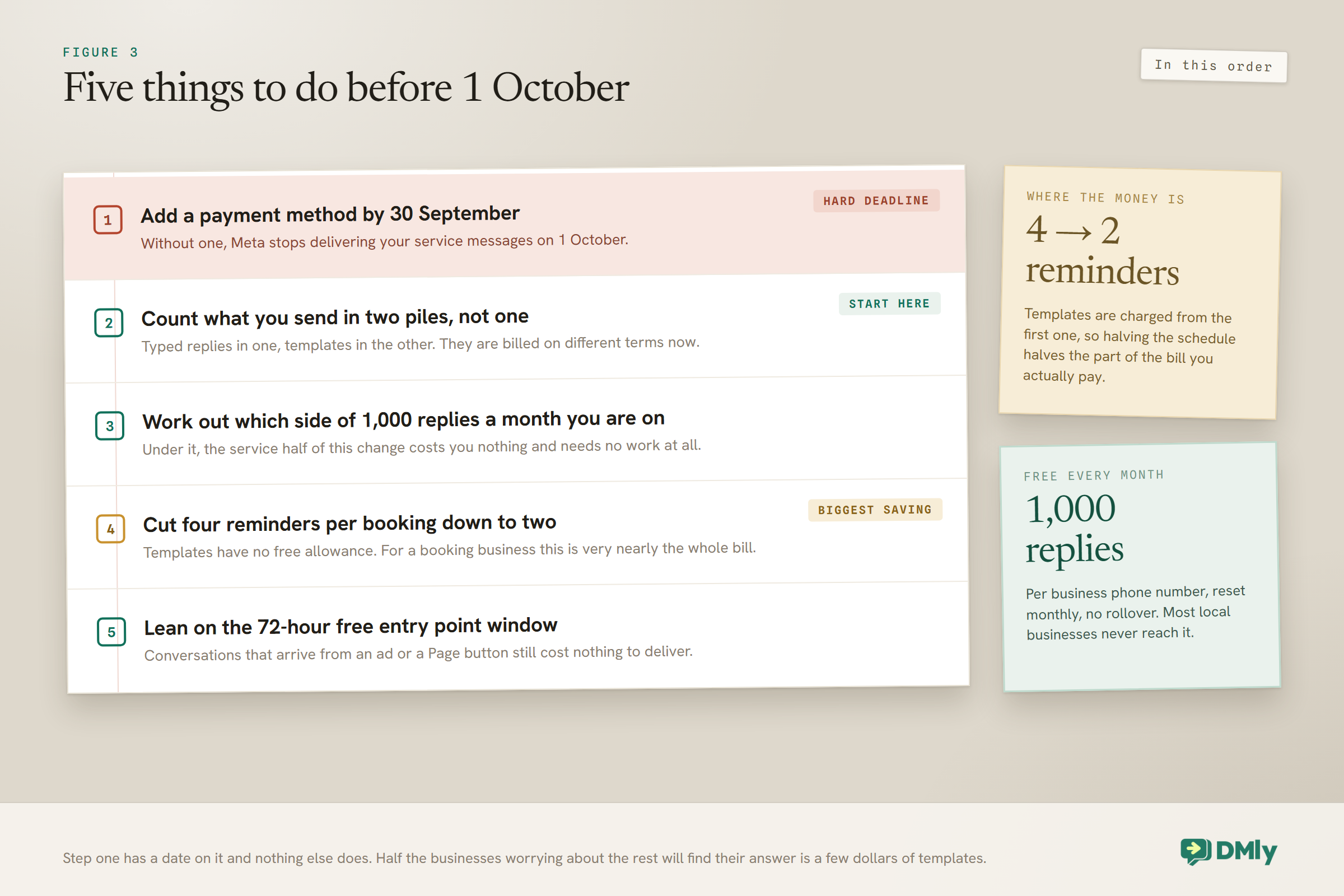
Before the five below, one job has a hard deadline of 30 September. Meta has said that any account on the WhatsApp Business Platform without a payment method on file by then will stop having its service messages delivered from 1 October, the day they start being chargeable. That applies whether or not you ever go over the allowance, because it is about having a valid account on file rather than about the size of the bill. If your replies have always been free you may never have had a reason to add billing details, which is exactly why this is worth doing today rather than in the last week of the month. You set it in WhatsApp Manager, under your business portfolio’s billing settings.
Then five things, in the order that gets you the most benefit for the least disruption. None of them takes a full day.
One: count your messages in two piles, not one. Typed replies in one pile, templates in the other, because they are now billed on completely different terms. The exercise in the box above takes five minutes, and it is the only way to know whether your answer is nothing at all or thirty dollars a month.
Two: find out which side of the allowance you are on. If the replies you type come to fewer than 1,000 a month on that phone number, the service half of this change costs you nothing and you can stop optimising it. If you are over, everything past that point is charged at your market’s rate, and the tidying below is worth an afternoon.
Three: check your reminder schedule. This is now the clearest saving on the page, because utility templates have no free allowance at all. If you send a booking confirmation, a 48-hour reminder, a 24-hour reminder and a two-hour reminder, that is four templates per booking and every one of them is charged. Two well-timed reminders usually perform as well as four, and for a booking business this is almost certainly your single biggest line.
Four: look for flows that send several messages where one would do. A greeting, then a menu, then a confirmation, then a follow-up is four sends doing the work of one well-written message with clear options, and the same goes for the standalone “Thanks!” and the emoji on its own line. Be honest about this one, though. If those are typed replies and you are under the allowance, tidying them saves you nothing in money, and it is only worth doing because it makes the conversation better. Open your automations in the flow builder and count the sends.
Five: lean into the free entry point. Ad-sourced and Page-button conversations carry that 72-hour free window, in which every message type is free to deliver. If you were already thinking about Click-to-WhatsApp ads, the maths just improved.
What Not to Do About It
Some of the obvious reactions to the WhatsApp pricing change are worse than the cost they avoid. Three in particular.
Do not reply less. This was always poor advice and the allowance makes it worse. Under 1,000 replies a month, being sparing with them saves you precisely nothing. Over it, you are weighing about two thirds of a cent per unsent message against the value of a booking. A booking is worth thousands of replies.
Do not batch your answers to save money. Waiting to send one long message instead of three quick ones sounds efficient and reads as slow. The customer does not know you are economising. Speed is what they are judging you on, and under the allowance you are not saving anything either.
Do not panic-migrate to SMS. SMS is often more expensive per message in the markets where WhatsApp is popular, and it has a fraction of the reply rate. Run the numbers for your own country before moving anything, and remember that a channel people ignore is not cheap at any price.
The right frame is that your outgoing messages now carry a small unit cost, the way a phone call always did. Nobody ever refused to pick up the phone because minutes were billable. What changed is that your templates have a price from the very first one, and your replies have one past the allowance, and tidying both up is a reasonable thing to spend an afternoon on.
What This Says About Where WhatsApp Is Going
The WhatsApp pricing change is less a new policy than the end of a promotional period, and Meta has left a floor under it. Meta charged for service conversations before November 2024, stopped for just under two years, and is now starting again above the monthly allowance. That is a cycle with a soft landing, not a betrayal.
What it signals is that Meta now considers business messaging established enough to price properly, which is also a sign that the channel is working. The businesses that will feel it least are the ones whose messages do a job: confirmations people need, answers people asked for, reminders that prevent no-shows.
The businesses that will feel it most are the ones sending a lot of messages that nobody would miss. That is not a bad thing for the platform to charge for. It is a slightly uncomfortable thing to be audited on, which is why the message-counting exercise is the most useful five minutes you will spend this month.
One last thing worth keeping an eye on. Sending more is now more expensive once you are past the allowance, and sending badly has always been expensive in a different currency: blocks, reports and a falling quality rating that eventually caps how many people you can reach at all. Our guide to quality rating and messaging limits covers that side, and after 1 October the two pressures point in the same direction. Send fewer, better messages. That was always the advice. Now it has a number attached.
Frequently Asked Questions
Do I need to add a payment method before 1 October?
If you are on the WhatsApp Business Platform, yes, and the date to work to is 30 September. Meta has said it will stop delivering service messages for accounts with no payment method on file once those messages become chargeable on 1 October. That holds even if you never expect to go over the allowance, because it is about having a valid account on file rather than about the size of your bill. It does not apply to the free WhatsApp Business app, which has no messaging charges at all. Check it in WhatsApp Manager under your business portfolio’s billing settings, and do it now rather than in the last week of September.
Is there a free allowance for WhatsApp service messages?
Yes, and it is the newest part of the WhatsApp pricing change. From 1 October 2026 every business phone number receives 1,000 free service messages a month, and Meta only charges from the 1,001st service message it delivers. The allowance resets at the start of every month and unused messages do not roll over. It covers service messages only, so utility templates such as booking confirmations and reminders are charged from the first one. It also does not change when a service message may be sent: that is still only inside an open 24-hour customer service window.
What is the WhatsApp pricing change, and is WhatsApp charging businesses for messages now?
From 1 October 2026, yes, but only on the WhatsApp Business Platform, the API version that businesses connect through a provider, and rather less than the headlines suggest. Two things start being charged: free-form service replies sent inside the 24-hour customer service window, and utility templates sent inside that same window. The service replies come with 1,000 free a month per business phone number, so a great many small businesses will pay nothing for them. The utility templates have no such allowance. The free WhatsApp Business app is completely unaffected, and receiving messages is free either way.
Does this affect the free WhatsApp Business app?
No, not at all. The app you download to your phone has no messaging charges and none are being introduced. This change applies only to businesses on the WhatsApp Business Platform, which involves a payment method registered with Meta and usually a provider. If you have never set up billing with Meta, you are not affected.
How much does a WhatsApp service message cost?
Nothing at all for the first 1,000 you send in a month on each business phone number. Above that it costs the same as a utility or authentication message to that customer’s country, so the rate depends entirely on where your customers are. On Meta’s published rate card effective 1 October, Brazil is 0.68 US cents and North America is 0.34 US cents, while the United Kingdom is 2.2 cents and Germany 5.5. Look up your own market rather than using an example, and take the allowance off the top before you multiply anything.
Are there volume discounts if I send a lot of service messages?
No. Meta states that it does not offer volume tiers for service messages, though it does continue to offer them for utility and authentication messages. The free monthly 1,000 is not a volume tier either: it is a fixed allowance off the top, not a rate that improves as you send more. So past that point the cost of answering customers scales in a straight line with how much you reply, with no discount for growing.
What messages are still free after 1 October?
Four things. Receiving messages is always free. Opening the 24-hour window costs nothing. Every business phone number gets 1,000 free service messages a month before any charge starts. And the 72-hour free entry point window is unchanged: if someone reaches you from a Click-to-WhatsApp ad or a Facebook Page call-to-action button and you reply within 24 hours, you can send any type of message to them free for 72 hours. What is not free is a utility template, which is charged from the first one whether the window is open or shut.
Why did Meta start charging for this again?
Service conversations were charged until November 2024, when Meta made them free, and that free period is now ending. It is a return to a previous model rather than a brand new fee, and Meta has kept a 1,000-message monthly allowance in place, which leaves the smallest senders out of it entirely. Meta has not published a detailed rationale, but the practical reading is that business messaging is now mature enough to price, which is also a sign the channel works.
Should I move to SMS or another channel to avoid the cost?
Almost certainly not on cost grounds alone. In most markets where WhatsApp is widely used, SMS costs more per message and gets a small fraction of the replies, so you would be paying more for less. Work out your actual monthly figure first. Now that the first 1,000 replies are free, most small businesses land in low single digit dollars a month and are paying only for templates, which is rarely worth restructuring a working channel over.
Will my booking confirmations and reminders cost money now?
Yes, and these are the ones to look at, because they are the half of this change with no free allowance. Confirmations and reminders are utility templates. Sent outside an open window they were already being charged; sent inside one they have been free since July 2025, and from 1 October they are charged too. There is no equivalent of the 1,000 free service messages here, so every template counts from the first. For a booking business this is now clearly the larger of the two changes, so if you are only going to look at one thing, look at how many confirmations and reminders you send per appointment.
Does a longer message cost more than a short one?
No. Service messages are charged per message, not by length or by character count, so one considered paragraph costs exactly the same as a two-word reply. That is the whole reason consolidating works: folding four short messages into one properly written message cuts that cost to a quarter without shortening what you actually say. It only saves you money above the allowance, though, so below that, consolidate because it reads better rather than because it is cheaper. The exception is Meta Business Agent, which is billed per token and therefore does scale with how much text is involved.
Writing about WhatsApp automation, bookings and growth for local business.
Turn WhatsApp into your busiest channel.
Start free and run message, bookings, payments and reviews in one place.
