
No Volume Discounts on Service Messages: What High-Volume Senders Should Do
Here are two prices, both correct, both taken from Meta’s published rate card for October 2026. The cost of your one thousand and first reply to a customer in the United States is 0.34 US cents. The cost of your five millionth reply to a customer in the United States is 0.34 US cents. Nothing you do between those two messages changes the price of the second one, because Meta has decided that service messages will not have volume tiers.
Two other charged categories do. Utility templates get cheaper as you send more of them. So do authentication codes. Marketing does not. Service is the new arrival, and it arrives on a flat line.
That sounds like bad news, and above a certain volume it genuinely is. Below that volume the free 1,000 a month outweighs it, and working out which side you are on takes one number and about two minutes. This guide is about that number.
The free WhatsApp Business app has no rates and no tiers: None of this touches the green app you install on a phone. There is no per-message pricing there, so there is nothing to discount. Everything below describes the WhatsApp Business Platform, the API version you reach through a provider such as DMly, and the full picture of what changes on 1 October is in our guide to the WhatsApp pricing change.
What Volume Tiers Are, and What Meta Just Declined to Extend
A volume tier is a bulk discount that applies automatically once your monthly count passes a threshold, and it works like an income tax band rather than a coupon. That second half is the part people get wrong, so it is worth being precise.
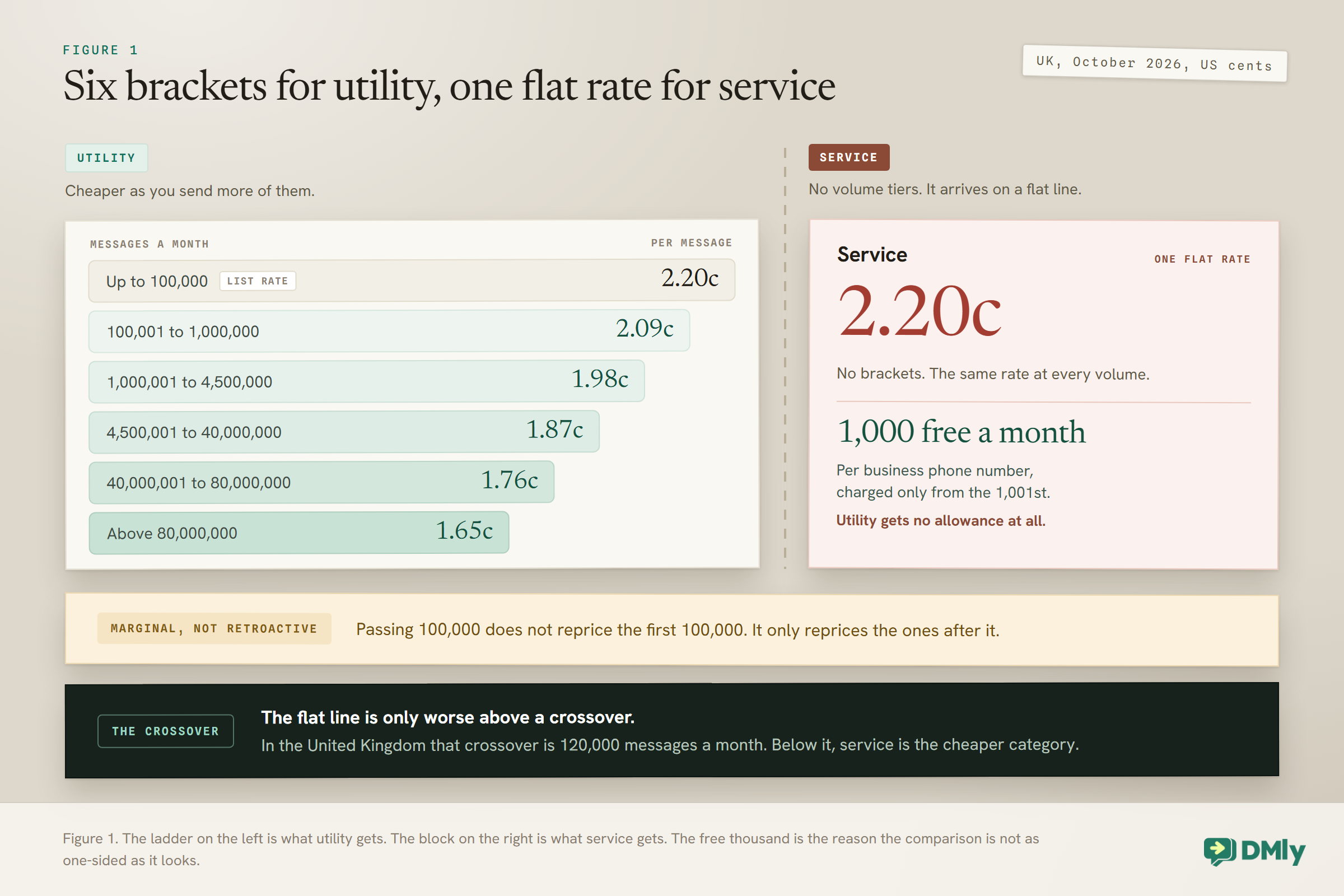
Meta sets a list rate for utility and authentication messages in each market. Send more than a set number of them in a calendar month and the messages above that number are charged at a lower rate. Send more still and the next slice gets cheaper again. There are six brackets, and the deepest one is 25 per cent below the list rate in most markets.
Meta’s own worked example makes the mechanics explicit: a business that sends a total of B messages in a month pays the list rate for the first A, then the tier rate for messages A plus one through to B. Crossing a threshold does not reprice the messages you already sent. It only reprices the ones after it.
On the upcoming-pricing page, in a section listing exactly how service messages will be charged from 1 October, Meta puts it in three words: volume tiers, none. It goes on to say that it will not offer volume tiers for service messages and that it continues to offer them for utility and authentication messages. The October rate card agrees: it has a Service column, and the matching volume-tier card, published alongside it, has columns for utility, authentication and authentication-international and no service column at all.
What counts as a service message, in one line: Any message you send that was not pre-approved as a template and was not produced by Meta’s own Business Agent product. Your typed replies, your automation’s plain text, your AI assistant’s answers, photos, voice notes, and interactive button messages sent while the customer’s window is open. If Meta approved the wording before you sent it, it is a template and the tiers can apply. If not, it is service and they do not. Our guide to WhatsApp message templates covers what a template actually is and what the three categories mean.
Where the Volume Tiers Actually Start, and Why That Matters More Than the Discount
It is easy to assume you were getting a discount and have now lost it. Read the thresholds and that assumption falls apart, because the first tier is a very long way up.
These are the first utility thresholds from Meta’s October volume-tier card. Below each threshold, you were paying list rate anyway:
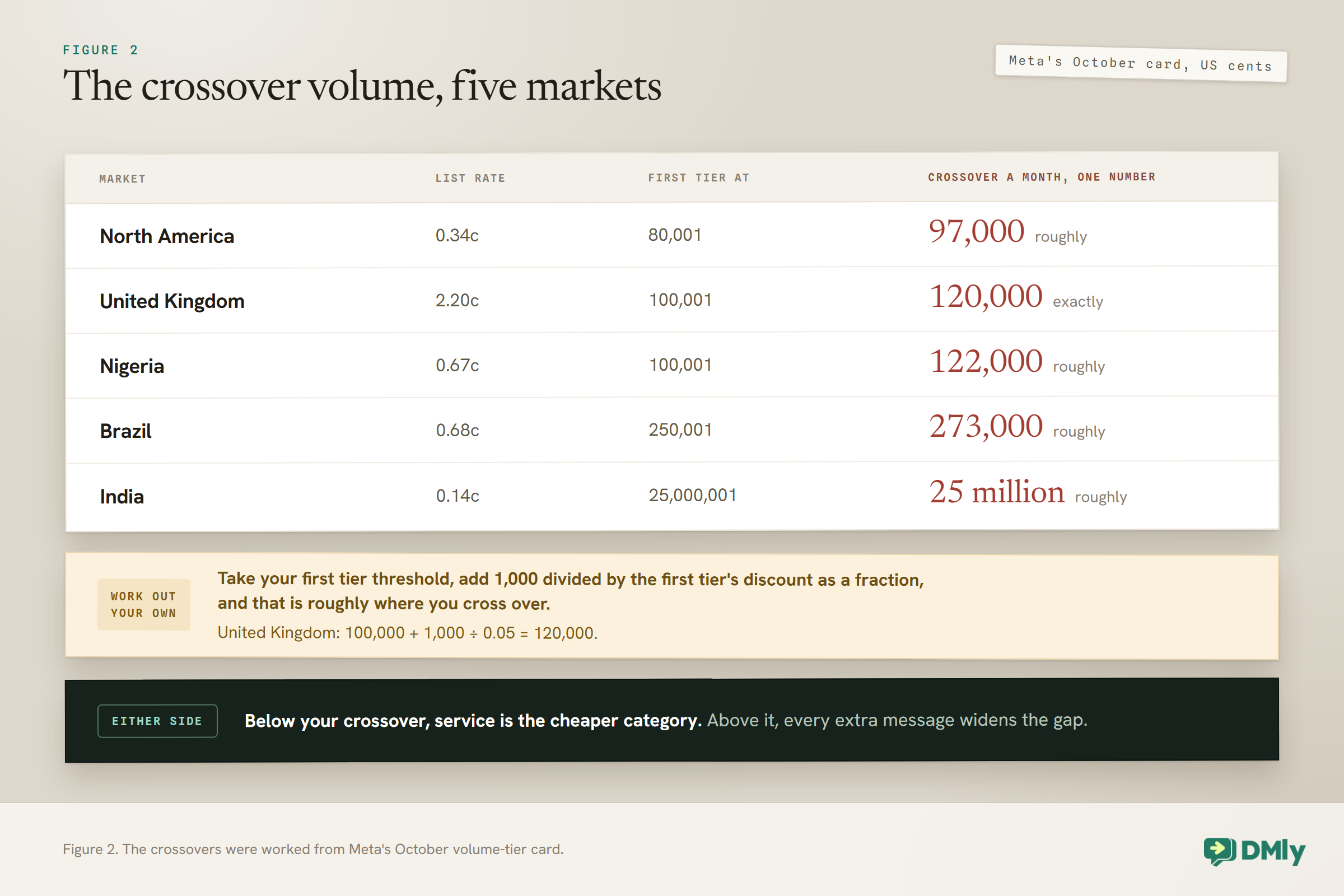
- North America. List rate 0.34 US cents. First discount begins at message 80,001 in a month.
- United Kingdom. List rate 2.20 cents. First discount at 100,001.
- Nigeria. List rate 0.67 cents. First discount at 100,001.
- Brazil. List rate 0.68 cents. First discount at 250,001.
- India. List rate 0.14 cents. First discount at 25,000,001.
A dental group with four practices sending 12,000 messages a month is well short of every one of those. If you are below your market’s first threshold, the volume tiers were never yours to lose.
And there is a second fact sitting next to the first one. Service messages come with a free monthly allowance and utility templates do not. Every business phone number gets 1,000 free service messages a month, charged only from the 1,001st, resetting monthly with no rollover. Utility templates are charged from the first one.
So below the tier thresholds, the category with no volume discount is the cheaper category. That is not a rhetorical flourish. In North America, 12,000 service messages from one number cost $37.40 and the same 12,000 as utility templates cost $40.80.
The Crossover: The Volume Where a Missing Discount Starts to Cost You
There is a precise number in every market where the missing volume tiers stop being free money and start being a real cost, and you can work yours out with a calculator in a minute.
The logic is simple. The free thousand saves you 1,000 times your market’s list rate every month, and it is worth the same amount whether you send 2,000 messages or two million. The missing tier costs you the discount you would have had on everything above the first threshold, and that grows with every message. Somewhere the second overtakes the first.
Computed from Meta’s October card, market by market:
- North America. Crossover at roughly 97,000 messages a month, on one business phone number.
- United Kingdom. Crossover at 120,000 a month, exactly.
- Nigeria. Crossover at roughly 122,000 a month.
- Brazil. Crossover at roughly 273,000 a month.
- India. Crossover at roughly 25 million a month, because the first Indian utility tier does not begin until 25,000,001.
Below your market’s crossover, the free allowance saves you more than the missing volume tiers cost. Above it, the gap opens and keeps opening. For messages to customers in India the crossover is so high that the answer, for practical purposes, is that service is simply the cheaper category and the tier question does not arise.
If your market is not on that list, our country rate card guide has the list rates, Meta’s volume-tier card has the thresholds and tier rates, and the arithmetic is the same everywhere: take your first tier threshold, add 1,000 divided by the first tier’s discount as a fraction (0.05 for 5 per cent), and that is roughly where you cross over.
Two Bills, Worked Out in Full
Numbers on a rate card are abstract until you put a business behind them, so here are two, both sending to customers in North America.
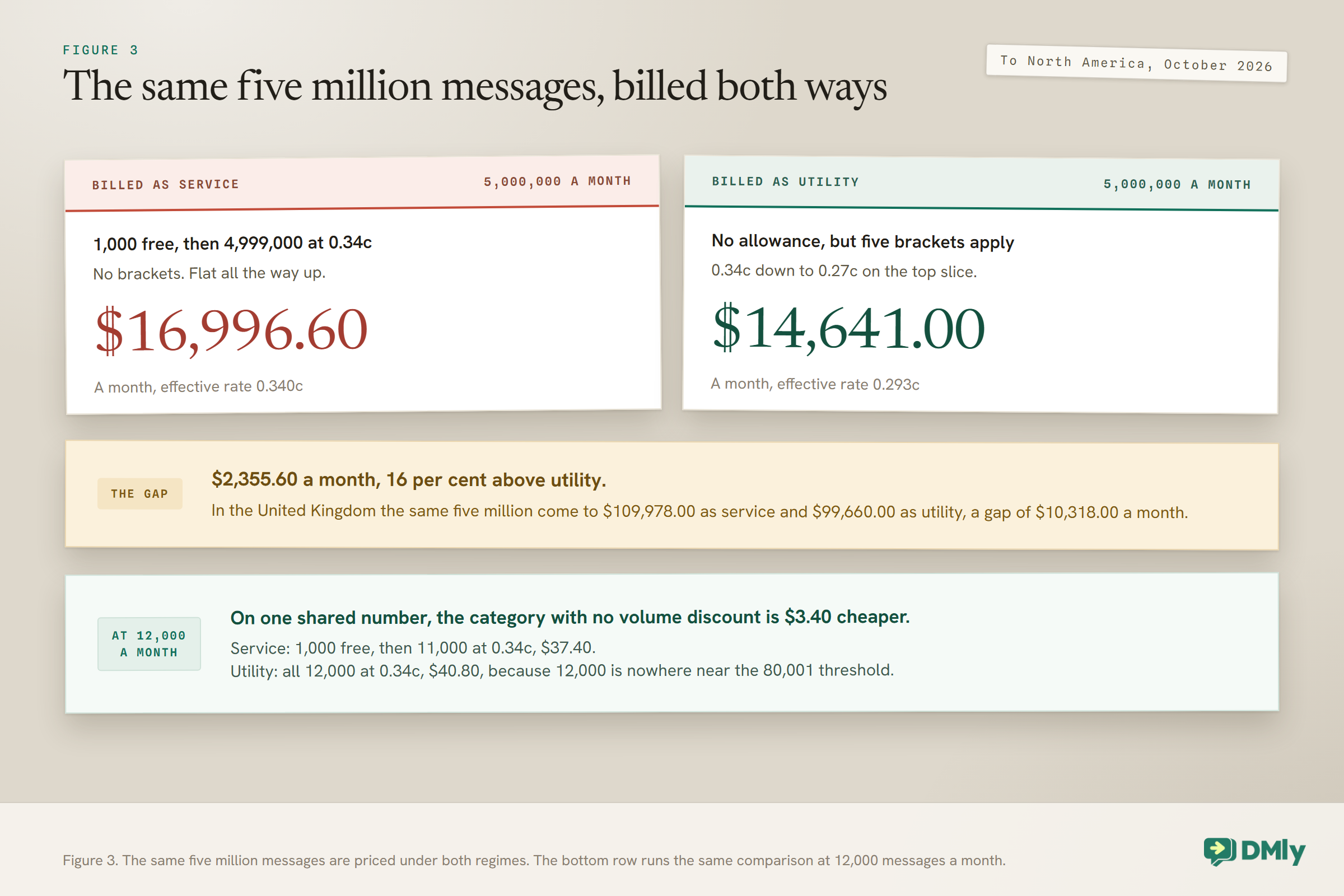
The first is a dental group with four practices. Twelve thousand messages a month on one shared number: a busy inbox and a lot of confirmations. Sent as service messages, the first 1,000 are free and the remaining 11,000 cost 0.34 cents each: $37.40 a month. Sent as utility templates instead, all 12,000 are charged at 0.34 cents, because 12,000 is nowhere near the 80,001 threshold: $40.80 a month. The category with no volume discount is $3.40 cheaper, and the practice manager will never think about tiers again.
The second is a national retailer running conversational support. Five million outbound messages a month. Sent as service messages, that is 4,999,000 charged at 0.34 cents flat: $16,996.60 a month. Sent as utility templates, the tier ladder does its work, and the bill comes to $14,641.00, an effective rate of 0.293 cents rather than 0.34.
The gap is $2,355.60 a month, 16 per cent above utility, and it is the entire practical content of the “no volume discounts” headline. In the United Kingdom the same five million messages come to $109,978.00 as service and $99,660.00 as utility, a gap of $10,318.00 a month.
Two things about that gap are worth saying plainly. It is real money for the businesses in the second group. And it is 16 per cent more on one line of a bill, not double.
Three Things About Volume Tiers That Are Easy to Get Wrong
If you are above your crossover, these three details decide how much the flat rate actually costs you.
1. Accrual is per business portfolio, not per phone number. Meta aggregates messages across every WhatsApp Business Account owned by a portfolio, for each market and category pair, and it says so explicitly. A group running six numbers under one portfolio reaches a utility tier six times faster than a group that has split them across six portfolios. If your business has grown by acquisition and your accounts are scattered, that is worth a conversation with your provider.
2. Only charged messages accrue, and service messages never do. Because service messages have no tiers of their own, they also contribute nothing toward your utility or authentication tiers. A conversational business that generates enormous message volume gets no tier progress out of any of it. Every message that counts toward a discount has to be a template.
3. There is one open question, and it is worth real money. Meta’s accrual rule says only charged messages count, and its published list of what does not count still names utility templates delivered inside an open 24-hour window. Those become charged on 1 October, and the list has not been updated either way. If they start counting, senders near a tier boundary will cross it sooner than they expect. We are not going to guess. If you are within sight of a threshold, ask your provider to confirm it in writing before you build a forecast on it.
A detail that catches multi-country groups: Tiers reset monthly at midnight in each WhatsApp Business Account’s own timezone, which means a portfolio with accounts in different timezones spends a few hours accruing toward two different months at once. Meta documents this and gives a worked example. It is a rounding artefact for most people and a reconciliation headache for anyone doing month-end finance across regions.
Measure Your Own Two Piles Before the Month Turns
Everything above turns on one number you probably do not have yet: how many of your outbound messages are templates and how many are free-form replies. Total message volume is now useless on its own, because the two halves are priced on completely different logic.
There are three places to get it.
Meta’s own analytics. The Pricing Analytics endpoint takes a pricing category and returns a volume and a cost for a date range and a business phone number. Query it for SERVICE and you have the count you need for the crossover arithmetic. Query it for UTILITY and you have your utility volume. If your provider surfaces this in their interface, use theirs; if not, this is a request worth making of them.
Your delivery webhooks, if you or your provider store them. Each message’s status webhooks include a pricing object with its category and pricing type, which gives you a per-message record rather than a monthly aggregate. That is the version you want if you need to know which flows are generating the volume, rather than just how much of it there is.
Your automation builder, which tells you how much each flow sends. In DMly, every step on a published flow carries a badge showing how many times it ran and how many messages it sent, counted from real runs rather than estimated. Walk your busiest flow and read the badges in order, and the sequence of numbers usually makes the answer obvious: four message steps in a row with near-identical counts is four messages where the flow could be sending one or two.
Do that once and you will know three things you cannot currently know: whether you are above or below your market’s crossover, which flows are generating the service volume, and whether any of your in-window templates are duplicating something a plain reply already said.
How Deep the Discount Goes, and Who Ever Reaches It
The other half of the “we have lost our discount” complaint is how big the discount was in the first place, and the honest answer is that the deepest brackets start a very long way up.
There are six brackets in every market on the card, and in most of them the deepest one is 25 per cent below the list rate. India is the exception at 30 per cent. In most markets that runs from list price down to three quarters of it, in five steps.
What differs enormously between markets is how far up the ladder those steps are placed, and this is the part worth reading twice, because it means “high volume” is not one thing.
- North America. The deepest utility bracket begins at 6,000,001 messages a month. A large retailer genuinely can reach it.
- United Kingdom. The deepest bracket begins at 80,000,001 a month. Thirteen times higher than North America.
- Nigeria. Also 80,000,001.
- Brazil. 70,000,001.
- India. 300,000,001 a month for the 30 per cent bracket.
Put that next to the crossover numbers from earlier. In North America the tier ladder is real and reachable and a serious conversational business will feel its absence on the service line.
Two smaller details that matter if you are near the top of that ladder. The brackets are set per market and per category, so your utility messages to India and to the United Kingdom climb two separate ladders and neither helps the other. And there is a third tiered column: authentication-international, which has its own rate and its own brackets in the markets that have one, and which from 1 October covers nine more markets than it did. If you send one-time passcodes across borders, that is a third ladder again.
What a High-Volume Sender Should Actually Do
If you are above your crossover, there are three levers with real money behind them, and none of them is a discount negotiation. Meta’s volume tiers are set by Meta, so the question is only ever which category your messages land in and how many of them there are.
Lever one: send fewer messages for the same outcome. This is the largest lever by a distance, and it is unglamorous. A flow that greets, then offers a menu, then acknowledges the choice, then confirms, sends four charged messages where a well-built one sends two. At five million messages a month, halving your message count saves more than any tier ever would. It is a whole subject of its own, and it is the natural next step for anyone running WhatsApp automation at volume.
Lever two: use the free entry point window properly. The change on 1 October does not touch it. When someone messages you from a click-to-WhatsApp ad or a Facebook page button using WhatsApp on Android or iOS, and you reply within 24 hours, messages in that conversation are free for 72 hours: marketing, utility, authentication and service alike. It scales with your ad spend rather than your message count, which makes it structurally different from a tier. Our guide to click-to-WhatsApp marketing covers what opens it.
Lever three: put messages in the category that fits, and audit that the category is right. This is not about relabelling things to save money, which Meta will recategorise anyway. It is about the messages that genuinely could be either. A confirmation sent while the window is open can be a template or plain text, and which one costs less depends on your volume.
There is a fourth thing, and it is administrative rather than clever: make sure a payment method is on file before 30 September. Meta has said that any provider or directly-integrated business without one will have service messages stopped once the month’s free 1,000 are used. For a high-volume sender that is not a billing inconvenience, it is an outage.
The One Structural Asymmetry, and Why It Usually Does Not Pay
There is a genuine quirk in how the two sides aggregate, and it is worth stating precisely so you can decide it is not worth acting on.
The free service allowance is granted per business phone number. Volume tiers accrue per business portfolio, across every account in it. Those two facts point in opposite directions. Adding a phone number gives you another 1,000 free service messages a month and costs you nothing in tier progress, because your utility volume keeps pooling at portfolio level regardless of how many numbers it is spread across.
Now price it. An extra allowance is worth exactly 1,000 times your market’s list rate, every month. That is $3.40 in North America, $22.00 in the United Kingdom, $6.70 in Nigeria, $1.40 in India and $55.00 in Germany. Against that you are running a second WhatsApp identity: a second display name to get approved, a second set of open windows to keep track of, a second quality rating that can be damaged independently, and customers who now have two numbers for you and may use the wrong one.
For almost everyone that is a bad trade, and we are not recommending it. It is in this article because somebody will notice the asymmetry and wonder, and the honest answer is that the arithmetic is small enough to close the question.
What Not to Do About It
Three reactions to this change that will cost you more than the change does.
Do not move your support off WhatsApp on price alone. A cheaper channel that gets a 20 per cent response rate may not be cheaper per resolved conversation. Cost per delivered message is the wrong denominator. If you are genuinely comparing, compare cost per issue closed.
Do not start refusing to answer people. It sounds absurd written down and it is a real reaction to a per-message price. A customer conversation that ends in a booking is worth many hundreds of times 0.34 cents. The only messages worth cutting are the ones that carry no information.
Do not build a forecast on a tier you have not reached. Because the brackets are marginal, hitting a threshold on the last day of the month reprices only the handful of messages after it. Modelling your whole volume at the tier rate overstates the saving substantially, and the mistake compounds across a year of budgeting. If you want a sanity check on what conversational messaging really costs to run, our breakdown of what a WhatsApp chatbot costs works it from the bottom up.
Frequently Asked Questions
Are there volume discounts for WhatsApp service messages?
No. Meta’s documentation states that it will not offer volume tiers for service messages and that it continues to offer them for utility and authentication messages. The October volume-tier card confirms it: there are columns for utility, authentication and authentication-international, and no service column at all.
Do volume tiers apply to marketing messages?
No. Volume tiers cover utility and authentication only. Marketing gets no volume discount either, so service now joins it rather than being singled out.
At what volume does this actually start costing me money?
At your market’s crossover, where the missing discount outweighs the free 1,000 a month. Roughly 97,000 messages a month in North America, 120,000 in the United Kingdom, 122,000 in Nigeria, 273,000 in Brazil and about 25 million in India. Below that number, the free 1,000 saves you more than the missing tiers cost.
Do tier discounts apply to my whole month once I cross a threshold?
No. They are marginal, like tax bands. Meta’s own example spells it out: you pay the list rate for the messages up to the threshold and the tier rate only for the ones above it. Crossing a threshold on the 30th of the month is worth very little.
Do my messages from different phone numbers count together for tiers?
Yes. Meta aggregates at the business portfolio level, across every WhatsApp Business Account the portfolio owns, per market and category pair. Splitting numbers does not fragment your tier progress. The free service allowance works the other way and is granted per phone number.
Do service messages count toward my utility volume tiers?
No. Only charged messages accrue, and they accrue within their own category. Service messages have no tiers of their own and contribute nothing toward utility or authentication tiers, so a high-volume conversational business earns no tier progress from any of that traffic.
Will in-window utility templates start counting toward tiers now that they are charged?
Unresolved as of 9 September 2026. Meta’s accrual rule says only charged messages count, and its published exclusion list still names utility templates delivered inside an open customer service window. Those become charged on 1 October and the list has not been amended. If you are near a threshold, get it confirmed rather than assuming either way.
Can I negotiate a better rate if I send millions of messages?
Meta sets the volume tiers itself and publishes them alongside its rate cards, and its pricing pages describe no way to negotiate the per-message rate. Where providers differ is in their own platform fees on top, which is a separate line from Meta’s.
How do I find out which tier I am currently in?
Meta fires an account update webhook with the event VOLUME_BASED_PRICING_TIER_UPDATE when an account reaches a new tier in a given market and month, and its pricing analytics endpoint reports intra-month progress. Note that the webhook’s category field only ever carries UTILITY or AUTHENTICATION, which is another way of seeing that service has no tiers.
Is a cheaper channel the answer if I am above the crossover?
Only if it resolves the same conversations. The honest comparison is cost per resolved conversation rather than cost per delivered message. Work out your own number before you move anything.
How often can these rates and thresholds change?
Meta publishes a pricing calendar that limits rate updates to the first day of each quarter, so 1 January, 1 April, 1 July and 1 October, with a minimum of one month’s notice for a rate card or volume tier change and longer notice for a change to the pricing model itself. Thresholds move as well as rates, so re-check your crossover each quarter.
Writing about WhatsApp automation, bookings and growth for local business.
Turn WhatsApp into your busiest channel.
Start free and run message, bookings, payments and reviews in one place.
