
How a WhatsApp Loyalty Program Actually Works: The Rules That Decide What You Can Send
It has no app to download, no card to lose and no password to reset. It has no portal a customer logs into to check their balance, because there is nothing to log into. It lives inside a thread that already sits between somebody’s sister and a message from their bank, and the business at the other end of it cannot start talking whenever it feels like it, cannot say whatever it likes, and can be switched off by the customer with two taps and no warning.
That is a WhatsApp loyalty program, described honestly. Everything appealing about it and everything difficult about it comes from the same fact: it is not a system your customer visits, it is a conversation you are a guest in.
The design half of this is well covered. If you have not decided what earns a reward, what the reward is worth, or whether you want points at all, start with our guide to building a loyalty program for a small business from scratch, which handles all of that properly and across six industries.
This page is the other half, and it is the half nobody writes: what WhatsApp actually permits. Which of your loyalty messages needs approval, which category it lands in, what that category costs, how many of your customers will never see it, and the two or three things you have probably been told to build that cannot be built. Every rule below is from Meta’s own documentation or DMly’s, checked in September 2026.
The three rules behind every WhatsApp loyalty program
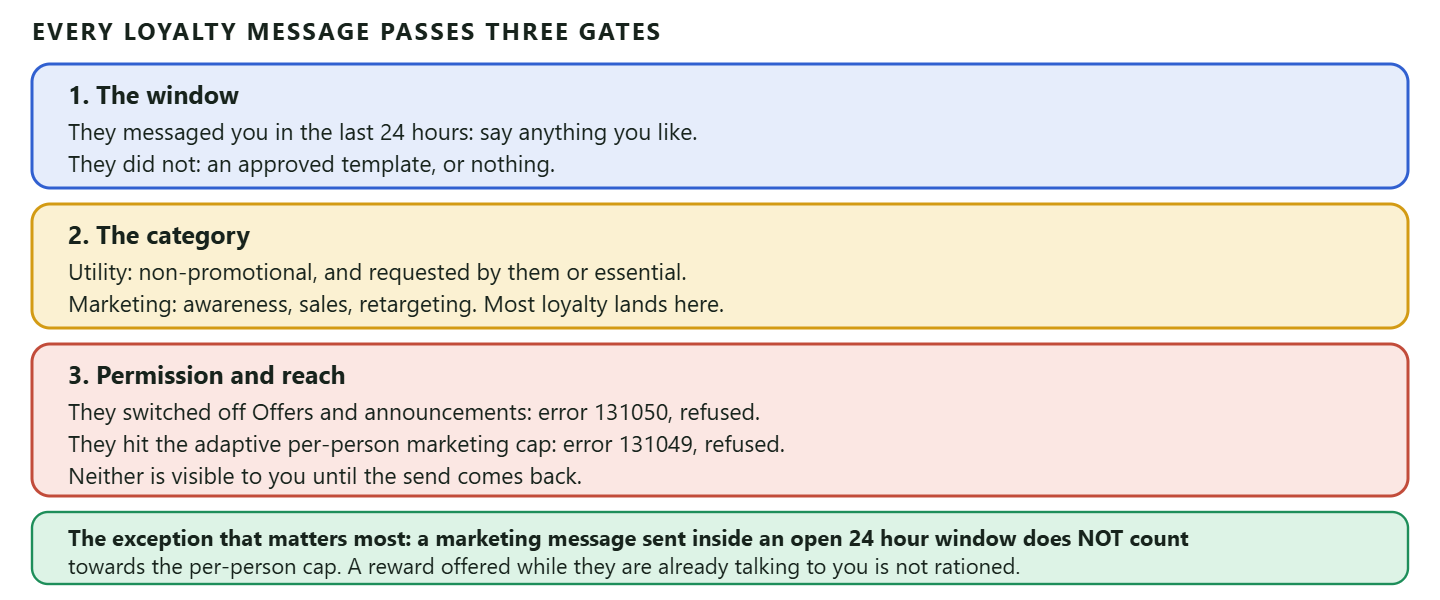
Before any reward logic, three rules decide whether a message leaves the building. They are not difficult, but a programme designed without them produces a lot of messages that quietly never arrive.
Rule one: you have 24 hours of free speech, and then you do not. DMly’s WhatsApp documentation puts it plainly: you can only send a free-form message to a contact within 24 hours of their last message to you, and outside that window Meta delivers approved templates only, nothing else. So the friendly “you are 60 points away” note you would write by hand is only sendable if the customer happens to be mid-conversation. Otherwise it has to be a template.
Rule two: a template has a category, and the category is not your decision alone. You propose one when you submit the template and Meta validates it against the content. Most loyalty messages land in marketing, which is the expensive, capped, opt-outable category. The next section is entirely about how to tell.
Rule three: the customer can turn marketing off without leaving the chat. WhatsApp gives people an Offers and announcements setting that stops marketing template messages from your business. When they use it, your send comes back failed with error 131050 and the message “Unable to deliver the message. This recipient has chosen to stop receiving marketing messages on WhatsApp from your business”. They stay your customer. They just stop being reachable by campaign.
Getting people in without a signup form
The single best thing about a WhatsApp loyalty program is that joining costs the customer one tap. No account, no password, no card in a wallet. That advantage is real and it is most of why the idea works, so it is worth setting up properly rather than settling for “message us to join”.
Three entry points do almost all the work:
- A QR code where the money changes hands. On the receipt, on the counter, on the table, on the packaging. The customer scans and a WhatsApp conversation opens with your text already typed.
- A link, on the website, in the email footer, in the Instagram bio, on the digital receipt.
- A keyword, so the poster can say “text JOIN to us” without a code at all.
Use a trackable version of the first two rather than a raw wa.me link, because the trackable one counts. DMly’s growth tools count how many times each one is opened, labelled clicks on a link and scans on a QR code, and when the message actually arrives they stamp that tool’s name onto the contact as their source. Two numbers instead of one: how many people looked, and how many joined. The mechanics of what a link can and cannot tell you are in our guide to click-to-chat links and what they cannot measure.
The limit to know before you print anything: on WhatsApp the source stamp applies to brand new contacts only. A regular who already exists in your list and scans the poster at the till keeps whatever source they had. So the scan count still rises and the attribution does not, and a programme aimed at existing regulars will look, in the numbers, like nobody joined. Facebook, Instagram and Telegram attribute every arrival.
The opt-in itself is the part to be careful about, because it is what makes everything afterwards legitimate. Ask for it in plain words in the conversation, say what they will get and roughly how often, and record the answer. “Reply YES and we will send you your points balance and member offers, about twice a month.” That sentence is doing real work: it is the difference between a loyalty programme and a list of people who once bought something and are now receiving adverts. The opt-in rules and how they interact with templates are covered properly in our guide to opt-in, templates and timing for WhatsApp broadcasts.
Which of your WhatsApp loyalty program messages count as marketing
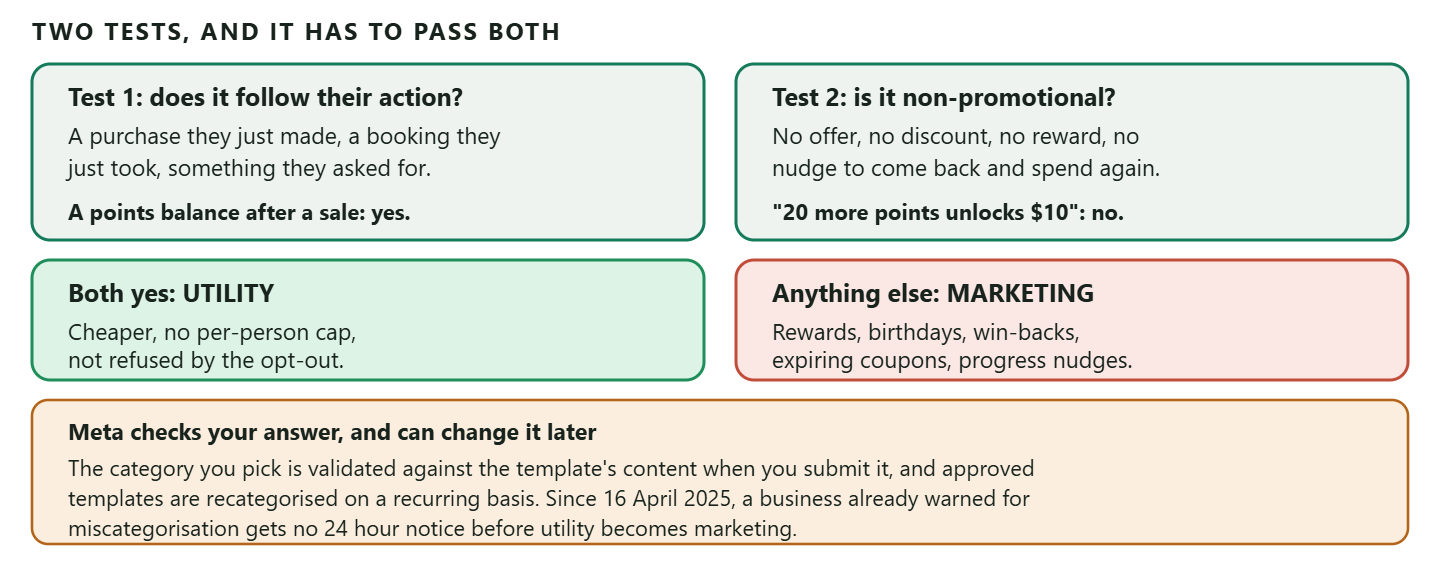
This is the question the whole programme turns on, and most businesses get it wrong in the same direction. Meta defines marketing templates as ones that “enable businesses to achieve a wide range of goals, from generating awareness to driving sales and retargeting customers”. Utility templates follow up on a user action or request, and to qualify they have to be non-promotional and either specific to or requested by the user, or essential for their safety.
Read those two definitions against your own loyalty messages and the answer usually stops being ambiguous.
| The message | Category | Why |
| “Thanks for your order. You earned 40 points, and you now have 280.” | Arguably utility | It follows a specific action they took and sells nothing |
| “You have 280 points. 20 more unlocks your $10 reward.” | Marketing | The second sentence exists to prompt another purchase |
| “Your $10 reward is ready. Code REWARD-4821.” | Marketing | It is an offer, however earned |
| “Happy birthday. Here is 20% off this week.” | Marketing | Promotional, and not requested |
| “We have not seen you since June. Here is 15% to come back.” | Marketing | Retargeting, which the definition names outright |
| “Your coupon REWARD-4821 expires on Friday.” | Marketing | Promotional content, even though it is a reminder |
Notice what happened there. Only the first row is even arguably utility, and it becomes marketing the moment you add the nudge that makes it useful. That is not a loophole to be gamed, it is the actual shape of the thing: a loyalty programme is a marketing programme, and WhatsApp treats it as one.
Do not try to win the argument by wording. Meta validates the category you pick against the content when you submit the template, and it runs a recurring process that recategorises approved templates that no longer match the guidelines. Since 16 April 2025, a business that has been warned for miscategorisation gets no notice at all: Meta’s documentation states that in that case “24 hour notice will not be provided before changing template categories from UTILITY to MARKETING”. So a template you built a cost model around can change category underneath you, and the first sign is the bill.
What the marketing category costs, in three currencies
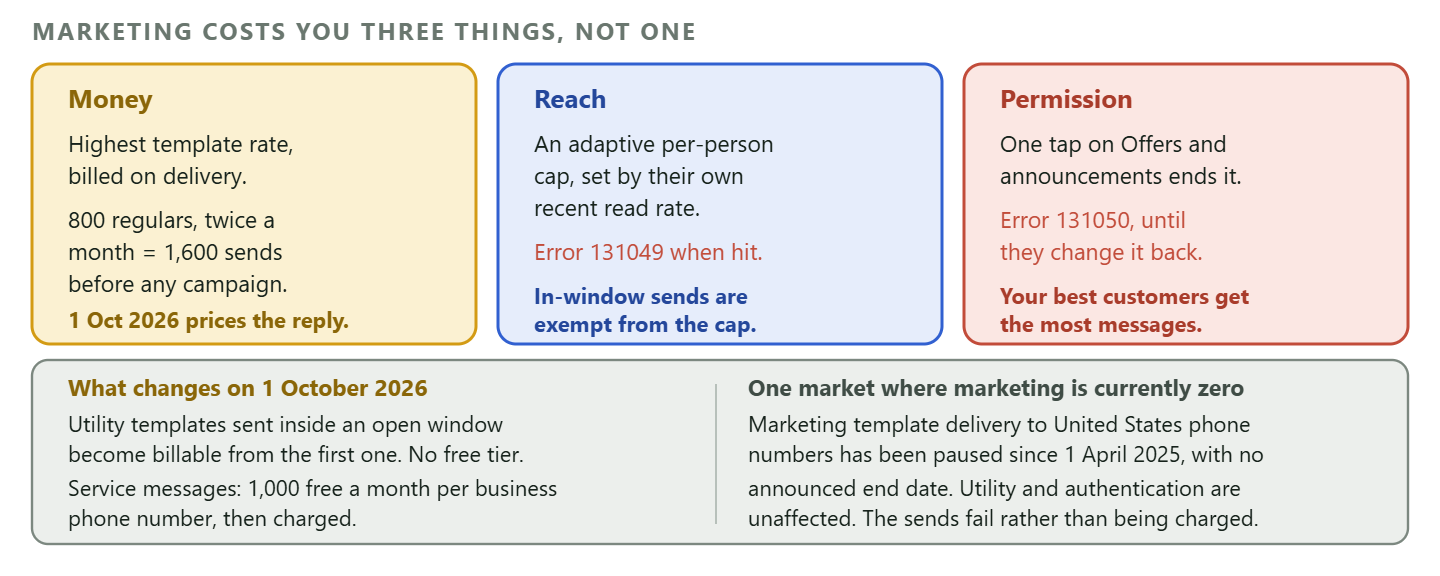
Marketing is not just the more expensive category. It is the one where the platform, and the customer, get a vote. Three separate costs, and only the first is money.
Money
Marketing templates are billed per message on delivery, at your market’s marketing rate, which is the highest of the categories. The number that matters for a loyalty programme is not the rate but the multiplication: a points update after every purchase, to a list of 800 regulars who visit twice a month, is 1,600 marketing messages a month before you have sent a single campaign. Current per-market rates are on the WhatsApp Business API rate card by country rather than quoted here, because they move.
One dated change to build into any plan. From 1 October 2026, Meta starts charging for two things that used to be free, and not on the same terms: service messages, meaning free-form replies inside the 24-hour window, and utility templates sent inside an open window. Every business phone number gets 1,000 free service messages a month, billed only from the 1,001st, with no rollover and a fresh 1,000 each month. A utility template sent inside an open window gets no allowance at all, so it is billed from the first one. For a business that confirms and reminds as well as rewards, that second one is usually the bigger bill, because the customer who has just messaged you to book is exactly the customer your confirmation template goes to, while the free-form replies your rewards produce have a thousand a month of headroom before they cost anything.
Reach
WhatsApp limits how many marketing template messages a person receives from any business in a given period, and the limit is not a fixed number. Meta describes it as adapting automatically over time based on a person’s recent engagement, using “a dynamic view of an individual’s recent marketing message read rate”. Hit it and the send returns error 131049, and retrying inside 24 hours makes it worse rather than better.
Here is the part that should change your design. Meta’s own documentation carves out an exception: if a WhatsApp user responds to a marketing message, that starts a 24-hour customer service window, and marketing messages sent inside it do not count towards the limit. So a programme built around conversations, where the reward message invites a reply and the follow-up happens inside the window it opened, is not rationed. A programme built around one-way monthly blasts is competing for that person’s cap with every other business they have ever given their number to.
Permission
The Offers and announcements setting is one tap for the customer and permanent for you until they change it back. What makes it dangerous for loyalty specifically is that the people most likely to use it are the ones getting the most messages, and in a loyalty programme those are your best customers.
And one market where the answer is currently zero. Marketing template delivery to United States phone numbers has been paused since 1 April 2025 and remains paused, with no announced end date. Utility and authentication templates are unaffected. The sends fail rather than being charged, so it costs nothing but a US business cannot run the marketing half of a loyalty programme over WhatsApp templates at all today. If your customers are in the US, the workable version is entirely in-window: reply-driven, tied to conversations customers start, plus utility messages that genuinely qualify.
What the customer actually receives
A reward in a WhatsApp loyalty program is a coupon, and it helps enormously to stop thinking of it as anything else. DMly’s documentation is direct about it: every loyalty reward is a coupon, and there is no second discount system to learn. Points accumulate, they cross the threshold you set under Points needed to redeem, and a coupon is created automatically.
The coupon carries the rules, and these are the ones worth setting deliberately:
- Type: a percentage or a fixed amount.
- Minimum subtotal, the bill it has to reach before the coupon is allowed. Despite the name it is measured against the gross total, tax included, so a minimum of $100 is met by a $90 bill carrying $10 of tax.
- Usage limit across everybody, and a separate per-contact limit.
- Validity window, the dates it works between.
One arithmetic detail catches people out. The discount applies to the gross total, subtotal plus tax. DMly’s own worked example: a 10% coupon on a bill of 100 plus 20 tax takes off 12, not 10. Over a year of rewards that difference is real, and it is the sort of thing you would rather find in a guide than in a reconciliation.
Points are awarded on a status, not on a promise, and the defaults are sensible: orders when Paid rather than merely confirmed, appointments when Completed, classes when Attended. You can loosen each of those to the earlier status if your business needs to, and you probably should not. One default is worth changing on purpose, though. The earning method starts on Earn per activity, a flat number of points per qualifying visit, so out of the box a $400 colour and a $12 fringe trim earn the same. Earn per amount spent is the other option, and it is what most businesses picture when they imagine points. And if money goes back, the points do too: voiding an invoice, refunding a payment or cancelling a confirmed order claws back the points and deactivates one unredeemed loyalty coupon for that client.
The reward that gets minted and never mentioned
This is the failure worth designing around, and it is invisible from where you are standing. DMly sends the code to the customer automatically the moment a loyalty coupon is minted, on whichever channel they are active on, and writes it to the inbox, so nobody has to remember to pass it on. That is the good version, and it is genuinely good. The documentation is also straight about the other half: delivery is best effort, and if the channel send fails the coupon still exists and the customer never heard about it.
On WhatsApp that failure has one dominant cause, and it is the 24-hour window from the top of this article. The automatic message is an ordinary send, not a template, so if the customer’s window is shut it is stopped and recorded as failed rather than delivered. A template would get through, except that there is no loyalty template to send. DMly ships twenty system templates and they cover appointment confirmations, updates and reminders, staff alerts, new conversations, invoices, payment receipts, failed payments, renewal reminders, gift cards, letter links, phone-number requests, review requests, CSAT surveys and client-portal login codes. Not one of them is a loyalty coupon. And the documented rule when a notification has no approved template and the window is closed is that nothing is sent at all.
So the whole transaction can complete without the customer ever knowing it happened. They spend enough to cross the threshold, the coupon is minted, the threshold’s worth of points is deducted from their balance, and the message announcing it never leaves the building. Points spent, reward issued, customer uninformed. This is not a bug to wait out. It is the window doing exactly what it is documented to do, and it lands hardest on the customer who pays in person and never messages you, which in a salon or a coffee shop is most of them.
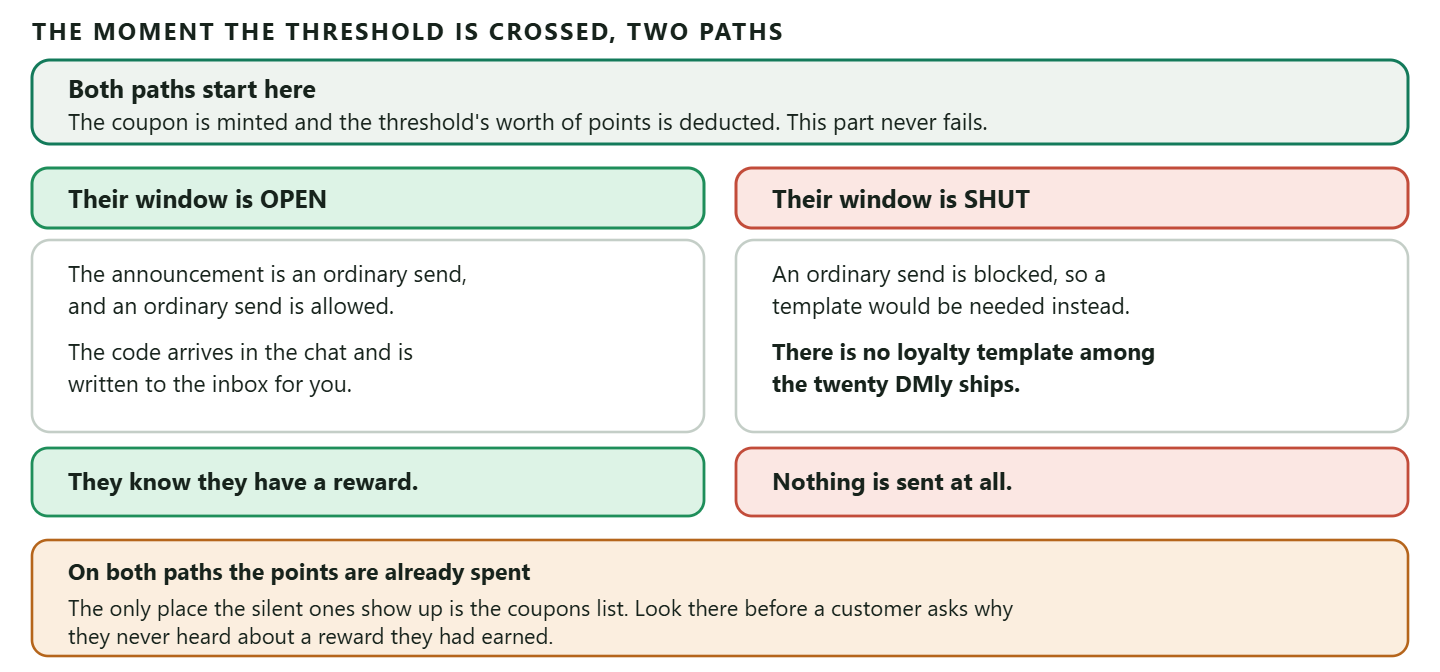
Three ways to stop it happening: Cross the threshold while they are talking to you. The moment a customer messages to book, confirm or ask a question is the moment their window is open, so a reward that lands then arrives. Or write the template yourself. A reward announcement is a marketing template, carrying that category’s price and its per-person cap. That is the honest trade rather than a way around it, and it is a perfectly good decision to make deliberately. Or check the coupons list. Every minted coupon is listed whether or not its message arrived, so a weekly look catches the quiet ones, and telling a regular in person that they have a reward waiting is not the worst conversation you will have that week.
Redeeming it, which is where most programmes actually break
A coupon is applied to an invoice or an order, and its rules are checked at that moment rather than when it was issued. That is the sentence to read twice, because it is where the customer experience goes wrong. The reward was generated in June, the customer arrives in September, the validity window closed in July, and the person on the till has to explain it.
Three habits prevent almost all of that. Put the expiry date in the message that delivers the reward, in words rather than only in the coupon. Set the validity window long enough to survive a normal gap between visits, which for a salon is longer than a month and for a coffee shop is much shorter. And tell whoever works the counter what a reward code looks like, because a customer holding a code nobody recognises is a worse experience than never having been offered one.
Two things about the limits, and the first one is reassuring. A loyalty code cannot be passed around. The code minted for a customer carries a suffix unique to them, so it belongs to that person in a way an ordinary coupon code does not, and the usual worry about a reward being forwarded to everybody they know does not apply to the loyalty half. The per-contact limit still matters for the coupons you write yourself.
What you cannot see is how one customer is using one. The coupons list counts total redemptions against the cap, shown as 3 / 10, and how many times a particular client has redeemed it is not displayed anywhere, even though the per-contact limit is still enforced behind the scenes. And if two invoices try to claim the last remaining use at the same moment, one gets the discount and the other is issued without it, which is worth knowing before it happens on a busy Saturday rather than afterwards.
Three things you will be told to build that you cannot
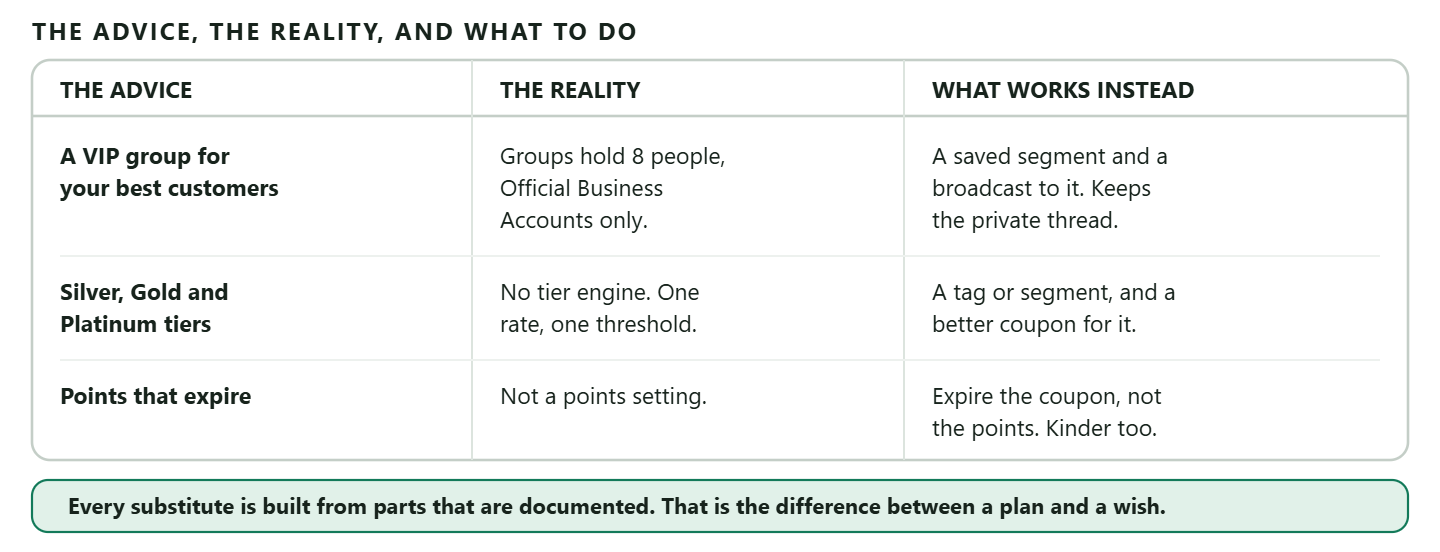
Every article about WhatsApp loyalty, including the previous version of this one, recommends at least one of these. Here is what is actually there.
The VIP group for your best customers
The advice is everywhere: put your top spenders in a WhatsApp group or community, give them early access, let them talk to each other. Meta’s Groups API documentation gives the numbers, and they end the idea. Groups are invite-only, they are available only to businesses with an Official Business Account, they are “not available for WhatsApp Business app phone numbers and phone numbers onboarded to Multi-solution Conversations”, only one Cloud API business can operate in a group, and a group holds a maximum of 8 participants.
Eight. Not eighty. A VIP circle of your best customers is not something you can run there, and DMly’s documentation does not cover groups at all, so it is not available through DMly either.
What works instead is duller and better: a saved segment of your top customers, and a broadcast to that segment. They do not see each other, which most of them will prefer, and you keep the one-to-one thread where the actual selling happens. The mechanics of segmenting and sending to a list are in our guide to WhatsApp newsletters and which of the two you actually want.
Silver, Gold and Platinum tiers
There is no tier engine. No built-in Silver, Gold and Platinum with different earning multipliers, because points accrue at one rate and cross one threshold. What you can do is build tiers out of the parts that exist: a tag or a saved segment that defines who is in the top group, and a different, better coupon for that segment. It behaves like a tier from the customer’s side and it needs you to decide the rule, rather than picking a preset. If tiering is central to your plan rather than decorative, the design side of it belongs in the loyalty programme guide, not here.
Points that expire
Expiry pressure is a classic loyalty device and it is not a points setting. The coupon has a validity window, so the reward can expire; the points themselves do not have an expiry date you can configure. That is not much of a loss. Expiring a customer’s points is the single fastest way to make a loyalty programme feel like a trick, and a reward with a two-week window creates the same urgency without the resentment.
Running a WhatsApp loyalty program on the free app instead of the API
Most businesses reading this are on the free WhatsApp Business app, not the Business Platform, and almost none of the machinery above applies to them. That is worth saying plainly rather than leaving people to work out which half of the article is theirs.
On the app there are no templates, so there is no category to argue about, no per-person marketing cap and no Offers and announcements refusal. You type a message and send it. What you lose is everything automatic: no flow awards points, no trigger sends a balance, nothing fires when somebody’s appointment is completed. A loyalty programme on the app is a loyalty programme you run by hand, which for a business with sixty regulars is completely reasonable and for one with six hundred is not.
The free broadcast era on the app is also ending, and the detail is easy to miss. Meta now documents business broadcasts, which replace marketing messages in some countries, are exclusively on the WhatsApp Business app, and are paid per message delivered within five days. The introductory trial ended on 30 April 2026 and unused credits expired with it. Meta has also begun rolling out a monthly broadcast limit in some countries and does not publish the number, so there is no figure to plan against, only a limit you will meet.
The practical read for a small business: run the programme by hand on the app while your regulars number in the dozens, and move to the platform when the manual version starts costing you an evening a week. The thing that forces the move is almost never the messaging, it is the counting.
A WhatsApp loyalty program you could start this month
Concrete, small, and built so that gate three never bites. A salon with about 400 regulars, five steps.
- Put a trackable QR code on the mirror and on the receipt, with one sentence: join our rewards on WhatsApp. Say what they get and how often, and ask them to reply to confirm.
- Award points on Completed appointments, not booked ones. It costs you nothing and it stops rewarding no-shows.
- Send the balance inside the conversation, not as a campaign. The appointment thread is already open when they message to book or to confirm, so the update goes out free-form, inside the window, uncapped and unrefused.
- Make the reward message ask a question. “Your next cut is on us. Want me to put you in for the same time in three weeks?” A reward that invites a reply opens a 24-hour window, and everything you send inside it stops counting against their marketing cap.
- Keep one campaign a month at most, to a segment rather than the whole list, and watch the opt-out rate rather than the redemption rate. Redemption tells you the reward was good; opt-outs tell you whether you will still have an audience in March.
That WhatsApp loyalty program runs almost entirely inside the window, which is why it works. The one thing to measure honestly is whether it is bringing people back at all, and what a messaging tool can and cannot tell you about that is set out in our guide to the metrics worth tracking after you automate messaging. For the wider question of whether messaging is holding on to your customers, see using messaging to improve customer retention.
One operational thing that will save you a bad afternoon: Broadcasts send an approved template, and DMly checks the template still reads Approved at send time, not when you scheduled it. It also does not enforce your Meta messaging tier, so a large broadcast on a low tier partially fails: some land, the rest come back as failures. And opted-out contacts never receive a broadcast but are still counted in your recipients and your failures unless you tick Reachable contacts only. Tick it every time, or your results will look worse than they were.
Frequently asked questions
What is a WhatsApp loyalty program?
A rewards scheme where enrolment, the balance updates and the reward itself all happen in a WhatsApp conversation instead of an app or a card. The customer joins with one tap, usually from a QR code or a link, and the reward arrives as a coupon in the chat.
Does a WhatsApp loyalty program need points?
No. A punch-card pattern, a free service after a set number of visits, or early access for regulars all work, and points are just the most flexible version. What the channel cares about is not the scheme, it is whether the message announcing it is a marketing template.
Can I send loyalty messages whenever I want?
Only inside 24 hours of the customer’s last message. Outside that, an approved template only, and for most loyalty content that means a marketing template, which is priced highest, subject to a per-person cap and refusable by the customer.
Why did my reward message not arrive?
Usually one of two errors. 131050 means the customer switched off Offers and announcements, so no marketing template from your business reaches them until they switch it back. 131049 means they have hit their adaptive per-person marketing limit; wait at least 24 hours before retrying, because sooner makes it worse. Neither is visible before you send.
Can I run a WhatsApp loyalty program in the United States?
The utility and in-window parts, yes. The marketing template half, no: delivery of marketing templates to United States phone numbers has been paused since 1 April 2025 with no announced end date. The sends fail rather than being charged. A US programme has to be built on conversations customers start and on messages that genuinely qualify as utility.
Can I create a VIP WhatsApp group for my best customers?
Not meaningfully. Meta’s Groups API is invite-only, limited to businesses with an Official Business Account, unavailable to WhatsApp Business app numbers, and capped at eight participants per group. Use a saved segment and a broadcast instead, which reaches everyone and keeps each conversation private.
My customer earned a reward. Why did they never get the code?
Most likely their 24-hour window was shut at the moment it was minted. The message announcing a loyalty coupon is an ordinary send rather than a template, and there is no loyalty template in the system set, so on WhatsApp a closed window means nothing goes out at all. The coupon exists and the points have already been deducted; only the announcement is missing. The coupons list shows every minted coupon, which is where to look before a customer asks.
What happens to a customer’s points if I refund them?
They go back. Voiding an invoice, refunding a payment or cancelling a confirmed order claws back the points and deactivates one unredeemed loyalty coupon for that client. Worth telling your team, because the alternative is a customer arriving with a reward that has quietly stopped working.
Should the points update be automatic after every purchase?
Only if it can go inside the window. An automatic balance update sent to every customer after every purchase is a marketing template each time, which is a real monthly cost and a real draw on each person’s cap. Send the same update free-form while the thread is still open and it is not a template at all: it is a service message, so it draws on nobody’s marketing cap, and from 1 October it costs nothing until you pass the 1,000 free service messages every business phone number gets each month.
The programme that survives is the one designed around the conversation rather than the campaign: enrol at the till with a trackable code, award points on completed work, deliver the balance while the thread is open, and make every reward message ask a question. DMly runs that shape natively, with points that turn into coupons automatically, segments for the offers that do need a broadcast, and one inbox for the replies the rewards produce.
Writing about WhatsApp automation, bookings and growth for local business.
Turn WhatsApp into your busiest channel.
Start free and run message, bookings, payments and reviews in one place.
